15 B2B Lead Generation Examples That Work in 2026
Real B2B lead generation examples you can copy this week — from website reveal to cold email, lead magnets, and outbound plays that fill pipeline without burning budget.
TL;DR
- B2B lead generation examples fall into three buckets: inbound (they find you), outbound (you find them), and hybrid (intent data plus direct outreach).
- The plays that win in 2026 are specific and measurable — website visitor reveal, gated calculators, niche lead magnets, and tightly-targeted cold email beat "post more on LinkedIn."
- Every outbound example depends on one thing: accurate contact data. A great sequence sent to a bounced address generates zero leads.
- You don't need a 12-tool stack. A finder, a verifier, a CRM, and a sending tool cover 90% of these examples.
- Below: 15 real, copyable plays with the channel, the cost band, and the tool that makes each one work.
What counts as a B2B lead generation example?#
A B2B lead generation example is any repeatable play that turns a stranger into a known, contactable prospect who has shown a buying signal. The signal can be loud (they booked a demo) or quiet (they visited your pricing page twice). The "example" is the specific mechanism — not the abstract channel.
Think of it like fishing. "Use the ocean" is a channel. "Drop a baited line at the reef at dawn where the snapper feed" is an example. Most teams fail at lead gen because they talk in channels. The teams that hit quota run named, measurable plays.
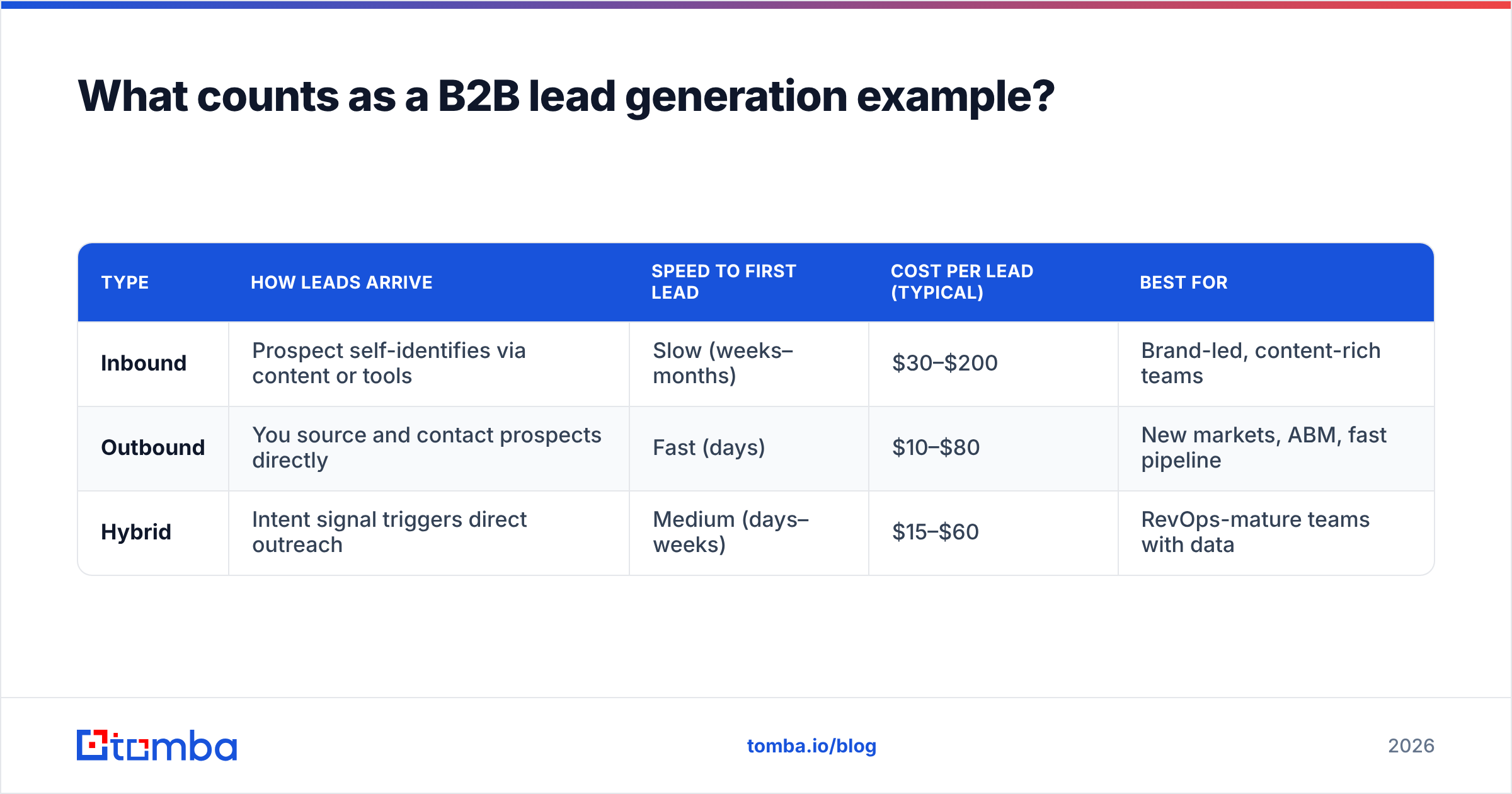
Here's how the three categories compare before we get into the specifics:
| Type | How leads arrive | Speed to first lead | Cost per lead (typical) | Best for |
|---|---|---|---|---|
| Inbound | Prospect self-identifies via content or tools | Slow (weeks–months) | $30–$200 | Brand-led, content-rich teams |
| Outbound | You source and contact prospects directly | Fast (days) | $10–$80 | New markets, ABM, fast pipeline |
| Hybrid | Intent signal triggers direct outreach | Medium (days–weeks) | $15–$60 | RevOps-mature teams with data |
Keep that table in mind. Almost every example below is a variation on one of these three rows.
What are the best inbound B2B lead generation examples?#
Inbound works when you give away something genuinely useful and ask for a work email in return. The trap is gating junk. Gate value.
- The interactive calculator. A ROI or pricing calculator out-converts a PDF every time because it personalizes the result. A payroll platform offering a "true cost of a bad hire" calculator collects role, headcount, and a work email — three fields that also qualify the lead.
- The benchmark report. Survey your customers once a year, publish the data, gate the full version. "2026 State of Outbound" reports pull links and leads for 12 months because nobody else has your numbers.
- The free micro-tool. A standalone utility that solves one annoying task earns trust before any sales touch. Tomba's free email checker and email permutator are exactly this pattern — useful on their own, branded, and a soft on-ramp to the paid product.
- Comparison and alternative pages. Buyers in-market search "[competitor] alternative." A neutral, honest comparison page captures that intent at the bottom of the funnel where it converts hardest.
- Webinar with a working takeaway. Not a 60-minute ad — a session where attendees leave with a template or audit they actually use. Registration is the lead; attendance is the qualification.

Inbound is patient money. It compounds, but it rarely fills next month's pipeline on its own. That's where outbound earns its seat.
What are concrete outbound B2B lead generation examples?#
Outbound is where most of the practical, fast B2B lead generation examples live — and where data quality decides everything. Here are the plays that still work in 2026.
- Tightly-scoped cold email. Pick one job title at one company size in one industry. Write three emails referencing a problem that exact segment has. A 200-prospect list with a sharp message beats a 5,000-prospect blast every time. Build the list with a domain search to pull every relevant address at a target company, then trim to the right roles.
- The "trigger event" sequence. Monitor for funding rounds, new executive hires, or tech-stack changes, then reach out within 72 hours referencing the event. New VPs of Sales buy tools in their first 90 days — catch them early.
- Multi-channel ABM. For a named account list of 50–100 logos, combine a LinkedIn connection, a personalized email, and a short loom. Each touch references the same business case. Account-based plays convert because the prospect sees you everywhere relevant.
- The referral ask, systematized. After every closed-won deal, ask "who else has this problem?" and actually log the answer. Warm intros convert 3–5x cold outreach but only if you make the ask a step in the process, not a hope.
- Bulk-then-personalize. Use a bulk email finder to enrich a conference attendee list or a scraped industry directory, verify the results, then personalize the first line by hand. Machines do the volume; humans do the relevance.
The common failure across all five: bad data. The CTO of your dream account never sees your perfect email because it bounced. Which is why verification isn't optional.
Why does contact data quality decide every outbound example?#
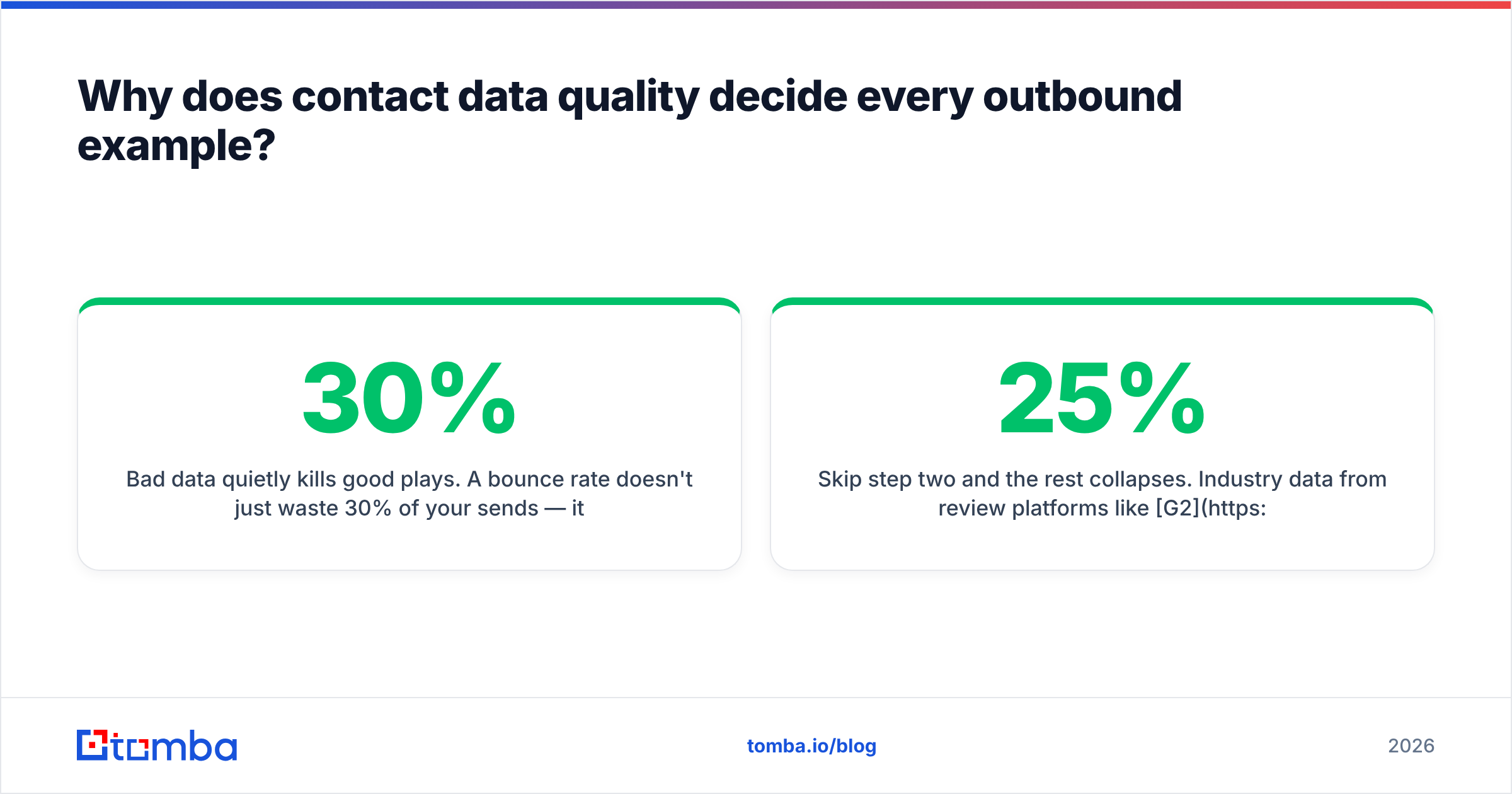
Bad data quietly kills good plays. A 30% bounce rate doesn't just waste 30% of your sends — it tanks your sender reputation, drops the other 70% into spam, and gets your domain blacklisted. One bad list can poison a quarter.
Run this four-step data hygiene loop before any outbound example ships:
- Find — source emails by domain, name, or role using an email finder rather than guessing formats.
- Verify — run every address through an email verifier to drop invalids and risky catch-alls before you send.
- Enrich — add title, company size, and LinkedIn with data enrichment so your personalization has fuel.
- Monitor — check your sender reputation and warm new domains before scaling volume.
Skip step two and the rest collapses. Industry data from review platforms like G2 consistently shows verified-list senders landing 15–25% higher deliverability than scrapers who send raw. The math is brutal and unambiguous: clean data is cheaper than wasted send volume.

What are hybrid B2B lead generation examples?#
Hybrid plays use a signal to decide who gets contacted and when. They're the highest-efficiency examples because you're never cold — the prospect already raised a hand, even if quietly.
- Website visitor reveal. Most B2B traffic leaves without filling a form. Tools that identify the companies visiting your site let you reach out to accounts already researching you. Tomba's website visitor reveal turns anonymous pricing-page traffic into a named outreach list.
- Content-to-outreach handoff. When a lead downloads a mid-funnel asset, enrich them and route to an SDR within the hour. Speed-to-lead under five minutes can multiply connect rates — most teams take 24 hours and lose the moment.
- Intent-data targeting. Subscribe to a third-party intent feed, filter for accounts surging on your category, and prioritize them in your outbound queue. You're still doing outreach — but only to people already shopping.
- Reverse email lookup on form fills. When someone signs up with just an email, run a reverse email lookup to enrich the rest of the profile and qualify before the first call.
- Re-engagement of closed-lost. Pull every "lost — no budget" deal from last year, re-verify the contacts (people change jobs), and re-approach with what's new. The cheapest pipeline is often the deals you already half-built.
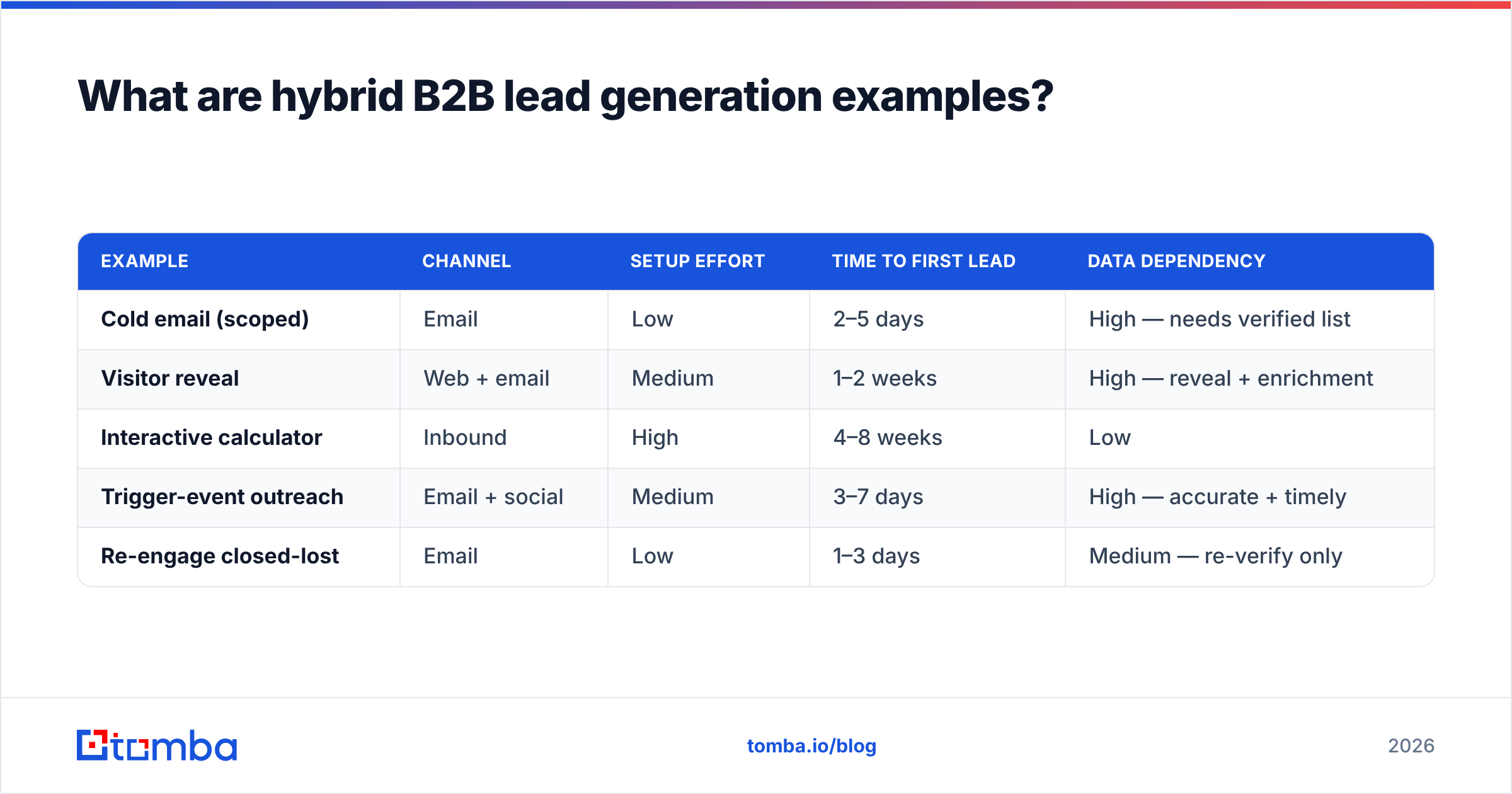
Here's how a few of these examples stack up on the practical metrics that matter when you're choosing where to spend next quarter:
| Example | Channel | Setup effort | Time to first lead | Data dependency |
|---|---|---|---|---|
| Cold email (scoped) | Low | 2–5 days | High — needs verified list | |
| Visitor reveal | Web + email | Medium | 1–2 weeks | High — reveal + enrichment |
| Interactive calculator | Inbound | High | 4–8 weeks | Low |
| Trigger-event outreach | Email + social | Medium | 3–7 days | High — accurate + timely |
| Re-engage closed-lost | Low | 1–3 days | Medium — re-verify only |
Notice the pattern: the fastest examples are also the most data-dependent. There's no free lunch — speed comes from outbound, and outbound runs on accurate contacts.
How do you pick the right examples for your team?#
Start with your constraint, not the tactic. The right B2B lead generation examples depend on what you're short on.
- Short on time, need pipeline now? Run scoped cold email and re-engage closed-lost. Both ship in under a week.
- Short on budget but long on expertise? Build a free micro-tool and a benchmark report. Slow, cheap, compounding.
- Drowning in anonymous traffic? Visitor reveal and content-to-outreach handoff capture demand you're already paying to generate.
- Mature RevOps with data budget? Layer intent data over ABM for the highest efficiency per rep hour.
Whatever you pick, instrument it. Track cost per lead, response rate, and lead-to-opportunity conversion per example. Kill the bottom 20% every quarter and double down on what converts. Reference frameworks from established players like HubSpot if you need a baseline scoring model, but trust your own numbers over any benchmark.
The teams that win don't run more examples — they run fewer, measure harder, and feed every one of them clean data.
Start with the data layer#
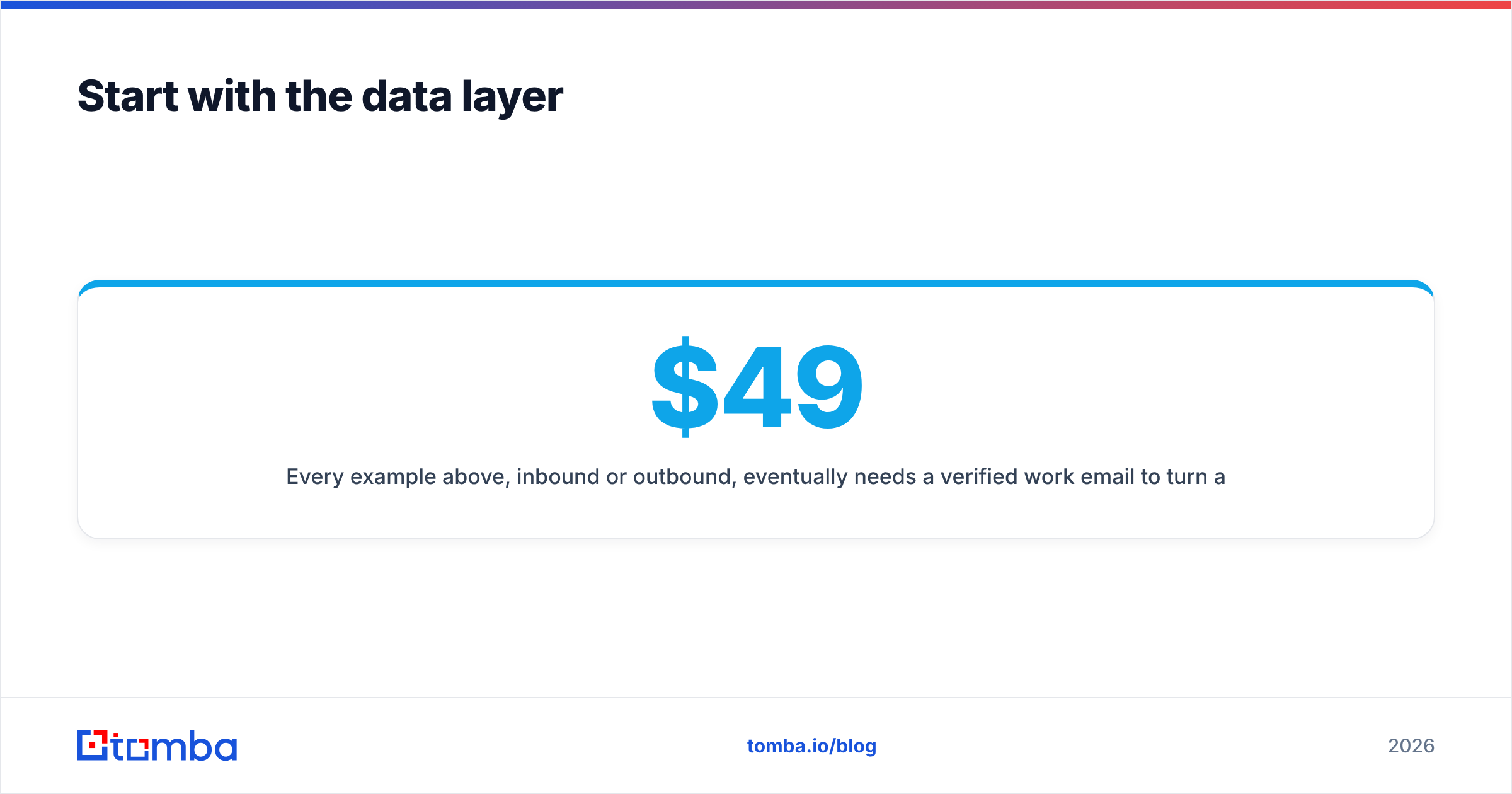
Every example above, inbound or outbound, eventually needs a verified work email to turn a signal into a conversation. That's the layer to get right first. Tomba's Email Finder finds professional addresses by domain, name, or company, and pairs with built-in verification so your lists arrive clean — not bounced. The Free tier gives you 25 searches a month to test a play before you commit; paid plans start at $49/mo (Starter), $99/mo (Growth), and $249/mo (Pro). Check current Tomba pricing and run your first scoped list this week — pick one example from this post, find 100 verified contacts, and ship it. Pipeline rewards the team that starts.
Ready to find emails that actually work?
Join 150,000+ professionals who stopped guessing and started sending. Free credits on signup — no credit card required.
Get the Tomba newsletter
Practical outbound tactics and product updates — once every two weeks.
About the author