B2B Lead Generation for Marketing Teams: 2026 Playbook
A practical 2026 framework for B2B lead generation built for marketing teams — channels, data, scoring, and the stack that actually moves pipeline.
TL;DR
- B2B lead generation for marketing teams in 2026 is an engine, not a campaign — channels, data, scoring, and handoff have to work as one system or leads leak at every stage.
- The biggest hidden cost is bad data: invalid emails, missing titles, and stale phone numbers quietly kill deliverability and waste SDR time.
- Multi-channel beats single-channel. Combine inbound content, paid, outbound email, and LinkedIn — then enrich every contact before it touches a sequence.
- Lead scoring and a clean MQL-to-SQL definition are what separate "lots of leads" from "leads sales will actually call."
- Verified contact data from a tool like Tomba is the cheapest leverage you have: it raises every downstream metric without changing your messaging.
What does B2B lead generation actually mean for a marketing team?#
Lead generation is the work of turning strangers into known, contactable, qualified prospects your sales team can pursue. For a marketing team specifically, it means owning the top and middle of the funnel: attracting attention, capturing identity, enriching it into usable data, and handing sales a list of people worth calling.
Think of it like running a water-treatment plant. Raw demand flows in from ads, content, and events — but it's full of sediment: fake emails, junk titles, tire-kickers, and duplicate records. Your job isn't to pump more water; it's to filter it so clean, usable pipeline comes out the other end. A team that obsesses over volume and ignores filtration floods sales with garbage and burns trust.
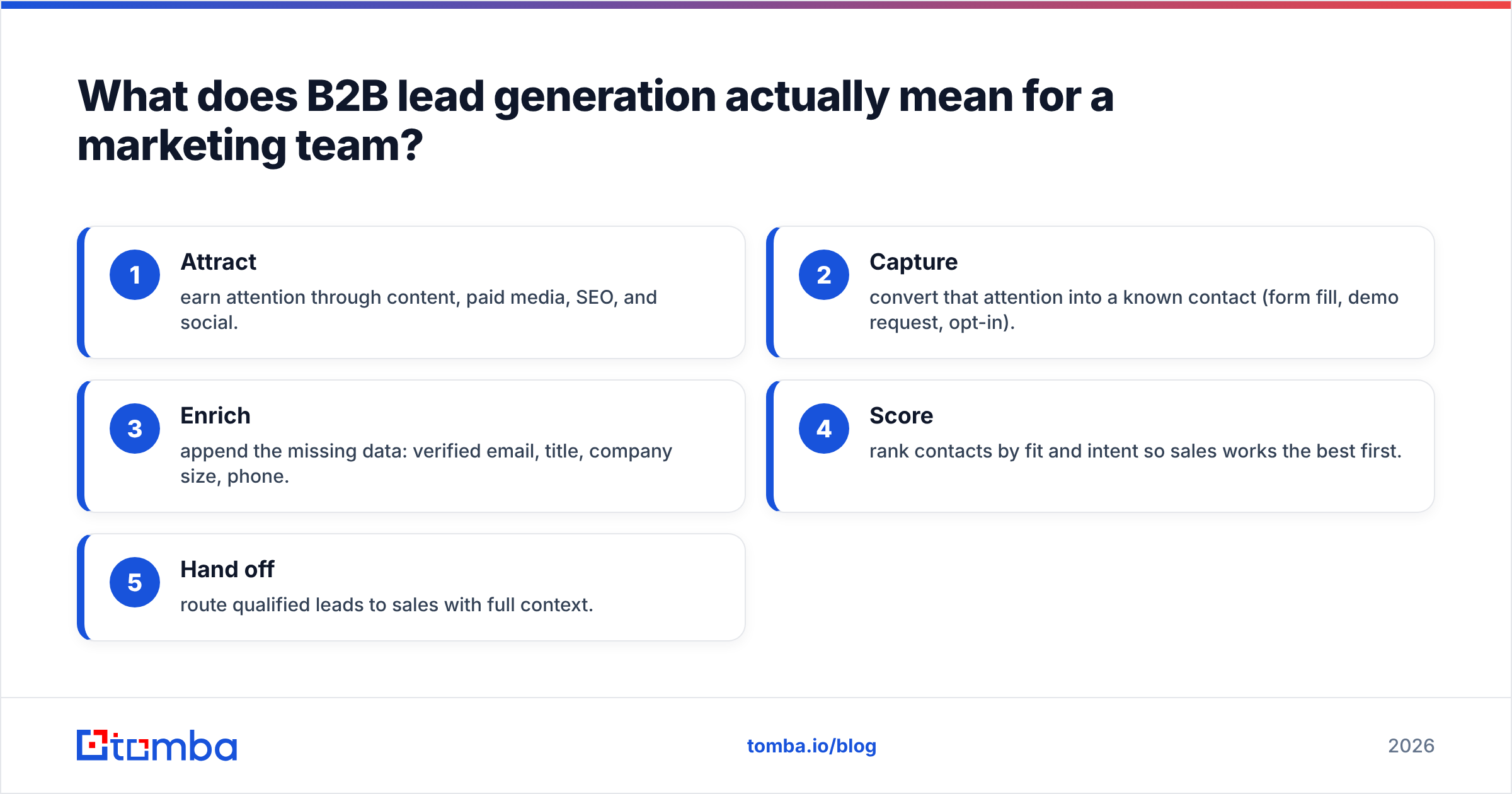
The marketing-owned stages usually break down like this:
- Attract — earn attention through content, paid media, SEO, and social.
- Capture — convert that attention into a known contact (form fill, demo request, opt-in).
- Enrich — append the missing data: verified email, title, company size, phone.
- Score — rank contacts by fit and intent so sales works the best first.
- Hand off — route qualified leads to sales with full context.
Skip enrichment and scoring, and you've just built a lead pile, not a lead engine.
Which lead generation channels work best in 2026?#
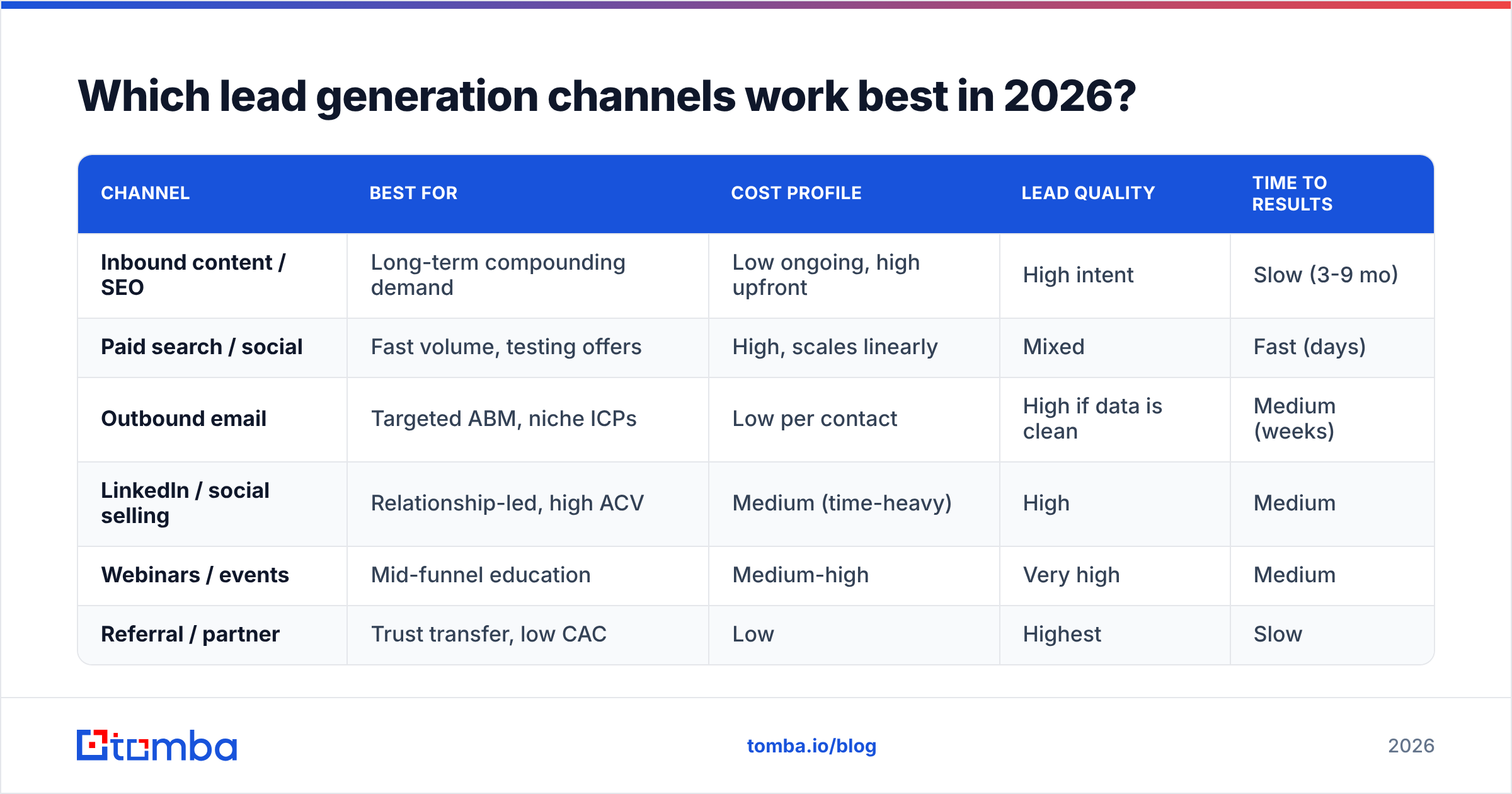
There's no single best channel — there's a best mix for your motion. The teams winning in 2026 run several channels in parallel and let each feed the others.
| Channel | Best for | Cost profile | Lead quality | Time to results |
|---|---|---|---|---|
| Inbound content / SEO | Long-term compounding demand | Low ongoing, high upfront | High intent | Slow (3-9 mo) |
| Paid search / social | Fast volume, testing offers | High, scales linearly | Mixed | Fast (days) |
| Outbound email | Targeted ABM, niche ICPs | Low per contact | High if data is clean | Medium (weeks) |
| LinkedIn / social selling | Relationship-led, high ACV | Medium (time-heavy) | High | Medium |
| Webinars / events | Mid-funnel education | Medium-high | Very high | Medium |
| Referral / partner | Trust transfer, low CAC | Low | Highest | Slow |
The mistake most teams make is treating these as separate budgets fighting for credit. They're a relay. SEO captures a name; enrichment fills in the email and title; outbound and LinkedIn re-engage the ones who didn't convert. A marketing qualified lead from a webinar becomes the seed for a personalized cold email two weeks later.

Wait — ignore that image direction; the point stands without it.
Let me restate that cleanly with the actual meme:
)
Why does data quality decide whether your engine works?#
Because every channel you just read about ends in the same place: a record in your CRM that someone in sales has to act on. If that record is wrong, all the upstream spend is wasted.
Here's the chain reaction bad data sets off:
- Bounced emails wreck your sender reputation. Once your bounce rate creeps past 2-3%, mailbox providers start routing even your good emails to spam — so your clean contacts stop hearing from you too.
- Wrong titles and seniority mean SDRs pitch the wrong message to the wrong person.
- Stale phone numbers burn an SDR's most expensive resource: dialing time.
- Duplicates inflate your reporting and double-contact prospects, which looks careless.
This is why verification belongs before the sequence, not after the bounce. Running contacts through an email verifier and appending missing fields with data enrichment is the single highest-ROI step most teams skip. It doesn't require new creative, new budget, or new headcount — just clean inputs.
For a deeper primer on why this matters at the infrastructure level, the email deliverability fundamentals and Google's own sender guidelines are worth bookmarking for the whole team.
How do you build a repeatable lead generation engine?#
Start with the ICP, end with the handoff. Here's the sequence that turns scattered tactics into a system.
1. Define your ICP and buying committee. Don't just name the company profile — name the 3-5 roles you need to reach inside it (economic buyer, champion, blocker). Every data and content decision flows from this.
2. Build the source list. Use domain search to pull every relevant contact at your target accounts, or extract leads from your inbound and content traffic. This is where a bulk email finder earns its keep on ABM target lists.
3. Enrich and verify. Append verified email, title, company size, and phone. Drop anything that fails verification — don't sequence a guess.
4. Score for fit and intent. Combine firmographic fit (do they match the ICP?) with behavioral intent (did they visit pricing, open three emails, attend a webinar?).
5. Route and hand off. Send only scored, verified leads to sales with the context that earned the score.
6. Measure and recycle. Track conversion at each stage, and feed unconverted-but-qualified leads back into nurture.
The discipline that makes this repeatable is writing down your MQL and SQL definitions and getting sales to sign off. If marketing and sales disagree on what "qualified" means, the handoff breaks every single week.
How should marketing teams score and qualify leads?#
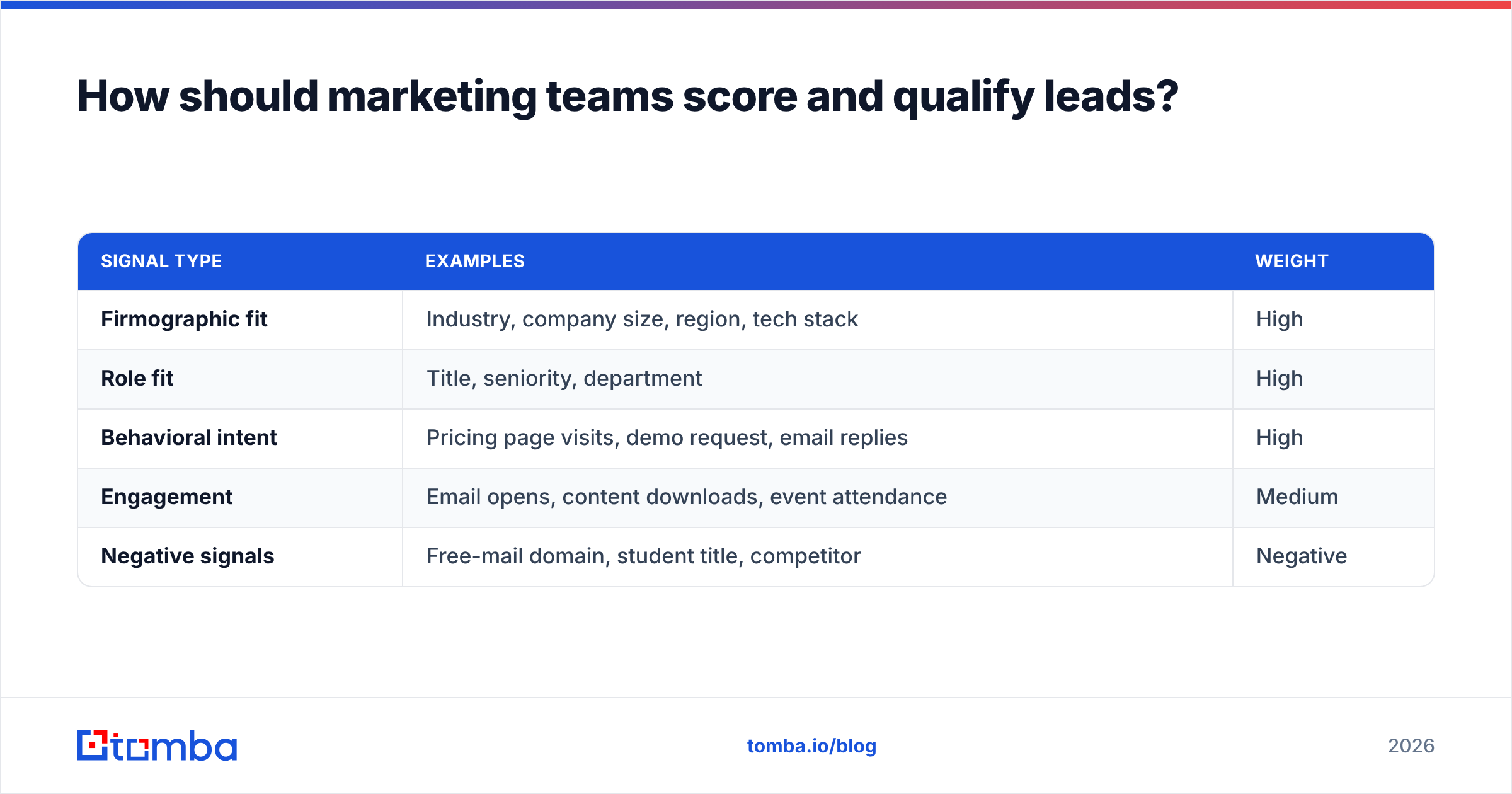
Score on two axes: fit (how well they match your ICP) and intent (how actively they're showing buying signals). A lead high on both is your SQL; high fit but low intent goes to nurture; high intent but low fit gets a polite, low-effort touch.
| Signal type | Examples | Weight |
|---|---|---|
| Firmographic fit | Industry, company size, region, tech stack | High |
| Role fit | Title, seniority, department | High |
| Behavioral intent | Pricing page visits, demo request, email replies | High |
| Engagement | Email opens, content downloads, event attendance | Medium |
| Negative signals | Free-mail domain, student title, competitor | Negative |
A few rules that keep scoring honest:
- Decay scores over time. A pricing-page visit from 90 days ago is not the same as one from yesterday.
- Cap engagement points. Ten email opens from a curious intern shouldn't outrank one demo request from a VP.
- Use negative scoring. Subtract points for disqualifiers so they don't clog the SQL queue.
When fit and intent both clear your threshold, that's when an SDR should pick up the phone — and they'll need accurate contact info to do it. This is exactly where a phone finder pays off: a verified mobile number turns a scored lead into an actual conversation instead of a voicemail.

What does a modern lead gen stack look like?#
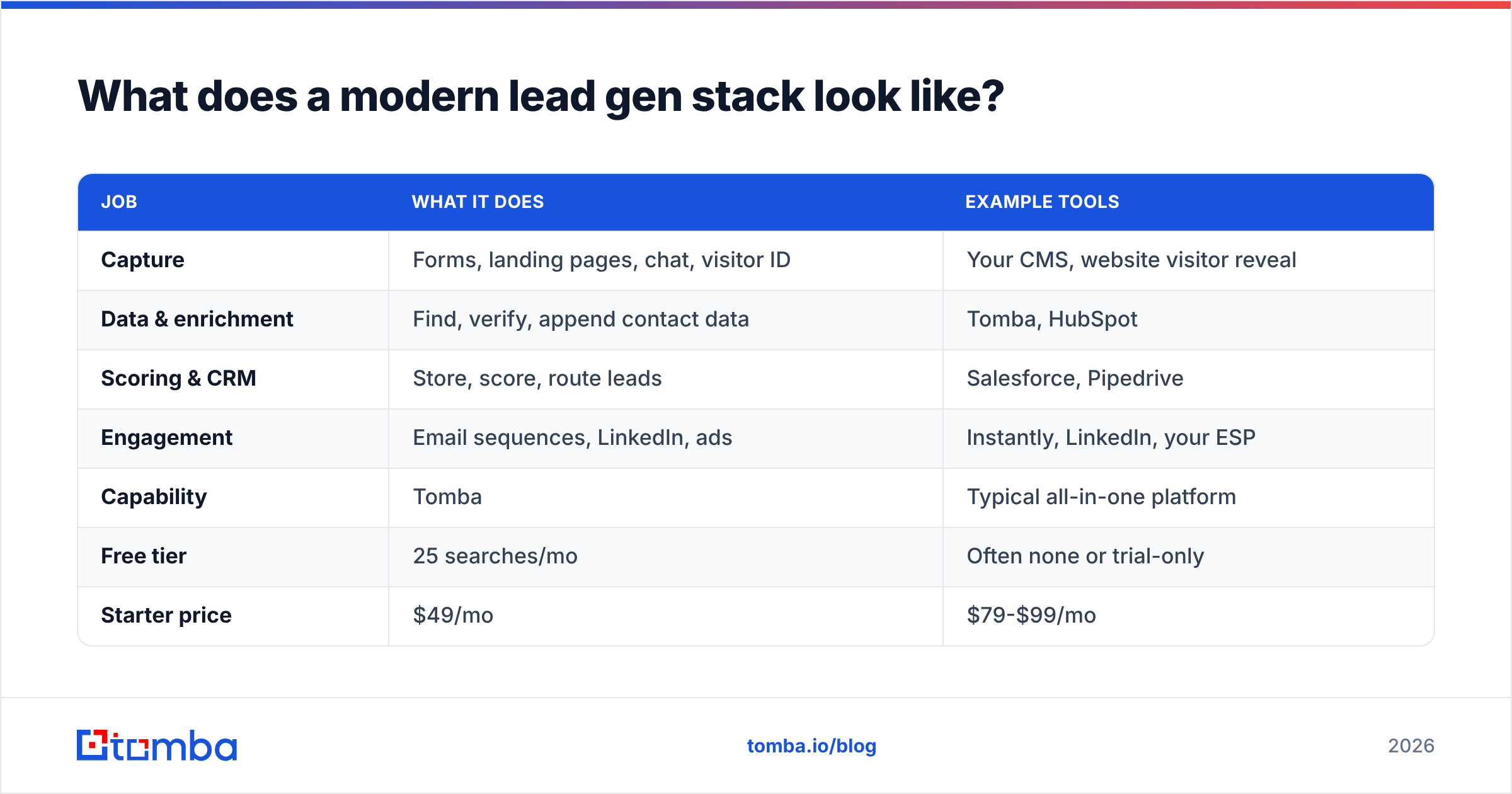
You don't need fifteen tools. You need four jobs covered: capture, data, scoring/CRM, and engagement.
| Job | What it does | Example tools |
|---|---|---|
| Capture | Forms, landing pages, chat, visitor ID | Your CMS, website visitor reveal |
| Data & enrichment | Find, verify, append contact data | Tomba, HubSpot |
| Scoring & CRM | Store, score, route leads | Salesforce, Pipedrive |
| Engagement | Email sequences, LinkedIn, ads | Instantly, LinkedIn, your ESP |
The connective tissue matters more than any single tool. If your enrichment doesn't sync into your CRM automatically, someone is copy-pasting — and that someone will stop doing it by week three. Tomba's HubSpot integration and Salesforce integration, plus a Tomba API for custom workflows, exist precisely so the data flows without a human in the loop. For teams that live in spreadsheets, the Google Sheets add-on enriches a list in place.
Where does Tomba fit against the broader category? Independent reviews on G2 are a useful sanity check, but here's the honest summary:
| Capability | Tomba | Typical all-in-one platform |
|---|---|---|
| Free tier | 25 searches/mo | Often none or trial-only |
| Starter price | $49/mo | $79-$99/mo |
| Email finder + verifier | Included | Usually separate add-ons |
| Phone + enrichment | Included | Premium tier |
| API + Sheets/Excel | Yes | Varies |
You can see the full breakdown on the Tomba pricing page. The point isn't that Tomba does everything — it's that the data layer is where marketing teams overpay and under-verify, and that's the layer to get right first.
How do you measure lead generation success?#
Stop reporting raw lead counts to leadership — it's a vanity number that invites "get me more leads" pressure. Report the funnel.
The metrics that actually drive decisions:
- MQL-to-SQL conversion rate — is marketing sending leads sales accepts?
- Cost per SQL (not cost per lead) — the real efficiency number.
- Lead-to-opportunity rate — does the engine produce pipeline, not just contacts?
- Data validity rate — what percent of your sourced contacts pass verification? If it's below 90%, fix your sources before spending another dollar on ads.
- Speed to first touch — how fast does a hand-raiser get contacted?
Track these monthly, and the conversation with sales shifts from "we need more leads" to "we need better leads from channel X" — which is a problem you can actually solve.
Common mistakes that quietly kill B2B lead gen#
- Buying lists. They're stale, unverified, and torch your sender reputation. Build and verify instead.
- Skipping verification. A 5% bounce rate isn't a small problem; it's a deliverability death spiral.
- No agreed MQL definition. Marketing and sales fighting over "qualified" is the most common pipeline leak.
- Single-channel dependence. When that one channel's cost doubles — and it will — your pipeline halves.
- Vanity reporting. Lead counts without conversion rates hide every real problem.
Where to start#
If you only fix one thing this quarter, fix your data layer. Pick your top 200 target accounts, run them through domain search to find the right contacts, verify every email, and append the missing titles and phone numbers before anything enters a sequence. You'll see deliverability, reply rates, and SDR efficiency move together — because they were all being dragged down by the same bad inputs.
The fastest way to do that is with the Tomba Email Finder: find professional emails by name, domain, or company, verify them in the same workflow, and push clean records straight into your CRM. Start on the free tier (25 searches a month, no card), and move to the $49/mo Starter plan once you've proven the lift. Clean data is the cheapest pipeline you'll ever buy.
// get started
Find, verify and enrich your first contacts today
Start on the free plan with 25 searches a month, then scale when your team is ready.
Free plan · No credit card required · GDPR & CCPA
// about the author