B2B Lead Generation Funnel: A 2026 Stage-by-Stage Guide
A practical, stage-by-stage breakdown of the B2B lead generation funnel for 2026 — the metrics, tools, and conversion math that actually move pipeline.
TL;DR
- A B2B lead generation funnel is the staged path a buyer takes from first touch to closed revenue — awareness, interest, consideration, intent, and decision — with a defined hand-off between marketing and sales.
- Most funnels leak at the top (bad contact data) and the middle (no MQL-to-SQL definition), not the bottom. Fixing data quality and stage definitions usually beats buying more traffic.
- Benchmark conversion: roughly 2-5% visitor-to-lead, 13% lead-to-MQL, 30-40% MQL-to-SQL, and 20-30% SQL-to-close. Multiply backwards from your revenue goal.
- Accurate, verified contact data is the single biggest lever on top-of-funnel efficiency — junk emails inflate cost per lead and wreck deliverability.
- Build the funnel around measurable stage gates, then automate the repeatable parts (enrichment, outreach, scoring) so reps spend time only on real opportunities.
What is a B2B lead generation funnel?#
A B2B lead generation funnel is the structured journey a potential buyer follows from the moment they first hear about you to the moment they sign. Think of it like a water filtration system: you pour a large, messy volume in at the top, and each stage removes the people who were never going to buy, so what reaches your sales team at the bottom is clean, qualified, and ready.
The B2B version differs from B2C in three ways that change how you build it. Deals involve buying committees of 6-10 people, not one shopper. Sales cycles run weeks to quarters, not minutes. And the average contract value is high enough that a single well-qualified lead can be worth more than thousands of consumer clicks. That economics is why precision beats volume in B2B — and why the quality of your contact data at the top of the funnel decides the efficiency of everything below it.
A funnel is not the same as a pipeline. The funnel is the marketing-and-early-sales motion that produces qualified opportunities; the pipeline is the late-stage sales process that closes them. Where they meet — the hand-off — is where most revenue leaks. We'll come back to that.
What are the stages of a B2B lead generation funnel?#
Different teams use different labels, but every working funnel maps to the same five jobs. Here is the canonical structure with the metric that governs each stage:
- Awareness (Top of Funnel) — A stranger discovers you via SEO, ads, social, or outbound. The job is reach. Govern it with traffic and impressions, but track qualified reach, not vanity volume.
- Interest (Lead capture) — The visitor exchanges contact info for value (a guide, demo, webinar, free tool). The job is conversion. Govern it with visitor-to-lead rate.
- Consideration (MQL) — The lead engages repeatedly and fits your ideal customer profile. The job is qualification. Govern it with a clear marketing qualified lead definition.
- Intent (SQL) — Sales accepts the lead and confirms budget, authority, need, and timing. The job is hand-off. Govern it with MQL-to-SQL acceptance rate.
- Decision (Closed-won) — The opportunity becomes revenue. The job is closing. Govern it with win rate and sales cycle length.
The numbered list above is your scaffolding. Notice that each stage has exactly one governing metric — if you can't name the number that tells you a stage is healthy, you can't fix it when it breaks.
What conversion rates should each funnel stage hit?#
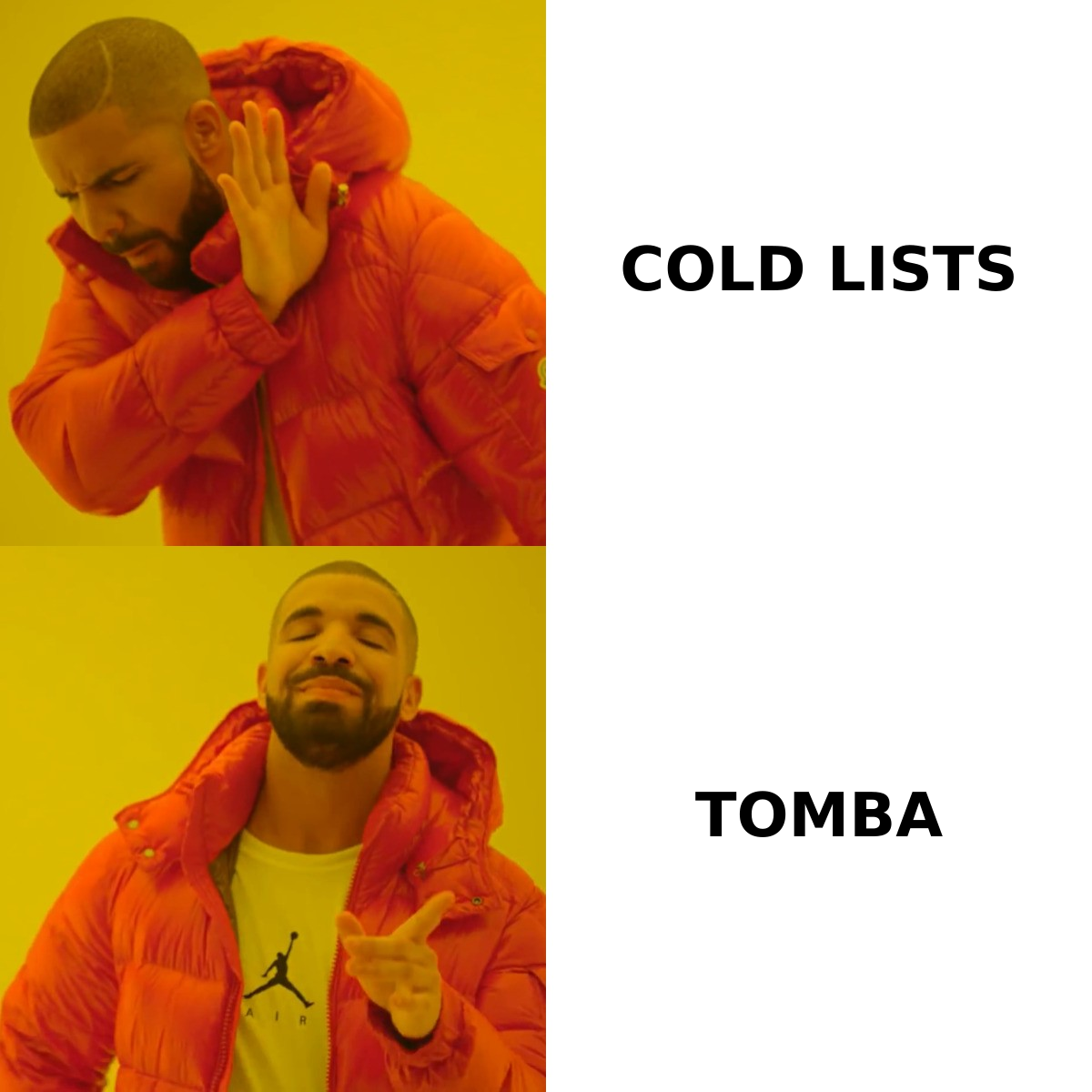
Benchmarks give you a sanity check, not a target — your numbers depend on industry, ACV, and motion. But here is a defensible 2026 reference set, drawn from aggregated B2B SaaS reporting, that you can use to model backwards from a revenue goal.
| Funnel stage | Conversion to next stage | What "good" looks like | Common failure |
|---|---|---|---|
| Visitor → Lead | 2-5% | Clear offer, low-friction form | Generic CTA, gated too early |
| Lead → MQL | 10-15% | Behavioral + fit scoring | No ICP definition |
| MQL → SQL | 30-40% | Tight sales/marketing SLA | "Marketing leads are junk" |
| SQL → Opportunity | 50-60% | Disciplined discovery | No qualification framework |
| Opportunity → Closed | 20-30% | Multi-threaded deals | Single-threaded, no champion |
Read the table as a chain. If you want 10 new customers a month and you close 25% of opportunities, you need 40 opportunities. If 55% of SQLs become opportunities, you need ~73 SQLs. Keep multiplying up and you'll find the top-of-funnel volume your goal actually requires — usually a sobering number that reframes "we need better copy" as "we need more qualified contacts."
The two weakest links in most B2B funnels are Lead-to-MQL (no scoring discipline) and MQL-to-SQL (no shared definition between teams). Both are process problems, not traffic problems. Buying more ads to fix them is like turning up the tap on a leaking bucket.
Why does contact data quality decide top-of-funnel efficiency?#
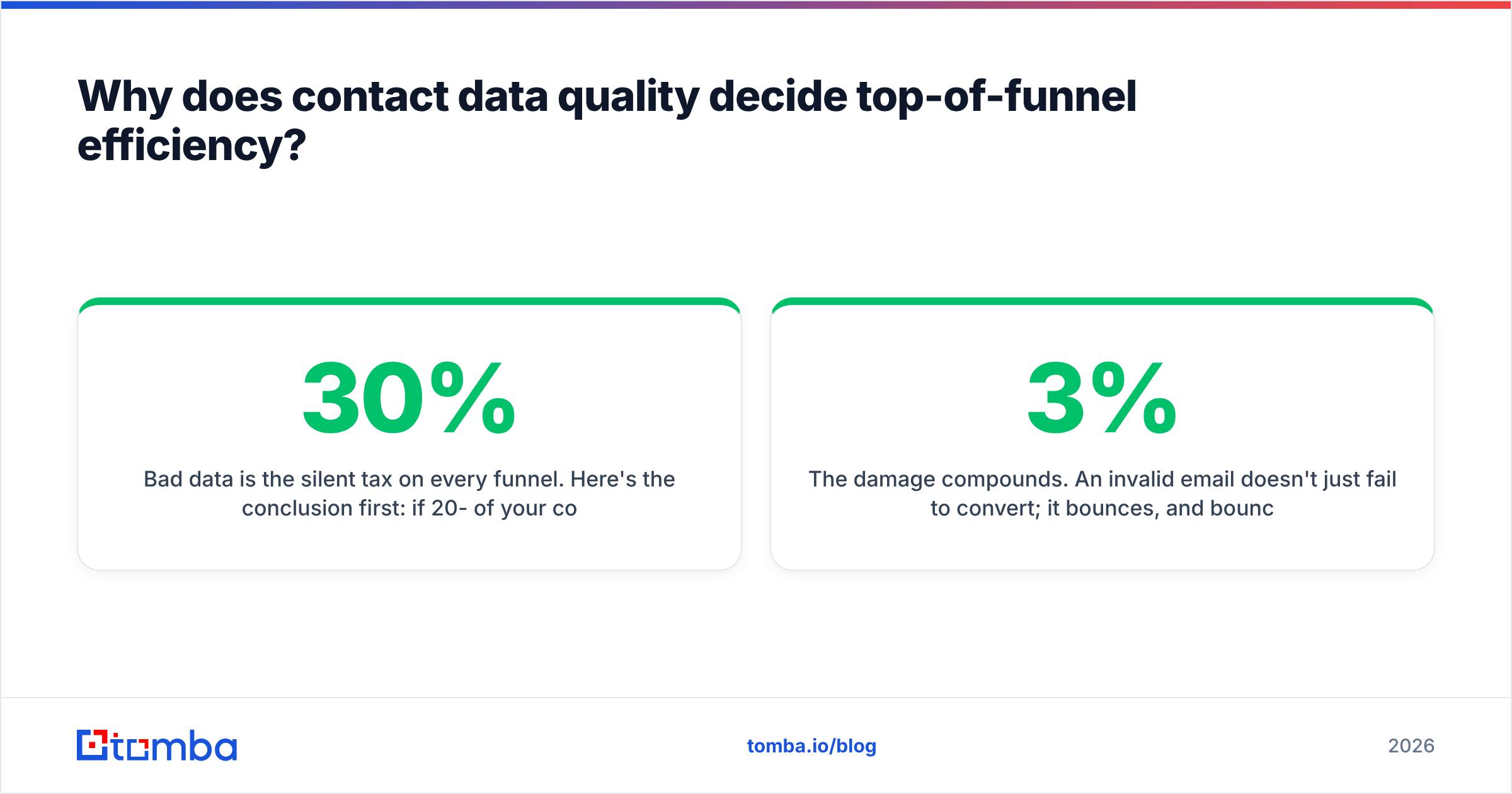
Bad data is the silent tax on every funnel. Here's the conclusion first: if 20-30% of your contacts are wrong — stale emails, generic info@ addresses, wrong companies — you are paying full cost-per-lead for prospects who can never convert, and you're burning sender reputation while you do it.
The damage compounds. An invalid email doesn't just fail to convert; it bounces, and bounce rates above 2-3% drag down your email deliverability for the valid contacts in the same send. So bad data at the top of the funnel quietly suppresses results across your entire list. Industry guidance from sources like HubSpot consistently ties database decay (B2B data degrades roughly 22-30% per year as people change jobs) to falling campaign performance.
This is where a dedicated data layer earns its keep. Instead of scraping unverified lists, you find and verify professional contacts at the moment you need them. A tool like the Tomba email finder returns the specific person's verified address by name and domain, and a separate email verifier step confirms it's deliverable before it ever enters your sequence. Run both at the lead-capture and enrichment stages and your top-of-funnel cost per qualified lead drops without spending a dollar more on traffic.
How do you build a B2B lead generation funnel step by step?#
Build it in the order revenue flows, not the order that's easiest. Here's a sequence you can implement in a quarter.
Step 1 — Define your ICP and buying committee. Write down the firmographics (industry, size, geography) and the 3-4 roles that sign off. Everything upstream is wasted if you don't know who you're filtering for.
Step 2 — Pick top-of-funnel channels that match the ICP. Inbound SEO and content for self-educators; outbound for high-ACV named accounts; paid for fast tests. Don't run all three at low intensity — concentrate.
Step 3 — Build the lead-capture layer. One strong offer per stage. A free tool or assessment converts colder traffic than a "request a demo" button. Keep forms short and enrich the rest with data enrichment after capture rather than asking for 11 fields up front.
Step 4 — Source and verify contacts for outbound. For named-account motion, use domain search to pull every relevant contact at a target company, then verify before outreach. This is the step that separates a 40% bounce list from a 98% deliverable one.
Step 5 — Score and route. Combine fit (ICP match) and behavior (pages, opens, replies) into a simple score. Above the threshold = MQL, routed to sales with context.
Step 6 — Define the SLA hand-off. Marketing commits to lead quality and volume; sales commits to follow-up speed and feedback. Put it in writing. This single document fixes more MQL-to-SQL leakage than any tool.
Step 7 — Measure, then automate the repeatable parts. Once a stage is stable, automate it — enrichment, sequencing, scoring — with sales automation so reps spend time only on human-judgment work.
What tools power each stage of the funnel?#
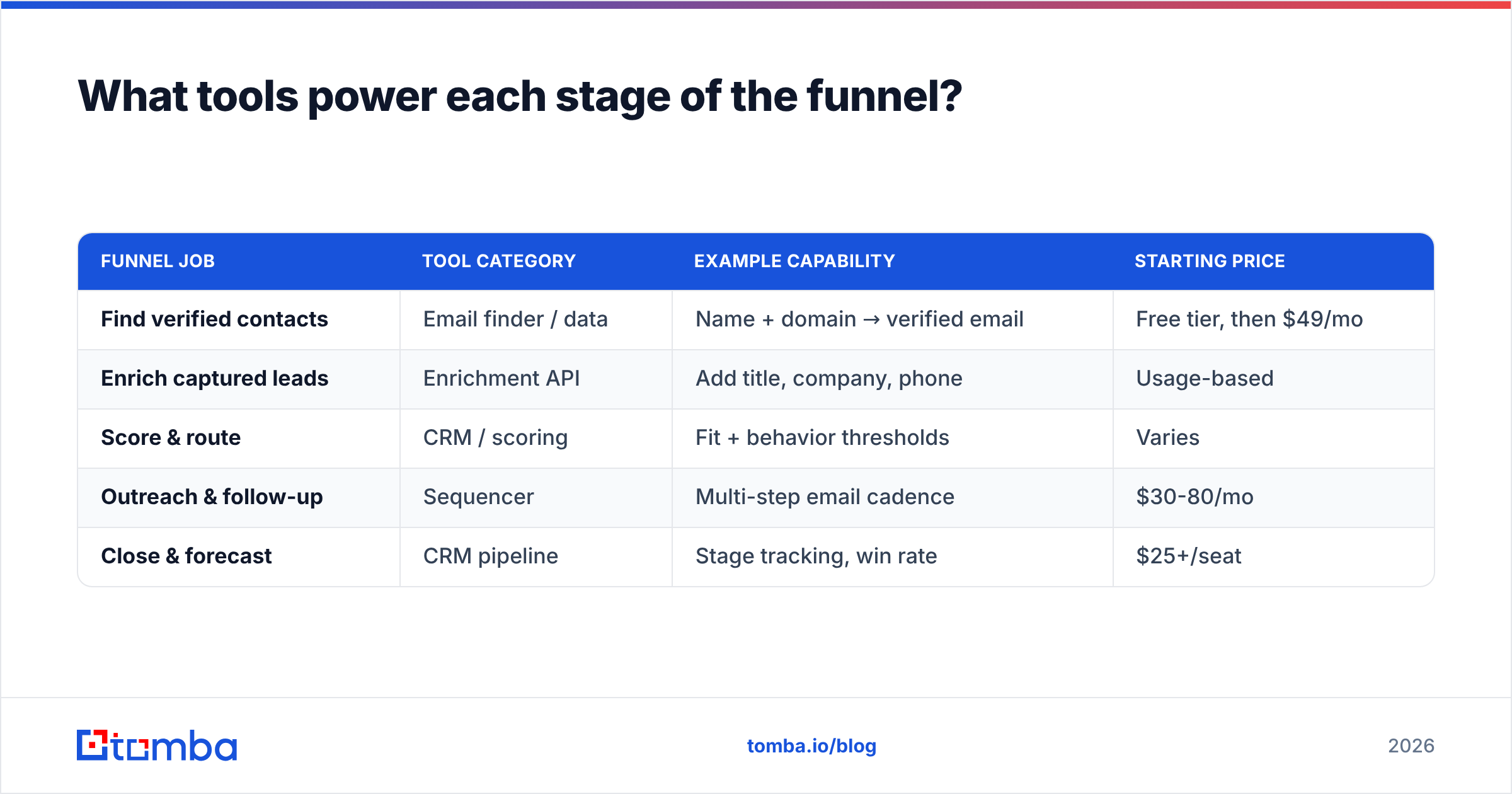
You don't need a 20-tool stack. You need one capable tool per job, well integrated. Here's how the categories map to funnel stages, with rough price anchors so you can budget realistically.
| Funnel job | Tool category | Example capability | Starting price |
|---|---|---|---|
| Find verified contacts | Email finder / data | Name + domain → verified email | Free tier, then $49/mo |
| Enrich captured leads | Enrichment API | Add title, company, phone | Usage-based |
| Score & route | CRM / scoring | Fit + behavior thresholds | Varies |
| Outreach & follow-up | Sequencer | Multi-step email cadence | $30-80/mo |
| Close & forecast | CRM pipeline | Stage tracking, win rate | $25+/seat |
For the data layer, Tomba pricing starts with a free tier of 25 searches per month, then Starter at $49/mo, Growth at $99/mo, and Pro at $249/mo — which covers most of the find-and-verify volume a single funnel needs. Compare options on a neutral marketplace like G2 before committing; the right pick depends on your verification accuracy needs and integration requirements, not the logo.
The integration point matters more than any single feature. If your finder writes verified contacts straight into your CRM and sequencer, the funnel runs itself between stage gates. Tomba connects through a HubSpot integration, native Google Sheets workflows, and a developer email finder API when you need to enrich at scale inside your own systems.
How do you fix a leaking B2B funnel?#
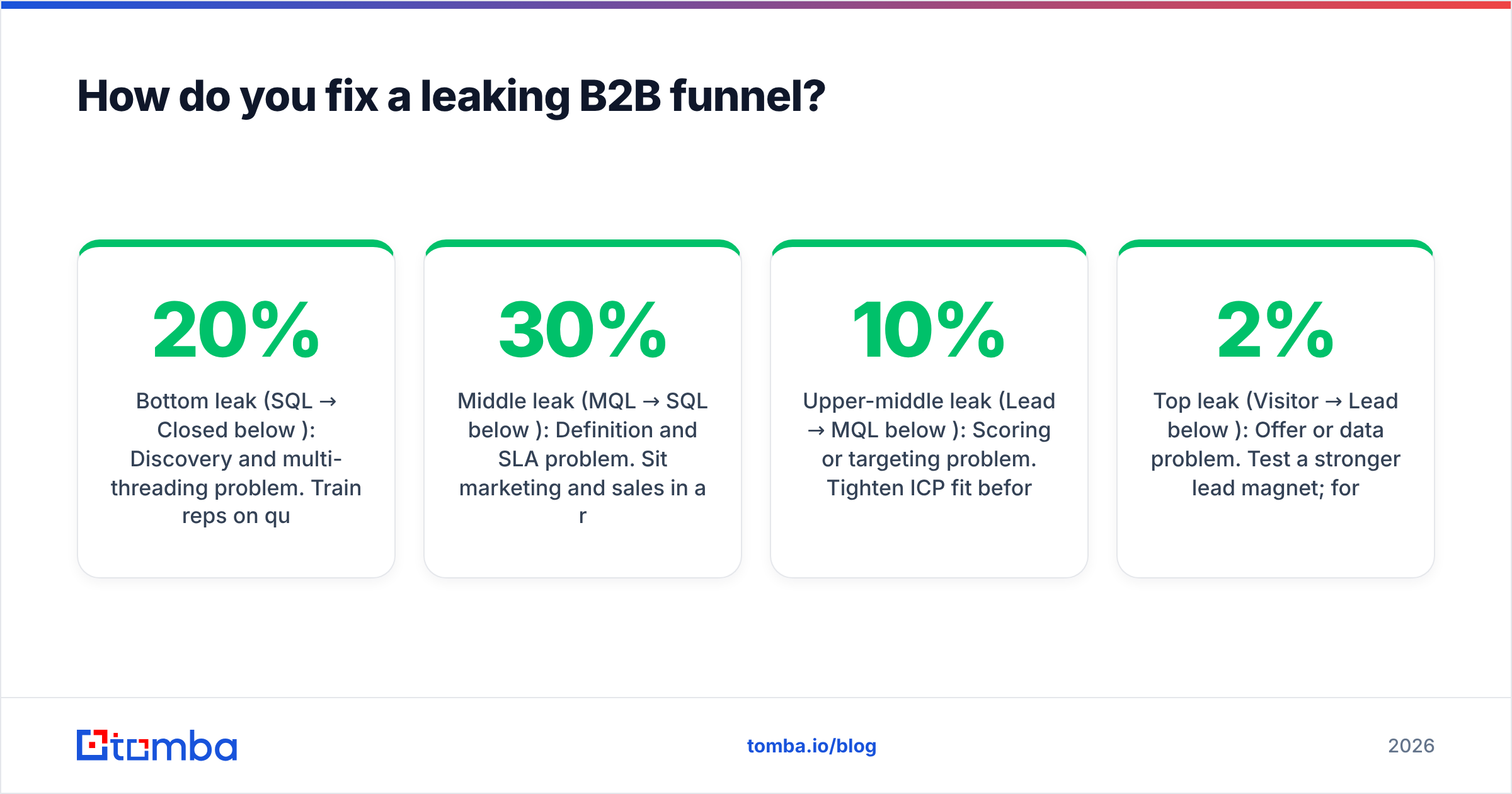
Diagnose top to bottom, fix bottom to top. Find the leak by laying your actual stage conversion rates next to the benchmark table above and looking for the biggest negative gap. Then fix the lowest broken stage first, because fixing an upstream leak just sends more volume into a downstream hole.
- Bottom leak (SQL → Closed below 20%): Discovery and multi-threading problem. Train reps on qualification; require a named champion before forecasting.
- Middle leak (MQL → SQL below 30%): Definition and SLA problem. Sit marketing and sales in a room and agree on what "qualified" means, in writing.
- Upper-middle leak (Lead → MQL below 10%): Scoring or targeting problem. Tighten ICP fit before adding behavioral points.
- Top leak (Visitor → Lead below 2%): Offer or data problem. Test a stronger lead magnet; for outbound, audit list deliverability with the email verifier.
A useful habit: review one funnel stage per week rather than the whole thing once a quarter. Small, frequent corrections keep the bucket from leaking faster than you can pour.
How is the funnel changing in 2026?#
Three shifts are worth planning for. First, buying committees are larger and more self-directed — much of the consideration stage now happens before a prospect ever talks to sales, which puts more weight on capturing and enriching anonymous interest early. Second, signal-based and intent-driven outbound is replacing spray-and-pray volume; the funnel rewards teams that reach the right account at the right moment with verified contacts. Third, deliverability rules keep tightening, so list hygiene is no longer optional — verified-before-send is the baseline, not a nice-to-have.
The constant across all three: clean, accurate, permission-respecting data wins. The teams that treat their contact database as an asset to maintain — not a list to burn — will out-convert the ones chasing volume.
Build the top of your funnel on data you can trust#
Your funnel is only as efficient as the contacts entering it. If the top of your funnel is full of stale, unverified, or generic addresses, every downstream metric is fighting gravity — higher cost per lead, lower deliverability, and reps wasting hours on prospects who were never reachable.
Start where the leverage is highest. Use the Tomba Email Finder to source verified professional emails by name, company, or domain, and feed your funnel real, deliverable contacts from the first stage. Spin up the free tier, run your next target-account list through it, and watch your visitor-to-lead and lead-to-MQL math improve before you spend another dollar on traffic. A funnel built on accurate data doesn't just convert better — it stays healthy as it scales.
// get started
Find, verify and enrich your first contacts today
Start on the free plan with 25 searches a month, then scale when your team is ready.
Free plan · No credit card required · GDPR & CCPA
// about the author