B2B Lead Generation Marketing: The 2026 Playbook That Works
A no-fluff 2026 guide to B2B lead generation marketing: channels that convert, the funnel math behind pipeline, and the tools that turn anonymous traffic into booked meetings.
B2B Lead Generation Marketing: The 2026 Playbook That Works
TL;DR
- B2B lead generation marketing in 2026 is won by accuracy and intent, not volume — a small list of verified, ICP-matched contacts beats 10,000 scraped emails every time.
- The channels that still produce pipeline: SEO + content, targeted outbound, paid retargeting, LinkedIn social selling, and webinars. Spray-and-pray is dead.
- Your funnel math matters more than your tactics. If you know your visitor→MQL→SQL→won rates, you can reverse-engineer exactly how many leads you need.
- Clean data is the multiplier. Bounced emails, wrong titles, and stale phone numbers quietly kill every campaign downstream.
- Tools like a reliable email finder and data enrichment turn raw interest into contactable, qualified leads.
If you run demand gen or own a number, you already know the uncomfortable truth: most "lead generation" advice is recycled fluff that ignores the part where leads actually have to convert. This guide is built around the math and the mechanics — what to do, in what order, and how to stop wasting budget on leads that never had a chance.
What is B2B lead generation marketing?#
B2B lead generation marketing is the system of attracting, identifying, and qualifying business buyers so your sales team can turn them into revenue. Think of it like fishing with the right bait in the right pond — not dumping a net in the ocean and hoping. You're matching a specific message to a specific buyer at a specific stage.
It splits into two motions:
- Inbound — buyers find you through search, content, referrals, or your community. Higher intent, slower to scale.
- Outbound — you find buyers through prospecting, cold email, calls, and ads. Faster to control, lower baseline intent.
The mistake teams make is treating these as rival religions. In 2026 the winning play is a blended engine: inbound captures the 3% actively shopping, outbound creates demand in the 97% who aren't — and shared data infrastructure connects both. A marketing qualified lead from a webinar and a cold-sourced prospect should land in the same enrichment and scoring pipeline.
)
Why do most B2B lead gen campaigns fail?#
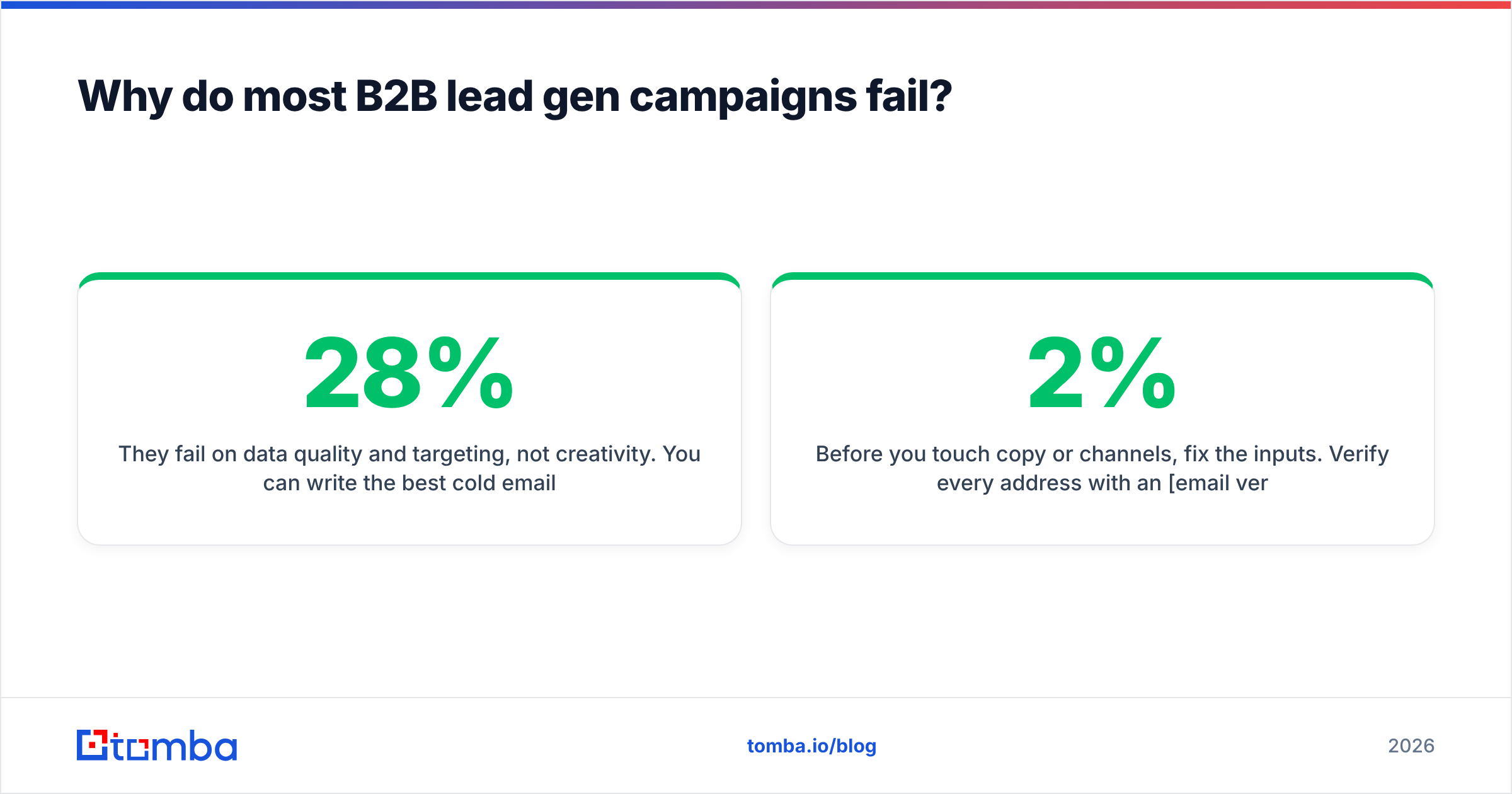
They fail on data quality and targeting, not creativity. You can write the best cold email of your life, but if 28% of the addresses bounce and half the rest are the wrong persona, your sender reputation tanks and your "campaign" becomes a deliverability problem.
Here's the chain of failure most teams never trace:
- Bad list → high bounce rate → spam folder placement → sender reputation damage → even your good emails don't land.
- Wrong persona → low reply rate → reps assume the message is broken → endless A/B testing of copy that was never the problem.
- No enrichment → generic messaging → ignored.
Before you touch copy or channels, fix the inputs. Verify every address with an email verifier, confirm titles and company data, and segment by genuine fit. Clean data isn't glamorous, but it's the difference between a 2% and a 12% reply rate.
Which B2B lead generation channels actually work in 2026?#
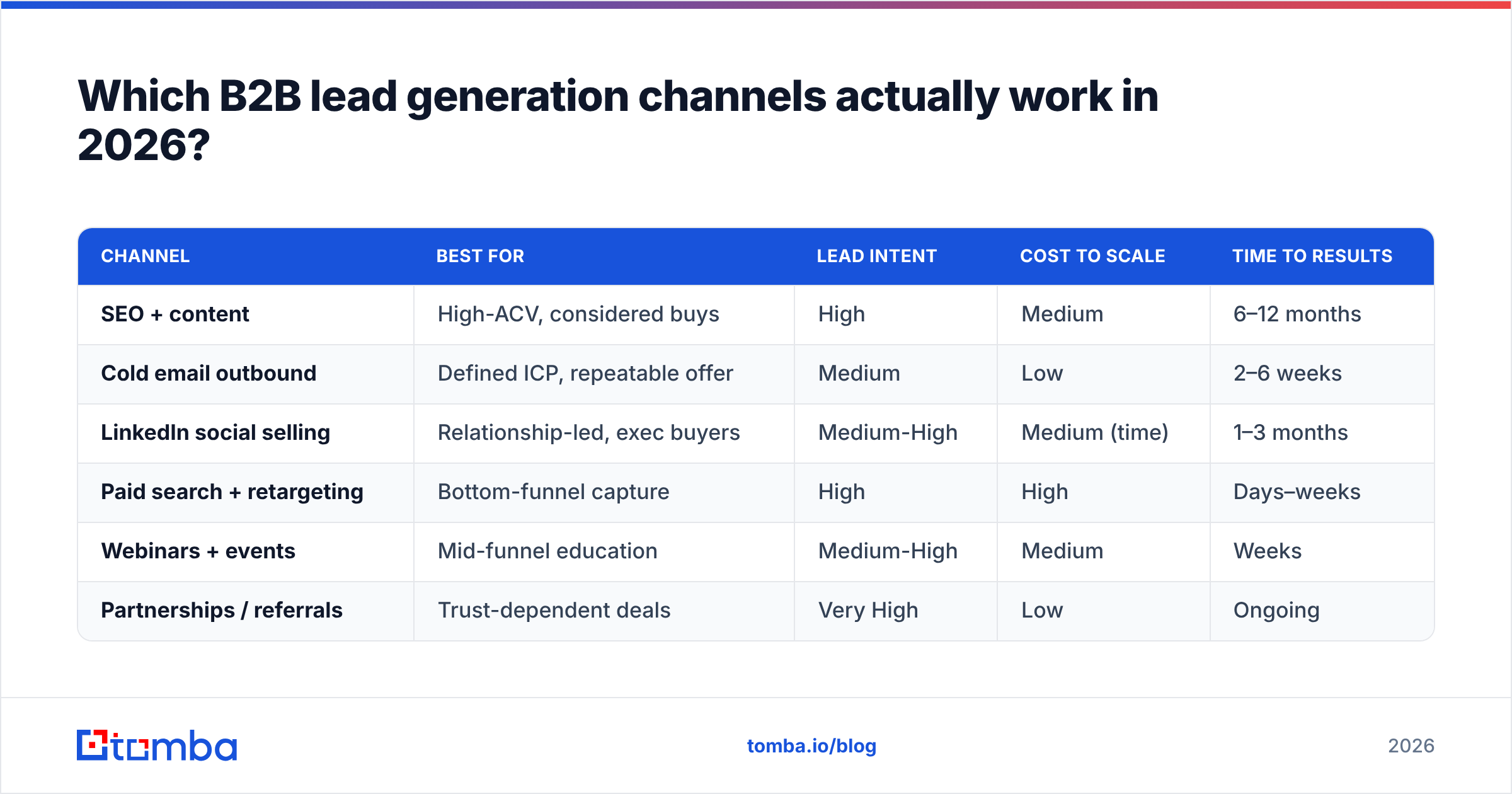
There's no single best channel — there's a best mix for your motion, ACV, and sales cycle. Below is a realistic comparison of the channels carrying B2B pipeline this year.
| Channel | Best for | Lead intent | Cost to scale | Time to results |
|---|---|---|---|---|
| SEO + content | High-ACV, considered buys | High | Medium | 6–12 months |
| Cold email outbound | Defined ICP, repeatable offer | Medium | Low | 2–6 weeks |
| LinkedIn social selling | Relationship-led, exec buyers | Medium-High | Medium (time) | 1–3 months |
| Paid search + retargeting | Bottom-funnel capture | High | High | Days–weeks |
| Webinars + events | Mid-funnel education | Medium-High | Medium | Weeks |
| Partnerships / referrals | Trust-dependent deals | Very High | Low | Ongoing |
A few honest takes:
- SEO compounds, paid doesn't. Content you rank in 2026 still pulls leads in 2027. The moment you stop paying for ads, the leads stop.
- Outbound is the fastest lever you control — but only if your data is clean. This is where a bulk email finder and verification step earn their keep.
- LinkedIn outreach works when it's genuinely personal. Automated connection spam is burning more brands than it builds. Treat LinkedIn outreach as relationship-building, not a numbers game.
How do you calculate how many leads you actually need?#
Start from revenue and work backwards — don't start from "let's generate more leads." The funnel math tells you the real target.
Say you need $1M in new ARR, your average deal is $20K, and your win rate is 25%:
- Closed deals needed: $1,000,000 ÷ $20,000 = 50 deals
- SQLs needed (at 25% win rate): 50 ÷ 0.25 = 200 SQLs
- MQLs needed (at 40% MQL→SQL): 200 ÷ 0.40 = 500 MQLs
- Leads needed (at 20% lead→MQL): 500 ÷ 0.20 = 2,500 leads
- Traffic/contacts needed (at 3% conversion): 2,500 ÷ 0.03 = ~83,000 visitors or touches
Now you know your real job: not "more leads," but specifically ~2,500 qualified leads — and you know which conversion rate, if improved, moves the goal fastest. Usually it's the win rate or the MQL→SQL handoff, both of which are data-quality and targeting problems, not volume problems.
What does a modern B2B lead gen workflow look like?#
The end-to-end motion that consistently produces pipeline looks like this:
- Define ICP precisely. Industry, size, tech stack, trigger events. Specific beats broad.
- Source contacts at the right accounts. Use domain search to pull the relevant decision-makers at a target company, not just whoever's email you stumbled on.
- Enrich and verify. Add titles, seniority, phone, and LinkedIn; drop anything that fails verification.
- Score and segment. Route hot, ICP-fit leads to sales now; nurture the rest.
- Engage on the right channel. Email for scale, phone for high-intent, LinkedIn for warm relationship plays.
- Measure per stage. Track conversion at each step so you fix the actual bottleneck.
)
The unsexy core of this whole workflow is contact data. Everything downstream — copy, timing, channel — is multiplied or divided by whether you reached the right person at a real, deliverable address. That's why your data layer deserves as much attention as your messaging.
Inbound vs outbound: which should you prioritize?#
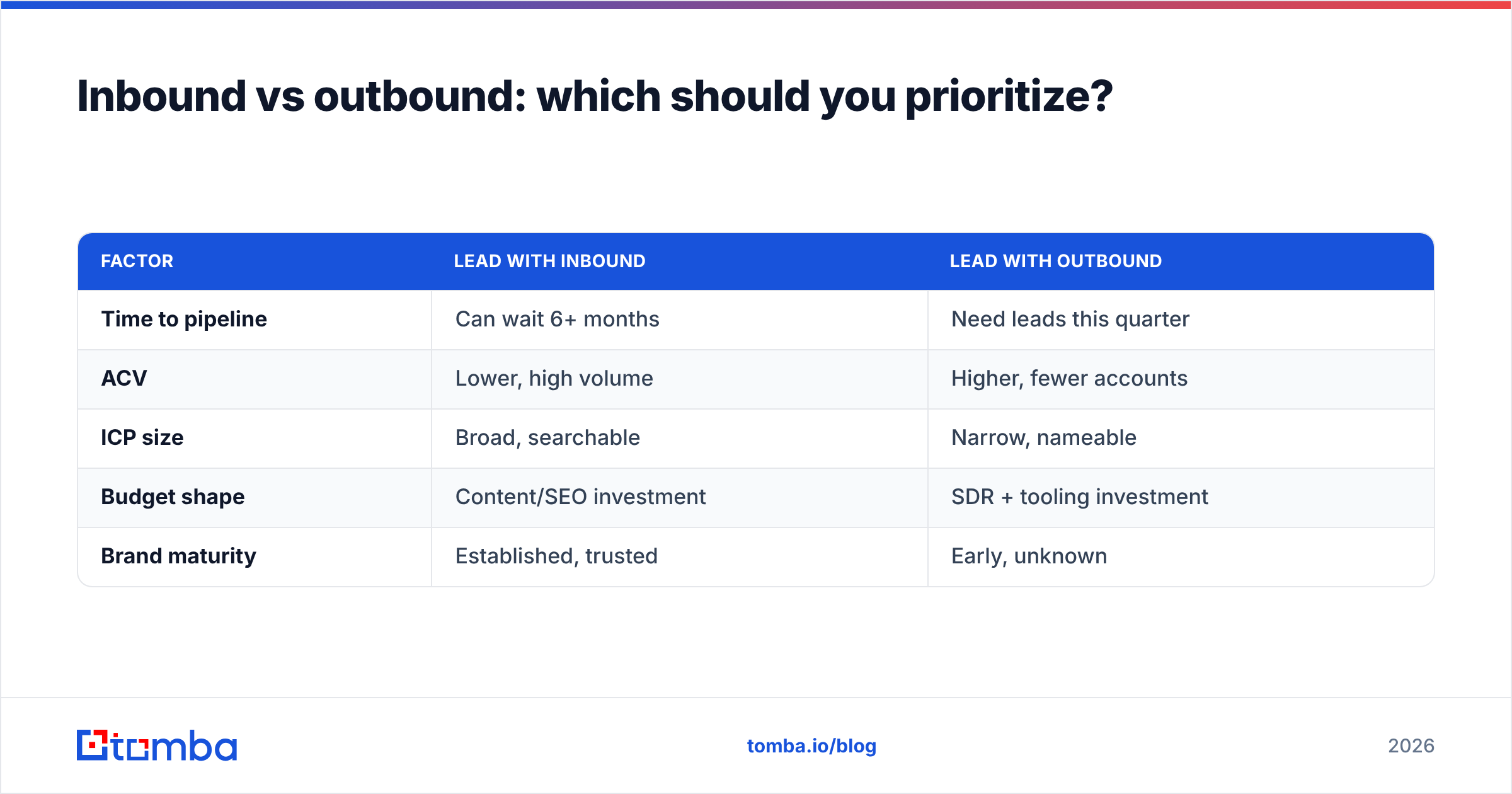
Prioritize based on your sales cycle and how urgently you need pipeline — not on ideology.
| Factor | Lead with inbound | Lead with outbound |
|---|---|---|
| Time to pipeline | Can wait 6+ months | Need leads this quarter |
| ACV | Lower, high volume | Higher, fewer accounts |
| ICP size | Broad, searchable | Narrow, nameable |
| Budget shape | Content/SEO investment | SDR + tooling investment |
| Brand maturity | Established, trusted | Early, unknown |
Most companies should run both, but sequence them. Early-stage teams usually need outbound first — you can name your 500 dream accounts today and start booking meetings in weeks, while content takes quarters to rank. Established brands with search demand should pour fuel on inbound and use outbound surgically for named enterprise targets.
The connective tissue is the same data foundation. Whether a lead raised their hand on your pricing page or you sourced them cold, you'll want to enrich leads and verify them before a rep ever reaches out.
How do you turn anonymous website traffic into leads?#
Most of your traffic leaves without filling out a form — 95%+ is typical. There are three ways to recover that lost intent:
- Conversion optimization. Better offers, fewer form fields, clearer CTAs. Capture more of the hand-raisers.
- Retargeting. Stay in front of visitors who left, pulling them back to convert.
- Visitor identification. De-anonymize companies hitting high-intent pages (pricing, demo, product) and proactively reach the right contact there.
That third lever is underused. If you can see that a target account visited your pricing page twice this week, you don't wait for a form — you find the decision-maker and reach out while intent is hot. Pair visitor signals with an email finder to go from "an anonymous company looked at us" to "here's the VP of Ops and her verified email" in minutes.
What tools do you need for a B2B lead gen engine?#
You need fewer tools than vendors want you to buy. The non-negotiables:
- A contact data / email finder to source verified emails and phone numbers at target accounts.
- An email verification layer to protect deliverability before you send.
- A CRM (your CRM is the system of record) to track every lead through the funnel.
- An outreach/sequencing tool for email and multichannel cadences.
- An enrichment source to fill in titles, firmographics, and intent.
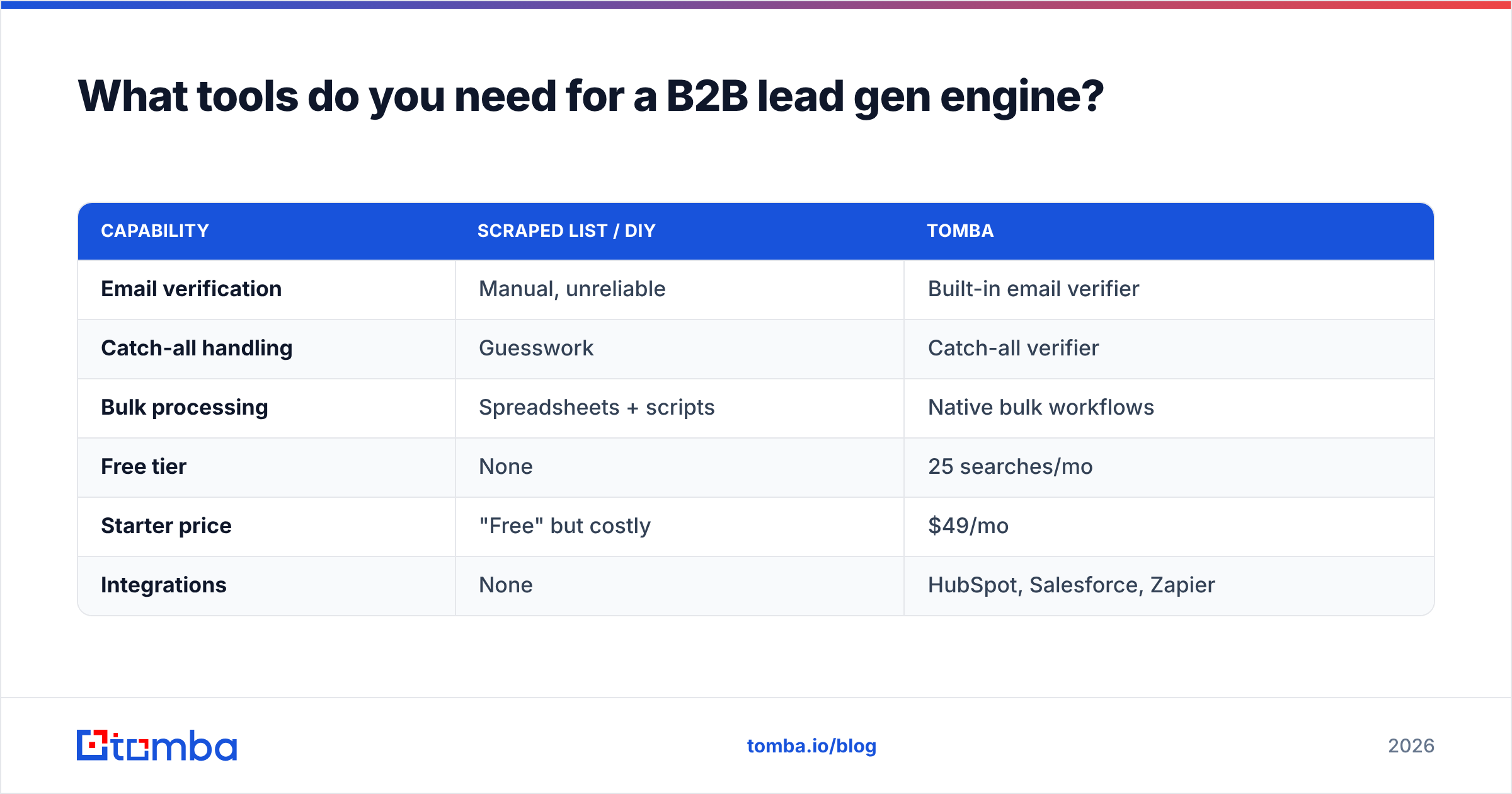
On data accuracy specifically, this is where budget gets wasted fastest. Cheap or scraped lists feel free but cost you deliverability and rep time. Here's how Tomba's data layer stacks up against the typical DIY approach:
| Capability | Scraped list / DIY | Tomba |
|---|---|---|
| Email verification | Manual, unreliable | Built-in email verifier |
| Catch-all handling | Guesswork | Catch-all verifier |
| Bulk processing | Spreadsheets + scripts | Native bulk workflows |
| Free tier | None | 25 searches/mo |
| Starter price | "Free" but costly | $49/mo |
| Integrations | None | HubSpot, Salesforce, Zapier |
You can see full Tomba pricing for the Growth ($99/mo) and Pro ($249/mo) tiers if you're running higher volume.
How do you measure B2B lead gen performance?#
Measure conversion rate at every funnel stage, not just total lead count — vanity metrics hide where pipeline actually leaks.
The metrics that matter:
- Lead→MQL→SQL→won rates per channel, so you can kill what doesn't convert.
- Cost per qualified lead (not cost per raw lead — raw leads are cheap and meaningless).
- Response rate on outbound, your earliest signal that targeting or data is off.
- Bounce rate as a data-health alarm. Above ~3% and you're risking deliverability.
- Pipeline velocity — how fast leads move stage to stage.
Industry benchmarks from sources like HubSpot's research and review data on G2 are useful directional anchors, but your own historical rates are the only numbers you should plan against. According to broad B2B marketing analysis, the highest-performing teams obsess over data quality and stage conversion far more than top-of-funnel volume.
Common mistakes that quietly kill pipeline#
- Buying lists instead of building them. Bought lists are stale, shared, and toxic to deliverability.
- Skipping verification. Every unverified send is a coin flip on your sender reputation.
- One message for all personas. A CFO and a practitioner do not care about the same things.
- Measuring leads, ignoring conversion. 10,000 bad leads is worse than 200 good ones — it just hides the problem behind a big number.
- Treating outbound and inbound as separate teams. They should share data, scoring, and a single definition of "qualified."
The bottom line#
B2B lead generation marketing in 2026 rewards precision over volume. Get your ICP tight, your funnel math honest, your channels matched to your motion — and above all, get your data clean. Every tactic in this guide is multiplied or divided by whether you're reaching the right person at a deliverable address.
That's the foundation worth building first. Start by sourcing verified, ICP-matched contacts at your target accounts with the Tomba Email Finder — find emails by domain, name, or company, verify them before you send, and feed your outreach engine leads that actually convert. Spin up the free tier (25 searches/month), prove the data quality on your own dream-account list, and scale from there.
// get started
Find, verify and enrich your first contacts today
Start on the free plan with 25 searches a month, then scale when your team is ready.
Free plan · No credit card required · GDPR & CCPA
// about the author