B2B Lead Generation Statistics You Need to Know in 2026
The numbers behind what actually works in B2B lead gen this year — conversion rates, channel ROI, cost-per-lead benchmarks, and the data quality stats most teams ignore.
You can't fix a pipeline you can't measure. The fastest way to know whether your lead generation is healthy or quietly bleeding money is to hold it against benchmarks — real numbers from real teams. This is the 2026 rundown of B2B lead generation statistics that actually change decisions, organized by the questions you're probably asking right now.
TL;DR — The B2B Lead Generation Statistics That Matter Most#
- Conversion reality check: The average B2B website converts visitors to leads at roughly 2.5–3%, and only about 13% of leads ever become qualified opportunities. Volume without qualification is vanity.
- Channel ROI leaders: Email marketing still posts the highest ROI of any channel (commonly cited around $36–$42 per $1 spent), while SEO and referrals deliver the lowest cost-per-lead over time.
- Speed wins deals: Responding to a new lead within 5 minutes makes you up to 21x more likely to qualify it than waiting 30 minutes. Most teams take over an hour.
- Data decay is the silent killer: B2B contact data degrades at roughly 22–30% per year. Bad data is the single most common cause of wasted outbound spend.
- Follow-up gap: Around 80% of sales need five or more follow-ups, yet nearly half of reps quit after one.
What Is the Average B2B Lead Conversion Rate in 2026?#
Conclusion first: most B2B funnels lose the overwhelming majority of leads, and that's normal — the goal is to lose fewer at each stage than your competitors.
Think of your funnel like a series of leaky buckets stacked on top of each other. Water poured in the top (traffic) trickles down through marketing-qualified leads, sales-qualified leads, opportunities, and finally closed deals. Each bucket leaks. The teams that win don't pour more water — they patch the leaks.
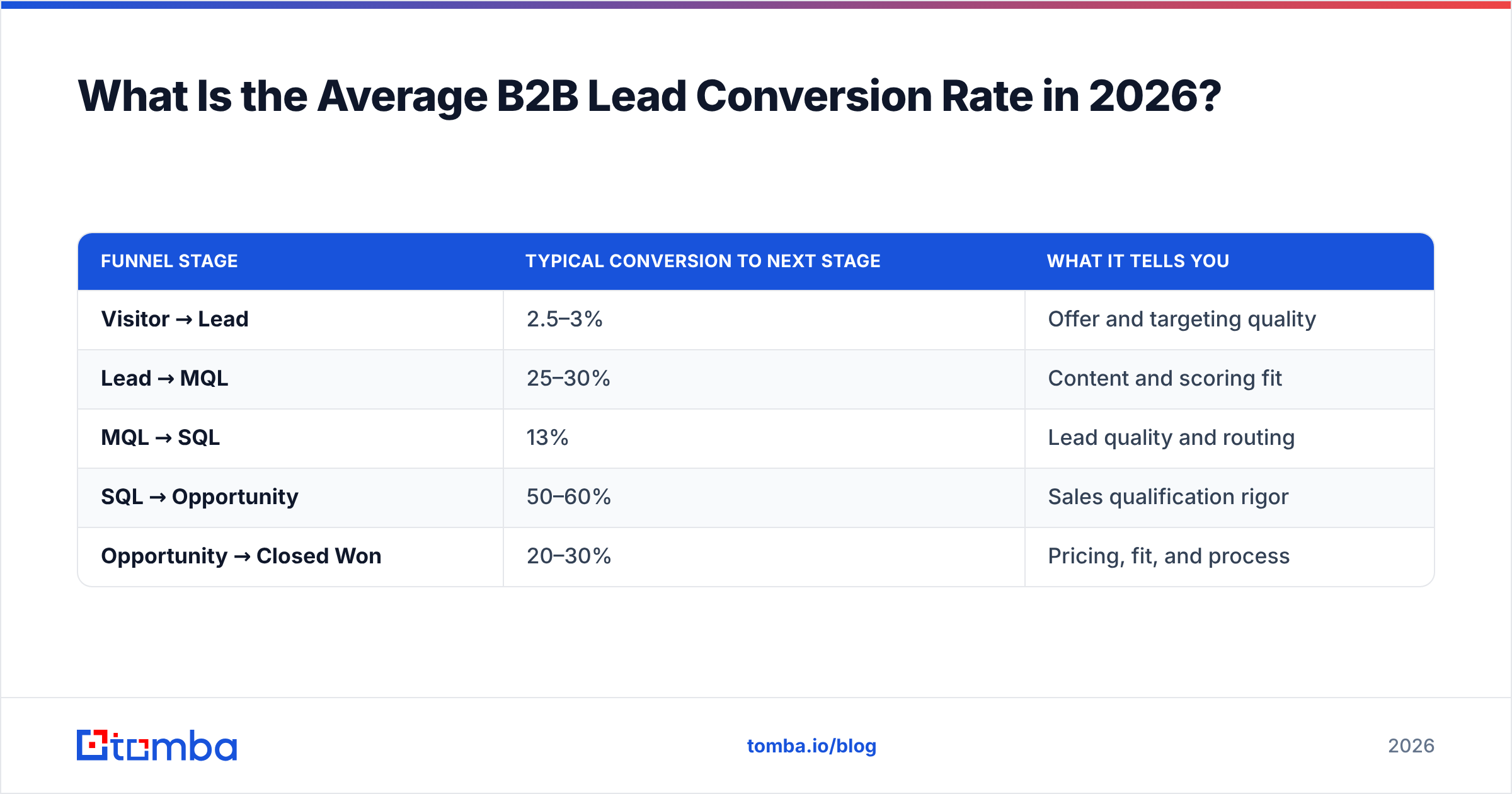
Here's a typical B2B SaaS funnel benchmark for 2026:
| Funnel stage | Typical conversion to next stage | What it tells you |
|---|---|---|
| Visitor → Lead | 2.5–3% | Offer and targeting quality |
| Lead → MQL | 25–30% | Content and scoring fit |
| MQL → SQL | 13% | Lead quality and routing |
| SQL → Opportunity | 50–60% | Sales qualification rigor |
| Opportunity → Closed Won | 20–30% | Pricing, fit, and process |
If your visitor-to-lead rate sits below 2%, the problem is almost always the offer or the audience — not your form. If your marketing qualified lead volume is high but SQLs are thin, your scoring model is rewarding the wrong behavior.
The single most actionable number here is the 13% MQL-to-SQL rate. Most teams obsess over the top of the funnel when the biggest leak is in the middle — leads that look interested but were never a real fit. That's a data and targeting problem, not a volume problem.
Which B2B Lead Generation Channels Have the Best ROI?#
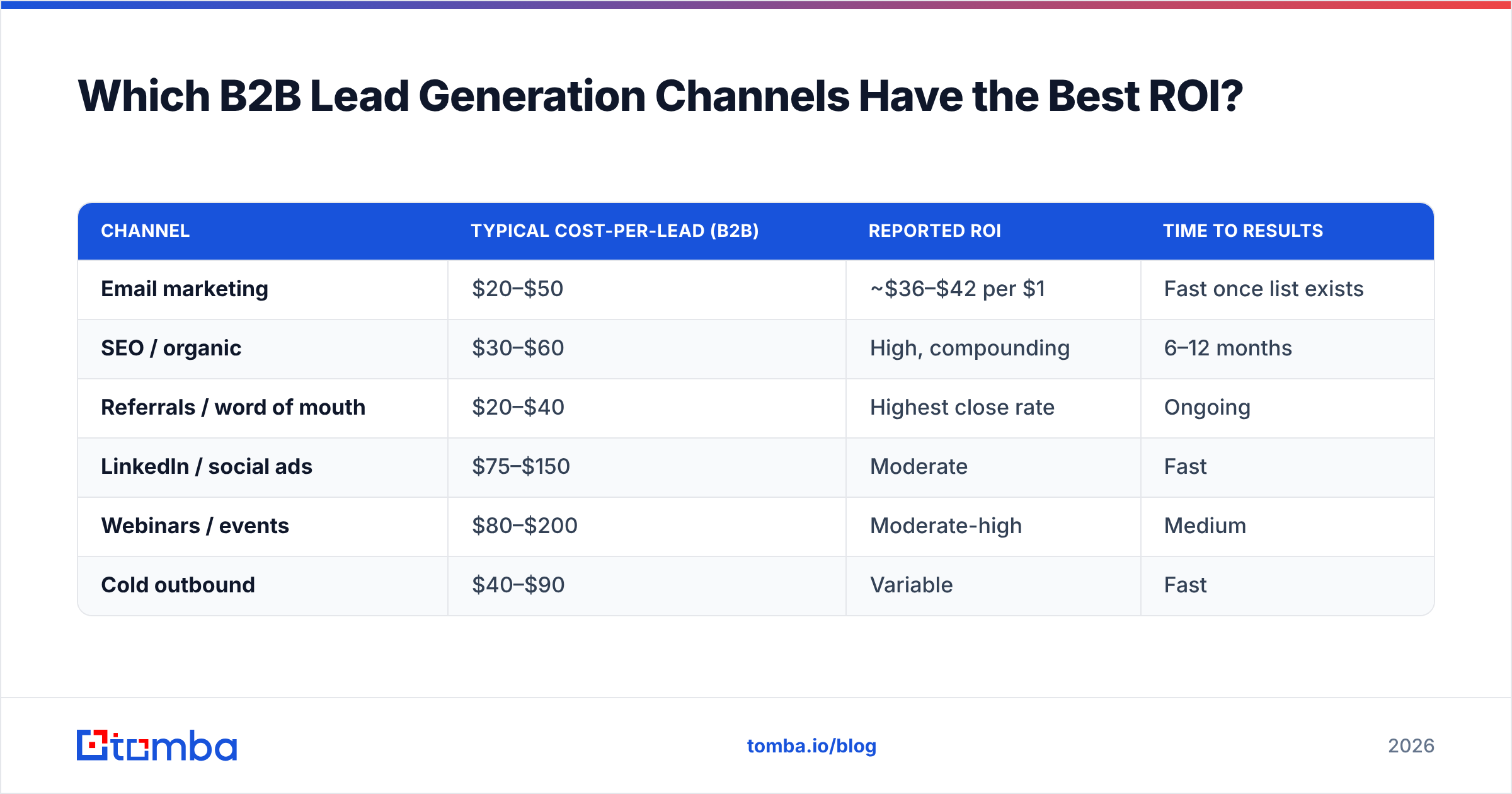
Conclusion first: email and organic search consistently deliver the lowest cost-per-lead and the highest long-term ROI, while paid social burns cash fastest if your targeting is loose.
Different channels behave like different financial instruments. Paid ads are a short-term loan — instant leads, high interest. SEO and content are an index fund — slow to start, compounding for years. Email is the dividend stock that quietly outperforms everything.
| Channel | Typical cost-per-lead (B2B) | Reported ROI | Time to results |
|---|---|---|---|
| Email marketing | $20–$50 | ~$36–$42 per $1 | Fast once list exists |
| SEO / organic | $30–$60 | High, compounding | 6–12 months |
| Referrals / word of mouth | $20–$40 | Highest close rate | Ongoing |
| LinkedIn / social ads | $75–$150 | Moderate | Fast |
| Webinars / events | $80–$200 | Moderate-high | Medium |
| Cold outbound | $40–$90 | Variable | Fast |
Two patterns hold up across nearly every B2B dataset:
- Referrals convert best. Referred leads close at 2–4x the rate of cold leads because trust is pre-loaded. They're hard to scale, but they should be a deliberate motion, not an accident.
- Email's ROI depends entirely on list quality. That $42-per-dollar figure assumes your list is real, opted-in or compliant, and deliverable. Send to a decayed list and the same channel posts negative ROI.
This is where the unglamorous work pays off. A clean, accurate contact list is the difference between email being your best channel and your worst. Tools like the Tomba Email Finder and a proper email verifier step exist precisely to keep that ROI number where the benchmark says it should be.
How Fast Do You Need to Respond to a B2B Lead?#
Conclusion first: within five minutes, or you've likely already lost.
The lead-response-time research is some of the most consistent data in all of B2B. Contacting a web lead within five minutes makes you up to 21x more likely to qualify it than waiting 30 minutes. After the first hour, the odds collapse. Yet the median first-response time across B2B companies is still measured in hours, not minutes.
Why the gap? Three reasons show up again and again:
- Routing delays — leads sit in a queue before a human sees them.
- Manual enrichment — reps stop to look up the company, the contact, the phone number before reaching out.
- No automation trigger — nobody is alerted in real time.
The second one is fixable today. If your reps are manually hunting for a phone number or job title before they can act, that's dead time bleeding straight into your conversion rate. Real-time data enrichment and instant alerts (via a HubSpot integration or similar) compress that window from hours to seconds.
What Do the Numbers Say About Follow-Up?#
Conclusion first: persistence is statistically underpriced — most reps quit right before the deal would have happened.
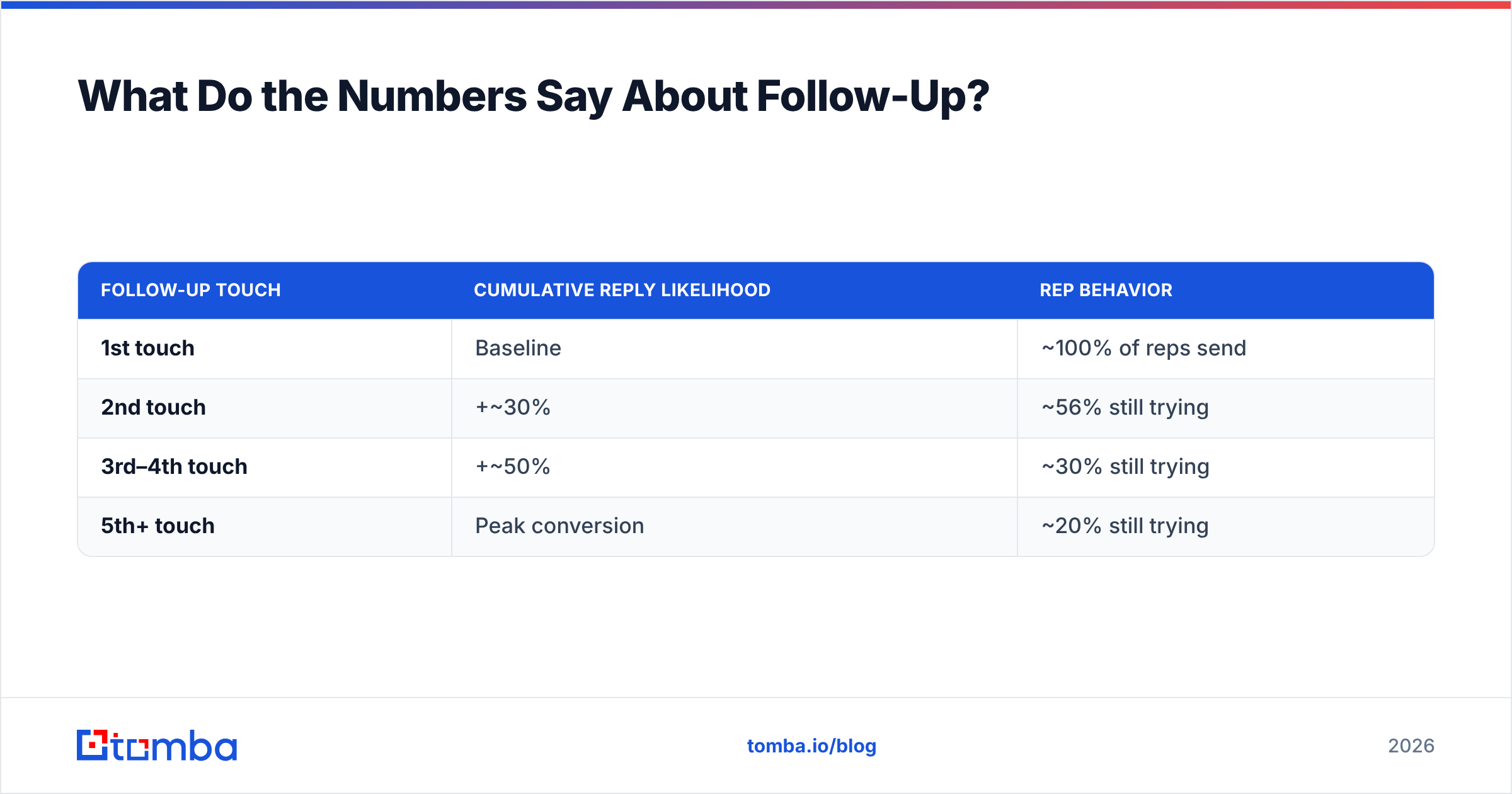
The follow-up statistics are brutal and rarely change year to year:
- 80% of sales require five or more follow-up touches after the first meeting.
- 44% of reps give up after one follow-up.
- The 6th to 8th touch is frequently where reply and meeting-booked rates spike.
| Follow-up touch | Cumulative reply likelihood | Rep behavior |
|---|---|---|
| 1st touch | Baseline | ~100% of reps send |
| 2nd touch | +~30% | ~56% still trying |
| 3rd–4th touch | +~50% | ~30% still trying |
| 5th+ touch | Peak conversion | ~20% still trying |
The math is almost unfair: the reps doing the most follow-ups are competing against the fewest people, in the zone where conversions peak. Persistence isn't a personality trait here — it's a process you can systematize with sequences and a clear response rate target.
Why Does Data Quality Show Up in Every Lead Generation Statistic?#
Conclusion first: because bad data quietly multiplies the cost of every other number on this page.
Here's the stat that ties the whole article together: B2B data decays at roughly 22–30% per year. People change jobs, companies rebrand, domains migrate, and emails go dead. Other commonly cited figures:
- The average B2B database contains 20–30% inaccurate or outdated records at any given time.
- Sales reps waste up to 27% of their time on bad or incomplete data.
- Poor data quality costs organizations an estimated $12.9 million per year on average (per widely cited Gartner research).
Now layer that on top of every other statistic above. Your 5-minute response time means nothing if the phone number is wrong. Your email ROI craters if a third of the list bounces. Your follow-up sequences fire into the void if the contact left the company eight months ago.
This is why data hygiene isn't a back-office task — it's a force multiplier. Concretely:
- Verify before you send. Running addresses through an email verification step before a campaign protects your sender reputation and your bounce rate.
- Re-enrich on a schedule. Treat your CRM like produce, not canned goods. Refresh contact data quarterly with bulk lead generation and enrichment runs.
- Find at the source. Pulling fresh emails by company with domain search beats buying a static list that started decaying the day it was compiled.
For more on how source data quality is established in the first place, Tomba documents its data sources openly — a useful reference point when you're evaluating any vendor's accuracy claims.
How Much Does a B2B Lead Actually Cost?#
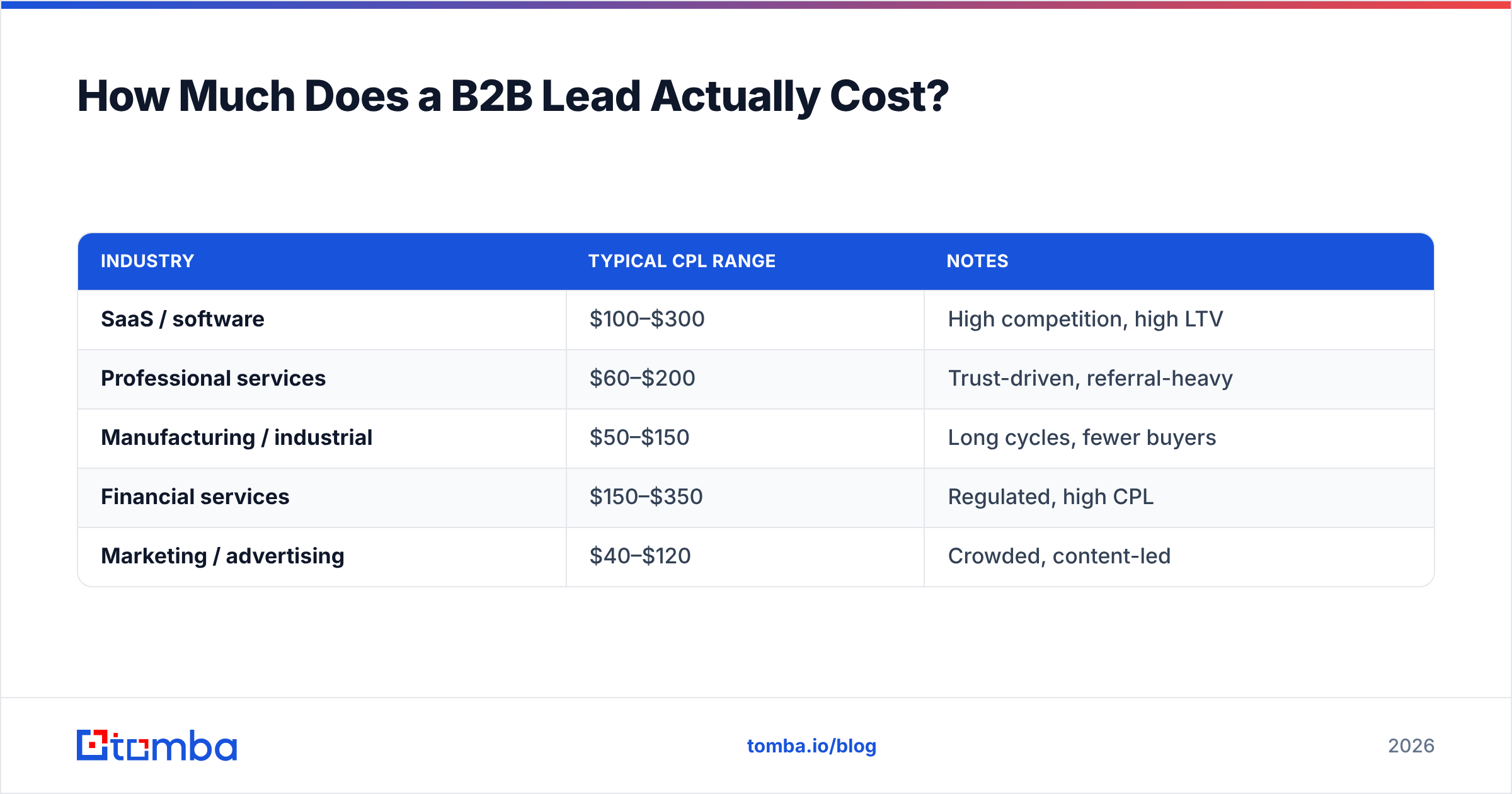
Conclusion first: cost-per-lead varies wildly by industry, but the headline B2B average sits around $50–$200, and SaaS and enterprise software trend toward the high end.
Cost-per-lead (CPL) is the number finance asks about, but on its own it's misleading. A $30 lead that never converts is more expensive than a $150 lead that closes. Always read CPL alongside lead-to-customer rate and average contract value.
| Industry | Typical CPL range | Notes |
|---|---|---|
| SaaS / software | $100–$300 | High competition, high LTV |
| Professional services | $60–$200 | Trust-driven, referral-heavy |
| Manufacturing / industrial | $50–$150 | Long cycles, fewer buyers |
| Financial services | $150–$350 | Regulated, high CPL |
| Marketing / advertising | $40–$120 | Crowded, content-led |
The lever most teams overlook is efficiency, not just acquisition. If you can lower the human cost of working each lead — less manual research, faster enrichment, fewer dead contacts — your effective CPL drops without spending another dollar on ads. Compare the math against your current stack using the published Tomba pricing: a Starter plan at $49/mo that keeps reps off manual lookups often pays for itself in recovered selling hours alone.
What Are the Biggest B2B Lead Generation Trends for 2026?#
A few shifts are reshaping the benchmarks above:
- Intent and signal-based outreach is replacing spray-and-pray. Teams reaching out based on real buying signals report materially higher reply rates than those working static lists.
- AI-assisted personalization is now table stakes — but only when it's grounded in accurate data. Personalized at scale on top of bad records just means you're wrong, faster.
- Quality over volume in metrics. More boards are tracking SQL-to-opportunity and pipeline velocity instead of raw lead counts. The 13% MQL-to-SQL benchmark is getting more executive attention than the top-of-funnel numbers.
- Privacy-first data practices. Compliance pressure (GDPR, CCPA, and successors) makes verified, sourced, consent-aware data a competitive advantage, not just a legal requirement. Industry analysts at Gartner and review platforms like G2 increasingly weight data governance in their evaluations.
For deeper definitional grounding on the terms behind these trends, the HubSpot research library and Tomba's own B2B glossary are both solid, free references.
How Should You Use These Statistics?#
Don't treat these numbers as targets to copy — treat them as a diagnostic. Walk your own funnel stage by stage and find the one metric that's furthest below benchmark. That's your highest-leverage fix.
For most B2B teams in 2026, that single weakest link is data quality, because it silently degrades every other number: response time, email ROI, follow-up effectiveness, and cost-per-lead all depend on the contact actually being reachable. Fix the data, and the rest of the funnel benchmarks move on their own.
Build Your Pipeline on Data That Matches the Benchmarks#
Every statistic on this page bends in your favor when the underlying contact data is accurate. That's the whole job of the Tomba Email Finder: turn a name, company, or domain into a verified, ready-to-contact email so your reps spend their time selling instead of guessing. Start free with 25 searches a month, scale to the $49/mo Starter plan when you're ready, and pair it with the built-in email verifier so your list quality — and your numbers — stay on the right side of these benchmarks. Pour cleaner water into the funnel, and fewer buckets leak.
// get started
Find, verify and enrich your first contacts today
Start on the free plan with 25 searches a month, then scale when your team is ready.
Free plan · No credit card required · GDPR & CCPA
Get the Tomba newsletter
Product and data updates
// about the author