B2B Lead Re-Engagement: How to Revive Dead Leads in 2026
Most dead leads aren't dead — they're stale. Here's a data-first B2B lead re-engagement playbook to revive dormant pipeline without buying a single new list.
B2B Lead Re-Engagement: How to Revive Dead Leads in 2026
Most "dead" leads in your CRM are not dead. They are stale. They changed jobs, switched inboxes, missed your timing, or simply got buried under 40 other vendors emailing them the same quarter. Writing them off means throwing away pipeline you already paid to acquire.
This is the playbook for getting that pipeline back.
TL;DR#
- Dormant ≠ dead. A large share of unresponsive B2B leads went quiet because of bad timing, role changes, or decayed contact data — not lack of interest.
- Re-engage before you re-buy. Reviving an existing lead is far cheaper than sourcing a net-new one, because acquisition and qualification costs are already sunk.
- Data refresh comes first. Before any "we miss you" email, verify the address and update the contact, or you will burn sender reputation on bounces.
- Segment by reason, not by age. Job-changers, ghosts, and closed-lost each need a different message and a different channel.
- Measure replies and meetings, not opens. Re-engagement is a pipeline play, so score it on revenue signals.
What is B2B lead re-engagement?#
B2B lead re-engagement is the structured process of winning back contacts who once showed interest but went quiet — old MQLs, trial users who never converted, closed-lost deals, and webinar registrants who ghosted. Think of it like a gym win-back campaign: the member already signed up once, so you are not selling the concept from scratch, you are removing whatever friction made them stop showing up.
The economics are the whole argument. When you re-engage, the cost of finding and qualifying the lead is already sunk. You are spending a few cents on data refresh and a sequence instead of full acquisition cost on a stranger. That is why re-engagement consistently beats cold sourcing on cost-per-meeting — when it is done with clean data.
The catch: most re-engagement programs fail before the first email sends, because the underlying contact data has quietly rotted.

Why do B2B leads go cold in the first place?#
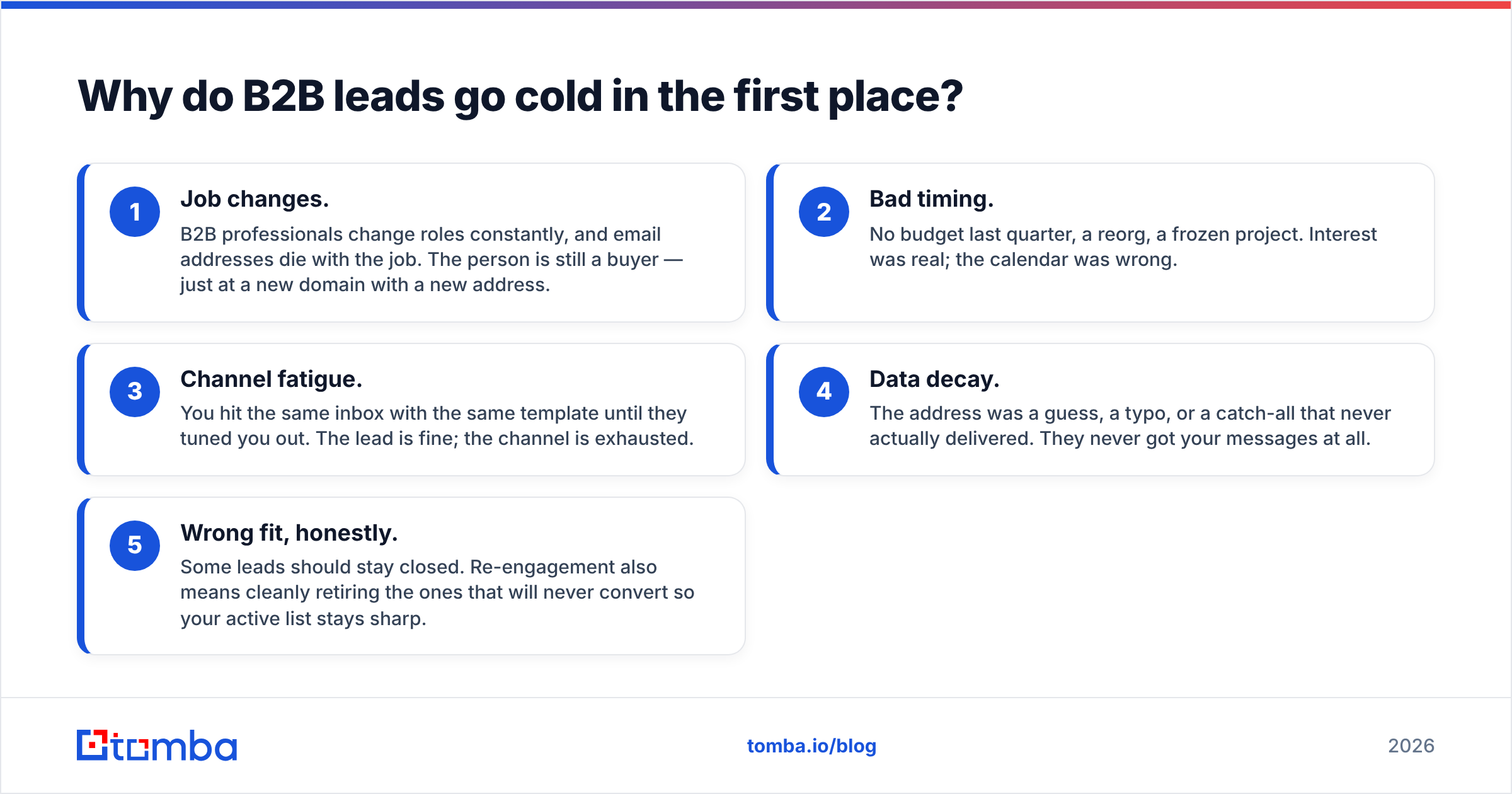
Leads rarely go silent for one reason. If you treat every dormant lead the same way, you will send a "just checking in" email to someone who left the company eight months ago. Here are the real causes, roughly in order of how often they show up:
- Job changes. B2B professionals change roles constantly, and email addresses die with the job. The person is still a buyer — just at a new domain with a new address.
- Bad timing. No budget last quarter, a reorg, a frozen project. Interest was real; the calendar was wrong.
- Channel fatigue. You hit the same inbox with the same template until they tuned you out. The lead is fine; the channel is exhausted.
- Data decay. The address was a guess, a typo, or a catch-all that never actually delivered. They never got your messages at all.
- Wrong fit, honestly. Some leads should stay closed. Re-engagement also means cleanly retiring the ones that will never convert so your active list stays sharp.
The first four are recoverable. The fifth is why you suppress, not delete — keep the record, stop the spend.
How do you build a B2B lead re-engagement workflow?#
A working program runs in five phases. Do them in order; skipping the data phase is the most common failure mode.
1. Pull and segment the dormant list#
Define "dormant" with a real threshold — for example, no inbound reply or site visit in 90+ days. Then segment by the reason they went cold, not just how long ago. A job-changer gets a different play than a no-budget ghost. Pull your closed-lost and stale-MQL segments out of your CRM and tag each by likely cause.
2. Refresh the data before you send anything#
This is the step everyone skips. Run the list through an email verifier to drop hard bounces, then re-find current addresses for anyone who changed jobs using an email finder. Layer in data enrichment to update title, company, and phone. If you skip this, your bounce rate spikes, your sender reputation tanks, and you damage deliverability for your active campaigns too.
3. Pick the channel by segment#
Email-fatigued leads respond better on LinkedIn or phone. Job-changers need a fresh first-touch, not a "following up" thread that references a company they left. Match the channel to the reason for silence.
4. Write a reason-to-return, not a guilt trip#
"We miss you" is about you. "Here is the thing that changed since we last talked" is about them — a new feature, a pricing change, a case study in their exact industry. Give a concrete reason the timing is different now.
5. Score on pipeline, then suppress the non-responders#
Track replies, meetings booked, and revived opportunities — not opens. After the sequence ends, suppress everyone who stayed silent so you stop paying to email a dead address.

Re-engage vs. buy new leads: which is cheaper?#
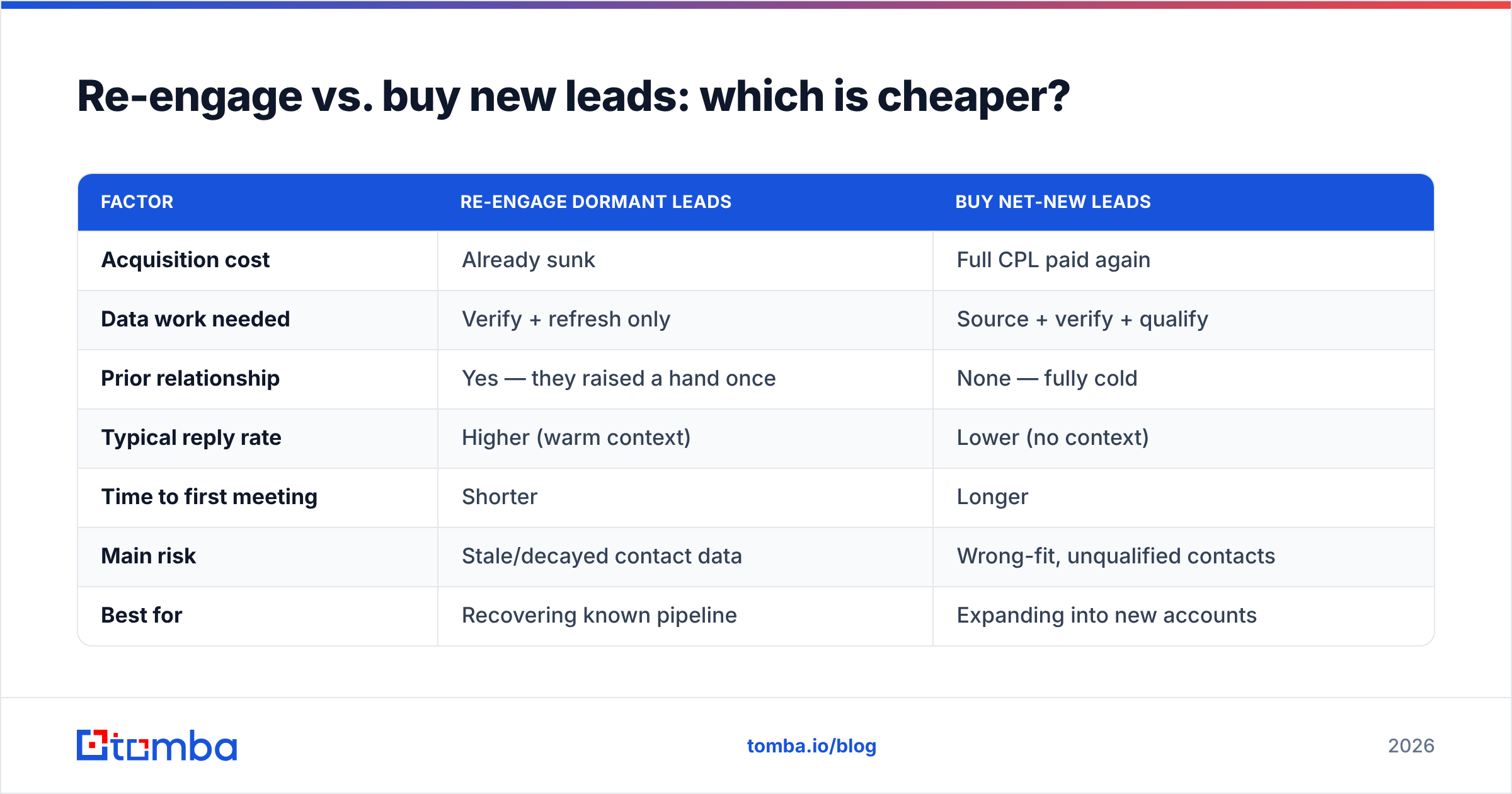
The honest answer is "re-engage first, then buy" — but the gap is bigger than most teams assume. Here is the side-by-side.
| Factor | Re-engage dormant leads | Buy net-new leads |
|---|---|---|
| Acquisition cost | Already sunk | Full CPL paid again |
| Data work needed | Verify + refresh only | Source + verify + qualify |
| Prior relationship | Yes — they raised a hand once | None — fully cold |
| Typical reply rate | Higher (warm context) | Lower (no context) |
| Time to first meeting | Shorter | Longer |
| Main risk | Stale/decayed contact data | Wrong-fit, unqualified contacts |
| Best for | Recovering known pipeline | Expanding into new accounts |
Re-engagement is not a replacement for new-business sourcing — it is the cheaper thing you should do first, before spending acquisition budget. The two work together: a healthy GTM motion recovers known pipeline and expands into new accounts in parallel.
What tools do you need for B2B lead re-engagement?#
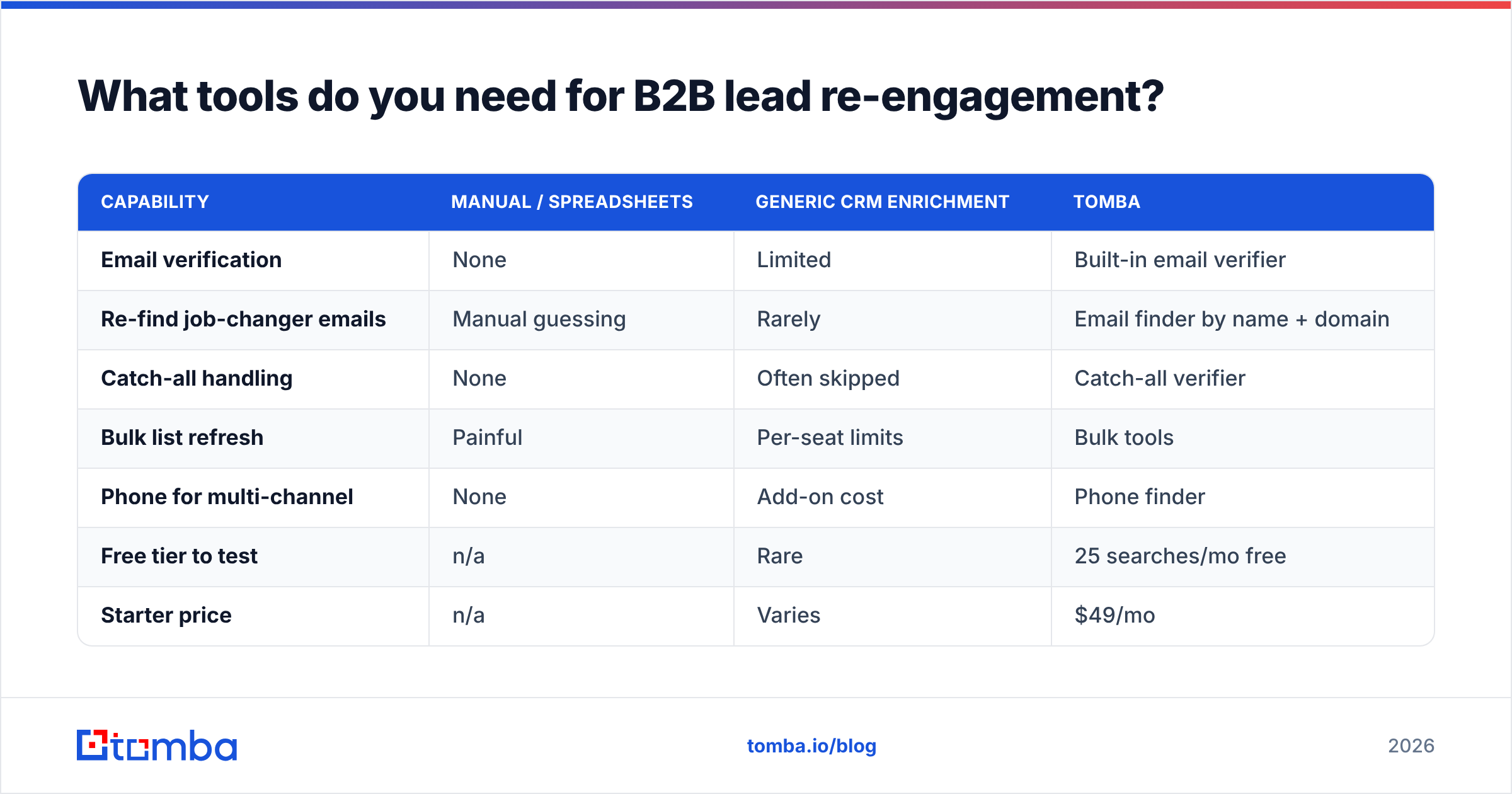
You need three capabilities: clean data, the ability to find new addresses for job-changers, and a way to enrich records at scale. You can stitch this together from point tools, or use a single data layer. Here is how the common options compare for a re-engagement use case specifically.
| Capability | Manual / spreadsheets | Generic CRM enrichment | Tomba |
|---|---|---|---|
| Email verification | None | Limited | Built-in email verifier |
| Re-find job-changer emails | Manual guessing | Rarely | Email finder by name + domain |
| Catch-all handling | None | Often skipped | Catch-all verifier |
| Bulk list refresh | Painful | Per-seat limits | Bulk tools |
| Phone for multi-channel | None | Add-on cost | Phone finder |
| Free tier to test | n/a | Rare | 25 searches/mo free |
| Starter price | n/a | Varies | $49/mo |
The point is not that you must use one vendor for everything. It is that re-engagement lives or dies on data hygiene, and the verify-find-enrich loop is the part teams most often try to do by hand — and the part that wastes the most time when they do.
For pricing specifics across tiers, the full Tomba pricing page lays out Free (25 searches/month), Starter at $49/mo, Growth at $99/mo, and Pro at $249/mo. Test the verify-and-refind loop on the free tier before you commit a budget.
How do you write a re-engagement email that gets replies?#
Stop apologizing for emailing them. The structure that works is short, specific, and gives an easy exit:
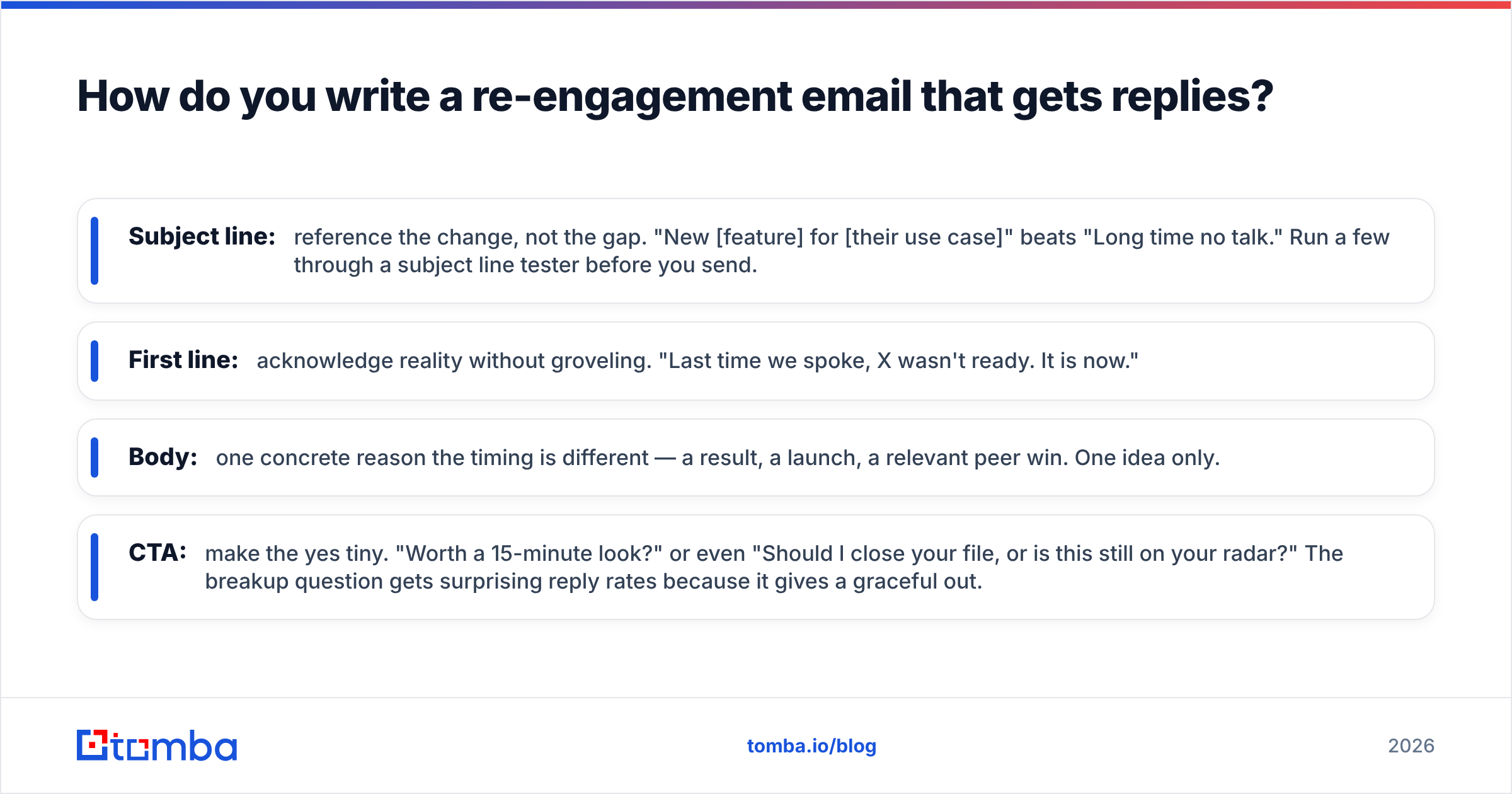
- Subject line: reference the change, not the gap. "New [feature] for [their use case]" beats "Long time no talk." Run a few through a subject line tester before you send.
- First line: acknowledge reality without groveling. "Last time we spoke, X wasn't ready. It is now."
- Body: one concrete reason the timing is different — a result, a launch, a relevant peer win. One idea only.
- CTA: make the yes tiny. "Worth a 15-minute look?" or even "Should I close your file, or is this still on your radar?" The breakup question gets surprising reply rates because it gives a graceful out.
Keep it under 90 words. A dormant lead skims; a wall of text gets archived. For more on improving reply rates across sequences, study what moves response rate and lean on proven cold email templates as a starting frame rather than writing from scratch.
One deliverability note: because you are emailing addresses that have been idle for months, warm up the sending domain and ramp volume gradually. Hitting a large stale list all at once is the fastest way to land in spam. The fundamentals of email deliverability apply doubly to re-engagement sends.
How do you measure re-engagement success?#
Vanity metrics will lie to you here. Opens are inflated by privacy proxies, and a re-opened thread feels like progress but books no revenue. Score the program on signals that map to pipeline:
- Reply rate segmented by cause (job-changer vs. ghost vs. closed-lost). This tells you which segment to invest in next.
- Meetings booked from revived leads — the real leading indicator.
- Revived opportunity value added back to the forecast.
- Bounce and complaint rate — your data-hygiene scorecard. If this is high, your refresh step failed.
- Suppression rate — the share you cleanly retired. A healthy program shrinks your dead-weight list over time.
Authorities like HubSpot and review aggregators such as G2 publish benchmark ranges you can compare against, but your own segmented baseline matters more than any industry average. Run a re-engagement cohort, measure it, and let the reply-by-segment data tell you where the recoverable pipeline actually is.
What mistakes kill re-engagement campaigns?#
A few predictable ways teams torpedo their own win-back:
- Sending before verifying. Bounces on a stale list wreck deliverability for everything else. Always verify first.
- One generic blast. "We miss you" to 5,000 mixed records ignores the reason each went cold. Segment or skip it.
- Ignoring job-changers. The highest-intent re-engagement target is often a known champion at a new company. Re-find them; don't re-email a dead address.
- No suppression plan. If silent leads stay in rotation forever, your list rots and your costs climb. Build the exit ramp before you start.
- Chasing opens. Optimize for replies and meetings, full stop.
Get those five right and re-engagement stops being a one-off "clean the CRM" chore and becomes a repeatable, low-cost pipeline source you run every quarter.
Start with the data layer#
Re-engagement is the cheapest pipeline you have, but only if the contact data underneath it is real. Before your next "we should win these back" project, run the dormant list through a verify-find-enrich pass: drop the bounces, re-find the job-changers, and update the records. The Tomba Email Finder handles the find-and-verify core, and the free tier (25 searches/month) is enough to prove the motion on a sample segment before you scale it across your whole dormant list. Clean the data, then re-engage — in that order — and the pipeline you already paid for comes back to life.
// get started
Find, verify and enrich your first contacts today
Start on the free plan with 25 searches a month, then scale when your team is ready.
Free plan · No credit card required · GDPR & CCPA
// about the author