B2B Lead Response Time in 2026: Why the 5-Minute Rule Wins
Slow follow-up quietly kills more pipeline than bad leads do. Here's what B2B lead response time should be in 2026, why 5 minutes matters, and how to fix it.
B2B Lead Response Time in 2026: Why the 5-Minute Rule Wins
TL;DR
- Speed beats polish. Contacting an inbound lead within 5 minutes can make you up to 100x more likely to connect and 21x more likely to qualify it than waiting 30 minutes.
- The B2B median is still embarrassing. Most teams take hours — sometimes more than a day — to respond, leaving easy pipeline on the table.
- Response time is a process problem, not a hustle problem. Routing, alerting, enrichment, and clean contact data fix it; "try harder" does not.
- Bad data is a hidden delay. If a rep has to hunt for the right email or phone number, your real response time is far worse than your CRM timestamp says.
- Measure, route, automate. Track first-touch latency, route by territory in seconds, and pre-enrich every lead so reps reach out instead of researching.
What is B2B lead response time?#
B2B lead response time is the gap between when a prospect raises their hand — a demo request, a form fill, a pricing page visit, a content download — and when a human (or a well-built automation) makes the first meaningful contact back. It's often called "speed-to-lead," and it's one of the few sales metrics that is both easy to measure and brutally predictive of revenue.
Think of an inbound lead like a customer walking into a physical store. If a salesperson greets them in the first minute, they feel seen and stick around. If they wander the aisles for twenty minutes with no help, they leave — and they were just as ready to buy. Online, the "walking out" happens silently and fast, because your prospect filled out three other forms on three competitor sites in the same session.
The classic Harvard Business Review study on lead response management found that firms responding within an hour were nearly 7x more likely to have a meaningful conversation with a decision-maker than those who waited even one extra hour — and 60x more likely than firms that waited 24 hours or more. More than a decade later, buyer patience has only shrunk.

Why does the 5-minute rule matter so much?#
The 5-minute rule comes from lead-response research (popularized by Lead Connect / InsideSales data) showing that the odds of connecting and qualifying collapse almost immediately after a lead comes in. The numbers that get quoted most often:
- Contact odds drop ~100x between a 5-minute and a 30-minute response.
- Qualification odds drop ~21x across that same window.
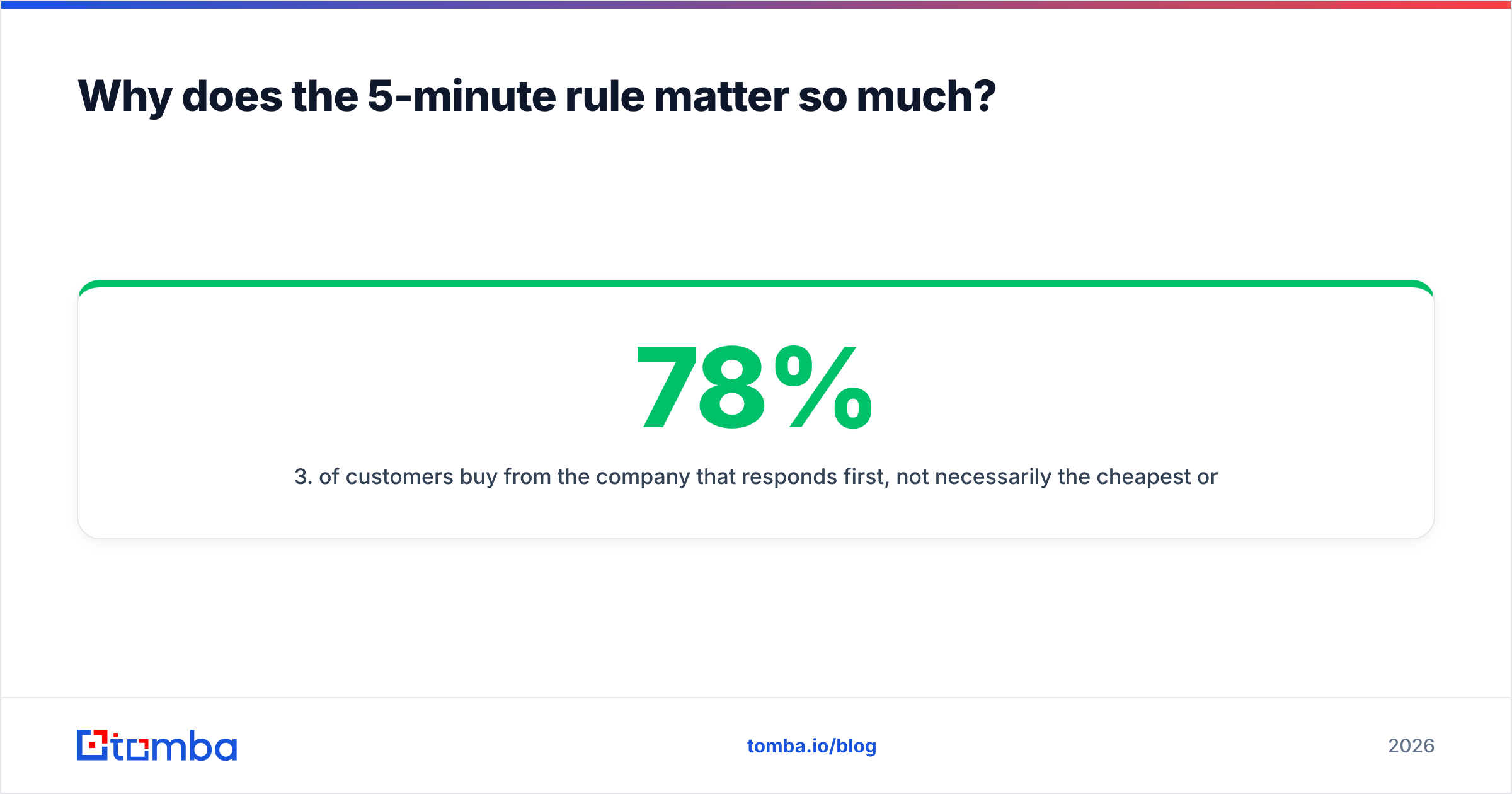
- 78% of customers buy from the company that responds first, not necessarily the cheapest or most featured.
- The half-life of an inbound lead is minutes, not days — intent decays the moment the prospect closes the tab.
- Most competitors are slow, so being fast is a cheap, durable advantage you control entirely.
- Speed compounds with relevance — a fast, personalized reply beats a fast generic one and a slow perfect one.
The mechanism is simple: a person who just submitted a form is, at that exact second, thinking about your category. Their browser tabs are open, their problem is top of mind, and their guard is down. Wait an hour and they're in a meeting. Wait a day and they've forgotten they filled out your form at all — or worse, a competitor already booked the call.
What's a good B2B lead response time in 2026?#
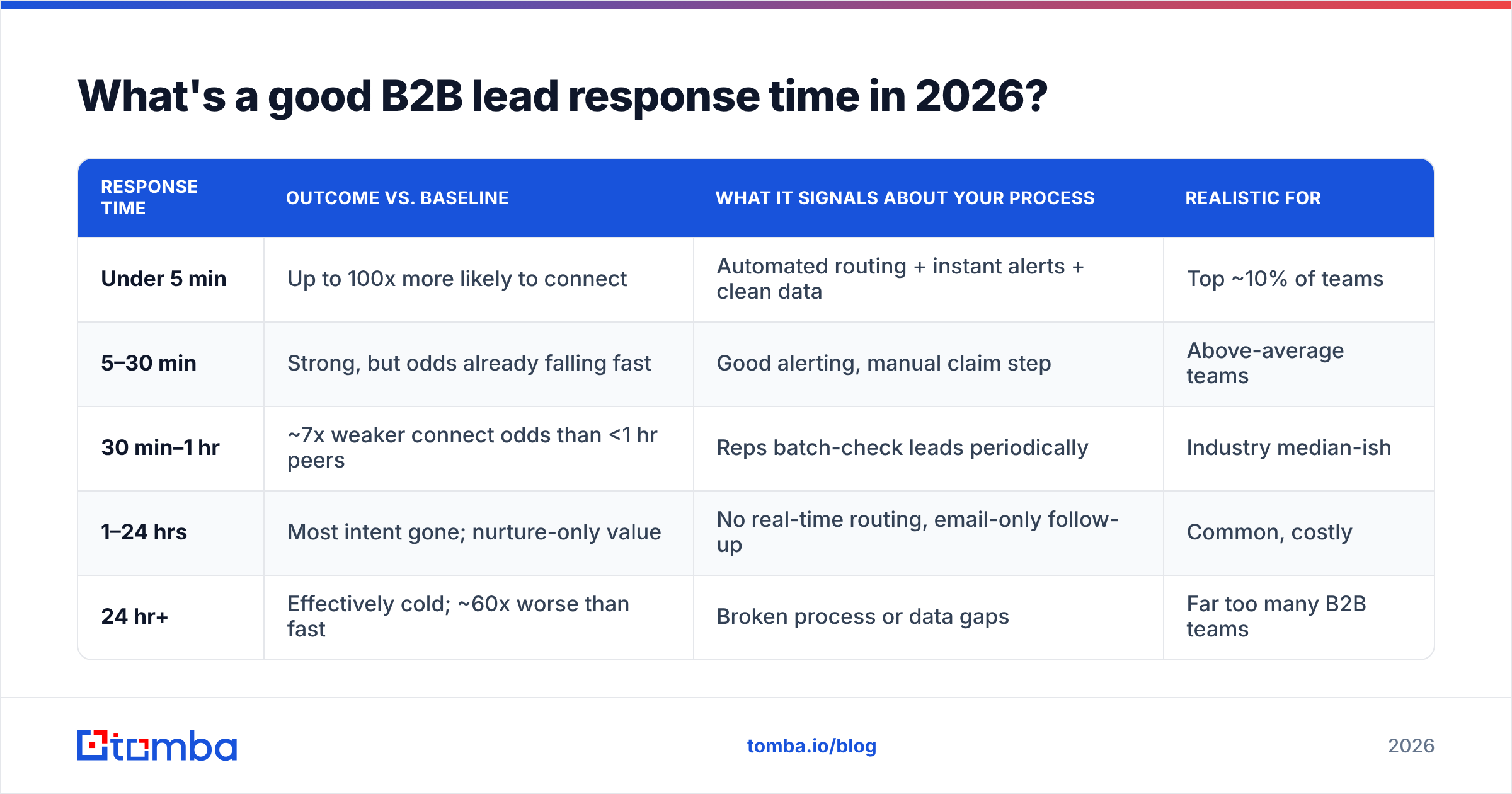
Short answer: under 5 minutes for hot inbound, under 1 hour for everything else, and you should be measuring it per source. Here's how the tiers shake out based on widely cited lead-response benchmarks and what high-performing teams actually hit.
| Response time | Outcome vs. baseline | What it signals about your process | Realistic for |
|---|---|---|---|
| Under 5 min | Up to 100x more likely to connect | Automated routing + instant alerts + clean data | Top ~10% of teams |
| 5–30 min | Strong, but odds already falling fast | Good alerting, manual claim step | Above-average teams |
| 30 min–1 hr | ~7x weaker connect odds than <1 hr peers | Reps batch-check leads periodically | Industry median-ish |
| 1–24 hrs | Most intent gone; nurture-only value | No real-time routing, email-only follow-up | Common, costly |
| 24 hr+ | Effectively cold; ~60x worse than fast | Broken process or data gaps | Far too many B2B teams |
The uncomfortable truth: studies repeatedly find the average first response in B2B is measured in hours, and a large share of inbound leads never get a second attempt at all. That gap between "what works" (minutes) and "what's normal" (hours) is exactly where you win deals competitors think they lost on price.
A few rules of thumb for 2026:
- Segment your SLA. A pricing-page demo request deserves a 5-minute SLA; a top-of-funnel ebook download can live with same-day.
- Count from the prospect's action, not your CRM's sync time. Integration lag is response time too.
- First touch ≠ first attempt. A voicemail and an unanswered email aren't a "response." Measure connects, then measure attempts as a leading indicator.
What actually slows teams down?#
It's rarely laziness. The four usual culprits are routing lag, alerting gaps, manual research, and dirty data — and the last one is the sneakiest.
When a lead comes in with just a name and a company (or a generic info@ address), the rep can't actually act. They have to find the real decision-maker's email, confirm it's valid, maybe dig up a direct phone number, and only then reach out. That "research tax" can add 10–40 minutes per lead before a single word is written — and it doesn't show up cleanly in your dashboards, because the clock in most CRMs starts when the rep opens the record, not when they finally have something to send.
This is why fixing response time is partly a lead management and scoring problem and partly a data problem. If every inbound lead arrives already enriched with a verified email, role, and phone number, the rep skips straight to the conversation.

How do you cut B2B lead response time?#
Build a pipeline where the lead is routed, enriched, and surfaced to the right rep automatically, so the human only does the human part. Here's the workflow that consistently gets teams under the 5-minute mark.
- Capture instantly. Push form fills to your CRM via webhook, not a nightly sync. Connect tools directly — for example, a HubSpot integration or Salesforce integration so there's no batch delay.
- Enrich on arrival. The moment a lead lands, auto-append a verified work email, job title, company size, and phone number. Use data enrichment so reps never start from a blank record.
- Verify before you send. A fast email to a dead address is just a fast bounce. Run every address through an email verifier so your first touch actually lands and your sender reputation stays intact.
- Route in seconds. Assign by territory, vertical, or round-robin automatically, and re-route if the owner doesn't claim it within a set window.
- Alert loudly. Slack/SMS ping the owner with one-click context. No inbox archaeology.
- Template the first touch, personalize the second. A 90% pre-written, 10% tailored opener sent in 4 minutes beats a bespoke essay sent in 4 hours.
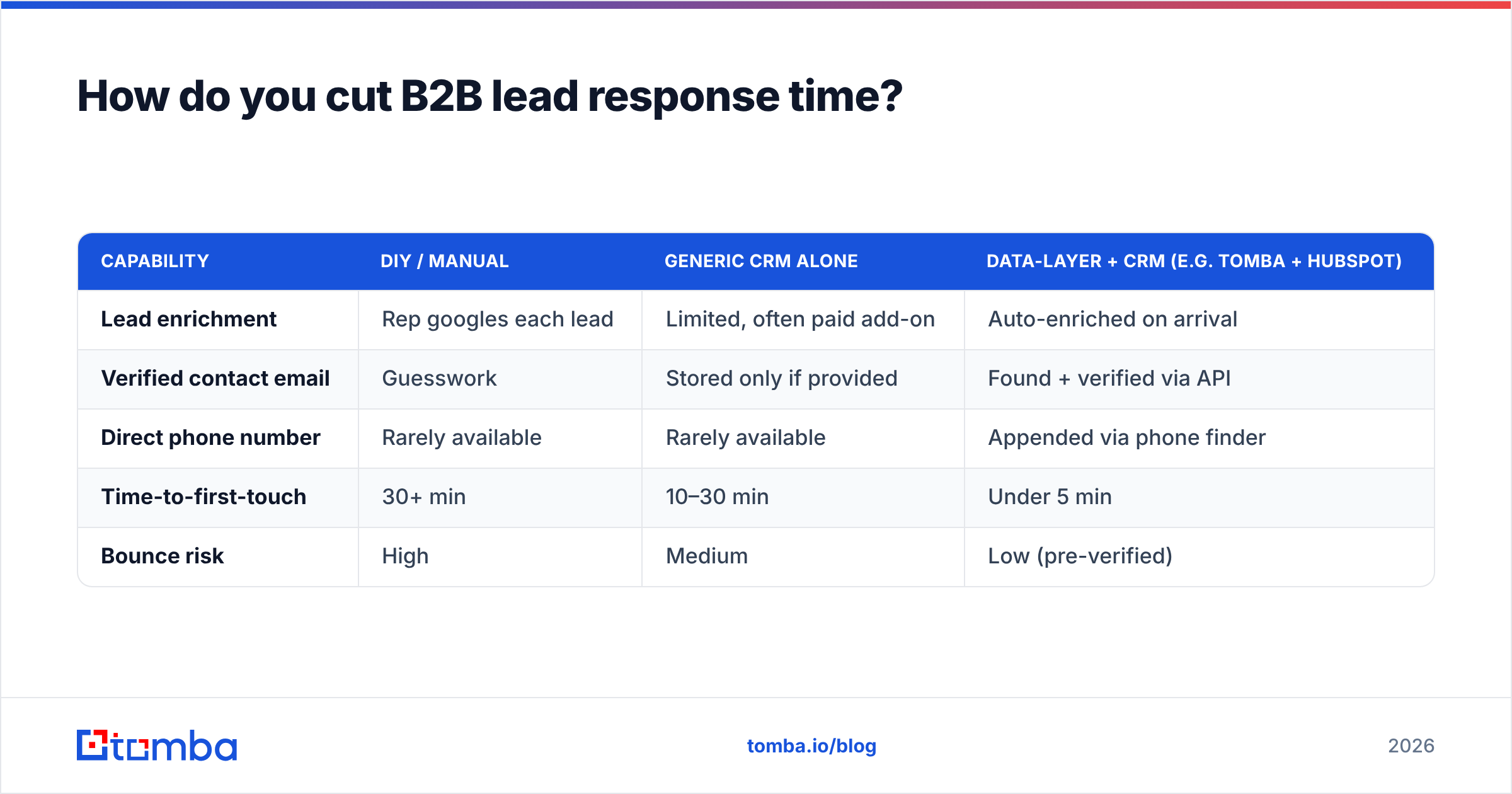
Speed-to-lead tooling at a glance#
| Capability | DIY / manual | Generic CRM alone | Data-layer + CRM (e.g. Tomba + HubSpot) |
|---|---|---|---|
| Lead enrichment | Rep googles each lead | Limited, often paid add-on | Auto-enriched on arrival |
| Verified contact email | Guesswork | Stored only if provided | Found + verified via API |
| Direct phone number | Rarely available | Rarely available | Appended via phone finder |
| Time-to-first-touch | 30+ min | 10–30 min | Under 5 min |
| Bounce risk | High | Medium | Low (pre-verified) |
The pattern is consistent: the teams hitting elite response times aren't working harder, they've removed the steps that used to happen between the lead arriving and the rep reaching out.
How do you measure and hold the line?#
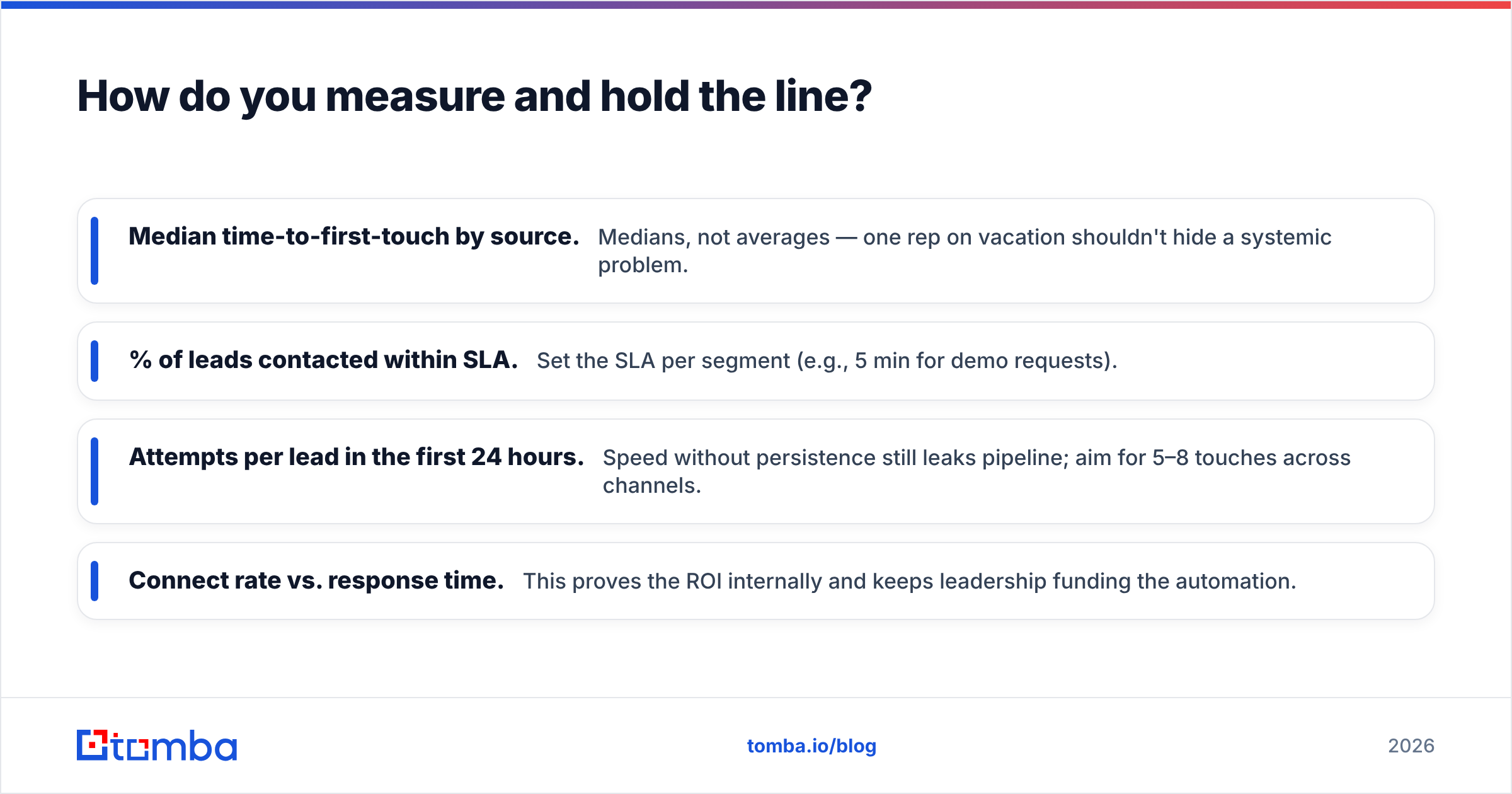
You can't improve what you don't timestamp. Track these four and review them weekly:
- Median time-to-first-touch by source. Medians, not averages — one rep on vacation shouldn't hide a systemic problem.
- % of leads contacted within SLA. Set the SLA per segment (e.g., 5 min for demo requests).
- Attempts per lead in the first 24 hours. Speed without persistence still leaks pipeline; aim for 5–8 touches across channels.
- Connect rate vs. response time. This proves the ROI internally and keeps leadership funding the automation.
Tie these to your broader pipeline metrics like response rate and win rate so the speed story connects to revenue, not just activity. For benchmarking your stack against alternatives, third-party review sites like G2 are a sane neutral reference before you commit budget.
One more guardrail: don't let "fast" degrade into "spammy." Verify addresses, respect opt-outs, and keep your first message genuinely useful. Speed amplifies whatever you send — including mistakes.
Frequently asked questions#
What is the ideal B2B lead response time? Under 5 minutes for hot inbound (demo and pricing requests) and under 1 hour for everything else. Anything past a day is functionally cold.
Does response time really matter more than personalization? Speed wins the connect; personalization wins the conversation. You need both, but if you have to choose for the first touch, fast-and-relevant beats slow-and-perfect.
Why is my real response time worse than my CRM says? Because the clock usually starts when a rep opens the record, not when the lead acted — and it ignores the minutes spent hunting for a valid email or phone number. Pre-enriching leads closes that hidden gap.
How do I respond in 5 minutes without burning out my reps? Automate routing, alerting, and enrichment. Reps should spend their minutes talking to prospects, not researching them.
The bottom line#
B2B lead response time is the cheapest competitive edge available in 2026: it costs you process discipline and clean data, not headcount. Most of your competitors are still answering inbound in hours, which means a sub-5-minute reply quietly steals deals they assume they lost on features or price.
The fastest way to get there is to stop making reps research leads. Let every inbound contact arrive already verified and ready to reach. Start free with the Tomba Email Finder — find and verify the right decision-maker's email by name, domain, or company, wire it into your CRM, and turn "let me look that up" into "already sent." Check Tomba pricing when you're ready to scale: a free tier with 25 searches, then Starter at $49/mo.
// get started
Find, verify and enrich your first contacts today
Start on the free plan with 25 searches a month, then scale when your team is ready.
Free plan · No credit card required · GDPR & CCPA
// about the author