B2B Leads in 2026: How to Find, Verify, and Convert Them
A practical 2026 playbook for sourcing B2B leads that actually convert — where to find them, how to verify contact data, and how to score them before outreach.
TL;DR
- B2B leads are companies and decision-makers who fit your ideal customer profile and have a plausible reason to buy — not just any email address you can scrape.
- The quality gap between a verified, well-scored lead and a raw scraped contact is the difference between a 20% reply rate and a spam folder.
- Sourcing is only step one. Verification and enrichment are where most teams leak money, sending to bounced inboxes and burning sender reputation.
- A repeatable B2B lead engine has four stages: define the ICP, source contacts, verify and enrich, then score and route to outreach.
- Tools like the Tomba Email Finder and an email verifier handle the unglamorous middle stages so reps spend time selling, not cleaning lists.
What are B2B leads, really?#
A B2B lead is a person at a company who matches your ideal customer profile and shows at least a weak signal that they might buy. That's the whole definition — fit plus signal. Everything else is noise dressed up as a lead.
Think of it like fishing. A pond full of fish is a market. A fish that swims near your bait is a lead. A fish that bites is an opportunity. Most teams confuse the pond for the bite — they buy a list of 50,000 "leads," blast it, and wonder why nobody responds. Those weren't leads. They were addresses.
In practice, B2B leads fall into a few tiers based on how much intent they've shown:
- Cold leads — they fit your ICP but have never heard of you. You found them through research or data enrichment.
- Marketing qualified leads (MQLs) — they engaged with content, a webinar, or a download. See what a marketing qualified lead actually requires.
- Sales qualified leads (SQLs) — sales has confirmed budget, authority, need, and timeline.
- Opportunities — an active deal with a forecastable close date.
The mistake is treating all four the same. A cold lead needs a reason to care; an SQL needs a reason to act now. Your outreach should change at every tier.
Where do you actually find B2B leads in 2026?#
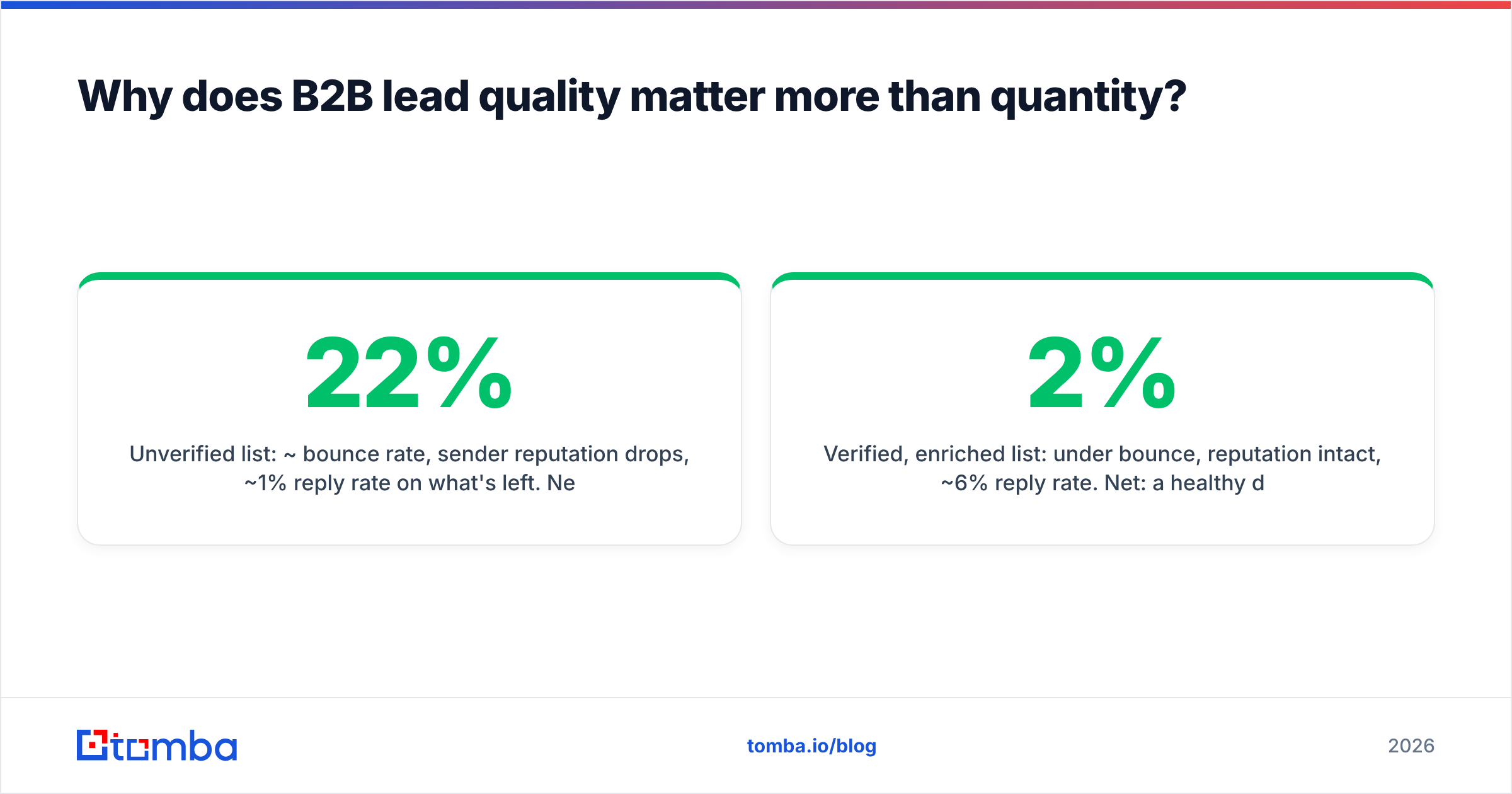
Short answer: layer multiple sources, because no single channel gives you both volume and quality. Here's how the main options compare.
| Source | Volume | Data freshness | Cost | Best for |
|---|---|---|---|---|
| Email finder tools | High | Real-time verified | Low–medium | Targeted outbound by domain or name |
| Bought contact lists | Very high | Often stale | Low upfront | Almost nothing — high bounce risk |
| LinkedIn / social | Medium | Current | Time-intensive | Relationship-led social selling |
| Inbound content | Low–medium | Self-updating | High to build | Warm, high-intent MQLs |
| Website visitor reveal | Medium | Real-time | Medium | Catching in-market accounts already browsing |
| Events & webinars | Low | Current | High | Mid-funnel relationship building |
The teams that win in 2026 don't pick one row. They run inbound to capture intent, use website visitor reveal to catch anonymous in-market traffic, then fill gaps with targeted outbound using a domain search to map every contact at a target account.
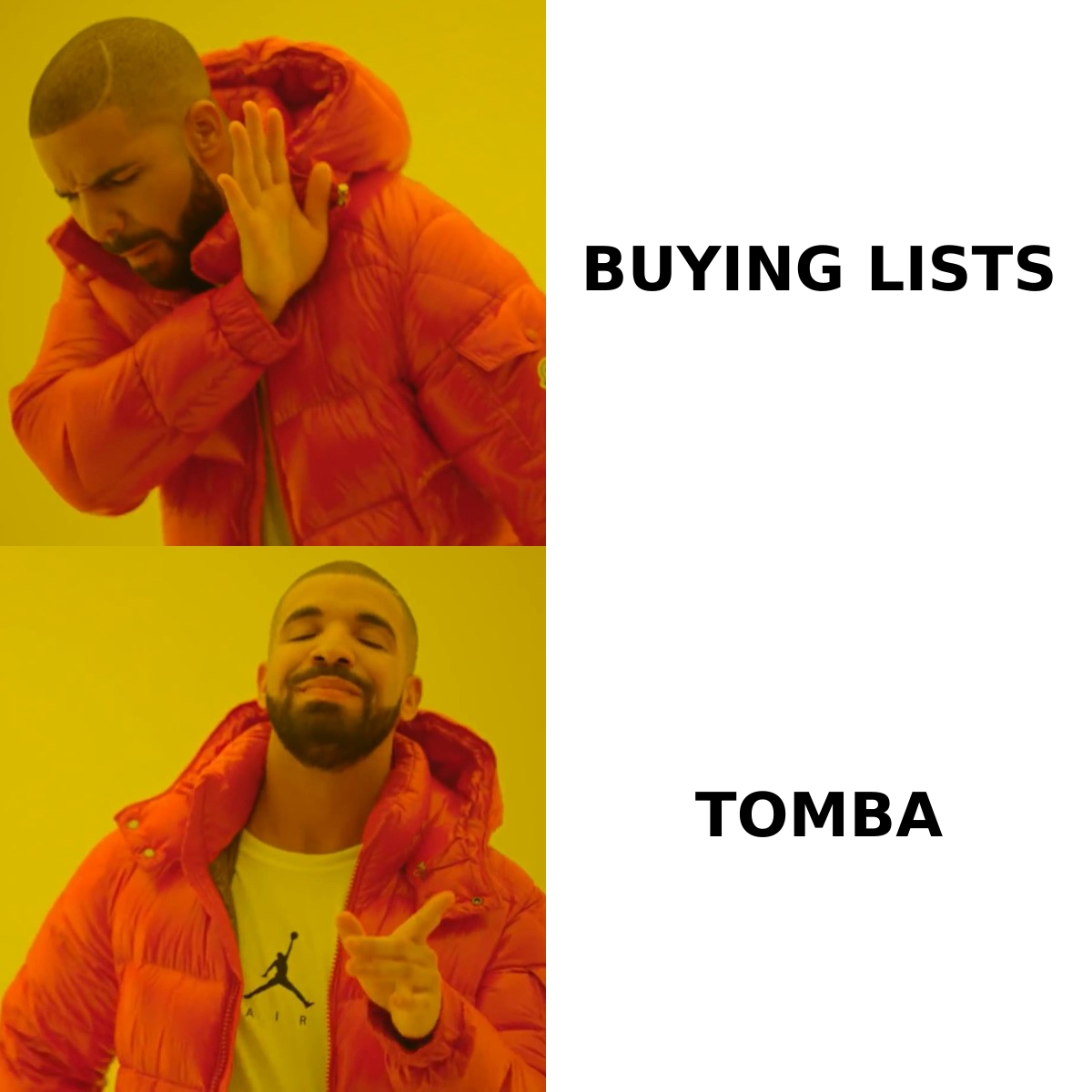
Buying a giant list feels productive because the number is big. But a list you didn't source and verify yourself is a liability — outdated titles, people who left the company, and spam traps that torch your domain reputation in a week.
Why does B2B lead quality matter more than quantity?#
Because your sender reputation is a shared, finite resource, and bad leads spend it fast.
Every email you send to a dead inbox, a spam trap, or an uninterested stranger chips away at your sender reputation. Once mailbox providers decide you're a low-quality sender, even your good emails land in spam. So a pile of unverified leads doesn't just waste a rep's time — it actively damages your ability to reach the leads who would have converted.
Here's the math that changes minds. Say you send to 10,000 contacts:
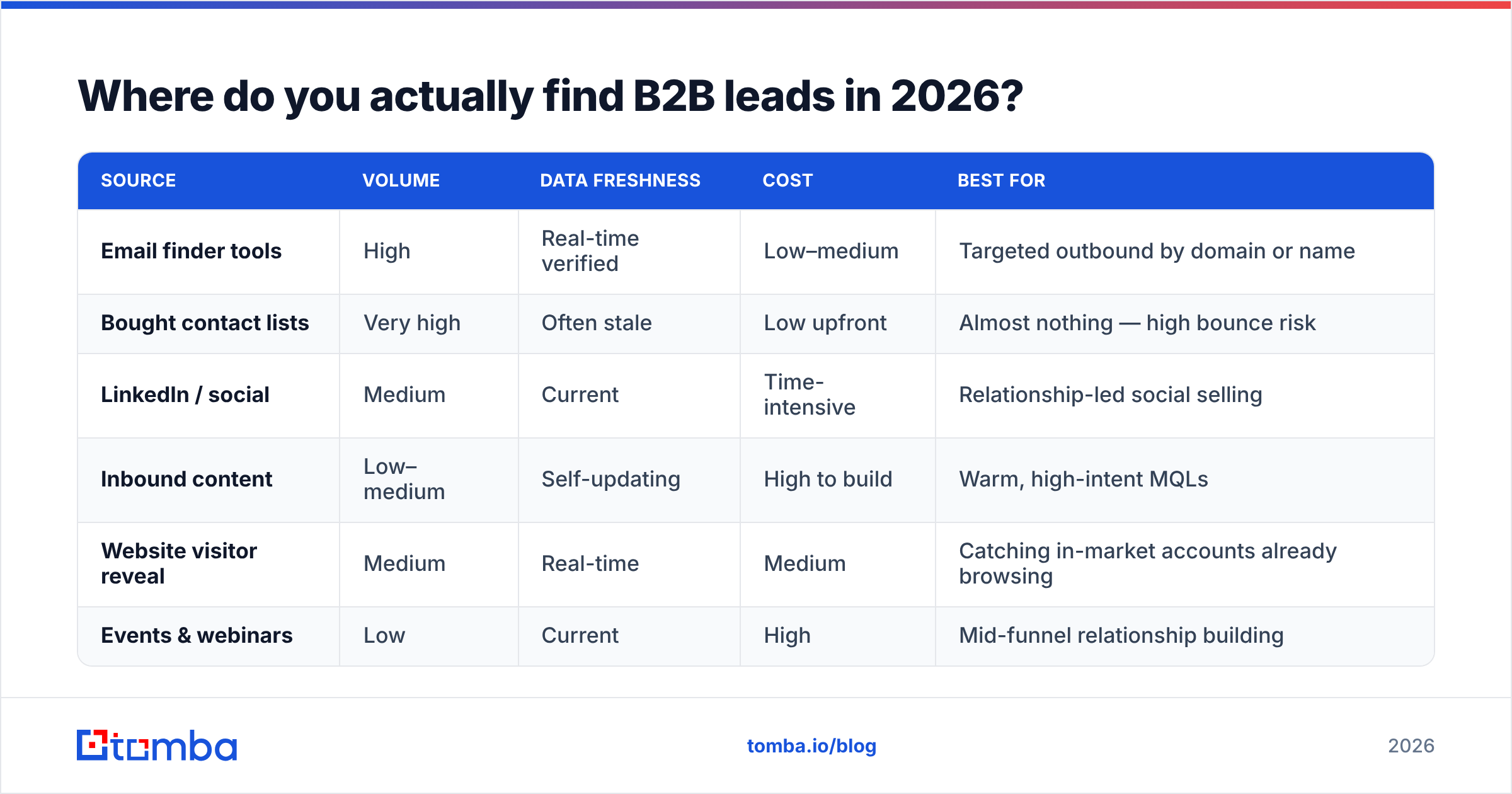
- Unverified list: ~22% bounce rate, sender reputation drops, ~1% reply rate on what's left. Net: a damaged domain and roughly 78 conversations.
- Verified, enriched list: under 2% bounce, reputation intact, ~6% reply rate. Net: a healthy domain and roughly 588 conversations.
Same headcount, same offer, same hours — 7x the pipeline, just from cleaning the inputs. This is why email deliverability is a lead-gen problem, not just an IT problem.
How do you verify and enrich B2B leads?#
Run every lead through verification before it touches your sending tool, then enrich it with the context reps need to personalize. Treat it as an assembly line, not an afterthought.
- Syntax and domain check — kill malformed addresses and dead domains instantly.
- MX and SMTP validation — confirm the mailbox actually exists. A solid email verifier does this without sending a real email.
- Catch-all handling — some domains accept everything, then bounce later. A catch-all verifier flags these so you can route them to a separate, lower-risk sequence.
- Enrichment — append job title, company size, tech stack, and LinkedIn so the message can be specific. Pull this through contact enrichment.
- De-duplication — merge the same person showing up from three sources before they get three emails.

The enrichment step is what separates "Hi {first_name}" spam from outreach that earns a reply. If you know a prospect's company just raised a round or shipped a feature, you have a reason to write that isn't about you. That context is sitting in the data — you just have to append it.
What does a B2B lead scoring model look like?#
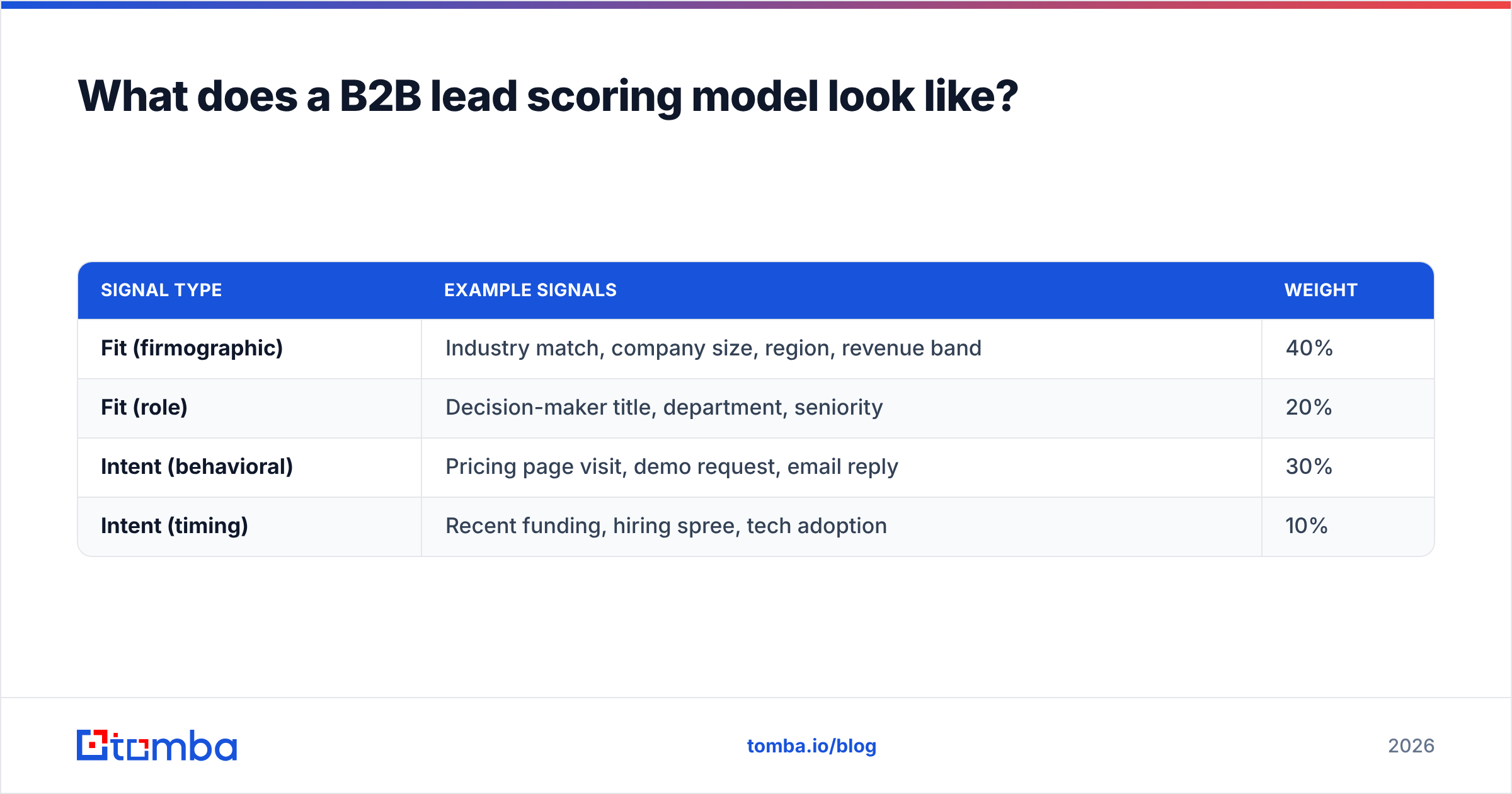
A lead score is one number that answers "should a rep call this person today?" Build it from two halves: fit and intent.
| Signal type | Example signals | Weight |
|---|---|---|
| Fit (firmographic) | Industry match, company size, region, revenue band | 40% |
| Fit (role) | Decision-maker title, department, seniority | 20% |
| Intent (behavioral) | Pricing page visit, demo request, email reply | 30% |
| Intent (timing) | Recent funding, hiring spree, tech adoption | 10% |
The trap is over-engineering this. You do not need a machine-learning model on day one. Start with a simple points system — +20 for a director-or-above title, +30 for a pricing page visit, −15 for a free-email domain — and route anyone over a threshold straight to a rep. Refine the weights once you have real conversion data to learn from. For the mechanics of routing and thresholds, see how lead management connects scoring to your CRM.
Good scoring does two things: it stops reps from wasting hours on poor-fit leads, and it surfaces the warm ones before a competitor gets there first. Speed-to-lead is still one of the highest-leverage metrics in B2B — the Harvard Business Review study on lead response found firms that contacted prospects within an hour were nearly 7x likelier to qualify them.
How do you turn scored B2B leads into pipeline?#
Match the channel and message to the lead's tier, then sequence with patience. A scored lead is a starting line, not a finish line.
For cold, high-fit leads, lead with relevance, not a pitch. Reference something specific to their company, keep it under 90 words, and make the ask small. A single tailored sentence beats three paragraphs of features.
For warm MQLs, move faster and reference their action: "Saw you downloaded our pricing teardown — most teams who grab that are wrestling with X. Is that you?"
For multi-threading into accounts, don't rely on one contact. Use a bulk email finder to map every relevant stakeholder, then sequence the champion, the economic buyer, and the blocker with messages tuned to each. Deals with three or more engaged contacts close at meaningfully higher rates.
A few rules that hold across tiers:
- Follow up more than once. Most replies come after the first email. Three to five touches over two weeks is the floor, not the ceiling.
- Vary the channel. Pair email with a LinkedIn touch and, for high-value accounts, a call using verified B2B phone numbers.
- Keep your list clean as you go. Re-verify before each major send; data decays at roughly 2–3% per month as people change jobs.
What are the most common B2B lead mistakes?#
The expensive errors are almost always upstream — in how leads are sourced and handled, not in the copy.
- Buying the biggest list. Volume without fit and verification is negative ROI once you count the reputation damage.
- Skipping verification to "save time." You don't save time; you trade an hour of cleaning for a week of deliverability recovery.
- No ICP discipline. If everyone is a lead, no one is. A tight, well-defined ICP makes every later step cheaper.
- One-and-done outreach. Quitting after one email throws away most of the pipeline you paid to source.
- Ignoring data decay. Last year's verified list is this year's bounce factory. Re-verify on a schedule.
Avoid those five and you're already ahead of most outbound teams — not because the tactics are clever, but because most teams skip the boring, compounding work of clean inputs.
How do the tools and tiers compare?#
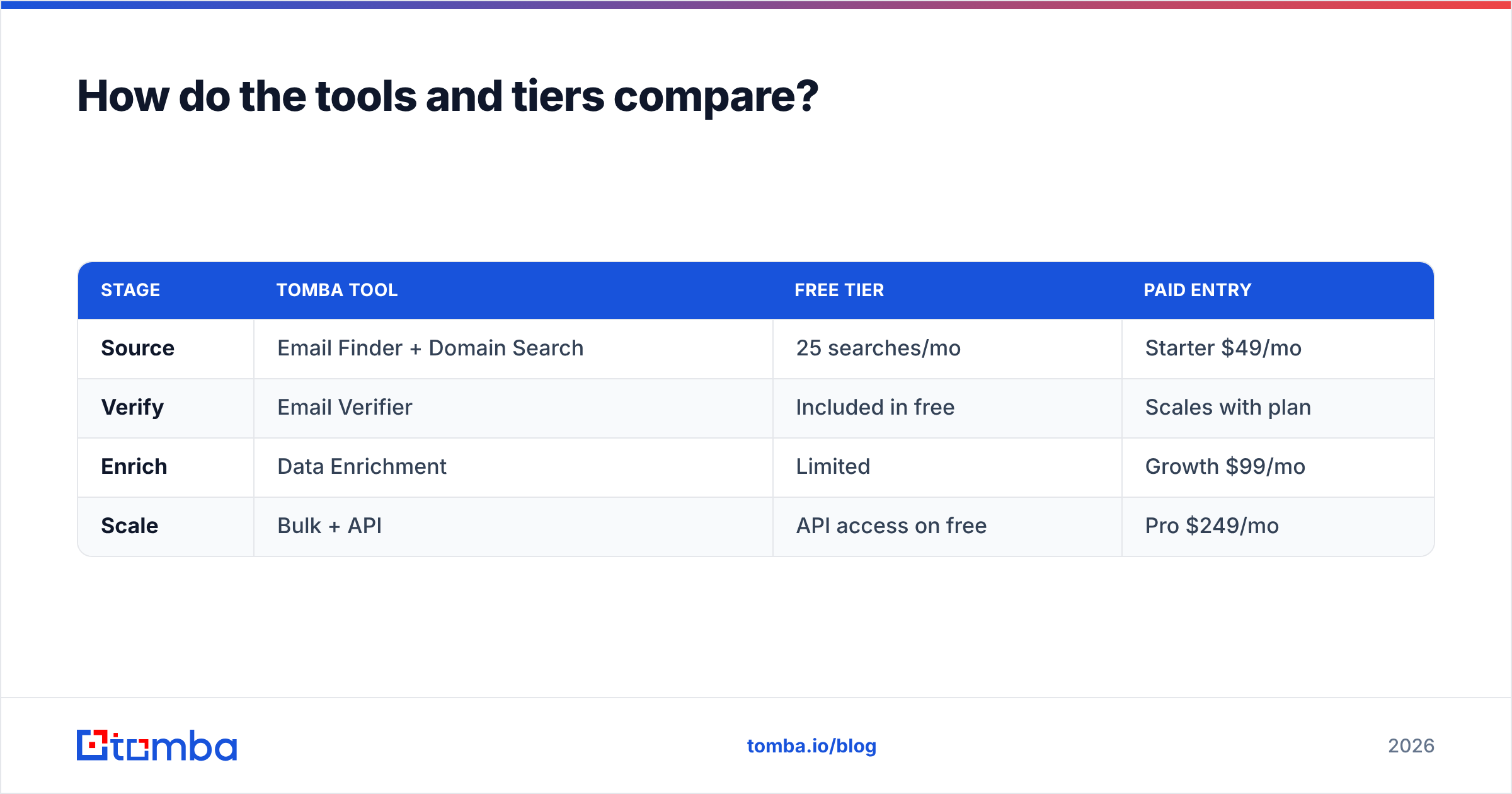
If you're assembling a stack, here's a rough map of where Tomba's pieces fit against the four-stage engine, with honest pricing.
| Stage | Tomba tool | Free tier | Paid entry |
|---|---|---|---|
| Source | Email Finder + Domain Search | 25 searches/mo | Starter $49/mo |
| Verify | Email Verifier | Included in free | Scales with plan |
| Enrich | Data Enrichment | Limited | Growth $99/mo |
| Scale | Bulk + API | API access on free | Pro $249/mo |
The free tier's 25 monthly searches is genuinely useful for testing a workflow or prospecting a handful of named accounts before you commit. When you're ready to scale, full Tomba pricing runs Starter at $49/mo through Pro at $249/mo, with custom Enterprise terms. Compare that against general-purpose platforms on G2 and the cost-per-verified-lead is what matters, not the sticker price.
Build the engine, not the list#
The teams generating predictable B2B leads in 2026 aren't the ones with the biggest lists — they're the ones with the cleanest pipeline from source to send. Define a tight ICP, source from layered channels, verify and enrich relentlessly, score on fit plus intent, then sequence with patience. Every stage compounds the one before it.
Start at the stage where you're leaking the most. If your bounce rate is ugly, fix verification first. If reps are chasing ghosts, fix scoring. If you simply don't have enough qualified contacts, start sourcing with the Tomba Email Finder — find verified, decision-maker emails by domain, name, or company, test it free with 25 searches this month, and turn raw research into leads your reps will actually want to call.
// get started
Find, verify and enrich your first contacts today
Start on the free plan with 25 searches a month, then scale when your team is ready.
Free plan · No credit card required · GDPR & CCPA
// about the author