B2B Lists vs BookYourData: Which Wins for Data in 2026?
Static B2B lists promise instant volume, BookYourData promises pay-as-you-go contacts. We compare accuracy, pricing, and deliverability so you buy data that actually converts.
Buying B2B contact data feels simple until the bounces start. You can purchase a pre-built B2B list, subscribe to a self-serve platform like BookYourData, or pull verified contacts on demand with a live email finder. Each model trades cost, control, and accuracy differently — and picking the wrong one quietly torches your sender reputation.
This guide breaks down b2b lists vs bookyourdata the way a RevOps lead actually evaluates them: by data freshness, true cost per usable contact, deliverability risk, and fit for your motion.
TL;DR#
- Generic B2B lists (CSV brokers, marketplace exports) are cheapest upfront but decay fastest — expect 20–40% of records dead within a year.
- BookYourData is a self-serve, pay-as-you-go contact platform with a verified-email guarantee and a la carte credits — better than raw lists, but you still pay per record and re-buy as data ages.
- Live email finders (like Tomba's email finder) verify at the moment of search, so you avoid paying for contacts that went stale on someone else's server.
- Accuracy and deliverability matter more than raw volume: 1,000 verified contacts beat 10,000 guesses every time.
- For most outbound teams in 2026, a hybrid — a database for discovery plus real-time verification before send — wins on cost per booked meeting.
What are B2B lists and how does BookYourData fit in?#
A B2B list is a static file of business contacts — name, title, company, email, sometimes phone — sold as a one-time download or recurring feed. Brokers compile these from web scraping, public filings, event registrations, and resold CRMs. You buy the file, import it, and start emailing.
BookYourData is a more modern take on the same need. Instead of a faceless broker, it's a self-serve platform: you filter by industry, title, location, and company size, then buy the exact contacts you want with credits. Its headline feature is a 95%+ email accuracy guarantee, with credits refunded for bounces beyond that threshold.
The core difference is delivery model, not data category. Both ultimately hand you a list. The question is how fresh that list is when it reaches your sequencer — and what you pay to keep it fresh.
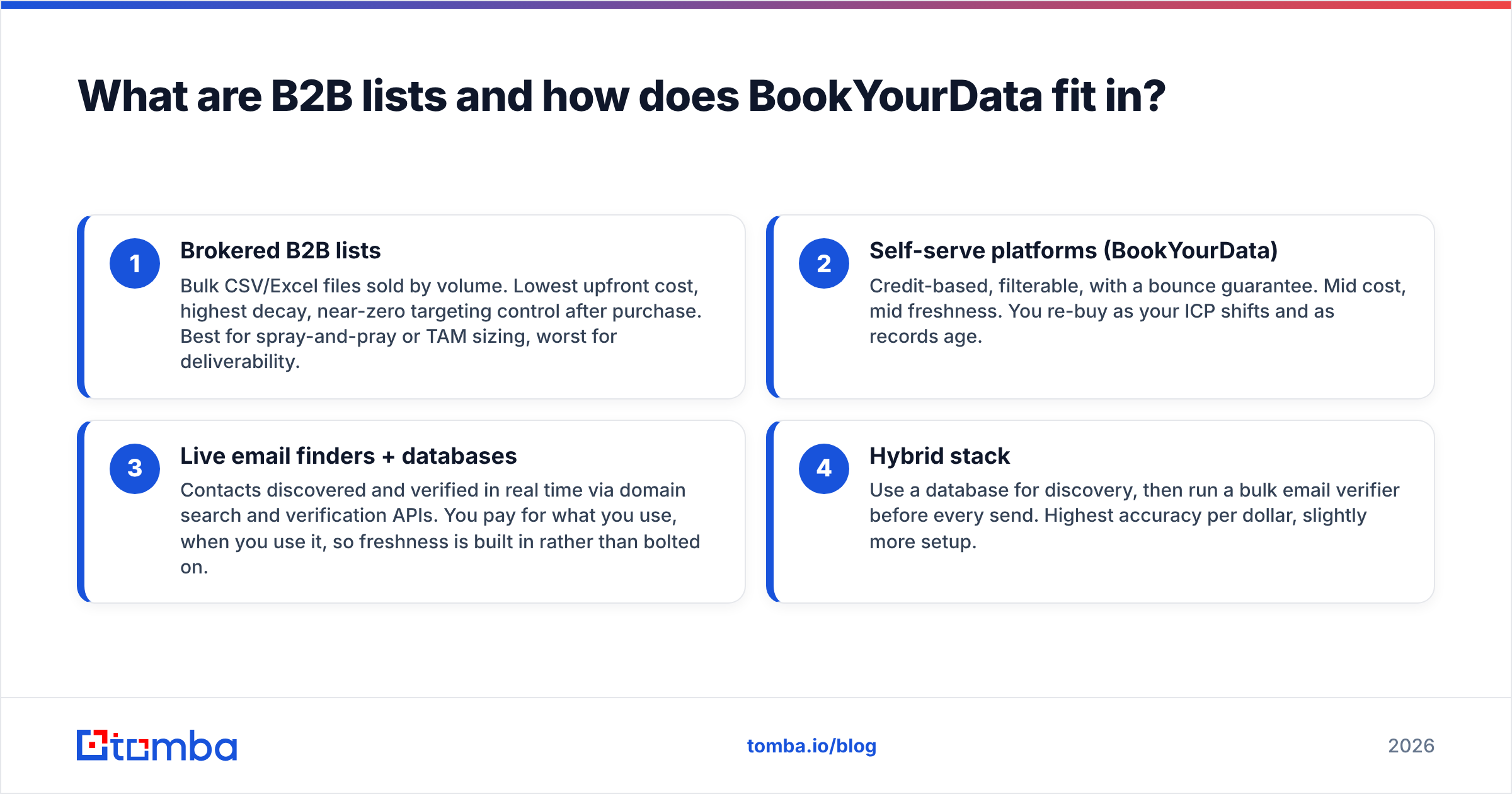
Here's the structural breakdown of the three sourcing models you're choosing between:
- Brokered B2B lists — Bulk CSV/Excel files sold by volume. Lowest upfront cost, highest decay, near-zero targeting control after purchase. Best for spray-and-pray or TAM sizing, worst for deliverability.
- Self-serve platforms (BookYourData) — Credit-based, filterable, with a bounce guarantee. Mid cost, mid freshness. You re-buy as your ICP shifts and as records age.
- Live email finders + databases — Contacts discovered and verified in real time via domain search and verification APIs. You pay for what you use, when you use it, so freshness is built in rather than bolted on.
- Hybrid stack — Use a database for discovery, then run a bulk email verifier before every send. Highest accuracy per dollar, slightly more setup.
Is BookYourData better than buying generic B2B lists?#
Yes, for most buyers — but the bar is low. Generic brokered lists are the riskiest data you can put into a cold email program because you cannot see how the records were sourced or when they were last validated.
BookYourData improves on that in three concrete ways:
- Targeting before purchase. You filter to your ICP and pay only for matching records, instead of buying a 50,000-row file where half the titles are irrelevant.
- A verification layer. The 95% accuracy guarantee means someone re-checked emails recently, which generic brokers rarely promise.
- Compliance posture. Self-serve platforms publish their data-handling and opt-out practices; anonymous CSV brokers usually don't, which is a real GDPR/CAN-SPAM liability.
What BookYourData doesn't solve is the fundamental flaw of any list: the moment you download it, it starts decaying. People change jobs at roughly 20–30% annually in B2B roles. A contact verified the day you buy it can be wrong six months later, and you've already paid for it.
How do B2B lists, BookYourData, and a live email finder compare?#
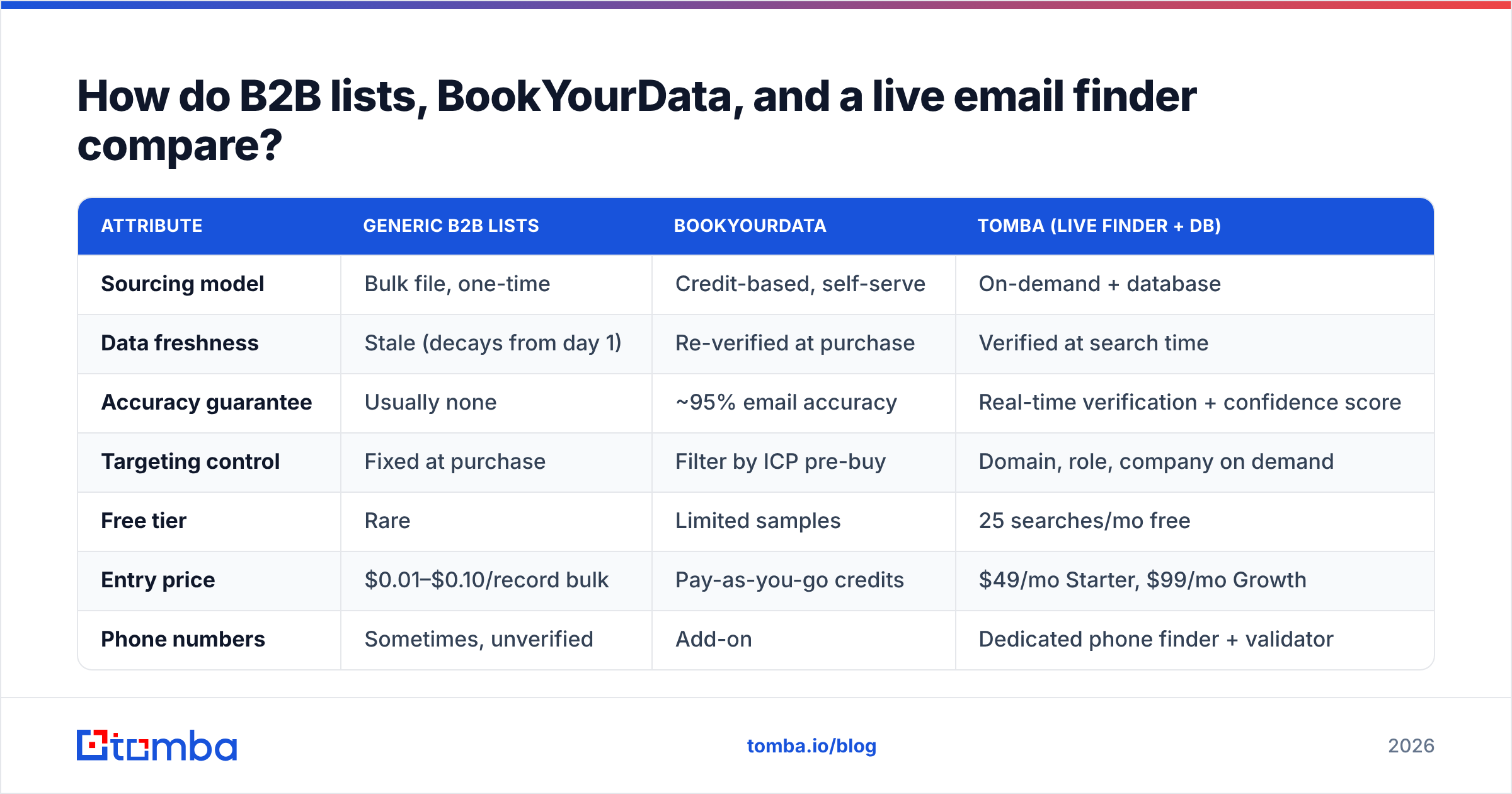
Here's the side-by-side on the attributes that decide cost per booked meeting, not just cost per row.
| Attribute | Generic B2B Lists | BookYourData | Tomba (Live Finder + DB) |
|---|---|---|---|
| Sourcing model | Bulk file, one-time | Credit-based, self-serve | On-demand + database |
| Data freshness | Stale (decays from day 1) | Re-verified at purchase | Verified at search time |
| Accuracy guarantee | Usually none | ~95% email accuracy | Real-time verification + confidence score |
| Targeting control | Fixed at purchase | Filter by ICP pre-buy | Domain, role, company on demand |
| Free tier | Rare | Limited samples | 25 searches/mo free |
| Entry price | $0.01–$0.10/record bulk | Pay-as-you-go credits | $49/mo Starter, $99/mo Growth |
| Phone numbers | Sometimes, unverified | Add-on | Dedicated phone finder + validator |
| Best for | TAM sizing, volume plays | Mid-volume targeted buys | Ongoing, deliverability-sensitive outbound |
| Deliverability risk | High | Medium | Low (verify before send) |
The pattern is clear: as you move left to right, you trade raw upfront volume for freshness and deliverability. For any team that emails the same domains repeatedly, that trade pays for itself fast.
Which option gives the lowest true cost per usable contact?#
Lowest sticker price is not lowest real cost. Calculate it like this: true cost = price paid ÷ contacts that are still valid and reachable when you actually email them.
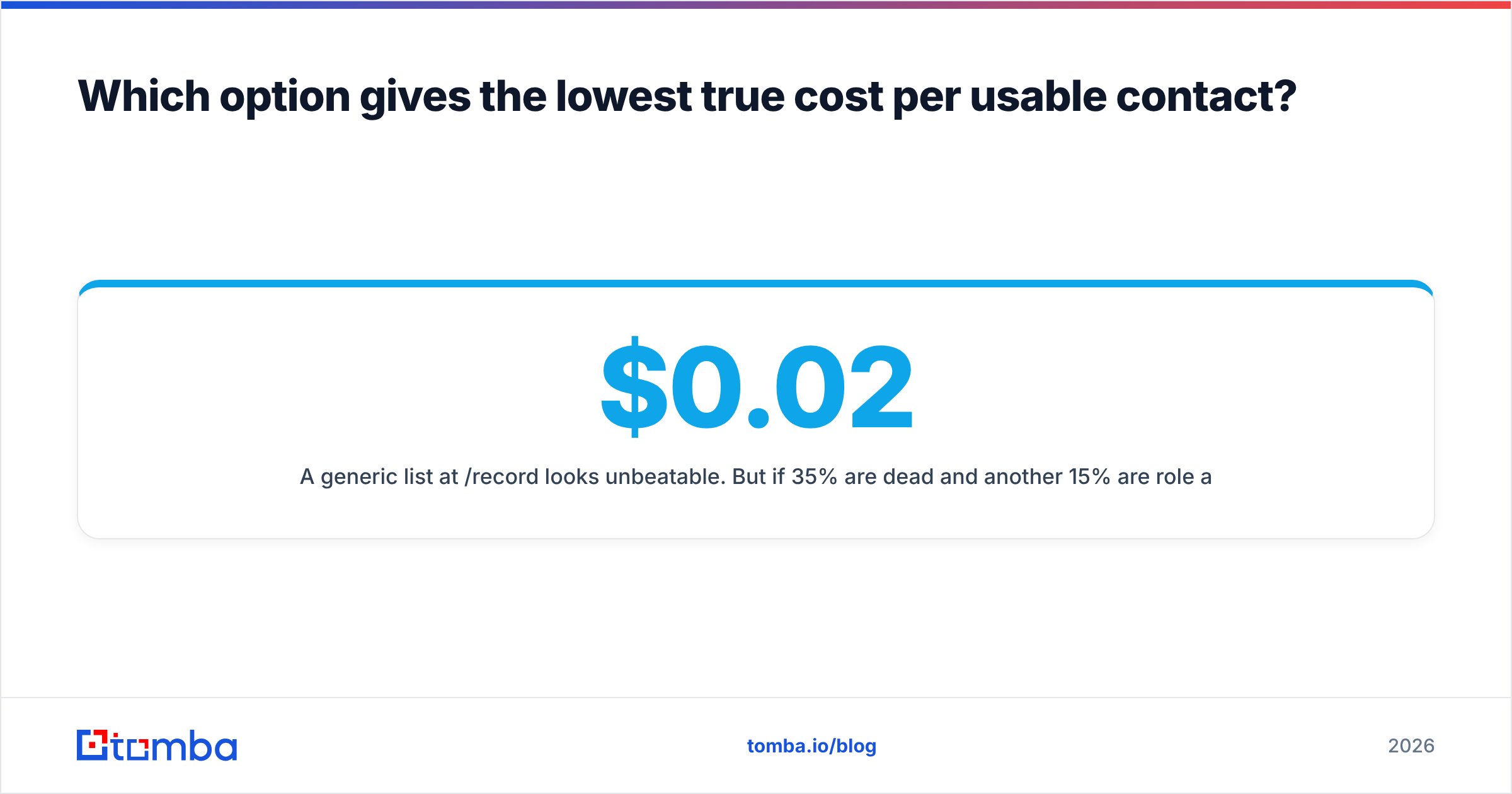
A generic list at $0.02/record looks unbeatable. But if 35% are dead and another 15% are role accounts or catch-alls you can't safely mail, your real cost per usable contact more than doubles — before counting the deliverability damage from bouncing into spam traps.
BookYourData's guarantee narrows that gap because bounced credits get refunded. But you still re-buy the same contact later when it ages out, so over a year the cumulative spend on a churning ICP adds up.
A live finder flips the math. Because verification happens at search time, you're not paying to store and re-buy data. You pull what you need, when you need it, and the email verifier confirms it's deliverable before it touches your sequencer. For teams running continuous outbound, that's typically the lowest cost per booked meeting — even if the per-search price looks higher than a bulk CSV.
You can sanity-check any vendor's freshness claims by reading how they actually source and refresh records — Tomba documents this on its data sources page, and reputable review sites like G2 let you cross-reference accuracy complaints from real users.
What about deliverability and sender reputation?#
This is where cheap data gets expensive. Every hard bounce and spam-trap hit drags down your domain reputation, and once mailbox providers throttle you, even your good emails land in spam.
The deliverability hierarchy maps directly onto the sourcing models:
- Generic lists carry the highest spam-trap and bounce risk because you can't audit them. One bad import can take weeks of warmup to recover from.
- BookYourData is safer thanks to its verification pass, but a list verified at purchase still ages between download and send, especially if you drip a 5,000-contact buy over two months.
- Live verification is the only model that checks an address immediately before you send. Pairing a finder with a catch-all verifier also tells you which risky domains to skip entirely.
If you're investing in cold email infrastructure — warmup, SPF/DKIM, domain rotation — feeding it stale data wastes that work. Protecting sender reputation is the single highest-ROI reason to prefer fresh, verified contacts over a discounted bulk file.
When should you actually buy a static list or use BookYourData?#
Static lists and BookYourData aren't always wrong. Use them when the job genuinely is "get a lot of contacts, fast, accuracy-tolerant":
- TAM/market sizing. You need counts and firmographics, not perfect emails. A bulk list is fine.
- Account-based research seeds. You'll manually enrich and verify the accounts that matter anyway.
- One-off campaigns with disposable domains. If you're isolating reputation risk on a throwaway sending domain, list quality matters less.
- Tightly filtered, small targeted pulls. BookYourData shines here — a few hundred precisely filtered, recently verified contacts for a specific play.
Reach for a live finder and database when:
- You run continuous outbound against an evolving ICP.
- Deliverability is mission-critical (your main domain, regulated industry, high-ACV accounts).
- You need enrichment beyond email — phone, LinkedIn, social — which a data enrichment workflow handles natively.
- You want API access to wire data straight into your CRM or product, which the Tomba API provides without a per-seat database license.
How does pricing really stack up?#
BookYourData uses credit packs that scale with volume, with the appeal that you only pay for contacts you choose. The hidden cost is repurchase: as records age or your filters change, you buy again.
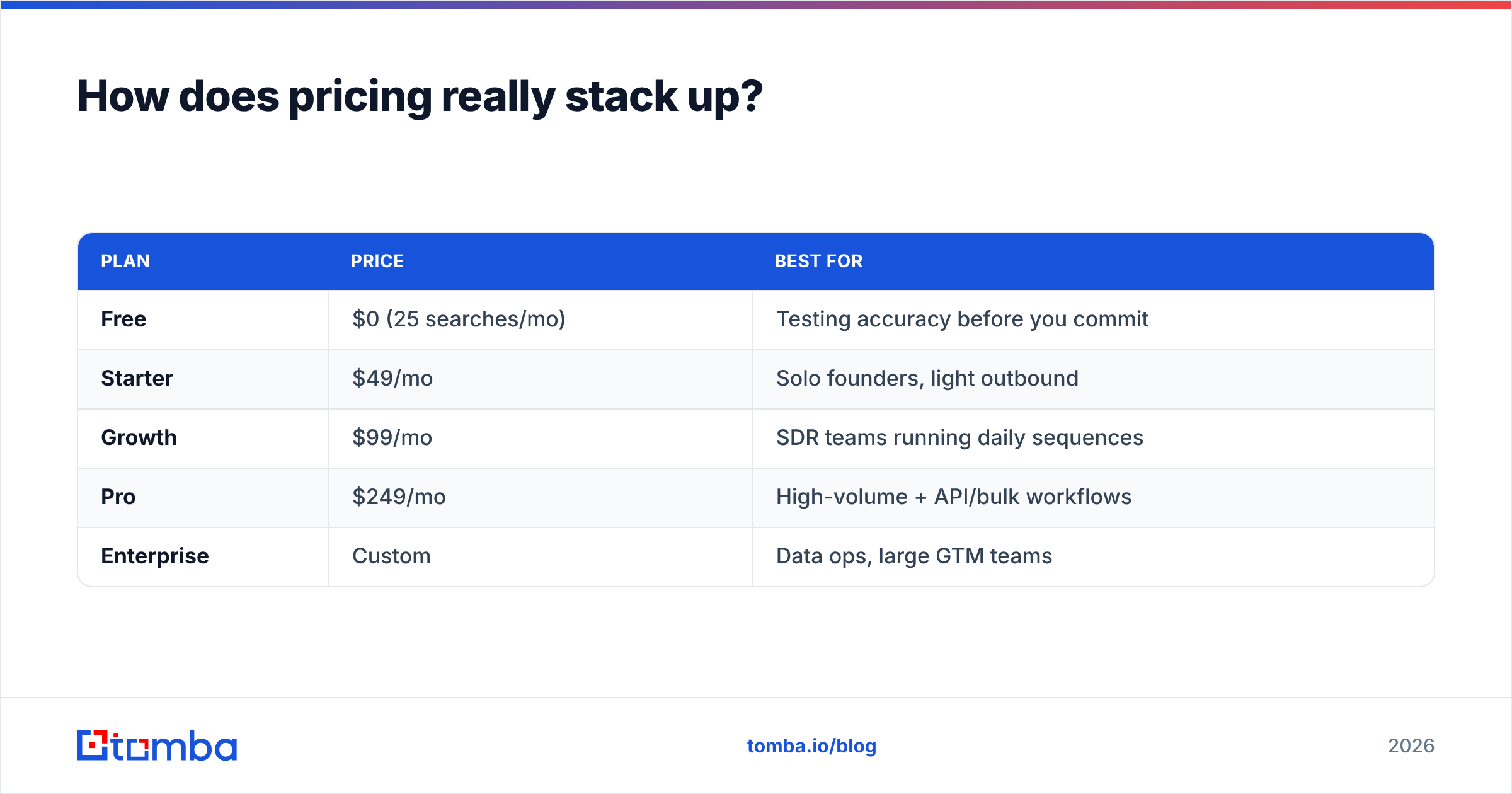
Tomba uses transparent monthly tiers so your cost is predictable regardless of how many times you re-verify the same domain:
| Plan | Price | Best for |
|---|---|---|
| Free | $0 (25 searches/mo) | Testing accuracy before you commit |
| Starter | $49/mo | Solo founders, light outbound |
| Growth | $99/mo | SDR teams running daily sequences |
| Pro | $249/mo | High-volume + API/bulk workflows |
| Enterprise | Custom | Data ops, large GTM teams |
Full breakdowns live on the Tomba pricing page, and you can pull contacts straight from the B2B database under the same plan rather than paying a separate per-record fee. For teams that re-touch the same accounts monthly, a flat subscription with built-in verification almost always beats stacking credit repurchases on a list that's quietly going stale.
What's the smartest setup for 2026?#
A hybrid. Don't think of it as b2b lists vs bookyourdata as a binary — think about which layer does which job:
- Discovery — Use a database or domain search to build your target account and contact list. This is where breadth matters.
- Verification — Before any send, run contacts through real-time verification so dead and catch-all addresses never reach your sequencer.
- Enrichment — Fill gaps (phone, role, LinkedIn) only for accounts that clear your scoring threshold, so you don't pay to enrich the whole list.
- Refresh on use — Re-verify at send time instead of re-buying quarterly. Freshness becomes a workflow, not a recurring invoice.
This setup gives you the targeting control of BookYourData, beats the price of bulk lists on a cost-per-meeting basis, and removes the decay problem that plagues every static file.
The bottom line#
Generic B2B lists win on sticker price and lose on everything that matters once the campaign runs. BookYourData is a genuine upgrade — filtered, guaranteed, compliant — but you're still buying a snapshot that ages the moment it's yours. A live email finder closes that gap by verifying contacts the instant you need them, which is why it usually delivers the lowest true cost per usable, deliverable contact.
If deliverability and predictable spend matter to your 2026 pipeline, start with the Tomba Email Finder: pull verified, fresh contacts on demand, confirm every address before send, and stop paying to re-buy data that someone else let go stale. Try it free with 25 searches a month and compare the bounce rate against your current list — the numbers make the decision for you.
// get started
Find, verify and enrich your first contacts today
Start on the free plan with 25 searches a month, then scale when your team is ready.
Free plan · No credit card required · GDPR & CCPA
// about the author