B2B Lists vs Clodura.ai: Which Wins for Prospecting 2026
Static B2B lists are cheap but decay fast. Clodura.ai adds intent and automation at a price. Here's how the two stack up in 2026 — and where a live email API beats both.
You have a quota to hit and two ways to fill the pipeline: buy a pre-built B2B list, or subscribe to a sales-intelligence platform like Clodura.ai that builds lists for you on demand. They look like the same purchase. They are not.
This guide breaks down B2B lists vs Clodura.ai on the only things that move revenue: how fresh the data is, how accurate the contacts are, what you actually pay, and how the data flows into your outbound motion.
TL;DR#
- Static B2B lists are cheap and instant, but they decay roughly 25–30% per year as people change jobs — you're often emailing ghosts by month three.
- Clodura.ai is a full sales-intelligence platform (database + intent + sequencing), which is more powerful but heavier and pricier than a raw list.
- Accuracy and freshness matter more than raw record count. A 10,000-row list with 30% bounces is worse than 3,000 verified contacts.
- The hidden third option: a live email-finder API that pulls and verifies contacts at the moment you need them, so data never goes stale on a shelf.
- If you only remember one thing: buy outcomes (verified, deliverable contacts), not rows.
What's the real difference between a B2B list and Clodura.ai?#
A B2B list is a static file. You pay once (or per record), download a CSV, and you own a snapshot of names, titles, emails, and companies frozen at the moment of export. It's a photograph.
Clodura.ai is a subscription platform. It maintains a contact database (the vendor claims hundreds of millions of contacts), layers on buyer-intent signals and org charts, and bundles a sequencing tool so you can email straight from the app. It's a live feed plus a workflow, not a one-time file. You can see the product scope on the Clodura.ai homepage and read verified user reviews on G2.
The analogy: a static list is buying a printed map. Clodura.ai is a GPS subscription — it reroutes as the roads change, but you pay every month and you're locked into its routing logic. The question is whether you need the live rerouting or just want to get from A to B today.
Which has fresher, more accurate data?#
This is where most list purchases go wrong. B2B contact data decays fast — people switch jobs, companies rebrand, domains change. Industry estimates put B2B data decay at 22–30% per year, which means a list bought in January is meaningfully wrong by summer.
Static lists have a structural problem: the data is only as good as the day it was exported, and nobody re-verifies it on your behalf. Clodura.ai re-crawls and refreshes its database continuously, so a search you run today reflects more recent reality than a CSV you bought last quarter. That's the genuine advantage of a platform model.
But "refreshed continuously" is not the same as "verified at send time." Even platform databases carry catch-all domains, role accounts, and addresses that pass a syntax check but bounce on delivery. That's why the smartest teams run any source — list or platform — through a dedicated email verifier before the first send. Bounces above 3–4% drag your sender reputation down and push the rest of your campaign into spam.
A quick way to judge any data source on freshness:
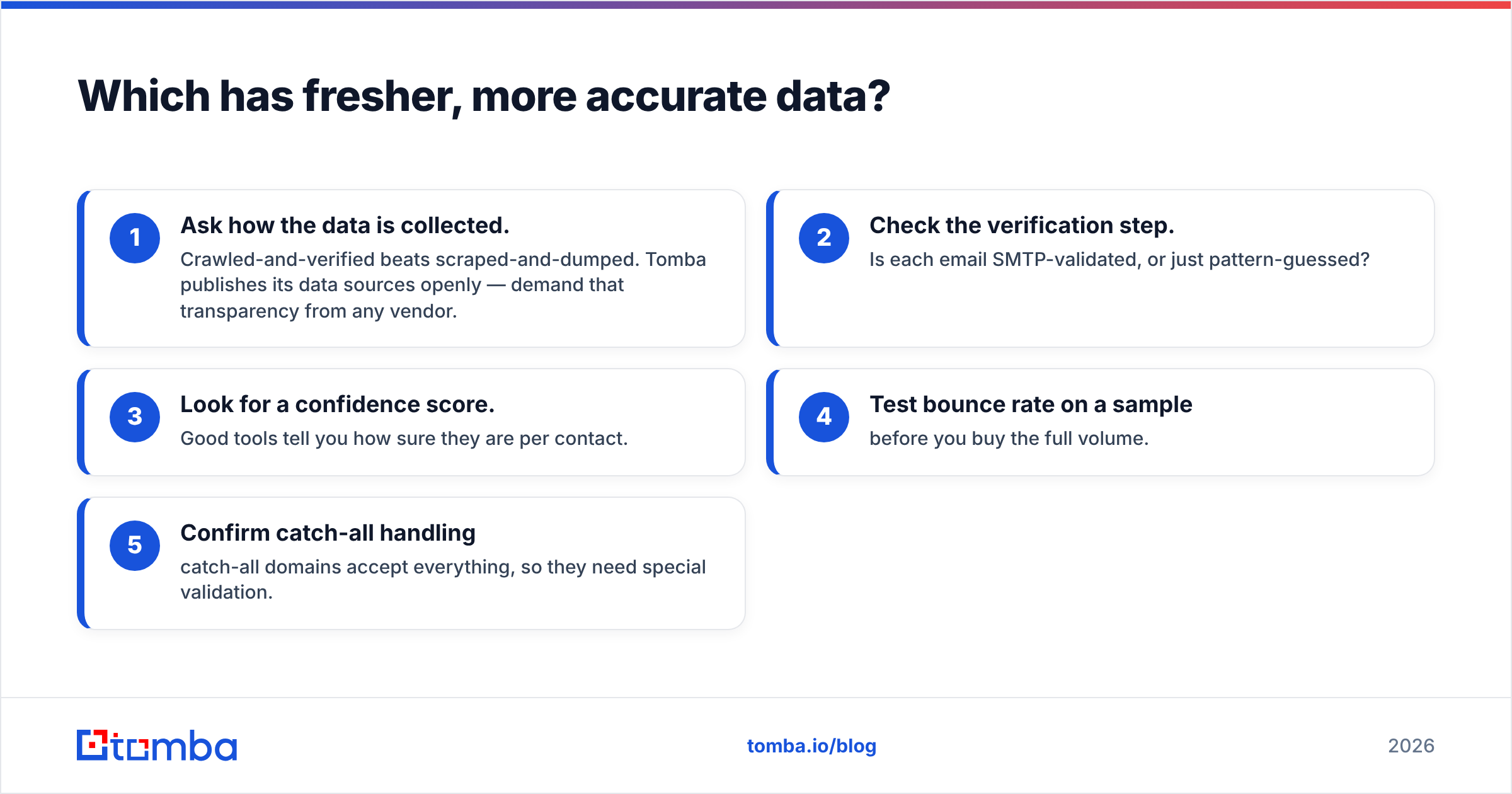
- Ask how the data is collected. Crawled-and-verified beats scraped-and-dumped. Tomba publishes its data sources openly — demand that transparency from any vendor.
- Check the verification step. Is each email SMTP-validated, or just pattern-guessed?
- Look for a confidence score. Good tools tell you how sure they are per contact.
- Test bounce rate on a sample before you buy the full volume.
- Confirm catch-all handling — catch-all domains accept everything, so they need special validation.
How do they compare head-to-head?#
Here's the practical breakdown across the attributes that actually decide a purchase.
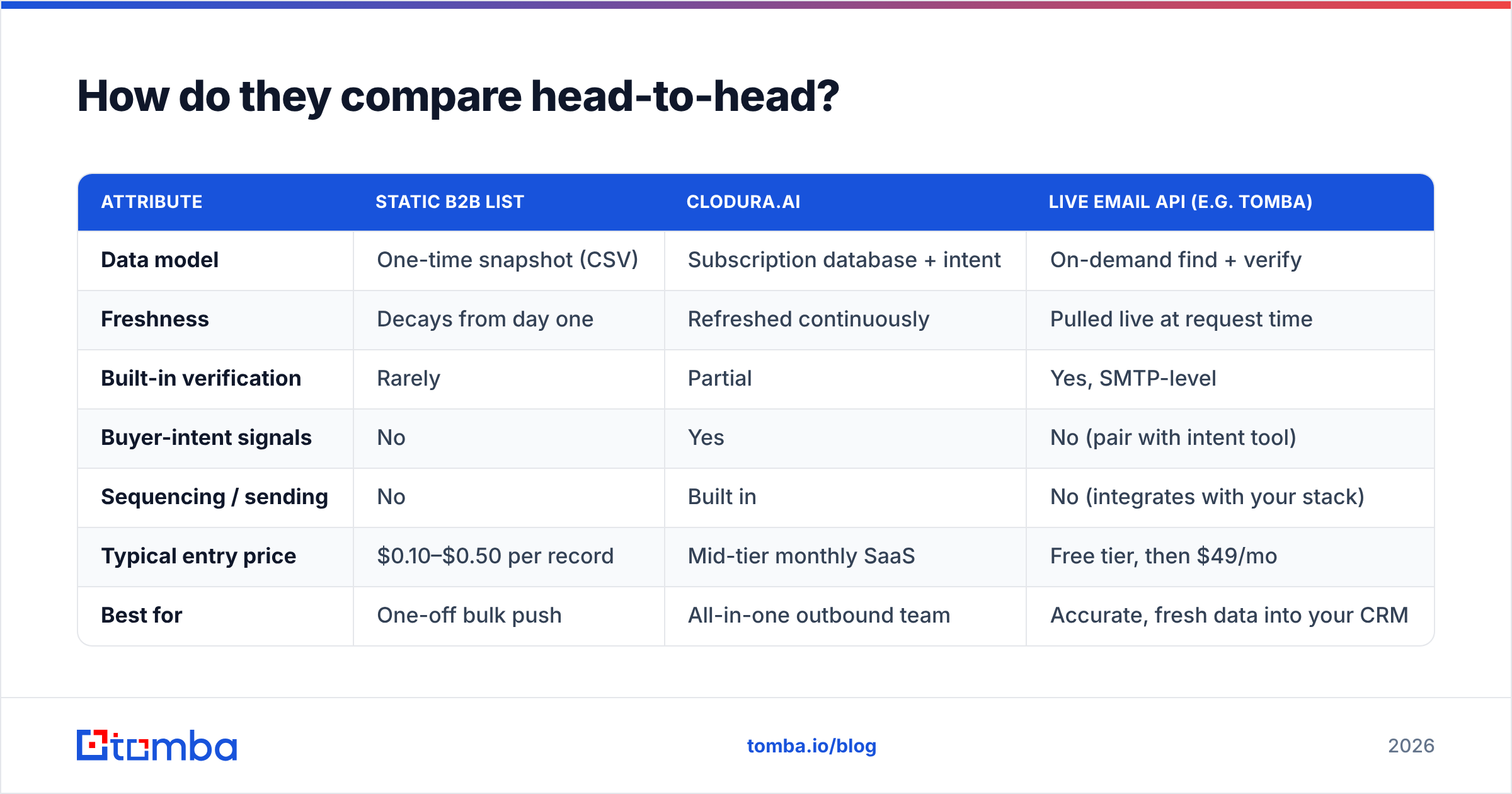
| Attribute | Static B2B List | Clodura.ai | Live Email API (e.g. Tomba) |
|---|---|---|---|
| Data model | One-time snapshot (CSV) | Subscription database + intent | On-demand find + verify |
| Freshness | Decays from day one | Refreshed continuously | Pulled live at request time |
| Built-in verification | Rarely | Partial | Yes, SMTP-level |
| Buyer-intent signals | No | Yes | No (pair with intent tool) |
| Sequencing / sending | No | Built in | No (integrates with your stack) |
| Typical entry price | $0.10–$0.50 per record | Mid-tier monthly SaaS | Free tier, then $49/mo |
| Best for | One-off bulk push | All-in-one outbound team | Accurate, fresh data into your CRM |
| Lock-in | None | Annual contract common | Pay-as-you-grow |
The pattern is clear: a list wins on simplicity and upfront cost, Clodura.ai wins on breadth and automation, and a live API wins on freshness and accuracy per contact without forcing you into one vendor's sending tool.
Is Clodura.ai worth the price over a cheap list?#
It depends on whether you're buying data or buying a workflow.
If you already run Outreach, Salesloft, or Instantly for sequencing and just need contacts, paying for Clodura.ai's full platform means paying for sequencing you won't use. In that case a list — or better, a live data source feeding your existing tools — is more efficient.
If you're a small team with no outbound stack at all, Clodura.ai's all-in-one bundle (data + intent + sending) can replace three tools, and the math changes. The intent signals especially earn their keep when you're trying to prioritize which of 5,000 accounts to call first.
What you should not do is buy a giant static list because the per-record price looks tiny. Cost-per-row is a vanity metric. The number that matters is cost per booked meeting, and a cheap list with a 28% bounce rate and stale titles quietly destroys that number — plus your domain reputation along the way.
Where does a live email-finder API beat both?#
Both options share a weakness: you're trusting a database that someone else maintains on their schedule, not yours. A static list is stale by design. A platform is fresher but still a warehouse — the record was verified whenever the crawler last passed, not when you hit send.
A live email finder flips the model. Instead of warehousing millions of rows hoping you'll need some of them, it finds and verifies the specific contacts you ask for, at the moment you ask. No shelf life, because nothing sits on a shelf.
This matters most in three workflows:
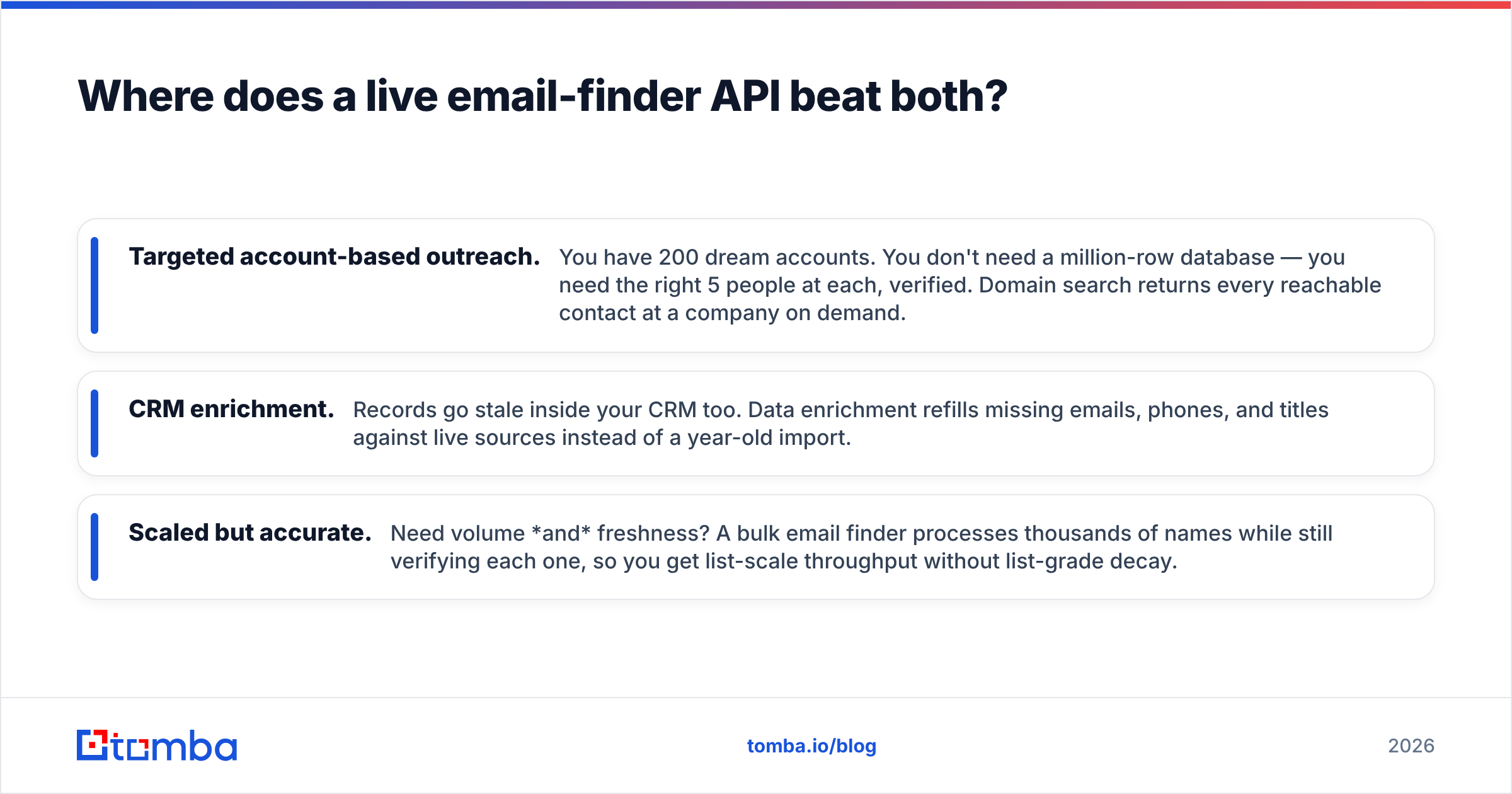
- Targeted account-based outreach. You have 200 dream accounts. You don't need a million-row database — you need the right 5 people at each, verified. Domain search returns every reachable contact at a company on demand.
- CRM enrichment. Records go stale inside your CRM too. Data enrichment refills missing emails, phones, and titles against live sources instead of a year-old import.
- Scaled but accurate. Need volume and freshness? A bulk email finder processes thousands of names while still verifying each one, so you get list-scale throughput without list-grade decay.
You can also wire this directly into your stack via the Tomba API, so enrichment happens automatically the instant a lead enters your CRM — no CSV import, no manual refresh cycle.
How should you choose for your team?#
Match the tool to the motion, not the other way around.
- Pick a static B2B list only for a genuine one-off — a single event blast or a market test — and verify every address first. Treat it as disposable.
- Pick Clodura.ai if you want one subscription to cover database, intent, and sequencing, and you don't already own those tools. Just budget for the platform price and the contract, and read recent Gartner and G2 reviews to confirm the data quality holds in your region and vertical.
- Pick a live email-finder API when accuracy and freshness are non-negotiable, you already have a sending stack, or you want data flowing into your CRM automatically without paying for an all-in-one bundle.
Most growing teams end up with a hybrid: a live finder/verifier for accuracy, plugged into whatever sequencer and CRM they already trust. That keeps data fresh without locking you into a single vendor's ecosystem.
What does it cost to start?#
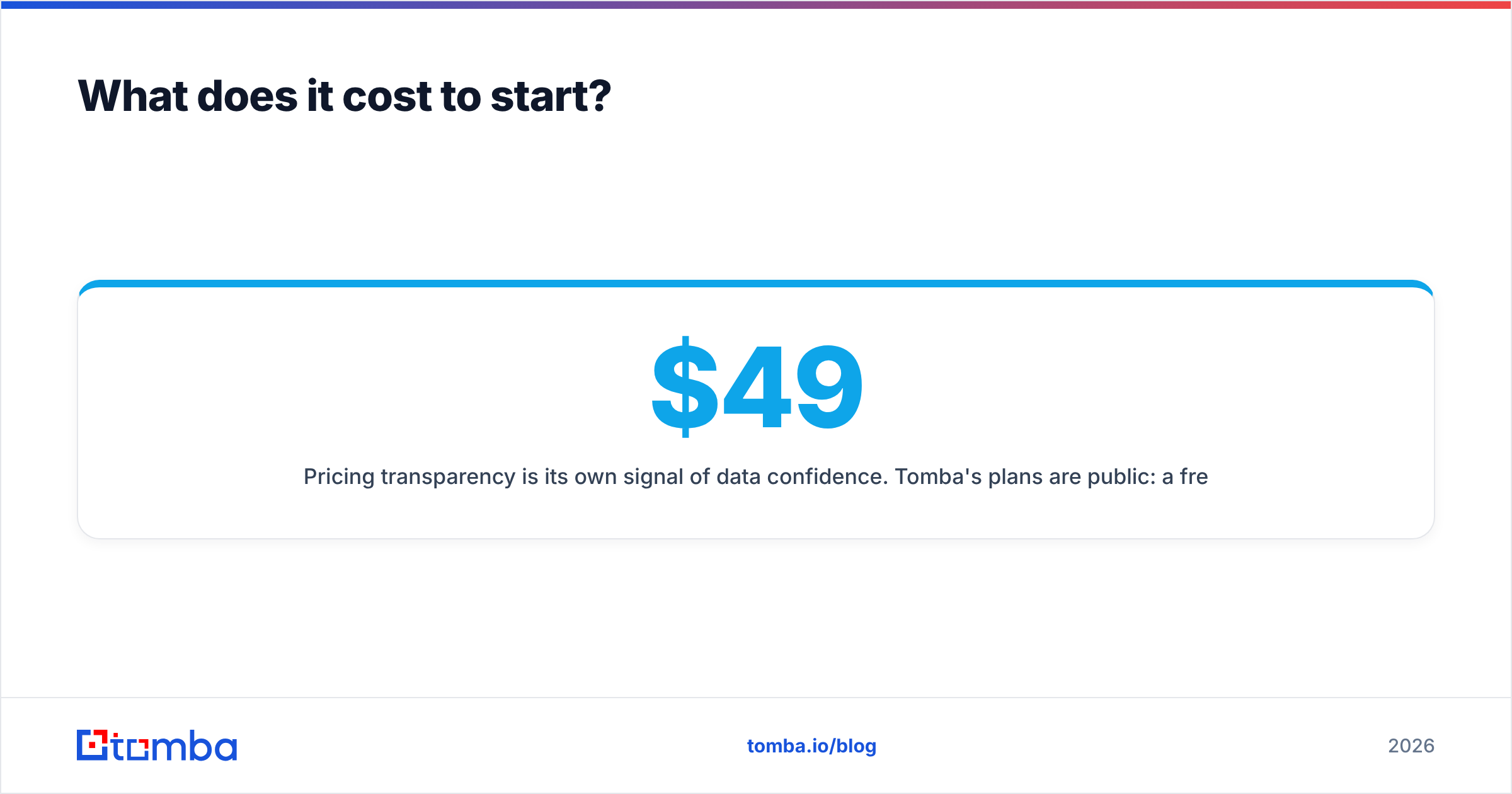
Pricing transparency is its own signal of data confidence. Tomba's plans are public: a free tier with 25 searches/month, Starter at $49/mo, Growth at $99/mo, Pro at $249/mo, and custom Enterprise — full details on the Tomba pricing page. You can test accuracy on the free tier before spending a cent, which you cannot do with a bulk list purchase or a platform behind a sales demo.
The bottom line#
B2B lists vs Clodura.ai isn't really a fight between two products — it's a choice between three philosophies. A static list buys you rows. Clodura.ai buys you a warehouse plus a workflow. A live email-finder buys you the one thing both struggle with: verified, deliverable contacts at the exact moment you need them.
If your campaigns live or die on deliverability — and in 2026 they do — start with data you can trust on contact. Run a few searches on the Tomba Email Finder free tier, verify the results, and compare the bounce rate against any list or platform you're considering. Let the inbox decide. Fresh, verified data is the cheapest insurance your pipeline will ever buy.
// get started
Find, verify and enrich your first contacts today
Start on the free plan with 25 searches a month, then scale when your team is ready.
Free plan · No credit card required · GDPR & CCPA
// about the author