B2B Lists vs Generect: Which Lead Data Wins in 2026?
Static B2B lists or Generect's live LinkedIn data? We compare accuracy, freshness, pricing, and coverage so you stop paying for contacts that bounce.
Buying a B2B list and subscribing to Generect look like two paths to the same goal: a spreadsheet full of decision-makers you can email tomorrow. They are not the same purchase. One sells you a frozen snapshot; the other sells you a live query against LinkedIn-sourced data. The difference shows up the moment you hit send and watch your bounce rate.
This guide breaks down B2B lists vs Generect on the only metrics that move pipeline: accuracy, freshness, coverage, compliance, and real cost per usable contact.
TL;DR — B2B Lists vs Generect#
- Static B2B lists are cheap up front but decay fast — roughly 2–3% of B2B contacts go stale every month, so a six-month-old list is already 15%+ wrong.
- Generect pulls fresher, LinkedIn-anchored company and people data with filtering and enrichment, but you pay a recurring subscription and still need to verify emails before sending.
- Neither guarantees deliverability on its own — you verify before you send, or you burn your domain reputation.
- For most teams, the winning stack is fresh sourcing + a dedicated verifier: pull or generate contacts, then validate them with a tool like the Tomba Email Finder and email verifier.
- Skip pre-built lists you can't trace to a source. If you can't see where the data came from, you can't trust the bounce rate.
What is a B2B list, and what is Generect?#
A B2B list is a pre-compiled file of business contacts — names, titles, companies, emails, sometimes phone numbers — sold or rented as a one-time download or periodic feed. Think of it like buying bottled water: convenient, sealed, and exactly as fresh as the day it was bottled. The bottling date is the problem.
Generect is a lead-generation and B2B data platform that builds lists on demand from LinkedIn-anchored sources, with filters for industry, role, company size, and intent-style signals, plus enrichment for emails and firmographics. It is closer to a tap than a bottle: you draw the data when you need it, so it reflects a more recent state of the world. You can see their positioning on the Generect homepage.
Here is the core distinction that everything else flows from:
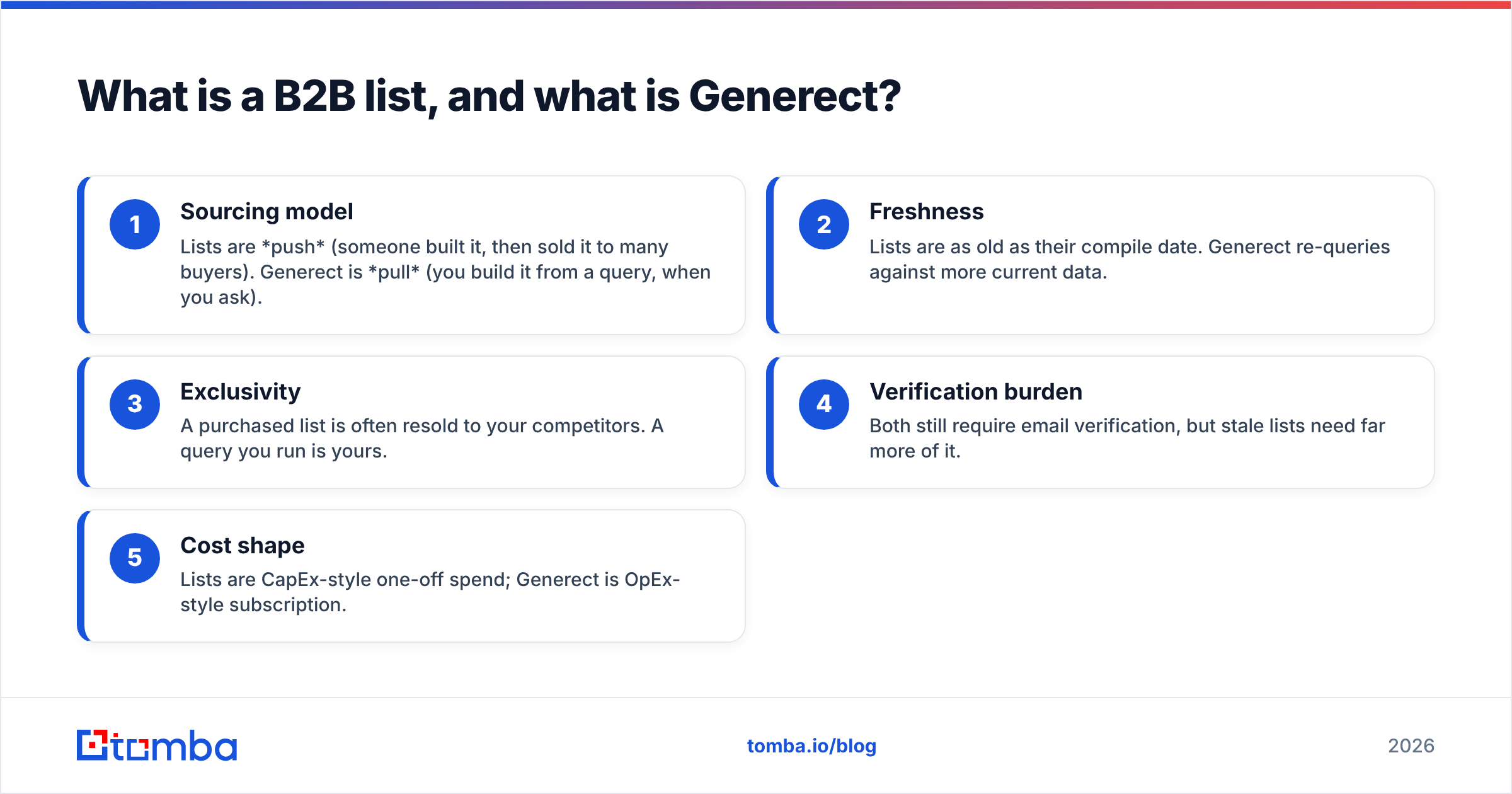
- Sourcing model — Lists are push (someone built it, then sold it to many buyers). Generect is pull (you build it from a query, when you ask).
- Freshness — Lists are as old as their compile date. Generect re-queries against more current data.
- Exclusivity — A purchased list is often resold to your competitors. A query you run is yours.
- Verification burden — Both still require email verification, but stale lists need far more of it.
- Cost shape — Lists are CapEx-style one-off spend; Generect is OpEx-style subscription.
How accurate is each, really?#
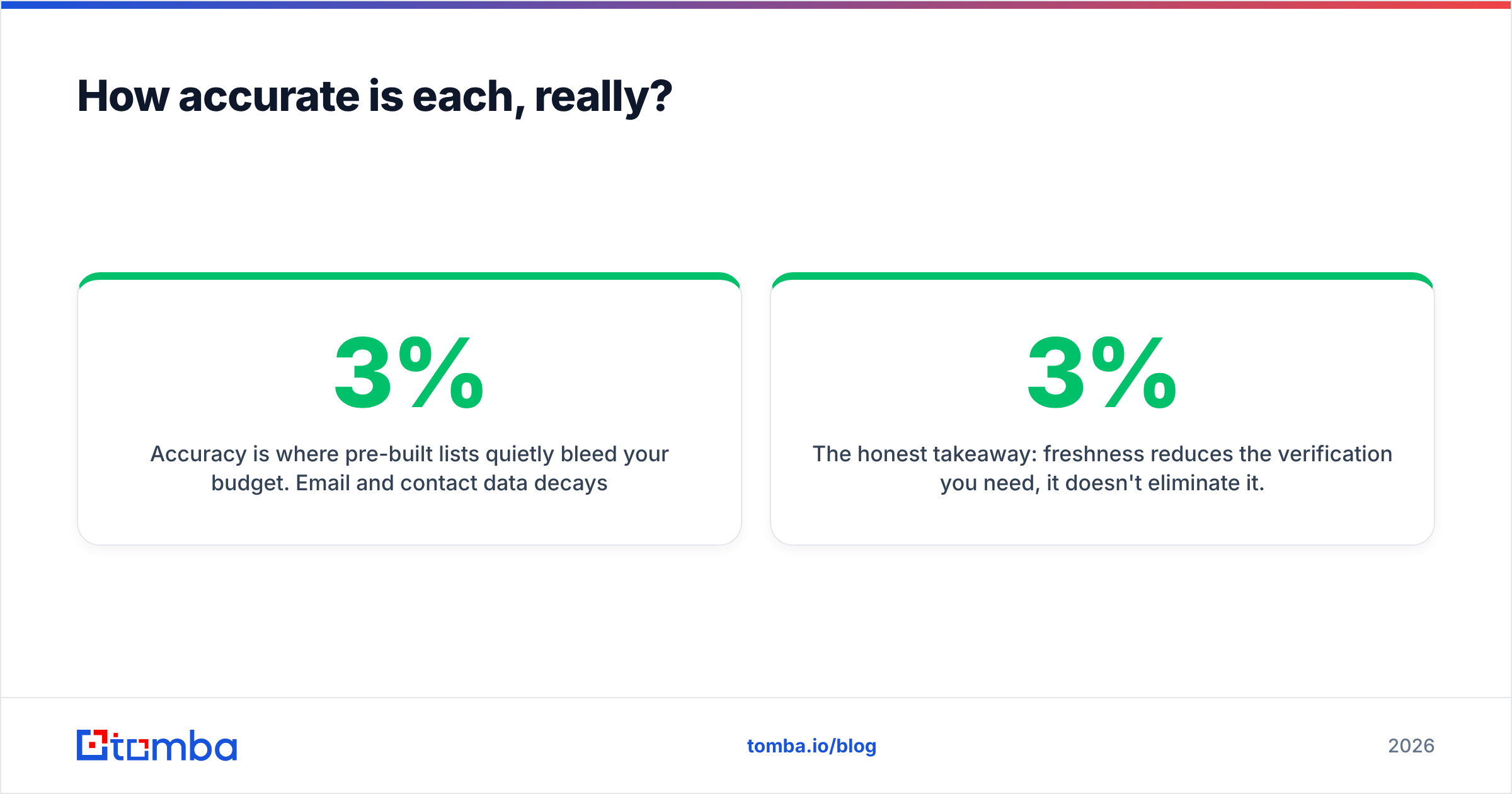
Accuracy is where pre-built lists quietly bleed your budget. Email and contact data decays continuously: people change jobs, companies rebrand domains, and role titles shift. Industry consensus puts B2B data decay around 2.5–3% per month, which compounds into 25–30% annual rot. A list sold to you "fresh" may have been compiled months before it reached your inbox.
Generect mitigates this by re-sourcing from LinkedIn-anchored profiles, which update more often than a static database dump. But "fresher" is not "verified." A LinkedIn-derived email pattern (first.last@company.com) is a strong guess, not a confirmed mailbox. Catch-all domains, role accounts, and recently departed employees still slip through.

The honest takeaway: freshness reduces the verification you need, it doesn't eliminate it. Whether you start from a purchased list or a Generect export, run the addresses through an email verifier before your sequence goes live. Aim for a bounce rate under 3% — most inbox providers start throttling you above that, and a single bad blast can dent sender reputation for weeks.
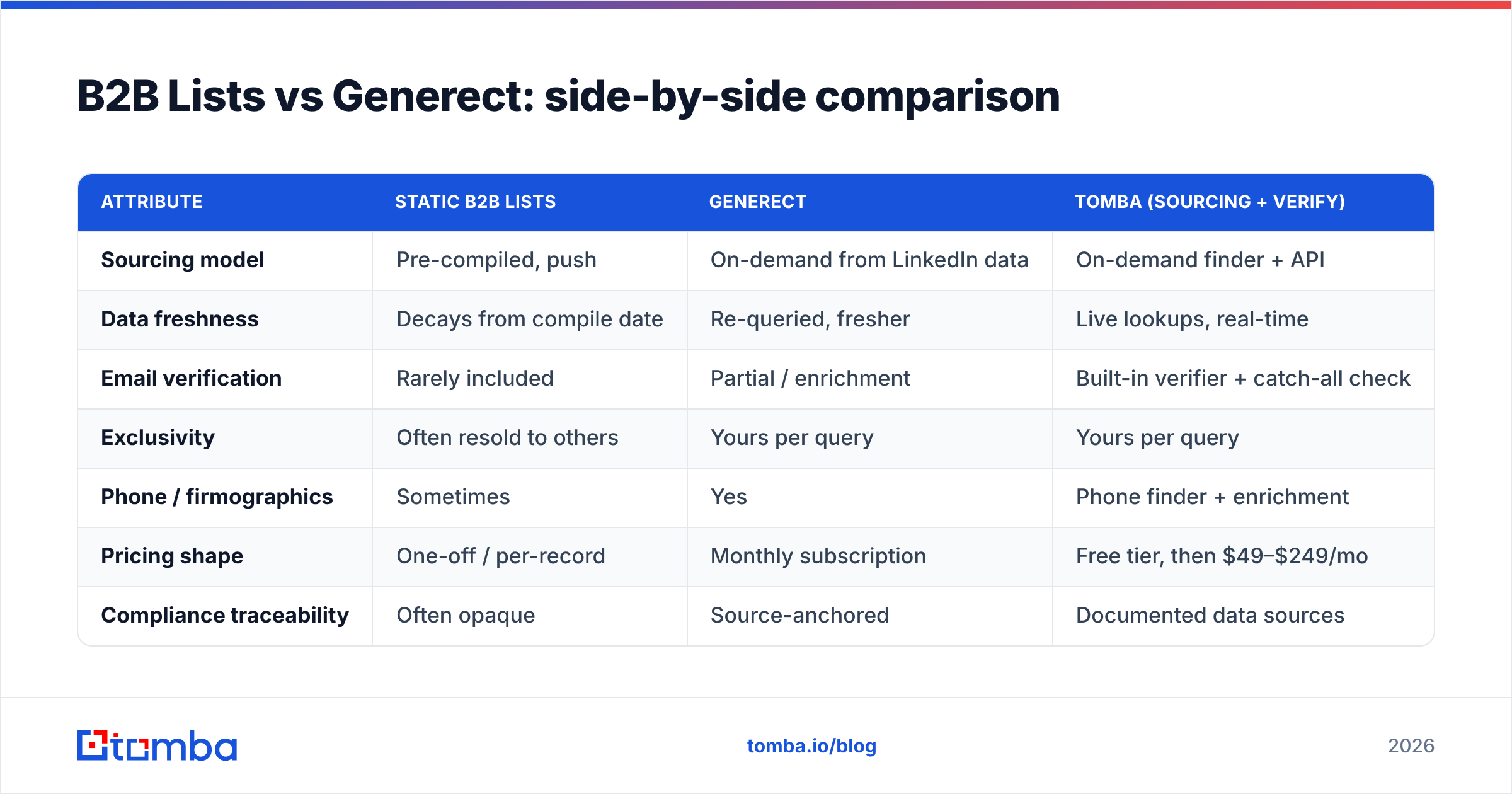
B2B Lists vs Generect: side-by-side comparison#
| Attribute | Static B2B Lists | Generect | Tomba (sourcing + verify) |
|---|---|---|---|
| Sourcing model | Pre-compiled, push | On-demand from LinkedIn data | On-demand finder + API |
| Data freshness | Decays from compile date | Re-queried, fresher | Live lookups, real-time |
| Email verification | Rarely included | Partial / enrichment | Built-in verifier + catch-all check |
| Exclusivity | Often resold to others | Yours per query | Yours per query |
| Phone / firmographics | Sometimes | Yes | Phone finder + enrichment |
| Pricing shape | One-off / per-record | Monthly subscription | Free tier, then $49–$249/mo |
| Compliance traceability | Often opaque | Source-anchored | Documented data sources |
| Best for | Quick, low-stakes volume | Ongoing LinkedIn-led prospecting | Accuracy-first outbound at any scale |
A few rows deserve a callout. Exclusivity matters more than buyers expect: a list resold to ten competitors means your prospect gets the same pitch ten times, and your reply rate craters through no fault of your copy. Compliance traceability is the row that gets companies fined — if you can't show where a contact's data came from, you can't honor a GDPR or CCPA deletion request properly. Generect's source-anchored model and a finder with documented data sources both beat an anonymous CSV here.
Which is better for cold email deliverability?#
Deliverability is decided before you write a single word of copy — it's decided by your list quality. Conclusion first: Generect-style fresh data gives you a better starting point than a bought list, but both lose to a verified pipeline.
Why? Because inbox placement is a function of bounce rate, spam-trap hits, and engagement. Old lists are landmines for the first two:
- Spam traps — recycled email addresses that mailbox providers use to catch senders mailing stale data. Purchased lists are far more likely to contain them.
- Hard bounces — every dead address signals to Gmail and Outlook that you don't maintain your list.
- Disengaged contacts — people who changed roles won't open a pitch meant for their old job, dragging down your engagement signals.
Generect reduces all three by sourcing more current records, but it can't confirm a mailbox accepts mail. That last mile is verification's job. If you want the mechanics, our breakdown of email deliverability walks through SPF, DKIM, and warmup — but the single highest-ROI step is verifying every address first.

What does each actually cost per usable contact?#
Sticker price lies. The number that matters is cost per contact that actually receives your email.
Say you buy a 10,000-record B2B list for $500 ($0.05/record). Sounds cheap. But if 25% are stale and another 10% are catch-all or role accounts you won't email, your usable count drops to ~6,500. Your real cost is closer to $0.077 per usable contact — and that's before the verification tool you now need anyway.
Generect's subscription model front-loads cost but improves the usable ratio because the data is fresher. You're paying more per month, but a larger share of each export is mailable. Run your own math: take the export, verify it, and divide spend by verified deliverable count, not raw rows.
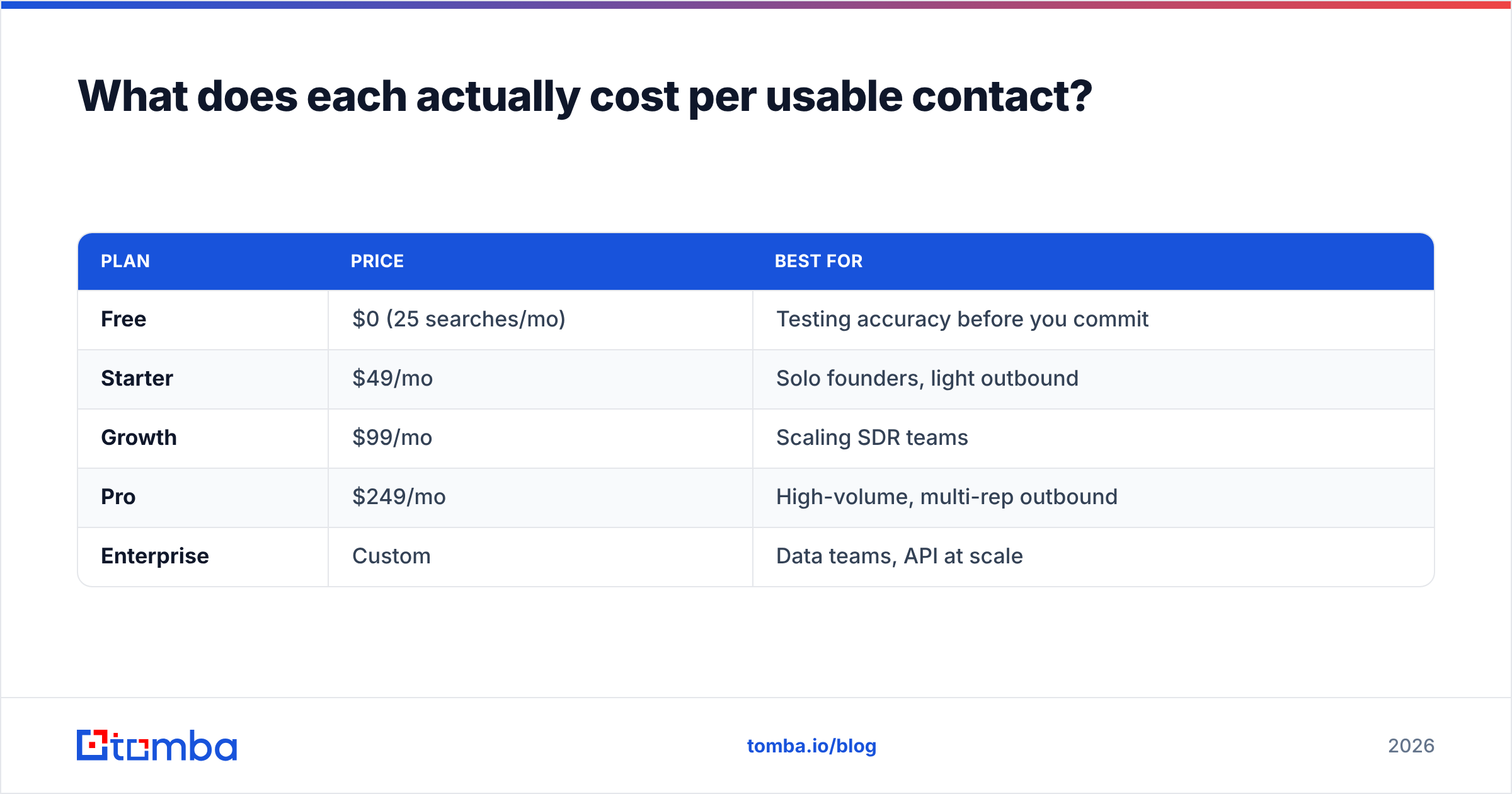
A verification-first finder changes the equation again by collapsing two purchases into one. With Tomba pricing, the tiers are straightforward:
| Plan | Price | Best for |
|---|---|---|
| Free | $0 (25 searches/mo) | Testing accuracy before you commit |
| Starter | $49/mo | Solo founders, light outbound |
| Growth | $99/mo | Scaling SDR teams |
| Pro | $249/mo | High-volume, multi-rep outbound |
| Enterprise | Custom | Data teams, API at scale |
The point isn't that one number beats another — it's that you should compare verified deliverable cost, not headline price. A $500 list that's 65% usable can be more expensive than a $99 subscription that's 90% usable.
When should you choose a B2B list anyway?#
Static lists aren't always the wrong call. Buy one when:
- The stakes are low and the volume is high — a broad awareness blast where a 10% bounce is survivable.
- You need a niche dataset Generect doesn't cover — a specialized vertical list from a reputable, traceable provider.
- You have your own verification step — you're treating the list as raw input, not a finished product.
Avoid lists when the source is anonymous, the data is "guaranteed accurate" with no methodology, or the price seems too good — those are the lists stuffed with spam traps. According to peer reviews on platforms like G2, the lowest-rated data vendors are almost always the ones selling opaque, resold files. Analyst firms such as Gartner make the same point about B2B data: traceability and refresh cadence predict quality far better than record count.
When is Generect the right pick?#
Choose Generect when your motion is LinkedIn-led and ongoing. If your reps live in Sales Navigator, build target account lists weekly, and want firmographic and role filtering tied to current profiles, the pull model fits. You're not buying a snapshot you'll regret in 90 days; you're querying when you need to.
It's a weaker fit if you need deep email verification baked in, very large bulk pulls on a tight budget, or a single API that handles finding, verifying, and enriching in one call. For those, a dedicated finder-and-verifier stack — or a LinkedIn finder plus data enrichment — covers more of the workflow without a second subscription.
How do you build the best stack of all three?#
Stop framing it as B2B lists vs Generect as if you must pick one and live with its weakness. The teams with the lowest bounce rates and highest reply rates treat sourcing and verification as separate, stackable jobs:
- Source fresh — pull from Generect, a finder, or a traceable list. Prioritize recency and source visibility over raw volume.
- Verify every address — run the full set through a verifier; drop hard-fails, flag catch-alls, and confirm before sending.
- Enrich what survives — add phone, seniority, and firmographics so reps can prioritize and personalize.
- Re-verify on a cadence — because data decays monthly, re-check anything older than 60–90 days before re-using it.
This is where a finder with verification built in earns its keep: you skip the export-import-reverify shuffle and get mailable contacts in one pass. That's the gap a purchased CSV never closes on its own, and the step Generect leaves to you.
The bottom line#
Generect beats a static B2B list on freshness, exclusivity, and compliance traceability — but neither is deliverable until you verify. Bought lists win only on up-front price, and that win evaporates once you divide by usable contacts. Run the verified-cost math before you sign anything.
If accuracy is the metric you actually care about, start with a tool built around it. The Tomba Email Finder finds professional emails by domain, name, or company, ships with verification and catch-all detection, and runs from a free tier so you can benchmark its hit rate against your current list before paying a cent. Pull a sample, verify it, compare the bounce rate — let the numbers, not the sales page, pick your data source.
// get started
Find, verify and enrich your first contacts today
Start on the free plan with 25 searches a month, then scale when your team is ready.
Free plan · No credit card required · GDPR & CCPA
// about the author