B2B Lists vs LimeLeads: Which Data Source Wins in 2026?
Pre-built B2B lists and LimeLeads both promise ready-to-call contacts, but they decay differently and price differently. Here is the honest 2026 breakdown.
You have budget for outbound data and two options on the table: buy a pre-built B2B list, or subscribe to a self-serve database like LimeLeads. They look interchangeable on a pricing page. They are not. One sells you a snapshot; the other sells you a search box over a snapshot. Neither keeps your data fresh on its own.
This guide breaks down b2b lists vs limeleads the way a RevOps lead actually evaluates them: cost per usable contact, how fast the records rot, compliance exposure, and what you still have to do after the data lands in your CRM.
TL;DR#
- A "B2B list" is a static export. You pay once, you own a CSV, and it starts decaying the moment it's delivered — roughly 22–30% of B2B contacts go stale per year.
- LimeLeads is a self-serve B2B database with filtered search and credit-based exports. More current than a one-off list, but you still pull static snapshots and verify on your side.
- Price favors LimeLeads for repeat use, while one-time bulk lists can be cheaper per record up front — and far more expensive once you count bounces.
- Neither tool verifies in real time at send. Whatever you export, run it through an email verifier before you load a sequence.
- The winning stack is hybrid: use a database for discovery, then a live finder + verifier (like Tomba) to confirm addresses the day you actually send.
What is a "B2B list" versus LimeLeads?#
A B2B list is a packaged file of contacts — name, title, company, email, sometimes phone — sold by a broker or scraped-and-resold by a vendor. You buy it, you download it, it's yours. The catch: it was accurate on the day it was compiled, not the day you import it.
LimeLeads is a B2B lead database you search yourself. You filter by industry, title, company size, and location, preview matching companies and contacts, then spend credits to reveal and export the records you want. It sits closer to tools like ZoomInfo or Apollo in shape, just smaller and cheaper. You can read their own positioning on the LimeLeads homepage.
The core difference is control versus convenience:
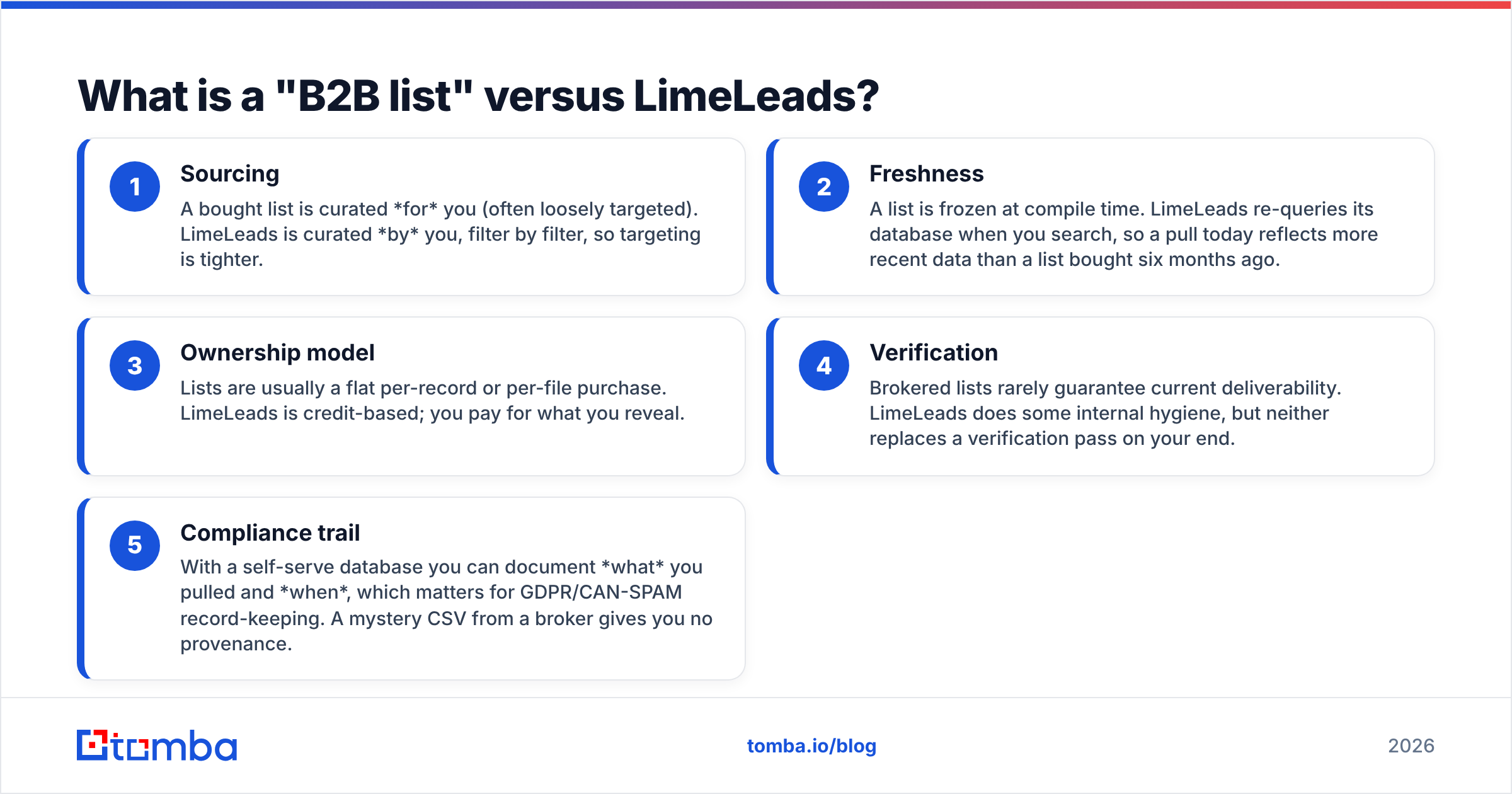
- Sourcing — A bought list is curated for you (often loosely targeted). LimeLeads is curated by you, filter by filter, so targeting is tighter.
- Freshness — A list is frozen at compile time. LimeLeads re-queries its database when you search, so a pull today reflects more recent data than a list bought six months ago.
- Ownership model — Lists are usually a flat per-record or per-file purchase. LimeLeads is credit-based; you pay for what you reveal.
- Verification — Brokered lists rarely guarantee current deliverability. LimeLeads does some internal hygiene, but neither replaces a verification pass on your end.
- Compliance trail — With a self-serve database you can document what you pulled and when, which matters for GDPR/CAN-SPAM record-keeping. A mystery CSV from a broker gives you no provenance.
That provenance gap is exactly where bought lists get teams into trouble. If you can't say where a contact came from, you can't prove consent — and you can't safely scale outreach against it.

How do B2B lists and LimeLeads compare head-to-head?#
Here's the side-by-side most buyers actually need. Numbers reflect typical 2026 market ranges; LimeLeads runs a credit model, so per-record cost depends on plan tier.
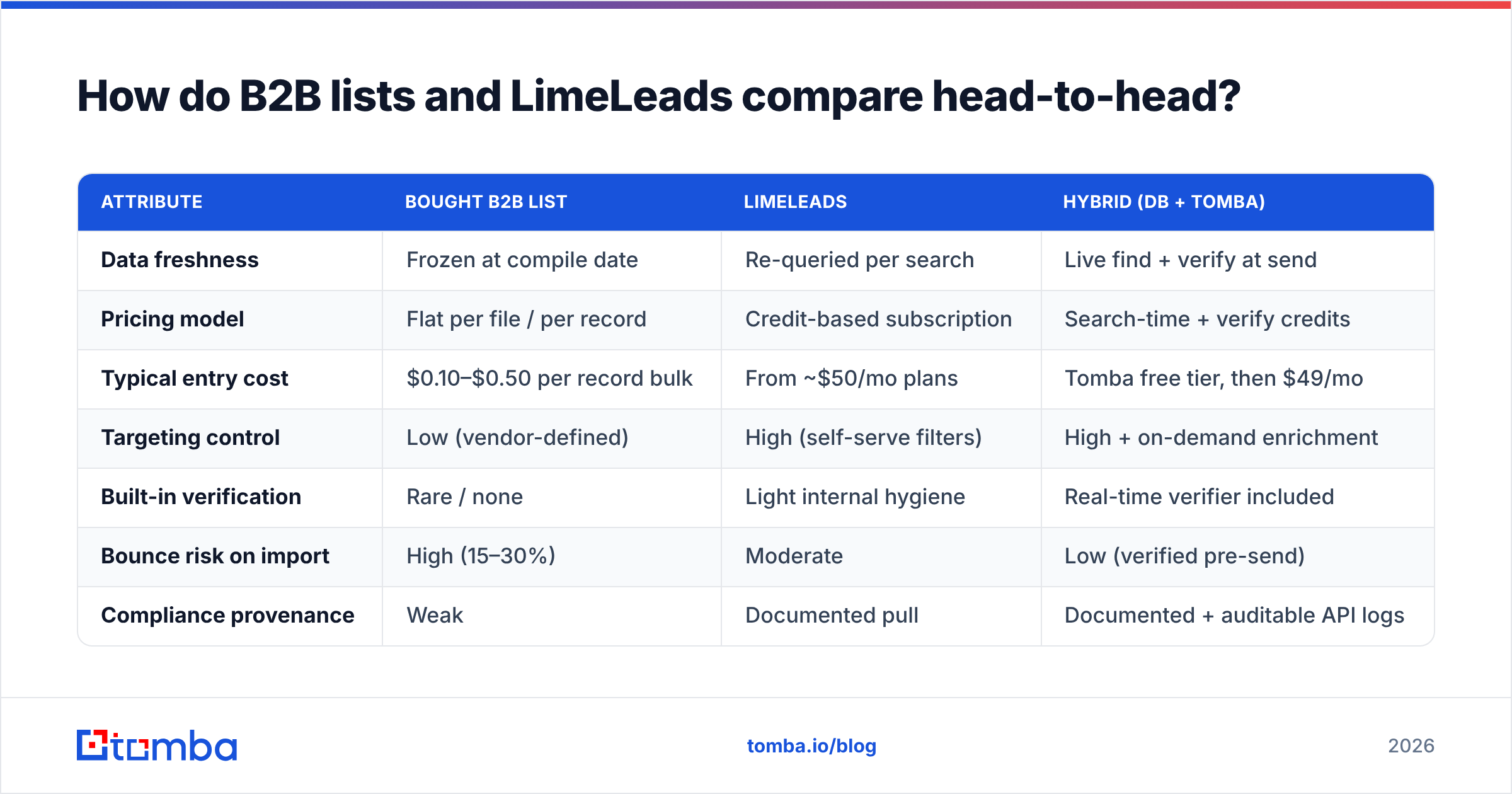
| Attribute | Bought B2B List | LimeLeads | Hybrid (DB + Tomba) |
|---|---|---|---|
| Data freshness | Frozen at compile date | Re-queried per search | Live find + verify at send |
| Pricing model | Flat per file / per record | Credit-based subscription | Search-time + verify credits |
| Typical entry cost | $0.10–$0.50 per record bulk | From ~$50/mo plans | Tomba free tier, then $49/mo |
| Targeting control | Low (vendor-defined) | High (self-serve filters) | High + on-demand enrichment |
| Built-in verification | Rare / none | Light internal hygiene | Real-time verifier included |
| Bounce risk on import | High (15–30%) | Moderate | Low (verified pre-send) |
| Compliance provenance | Weak | Documented pull | Documented + auditable API logs |
| Best for | One-time blast | Repeat self-serve sourcing | Ongoing, deliverability-first outbound |
The pattern is consistent across review sites — browse the LimeLeads category on G2 and you'll see the same trade-off: self-serve databases win on freshness and targeting, static lists win only on raw upfront price.
Which is more accurate in 2026?#
Neither is "accurate" in the sense you want — both need a verification layer. Accuracy in B2B data is a decay problem, not a one-time score.
People change jobs. Gartner and most data vendors converge on roughly 2–2.5% of B2B contacts going stale every month, which compounds to a quarter of any list in a year. A list bought in January is meaningfully wrong by summer. LimeLeads mitigates this because each search hits a database that's been updated since your last pull — but the records you exported last month are just as frozen as any CSV.
This is why the smartest teams treat every exported address as a hypothesis, not a fact. You confirm it right before you send. Tomba's published data sources and on-demand verification exist precisely to close that gap — you don't trust a stored value, you re-check it against live mail-server signals at send time.
If catch-all domains are a big part of your target accounts, that decay problem gets worse, because a standard verifier can't confirm them. A dedicated catch-all verifier is the only way to grade those addresses with any confidence.
What does each actually cost per usable contact?#
The sticker price lies. The number that matters is cost per contact that lands in an inbox and is still employed there.
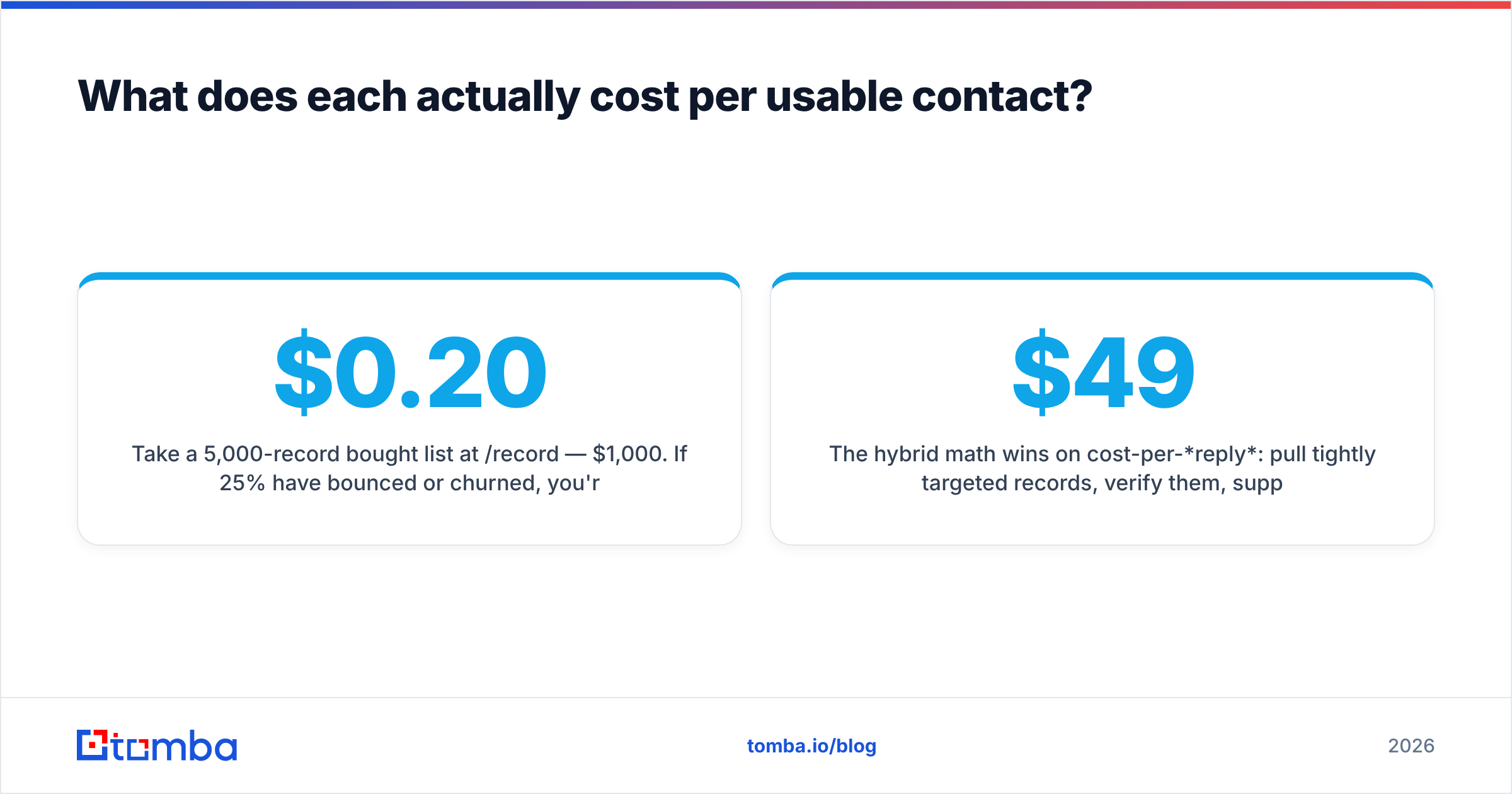
Take a 5,000-record bought list at $0.20/record — $1,000. If 25% have bounced or churned, you're really paying $1,000 for 3,750 usable contacts, or $0.27 each — before you've found a single reply. Worse, sending to that 25% damages your sender reputation, which taxes deliverability on the good 75% too.
LimeLeads' credit model is easier to control because you only reveal what matches your filters, so you waste fewer credits on records you'd never contact. But you still pay for stale reveals you can't tell apart from fresh ones until you verify.
The hybrid math wins on cost-per-reply: pull tightly targeted records, verify them, suppress the dead ones, and send only to confirmed inboxes. Tomba's pricing starts with a free tier of 25 searches/month, then Starter at $49/mo and Growth at $99/mo — and because verification is built in, you're not buying a list and a separate hygiene tool.
Is LimeLeads better than buying a list?#
For most repeat-use cases, yes — but it's the wrong question. The real comparison isn't list-vs-LimeLeads, it's static snapshot vs live lookup.
LimeLeads beats a brokered list on every axis that compounds over time: targeting, freshness, and compliance provenance. If you run outbound more than once a quarter, a self-serve database almost always returns more usable contacts per dollar than a one-off file.
But LimeLeads is still a snapshot tool. The moment you export, you're back to a decaying CSV. That's why pairing any database with a live finder changes the economics. Instead of trusting a stored email, you resolve it on demand:
- Have a name and company but no email? An email finder returns the current address from live sources.
- Have a domain and want the whole team? A domain search maps every reachable contact at that company.
- Have a messy export? Data enrichment fills the gaps — title, company, social — so your CRM isn't full of half-records.
- Building at scale? The Tomba API does all of the above programmatically, with logged provenance for compliance.
When should you still buy a static B2B list?#
Honesty matters here, so here are the cases where a bought list genuinely makes sense:
- A one-time event push — a single webinar or conference blast where you'll never touch the data again and freshness barely matters.
- A market-sizing exercise — you need rough counts of companies in a segment, not deliverable contacts.
- A vertical so niche that no self-serve database covers it and a specialist broker is the only source.
In all three, you should still run the file through verification before any email touches it. A static list isn't dangerous because it's static — it's dangerous when you send to it unverified.
For everything ongoing — recurring outbound, ABM, territory expansion — a queryable B2B database plus live verification beats a list every time.
What does the ideal 2026 data workflow look like?#
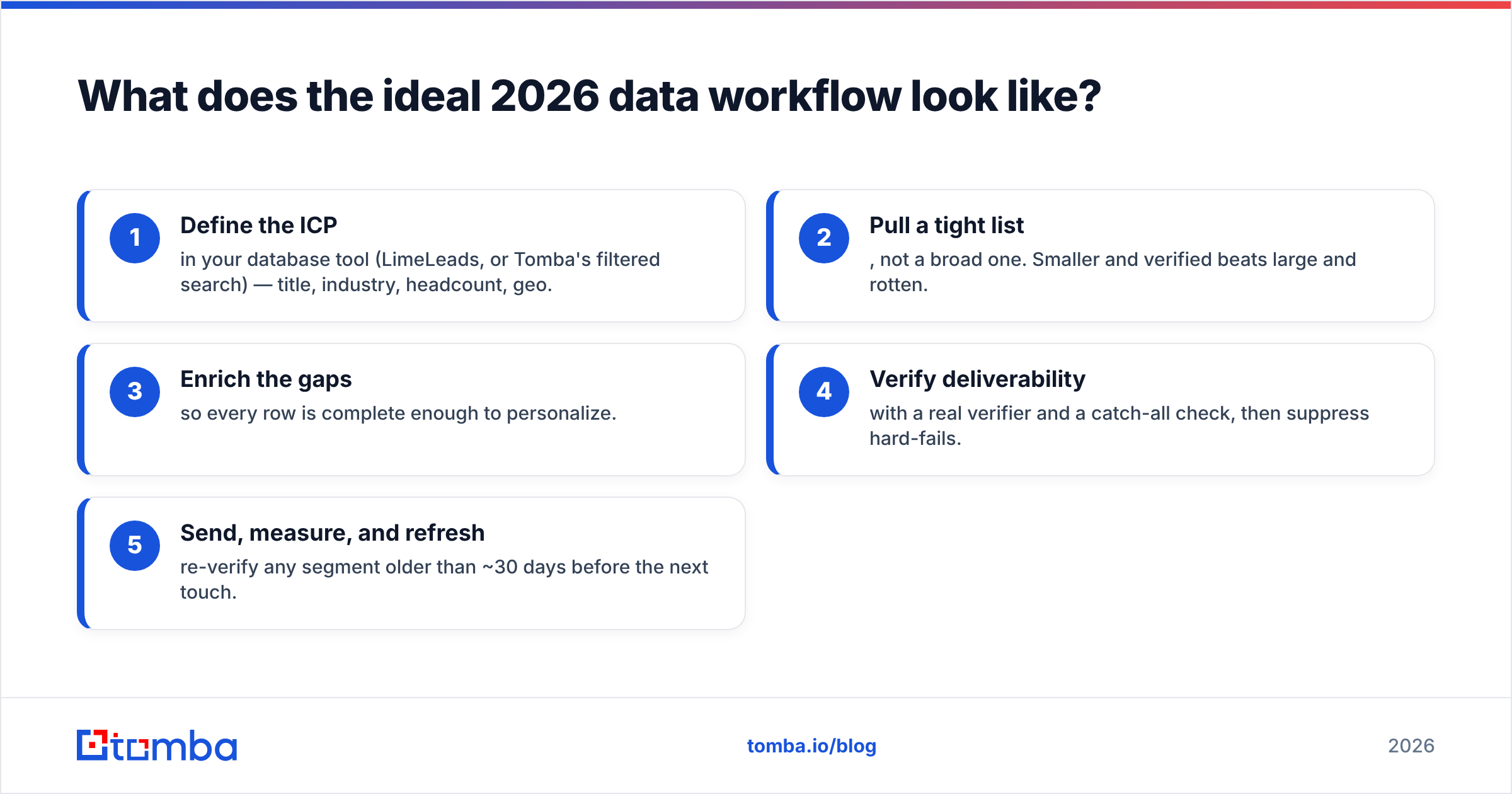
Conclusion first: discover in a database, confirm with a live finder, verify before send, log everything. Here's the sequence:
- Define the ICP in your database tool (LimeLeads, or Tomba's filtered search) — title, industry, headcount, geo.
- Pull a tight list, not a broad one. Smaller and verified beats large and rotten.
- Enrich the gaps so every row is complete enough to personalize.
- Verify deliverability with a real verifier and a catch-all check, then suppress hard-fails.
- Send, measure, and refresh — re-verify any segment older than ~30 days before the next touch.
This is the difference between treating data as a purchase and treating it as a pipeline. Lists and LimeLeads both sell you step 1. The deliverability — the part that actually determines whether you book meetings — lives in steps 3 through 5.
The bottom line#
If you're choosing strictly between a brokered list and LimeLeads, LimeLeads wins for anyone doing outbound more than once: tighter targeting, fresher records, and a compliance trail you can actually defend. A static list only earns its place in one-off, freshness-doesn't-matter scenarios — and even then, verify it first.
But the framing of b2b lists vs limeleads undersells what 2026 outbound needs. Both are snapshots. The teams hitting inbox and booking meetings are the ones who stop trusting stored data and start confirming it at send time.
That's where Tomba fits. Use the Tomba Email Finder to resolve current, verified addresses on demand — by name, company, or domain — with verification and enrichment built into the same workflow and the same $49/mo plan. Start on the free tier with 25 searches, point it at your hardest-to-reach accounts, and compare the bounce rate against your last bought list. The difference shows up in your reply rate within a week.
// get started
Find, verify and enrich your first contacts today
Start on the free plan with 25 searches a month, then scale when your team is ready.
Free plan · No credit card required · GDPR & CCPA
// about the author