B2B Lists vs Oceanio: Which B2B Data Provider Wins in 2026?
B2B Lists sells static contact files; Ocean.io sells lookalike account intelligence. Here's how the two stack up on coverage, accuracy, pricing, and fit — plus the missing piece both leave behind.
Choosing between a bought contact file and an account-intelligence platform is really a choice about how you want to build pipeline — not just who sells the cleaner spreadsheet. B2B Lists and Ocean.io sit on opposite ends of that spectrum, and picking the wrong one wastes both budget and quarters.
TL;DR#
- B2B Lists is a static, pre-packaged contact-file vendor: you buy a CSV (or a managed list build) of names, titles, and emails for a target segment. Cheap to start, fast to deliver, decays fast.
- Ocean.io is a company-data and lookalike platform: you describe an ideal customer, and it surfaces similar accounts plus contacts, with firmographic and technographic filters. Better for repeatable targeting, pricier, account-first.
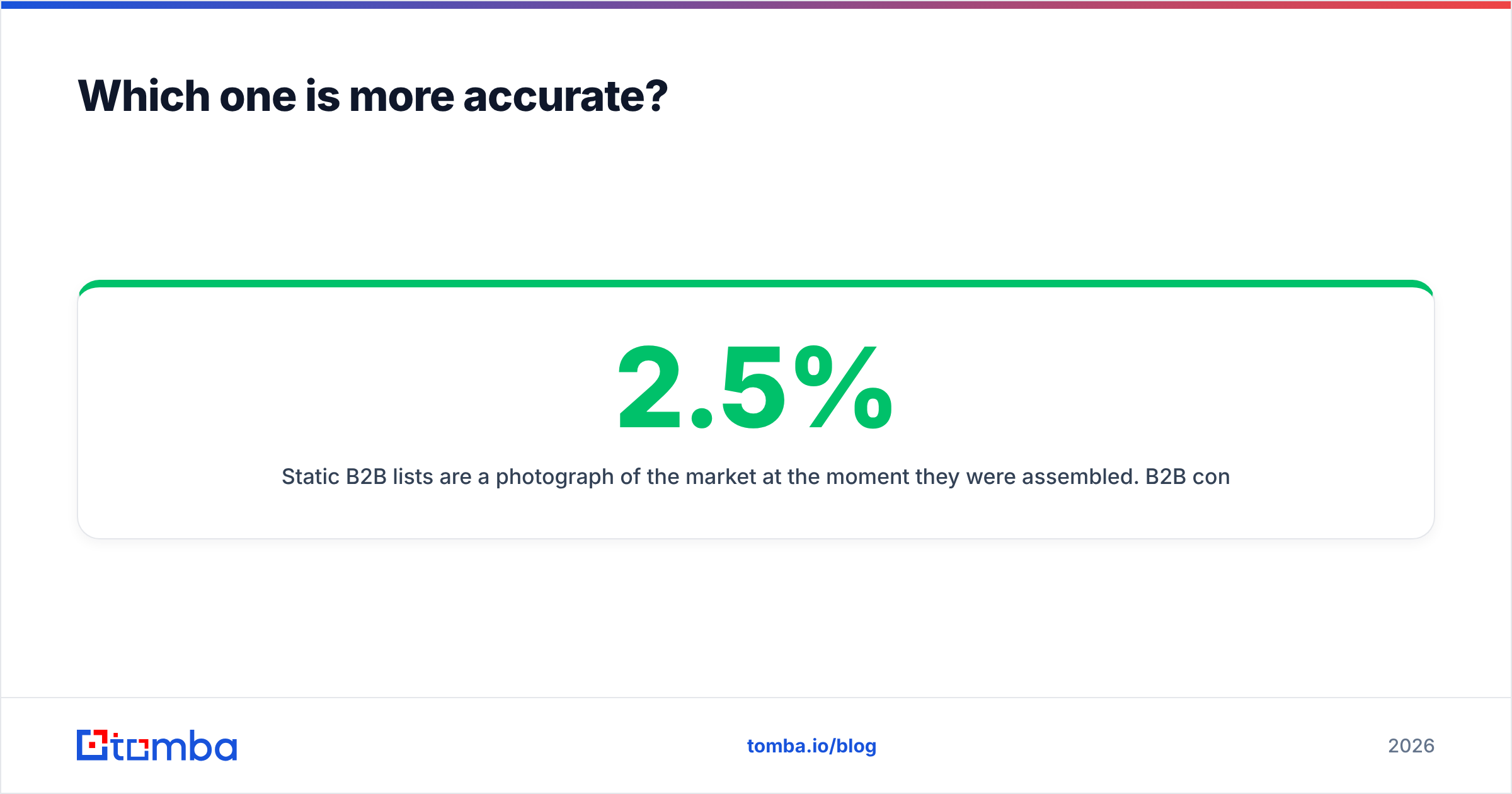
- Accuracy is the real battleground. Pre-built lists rot at roughly 2–2.5% per month; lookalike platforms are fresher but still need verification before you send.
- Neither replaces an email-finder + verifier layer. Whichever you choose, run contacts through a verification step to protect deliverability.
- If you want pay-as-you-go, API-first contact data without a platform contract, a tool like Tomba Email Finder is the lighter-weight third option.
What is B2B Lists?#
B2B Lists is the broad category — and several vendors trade under variations of that name — of pre-compiled contact databases sold as deliverables. You define a segment (say, "VP Marketing at US SaaS companies, 50–500 employees"), and you receive a file: company, contact name, title, email, sometimes phone and LinkedIn URL.
Think of it like buying a bag of pre-cut vegetables. It's fast, it's ready to use tonight, and you didn't have to learn knife skills. The trade-off is freshness — those vegetables were cut days ago, and a B2B list was compiled before you ever saw it.
The model works well when:
- You need volume now and don't have time to build a targeting motion.
- Your ICP is broad and you can tolerate some waste.
- Budget is tight and you want a fixed, predictable cost per record.
The model breaks down when your ICP is narrow, when you re-target the same market every quarter, or when deliverability matters more than raw count — because list decay quietly destroys sender reputation.
What is Ocean.io?#
Ocean.io is a company-data platform built around lookalike search. Instead of handing you a finished file, it lets you feed in your best customers and find statistically similar companies, then layer firmographic, technographic, and headcount-growth filters on top. Contact data sits on top of the account layer.
Continuing the kitchen analogy: Ocean.io isn't pre-cut vegetables — it's a smart grocery app that, after seeing what you cooked last month, suggests the exact produce that fits your recipes and tells you which stores stock it. More work, far better fit.
Ocean.io's strengths:
- Account-first targeting — ideal for ABM and territory planning.
- Lookalike modeling — turns "our 20 best logos" into a ranked list of similar accounts.
- Firmographic + technographic filters — slice by tech stack, growth signals, geography.
- CRM enrichment — push matched accounts into HubSpot or Salesforce.
The cost is real money and a learning curve. You're buying a platform and a workflow, not a one-time file.
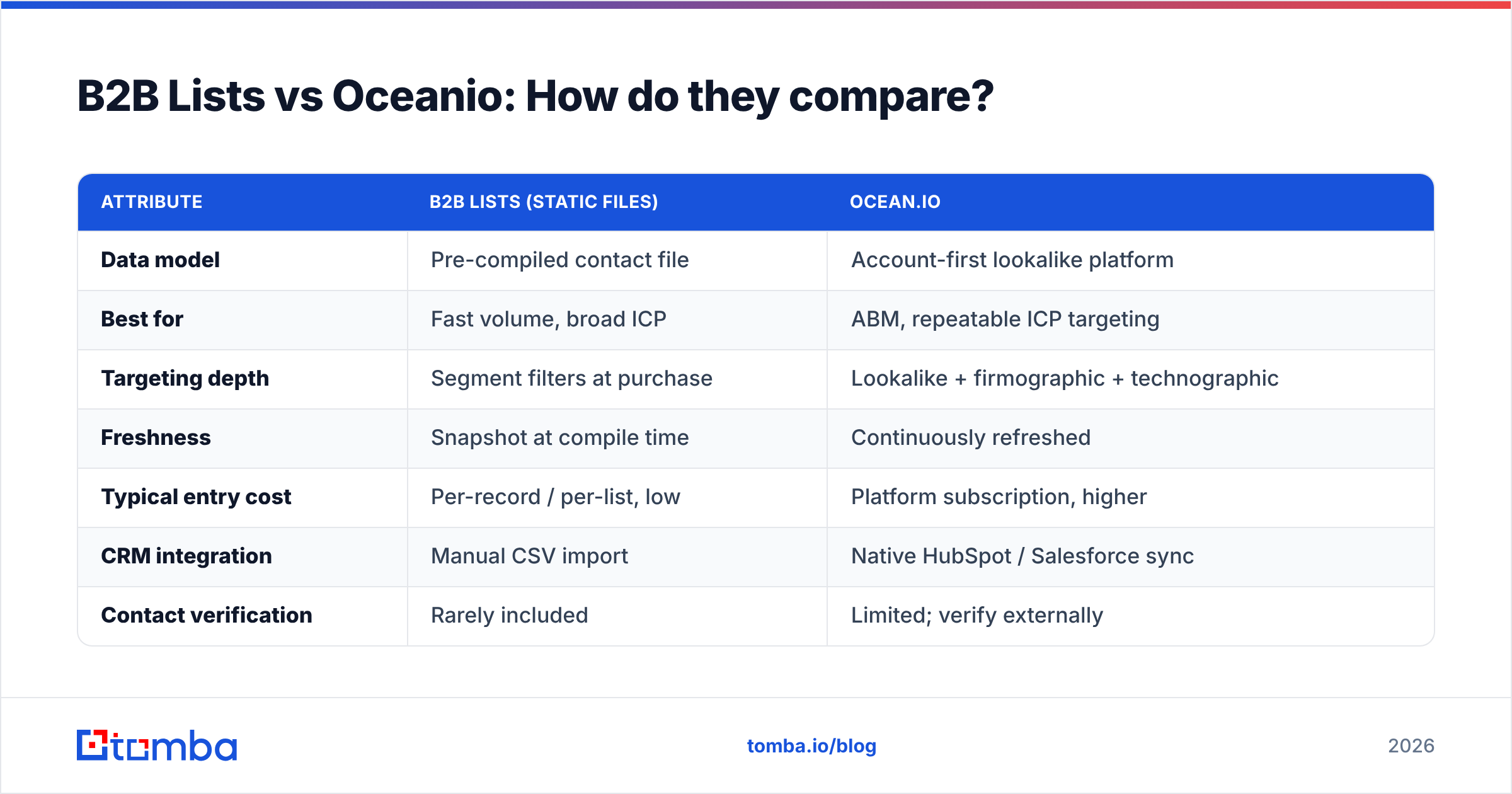
B2B Lists vs Oceanio: How do they compare?#
Here's the head-to-head on the attributes that actually change your results. (Pricing for both varies by contract and region; treat these as directional ranges from public reviews on G2, not quotes.)
| Attribute | B2B Lists (static files) | Ocean.io |
|---|---|---|
| Data model | Pre-compiled contact file | Account-first lookalike platform |
| Best for | Fast volume, broad ICP | ABM, repeatable ICP targeting |
| Targeting depth | Segment filters at purchase | Lookalike + firmographic + technographic |
| Freshness | Snapshot at compile time | Continuously refreshed |
| Typical entry cost | Per-record / per-list, low | Platform subscription, higher |
| CRM integration | Manual CSV import | Native HubSpot / Salesforce sync |
| Contact verification | Rarely included | Limited; verify externally |
| Learning curve | None | Moderate |
| API access | Usually none | Yes |
The pattern is clear: B2B Lists optimizes for speed and cost, Ocean.io for precision and repeatability. Neither optimizes for deliverability out of the box — that's the gap we'll come back to.
Which one is more accurate?#
Ocean.io is fresher, but neither is "send-ready" without verification. Here's why, in plain numbers.
Static B2B lists are a photograph of the market at the moment they were assembled. B2B contact data decays at roughly 2 to 2.5% per month as people change jobs, companies restructure, and domains get retired — so a list that was 95% accurate at compile time can drop below 80% in under a year. If you bought it "fresh" but it was actually built six months ago, you're starting in a hole.
Ocean.io refreshes its account graph continuously, so the firmographic layer stays current. But the contact email on top of any account is still a best-guess at send time, and platform-supplied emails are notorious for catch-all domains that look valid but bounce or black-hole.
This is the part both categories under-serve. Before any address goes into a sequence, it should pass through an email verifier — and catch-all domains specifically need a catch-all verifier that probes deliverability rather than just syntax. Skipping this step is the single fastest way to torch email deliverability and land in spam folders.
What does each cost?#
Cost structure matters as much as the sticker price, because the two vendors charge for fundamentally different things.
- B2B Lists — per-record or per-list. You pay for the deliverable. A one-time file for a niche segment can run a few hundred dollars; managed, recurring list builds cost more. Predictable, but you re-buy every time the data ages out.
- Ocean.io — platform subscription. You pay for seats and credits/contact limits, typically on an annual contract. Higher commitment, but the cost amortizes if you target the same market repeatedly.
- Hidden cost #1 — verification. Both models push the verification bill onto you. Budget for it; bounces are more expensive than verification.
- Hidden cost #2 — wasted sends. Every dead contact you email is a small tax on your domain reputation. Cheap lists with high decay carry the highest hidden cost here.
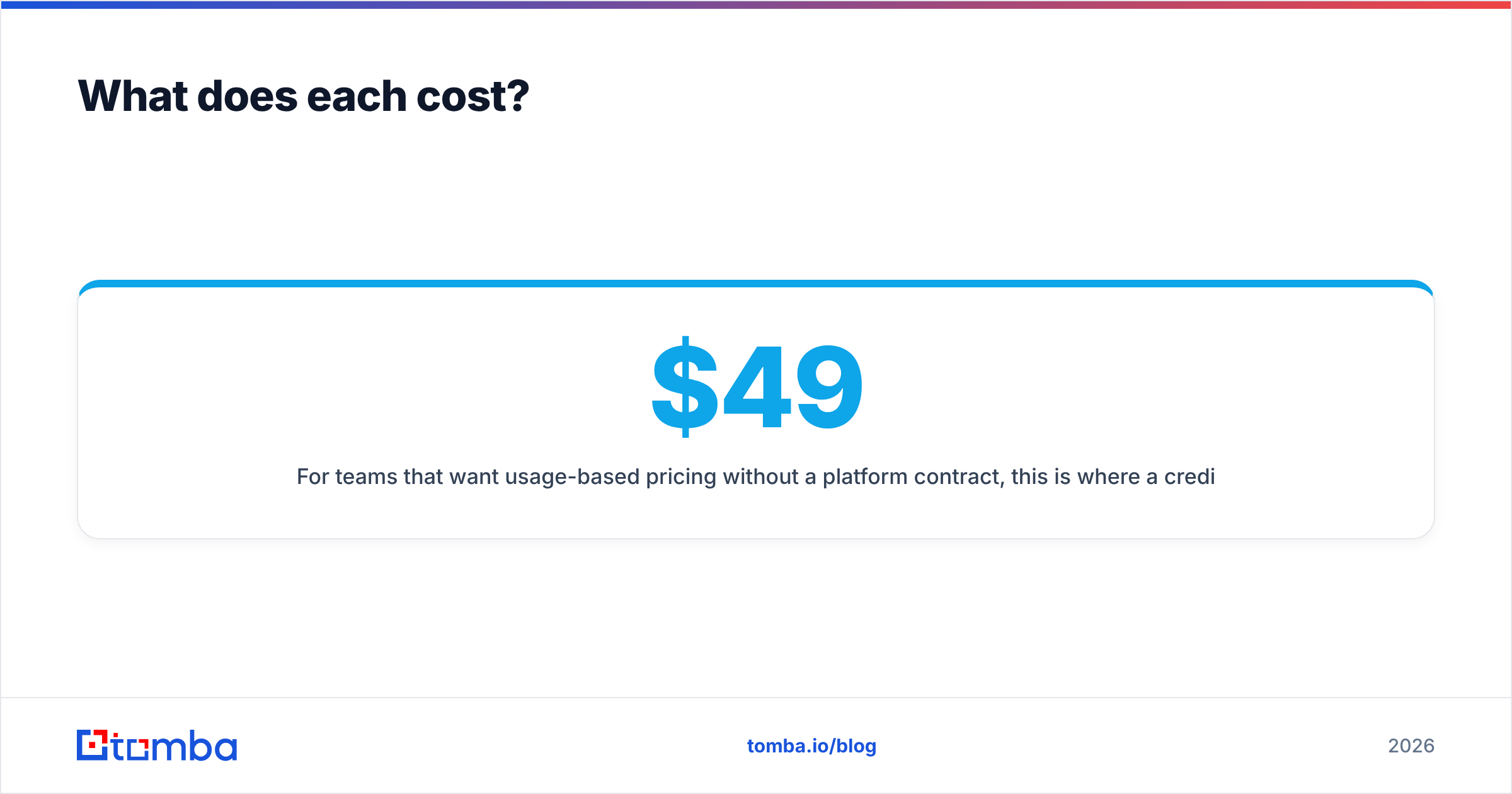
For teams that want usage-based pricing without a platform contract, this is where a credit-based tool changes the math. Tomba pricing starts with a free tier (25 searches/mo), then Starter at $49/mo, Growth at $99/mo, and Pro at $249/mo — so you pay for the contacts you actually pull rather than a seat license or a stale bulk file.
Which should you choose for your GTM motion?#
Match the tool to the motion, not the other way around.
- High-volume, broad outbound, tight budget → B2B Lists. If you're spraying a wide net and can absorb some waste, a static file gets you moving today. Just verify before you send and re-buy on a schedule.
- Account-based marketing, defined ICP, sales + marketing alignment → Ocean.io. If you re-target the same market every quarter and care about fit over raw count, the lookalike model pays back the subscription.
- Lean teams, API-first workflows, precision per contact → an email-finder layer. If your real need is "find and verify the right person at this specific company, on demand," you don't need either a bulk file or a full platform. You need a finder + verifier you can call from a script, a sheet, or your CRM.
That third path is where Tomba fits. Use domain search to pull every contact at a target account, the bulk email finder when you do need volume, and the Tomba API to wire it all into your stack. It complements either B2B Lists or Ocean.io rather than competing head-on: bring the account, Tomba finds and verifies the human.
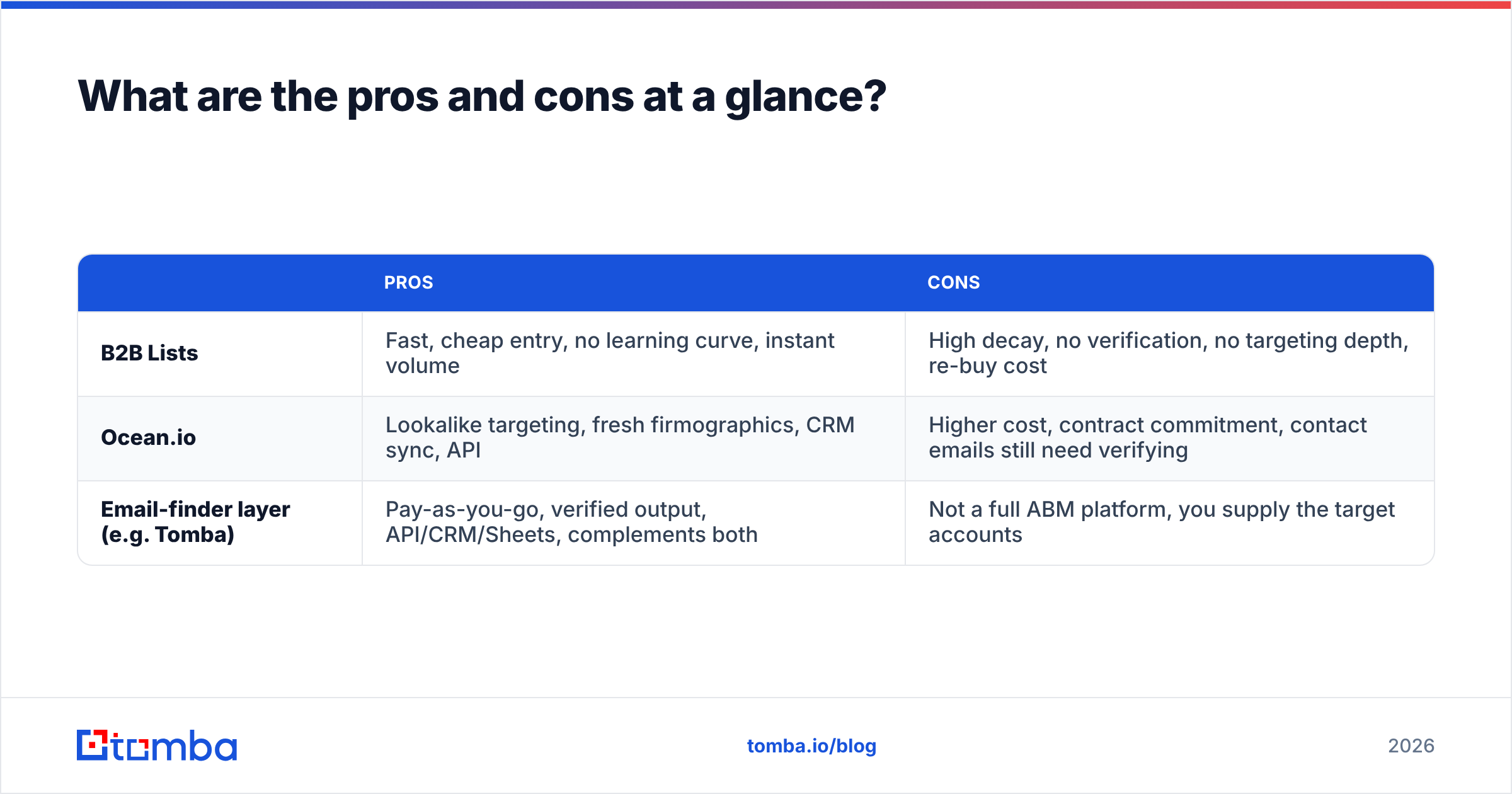
What are the pros and cons at a glance?#
| Pros | Cons | |
|---|---|---|
| B2B Lists | Fast, cheap entry, no learning curve, instant volume | High decay, no verification, no targeting depth, re-buy cost |
| Ocean.io | Lookalike targeting, fresh firmographics, CRM sync, API | Higher cost, contract commitment, contact emails still need verifying |
| Email-finder layer (e.g. Tomba) | Pay-as-you-go, verified output, API/CRM/Sheets, complements both | Not a full ABM platform, you supply the target accounts |
How do you actually combine them?#
Most strong GTM teams in 2026 don't pick one and stop. A common, pragmatic stack looks like this:
- Define accounts with Ocean.io's lookalike model (or a one-time B2B Lists pull if budget is tight).
- Find the right contacts at those accounts with a finder rather than trusting the bundled emails.
- Verify every address through an email verifier and a catch-all check before it touches your sequencer.
- Sync to CRM and enrich the record with data enrichment so reps see firmographics, role, and phone in one place.
- Re-run on a cadence — because, again, the data decays whether you bought a list or modeled an account.
This layered approach means the expensive platform decision (Ocean.io vs a list vendor) becomes less make-or-break: your accuracy comes from the verification layer, not from whichever source you started with.
The bottom line#
B2B Lists wins on speed and price; Ocean.io wins on targeting and freshness — but accuracy is decided by what you do after you get the data. If your motion is broad and budget-driven, start with a list and verify hard. If it's account-based and repeatable, Ocean.io's lookalike engine earns its subscription. Either way, the contacts you send to are only as good as your verification step.
If your real bottleneck is finding and verifying the right people on demand — without a platform contract or a stale bulk file — start free with the Tomba Email Finder. You get 25 searches a month at no cost, verified output, and an API that drops into whatever stack you've already built. Bring the account; let Tomba find the human, confirm the address, and keep your domain reputation intact.
// get started
Find, verify and enrich your first contacts today
Start on the free plan with 25 searches a month, then scale when your team is ready.
Free plan · No credit card required · GDPR & CCPA
// about the author