B2B Lists vs RocketReach: Which Wins for Lead Data in 2026
Static B2B lists are cheap upfront but decay fast. RocketReach finds contacts on demand. Here's an honest, data-driven breakdown of which to trust in 2026 — and a more accurate third option.
You have a sales target and two ways to fill the pipeline: buy a pre-built B2B list, or pull contacts on demand from a tool like RocketReach. Both promise "thousands of decision-makers." Only one of them ages well — and neither is the most accurate option on the market.
This is a neutral, numbers-first breakdown of B2B lists vs RocketReach: what each actually delivers, where each quietly fails, and how to pick based on your motion rather than the marketing.
TL;DR#
- Static B2B lists win on upfront cost-per-record but lose fast to data decay — roughly 2-3% of B2B contacts go stale every month, so a list is worse the day after you buy it.
- RocketReach wins on freshness and self-serve search (it looks contacts up live), but accuracy is inconsistent and credits get expensive at scale.
- For cold outreach, freshness and verification beat volume every time. A 10,000-row list with 30% bounces is worse than 3,000 verified contacts.
- A real-time finder with built-in verification — like Tomba Email Finder — closes the gap by finding and validating in one step.
- Pick by motion: ABM and niche targeting favor on-demand finders; broad, low-ACV blasts sometimes still favor lists. Compliance favors neither blindly.
What's the real difference between a B2B list and RocketReach?#
The short version: a B2B list is a snapshot; RocketReach is a lookup.
Think of it like the difference between a printed phone book and calling directory assistance. The phone book (your purchased list) was accurate the day it went to print and slowly rots on your shelf. Directory assistance (RocketReach) checks a live index when you ask — fresher, but you pay per call and the operator sometimes guesses.
- A purchased B2B list is a CSV or database export you buy once. You own the rows, but they're frozen in time. Job changes, company moves, and email format updates immediately start eroding accuracy.
- RocketReach is a contact-search platform. You search by name, company, or role and it returns emails and phone numbers pulled from its live index, charged against monthly credits.
- The hidden third category is a verification-first email finder. Instead of handing you a stale block of rows or an unverified guess, it finds the address and runs an SMTP-level check before you ever hit send.

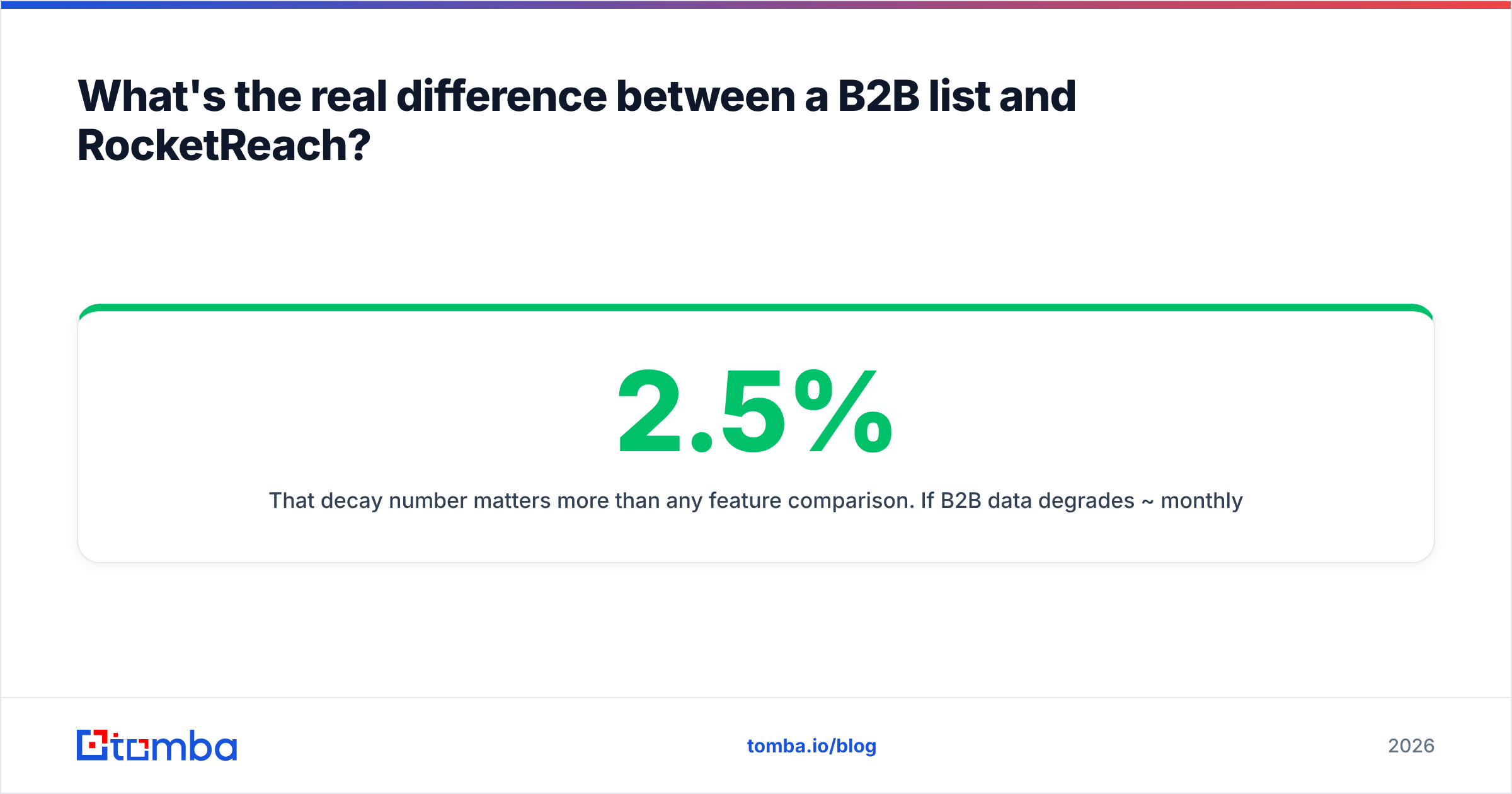
That decay number matters more than any feature comparison. If B2B data degrades ~2.5% monthly, a list that's "95% accurate" at purchase drops below 80% accuracy inside a year — and you have no way to tell which rows died.
How do B2B lists and RocketReach compare on price and accuracy?#
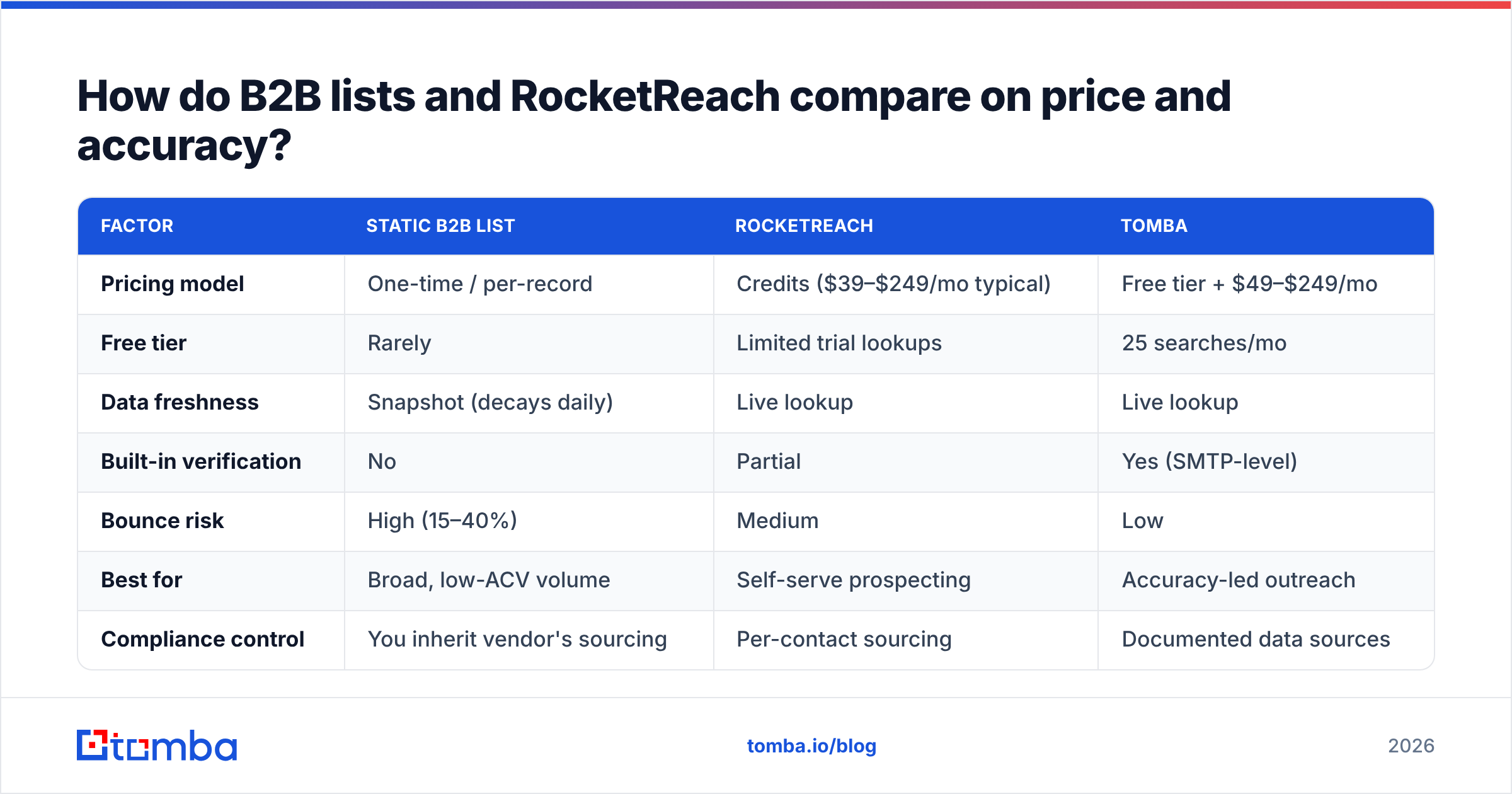
Here's the honest side-by-side. Numbers for list vendors are typical market ranges; RocketReach reflects its published self-serve tiers; Tomba reflects its public pricing.
| Factor | Static B2B List | RocketReach | Tomba |
|---|---|---|---|
| Pricing model | One-time / per-record | Credits ($39–$249/mo typical) | Free tier + $49–$249/mo |
| Free tier | Rarely | Limited trial lookups | 25 searches/mo |
| Data freshness | Snapshot (decays daily) | Live lookup | Live lookup |
| Built-in verification | No | Partial | Yes (SMTP-level) |
| Bounce risk | High (15–40%) | Medium | Low |
| Best for | Broad, low-ACV volume | Self-serve prospecting | Accuracy-led outreach |
| Compliance control | You inherit vendor's sourcing | Per-contact sourcing | Documented data sources |
A few things stand out. First, the "cheap" list is only cheap if you ignore bounce cost — every hard bounce dents your sender reputation, and a 30% bounce rate can get a sending domain throttled or blocked. Second, RocketReach and Tomba both look data up live, so the real differentiator between them is verification depth, not freshness.
If your primary worry is deliverability, run found addresses through an email verifier before the first send regardless of which source you choose. The cheapest insurance in cold email is not sending to a dead inbox.
Is RocketReach better than buying a B2B list?#
For most modern outbound teams, yes — but with caveats.
RocketReach beats a static list on the dimensions that actually drive replies:
- Freshness. Because it queries live, you're not inheriting a 9-month-old snapshot. The job-change problem that wrecks purchased lists is far smaller.
- Targeting precision. You pull exactly the 200 contacts you need this week instead of paying for 50,000 rows where 80% are out of ICP.
- Self-serve speed. Reps find and export contacts inside their own workflow rather than waiting on a data-ops handoff.
- Compliance traceability. Per-contact lookups are easier to defend than a bulk list whose origins the vendor won't fully disclose.
Where purchased lists still hold ground:
- Raw cost at extreme volume. If you're sending low-stakes, high-volume campaigns and accept the bounce risk, per-record list pricing can undercut credits.
- Offline or enrichment use. A list you own can be loaded into a warehouse and joined against firmographics without per-lookup metering.
But "RocketReach beats lists" is the wrong finish line. The better question is whether RocketReach beats a finder that verifies as it goes — and on accuracy, that's where it gets squeezed. RocketReach returns addresses with a confidence label; a verification-first tool returns addresses it has actually pinged. Those are different guarantees.
What does data decay actually cost you?#
This is the part list vendors don't put on the pricing page.
When you compare email finder accuracy across sources, the variable that dominates isn't the find rate at purchase — it's how fast the data rots and whether anything verifies it before you send.

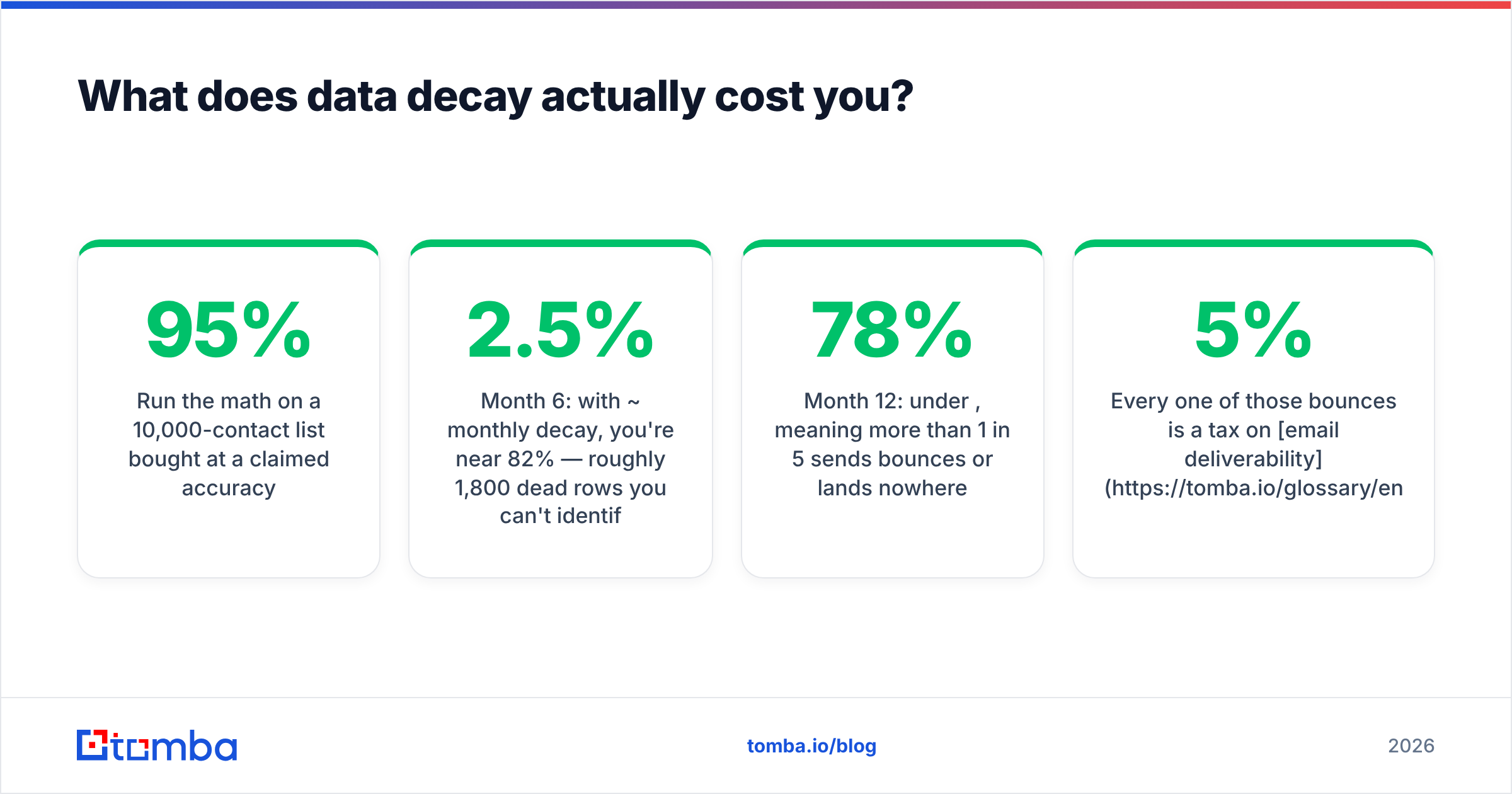
Run the math on a 10,000-contact list bought at a claimed 95% accuracy:
- Month 0: ~9,500 good addresses, 500 already wrong.
- Month 6: with ~2.5% monthly decay, you're near 82% — roughly 1,800 dead rows you can't identify.
- Month 12: under 78%, meaning more than 1 in 5 sends bounces or lands nowhere.
Every one of those bounces is a tax on email deliverability. Mailbox providers read bounce rate as a spam signal. Cross 5% and you're flirting with throttling; cross 10% and your warmup work unravels. So the "cheap" list quietly raises the cost of every other email you send from that domain.
RocketReach sidesteps the decay problem by looking up fresh — but if the returned address was never SMTP-verified, you've traded stale-and-known for fresh-and-unconfirmed. A catch-all domain, for example, will happily accept any address at the SMTP layer, so you need a dedicated catch-all verifier to know whether the mailbox is real. That's exactly the gap a verification-first finder is built to close.
Where does Tomba fit between lists and RocketReach?#
Tomba is the on-demand finder that treats verification as part of finding, not an upsell. It's the answer to the accuracy problem both other options leave open.
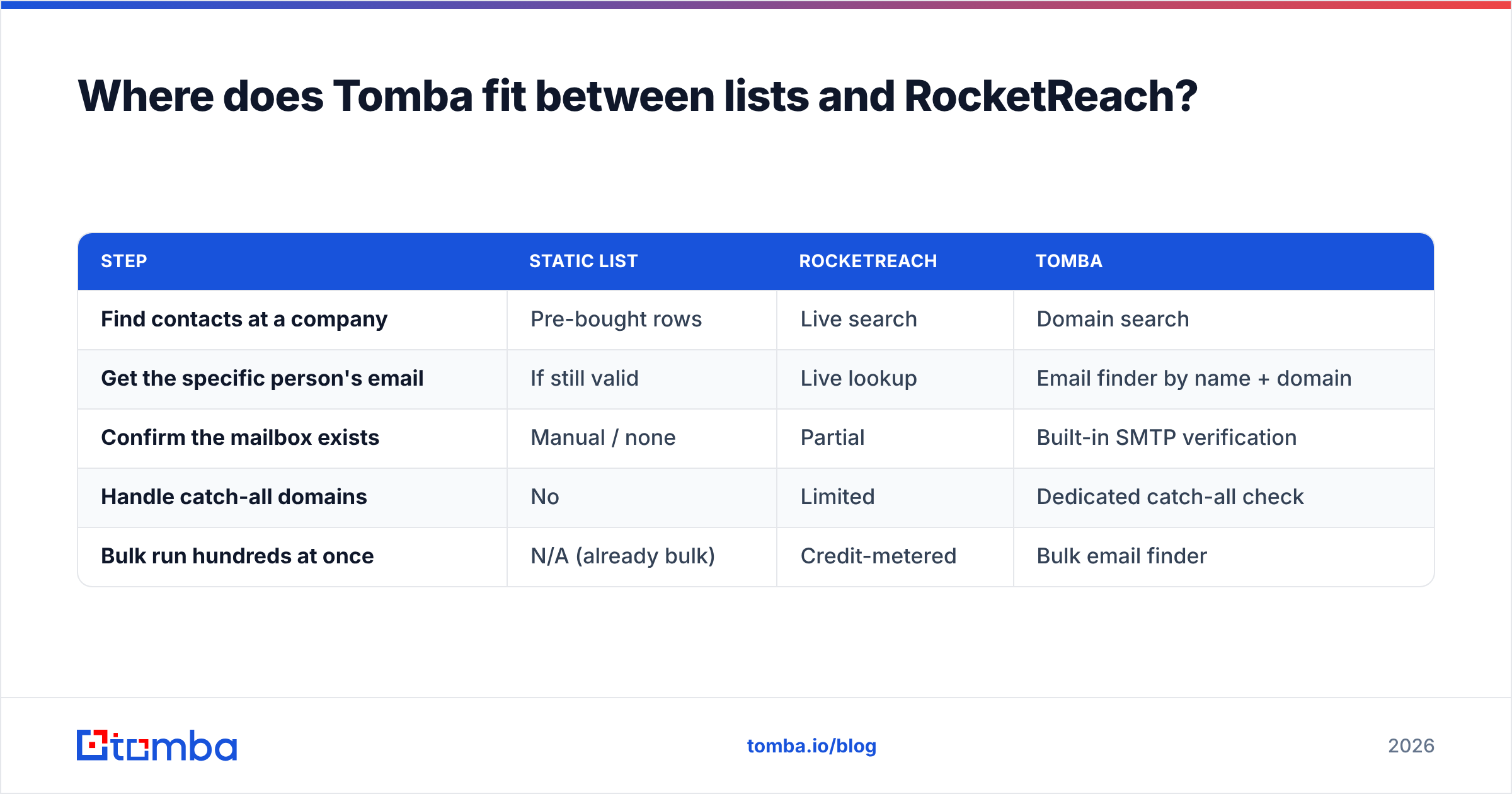
Here's how the three approaches line up on the workflow that matters — going from "I know the company" to "I have a deliverable address."
| Step | Static List | RocketReach | Tomba |
|---|---|---|---|
| Find contacts at a company | Pre-bought rows | Live search | Domain search |
| Get the specific person's email | If still valid | Live lookup | Email finder by name + domain |
| Confirm the mailbox exists | Manual / none | Partial | Built-in SMTP verification |
| Handle catch-all domains | No | Limited | Dedicated catch-all check |
| Bulk run hundreds at once | N/A (already bulk) | Credit-metered | Bulk email finder |
Tomba's stack also covers the parts of prospecting a static list can't touch: a phone finder for multichannel sequences, data enrichment to fill firmographic gaps, and an email finder API so the whole thing runs inside your CRM or sequencer instead of a manual export-import dance.
On price, Tomba's free tier (25 searches/mo) lets you test accuracy on your own ICP before paying — something no list vendor offers, since you can't return a CSV once you've seen it. Paid plans run Starter at $49/mo, Growth at $99/mo, and Pro at $249/mo, which sits in the same band as RocketReach's self-serve tiers while bundling verification in rather than charging for it separately.
When should you still buy a B2B list?#
Being fair to lists: they aren't dead, they're just narrow.
Buy a static list when all of these are true:
- Your ACV is low and your volume is enormous. The economics of per-record pricing only beat per-lookup when you genuinely need tens of thousands of rows and accept higher bounce risk.
- You'll verify before sending anyway. A list is a raw input. Pipe it through verification and dedupe it with a tool like Tomba's before the first send, and you neutralize the worst of the decay problem.
- The data feeds a warehouse, not a sender. For analytics, TAM sizing, or enrichment joins, owning the rows beats metered lookups.
- The vendor discloses sourcing. If they can't tell you where contacts came from and how consent was handled, the compliance liability outweighs the savings.
Use an on-demand finder (RocketReach or, for accuracy, Tomba) when you're running real cold outreach, doing account-based targeting, or simply can't afford the deliverability hit of a stale file. For most teams in 2026, that's the default.
How do I evaluate any of these before committing?#
Don't trust accuracy claims — test them on contacts you can verify yourself.
- Pick 50 known-good contacts at companies you already do business with. You know their real emails.
- Run the same 50 through each source — your prospective list sample, RocketReach, and Tomba's free tier.
- Measure two numbers: find rate (did it return an address?) and accuracy (was it the right address?). The gap between those two is where bounces hide.
- Send a verification pass on every result. A source with a 90% find rate but a 70% verified rate is a bounce machine in disguise.
- Check compliance docs. Read how each vendor sources and lets contacts opt out. For Tomba, that's spelled out in its data sources page.
This 30-minute test tells you more than any vendor benchmark, because it's run on your ICP, which is the only data quality that matters to your numbers.

For broader context on the category, third-party review sites like G2's lead intelligence grid and Capterra aggregate real user reports on accuracy and support — useful for sanity-checking any single vendor's claims, including this one.
The verdict: which wins?#
On freshness, RocketReach beats a static list. On accuracy, a verification-first finder beats both.
- Choose a static B2B list only for high-volume, low-ACV, warehouse, or enrichment use — and verify before you send.
- Choose RocketReach for fast, self-serve, on-demand prospecting where freshness matters more than guaranteed deliverability.
- Choose a verification-first finder when bounce rate, sender reputation, and reply rate are the metrics you're actually paid on.
The thread running through all of it: in cold outreach, the expensive mistake isn't paying a few cents more per contact — it's sending to addresses that don't exist and dragging your whole domain down with them.
If accuracy and deliverability are what you're optimizing for, start with the Tomba Email Finder. Find the contact, verify the mailbox, and export a clean, deliverable list — in one pass, on a free tier you can test against your own accounts before you spend a dollar. Find fewer dead emails, send to more real inboxes, and let your sender reputation do the compounding for you.
// get started
Find, verify and enrich your first contacts today
Start on the free plan with 25 searches a month, then scale when your team is ready.
Free plan · No credit card required · GDPR & CCPA
// about the author