B2B Lists vs Salesbot: Which Wins Pipeline in 2026?
Static B2B lists or an automated salesbot? We break down cost, accuracy, speed, and ROI so you know exactly where your pipeline budget should go in 2026.
You have a quota to hit and two ways to spend the budget: buy a B2B contact list, or deploy a salesbot that finds, messages, and qualifies prospects on autopilot. They sound like competing answers to the same question, but they solve different problems — and picking the wrong one quietly burns both money and sender reputation.
This guide compares b2b lists vs salesbot on the dimensions that actually move pipeline: data freshness, cost per qualified meeting, speed to first touch, compliance risk, and where each one breaks down at scale.
TL;DR#
- B2B lists are static snapshots of contact data — fast to buy, but they decay roughly 2–2.5% per month and put the entire outreach workload on your team.
- Salesbots are automated agents that prospect, personalize, and follow up continuously — great for speed, but only as good as the data feeding them.
- The "versus" framing is mostly false: a salesbot running on a stale purchased list produces stale automated spam at scale.
- The winning 2026 stack is fresh, verified data on demand (via API or enrichment) feeding a tightly-scoped automation layer.
- Lead with accuracy. A 95%+ verified source like Tomba beats both a cheap bulk list and a flashy bot that emails dead inboxes.
What is a B2B list and what is a salesbot?#
A B2B list is a pre-compiled file of company and contact records — names, titles, emails, phone numbers, firmographics — usually sold per record or per package. You buy it, import it into your CRM, and start working it manually or through your sequencer.
A salesbot is software that automates the prospecting motion itself. Depending on the vendor, "salesbot" can mean a website chatbot that qualifies inbound visitors (like HubSpot's Salesbot), or an AI outbound agent that scrapes targets, writes personalized messages, sends sequences, and books meetings with minimal human input.
Here's the core distinction in plain terms: a B2B list is inventory, a salesbot is labor. One gives you raw contacts; the other does work with contacts. Comparing them directly is a bit like asking whether you should buy groceries or hire a cook — the honest answer depends on what's already in your kitchen.
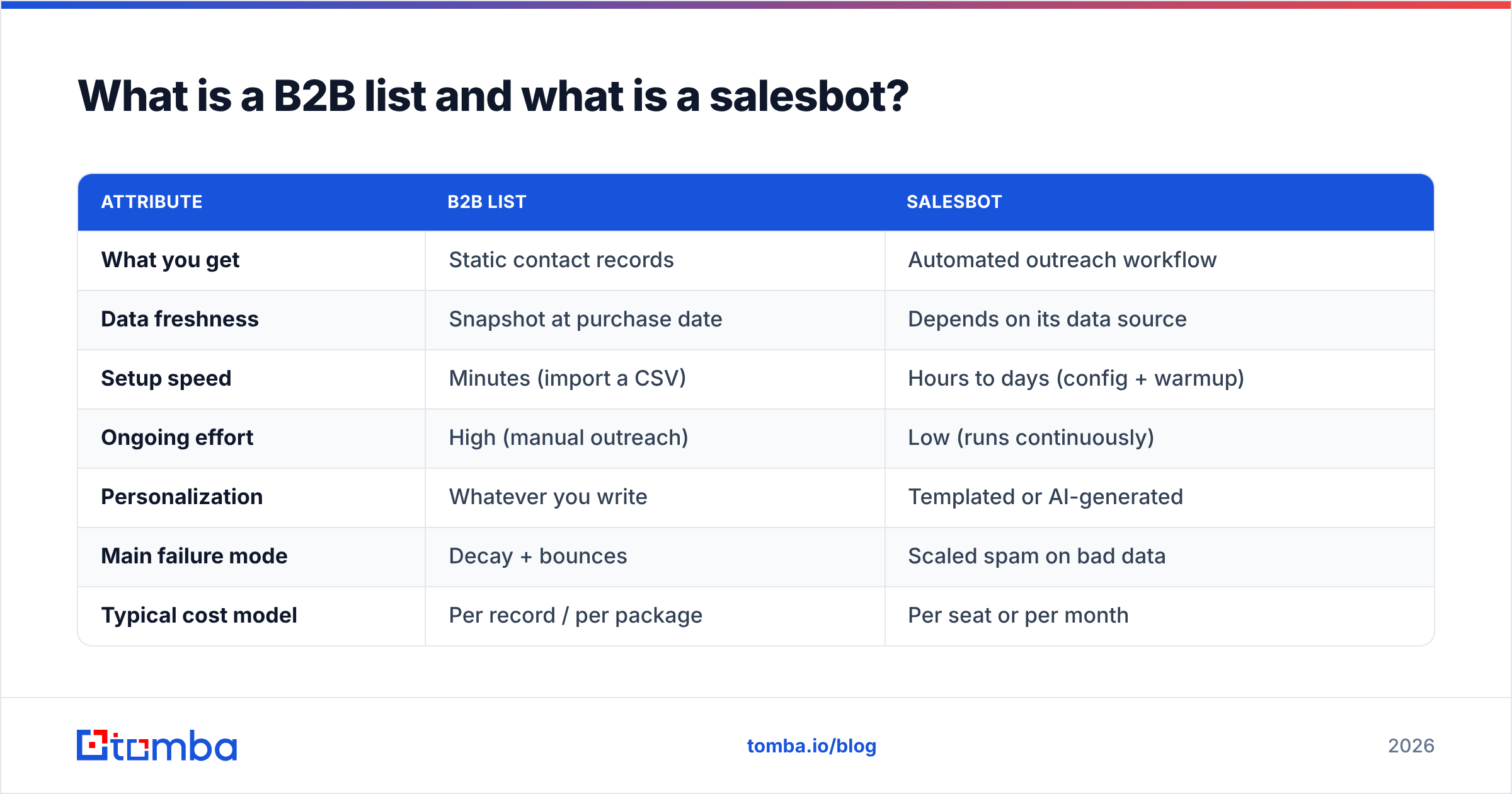
| Attribute | B2B List | Salesbot |
|---|---|---|
| What you get | Static contact records | Automated outreach workflow |
| Data freshness | Snapshot at purchase date | Depends on its data source |
| Setup speed | Minutes (import a CSV) | Hours to days (config + warmup) |
| Ongoing effort | High (manual outreach) | Low (runs continuously) |
| Personalization | Whatever you write | Templated or AI-generated |
| Main failure mode | Decay + bounces | Scaled spam on bad data |
| Typical cost model | Per record / per package | Per seat or per month |
Why do B2B lists decay so fast?#
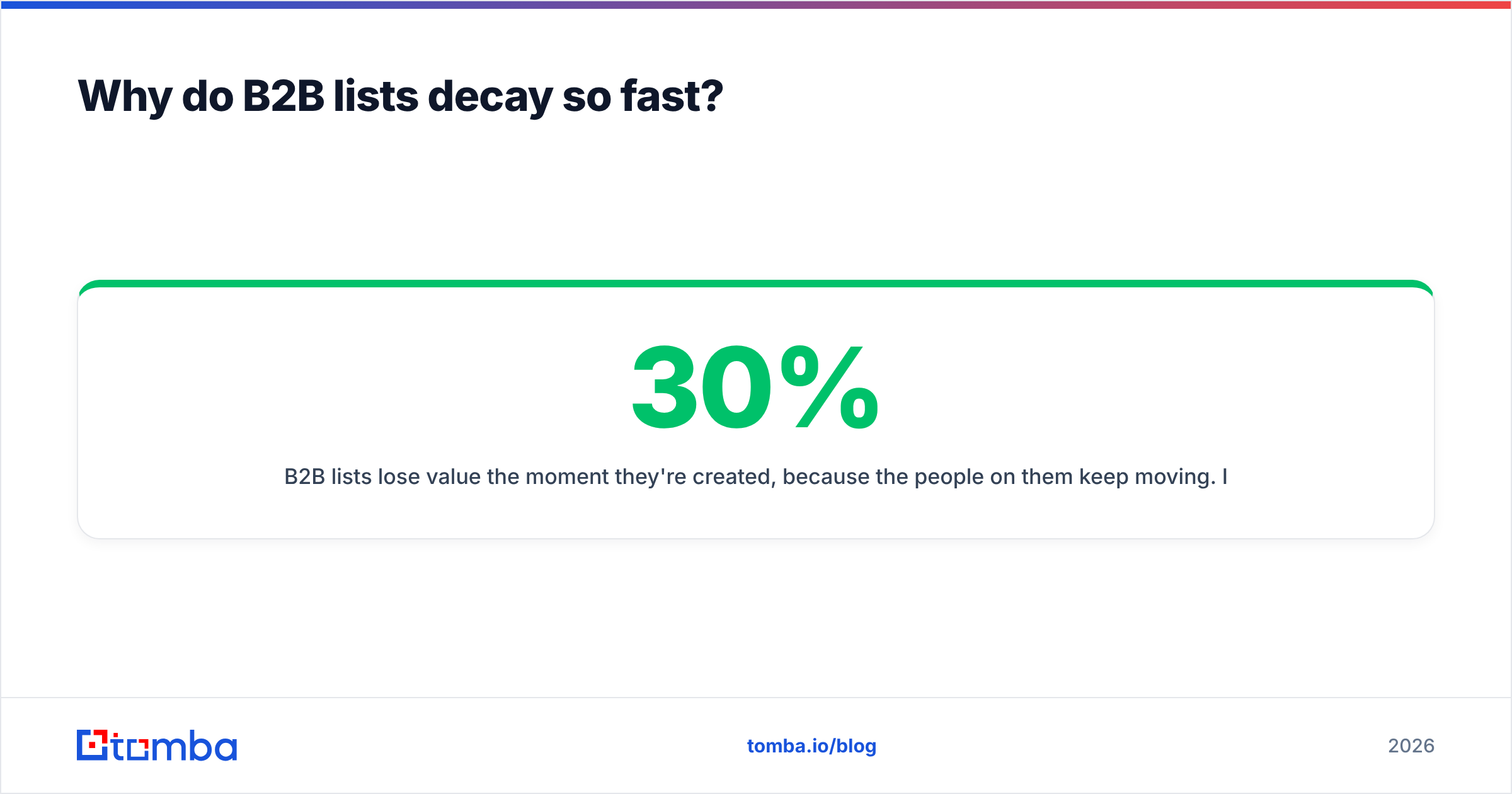
B2B lists lose value the moment they're created, because the people on them keep moving. Industry data consistently puts B2B contact decay at about 22.5–30% per year — roughly 2% to 2.5% every month — driven by job changes, promotions, company switches, and domain migrations.
That decay shows up as three hidden costs:
- Bounce rate — Dead inboxes spike your hard-bounce rate. Mailbox providers read that as a low-quality sender and start routing you to spam.
- Wasted rep time — Every call to a disconnected number or email to a former employee is paid time producing nothing.
- Reputation damage — Once your sender reputation drops, even your good emails underperform. The damage outlives the bad list.
A purchased list also says nothing about intent. You bought 10,000 records; you have no idea which 200 are actually in-market this quarter. That's the gap automation is supposed to close — but automation can't fix data it was never given.
Can a salesbot fix bad data? (No — and here's why)#
A salesbot amplifies whatever you feed it. Point it at a fresh, verified, well-segmented dataset and it multiplies your reps' reach. Point it at a stale purchased list and it sends thousands of irrelevant, undeliverable messages faster than any human could — torching your domain in the process.
This is the trap most teams fall into in the b2b lists vs salesbot debate. They treat the bot as a substitute for data quality when it's actually a multiplier of data quality, in both directions.
Three concrete risks of running a salesbot on a low-quality list:
- Deliverability collapse. High bounce volume plus spam complaints can blacklist your sending domain. Check yours with a blacklist checker before and during any automated campaign.
- Compliance exposure. GDPR, CAN-SPAM, and CCPA all assume you can justify why you contacted someone. Scraped or resold lists with no provenance make that hard. Gartner's guidance on B2B data governance is blunt about sourcing risk.
- Brand erosion. Obvious mass-bot messaging trains your ICP to ignore your name. The cost isn't one campaign — it's every future campaign.
The fix isn't "don't automate." It's "automate on data you trust."
B2B lists vs salesbot: which is cheaper per meeting?#
Sticker price is the wrong metric. The number that matters is cost per qualified meeting, and that depends on data accuracy far more than on which tool you bought.
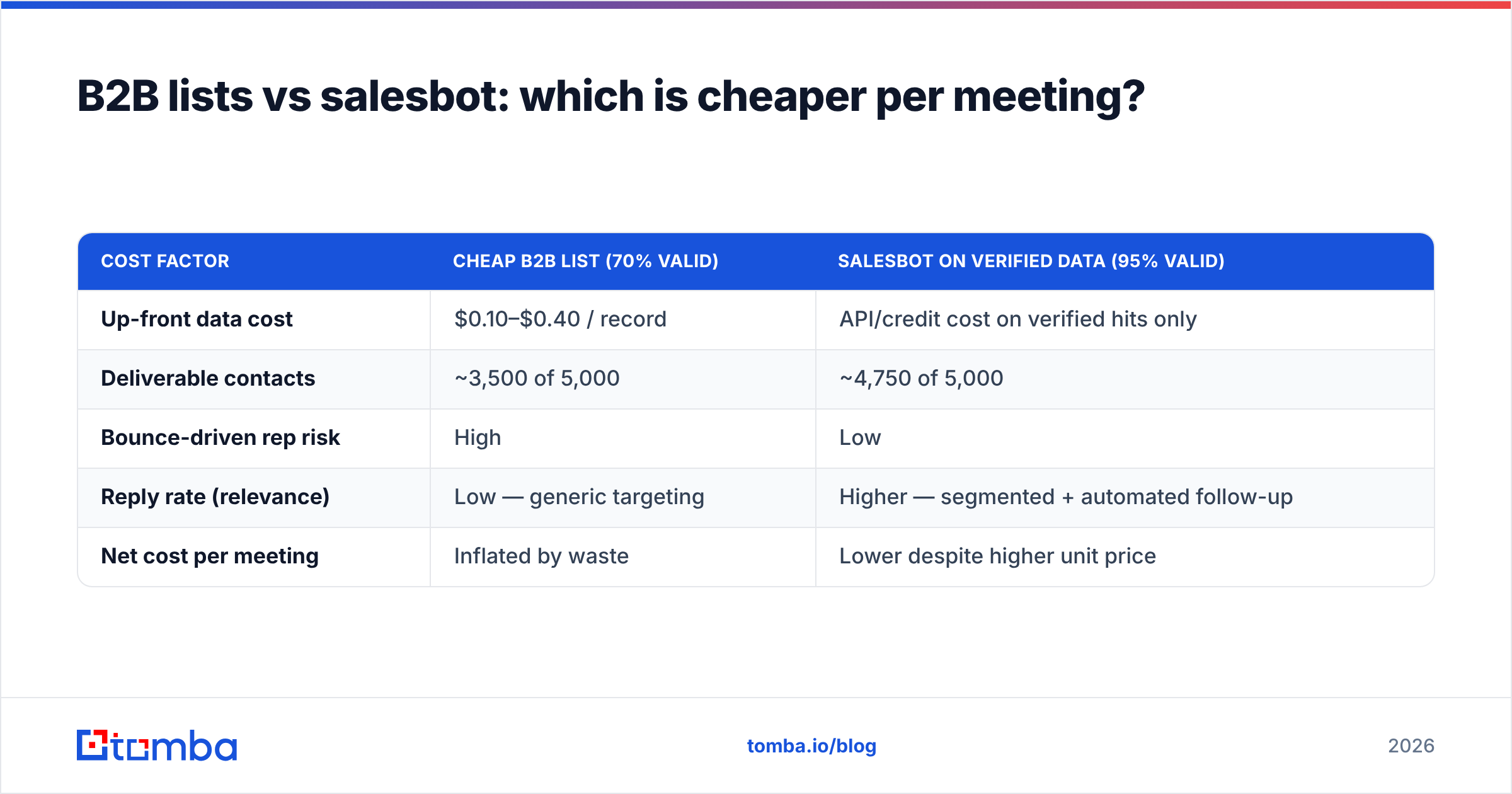
Run the math on a 5,000-contact campaign:
| Cost factor | Cheap B2B list (70% valid) | Salesbot on verified data (95% valid) |
|---|---|---|
| Up-front data cost | $0.10–$0.40 / record | API/credit cost on verified hits only |
| Deliverable contacts | ~3,500 of 5,000 | ~4,750 of 5,000 |
| Bounce-driven rep risk | High | Low |
| Reply rate (relevance) | Low — generic targeting | Higher — segmented + automated follow-up |
| Net cost per meeting | Inflated by waste | Lower despite higher unit price |
The "cheap" list is rarely cheaper once you price in bounces, rep hours, and reputation repair. A 95%-deliverable source with data enrichment wins on the only line that matters: meetings booked per dollar.
That's also why a salesbot is only as economical as its inputs. Feed it verified contacts pulled fresh via the Tomba API and the per-meeting cost drops; feed it a resold list and the bot just spends your money faster.
When should you use each one?#
Neither approach is universally right. Match the tool to the situation.
Use a B2B list when:
- You need volume immediately for a one-off event push or a market test and accept the decay.
- You have strong manual personalization — a small SDR team that researches each account by hand.
- Your TAM is tiny and you'd rather hand-pick 200 accounts than automate.
Use a salesbot when:
- Your motion is repeatable — similar personas, predictable triggers, high volume.
- You can feed it verified, segmented data rather than a generic dump.
- Follow-up discipline is your bottleneck — bots never forget the third touch.
- You can monitor deliverability continuously and pause on warning signs.
Use both (the real 2026 answer) when: you want the bot's scale and the list's immediacy — sourced from a single fresh, verified data layer instead of a purchased file.
What does the modern stack actually look like?#
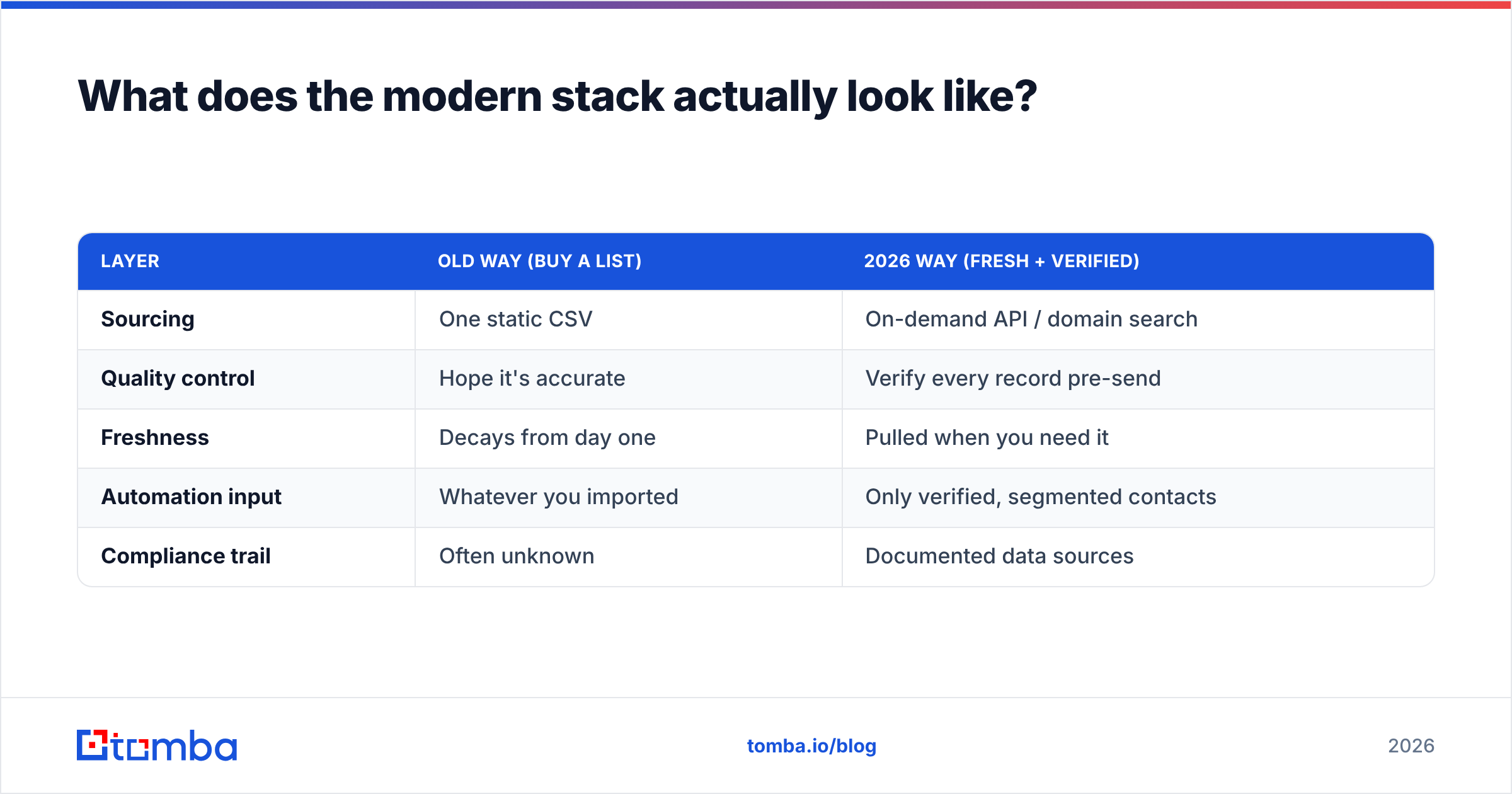
The teams winning in 2026 stopped buying lists or buying bots. They build outreach on three layers:
- A verified data source — pulled on demand, not bought as a frozen file. Use a domain search to map a target company's contacts, an email finder to get the right person, and a bulk email finder when you need to populate a whole segment at once.
- A verification gate — every address checked before send, so the bot never burns reputation on bad inboxes. Catch-all domains get special handling via a catch-all verifier.
- A scoped automation layer — the salesbot, sequencer, or chatbot that does the outreach, fed exclusively by layers 1 and 2.
This is the difference between "list vs bot" thinking and "pipeline system" thinking. The data isn't a one-time purchase; it's a live feed. Tomba's plans are built around exactly this — see the Tomba pricing tiers for how credit-based, verify-as-you-go sourcing replaces the buy-a-list model.
| Layer | Old way (buy a list) | 2026 way (fresh + verified) |
|---|---|---|
| Sourcing | One static CSV | On-demand API / domain search |
| Quality control | Hope it's accurate | Verify every record pre-send |
| Freshness | Decays from day one | Pulled when you need it |
| Automation input | Whatever you imported | Only verified, segmented contacts |
| Compliance trail | Often unknown | Documented data sources |
Vendors are rated on exactly these axes — you can sanity-check any provider's reputation on G2's lead intelligence category before committing budget.
How do you measure if it's working?#
Whatever you choose, instrument it. The metrics that tell you the truth:
- Bounce rate — keep hard bounces under 2%. Above that, your data (not your copy) is the problem.
- Deliverability rate — what share of sent mail actually lands in the inbox. Track email deliverability as a first-class KPI, not an afterthought.
- Reply and positive-reply rate — volume means nothing if nobody answers; segment quality drives this.
- Cost per qualified meeting — the single number that settles the b2b lists vs salesbot debate for your specific motion.
- Sender reputation score — monitor it continuously; it's the leading indicator of everything else.
If your bot is sending more but your reply rate is falling, you don't have an automation problem — you have a data problem wearing an automation costume.
The verdict: it's not lists vs salesbot, it's stale vs verified#
The honest conclusion: a salesbot beats a static list for most repeatable B2B motions — but only when it runs on fresh, verified data. A bot on a bought list is the worst of both worlds: maximum spam, maximum reputation risk, minimum relevance. A hand-worked list can outperform a badly-fed bot, but it won't scale.
So stop framing it as a binary. Buy neither a frozen file nor a bot you'll point at garbage. Build a pipeline on verified contacts you can pull on demand, gate every send through verification, then let automation do the repetitive work.
That's where Tomba fits. Use the Tomba Email Finder to source the exact decision-makers you need, verify them before they ever reach your sequencer, and feed your salesbot — or your SDRs — data that's 95%+ deliverable instead of a list that started decaying the day you bought it. Start free with 25 searches a month, scale to the Starter plan at $49/mo when you're ready, and replace "buy a list and hope" with a system that actually fills the calendar. Find your first verified contacts at tomba.io/email-finder.
// get started
Find, verify and enrich your first contacts today
Start on the free plan with 25 searches a month, then scale when your team is ready.
Free plan · No credit card required · GDPR & CCPA
// about the author