B2B Lists vs Seamless.AI: Which Wins for Prospecting in 2026?
Bought B2B lists are cheap and instant; Seamless.AI promises fresh, on-demand contacts. Here's an honest 2026 breakdown of cost, accuracy, and when each actually wins.
You have a quota to hit and two ways to fill the pipeline: buy a static B2B list, or pay for a self-serve data tool like Seamless.AI. They sound interchangeable. They are not. One is a frozen snapshot you rent; the other is a live well you pump on demand. Pick wrong and you burn budget on bounced emails and angry "who gave you my number" replies.
This guide compares B2B lists vs Seamless.AI the way a RevOps lead actually evaluates them: decay rate, real cost per usable contact, compliance exposure, and the workflow tax each one adds.
TL;DR#
- Bought B2B lists are fast and cheap up front, but data decays ~2.5% per month, so a list is meaningfully stale within a quarter. Best for one-off, low-stakes blasts.
- Seamless.AI gives you on-demand, self-sourced contacts with intent signals, but credit limits, verification gaps, and pricing opacity are real friction points.
- Real cost is never the sticker price — it's cost per deliverable contact after bounces, dedupe, and wasted rep time.
- For most teams in 2026, the winning move is neither: it's a real-time finder + verifier API you query at the moment of outreach, so data is fresh by definition.
- Compliance (GDPR/CCPA) punishes stale, unconsented lists hardest — provenance matters more than volume.
What is a bought B2B list?#
A bought B2B list is a static file — usually CSV or an Excel export — of contacts you purchase from a data broker or list vendor. You pay once, you get a fixed number of rows (name, title, company, email, sometimes phone), and that's the deal. Think of it like buying a printed phone book: accurate the day it shipped, slowly rotting every day after.
The appeal is obvious. You get volume immediately, the per-record price looks tiny, and there's no software to learn. The catch is equally obvious once you've run one: B2B contact data decays fast. Industry estimates put email/job-title decay at roughly 30% per year as people change roles, companies rebrand, and domains shift. By month three a meaningful slice of your list is pointing at someone who left.
Lists also carry the heaviest compliance baggage. You usually have no idea how the data was collected or whether the contact ever consented to outreach — a problem when email deliverability and spam complaints start dragging your domain reputation down.
What is Seamless.AI?#
Seamless.AI is a sales intelligence platform that lets reps search for contacts and "build" lists in real time using a search engine that crawls and pieces together data on demand. Instead of handing you a frozen file, it positions itself as a live lookup tool with a Chrome extension, CRM pushes, and intent data add-ons. You can read their pitch on the Seamless.AI homepage and the mixed-but-real user reviews on G2.
In practice Seamless.AI sits a tier above raw lists: the data is fresher because it's assembled when you query, and it integrates into your workflow rather than living in a spreadsheet. But it has its own friction. Credits run out faster than expected, the free tier is limited, verification isn't bulletproof (you'll still want a separate email verifier pass), and pricing is famously hard to pin down without a sales call. If those tradeoffs bother you, it's worth scanning a Seamless.AI alternative or two before committing annually.
B2B lists vs Seamless.AI: the core differences#
Here's the head-to-head on the attributes that actually move your numbers.
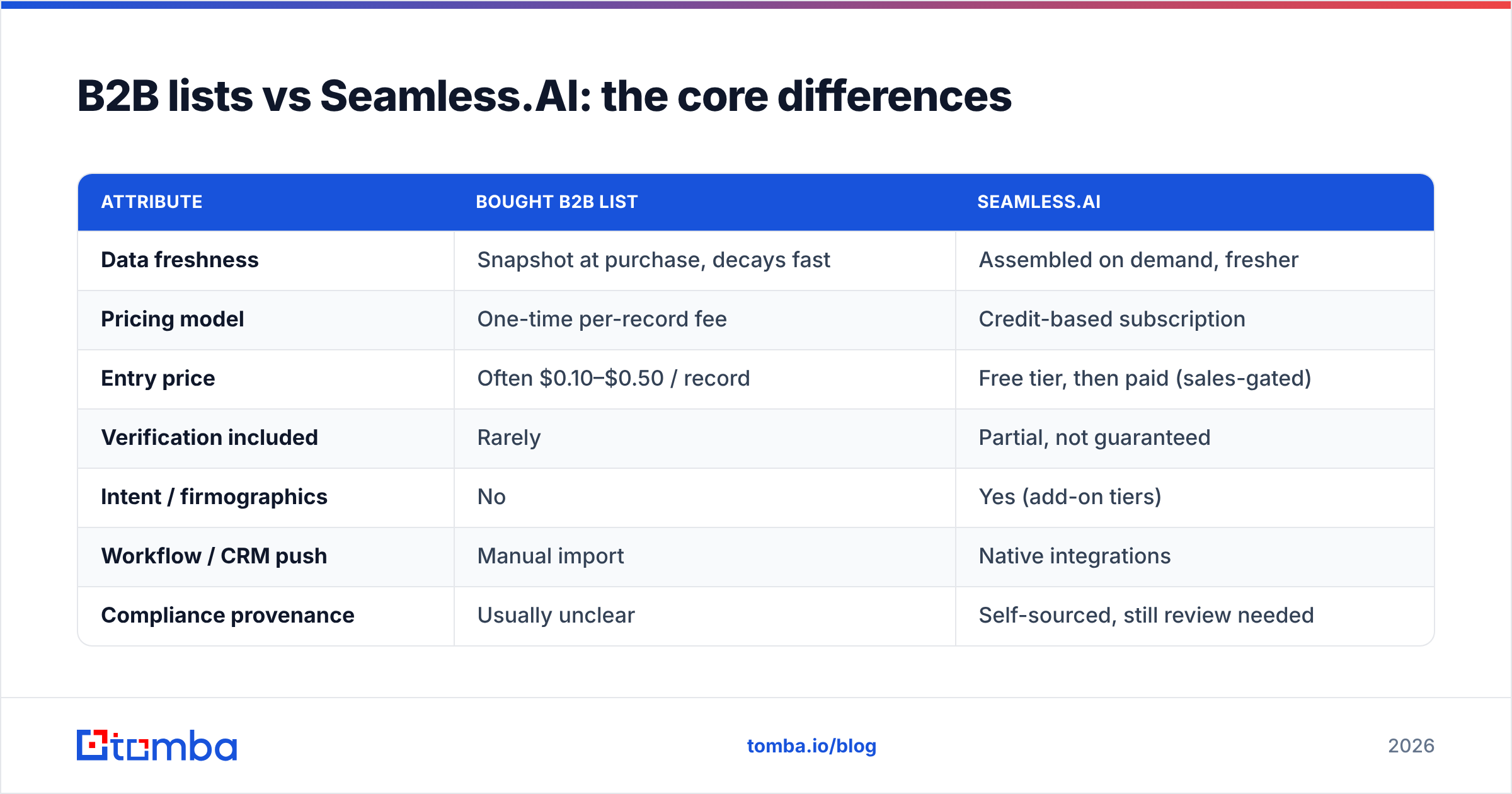
| Attribute | Bought B2B List | Seamless.AI |
|---|---|---|
| Data freshness | Snapshot at purchase, decays fast | Assembled on demand, fresher |
| Pricing model | One-time per-record fee | Credit-based subscription |
| Entry price | Often $0.10–$0.50 / record | Free tier, then paid (sales-gated) |
| Verification included | Rarely | Partial, not guaranteed |
| Intent / firmographics | No | Yes (add-on tiers) |
| Workflow / CRM push | Manual import | Native integrations |
| Compliance provenance | Usually unclear | Self-sourced, still review needed |
| Best for | One-off low-stakes sends | Ongoing rep-driven prospecting |
The pattern: lists win on raw upfront cost and zero learning curve. Seamless.AI wins on freshness, workflow, and signals — at a higher and murkier price.
Which is more accurate?#
Real-time sourcing beats a static list on accuracy, but neither is "set and forget." A list is only as good as its capture date, and you have no control over that date. Seamless.AI rebuilds records when you search, so it dodges the worst of decay — yet "real time" doesn't mean "verified." Crawled-and-stitched emails still include guesses and catch-all domains that pass a surface check but bounce when you actually send.
That's why accuracy should be measured after a verification pass, not before. The number that matters is cost per deliverable contact:
- Start with raw records. 5,000 from a list, or 5,000 pulled via credits.
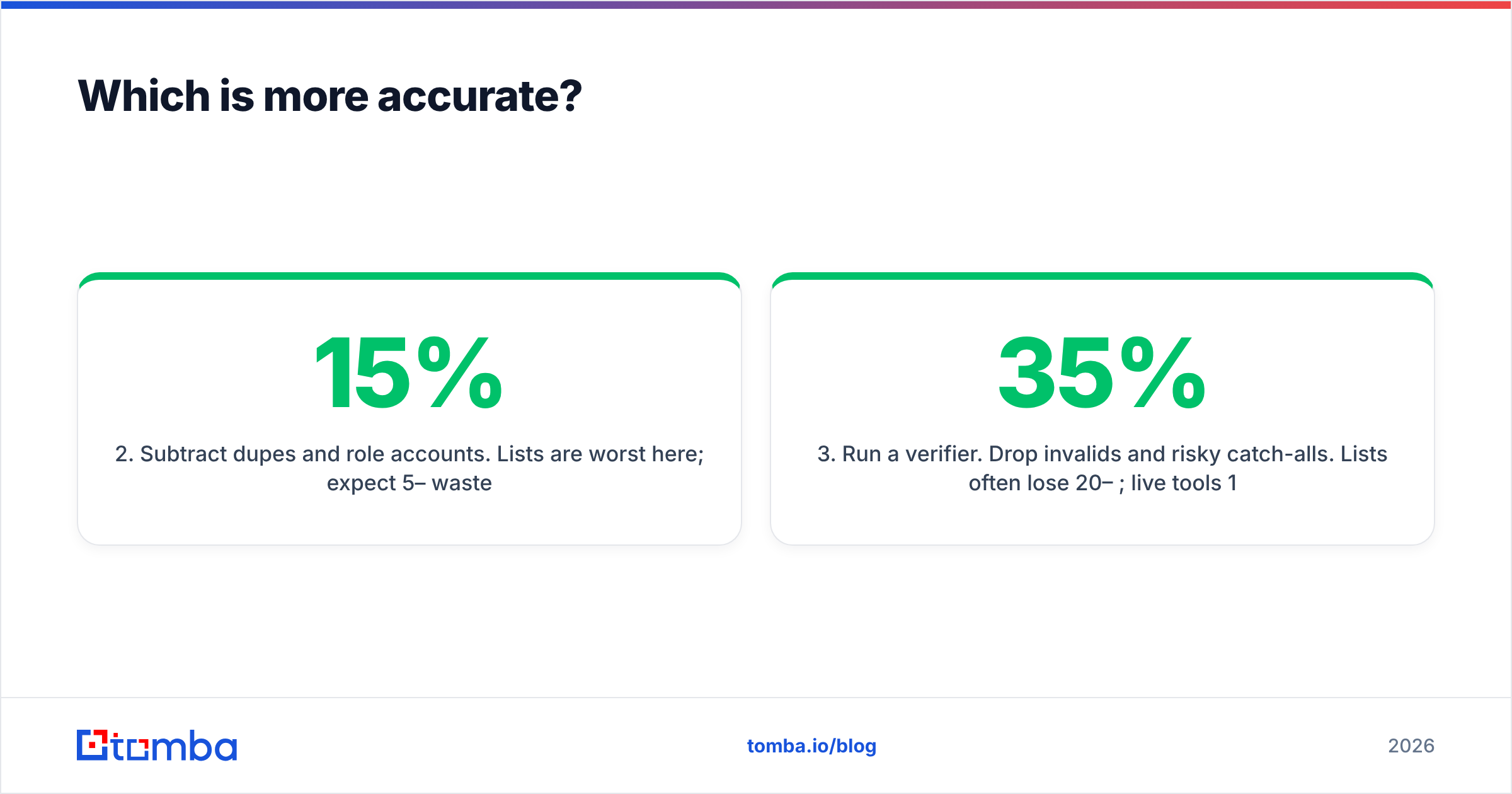
- Subtract dupes and role accounts. Lists are worst here; expect 5–15% waste.
- Run a verifier. Drop invalids and risky catch-alls. Lists often lose 20–35%; live tools 10–20%.
- Subtract job-change decay. Hits stale lists hardest.
- Divide your total spend by what survived. That's your true unit cost.
Teams routinely find a "cheap" list costs more per usable contact than a pricier real-time source once bounces are priced in. If you only remember one thing: always verify emails before a campaign, regardless of where the data came from.
What about compliance and deliverability?#
Compliance is where bought lists quietly become a liability. Under GDPR and CCPA, the legal questions are where did this data come from and was there a lawful basis to contact this person. A brokered list rarely gives you a clean answer, which is both a regulatory risk and a sender reputation risk — high bounce rates and spam complaints from a cold purchased list can get your sending domain throttled or blacklisted.
Self-sourced data (Seamless.AI, or a finder API you query yourself) at least gives you provenance: you know which public or business source the record traces to. It doesn't make outreach automatically compliant, but it's defensible in a way a mystery CSV never is. For the deliverability side specifically, pair any data source with proper SPF/DKIM setup and a warmup ramp — fresh data into a cold domain still lands in spam.
Is there a third option that beats both?#
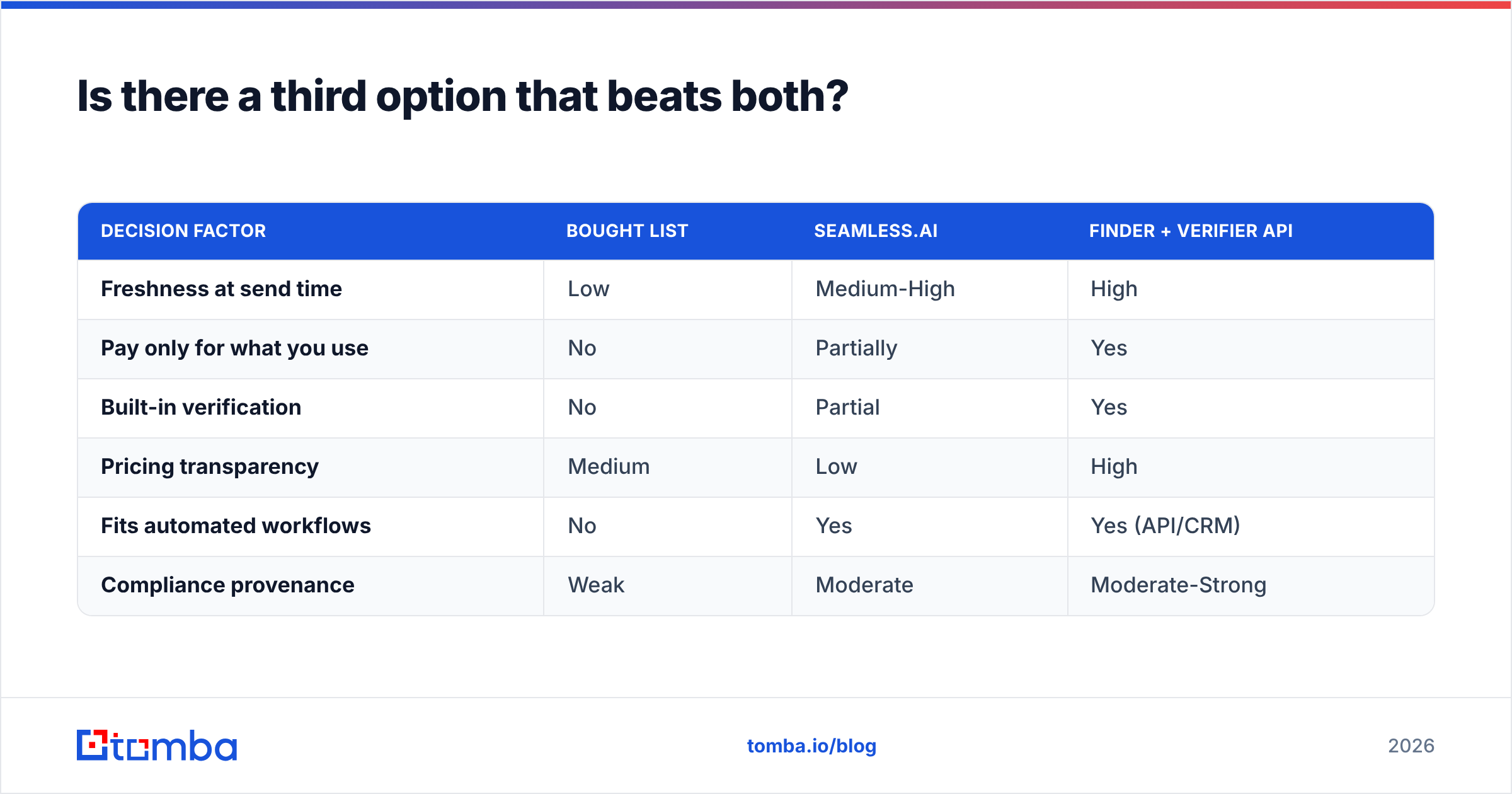
Yes — query a real-time finder and verifier API at the moment of outreach, so the data is fresh by definition and verified before it ever hits your sequencer. This is the model that's quietly won most modern outbound teams, because it collapses the list-vs-tool tradeoff: you get the freshness of on-demand sourcing and the unit economics of paying only for what you use.
Here's how the three approaches stack up on the decisions that matter:
| Decision factor | Bought List | Seamless.AI | Finder + Verifier API |
|---|---|---|---|
| Freshness at send time | Low | Medium-High | High |
| Pay only for what you use | No | Partially | Yes |
| Built-in verification | No | Partial | Yes |
| Pricing transparency | Medium | Low | High |
| Fits automated workflows | No | Yes | Yes (API/CRM) |
| Compliance provenance | Weak | Moderate | Moderate-Strong |
Tomba sits in that third column. You can find emails by name and domain through the email finder, enrich those records with firmographic and social data via data enrichment, and pull from a transparent B2B database with documented data sources — so you're never holding a record you can't trace. Pricing is published, not sales-gated: a free tier (25 searches/mo), Starter at $49/mo, Growth at $99/mo, and Pro at $249/mo, with full Tomba pricing on the site.
When does each option actually win?#
No tool is universally right. Match the source to the job.
- Buy a list when: you need a one-time, low-stakes send (an event invite, a regional awareness blast), the budget is tiny, and you accept a high bounce rate. Verify it before sending anyway.
- Use Seamless.AI when: you have reps doing manual, account-by-account prospecting, you value the Chrome extension and CRM push, and you can live with credit limits and opaque pricing.
- Use a finder + verifier API when: you run repeatable, automated outbound, you want fresh data at send time, and you need predictable per-credit economics that scale with volume — not an annual contract you negotiate blind.
A practical hybrid many teams land on: use a real-time finder/verifier as the system of record for fresh contacts, layer Seamless.AI or a list only where it fills a specific gap, and route everything through verification before it touches a sequencer.
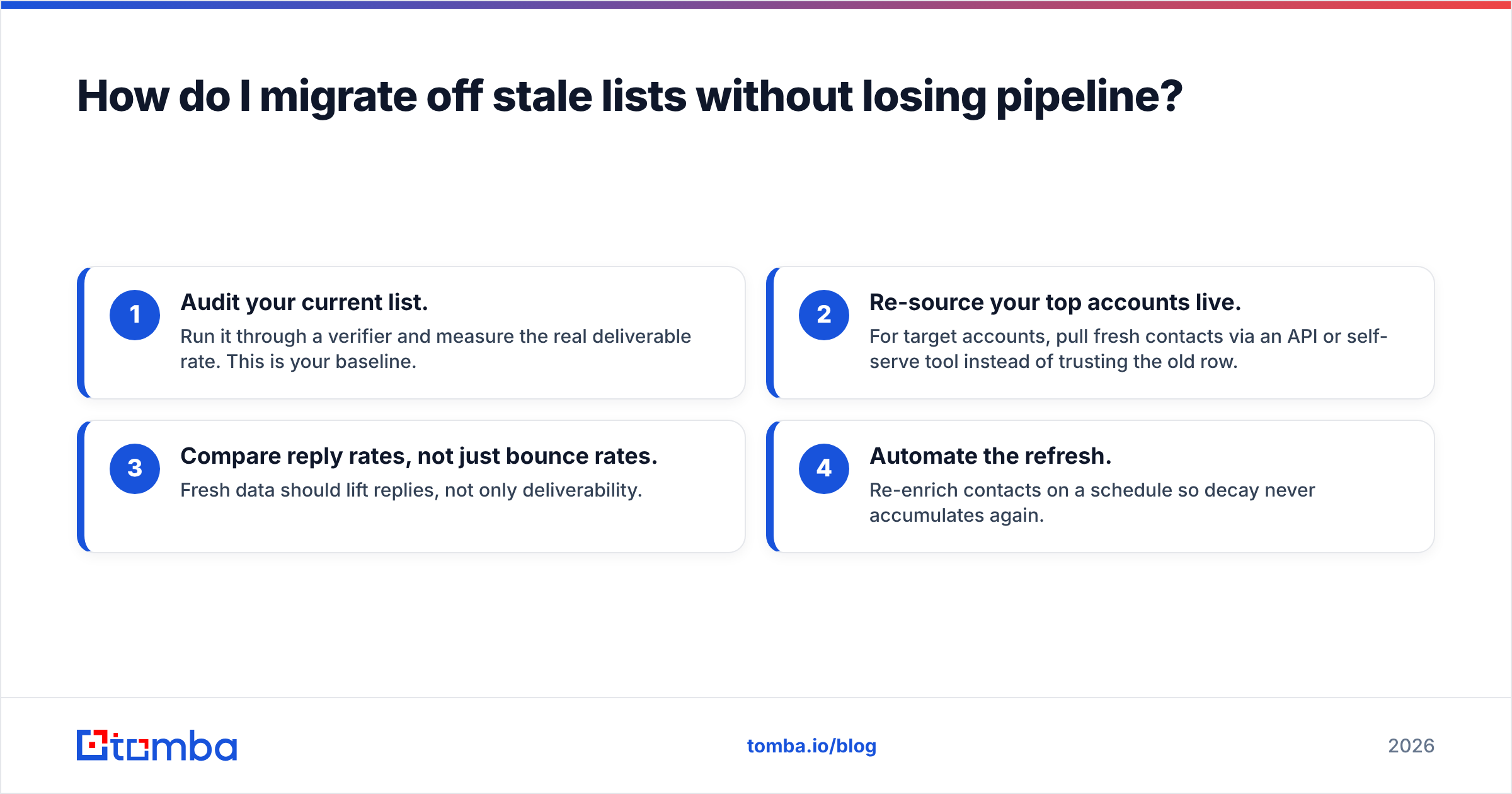
How do I migrate off stale lists without losing pipeline?#
Don't rip everything out at once. Run the new source in parallel:
- Audit your current list. Run it through a verifier and measure the real deliverable rate. This is your baseline.
- Re-source your top accounts live. For target accounts, pull fresh contacts via an API or self-serve tool instead of trusting the old row.
- Compare reply rates, not just bounce rates. Fresh data should lift replies, not only deliverability.
- Automate the refresh. Re-enrich contacts on a schedule so decay never accumulates again.
The goal isn't a one-time cleanup — it's a workflow where stale data can't pile up because every contact is sourced fresh when you need it.
The bottom line#
B2B lists win on upfront price and simplicity but lose on decay, verification, and compliance. Seamless.AI wins on freshness and workflow but loses on cost clarity and credit friction. For most teams running repeatable outbound in 2026, the smarter play is a real-time, verified, pay-for-what-you-use data layer that sidesteps both weaknesses.
If that's the direction you're leaning, start with the Tomba Email Finder — find professional emails by name, company, or domain, verify them in the same flow, and skip the stale-CSV tax entirely. Spin up the free tier, run your worst old list through it, and compare the deliverable rate before you renew any list contract or sign a sales-gated deal. The numbers tend to make the decision for you.
// get started
Find, verify and enrich your first contacts today
Start on the free plan with 25 searches a month, then scale when your team is ready.
Free plan · No credit card required · GDPR & CCPA
// about the author