B2B Lists vs SMARTe: Which Data Source Wins in 2026?
Static B2B lists rot fast and SMARTe sells live enrichment — but which actually fills your pipeline? A neutral 2026 breakdown of cost, accuracy, and fit.
Buying a B2B list feels fast: pay once, download a spreadsheet, start emailing. Subscribing to a platform like SMARTe feels heavier: seats, credits, integrations. But the cheap option is rarely the cheap option once your bounce rate climbs and your domain reputation tanks. This guide compares both honestly so you can pick the data source that actually moves pipeline in 2026.
TL;DR#
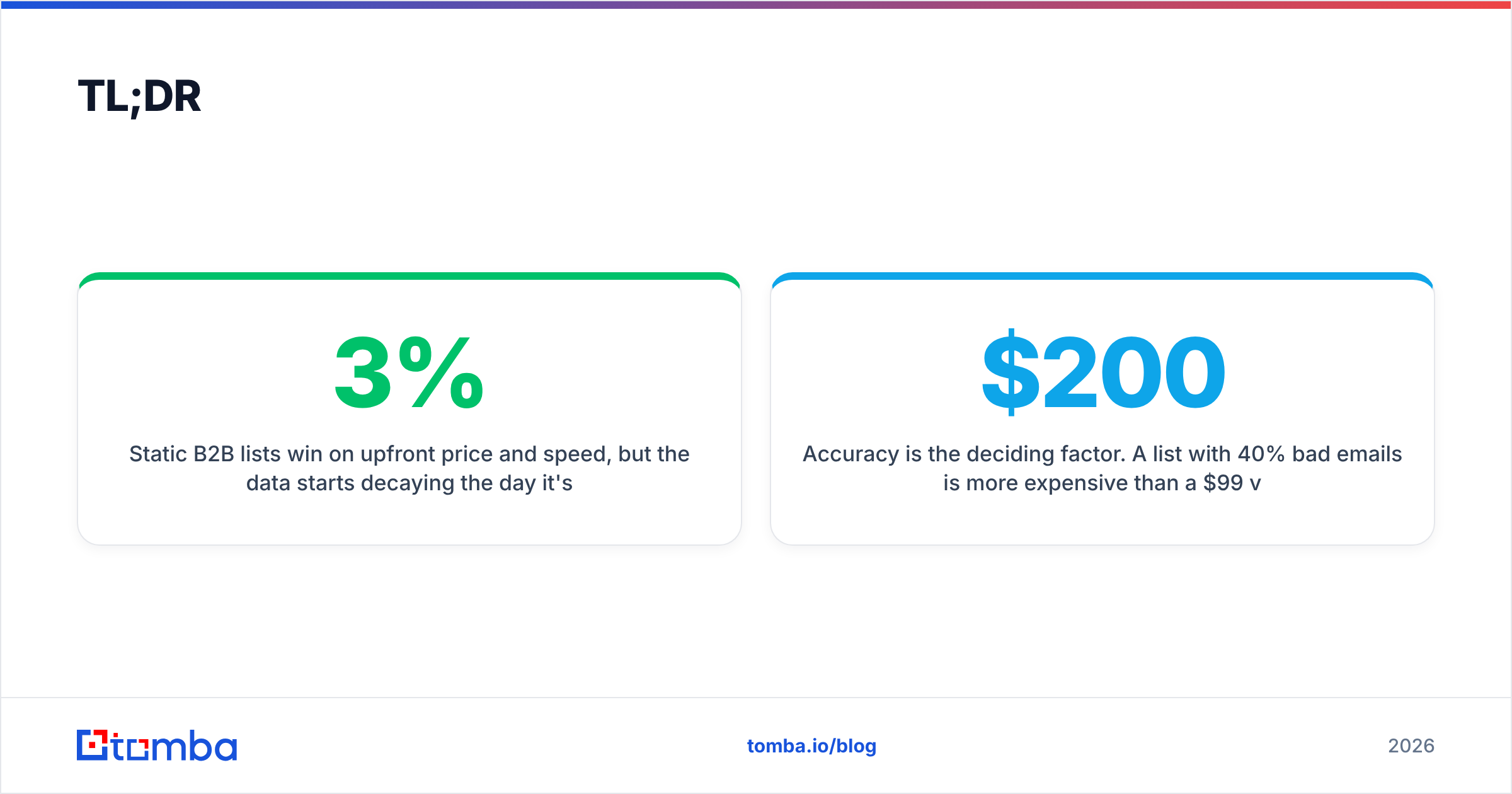
- Static B2B lists win on upfront price and speed, but the data starts decaying the day it's exported — roughly 2-3% of B2B contacts go stale every month.
- SMARTe is a live data-intelligence platform with enrichment, intent signals, and global mobile coverage — stronger for ongoing programs, heavier on cost and onboarding.
- The real question isn't "list or SMARTe" — it's "stale snapshot or refreshable pipeline." A one-off campaign and an always-on outbound motion need different tools.
- Accuracy is the deciding factor. A $200 list with 40% bad emails is more expensive than a $99/mo verified source once you price in burned domain reputation.
- A focused email finder + verifier (like Tomba Email Finder) often beats both when you already know who to target and just need clean, current contact data.
What is a B2B list, really?#
A B2B list is a static snapshot of contacts — names, titles, companies, emails, sometimes phone numbers — sold as a file or a one-time export. Think of it like a printed phone book: accurate the day it ships, slowly wrong every day after.
Lists come from three places: scraped public sources, resold data brokers, or compiled directories. Quality ranges wildly. A hand-built list from a niche provider can be excellent; a 50,000-row "ALL US CMOs" dump for $99 is almost always junk padded with role changes, dead inboxes, and catch-all domains.
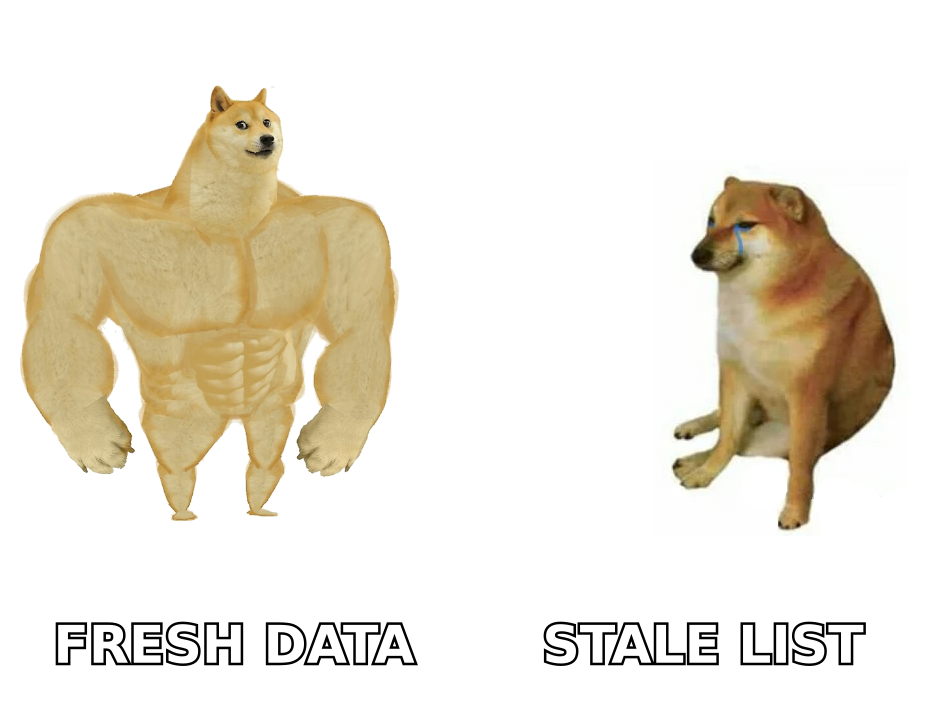
The core weakness is decay. People change jobs, companies rebrand, and email formats shift. Research from data vendors consistently puts B2B data decay at 25-30% per year. A list you bought in January is meaningfully wrong by summer, and you have no mechanism to refresh it short of buying again.
What is SMARTe?#
SMARTe is a B2B data-intelligence platform focused on go-to-market teams that need contact and company data on demand — not a one-time file, but an ongoing source. Its pitch centers on global coverage (strong mobile/phone data outside the US), GDPR/CCPA-aware compliance workflows, and a browser extension that pulls contacts straight from LinkedIn and company sites.
Where a list is a noun (a thing you own), SMARTe is closer to a verb (a service you query). You enrich a record, reveal a direct dial, or push a contact into your CRM as you work an account. That model fits account-based motions where reps research and build target lists continuously rather than blasting one giant file.
The trade-off is the usual platform trade-off: per-seat or credit-based pricing, an onboarding curve, and the reality that you're renting access. Stop paying, and the tap closes. You can read SMARTe's positioning on directories like G2 where buyers compare it against other B2B databases.
B2B lists vs SMARTe: how do they compare?#
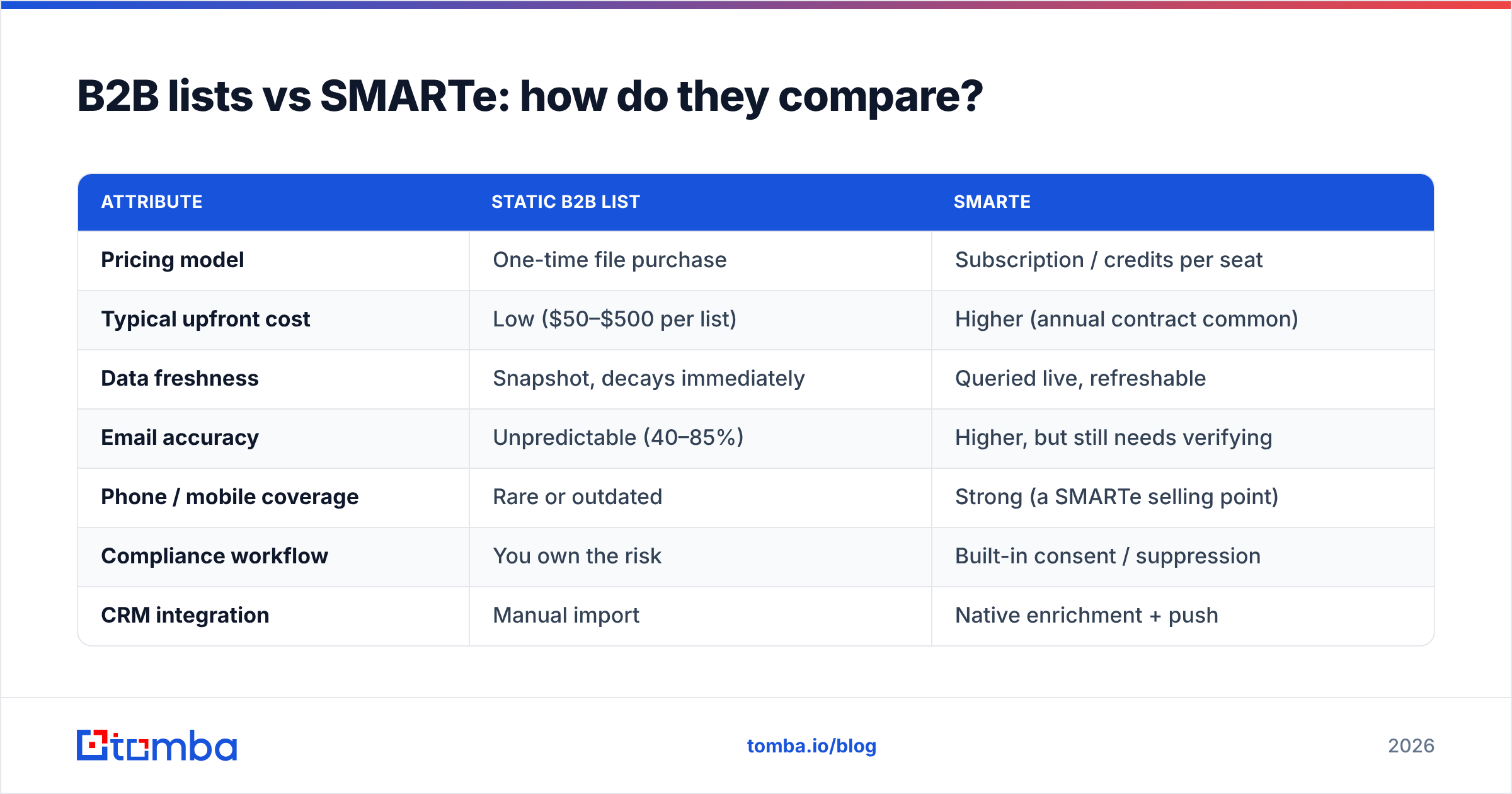
Here's the head-to-head on the attributes that actually change your results. Treat this as directional — exact numbers vary by region, seniority, and how you negotiate.
| Attribute | Static B2B List | SMARTe |
|---|---|---|
| Pricing model | One-time file purchase | Subscription / credits per seat |
| Typical upfront cost | Low ($50–$500 per list) | Higher (annual contract common) |
| Data freshness | Snapshot, decays immediately | Queried live, refreshable |
| Email accuracy | Unpredictable (40–85%) | Higher, but still needs verifying |
| Phone / mobile coverage | Rare or outdated | Strong (a SMARTe selling point) |
| Compliance workflow | You own the risk | Built-in consent / suppression |
| CRM integration | Manual import | Native enrichment + push |
| Best for | One-off blast, fixed niche | Ongoing ABM / outbound programs |
| Verification included | Almost never | Partial — verify before sending |
The pattern is clear: lists are a capital expense you depreciate fast; SMARTe is an operating expense that keeps producing as long as you pay. Neither is "better" in the abstract — it depends on whether your need is a one-time event or a continuous motion.
When does a static B2B list actually win?#
Lists get unfairly dunked on, so let's be fair. A bought list is the right call in specific situations:
- One-off, time-boxed campaigns. Promoting a single webinar to a tightly defined niche? A clean, targeted list you verify yourself can be cheaper than a platform subscription you'll cancel next month.
- Tiny, stable markets. If your total addressable market is 800 dental-equipment distributors that rarely change, a well-built list barely decays before you've worked it.
- You already have enrichment tooling. When you own a separate email verifier and enrichment stack, a raw list becomes usable feedstock rather than a liability.
- Budget reality. Early-stage teams with no recurring data budget can start with a verified list and graduate to a platform once volume justifies it.
The non-negotiable in every one of these cases: verify before you send. A list is only as good as the scrub you run on it. Skip that step and you're gambling your domain reputation on a stranger's spreadsheet.
When is SMARTe (or a platform) the right call?#
Choose a live platform when your data need is continuous and account-based rather than a single batch:
- Always-on outbound or ABM, where reps build and rework target accounts weekly.
- Direct-dial dependence — if your motion lives on the phone, SMARTe's mobile coverage is a genuine differentiator over most lists.
- Compliance-sensitive regions — built-in suppression and consent handling reduces legal exposure versus a list where you inherit unknown sourcing.
- CRM-native workflows — enrichment that fires automatically as records enter HubSpot or Salesforce beats manual CSV imports every time.
The honest caveat: platforms charge for breadth you may not use. If you only need verified emails for known targets, you're paying for intent data, org charts, and mobile numbers that sit idle. That's the gap a focused tool fills.
How much does data quality actually cost you?#
Conclusion first: the sticker price is the smallest number in the equation. The expensive part is what bad data does to your sender reputation.
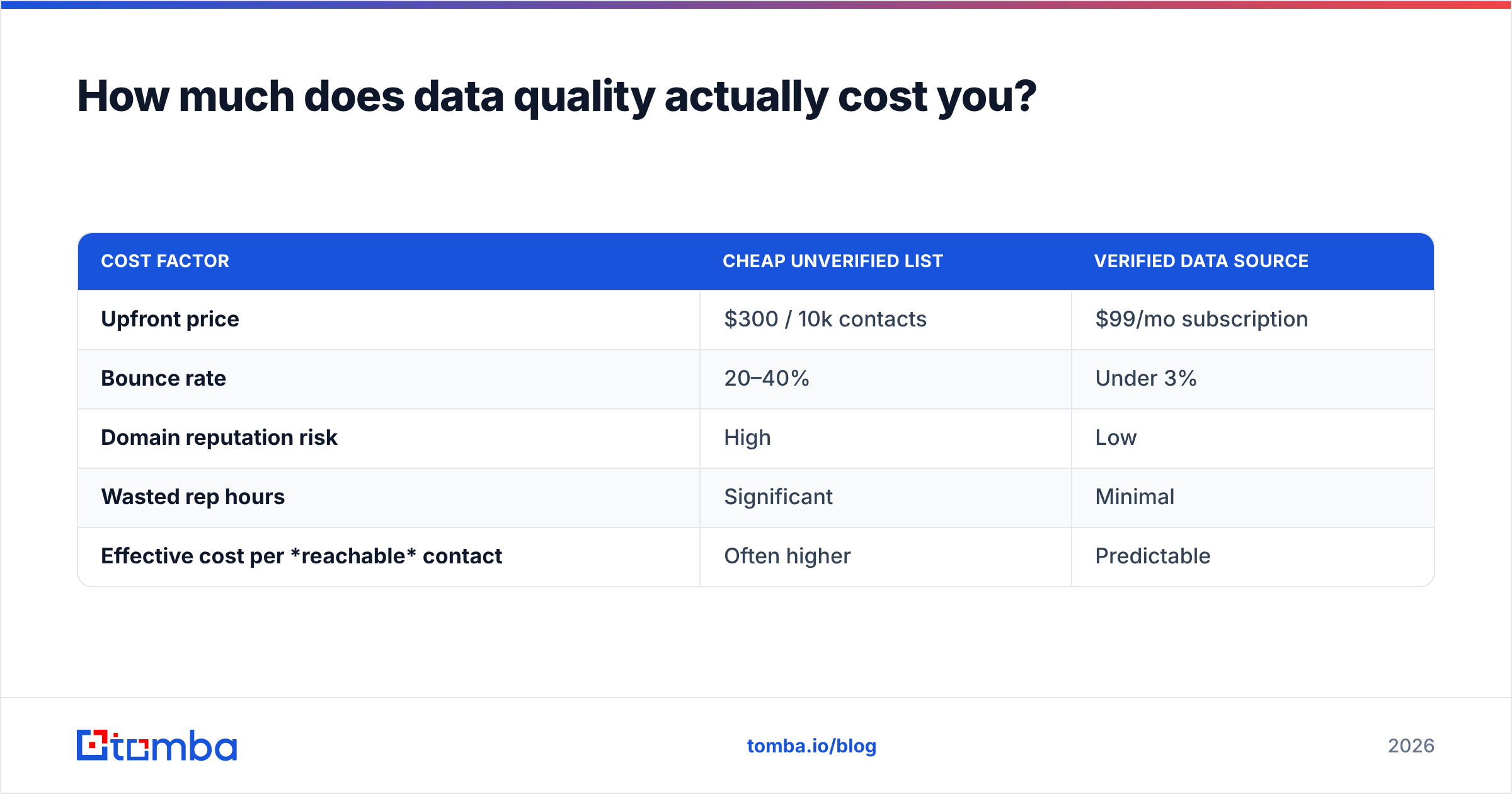
Walk the math. Say you buy a 10,000-contact list for $300. Sounds like 3 cents a contact. But if 35% of those emails are dead or catch-all, you'll hit a bounce wall. Mailbox providers read high bounce rates as a spam signal, and your email deliverability collapses — not just for that campaign, but for every email your domain sends afterward. Now your "cheap" list has poisoned your good outreach too.
| Cost factor | Cheap unverified list | Verified data source |
|---|---|---|
| Upfront price | $300 / 10k contacts | $99/mo subscription |
| Bounce rate | 20–40% | Under 3% |
| Domain reputation risk | High | Low |
| Wasted rep hours | Significant | Minimal |
| Effective cost per reachable contact | Often higher | Predictable |
This is why "verify before sending" isn't optional advice — it's the entire ballgame. Whether your contacts come from a list or a platform, running them through a catch-all verifier and standard verification before the first send is the single highest-ROI step in the whole process.
Is there a third option between lists and SMARTe?#
Yes — and for a lot of teams it's the smartest one. Conclusion first: when you already know which companies and people you want, you don't need a giant database or a static list. You need an accurate way to find and verify their contact details on demand.
That's the email-finder model. Instead of buying 50,000 rows you'll never email or renting a platform with features you won't touch, you:
- Identify target accounts from your ICP (you usually know these already).
- Run domain search to pull the verified email patterns and named contacts at each company.
- Find specific people by name and company through an email finder, getting current addresses rather than a snapshot.
- Verify every result so your bounce rate stays under control before the first send.
- Enrich and push clean records into your CRM without inheriting a list's unknown sourcing.
This approach sidesteps the core weaknesses of both alternatives. There's no decaying snapshot like a list, and no paying for breadth you don't use like a full intelligence platform. You pull fresh, verified data exactly when you need it.
How the three models stack up#
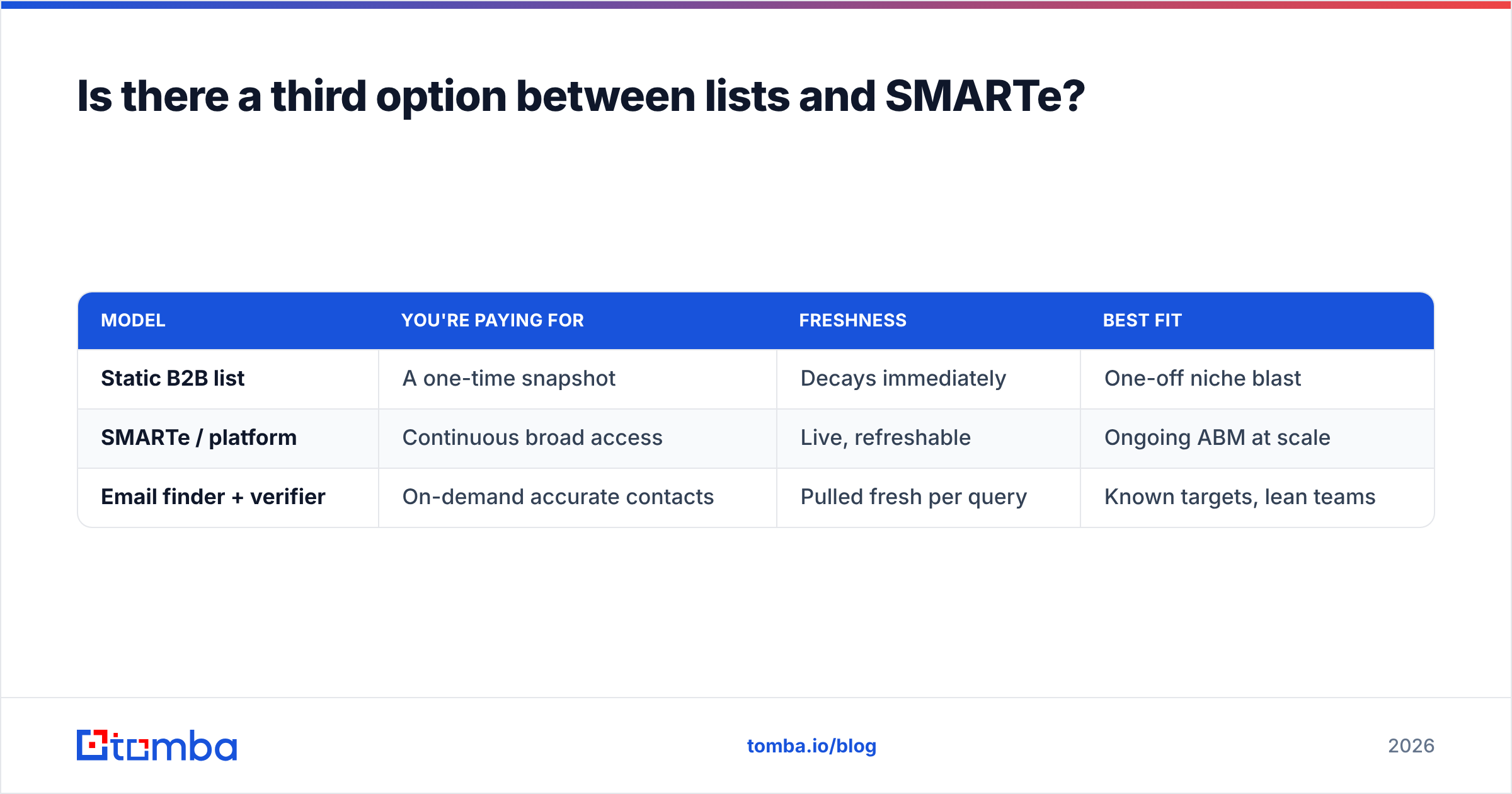
| Model | You're paying for | Freshness | Best fit |
|---|---|---|---|
| Static B2B list | A one-time snapshot | Decays immediately | One-off niche blast |
| SMARTe / platform | Continuous broad access | Live, refreshable | Ongoing ABM at scale |
| Email finder + verifier | On-demand accurate contacts | Pulled fresh per query | Known targets, lean teams |
Tomba's pricing reflects that lean model: a free tier with 25 searches/mo, Starter at $49/mo, Growth at $99/mo, and Pro at $249/mo — so you pay for finding and verifying contacts, not for a warehouse of data you'll never touch.
How do you choose for your team?#
Run your situation through three questions:
- Is your need a one-time event or an ongoing motion? Event → a verified list might be cheapest. Ongoing → you want a refreshable source (platform or email finder).
- Do you know your targets, or do you need to discover them? Known targets → an email finder is leaner and cheaper. Need discovery, intent, and org charts → a platform like SMARTe earns its cost.
- Does your motion live on email or on the phone? Phone-heavy → SMARTe's mobile coverage is hard to beat with a list, though you can pair an email finder with a dedicated phone finder for direct dials.
A practical hybrid many teams land on: use a focused email finder and verifier as the daily driver for outbound, and bring in a heavier platform only for the accounts that justify deep research. You get clean contact data for the bulk of your pipeline without paying enterprise platform rates across every seat.
What about compliance and data sourcing?#
This is where bought lists carry the most hidden risk. When you buy a random list, you inherit its sourcing — and you usually can't prove where the data came from or whether consent exists. Under GDPR and similar regimes, "I bought it from someone" is not a defense.
Platforms like SMARTe invest in compliance workflows precisely because their buyers demand it. A reputable email finder takes the same posture: transparent data sources and verification you can audit. Whatever you choose, ask the vendor exactly where data originates and how they handle suppression and removal requests. If they can't answer clearly, that's your answer.
The bottom line#
A static B2B list is a snapshot that starts dying on delivery — fine for a one-off blast into a stable niche if you verify it first, dangerous as a foundation for ongoing outreach. SMARTe is a capable live platform that earns its cost for continuous, phone-heavy, account-based programs but charges for breadth lean teams rarely use. And for the very common case — you know who you want and just need their current, verified contact details — a focused email finder beats both on cost and freshness.
Stop renting decaying snapshots and stop overpaying for unused breadth. With Tomba Email Finder you pull fresh, verified professional emails by name, company, or domain — backed by transparent data sources and built-in verification — starting free with 25 searches a month and scaling at $49/mo when you're ready. Find the people you actually want to reach, confirm they're reachable, and keep your domain reputation intact while you do it.
// get started
Find, verify and enrich your first contacts today
Start on the free plan with 25 searches a month, then scale when your team is ready.
Free plan · No credit card required · GDPR & CCPA
// about the author