B2B Lists vs WarpLeads: Which Lead Source Wins in 2026?
Pre-built B2B lists promise instant volume, WarpLeads promises unlimited exports. We compare freshness, accuracy, pricing, and deliverability so you stop wasting cold-email budget on dead contacts.
B2B Lists vs WarpLeads: Which Lead Source Actually Fills Your Pipeline?
You have a quota, a cold-email tool, and zero contacts to load into it. The fastest fix looks like buying a pre-built B2B list or signing up for a high-volume export platform like WarpLeads. Both get names and emails into your sequence by Friday. Only one keeps your domain out of the spam folder by Monday.
This guide compares the two approaches head-to-head — not as a marketing pitch, but as a working evaluation of where each one breaks down.
TL;DR#
- Pre-built B2B lists win on upfront speed and price-per-record, but decay fast — 20-30% of contacts go stale within a year, and you inherit whatever bounce rate the seller baked in.
- WarpLeads wins on volume and freshness with unlimited exports, but raw scraped exports still need independent verification before you send.
- Neither is "set and forget." Both demand a verification layer to protect email deliverability and sender reputation.
- The real winning stack is targeted sourcing plus real-time verification — which is where a finder-and-verifier workflow beats both a static list and a bulk dump.
- Skip the part where you pay for bounces. Verify before you send, every time.
What Are Pre-Built B2B Lists?#
A pre-built B2B list is exactly what it sounds like: a spreadsheet of companies and contacts someone else already assembled, sliced by industry, title, geography, or company size. You pay per record or per list, download a CSV, and load it into your CRM or sequencer.
The appeal is obvious. There's no research, no sourcing, no waiting. You buy 5,000 "VP of Marketing at SaaS companies" rows and you're sending within the hour.
The catch is just as obvious once you've run a few campaigns. Lists are snapshots. The moment a contact changes jobs, gets promoted, or leaves the company, that row is dead — and B2B job-change rates run high enough that a list bought in January is meaningfully worse by June. You also have no idea how many other buyers got the identical file, which means your "exclusive" prospect has heard six versions of the same pitch this month.
What Is WarpLeads?#
WarpLeads is a lead-generation platform built around high-volume exports. Instead of selling you a fixed list, it lets you pull large quantities of B2B contact data — often marketed as "unlimited exports" — filtered by your criteria. The pitch is scale: stop rationing credits and just export as many leads as your outbound engine can chew through.
For teams running heavy cold-email volume, that model is attractive. You're not nickel-and-dimed per contact, and the data is generated closer to send-time than a list that's been sitting in a vendor's catalog for months.
But "more leads, faster" introduces its own problem. Bulk-exported data is only as good as its verification at the moment of export. A massive export of unverified addresses is just a bigger way to torch your domain reputation. Volume without accuracy is a liability, not an asset.
B2B Lists vs WarpLeads: The Core Comparison#
Here's how the two approaches stack up on the attributes that actually decide whether a campaign lands.
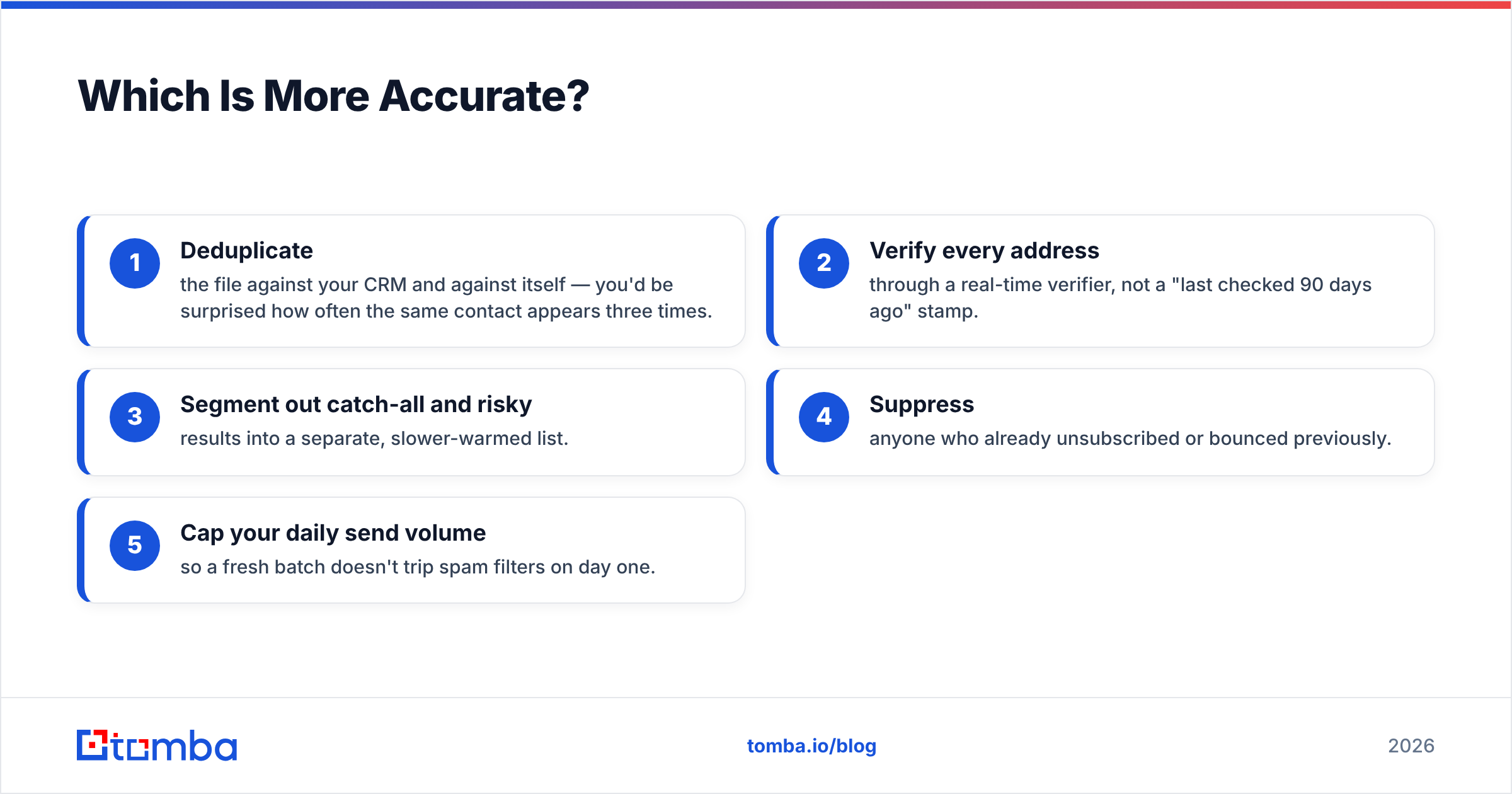
| Attribute | Pre-Built B2B Lists | WarpLeads |
|---|---|---|
| Data freshness | Snapshot — decays from day one | Generated closer to export time |
| Volume model | Fixed list / per-record | High-volume / unlimited exports |
| Exclusivity | Often resold to many buyers | Filtered to your criteria, but shared pool |
| Built-in verification | Rarely, varies wildly by seller | Limited — export ≠ verified |
| Typical bounce risk | High (5-15%+ on aged lists) | Moderate, depends on hygiene |
| Best for | One-off campaigns, tight budgets | High-volume outbound teams |
| Biggest weakness | Stale, non-exclusive data | Raw exports need verification |
The pattern across every row is the same: speed and volume sit on one side, accuracy and freshness on the other. Neither option hands you all four.
Which Is More Accurate?#
Accuracy is the whole game, because every dead address you send to does three things: it wastes a slot in your sequence, it costs you nothing in replies, and — the expensive one — it dings your sender reputation with mailbox providers.
Pre-built lists are the riskier bet here. You're trusting a seller's last refresh date, which you usually can't verify, and you're inheriting their collection method. A list scraped two years ago and re-sold today will quietly bounce a tenth of your sends.
WarpLeads' fresher generation model helps, but "fresh" is not the same as "verified." An email that exists in a database and an email that actually accepts mail are different claims. The only way to know the difference is to run the addresses through a verification step before they enter your sequencer.
This is the step most teams skip and then blame the data provider. Whichever source you pick, route the output through an email verifier first. A good verifier catches invalid syntax, dead mailboxes, role accounts, and — critically — flags risky catch-all domains that look valid but silently swallow mail.
A Simple Pre-Send Hygiene Checklist#
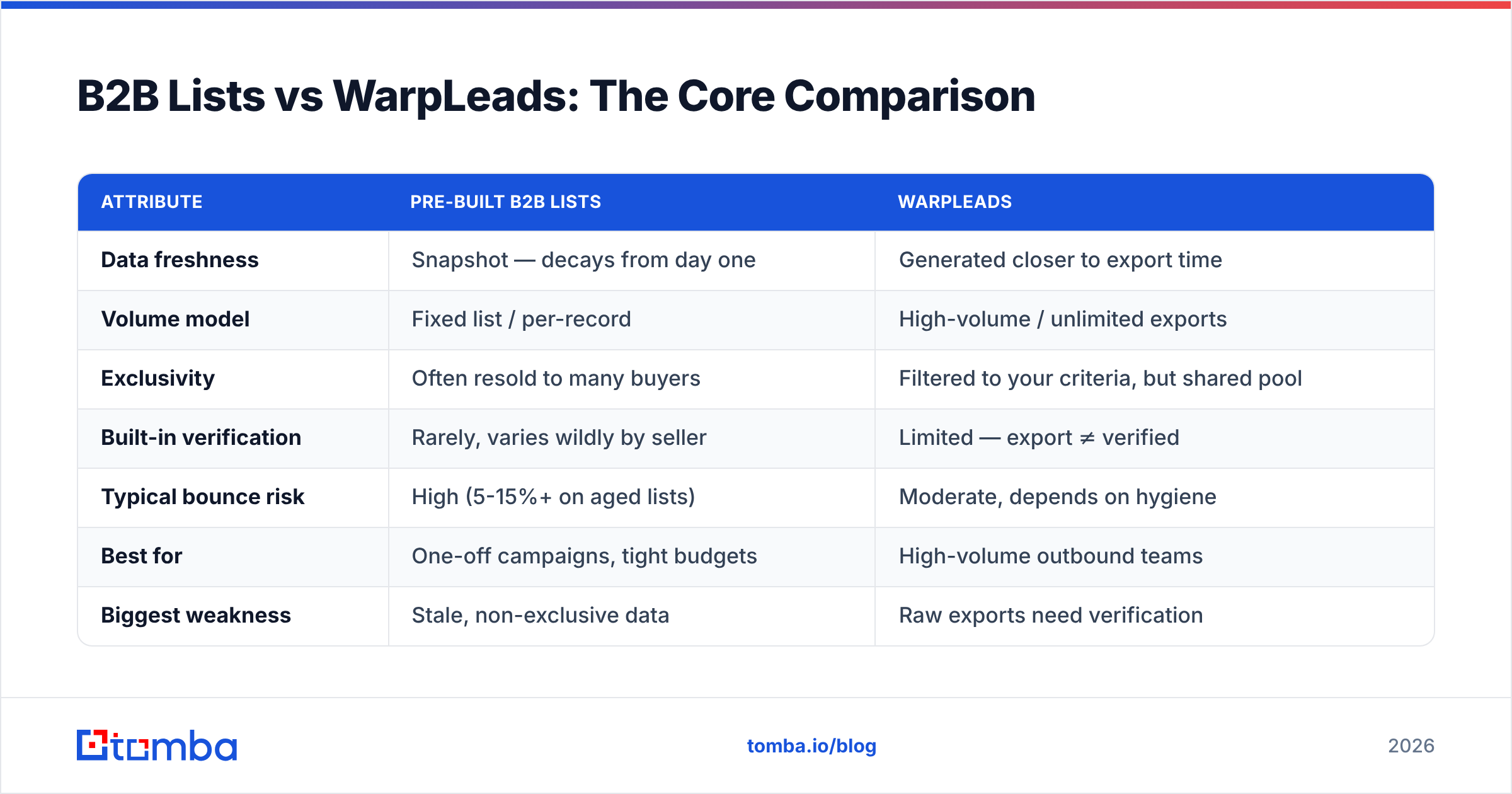
- Deduplicate the file against your CRM and against itself — you'd be surprised how often the same contact appears three times.
- Verify every address through a real-time verifier, not a "last checked 90 days ago" stamp.
- Segment out catch-all and risky results into a separate, slower-warmed list.
- Suppress anyone who already unsubscribed or bounced previously.
- Cap your daily send volume so a fresh batch doesn't trip spam filters on day one.
Which Is Cheaper — Really?#
Per-record, a bulk list or an unlimited-export plan looks unbeatable. But cost-per-record is the wrong metric. The number that matters is cost per booked meeting, and that math punishes bad data hard.
Say you buy 10,000 contacts at a low per-record price. If 12% bounce and another 20% are mistargeted, you're actually paying for roughly 6,800 usable contacts — plus the reputation damage from those 1,200 bounces, which suppresses deliverability on the good 6,800 too. The cheap list just got expensive.
A platform with unlimited exports removes the per-record anxiety, but you still pay in deliverability if you don't verify. The cheapest possible source feeding a damaged sending domain produces zero meetings, which is an infinite cost per meeting.
For context on how buyers rate these platforms on value versus hidden costs, independent review sites like G2 are a better signal than any vendor's own pricing page.
When Should You Use Each One?#
Neither tool is universally wrong. They fit different jobs.
Reach for a pre-built B2B list when:
- You need a one-off campaign for a narrow, well-defined segment and you'll verify before sending.
- Budget is fixed and you accept that some decay is the cost of doing business.
- The list seller publishes a recent, verifiable refresh date and a bounce guarantee.
Reach for WarpLeads (or any unlimited-export tool) when:
- You run consistently high outbound volume and per-record pricing is throttling you.
- You already have a verification and warmup layer in place to handle bulk exports.
- Your offer is broad enough that volume actually correlates with pipeline.
Reach for a targeted finder-plus-verifier workflow when:
- You sell to specific accounts and need the right person, not 10,000 maybes.
- Deliverability is non-negotiable because your domain is your business.
- You want fresh data pulled at the moment you need it, not from a months-old cache.
That third option is the one most teams overlook, and it's usually the one that wins.
Is There a Better Third Option?#
Yes — and it sidesteps the false choice entirely. Instead of buying a static list or dumping a bulk export, you source contacts on demand and verify them in the same motion.
Tools like the Tomba Email Finder let you find professional email addresses by name, company, or domain search at the exact moment you're building a campaign — so the data is as fresh as the day you send. Pair that with the built-in email verification and a catch-all verifier, and you get the freshness WarpLeads promises plus the accuracy a bought list almost never delivers.
Here's how the three approaches compare on the decisions that matter:
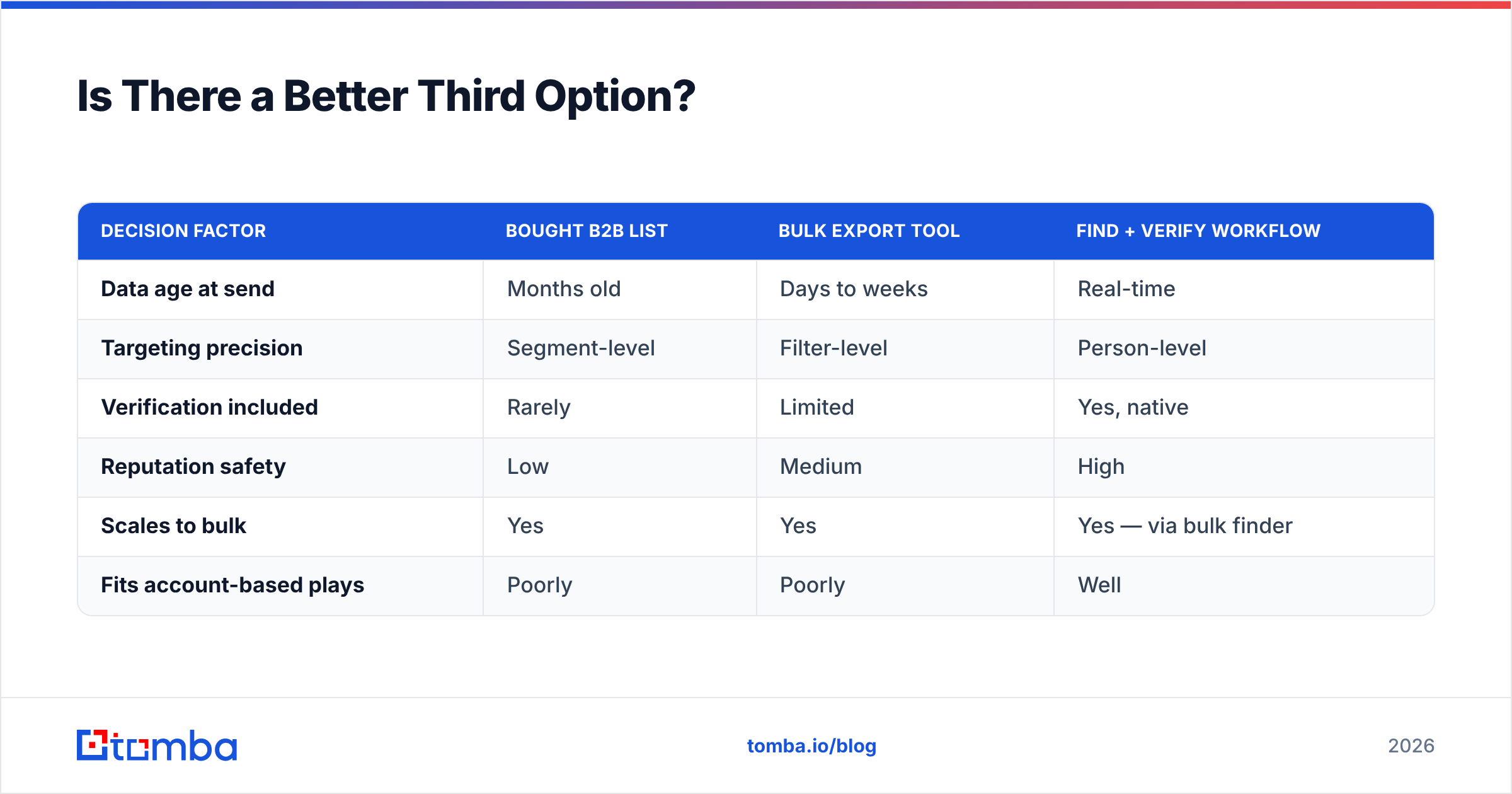
| Decision factor | Bought B2B List | Bulk Export Tool | Find + Verify Workflow |
|---|---|---|---|
| Data age at send | Months old | Days to weeks | Real-time |
| Targeting precision | Segment-level | Filter-level | Person-level |
| Verification included | Rarely | Limited | Yes, native |
| Reputation safety | Low | Medium | High |
| Scales to bulk | Yes | Yes | Yes — via bulk finder |
| Fits account-based plays | Poorly | Poorly | Well |
For teams that need scale, a bulk email finder plus data enrichment reproduces the volume of an export platform while keeping verification in the loop. You're not trading accuracy for quantity — you get both.
How Does Pricing Compare?#
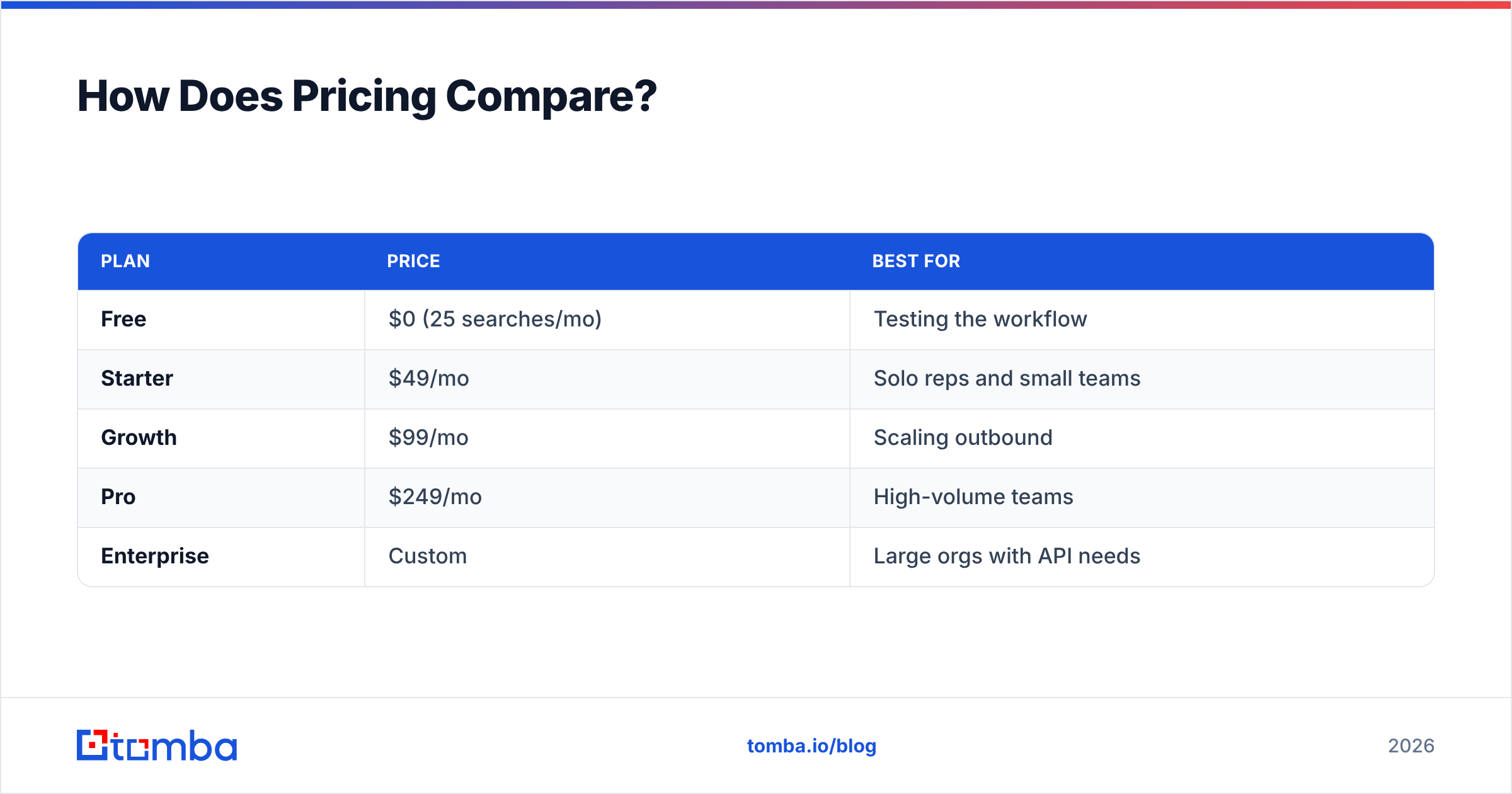
If you go the find-and-verify route, the cost structure is transparent and credit-based rather than mystery-priced per list. Tomba's tiers, for reference:
| Plan | Price | Best for |
|---|---|---|
| Free | $0 (25 searches/mo) | Testing the workflow |
| Starter | $49/mo | Solo reps and small teams |
| Growth | $99/mo | Scaling outbound |
| Pro | $249/mo | High-volume teams |
| Enterprise | Custom | Large orgs with API needs |
Full breakdowns live on the Tomba pricing page. The free tier exists specifically so you can compare real verified output against a sample of your bought list before committing budget — run both, check the bounce rates, and let the numbers decide.
You can also wire verification directly into your stack through the email finder API, so every lead — whether it came from a list, an export, or a manual find — passes through the same hygiene gate before it reaches your sequencer.
The Bottom Line#
The honest answer to "B2B lists vs WarpLeads" is that you're comparing two ways to get volume, when the metric that funds your quota is deliverable, well-targeted volume. A bought list gives you stale breadth. WarpLeads gives you fresh breadth that still needs cleaning. Both leave the verification problem on your desk.
Solve the verification problem first and the sourcing question gets easier. Source contacts when you need them, verify before you send, and your cost-per-meeting drops no matter which channel fed the top of the funnel.
Want to see the difference on your own segment? Start with the Tomba Email Finder free tier — pull a fresh, verified batch, run it beside whatever list or export you're considering, and compare the bounce rates directly. Your sending domain will thank you, and so will your reply rate.
// get started
Find, verify and enrich your first contacts today
Start on the free plan with 25 searches a month, then scale when your team is ready.
Free plan · No credit card required · GDPR & CCPA
// about the author