B2B Market Expansion Strategy: A 2026 Playbook for Growth
A practical 2026 framework for B2B market expansion: how to score new segments, build the data foundation, and de-risk entry before you spend a dollar on outbound.
Expanding into a new market is the fastest way to add a revenue line — and the fastest way to burn a quarter of budget if you skip the homework. A b2b market expansion strategy is the difference between a deliberate, data-backed entry and a hopeful spray of cold emails into a segment you barely understand.
This playbook walks through how to choose where to grow, prove demand before you commit, and build the contact-data layer that makes execution possible. It is written for founders, RevOps leads, and heads of sales who own the number — not for a textbook exam.
TL;DR#
- Expansion is a scoring problem, not a gut call. Rank candidate segments on market size, fit, competition, and cost-to-serve before you pick one.
- Validate demand cheaply with a 90-day pilot — 50 to 100 targeted conversations beat a six-figure launch built on assumptions.
- Your data foundation decides your ceiling. Accurate contact data and verified emails are the bottleneck for every new-market motion.
- Sequence the entry: beachhead segment first, then adjacent expansion, then scale. Don't open three fronts at once.
- Instrument everything so you can kill or double down on a market within one quarter, not one year.
What is a B2B market expansion strategy?#
A b2b market expansion strategy is a documented plan for selling your existing product to a new set of buyers — a new industry, company size, geography, or use case — with defined targets, a validation method, and a resourcing model.
Think of it like a restaurant opening a second location. You don't just sign a lease across town; you study foot traffic, local tastes, what competitors charge, and whether your supply chain can stretch. Technically, expansion means extending your go-to-market into a segment where your current revenue operations processes — pipeline, messaging, data — have to be re-tuned rather than copy-pasted.
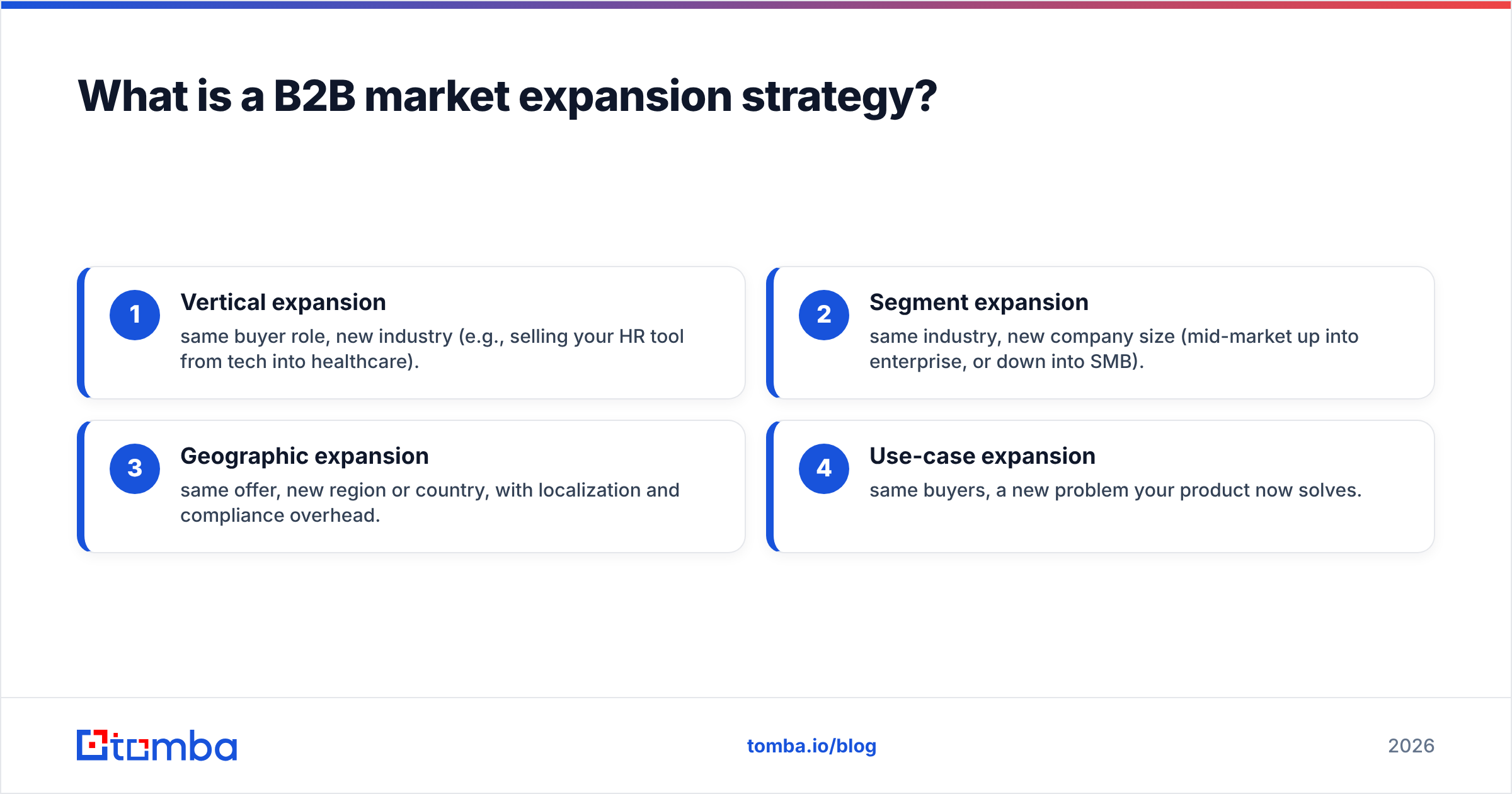
There are four common expansion vectors:
- Vertical expansion — same buyer role, new industry (e.g., selling your HR tool from tech into healthcare).
- Segment expansion — same industry, new company size (mid-market up into enterprise, or down into SMB).
- Geographic expansion — same offer, new region or country, with localization and compliance overhead.
- Use-case expansion — same buyers, a new problem your product now solves.
Each vector changes your ideal customer profile, which changes the list you need to build, which changes the data you have to source and verify. That data dependency is the thread running through this entire guide.

How do you choose which market to expand into?#
Score candidate markets against weighted criteria instead of arguing about them in a meeting. Build a simple model, rank every option, and let the numbers narrow the field to two or three finalists you can pilot.
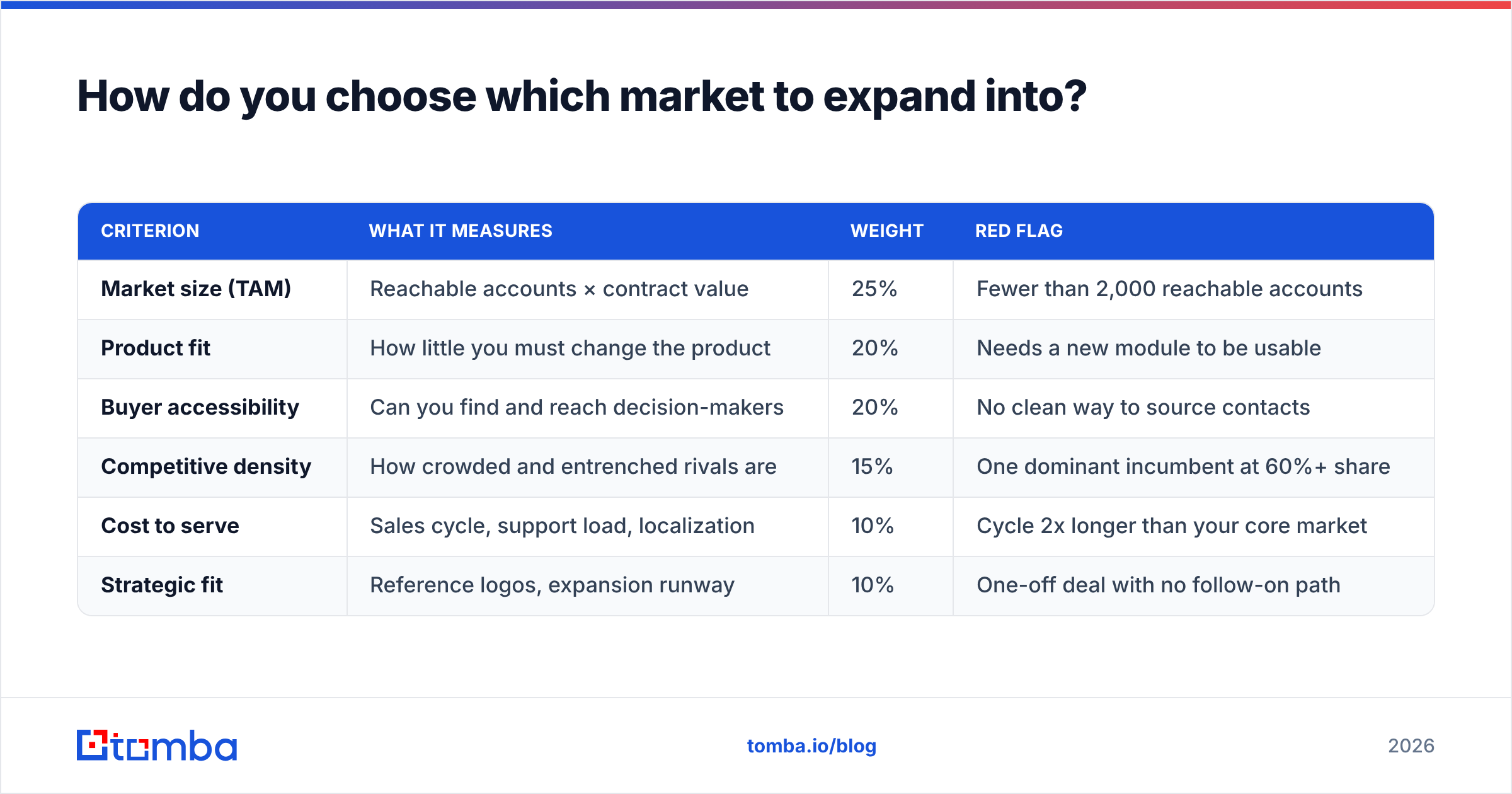
Here are the criteria that actually predict success, with how to weight them:
| Criterion | What it measures | Weight | Red flag |
|---|---|---|---|
| Market size (TAM) | Reachable accounts × contract value | 25% | Fewer than 2,000 reachable accounts |
| Product fit | How little you must change the product | 20% | Needs a new module to be usable |
| Buyer accessibility | Can you find and reach decision-makers | 20% | No clean way to source contacts |
| Competitive density | How crowded and entrenched rivals are | 15% | One dominant incumbent at 60%+ share |
| Cost to serve | Sales cycle, support load, localization | 10% | Cycle 2x longer than your core market |
| Strategic fit | Reference logos, expansion runway | 10% | One-off deal with no follow-on path |
Score each finalist 1–5 on every row, multiply by the weight, and sum. The highest weighted score is your beachhead — the single segment you enter first and win decisively before expanding to adjacent ones. Geoffrey Moore's Crossing the Chasm popularized this beachhead logic for a reason: dominating one narrow segment creates the references and playbooks that make the next one cheaper.
Buyer accessibility carries a 20% weight on purpose. A market you cannot reach is a market you cannot sell to, no matter how large the TAM. If you can't reliably build a list of decision-makers and contact them, the segment is theoretical revenue. This is where your data layer either unlocks or blocks the whole plan — more on that below.
How do you validate demand before committing budget?#
Run a 90-day pilot built around real conversations, not a full launch. The goal is to buy evidence cheaply: can you find the buyers, do they have the pain, and will they pay for your version of the fix?
A lightweight validation sprint looks like this:
- Weeks 1–2: Build the target list. Pull 100–200 accounts that match the new ICP and source verified contacts for the decision-maker and one champion at each. Use domain search to map the right people inside each target company.
- Weeks 3–8: Run outbound and book calls. Send a tightly-segmented sequence. Track reply rate, positive-reply rate, and meeting rate against your core-market baselines. A new segment that converts at half your baseline is a warning, not a death sentence — but a tenth is a red flag.
- Weeks 9–12: Pressure-test pricing and objections. In every call, probe budget, current alternatives, and the one feature they ask about first. Patterns here rewrite your messaging.
The numbers you collect become the business case. If 100 verified contacts produce 20 conversations and 5 qualified opportunities, you can model what 1,000 contacts produce — and decide with data instead of optimism.
This is also the cheapest moment to discover that your contact data for the new market is thin. A pilot that stalls because half your emails bounce isn't a demand problem; it's a data problem masquerading as one. Verify before you send so a soft signal isn't actually a deliverability failure.
Why is your data foundation the real bottleneck?#
Because every expansion motion — list building, outbound, ABM, partner sourcing — runs on contact data, and new markets are exactly where your existing data is weakest. You have years of accumulated knowledge about your core segment and almost none about the new one.
When you enter a fresh vertical or region, you typically face:
- No existing contact records for the new accounts.
- Unknown email patterns at companies you've never sold to.
- Higher catch-all and bounce rates because you can't lean on prior send history.
- Stale third-party lists that were scraped months ago and never re-verified.
This is the silent killer of expansion plans. Teams budget for ads, headcount, and tooling, then try to run the whole motion on a contact list that decays at roughly 22–30% per year as people change jobs. The fix is to treat data as infrastructure: source it freshly, verify it before every campaign, and enrich it so reps spend time selling, not Googling.
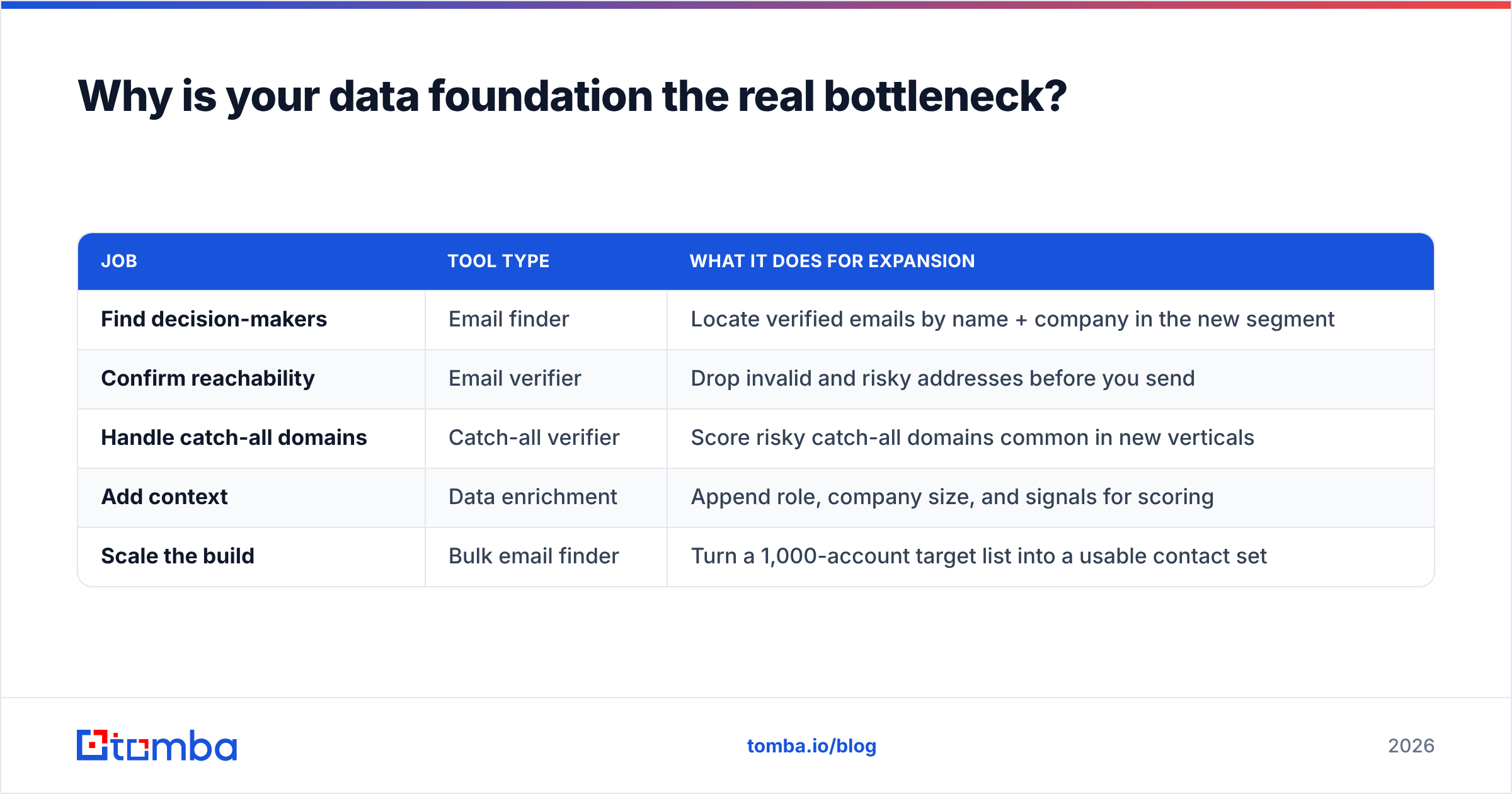
A practical data stack for new-market entry pairs a finder, a verifier, and enrichment:
| Job | Tool type | What it does for expansion |
|---|---|---|
| Find decision-makers | Email finder | Locate verified emails by name + company in the new segment |
| Confirm reachability | Email verifier | Drop invalid and risky addresses before you send |
| Handle catch-all domains | Catch-all verifier | Score risky catch-all domains common in new verticals |
| Add context | Data enrichment | Append role, company size, and signals for scoring |
| Scale the build | Bulk email finder | Turn a 1,000-account target list into a usable contact set |

How do you sequence and resource the expansion?#
Enter one market at a time and fully resource it before opening the next. The most common failure mode is splitting a small team across three new segments and going half-speed in all of them. Concentration wins beachheads.
A staged rollout that holds up in practice:
- Beachhead (Quarter 1). One segment, two to three dedicated reps, one tailored playbook, weekly review. Win 5–10 reference customers.
- Adjacent expansion (Quarter 2–3). Use the beachhead's references and case studies to enter the nearest neighboring segment. Reuse 70% of the playbook; re-tune messaging and data sources for the rest.
- Scale (Quarter 4+). Once two segments are repeatable, codify the motion, hire against it, and consider parallel fronts.
Resourcing-wise, budget for the boring infrastructure, not just the exciting growth. A typical first-market entry needs sourcing and verification credits, sequencing software, CRM hygiene, and enough sales capacity to actually work the pipeline you generate. Underfunding any one link starves the others.
Connect your data tooling directly to where reps live. If your team runs on HubSpot or Salesforce, push verified contacts straight into the CRM with native integrations so the new-market list doesn't rot in a spreadsheet. The less manual handoff, the faster a market reaches break-even.
What does a realistic budget look like?#
Plan for a multi-month runway before payback. New markets rarely return cash in the first 60 days; the honest model assumes a quarter or two of investment ahead of meaningful revenue.
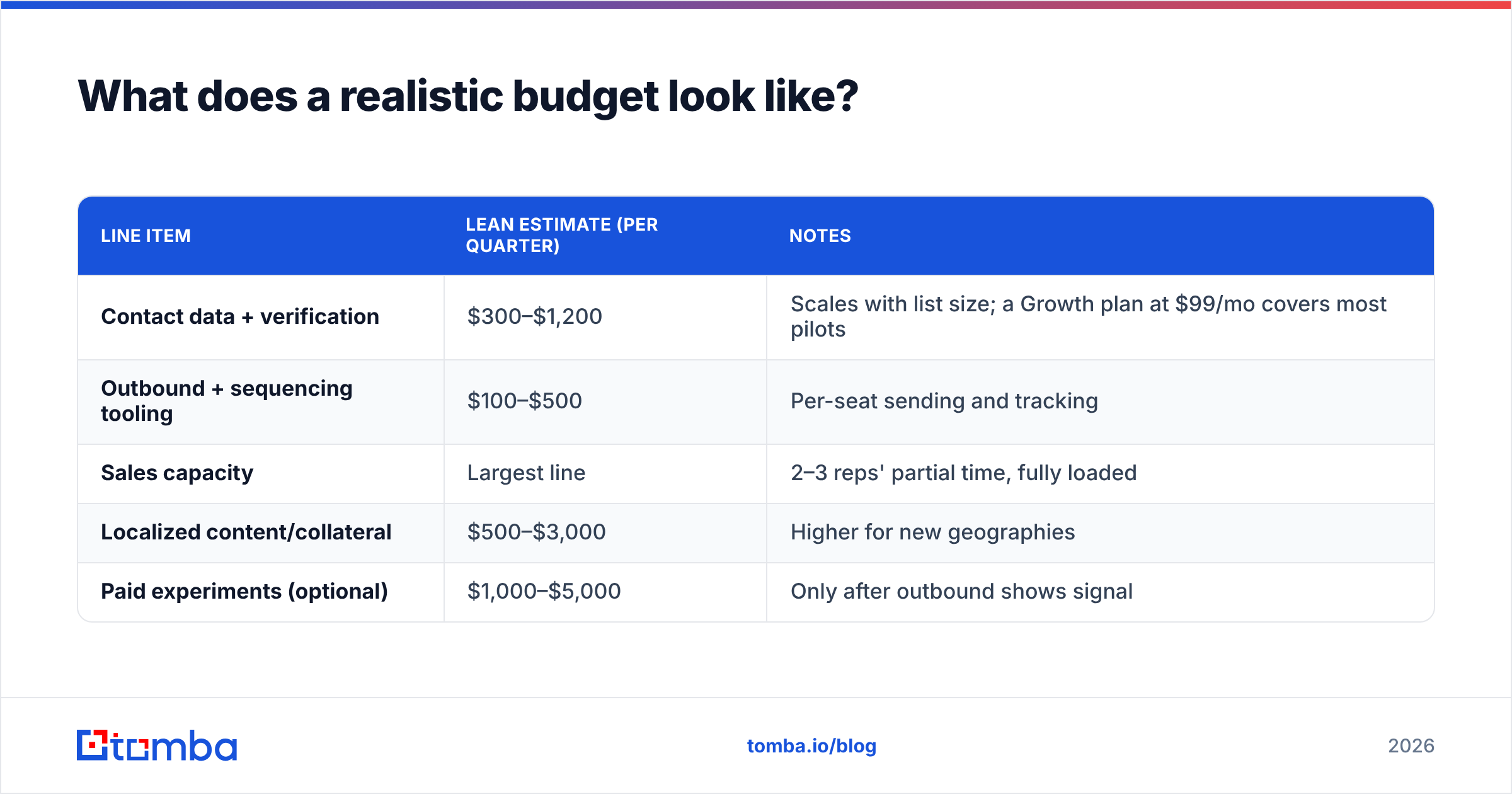
A lean entry budget for one beachhead segment over a quarter might break down like this:
| Line item | Lean estimate (per quarter) | Notes |
|---|---|---|
| Contact data + verification | $300–$1,200 | Scales with list size; a Growth plan at $99/mo covers most pilots |
| Outbound + sequencing tooling | $100–$500 | Per-seat sending and tracking |
| Sales capacity | Largest line | 2–3 reps' partial time, fully loaded |
| Localized content/collateral | $500–$3,000 | Higher for new geographies |
| Paid experiments (optional) | $1,000–$5,000 | Only after outbound shows signal |
Notice the data line is the smallest controllable cost and the highest-leverage one. Skimping there to "save money" inflates every other line, because bounced sends, wasted rep hours, and mis-targeted ads all trace back to bad contact data. For most teams, Tomba's Free tier (25 searches/mo) is enough to test the waters, and the $49/mo Starter plan or $99/mo Growth plan covers a real pilot without an enterprise commitment.
How do you measure whether the expansion is working?#
Instrument the funnel from day one so you can make a kill-or-scale decision within one quarter. Vanity metrics like "emails sent" tell you nothing; conversion-rate comparisons against your core market tell you everything.
Track these against your established baselines:
- Verified-contact rate — of accounts targeted, how many produced a deliverable email. Below 70% signals a data sourcing problem.
- Positive reply rate — the cleanest early demand signal. Compare directly to your core market.
- Meeting-to-opportunity rate — measures whether the pain is real and budgeted.
- Sales cycle length — new markets often run longer; know by how much so forecasts stay honest.
- CAC payback — the gate for scaling. If payback is wildly longer than your core market, fix the motion before adding spend.
Set explicit thresholds before you start — for example, "if positive reply rate is below 40% of baseline after 200 contacts, we revisit the segment." Pre-committed thresholds prevent the sunk-cost trap where a struggling market keeps getting "one more month."
For deeper benchmarking on what good outbound looks like, vendor research from HubSpot and peer reviews on G2 are useful external reference points to calibrate your expectations against the broader market.
Common mistakes that sink B2B expansion#
Avoid the patterns that kill most market-entry attempts:
- Entering on TAM alone. A huge market you can't reach or differentiate in is a trap. Buyer accessibility and competitive density matter as much as size.
- Reusing core-market messaging verbatim. Your value prop has to be re-articulated in the new buyer's language and pain.
- Treating data as an afterthought. Stale or unverified lists turn a demand test into a deliverability test and corrupt your signal.
- Opening too many fronts. Three half-resourced markets lose to one fully-resourced beachhead every time.
- No kill criteria. Without pre-set thresholds, you'll keep funding a loser out of stubbornness.
Each of these is avoidable with the scoring, validation, and data discipline above. Expansion isn't luck; it's a process you can run repeatedly once the first one works.
Putting it together#
A working b2b market expansion strategy is sequential and evidence-driven: score your candidate markets, validate the winner with a cheap 90-day pilot, build on a verified data foundation, resource one beachhead fully, and instrument the funnel so you can scale or kill within a quarter. The teams that win new markets aren't the ones with the biggest budgets — they're the ones who refuse to spend until the data says go.
The single highest-leverage investment in that whole sequence is your contact data, because it gates every other step. Start your pilot the right way: use the Tomba Email Finder to build a verified, decision-maker-level target list for your new segment, run it against the email verifier before you send, and enter your next market with evidence instead of optimism. The Free tier lets you test the segment today, and you can scale into a paid plan only once the numbers prove the market is real.
// get started
Find, verify and enrich your first contacts today
Start on the free plan with 25 searches a month, then scale when your team is ready.
Free plan · No credit card required · GDPR & CCPA
// about the author