B2B Marketing Campaign Playbook: Build One That Converts in 2026
A practical, step-by-step framework for planning, launching, and measuring a B2B marketing campaign that actually books pipeline in 2026 — not just impressions.
A B2B marketing campaign is not a single email blast or a clever ad. It is a coordinated set of actions — across channels, over weeks — aimed at one audience to drive one measurable business outcome. Get the targeting, sequencing, and measurement right and you build pipeline. Get them wrong and you generate noise that finance will eventually defund.
This playbook walks through how to plan, launch, and measure a campaign in 2026, with concrete budgets, channel mixes, and the metrics that matter.
TL;DR#
- A B2B marketing campaign is a multi-channel, time-boxed effort tied to one audience and one revenue goal — not a list of disconnected tactics.
- Targeting beats volume. Clean account and contact data is the single biggest lever on campaign ROI, and the cheapest to fix.
- The winning 2026 mix is layered: ABM for top accounts, content and paid for demand, outbound email and LinkedIn for direct reach.
- Measure pipeline and revenue influenced, not just MQLs. Vanity metrics hide dying campaigns.
- Build a feedback loop: enrich, segment, launch, measure, refine — every two weeks, not every quarter.
What is a B2B marketing campaign?#
A B2B marketing campaign is a structured initiative that uses multiple touchpoints to move a defined group of business buyers toward a specific action — a demo, a trial, a download, or a sales conversation. The "B2B" part matters because the buying behavior is fundamentally different from consumer marketing.
Think of a B2B campaign like landing a commercial aircraft instead of a paper plane. You are not appealing to one impulse buyer; you are guiding a buying committee of five to eleven people through a months-long approval process. Marketing's job is to keep every one of those people informed and warm until sales can close.
Three traits define a real campaign versus a random act of marketing:
- One audience. A named segment — by industry, company size, role, or intent signal — not "everyone who might buy."
- One primary goal. Pipeline generated, not "awareness." Awareness is a means, not an outcome you can bank.
- One time box. A start, a peak, and an end so you can measure lift against a baseline.
If you cannot name the audience, the goal, and the dates, you have a marketing activity, not a campaign.
Why do most B2B campaigns fail?#
Most campaigns fail before the first asset ships, because the targeting data is wrong. You can write brilliant copy and design beautiful ads, but if 30% of your contact list bounces or routes to the wrong person, you have already capped your ceiling.
The failure pattern is predictable:
- Stale or purchased lists. Bought databases decay roughly 22–30% per year as people change jobs. Sending to them tanks your email deliverability and burns your sender reputation.
- No segmentation. One message to a 50-person startup and a 50,000-person enterprise insults both.
- Channel monogamy. Betting the whole budget on one channel — usually paid ads — with no organic or direct-outreach backstop.
- MQL theater. Optimizing for form fills that sales never works because the leads were never qualified.
The fix for the first and most expensive problem is data hygiene. Before you spend a dollar on creative, verify and enrich your target list so every send reaches a real, current decision-maker. A quick pass with an email verifier removes the dead addresses that would otherwise drag down the entire campaign.
How do you plan a B2B marketing campaign step by step?#
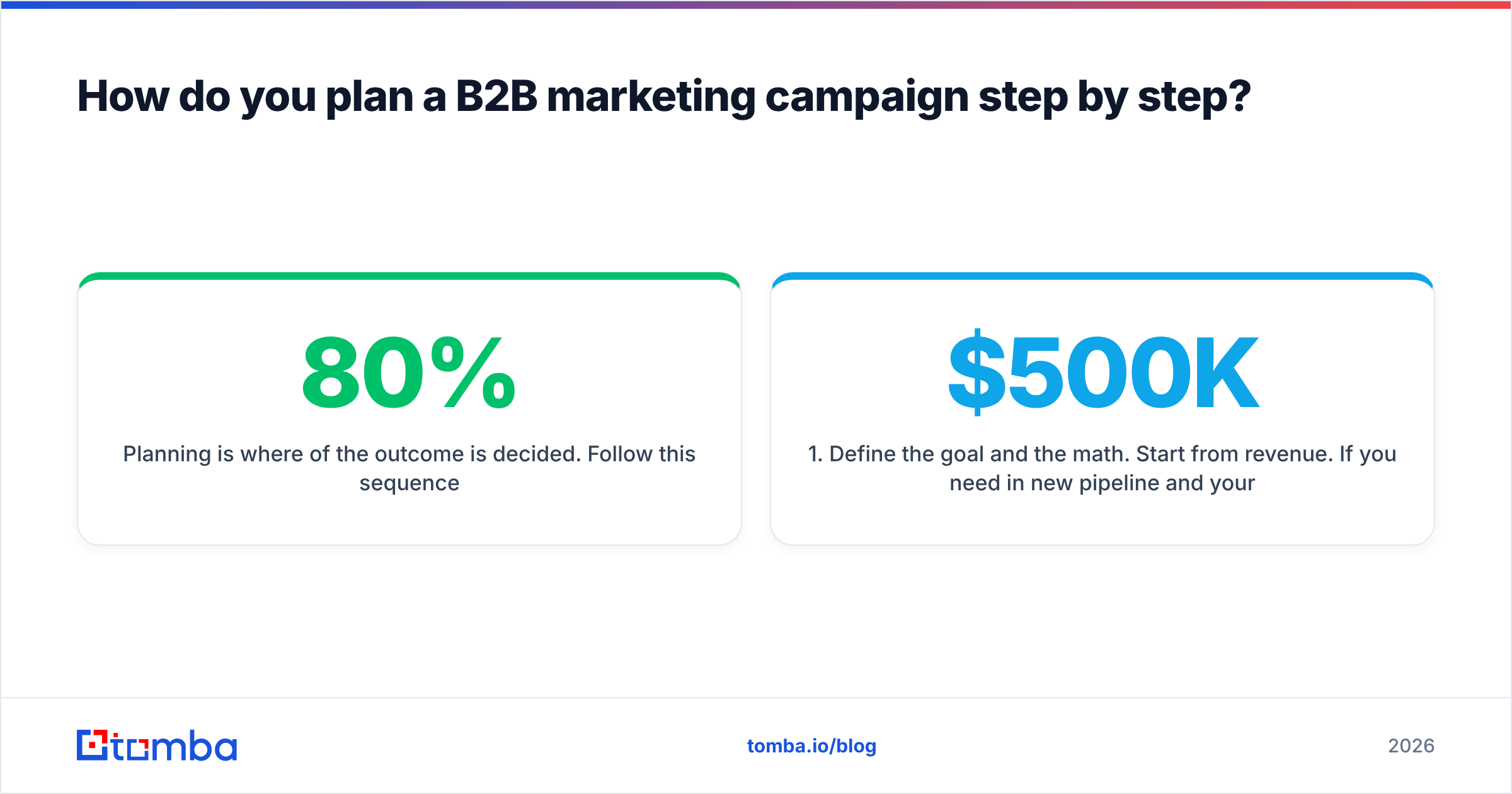
Planning is where 80% of the outcome is decided. Follow this sequence.
1. Define the goal and the math. Start from revenue. If you need $500K in new pipeline and your average deal is $25K, you need 20 opportunities. At a 20% lead-to-opp rate, that is 100 qualified leads. Now you know the size of the funnel you must fill.
2. Build the target account and contact list. Define your ideal customer profile (firmographics + technographics), then source the actual companies and the people inside them. Use a domain search to pull every relevant contact at a target company, then enrich each record with role, seniority, and verified contact details.
3. Craft the offer and message. B2B buyers respond to specificity and proof, not adjectives. Lead with the problem you solve and the measurable result. Tailor the angle per segment.
4. Choose the channel mix. Layer channels by funnel stage (see the table below). No single channel carries a B2B campaign in 2026.
5. Sequence the touches. Map a 4–6 week cadence: an opening touch, value-add content, a direct offer, and a breakup. Coordinate so the LinkedIn ad, the email, and the SDR call reinforce the same story.
6. Instrument everything. Set up tracking before launch — UTMs, CRM stages, and attribution — so you can read results in week one, not month three.
What channels should a B2B campaign use in 2026?#
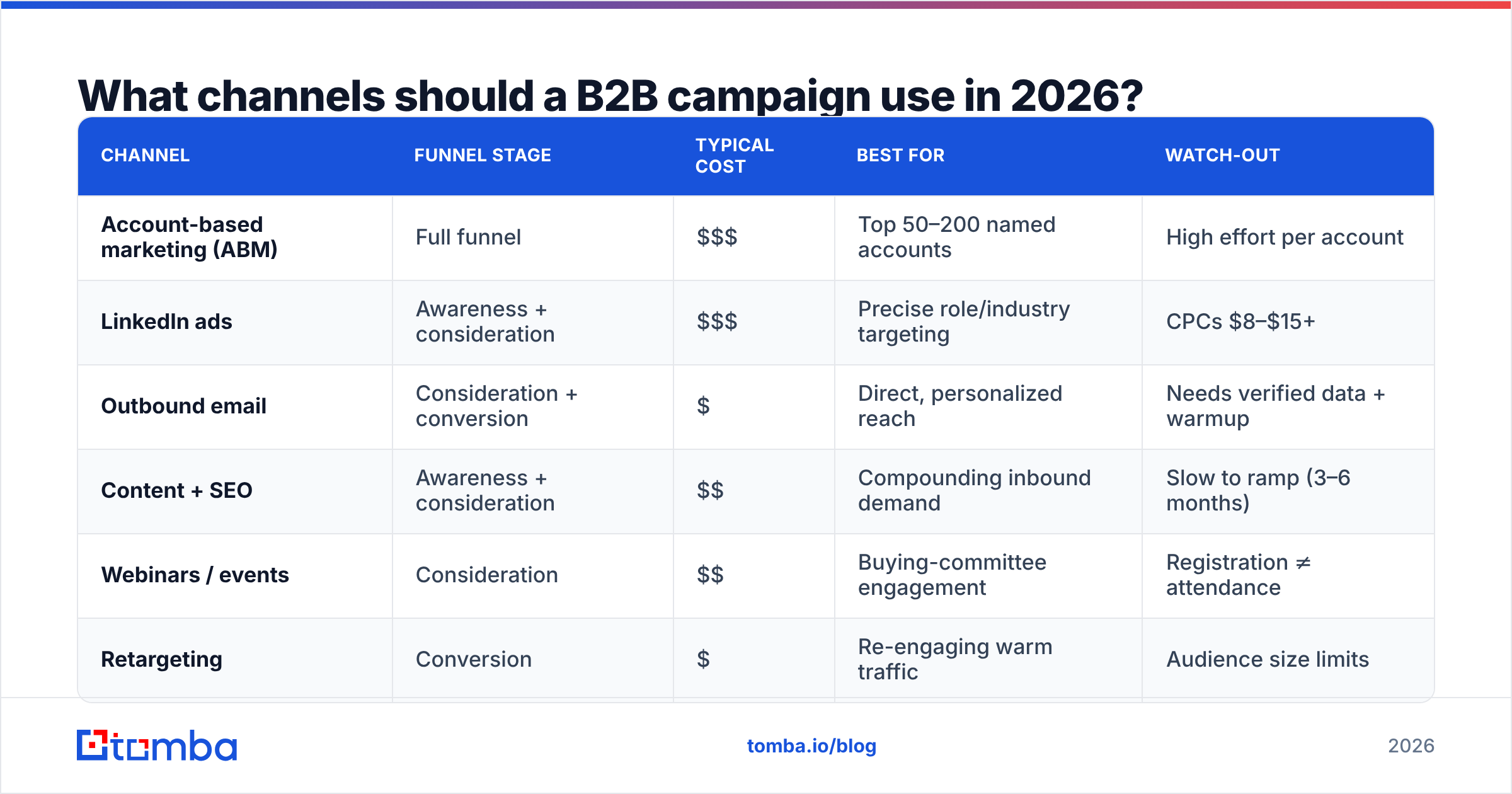
Use a layered mix matched to funnel stage. The table below maps the most effective channels to their job, typical cost, and best use.
| Channel | Funnel stage | Typical cost | Best for | Watch-out |
|---|---|---|---|---|
| Account-based marketing (ABM) | Full funnel | $$$ | Top 50–200 named accounts | High effort per account |
| LinkedIn ads | Awareness + consideration | $$$ | Precise role/industry targeting | CPCs $8–$15+ |
| Outbound email | Consideration + conversion | $ | Direct, personalized reach | Needs verified data + warmup |
| Content + SEO | Awareness + consideration | $$ | Compounding inbound demand | Slow to ramp (3–6 months) |
| Webinars / events | Consideration | $$ | Buying-committee engagement | Registration ≠ attendance |
| Retargeting | Conversion | $ | Re-engaging warm traffic | Audience size limits |
A balanced 2026 campaign for a mid-market SaaS company might allocate roughly 35% to outbound and ABM, 30% to paid social and search, 25% to content, and 10% to events and retargeting. Adjust to your sales motion: high-ACV deals tilt toward ABM and events; high-velocity, low-ACV deals tilt toward content and outbound.
Outbound email remains the highest-ROI direct channel when the data is clean. The catch is that it lives or dies on accuracy — which is why the list-building step above is non-negotiable. If you want to benchmark realistic open and reply rates, HubSpot's email marketing benchmarks are a credible reference point.
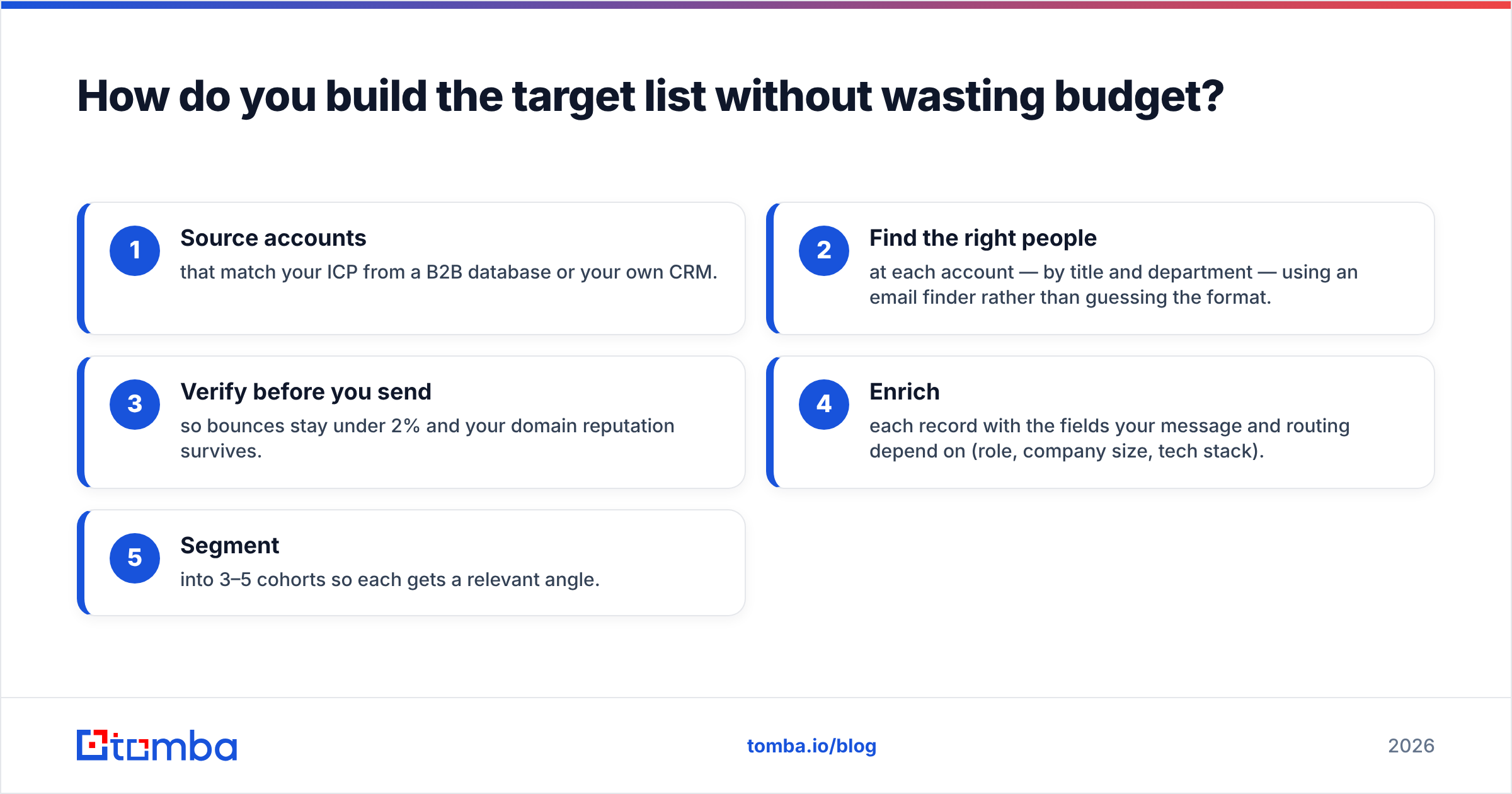
How do you build the target list without wasting budget?#
Treat list-building as the highest-leverage hour of the whole campaign. A campaign aimed at 1,000 verified, well-fit contacts will out-perform one blasted at 10,000 scraped addresses, every time.
Here is the lean workflow:
- Source accounts that match your ICP from a B2B database or your own CRM.
- Find the right people at each account — by title and department — using an email finder rather than guessing the format.
- Verify before you send so bounces stay under 2% and your domain reputation survives.
- Enrich each record with the fields your message and routing depend on (role, company size, tech stack).
- Segment into 3–5 cohorts so each gets a relevant angle.
This is also where most teams over-buy. You do not need a 100,000-contact database to run a focused campaign. You need the few thousand contacts that match your ICP, verified and current. For bulk work, a bulk email finder processes a list of companies into verified contacts in one pass, so you skip the manual one-by-one lookup.
What metrics actually prove a campaign worked?#
Measure outcomes, not activity. The hierarchy of metrics, from least to most meaningful:
- Vanity (track, don't celebrate): impressions, clicks, open rate.
- Engagement (leading indicators): reply rate, content downloads, demo requests, response rate.
- Pipeline (what finance cares about): marketing-qualified leads, sales-accepted leads, opportunities created, pipeline value.
- Revenue (the only one that matters long-term): closed-won revenue influenced, cost per opportunity, and return on campaign spend.
Set a baseline before launch so you can attribute lift. A campaign that produced 40 opportunities sounds great until you learn the same segment produced 35 with no campaign at all. Attribution does not have to be perfect — it has to be consistent enough to compare campaigns and kill the losers fast. Industry analysts like Gartner publish useful frameworks for multi-touch B2B attribution if you want to formalize this.
The practical rule: review leading indicators weekly and pipeline metrics every two weeks. If reply and conversion rates are flat by week two, the problem is usually targeting or offer — fix those before spending more on reach.
How much should a B2B campaign cost?#
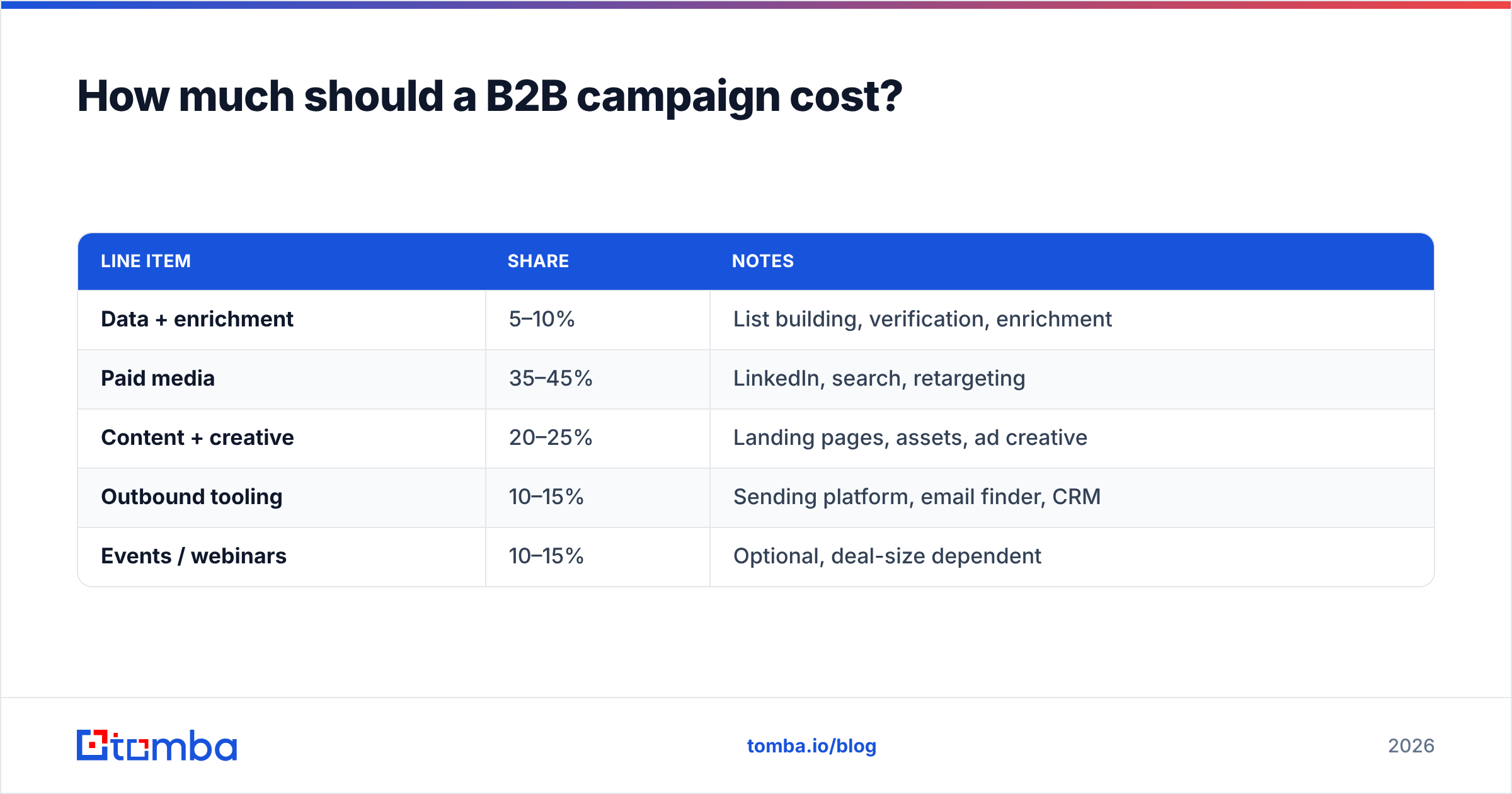
Budget as a function of the pipeline goal, not a fixed percentage. A common benchmark is a 3:1 to 5:1 pipeline-to-spend ratio for a healthy campaign — meaning $100K of spend should generate $300K–$500K in qualified pipeline. If you are below 3:1, the campaign is inefficient; diagnose targeting and offer before scaling.
A representative mid-market campaign budget over six weeks:
| Line item | Share | Notes |
|---|---|---|
| Data + enrichment | 5–10% | List building, verification, enrichment |
| Paid media | 35–45% | LinkedIn, search, retargeting |
| Content + creative | 20–25% | Landing pages, assets, ad creative |
| Outbound tooling | 10–15% | Sending platform, email finder, CRM |
| Events / webinars | 10–15% | Optional, deal-size dependent |
Note that data and tooling together are a small slice of total spend but determine the efficiency of every other line. Tools like Tomba sit in that 5–15% band. For reference, Tomba pricing starts with a free tier of 25 searches per month, then Starter at $49/mo, Growth at $99/mo, and Pro at $249/mo — modest against a five-figure media budget, yet they govern whether that media reaches real buyers. You can compare options on a neutral marketplace like G2 before committing.
How do you keep a campaign improving after launch?#
Run it as a loop, not a launch. The two-week refinement cadence looks like this:
- Read the data. Which segment, channel, and message combination is converting?
- Cut the losers. Pause the bottom-performing ads and segments. Reallocate that budget.
- Double down on winners. Expand the audiences and creative that are working.
- Refresh the list. Re-verify contacts and add new accounts that matched your best-converting segment.
- Test one variable. Subject line, offer, or landing page — one change at a time so you can read the result.
The teams that win at B2B marketing are not the ones with the biggest budgets. They are the ones with the tightest feedback loop and the cleanest data feeding it. Connect your stack — for example via a HubSpot integration — so enriched, verified contacts flow straight into your CRM and campaign tooling without manual exports.
The bottom line#
A B2B marketing campaign succeeds or fails on three things: the precision of your targeting, the coordination of your channels, and the honesty of your measurement. Spend your first hour on the list, your campaign weeks on coordinated touches, and your review cadence on cutting what does not work.
Everything downstream — your ad spend, your copy, your sales follow-up — is leveraged by the quality of the contact data underneath it. Start there. Use the Tomba Email Finder to build a verified, ICP-matched contact list before you launch, so every dollar of your campaign budget reaches a real decision-maker instead of a dead inbox. Try it free with 25 searches, then scale up as your pipeline does.
// get started
Find, verify and enrich your first contacts today
Start on the free plan with 25 searches a month, then scale when your team is ready.
Free plan · No credit card required · GDPR & CCPA
// about the author