How to Build a B2B Marketing List That Converts in 2026
A bought B2B marketing list looks cheap until your bounce rate tanks your domain. Here's how to build, verify, and segment a list that actually converts in 2026.
A B2B marketing list is only as good as the day it was built — and most of them rot faster than the people buying them realize. If your last campaign hit a 15% bounce rate, the problem usually isn't your copy. It's the list.
TL;DR#
- A B2B marketing list is a structured set of business contacts (name, role, company, verified email, sometimes phone) you can legally market to.
- Buying a generic list is fast and cheap, but it bounces hard, ages within 90 days, and can torch your sender reputation.
- Building your own list — sourced by ICP, verified before send — costs more upfront and wins on deliverability and conversion.
- Verification is non-negotiable: B2B email data decays roughly 2.5% per month, so a "fresh" list is half-dead in under two years.
- The realistic 2026 playbook is hybrid: define a tight ICP, pull contacts with an email finder, verify every address, then segment before you send.
What is a B2B marketing list?#
A B2B marketing list is a database of business contacts you intend to reach with marketing or sales outreach. Think of it like a guest list for a dinner party: it's not just names, it's the right names, with current addresses, grouped so you know who gets the vegetarian plate.
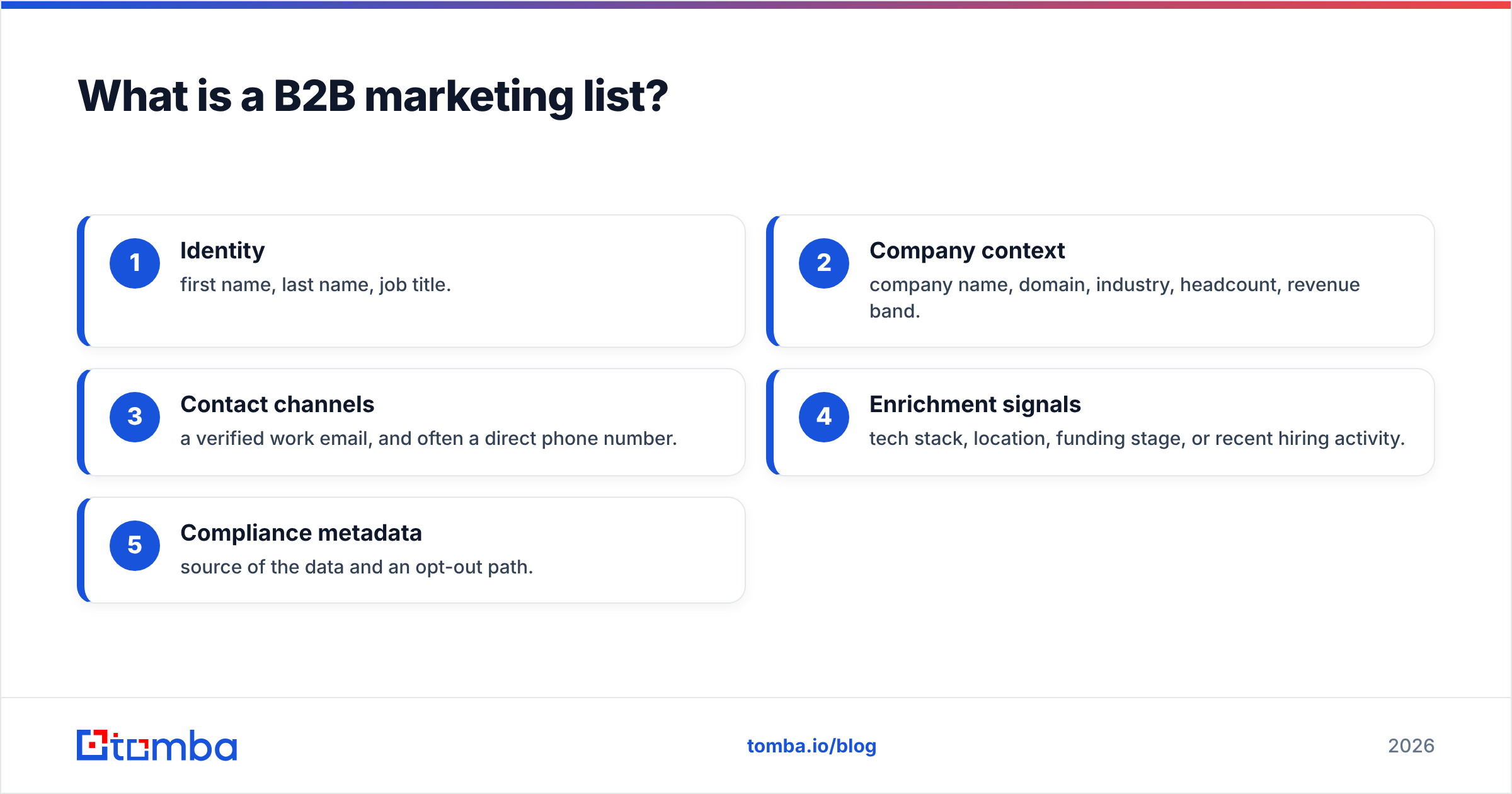
A usable B2B list typically carries:
- Identity — first name, last name, job title.
- Company context — company name, domain, industry, headcount, revenue band.
- Contact channels — a verified work email, and often a direct phone number.
- Enrichment signals — tech stack, location, funding stage, or recent hiring activity.
- Compliance metadata — source of the data and an opt-out path.
Strip away the enrichment and you still have a list. Strip away the verified email and you have a liability. The contact channel is the part that decays, and it's the part everyone under-invests in.
Should you buy or build a B2B marketing list?#
Build it. Buying a pre-packaged list is the single fastest way to wreck a new sending domain. That's the short answer, but the trade-off deserves a real look, because "buy" isn't always wrong — it's wrong by default.
Bought lists are sold to many buyers, scraped at unknown dates, and rarely re-verified. The moment a few hundred addresses bounce, mailbox providers flag your domain and your good emails start landing in spam too. You don't just lose the dead contacts — you lose deliverability on the live ones.
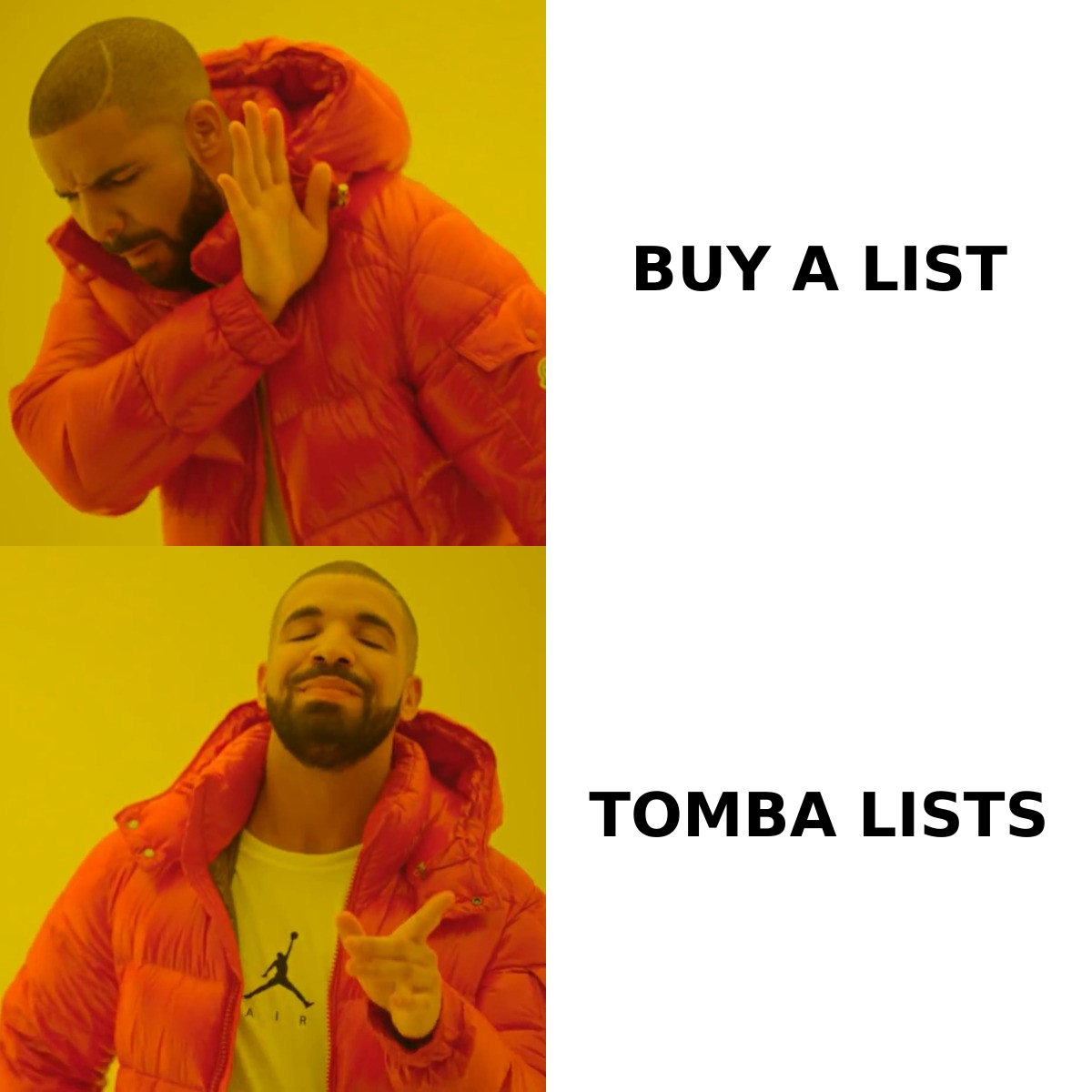
Here's the honest comparison:
| Factor | Bought list | Self-built list |
|---|---|---|
| Time to first send | Hours | Days to weeks |
| Cost per 1,000 contacts | $50–$400 | Tool subscription + time |
| Email accuracy at send | Often 50–70% | 95%+ if verified |
| Bounce rate risk | High (10–20%) | Low (<3%) |
| Exclusivity | Sold to many buyers | Yours alone |
| ICP fit | Generic | Precisely targeted |
| Compliance clarity | Murky | You control the source |
| Domain reputation risk | Severe | Minimal |
The pattern is clear: buying optimizes for speed, building optimizes for everything that determines whether the campaign actually works. If you're under deadline pressure and tempted by a cheap CSV, at least run it through an email verifier before the first send — that single step prevents most of the reputation damage.
How do you build a B2B marketing list step by step?#
Building a list is a pipeline, not a purchase. Each stage filters the noise the previous stage let through.
1. Define your ICP before you touch a tool#
Your Ideal Customer Profile is the spec sheet for the whole list. Without it you're collecting contacts the way a vacuum collects dust — indiscriminately. Nail down:
- Firmographics: industry, company size, revenue, geography.
- Role targets: the specific titles that sign off on your product.
- Trigger signals: hiring, funding, a tech-stack change, expansion.
A list of 500 contacts that match your ICP outperforms 50,000 random ones. Tighter is almost always better.
2. Source the contacts#
This is where an email finder earns its keep. Instead of scraping LinkedIn by hand, you feed in a company domain or a name and get back the work email pattern. Tomba's domain search returns every public email on a company domain with the role attached, so you can pull the four people who matter at a target account instead of guessing the format.
For broader sweeps, a bulk email finder takes a list of companies or names and returns verified contacts in one pass — the difference between an afternoon and a week.
3. Verify every address#
Sourcing gives you candidates. Verification gives you a list. An email verifier checks each address against the mail server (SMTP), filters out role accounts like info@ and sales@, and flags risky catch-all domains. Skip this and you're back to bought-list bounce rates.
Catch-all domains deserve special attention because they accept every address whether the mailbox exists or not. A dedicated catch-all verifier uses additional signals to estimate whether a catch-all address is actually deliverable, so you're not flying blind on a chunk of your list.
4. Enrich for segmentation#
Once addresses are clean, data enrichment layers in the context that makes personalization possible — seniority, department, company size, tech stack. This is what lets you write "I saw you're scaling your RevOps team" instead of "Dear valued professional."
5. Segment before you send#
A single blast to a mixed list is a wasted list. Split by persona, industry, or funnel stage so the message matches the reader. Segmentation is consistently one of the highest-leverage moves in B2B email — it's the difference between a relevant note and noise.
How do you keep a B2B marketing list from rotting?#
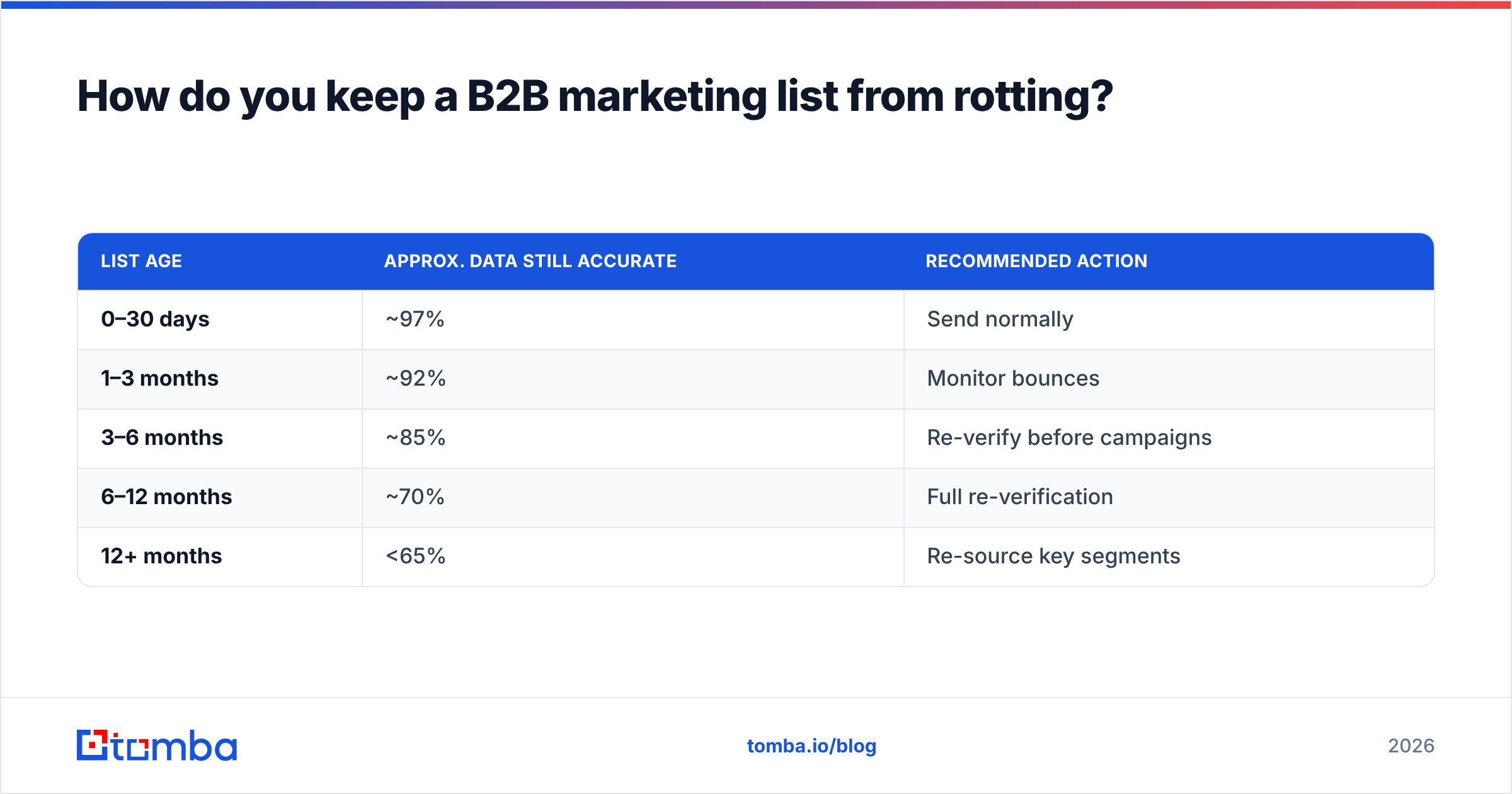
Treat the list as a perishable asset and re-verify on a schedule. B2B contact data decays at roughly 2.5–3% per month as people change jobs, companies get acquired, and email formats shift. Do the math and about 30% of any list is stale within a year.
| List age | Approx. data still accurate | Recommended action |
|---|---|---|
| 0–30 days | ~97% | Send normally |
| 1–3 months | ~92% | Monitor bounces |
| 3–6 months | ~85% | Re-verify before campaigns |
| 6–12 months | ~70% | Full re-verification |
| 12+ months | <65% | Re-source key segments |
Practical maintenance habits:
- Re-verify quarterly at minimum, monthly for high-value segments.
- Suppress hard bounces immediately — never re-send to a confirmed dead address.
- Watch engagement decay. A contact who hasn't opened in six months is a deliverability risk even if the address is live.
- Re-source champions who switch jobs — a known contact at a new company is your warmest possible lead, and a reverse email lookup helps you re-find them.
According to HubSpot's research on email marketing, list hygiene is one of the strongest predictors of deliverability — clean lists consistently outperform larger dirty ones.
Is buying a B2B marketing list legal?#
It depends on the jurisdiction, and "legal" is not the same as "effective." In the United States, CAN-SPAM permits cold B2B email if you include a valid physical address and a working opt-out. In the EU and UK, GDPR and PECR raise the bar — you generally need a lawful basis such as legitimate interest, and contacts must be able to object easily.
The compliance reality:
- Document your data source. If you can't say where an address came from, that's a red flag under GDPR.
- Honor opt-outs instantly and permanently across every system.
- Avoid consumer (B2C) addresses in B2B lists — personal Gmail addresses carry far stricter consent rules than work emails.
- Keep records. Regulators care less about perfection and more about demonstrable good-faith process.
A self-built, verified list with a clear source trail is far easier to defend than a purchased CSV of unknown origin. This is another quiet advantage of building over buying.
What tools do you need to build a B2B marketing list?#
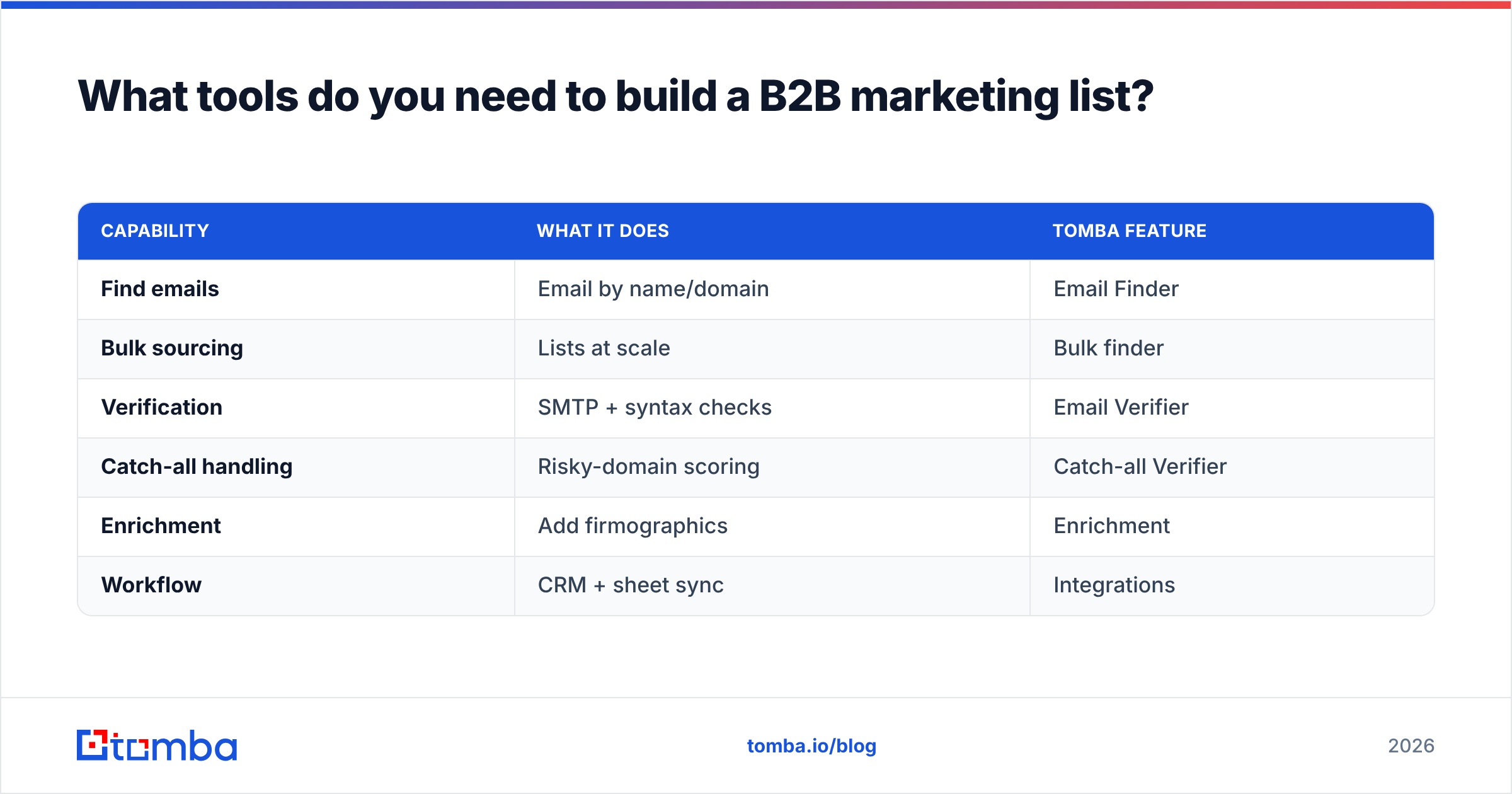
You need three capabilities — find, verify, enrich — and a way to push the output into your stack. You can stitch these from separate vendors, but a single platform reduces the credit-juggling and keeps your data consistent.
| Capability | What it does | Tomba feature |
|---|---|---|
| Find emails | Email by name/domain | Email Finder |
| Bulk sourcing | Lists at scale | Bulk finder |
| Verification | SMTP + syntax checks | Email Verifier |
| Catch-all handling | Risky-domain scoring | Catch-all Verifier |
| Enrichment | Add firmographics | Enrichment |
| Workflow | CRM + sheet sync | Integrations |
Tomba's pricing scales with how much list-building you do. The Tomba pricing tiers run from a Free plan (25 searches/month) to Starter at $49/mo, Growth at $99/mo, and Pro at $249/mo, with Enterprise available for custom volume. For a small team building targeted lists, Starter or Growth covers most monthly needs without the per-seat tax that larger platforms like those reviewed on G2 tend to charge.
If your workflow already lives in spreadsheets or a CRM, the HubSpot integration and Google Sheets add-on let you find and verify contacts without exporting CSVs back and forth.
How big should a B2B marketing list be?#
Smaller and more accurate beats bigger and noisier — every time. The instinct to chase volume is the most expensive mistake in list-building.
A focused list of 1,000 verified, on-ICP contacts will out-convert a 50,000-contact bought list, and it won't burn your domain doing it. Here's why volume backfires:
- Deliverability is shared. Every bounce from a junk contact hurts the inbox placement of your good contacts.
- Personalization doesn't scale to garbage. You can't write relevant copy for contacts you know nothing about.
- Cost per meeting, not cost per contact, is the metric that matters. A bigger list with a worse conversion rate often costs more per booked meeting.
Size your list to your ICP and your capacity to follow up properly. If you can only run thoughtful sequences to 500 accounts this quarter, a 500-account list is the right size.
Common mistakes that kill B2B marketing lists#
- Sending before verifying. The number-one cause of high bounce rates and blacklisting.
- Ignoring catch-all domains. They quietly inflate your "valid" count with addresses that may not exist.
- One list for everyone. No segmentation means no relevance means no replies.
- Set-and-forget. A list you built last year is a different list today, minus 30%.
- Buying for speed. The hours you save sourcing, you lose tenfold cleaning up reputation damage.
- No suppression list. Re-emailing bounced or unsubscribed contacts is both ineffective and, in some jurisdictions, illegal.
Avoid these six and you're already ahead of most B2B senders.
Build a list that actually converts#
A great B2B marketing list isn't bought — it's built, verified, and maintained. Start by defining a tight ICP, then use the Tomba Email Finder to source contacts by name, company, or domain, verify every address before you send, and enrich what's left so your outreach reads like it was written for one person. The Free plan gives you 25 searches to test the workflow on real targets before you commit. Build the list right once, keep it clean, and your bounce rate stops being the reason your campaigns underperform.
// get started
Find, verify and enrich your first contacts today
Start on the free plan with 25 searches a month, then scale when your team is ready.
Free plan · No credit card required · GDPR & CCPA
// about the author