The Best B2B Marketing Tools in 2026: A Practical Stack Guide
A no-fluff breakdown of the B2B marketing tools that actually move pipeline in 2026 — by category, price, and use case — plus how to wire them into one stack.
Buying B2B marketing tools is easy. Building a stack that actually produces pipeline is hard. The difference is almost never the logo on the dashboard — it is whether the tools share clean data, hand leads off without friction, and earn back more than they cost.
This guide skips the "50 must-have tools" listicle treatment. Instead, you get the categories that matter, the leading options in each, honest pricing, and a blueprint for wiring them together in 2026.
TL;DR#
- Spend follows the funnel, not the hype. Prioritize data quality and lead capture before you buy another content scheduler.
- Six categories cover most B2B teams: CRM, marketing automation, data/enrichment, content & SEO, outbound, and analytics.
- Bad data quietly breaks every other tool. A verified contact source like Tomba Email Finder is the foundation, not an afterthought.
- Consolidate where you can. Most teams overpay for overlapping features across 8–12 tools they could trim to 5–6.
- Tomba pricing starts free (25 searches/mo), then $49/mo, with a public API so data flows into the rest of your stack.
What counts as a "B2B marketing tool" in 2026?#
A B2B marketing tool is any software that helps you find, attract, convert, or measure business buyers. That is a wide net, so it helps to think in layers rather than logos. Each layer feeds the next, and a weak layer caps the performance of everything downstream.
Here is the stack most B2B teams converge on, top to bottom:
- Data & enrichment — who your buyers are, their verified email, company, and role. This is the fuel. Tools: Tomba, Clearbit, Apollo.
- CRM — the single source of truth for every account and deal. Tools: HubSpot, Salesforce, Pipedrive.
- Marketing automation — nurture sequences, scoring, and lifecycle emails. Tools: HubSpot, Marketo, ActiveCampaign.
- Content & SEO — the engine that earns inbound demand. Tools: Ahrefs, Semrush, Surfer.
- Outbound & cold email — proactive pipeline when inbound is slow. Tools: Instantly, Smartlead, Lemlist.
- Analytics & attribution — proof of what works so you can cut what doesn't. Tools: GA4, HockeyStack, Dreamdata.
If you only remember one thing: the layers at the bottom are infrastructure, and the layers at the top are amplifiers. Amplifying bad data just produces wrong answers faster.
)
Which B2B marketing tools matter most by category?#
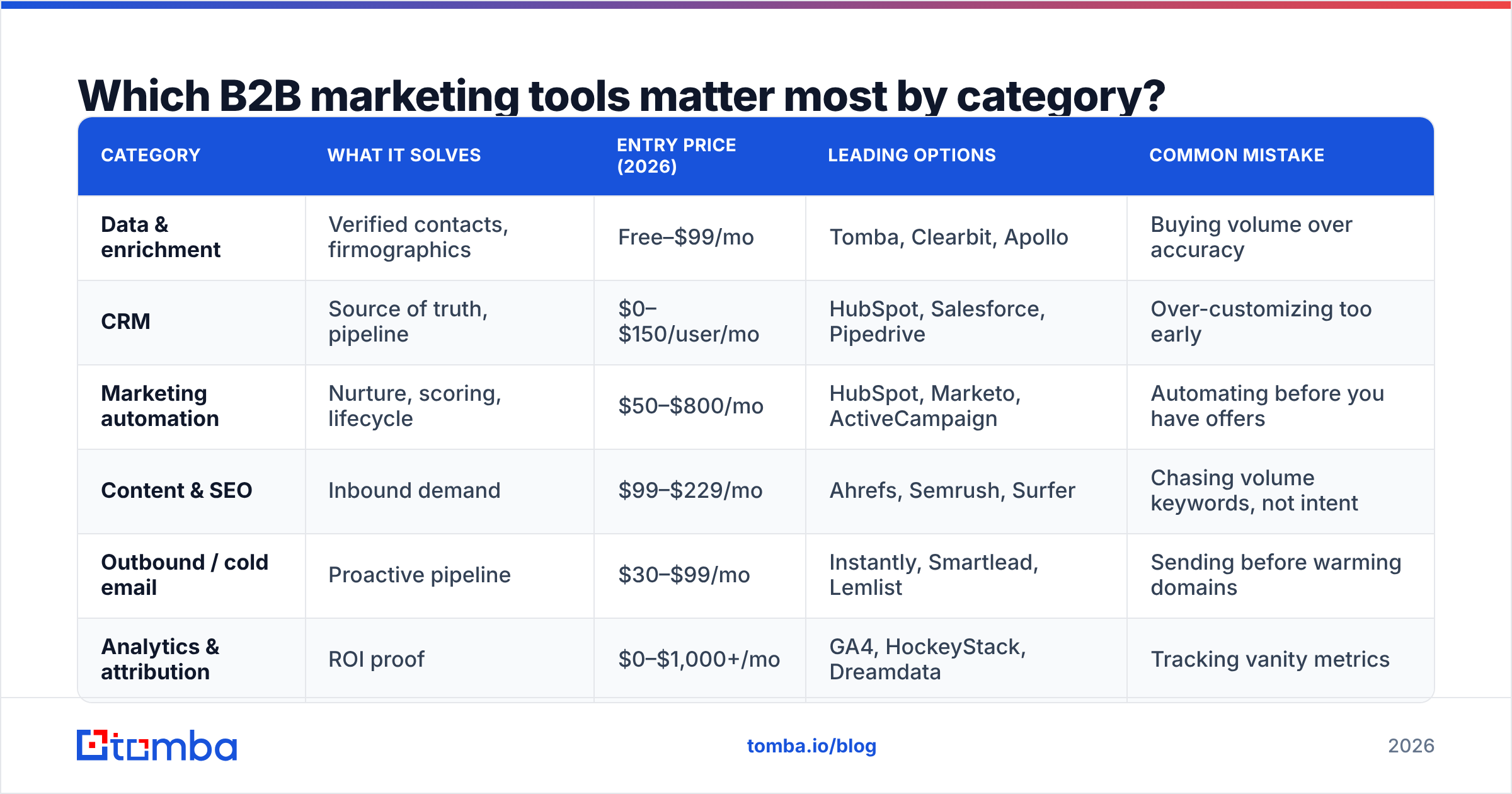
You do not need every category staffed on day one. You need the ones that match where your pipeline actually leaks. Below is a practical comparison of the categories, what each solves, a representative price band, and the trap teams fall into.
| Category | What it solves | Entry price (2026) | Leading options | Common mistake |
|---|---|---|---|---|
| Data & enrichment | Verified contacts, firmographics | Free–$99/mo | Tomba, Clearbit, Apollo | Buying volume over accuracy |
| CRM | Source of truth, pipeline | $0–$150/user/mo | HubSpot, Salesforce, Pipedrive | Over-customizing too early |
| Marketing automation | Nurture, scoring, lifecycle | $50–$800/mo | HubSpot, Marketo, ActiveCampaign | Automating before you have offers |
| Content & SEO | Inbound demand | $99–$229/mo | Ahrefs, Semrush, Surfer | Chasing volume keywords, not intent |
| Outbound / cold email | Proactive pipeline | $30–$99/mo | Instantly, Smartlead, Lemlist | Sending before warming domains |
| Analytics & attribution | ROI proof | $0–$1,000+/mo | GA4, HockeyStack, Dreamdata | Tracking vanity metrics |
Notice the entry prices. The cheapest line item — data and enrichment — is the one with the highest leverage, because it determines whether your CRM, automation, and outbound tools are working with real people or noise.
Why does data quality decide the whole stack?#
Think of your martech stack as a kitchen. The CRM is your fridge, automation is the recipe, outbound is the plating. None of it matters if the ingredients are spoiled. In B2B, "spoiled" means bounced emails, wrong job titles, and contacts who left the company eight months ago.
B2B data decays fast — industry estimates from vendors like HubSpot put contact-data rot at roughly 22–30% per year as people change roles. That means even a clean list goes stale within 12 months. A tool that finds and verifies contacts on demand keeps the rest of the stack honest. This is exactly where an email verifier and live domain search earn their keep: you enrich at the moment of outreach, not from a CSV you bought last year.
How do you build a B2B marketing stack without overspending?#
Start with the funnel stage that is failing, and buy backward from there. Most teams do the opposite — they buy the shiny analytics or automation platform first and then discover they have nothing good to measure or nurture.
Use this sequencing:
- No pipeline at all? Start with data + outbound. You need to reach the right people before anything else matters. Pair a verified contact source with a cold-email sender.
- Leads but no follow-through? Add a CRM and basic automation so nothing falls through the cracks.
- Plenty of activity but no proof? Add analytics and attribution to cut wasted spend.
- Scaling and drowning in manual work? Add enrichment automation and integrations to remove copy-paste between tools.
A lean, effective 2026 stack for a small B2B team often looks like this: HubSpot (CRM + automation, free or Starter), Tomba (data + verification), one SEO tool (Ahrefs or Semrush), one cold-email sender (Instantly or Smartlead), and GA4 for analytics. That is five tools, not fifteen, and it covers every layer.
)
What should you spend at each company stage?#
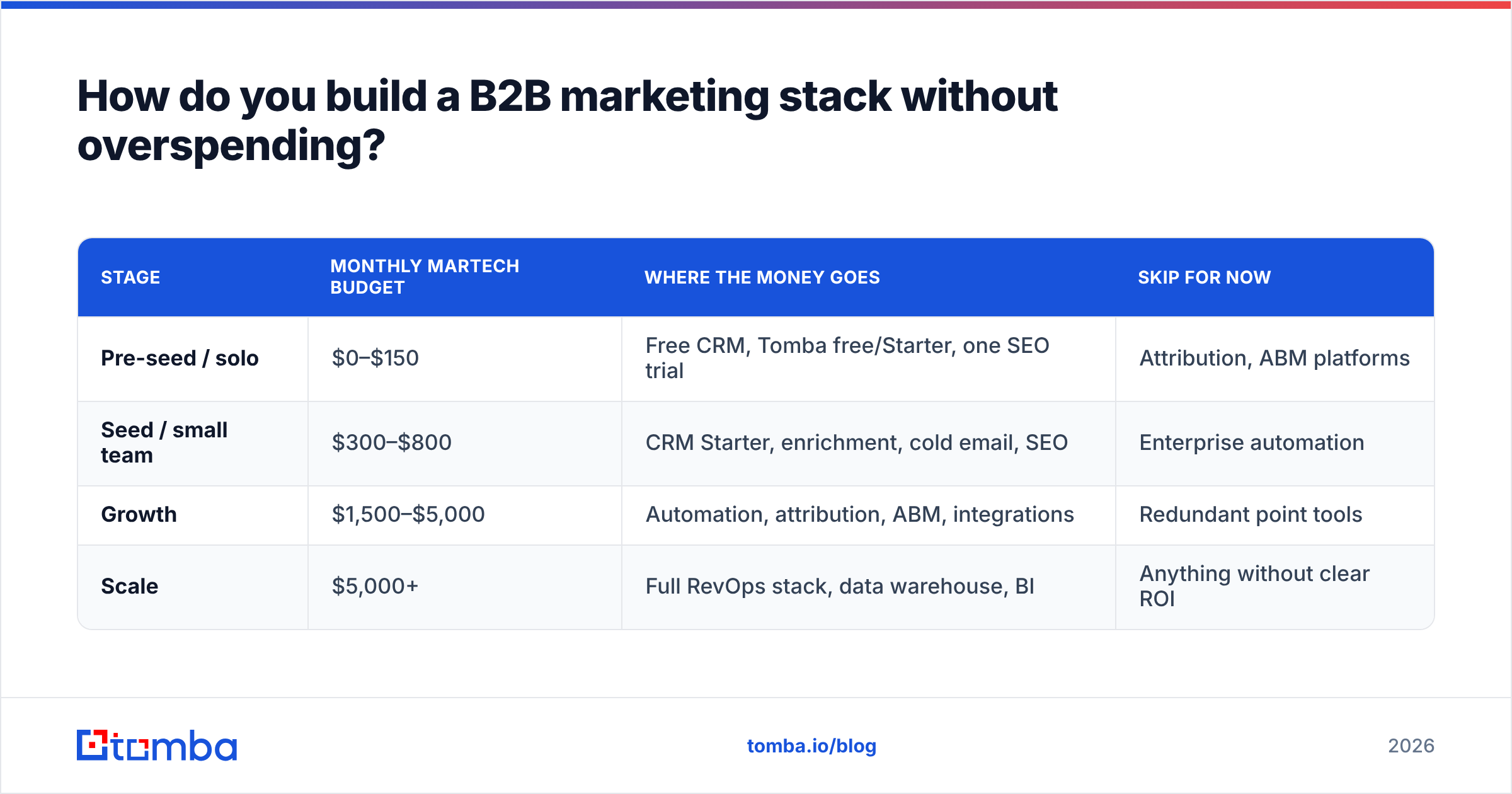
Budget is a function of stage, not ambition. Here is a realistic split.
| Stage | Monthly martech budget | Where the money goes | Skip for now |
|---|---|---|---|
| Pre-seed / solo | $0–$150 | Free CRM, Tomba free/Starter, one SEO trial | Attribution, ABM platforms |
| Seed / small team | $300–$800 | CRM Starter, enrichment, cold email, SEO | Enterprise automation |
| Growth | $1,500–$5,000 | Automation, attribution, ABM, integrations | Redundant point tools |
| Scale | $5,000+ | Full RevOps stack, data warehouse, BI | Anything without clear ROI |
The single best cost-control move is consolidation. Audit your stack quarterly and kill any tool whose core job is already covered by another. Two tools doing 60% of each other's work cost more than one tool doing 100%.
Are all-in-one platforms better than best-of-breed tools?#
It depends on your team size and how much your data needs to move between systems. All-in-one suites (HubSpot, Salesforce Marketing Cloud) win on simplicity and native integration. Best-of-breed stacks win on depth and price-per-function.
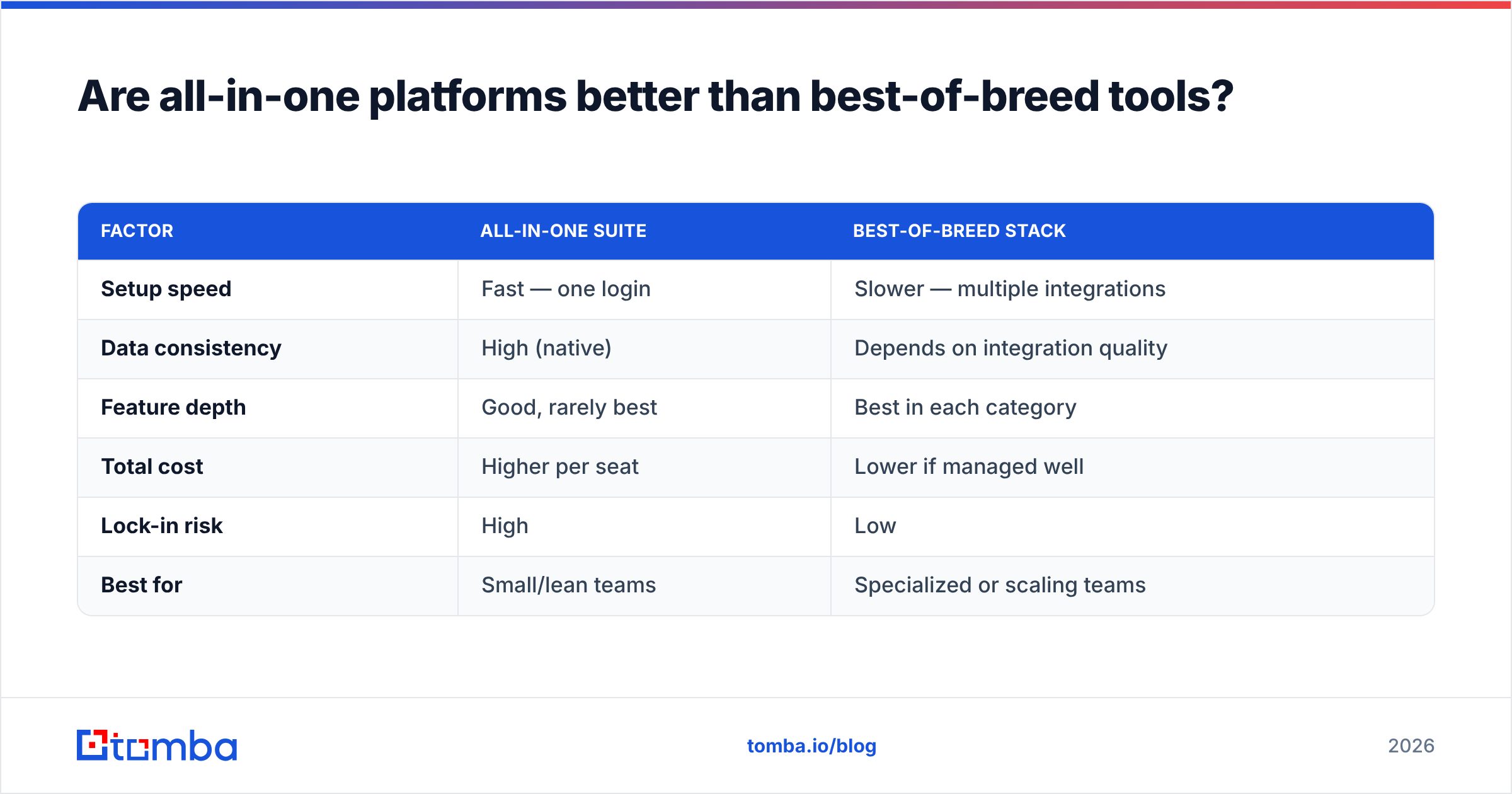
Here is the honest trade-off:
| Factor | All-in-one suite | Best-of-breed stack |
|---|---|---|
| Setup speed | Fast — one login | Slower — multiple integrations |
| Data consistency | High (native) | Depends on integration quality |
| Feature depth | Good, rarely best | Best in each category |
| Total cost | Higher per seat | Lower if managed well |
| Lock-in risk | High | Low |
| Best for | Small/lean teams | Specialized or scaling teams |
For most B2B teams under 50 people, a hybrid wins: an all-in-one core (HubSpot for CRM + automation) plus a few best-of-breed specialists for the jobs the suite does poorly — namely contact data, deep SEO, and cold email. The key is making them talk to each other.
That is why integrations matter more than features. A tool that exports to a CSV is a tool you will eventually stop updating. Tomba's HubSpot integration and open API mean verified contacts land directly in your CRM, so enrichment is part of the workflow instead of a weekly chore. Check vendor ratings on G2 before you commit — integration quality and support responsiveness rarely show up on the pricing page.
Where does Tomba fit in a B2B marketing stack?#
Tomba sits at the data layer — the foundation everything else stands on. Its job is to turn a name, a company, or a domain into a verified, deliverable contact, and to keep that contact accurate over time.
Concretely, B2B marketers use Tomba to:
- Find decision-makers with the email finder when you have a name and company but no contact.
- Pull entire org charts with domain search to map buying committees before an ABM push.
- Verify before you send with the email verifier, so cold-email domains stay healthy and bounce rates stay low.
- Enrich CRM records automatically through integrations, killing manual data entry.
Pricing is straightforward and built for teams that are watching budget: a free tier with 25 searches per month, then Starter at $49/mo, Growth at $99/mo, and Pro at $249/mo, with Enterprise available for high-volume needs. Full details are on the Tomba pricing page. The free tier is genuinely usable for testing accuracy before you commit a dollar — which is exactly how you should evaluate any data vendor.
How do you evaluate a data tool before buying?#
Run the same three checks on any enrichment or contact tool, Tomba included:
- Accuracy on your ICP, not theirs. Pull 50 contacts in your actual target market and verify deliverability. Vendor-wide accuracy stats mean nothing if they miss your niche.
- Coverage in your geography. A tool strong in North America may be thin in EMEA or APAC. Test the regions you sell into.
- How data exits the tool. API, native CRM sync, or just a CSV? The export path determines whether enrichment becomes a habit or a one-time stunt.
Analysts like Gartner consistently flag data quality as the top predictor of martech ROI. The tool that scores highest on those three checks is the one that will quietly make every other tool in your stack perform better.
What's the simplest stack that actually works in 2026?#
If you want a starting point you can stand up this week, here it is — five tools, every funnel layer covered, under most small-team budgets:
- CRM + automation: HubSpot (free or Starter)
- Data + verification: Tomba (free → $49/mo)
- SEO + content: Ahrefs or Semrush
- Outbound: Instantly or Smartlead
- Analytics: GA4
Add complexity only when a specific bottleneck demands it — attribution when spend gets serious, ABM when you move upmarket, a data warehouse when reporting outgrows spreadsheets. Resist buying ahead of the problem. Every tool you add is a tool someone has to maintain, integrate, and justify.
The teams that win in 2026 are not the ones with the most logos in their stack. They are the ones whose tools share clean data and hand work off without friction. Start with the foundation, keep it lean, and let results — not features — decide what you add next.
Get the data layer right first#
Before you spend on another automation seat or content subscription, make sure the contacts feeding your stack are real. Spin up the Tomba Email Finder on the free tier, run your actual target accounts through it, and check the deliverability yourself. If verified data lands in your CRM and your bounce rate drops, you have found the foundation worth building on — and every other tool in your stack will perform better for it.
// get started
Find, verify and enrich your first contacts today
Start on the free plan with 25 searches a month, then scale when your team is ready.
Free plan · No credit card required · GDPR & CCPA
// about the author