B2B Marketing Trends 2026: 9 Shifts Reshaping Pipeline
The B2B marketing trends that actually move pipeline in 2026: AI-assisted GTM, signal-based outbound, dark social, and the data hygiene that makes it all work.
The B2B marketing playbook that worked in 2022 is quietly failing. Buyers research in private, gate forms convert worse every quarter, and "more content" stopped being a strategy around the time everyone got an AI writer. If you are planning budget and headcount for the rest of 2026, here is what the data — and the spend — is actually rewarding.
TL;DR#
- AI moved from writing to operating. The winners use it for research, routing, and enrichment, not just blog drafts.
- Signal-based outbound beats volume. Targeting accounts showing intent outperforms spray-and-pray by a wide margin.
- Dark social is the new top of funnel. Buyers self-educate on LinkedIn, Slack, and podcasts long before they fill a form.
- Data quality is the hidden multiplier. Every trend below collapses if your contact data is stale or unverified.
- Fewer, deeper plays win. Consolidated GTM motions outperform 11 half-run channels.
What are the biggest B2B marketing trends in 2026?#
The headline shift is from activity to precision. For a decade, B2B marketing rewarded volume — more emails, more content, more retargeting impressions. That math broke. Inboxes tightened, third-party cookies finished dying, and buyers learned to ignore anything that smells like a campaign.
The 2026 trends all point in one direction: reach fewer, better-qualified people, with a reason to talk that you actually earned. According to Gartner's research on B2B buying, buyers now spend the majority of their journey away from sellers entirely, learning independently. Your job is no longer to interrupt that journey — it is to show up credibly inside it.
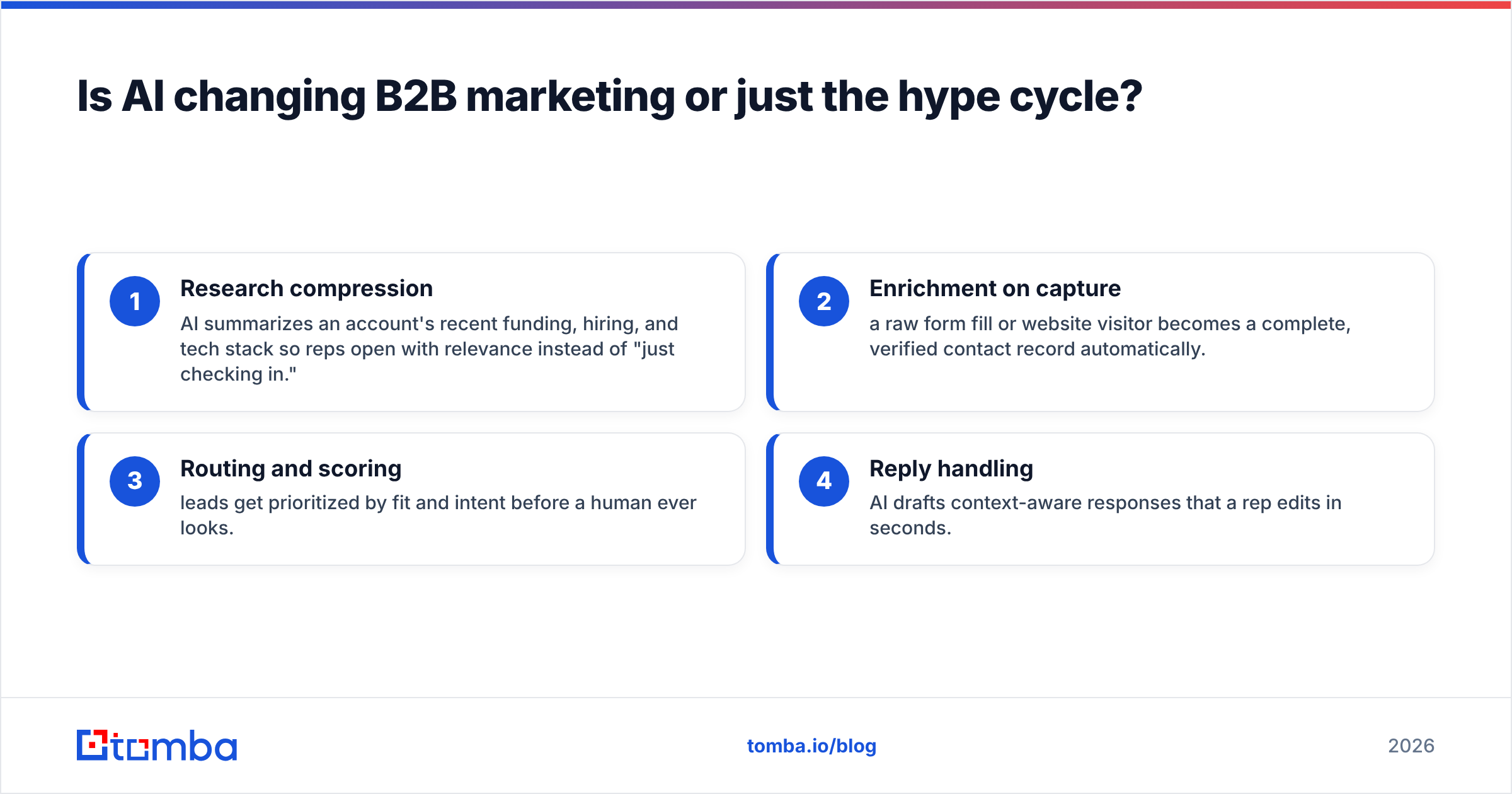
Is AI changing B2B marketing or just the hype cycle?#
Both, but the useful part is unglamorous. The 2024–2025 wave was about generating — copy, images, subject lines. The 2026 wave is about operating: AI that enriches a lead the moment it lands, scores it against your ICP, routes it to the right rep, and drafts a first-touch grounded in real account context.
The teams seeing returns treat AI as connective tissue between systems, not a content faucet. A few patterns that are working now:
- Research compression — AI summarizes an account's recent funding, hiring, and tech stack so reps open with relevance instead of "just checking in."
- Enrichment on capture — a raw form fill or website visitor becomes a complete, verified contact record automatically.
- Routing and scoring — leads get prioritized by fit and intent before a human ever looks.
- Reply handling — AI drafts context-aware responses that a rep edits in seconds.
The trap is using AI to produce more low-quality output. If you generate 500 personalized emails to addresses you never verified, you have automated your own bounce rate. That is why the unsexy layer — clean, current contact data — decides whether any of this works.
Why does data quality decide whether the trends work?#
Because every trend above is a multiplier on your underlying data, and a multiplier on garbage is more garbage at scale. Intent signals are useless if you cannot reach the person. AI personalization fails if the contact left the company eight months ago. Account-based plays collapse when half the buying committee is missing from your CRM.
B2B data decays fast — research consistently puts contact data decay at roughly 30% per year as people change jobs, titles, and companies. That means a list you bought 18 months ago is now mostly fiction. The fix is continuous, not one-time: verify before you send, enrich on capture, and re-validate on a schedule.
This is where an email verifier and ongoing data enrichment stop being "nice to have" and become the foundation the rest of your stack sits on. Sending to verified addresses protects your sender reputation, which protects your deliverability, which protects every campaign downstream.

Should you still rely on gated content and forms?#
Mostly no — at least not as your primary engine. Gated whitepapers trained buyers to type "asdf@asdf.com" and trained marketers to celebrate vanity MQLs that sales ignores. The 2026 move is ungated education plus signal capture.
Instead of trading a PDF for an email, you publish the insight openly, build trust in public, and capture intent through behavior — who visited pricing twice, who attended the webinar, who engaged with three LinkedIn posts. Then you use tools like website visitor reveal and intent data to identify those accounts and reach out with context, rather than waiting on a form.
This does not mean forms die entirely. High-intent actions — demo requests, ROI calculators, pricing inquiries — still warrant a form. The shift is that the form is the end of a trust-building journey, not the toll booth at the start.
How do the 2026 B2B marketing channels compare?#
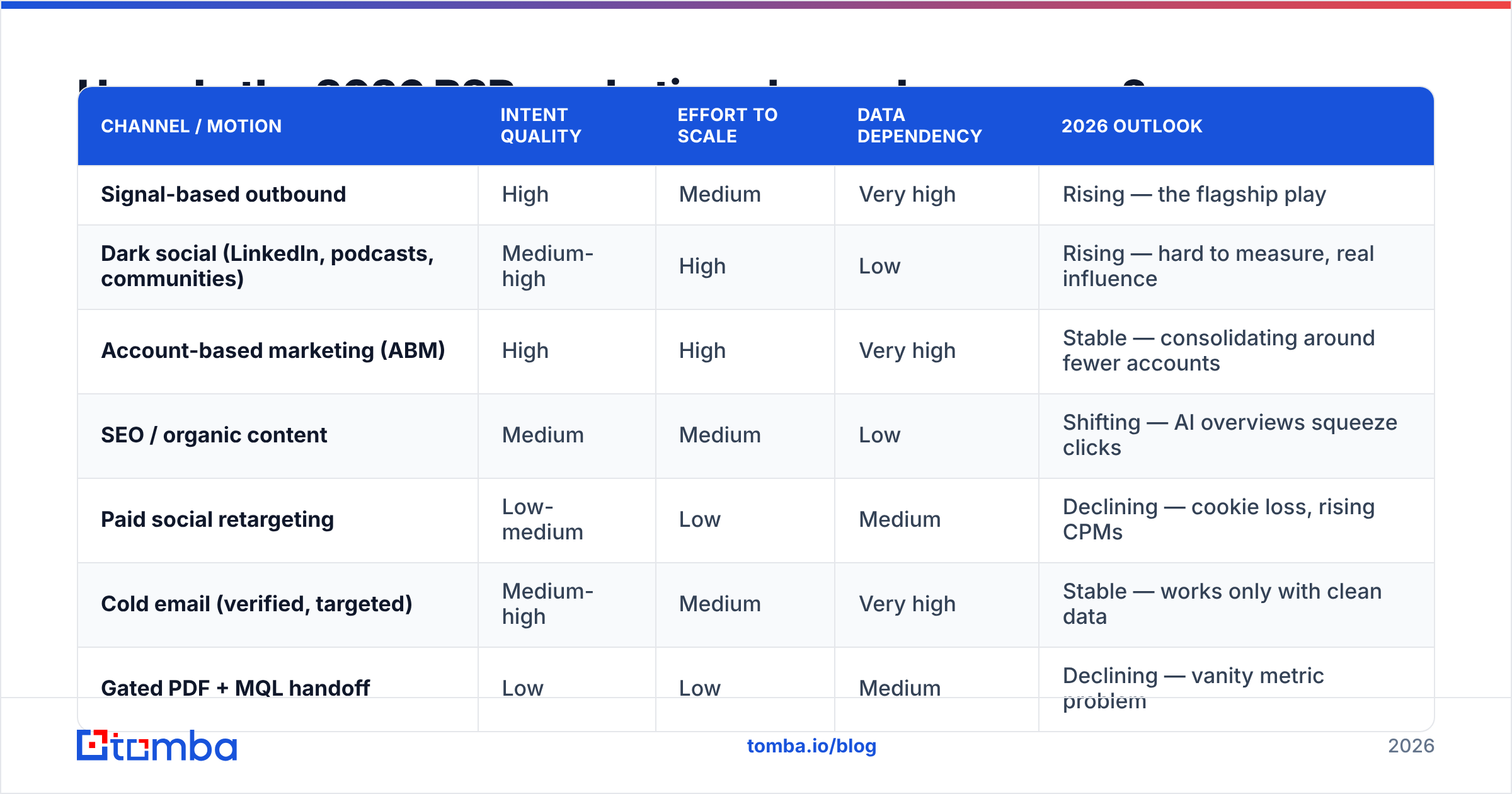
Not every channel deserves equal budget. Here is how the major motions stack up on the metrics that matter heading into 2026:
| Channel / Motion | Intent quality | Effort to scale | Data dependency | 2026 outlook |
|---|---|---|---|---|
| Signal-based outbound | High | Medium | Very high | Rising — the flagship play |
| Dark social (LinkedIn, podcasts, communities) | Medium-high | High | Low | Rising — hard to measure, real influence |
| Account-based marketing (ABM) | High | High | Very high | Stable — consolidating around fewer accounts |
| SEO / organic content | Medium | Medium | Low | Shifting — AI overviews squeeze clicks |
| Paid social retargeting | Low-medium | Low | Medium | Declining — cookie loss, rising CPMs |
| Cold email (verified, targeted) | Medium-high | Medium | Very high | Stable — works only with clean data |
| Gated PDF + MQL handoff | Low | Low | Medium | Declining — vanity metric problem |
The pattern is clear: the rising motions all demand high-quality, current data, while the declining ones are the cheap-to-run, low-intent tactics that buyers have learned to tune out.
What is "dark social" and why does it matter now?#
Dark social is all the buyer education that happens where you can't track it — a Slack community recommending your product, a LinkedIn post that gets forwarded in DMs, a podcast mention, a peer Slack thread. It is the conversation about you that you never see in Google Analytics.
It matters because it is now where most B2B trust is built. Buyers ask peers before they ask vendors. The practical implication: you cannot attribute it cleanly, so stop trying to force last-click attribution on it. Instead:
- Show up consistently where your buyers actually hang out — relevant communities, LinkedIn, niche podcasts.
- Make your best people visible. Founder-led and expert-led content travels further than brand accounts.
- Ask "how did you hear about us?" on forms — self-reported attribution often reveals the dark-social channels your dashboards miss.
The companies winning here treat social selling and community presence as a real channel with real headcount, not an intern's side project.
How should outbound change in 2026?#
Outbound is not dead — untargeted outbound is dead. The 2026 version is signal-based: you reach out because something changed at the account that makes your offer timely. New funding, a relevant new hire, a product launch, a tech-stack change, a job posting that hints at a pain point.
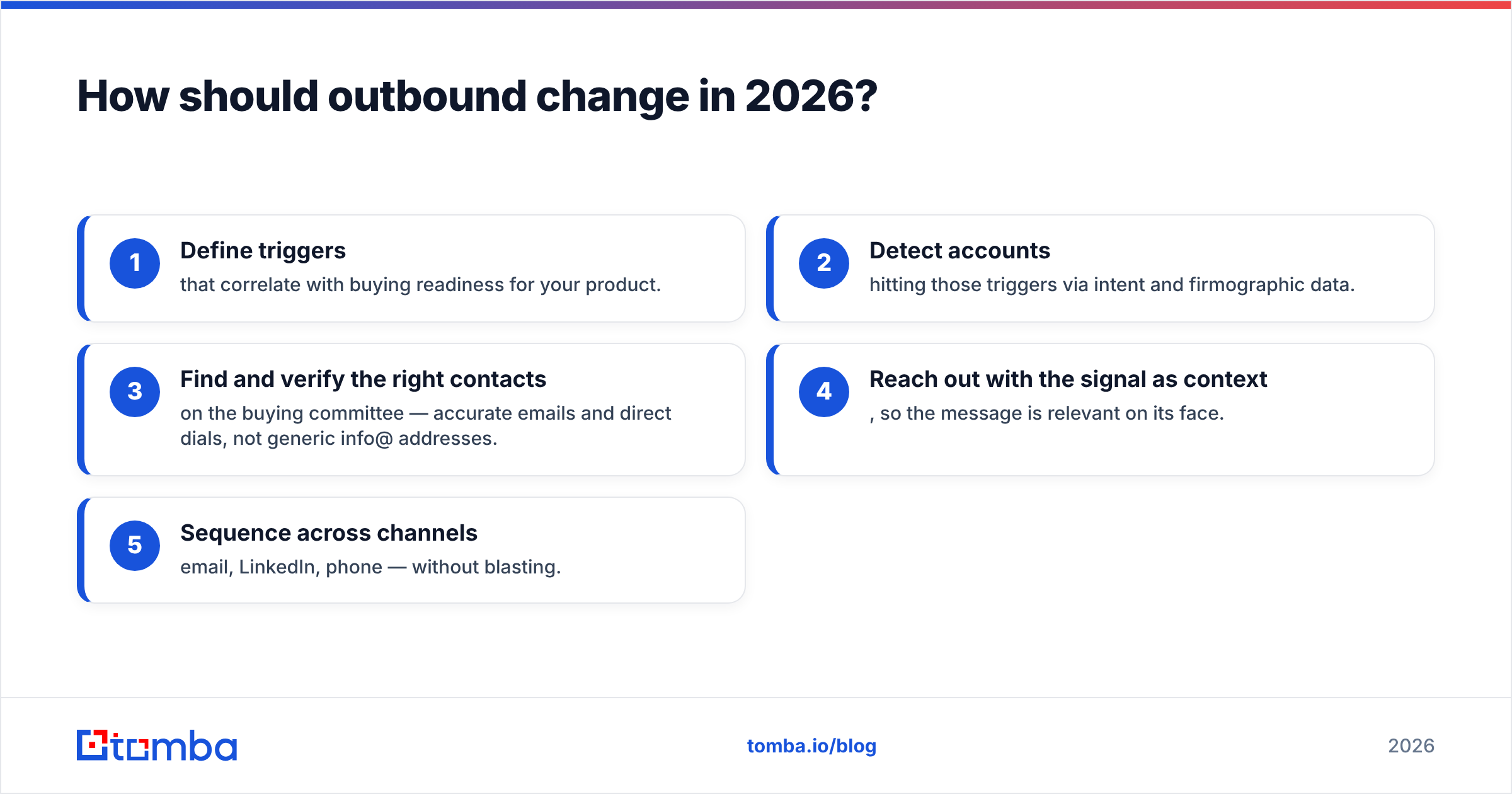
A workable signal-based outbound loop looks like this:
- Define triggers that correlate with buying readiness for your product.
- Detect accounts hitting those triggers via intent and firmographic data.
- Find and verify the right contacts on the buying committee — accurate emails and direct dials, not generic info@ addresses.
- Reach out with the signal as context, so the message is relevant on its face.
- Sequence across channels — email, LinkedIn, phone — without blasting.
Step 3 is where most teams quietly fail. You can have perfect triggers and great copy, but if you cannot find a verified, current email for the VP of Engineering, the play never launches. Pairing a domain search to map the company with an email finder to reach the right person is the connective step that turns a signal into a conversation. For multichannel follow-up, a phone finder closes the gap when email goes quiet.
What about measurement and RevOps?#
Measurement is consolidating under revenue operations. The trend is away from siloed marketing dashboards that report MQLs nobody trusts, and toward a single revenue view where marketing, sales, and success share one definition of a qualified account and one pipeline number.
Three practical RevOps shifts for 2026:
- Pipeline over leads. Report on sourced and influenced pipeline, not raw lead counts.
- One source of truth. Marketing and sales work from the same enriched, deduplicated CRM — not two conflicting databases.
- Self-reported + multi-touch blended. Stop arguing about attribution models; triangulate.
This only works if the underlying records are clean. A CRM full of duplicates, missing fields, and dead contacts makes every report a negotiation. Continuous enrichment and verification are the quiet infrastructure that lets RevOps actually trust its own numbers. According to HubSpot's State of Marketing research, data-driven alignment between teams remains one of the strongest predictors of revenue growth.
Which trends should you ignore?#
Conclusion first: ignore anything that adds volume without adding precision. Specifically, be skeptical of:
- AI content at scale for SEO. Search engines are surfacing AI overviews and rewarding genuine expertise; mass-produced posts increasingly earn nothing.
- Buying giant unverified lists. Cheaper than ever, more damaging than ever to deliverability.
- Chasing every new channel. A half-run presence on six platforms loses to a deep presence on two.
- Vanity MQL targets. If sales ignores 90% of your leads, the metric is the problem.
The throughline: 2026 rewards depth, accuracy, and restraint over breadth and noise.
How do you put these B2B marketing trends into practice?#
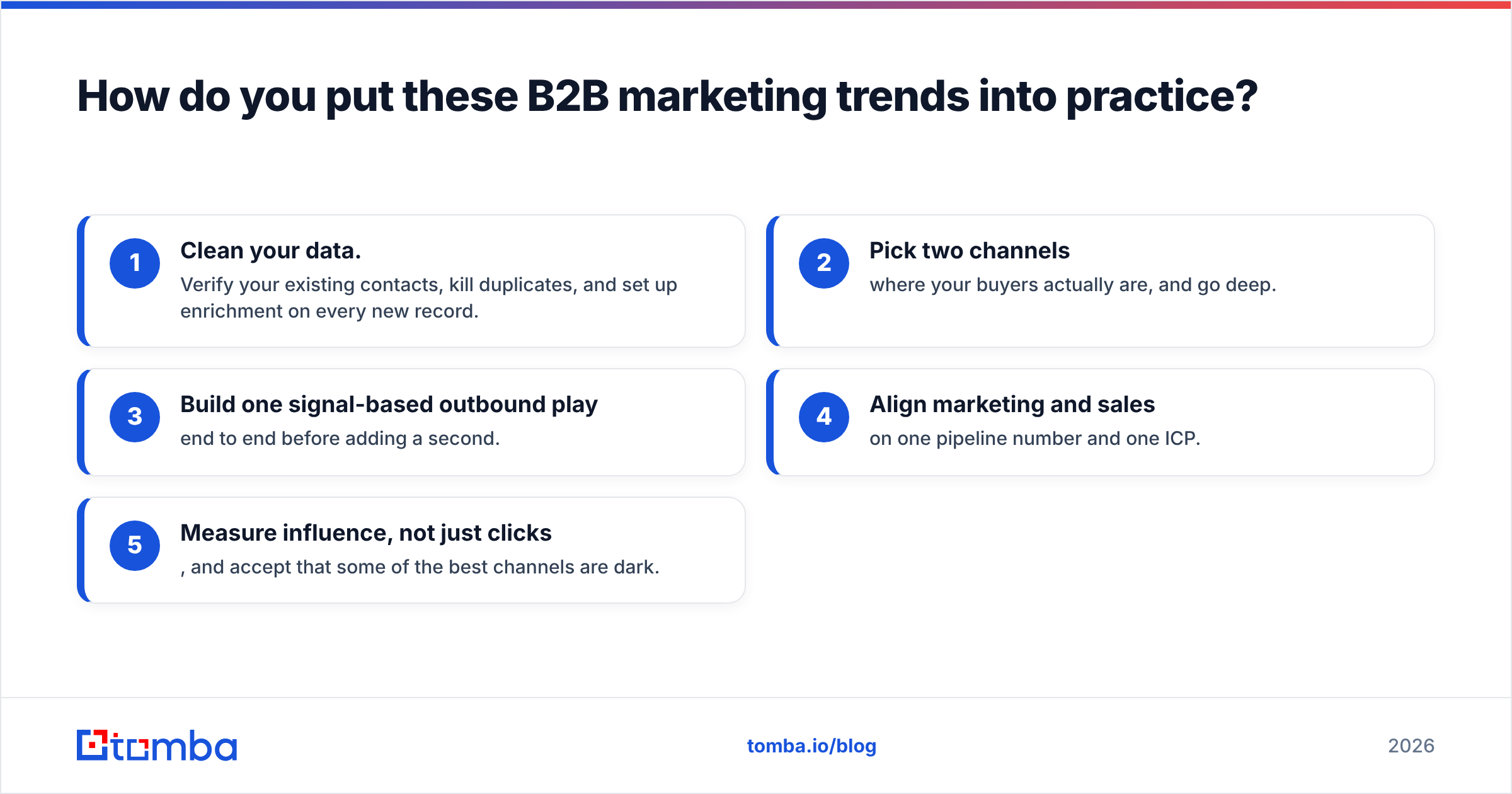
Start with the foundation, then layer the flashy stuff on top. In order:
- Clean your data. Verify your existing contacts, kill duplicates, and set up enrichment on every new record.
- Pick two channels where your buyers actually are, and go deep.
- Build one signal-based outbound play end to end before adding a second.
- Align marketing and sales on one pipeline number and one ICP.
- Measure influence, not just clicks, and accept that some of the best channels are dark.
None of these trends are exotic. They are a return to fundamentals — reach the right person, at the right moment, with something true to say — executed with better data and smarter tooling than was possible two years ago.
Get the data layer right first#
Every trend in this post sits on top of one thing: knowing who your buyers are and being able to reach them. That is the unglamorous foundation that makes AI, ABM, and signal-based outbound actually convert instead of bounce.
If you want to start where it matters, the Tomba Email Finder turns a name and a company into a verified, reachable contact in seconds — so your 2026 plays launch on real data, not a list that decayed last spring. Spin up a free account (25 searches a month), test it against your ICP, and see how clean your pipeline gets when the foundation holds. Check the full Tomba pricing when you are ready to scale from one play to ten.
// get started
Find, verify and enrich your first contacts today
Start on the free plan with 25 searches a month, then scale when your team is ready.
Free plan · No credit card required · GDPR & CCPA
// about the author