B2B Prospecting in 2026: A Complete Step-by-Step Guide
A practical 2026 framework for B2B prospecting: how to build a target list, find verified contacts, sequence outreach, and book more meetings without burning your domain.
(title rendered separately)
B2B prospecting in 2026 is less about volume and more about precision. The reps who win aren't the ones sending the most emails — they're the ones reaching the right people with verified data and a reason to reply. This guide walks you through the full motion: define your target, build a clean list, find accurate contact details, and run sequences that actually book meetings.
TL;DR#
- B2B prospecting is the process of identifying and reaching companies and people who fit your ideal customer profile (ICP) — before they raise their hand.
- The 2026 playbook is: define ICP → build a target list → enrich with verified contacts → multichannel sequence → measure and refine.
- Data quality is the whole game. A 20% bounce rate quietly destroys your sender reputation and your numbers.
- Use an email finder plus an email verifier so every send lands on a real inbox.
- Track reply rate and meetings booked, not just emails sent. Activity is not progress.
What is B2B prospecting?#
B2B prospecting is the work of finding and qualifying potential buyers at other companies, then opening a conversation with them. Think of it like fishing: anyone can throw a line in the water, but a good angler knows which lake holds the fish, what bait they take, and when they're biting. Prospecting is choosing the lake and the bait — not just casting.
Technically, prospecting sits at the top of your outbound funnel. It covers list building, contact research, qualification, and first-touch outreach across email, phone, and LinkedIn. It ends where the sales process proper begins: a booked discovery call or a clear "not now."
The shift in 2026 is that buyers are harder to reach and more skeptical. Inboxes are crowded, spam filters are smarter, and generic blasts get ignored or flagged. The reps who break through treat prospecting as a research discipline first and a sending activity second.
Why does B2B prospecting fail for most teams?#
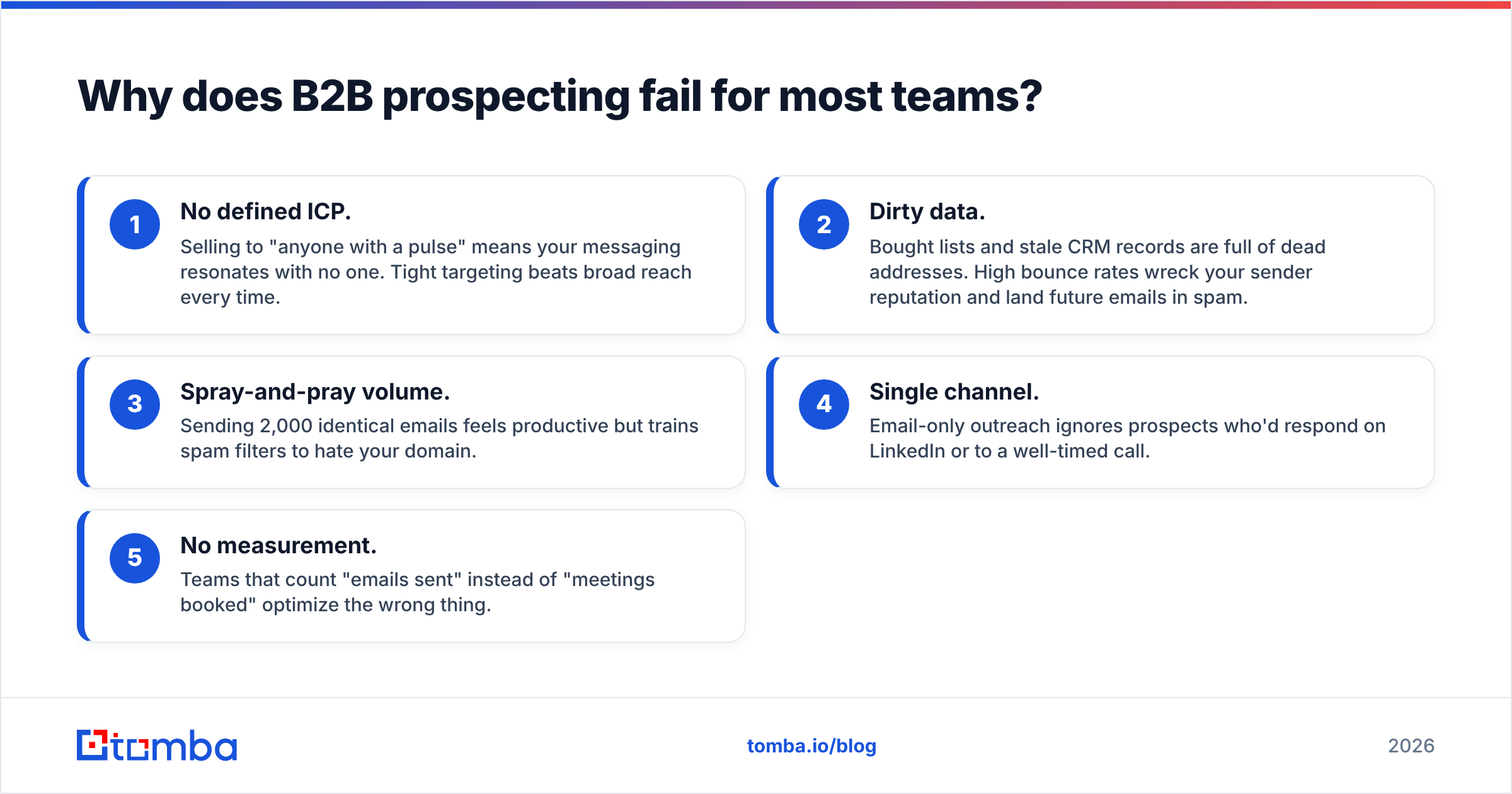
Most prospecting underperforms for predictable reasons. Here are the five that show up again and again:
- No defined ICP. Selling to "anyone with a pulse" means your messaging resonates with no one. Tight targeting beats broad reach every time.
- Dirty data. Bought lists and stale CRM records are full of dead addresses. High bounce rates wreck your sender reputation and land future emails in spam.
- Spray-and-pray volume. Sending 2,000 identical emails feels productive but trains spam filters to hate your domain.
- Single channel. Email-only outreach ignores prospects who'd respond on LinkedIn or to a well-timed call.
- No measurement. Teams that count "emails sent" instead of "meetings booked" optimize the wrong thing.
Fixing these isn't complicated, but it does require discipline. The rest of this guide is the fix.
How do you build a B2B prospecting process in 2026?#
A repeatable process beats heroic individual effort. Here's the five-stage motion that consistently produces pipeline.
Step 1: Define your ICP and buyer personas#
Start with the accounts where you already win. Look at your best customers and pull out the patterns: industry, company size, tech stack, region, and the trigger events that made them buy. That's your ICP. Then define the personas inside those accounts — the economic buyer, the champion, and the end user — because you'll message each one differently.
Step 2: Build a target account list#
With your ICP locked, build a list of named accounts. Use LinkedIn Sales Navigator, industry directories, and a B2B database to assemble companies that match. Aim for quality over quantity: 200 accounts you genuinely fit beats 5,000 you don't.
Step 3: Find and verify contact data#
This is where most lists die. You need the right person's real, deliverable email — not a guess. Run your target names through an email finder, then a verifier to confirm each address is live. We'll go deep on this in the next section.
Step 4: Sequence multichannel outreach#
Wrap each contact in a sequence that mixes email, LinkedIn, and phone over 2–3 weeks. Lead with relevance — a trigger event, a shared connection, a specific problem — not a feature dump.
Step 5: Measure, learn, refine#
Track reply rate, positive reply rate, and meetings booked per 100 contacts. Kill what doesn't work, double down on what does.
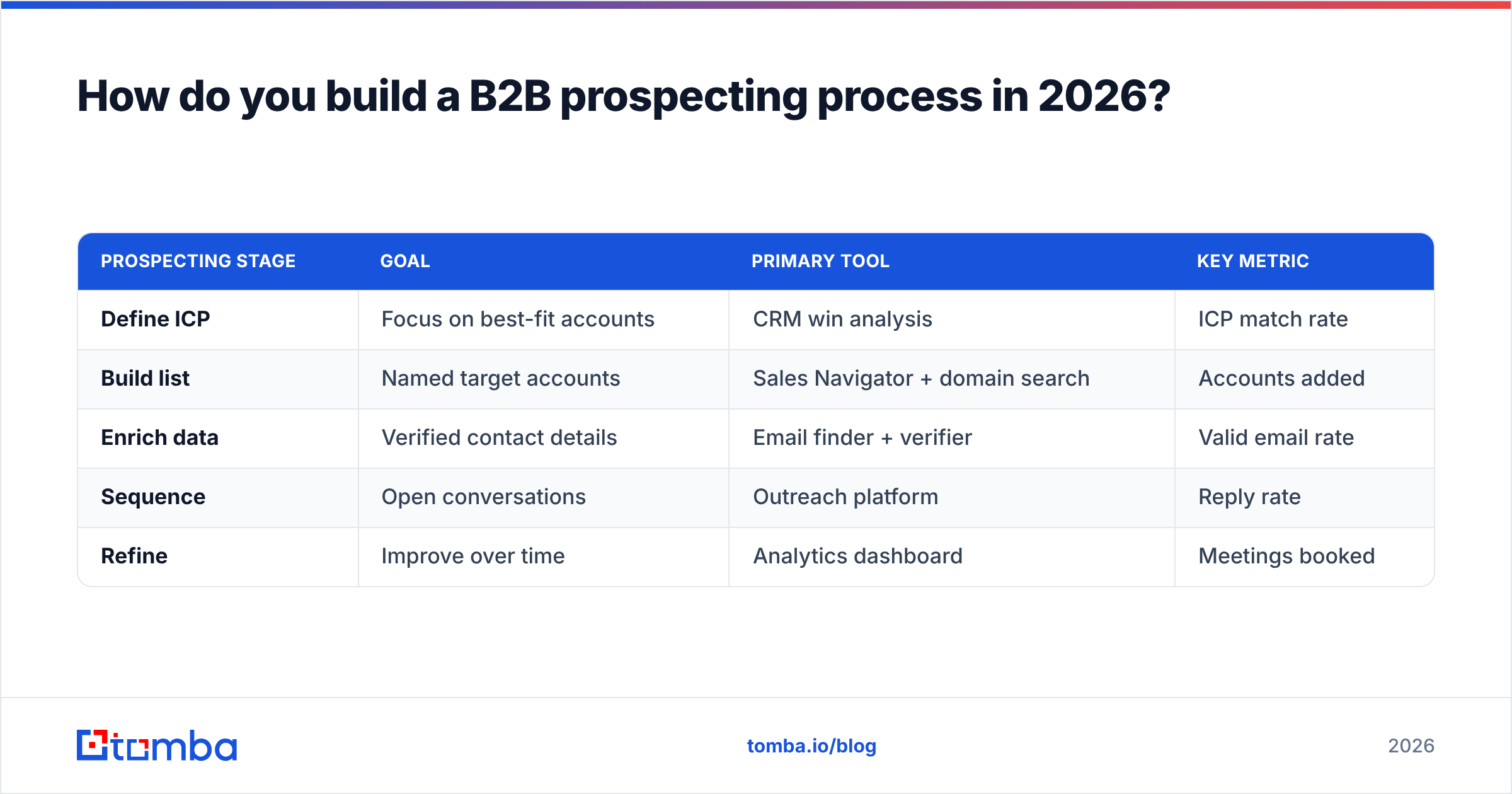
| Prospecting stage | Goal | Primary tool | Key metric |
|---|---|---|---|
| Define ICP | Focus on best-fit accounts | CRM win analysis | ICP match rate |
| Build list | Named target accounts | Sales Navigator + domain search | Accounts added |
| Enrich data | Verified contact details | Email finder + verifier | Valid email rate |
| Sequence | Open conversations | Outreach platform | Reply rate |
| Refine | Improve over time | Analytics dashboard | Meetings booked |
How do you find accurate prospect contact data?#
Accurate contact data is the foundation everything else rests on. Without it, your perfect ICP and clever copy land nowhere. The workflow has three moves.
First, find the email. Given a name and a company domain, an email finder returns the most likely professional address, scored by confidence. For whole-company prospecting, a domain search pulls every public email pattern at a target account so you can map the buying committee in one pass.
Second, verify it. Before you send, run each address through an email verifier. Verification checks the mailbox exists and accepts mail, which keeps your bounce rate low. For tricky domains that accept everything, a catch-all verifier tells you whether an address is actually safe to send.
Third, enrich and add channels. Layer in data enrichment for job titles and company details, and pull B2B phone numbers for multichannel plays. At scale, a bulk email finder processes your whole target list at once.
Why does verification matter so much? Mailbox providers watch your bounce rate. A clean sender keeps high inbox placement; a dirty one gets throttled and filtered. Protecting email deliverability is not optional housekeeping — it's the difference between your campaign reaching inboxes or vanishing into spam.
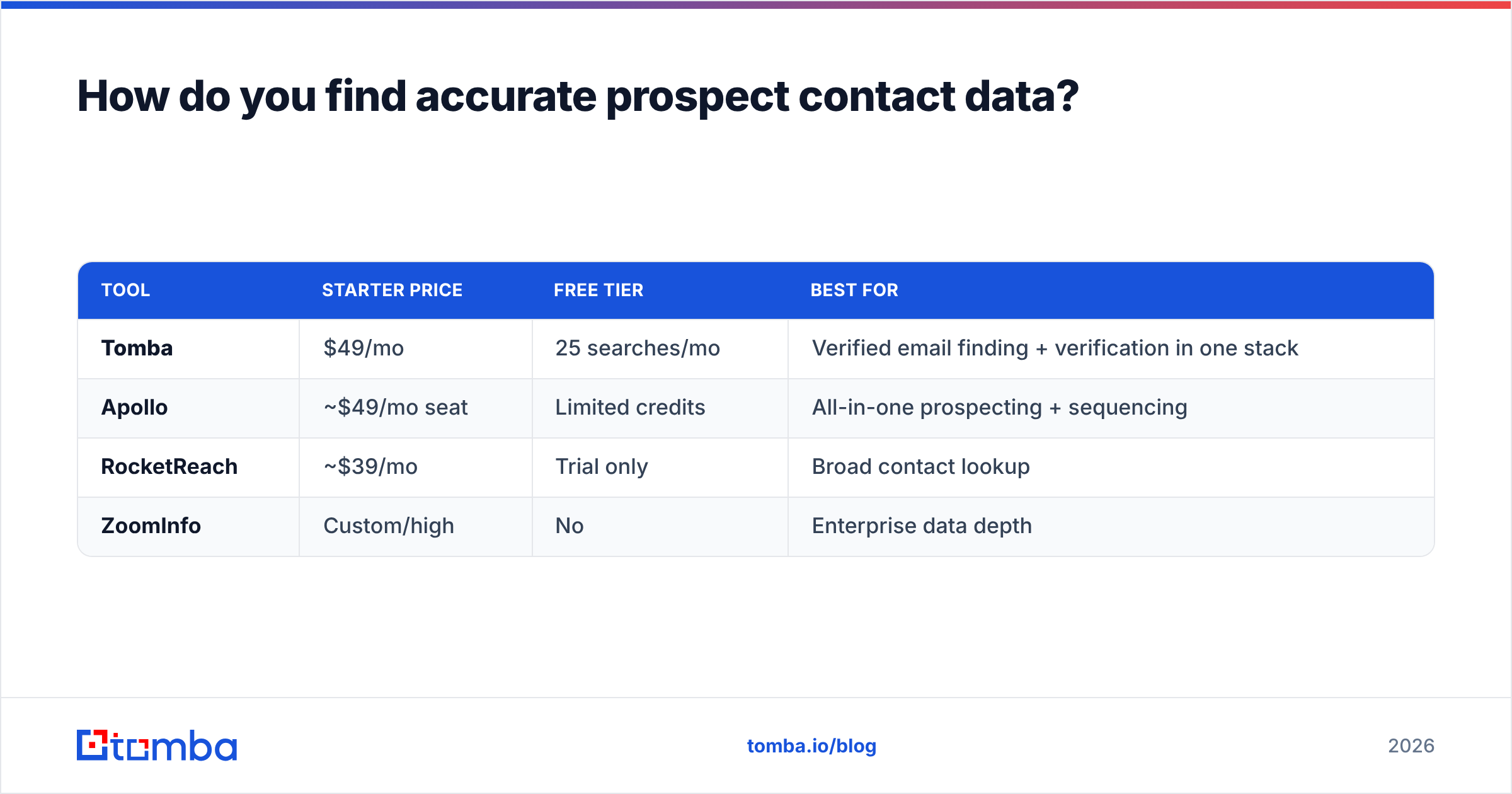
How does Tomba compare to other prospecting data tools?#
Here's an honest look at where common options fit. Pricing reflects published starter tiers; check each vendor for current details and your own volume needs.
| Tool | Starter price | Free tier | Best for |
|---|---|---|---|
| Tomba | $49/mo | 25 searches/mo | Verified email finding + verification in one stack |
| Apollo | ~$49/mo seat | Limited credits | All-in-one prospecting + sequencing |
| RocketReach | ~$39/mo | Trial only | Broad contact lookup |
| ZoomInfo | Custom/high | No | Enterprise data depth |
See full Tomba pricing for Growth ($99/mo), Pro ($249/mo), and Enterprise tiers. If you're evaluating alternatives, our comparisons of an Apollo alternative and a RocketReach alternative break down the trade-offs in detail. For a third-party view, browse verified reviews on G2.
What does a high-converting prospecting sequence look like?#
A sequence is a planned series of touches across channels, spaced over time. The aim is to be persistent without being annoying — show up enough to be noticed, with enough value that being noticed is welcome.
A reliable 2026 structure runs 8–10 touches over about three weeks:
- Day 1 — Email: Short, specific, tied to a trigger event. One clear ask.
- Day 2 — LinkedIn: Connection request or a comment on their recent post. No pitch.
- Day 4 — Email: Add value — a relevant resource, benchmark, or insight.
- Day 6 — Phone: A brief, prepared call. Reference your earlier email.
- Day 9 — Email: A different angle on the same problem.
- Day 13 — LinkedIn message: Soft, human, low-pressure.
- Day 18 — Breakup email: "Should I close your file?" These get surprising reply rates.
The copy matters more than the cadence. Lead with the prospect's world, keep it under 90 words, and make the call to action a small yes (a question, not a 30-minute demo). For first drafts, a cold email AI writer gets you a workable skeleton fast — then you edit for relevance. Pre-send, run a spam checker so trigger words don't sink an otherwise good message. HubSpot's research on sales follow-up is a good external benchmark for cadence and timing.
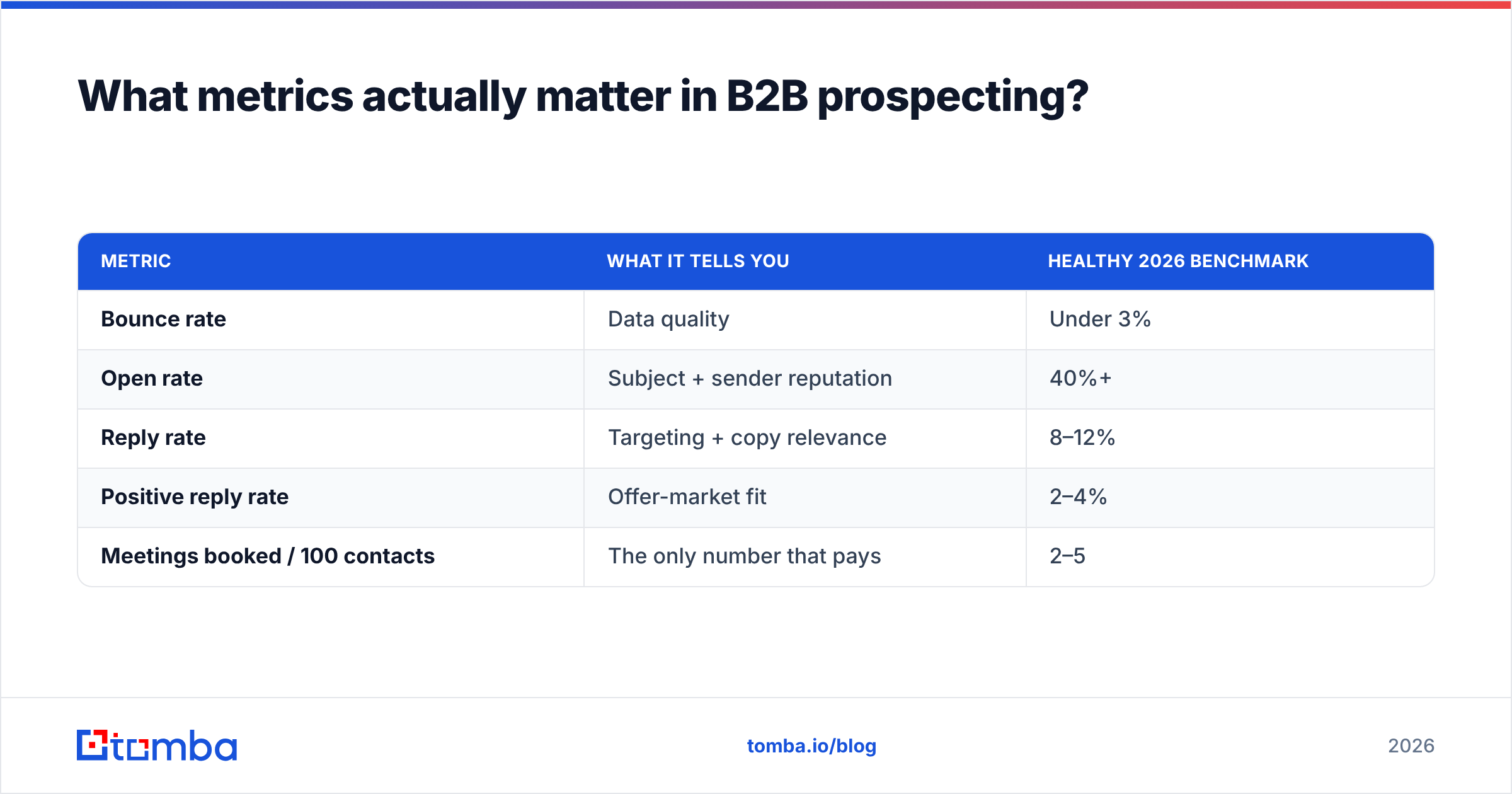
What metrics actually matter in B2B prospecting?#
Measure outcomes, not motion. The vanity metric trap is counting emails sent and calls dialed; those are inputs, not results. Here's the hierarchy that tells the truth.
| Metric | What it tells you | Healthy 2026 benchmark |
|---|---|---|
| Bounce rate | Data quality | Under 3% |
| Open rate | Subject + sender reputation | 40%+ |
| Reply rate | Targeting + copy relevance | 8–12% |
| Positive reply rate | Offer-market fit | 2–4% |
| Meetings booked / 100 contacts | The only number that pays | 2–5 |
If your bounce rate is high, fix data before anything else — a verifier solves it overnight. If opens are low, your subject lines or sender reputation need work. If you get opens but no replies, your targeting or copy is off. Diagnosing in this order saves weeks of guesswork. Tracking response rate over time is the cleanest signal that your prospecting is improving.
How do you scale prospecting without burning your domain?#
Scaling is where careless teams self-destruct. More volume on a cold domain equals more spam complaints and a tanked reputation. Scale the right way:
- Warm up new domains and inboxes before sending volume. Use a warmup calculator to plan the ramp.
- Spread sending across multiple inboxes rather than blasting from one.
- Verify continuously, not just once — data decays roughly 25–30% per year as people change jobs.
- Automate the plumbing, personalize the message. Connect your stack with integrations so verified data flows into your CRM, and reserve human effort for the first line of every email.
- Refresh your list quarterly with re-enrichment so you're never working dead records.
Done well, scaling prospecting feels like turning up a dial, not lighting a fuse. The data layer stays clean, deliverability holds, and your reply rate survives the volume increase.
Final takeaway and next step#
B2B prospecting in 2026 rewards precision: a tight ICP, verified contact data, a thoughtful multichannel sequence, and honest measurement. Skip the verified-data step and everything downstream leaks. Nail it and a modest list outperforms a bloated one every time.
Start where the leverage is highest — your data. Spin up the Tomba Email Finder to turn your target account list into verified, deliverable contacts, pair it with the verifier to keep your bounce rate near zero, and watch your reply rate climb. The free tier gives you 25 searches a month to test it on your next campaign before you commit to a paid plan. Build the clean list first; the meetings follow.
// get started
Find, verify and enrich your first contacts today
Start on the free plan with 25 searches a month, then scale when your team is ready.
Free plan · No credit card required · GDPR & CCPA
// about the author