B2B Referral Email Template: 9 Examples That Convert in 2026
Steal 9 proven B2B referral email templates for 2026, plus the timing, structure, and follow-up sequence that turn happy customers into a steady pipeline of warm intros.
B2B Referral Email Template: 9 Examples That Convert in 2026
Referrals close faster, churn slower, and cost less than any other channel you run. Yet most teams never ask for them in writing — they wait for word of mouth and hope. This guide fixes that with nine copy-paste B2B referral email templates, the timing rules that decide whether they land, and a follow-up sequence that keeps the ask alive without nagging.
TL;DR#
- A referral email asks a satisfied contact to introduce you to someone who fits your ICP — it works because it borrows the sender's trust, which no cold email can buy.
- Timing beats wording. Ask right after a win (onboarding milestone, renewal, positive review, support save), not on a random Tuesday.
- The best templates make saying yes effortless — name the exact person or role, write the forwardable blurb for them, and keep the lift under 30 seconds.
- Nine templates below cover happy customers, partners, new closed-won deals, NPS promoters, internal champions, and lapsed contacts.
- Pair referrals with verified contact data so the intro actually reaches the right inbox — a dead address kills a warm lead instantly.
What is a B2B referral email and why does it outperform cold outreach?#
A B2B referral email is a short message asking an existing happy contact — a customer, partner, or champion — to introduce you to someone in their network who matches your ideal customer profile. Think of it like asking a friend to vouch for you at a dinner party instead of cold-calling a stranger: the same pitch lands completely differently when it arrives with trust attached.
The math is hard to argue with. Referred prospects arrive pre-qualified and pre-warmed, so they move through the funnel faster and stick around longer. Industry research consistently shows referred customers convert at higher rates and carry stronger lifetime value than leads from paid or cold channels — HubSpot's sales statistics round up much of this data if you want the receipts.
Cold outreach asks a stranger to gamble on you. A referral hands you the one thing cold email can never manufacture: a trusted third party saying "talk to these people, they're good." Your job in the email is simply to make that endorsement easy to give.
When should you send a referral request email?#
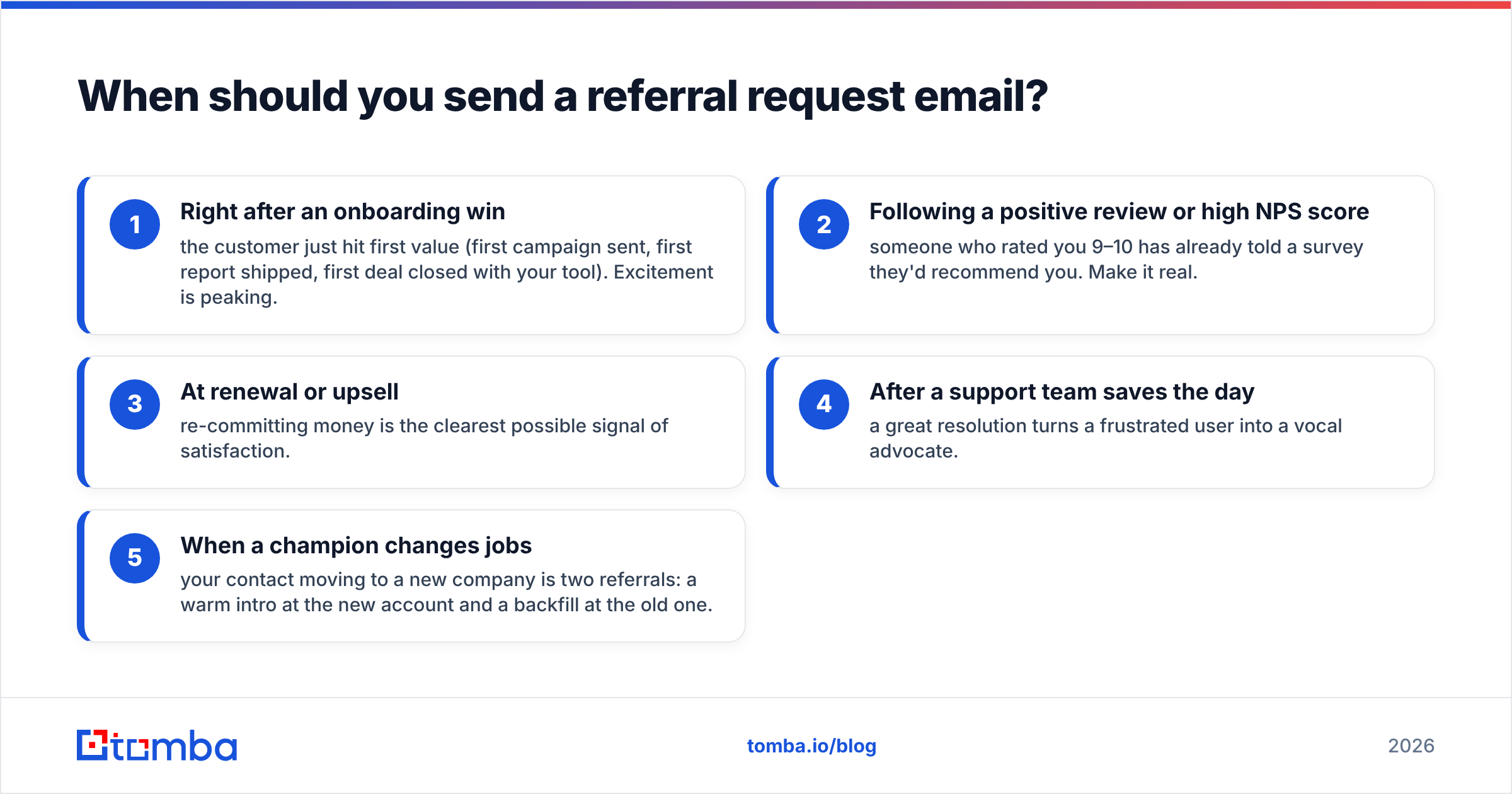
Conclusion first: send when the value you delivered is freshest in the contact's mind. A referral ask is a withdrawal from a goodwill account — only ask when the balance is high.
The highest-converting trigger moments:
- Right after an onboarding win — the customer just hit first value (first campaign sent, first report shipped, first deal closed with your tool). Excitement is peaking.
- Following a positive review or high NPS score — someone who rated you 9–10 has already told a survey they'd recommend you. Make it real.
- At renewal or upsell — re-committing money is the clearest possible signal of satisfaction.
- After a support team saves the day — a great resolution turns a frustrated user into a vocal advocate.
- When a champion changes jobs — your contact moving to a new company is two referrals: a warm intro at the new account and a backfill at the old one.
Avoid asking during active issues, mid-negotiation, or immediately after a price increase. The wrong moment turns a willing advocate into someone who quietly ignores you.
How do you structure a high-converting referral email?#
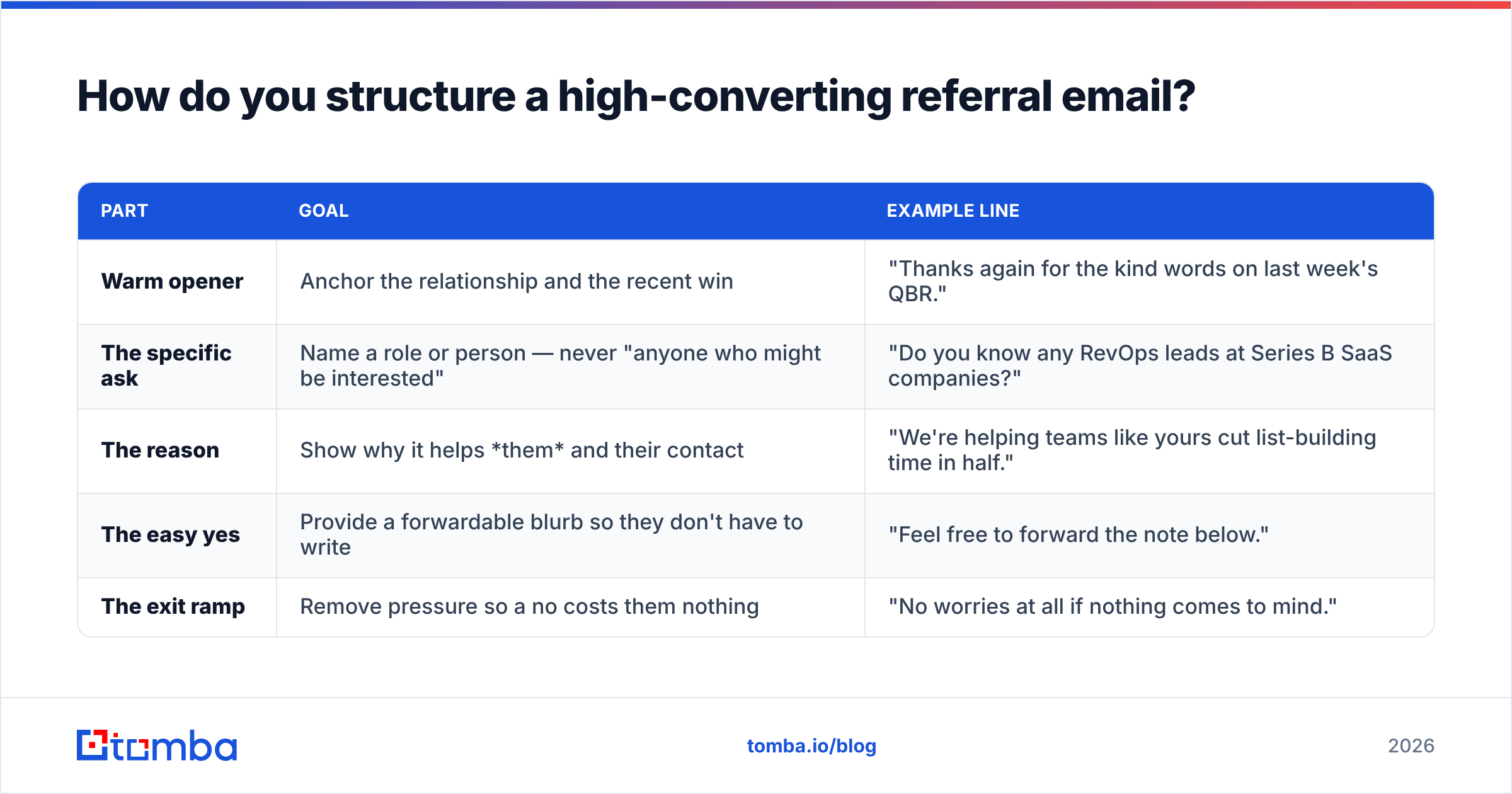
Every referral email that converts shares the same five-part skeleton. Keep the whole thing under 150 words.
| Part | Goal | Example line |
|---|---|---|
| Warm opener | Anchor the relationship and the recent win | "Thanks again for the kind words on last week's QBR." |
| The specific ask | Name a role or person — never "anyone who might be interested" | "Do you know any RevOps leads at Series B SaaS companies?" |
| The reason | Show why it helps them and their contact | "We're helping teams like yours cut list-building time in half." |
| The easy yes | Provide a forwardable blurb so they don't have to write | "Feel free to forward the note below." |
| The exit ramp | Remove pressure so a no costs them nothing | "No worries at all if nothing comes to mind." |
The single biggest lever is specificity. "Anyone you think might benefit" forces the reader to do mental work, so they do nothing. "A VP of Sales at a 50–200 person B2B software company" hands them a search filter their brain can actually run.
The 9 B2B referral email templates#
Copy these, swap the brackets, and match the trigger to the moment.
1. The happy-customer ask (post-win)#
Subject: Quick favor, [First Name]?
Hi [First Name],
Loved seeing [specific result, e.g. "your team hit 3x reply rates this month"]. Since things are clicking, I wanted to ask: do you know one or two [role, e.g. "demand-gen leads"] at similar [industry] companies who are fighting the same problem you were?
If anyone comes to mind, I've written a short intro below you can forward — zero work on your end. And no pressure at all if not.
Thanks,
[Your name]
2. The NPS promoter#
Subject: You rated us a [9/10] — thank you
Hi [First Name],
Thank you for the [9] on our recent survey. That means a lot. Quick question while it's top of mind: is there a colleague or peer at another company who'd benefit from the same results? Happy to make it effortless — I'll send a tailored note you can pass along.
3. The renewal moment#
Subject: Excited for year two
Hi [First Name],
Glad to have [Company] on board for another year. As we kick off, I'd love your help reaching teams like yours. Who are two people in your network wrestling with [problem]? I'll do all the writing — you just forward.
4. The forwardable intro (the blurb you attach)#
Hi [Contact],
[Referrer] mentioned you're working on [problem]. We help [ICP] [outcome] without [pain]. Worth a 15-minute look? Here's a quick overview: [link]. — [Your name], [Company]
5. The partner / vendor cross-referral#
Subject: Sending business each other's way?
Hi [First Name],
Our customers keep asking for [partner's service], and I'd guess yours occasionally need [your service]. Want to set up a simple referral loop? I'll start — here are two of my accounts that could use what you do.
6. The champion-changed-jobs#
Subject: Congrats on the new role!
Hi [First Name],
Huge congrats on joining [New Company]. If the team there is dealing with [problem], I'd love a quick intro to whoever owns it. And if there's anyone at [Old Company] I should stay in touch with, point me their way.
7. The internal champion (expand within an account)#
Subject: Other teams at [Company]?
Hi [First Name],
Now that [your team] is seeing [result], are there other departments at [Company] hitting the same wall? A two-line intro to the right lead would help me help them faster.
8. The review-site follow-up#
Subject: Thank you for the [G2] review
Hi [First Name],
Just read your review on [G2] — genuinely appreciated. Many of our best customers come from people like you. Anyone specific you'd recommend we talk to? I'll handle the outreach.
9. The re-engagement of a lapsed contact#
Subject: Not a pitch — a quick ask
Hi [First Name],
We didn't end up working together, but I respect your read on this space. Even if we're not a fit, do you know a [role] who is? Happy to make the intro painless.
How do you follow up without being annoying?#
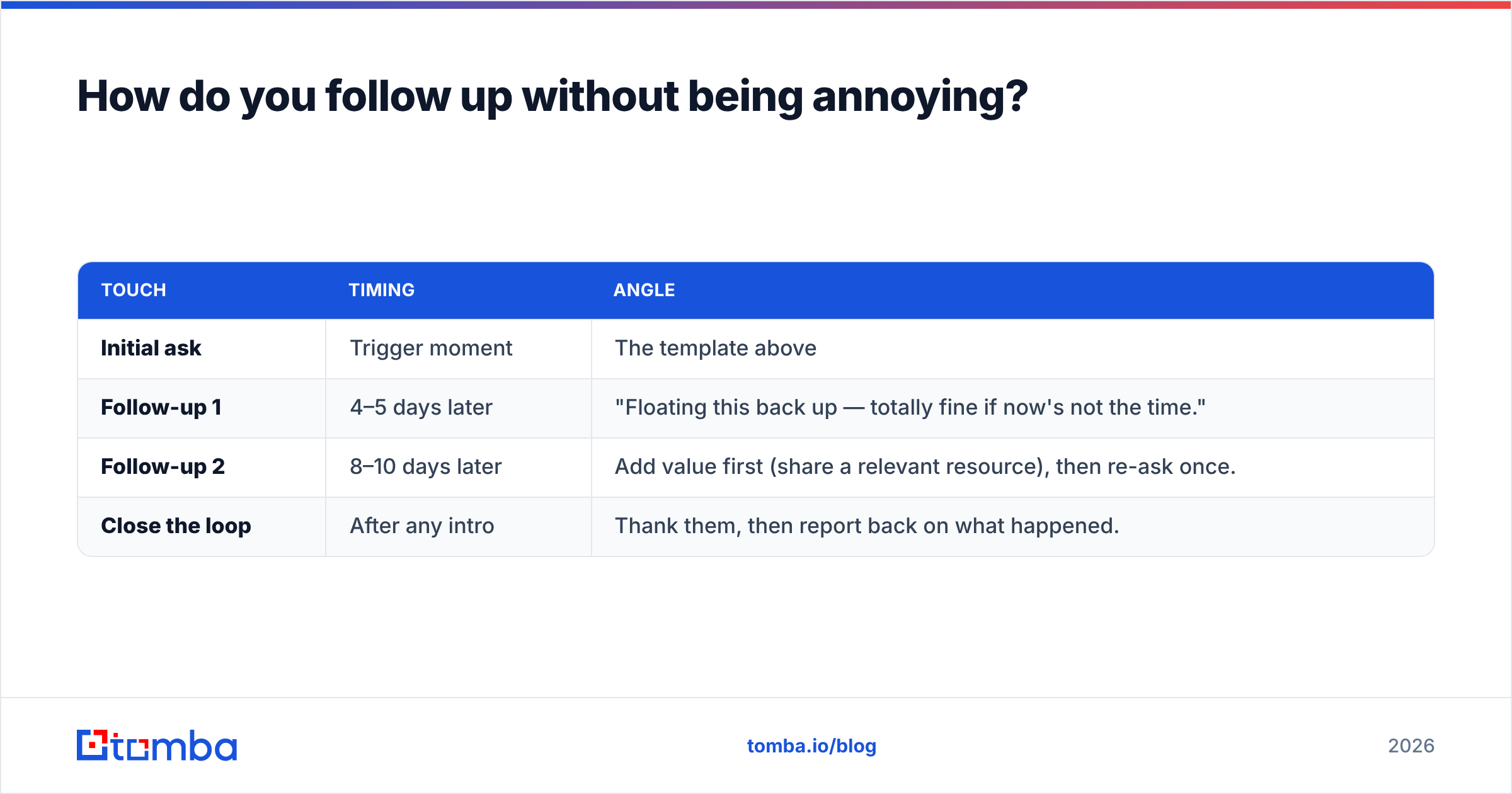
Most referrals die in silence, not rejection. People mean to help and then life happens. A light two-touch follow-up recovers a large share of them.
| Touch | Timing | Angle |
|---|---|---|
| Initial ask | Trigger moment | The template above |
| Follow-up 1 | 4–5 days later | "Floating this back up — totally fine if now's not the time." |
| Follow-up 2 | 8–10 days later | Add value first (share a relevant resource), then re-ask once. |
| Close the loop | After any intro | Thank them, then report back on what happened. |
That last step is the one everyone skips and the one that compounds. When you tell a referrer "the intro you made turned into a deal," you've trained them to refer again. Gratitude that loops back is the entire flywheel.
If you want to refine the wording of any of these touches, a quick pass through a tool like the cold email templates library or a subject line tester helps you ship faster without overthinking it.
How do you reach the person you were referred to?#
A warm intro is only half the job. Often your champion gives you a name and a company but not a working email — "Talk to Dana in RevOps at Acme, tell her I sent you." Now you have a referral with nowhere to land.
This is where contact data closes the gap. Instead of guessing dana@acme.com and bouncing, you can confirm the real address before you send. A bounced first email to a referred lead wastes the warmest introduction you'll get all quarter.
A practical workflow:
- Find the address — use an email finder to pull Dana's verified work email from her name and company domain.
- Verify before sending — run it through an email verifier so your warm intro doesn't bounce and torch your sender reputation.
- Enrich the context — layer on data enrichment to confirm her role and seniority before you write, so the reference email actually matches who she is.
A study of email accuracy from review platforms like G2 consistently ranks verification as the difference between outreach that lands and outreach that quietly disappears into spam folders.
Referral email tactics vs. cold email: which should you run?#
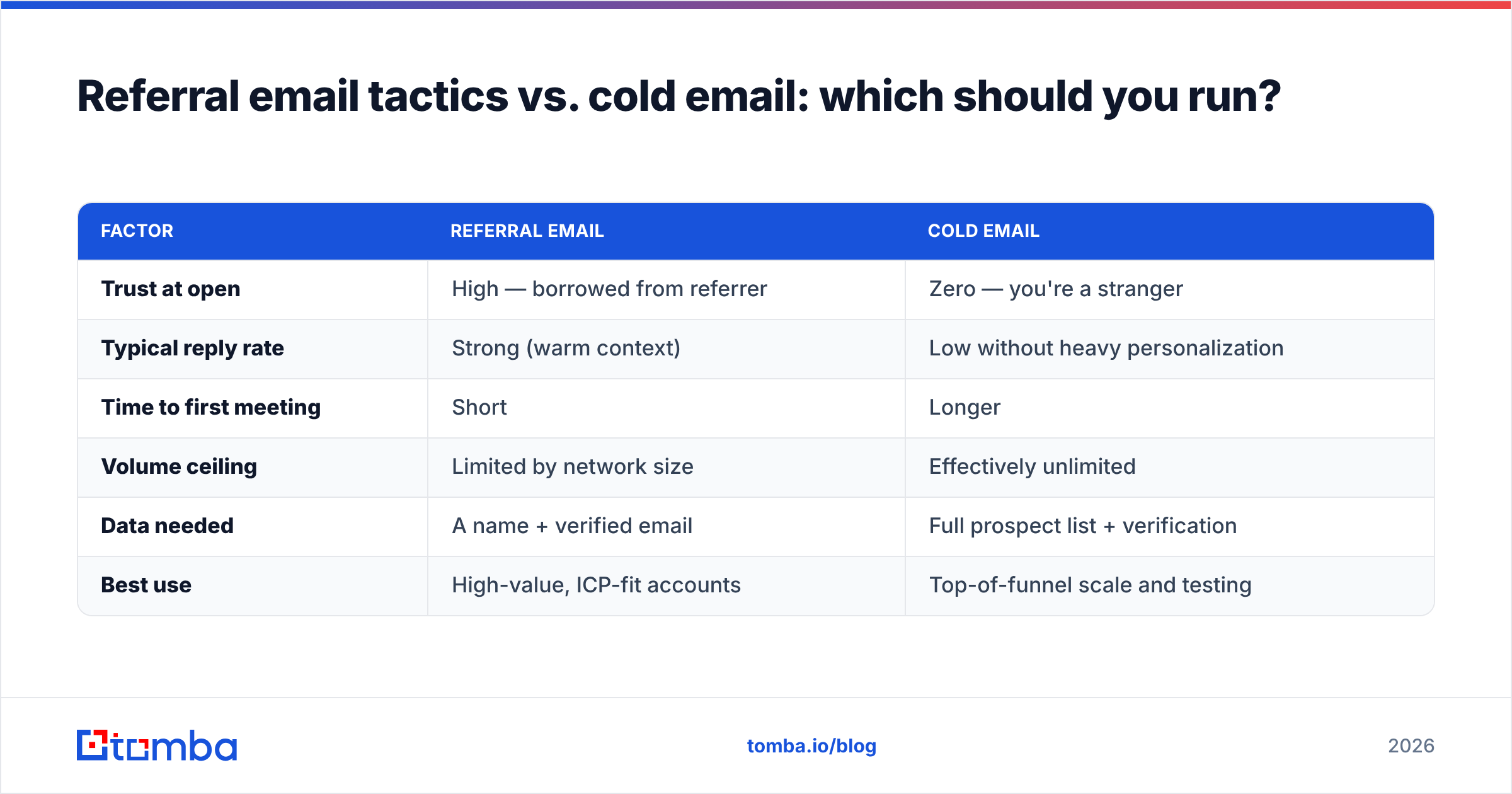
You should run both, but weight your effort toward referrals because the ceiling is higher. Here's the honest comparison.
| Factor | Referral email | Cold email |
|---|---|---|
| Trust at open | High — borrowed from referrer | Zero — you're a stranger |
| Typical reply rate | Strong (warm context) | Low without heavy personalization |
| Time to first meeting | Short | Longer |
| Volume ceiling | Limited by network size | Effectively unlimited |
| Data needed | A name + verified email | Full prospect list + verification |
| Best use | High-value, ICP-fit accounts | Top-of-funnel scale and testing |
Referrals win on quality; cold email wins on volume. The teams that grow fastest use referrals to land their best logos and cold outreach to fill the gaps — both fueled by the same clean, verified contact data. For more on the warm-intro mechanics, the response rate glossary entry is a useful primer on what "good" looks like.
Common mistakes that kill referral emails#
- Asking too soon. Requesting a referral before you've delivered value reads as presumptuous. Earn the win first.
- Being vague. "Know anyone who'd like this?" gets ignored. Name a role, a company size, a specific pain.
- Making them work. If the referrer has to write the intro, look up the email, and explain your product, they won't. Pre-write everything.
- Never closing the loop. Failing to report back kills repeat referrals — the source assumes nothing happened.
- Sending to a guessed address. A bounced intro embarrasses you in front of your champion. Verify first, always.
Frequently asked questions#
How many referral emails should I send per customer? Quality over volume. One well-timed ask at a peak moment beats five generic requests. If they decline, wait for the next genuine win before asking again.
What's the ideal length for a B2B referral email? Under 150 words. The reader should grasp the ask in one screen without scrolling. Long emails signal effort required, and effort kills referrals.
Should I offer an incentive for referrals? In B2B, relationship and reciprocity usually outperform cash. A formal referral program with rewards can work at scale, but a personal ask after a real win converts better one-to-one.
How do I find the email of someone I was referred to? Use an email finder with the person's name and company domain, then verify the result before sending so your warm intro actually reaches their inbox.
Turn warm intros into booked meetings#
The templates above generate the referral — but a referral with a dead email address is a lead you'll never reach. Once a champion hands you a name and a company, Tomba Email Finder confirms the real, deliverable address in seconds so your warm introduction lands in the right inbox the first time. Start free with 25 searches a month, and scale up on the Starter plan at $49/mo when referrals start compounding. Write the ask, get the intro, find the inbox — and let trust do the closing.
// get started
Find, verify and enrich your first contacts today
Start on the free plan with 25 searches a month, then scale when your team is ready.
Free plan · No credit card required · GDPR & CCPA
// about the author