B2B Research in 2026: A Practical Framework for Sales Teams
B2B research turns a blank prospect list into a prioritized pipeline. Here is the 2026 framework, tools, and data sources that actually move revenue.
B2B research is the work you do before outreach: deciding which companies are worth your time, who inside them actually makes decisions, and how to reach those people with the right context. Done well, it is the difference between a 2% reply rate and a 20% one. Done badly, it is a stack of stale spreadsheets that quietly drains your week.
This guide breaks down what B2B research actually involves in 2026, the framework to run it repeatably, and the tools and data sources that hold up under scrutiny.
TL;DR#
- B2B research is the systematic process of identifying target accounts, mapping buying committees, and gathering contact and context data before you reach out.
- A repeatable framework has five stages: define the ICP, source accounts, enrich contacts, verify data, and prioritize.
- Data decays fast — roughly 25-30% of B2B contact data goes stale every year — so verification is not optional.
- Tool choice matters less than data accuracy and workflow fit; budget for both a finder and a verifier.
- You can run a tight research motion on a small budget; the expensive mistake is skipping verification and burning sender reputation.
What is B2B research?#
B2B research is everything that happens between "we sell to mid-market SaaS companies" and "here is a named contact, their email, and a reason they'll care." It is reconnaissance for revenue.
Think of it like a chef sourcing ingredients before service. You don't start cooking and hope the pantry has what you need — you check supply, quality, and freshness first. In sales, the "ingredients" are accounts that fit your ideal customer profile, the people who hold budget, and accurate ways to contact them. Skip the sourcing and you waste the whole service.
Technically, B2B research spans three layers:
- Account research — firmographics (industry, size, revenue), technographics (what tools they run), and intent signals (hiring, funding, expansion).
- People research — who sits on the buying committee, their role, seniority, and tenure.
- Contact research — the verified email, phone number, and social profiles you'll actually use to reach them.
Most teams are decent at layer one and weak at layers two and three. That is exactly where deals stall.
Why does B2B research matter in 2026?#
Because buyers got harder to reach and data got easier to waste. Inbox filters are stricter, buying committees grew (Gartner pegs the typical B2B buying group at six to ten stakeholders), and a single bounce can dent your sender reputation for weeks.
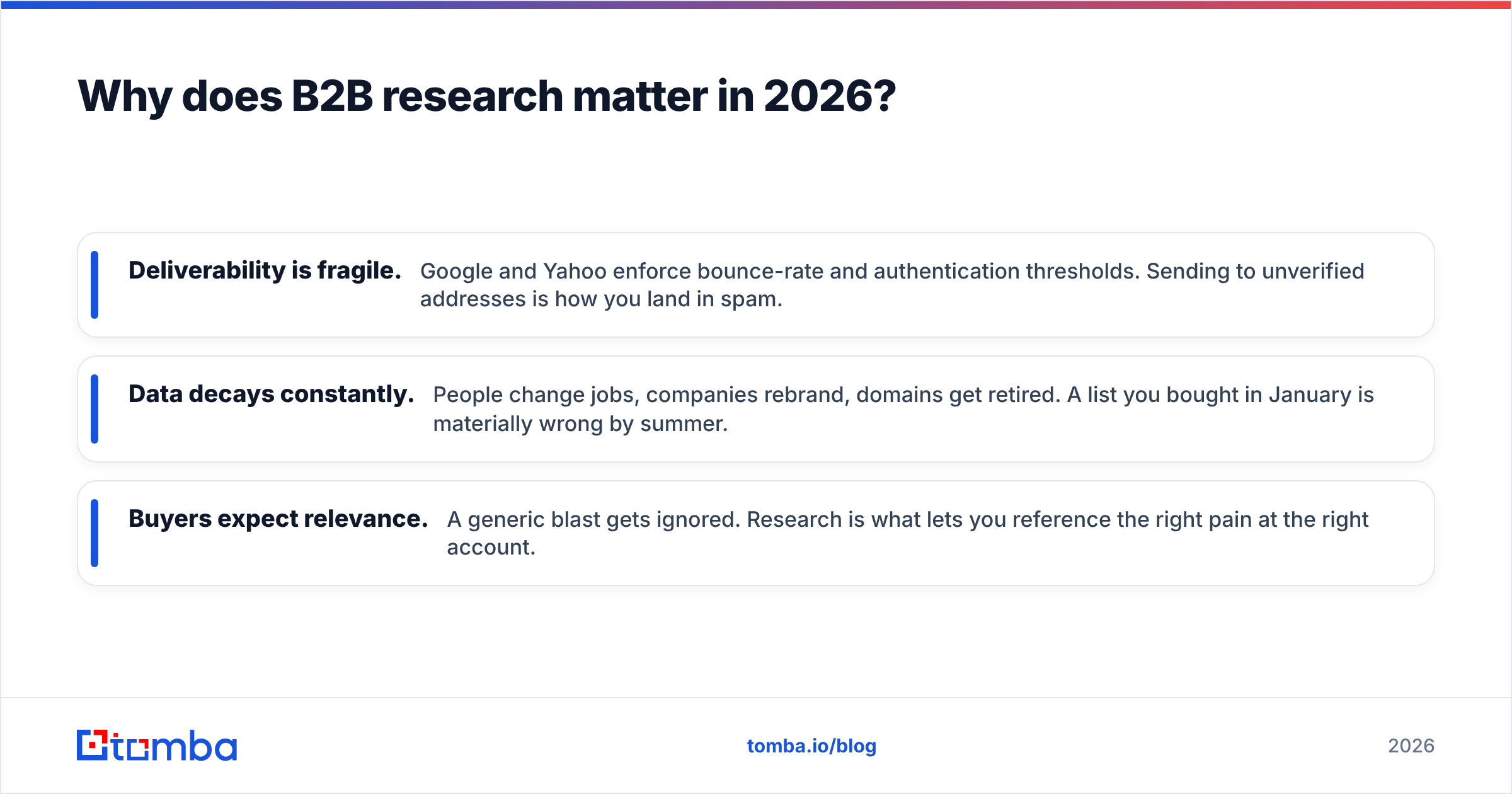
Three forces make research non-negotiable this year:
- Deliverability is fragile. Google and Yahoo enforce bounce-rate and authentication thresholds. Sending to unverified addresses is how you land in spam.
- Data decays constantly. People change jobs, companies rebrand, domains get retired. A list you bought in January is materially wrong by summer.
- Buyers expect relevance. A generic blast gets ignored. Research is what lets you reference the right pain at the right account.
The payoff is concentration. Good research means you contact fewer people but the right ones — and your win rate climbs because of it.
What does a B2B research framework look like?#
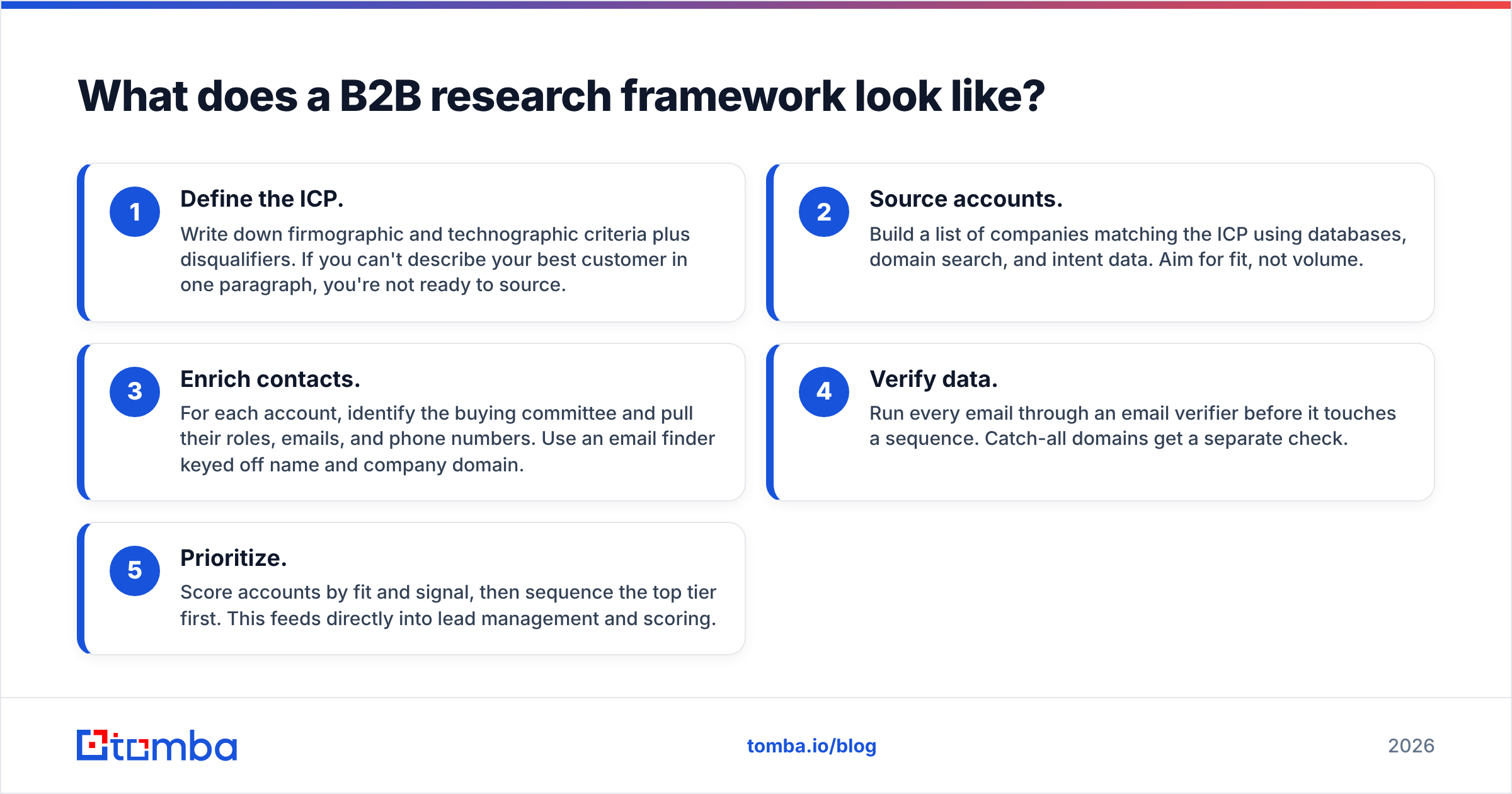
The five-stage loop below is the backbone. Run it the same way every time so it becomes a system, not a scramble.
- Define the ICP. Write down firmographic and technographic criteria plus disqualifiers. If you can't describe your best customer in one paragraph, you're not ready to source.
- Source accounts. Build a list of companies matching the ICP using databases, domain search, and intent data. Aim for fit, not volume.
- Enrich contacts. For each account, identify the buying committee and pull their roles, emails, and phone numbers. Use an email finder keyed off name and company domain.
- Verify data. Run every email through an email verifier before it touches a sequence. Catch-all domains get a separate check.
- Prioritize. Score accounts by fit and signal, then sequence the top tier first. This feeds directly into lead management and scoring.
Each stage hands clean inputs to the next. Skip verification and stage five is built on sand.
Where does B2B research data come from?#
Reliable contact data comes from a blend of sources, and the blend is what determines accuracy. No single source is complete.
- Public web and company sites — team pages, press releases, and footers reveal email patterns and named leadership.
- Professional networks — LinkedIn and similar platforms map titles, tenure, and reporting lines.
- Crowdsourced and licensed databases — aggregated B2B records, useful for scale but uneven on freshness.
- Real-time verification — SMTP and pattern checks confirm whether an address actually exists right now.
The best providers cross-reference all four and timestamp their records. If a vendor won't tell you how often data is refreshed or where it comes from, treat the accuracy claims with caution. Tomba publishes its data sources openly, which is the kind of transparency you should demand before trusting any list.
How do B2B research tools compare?#
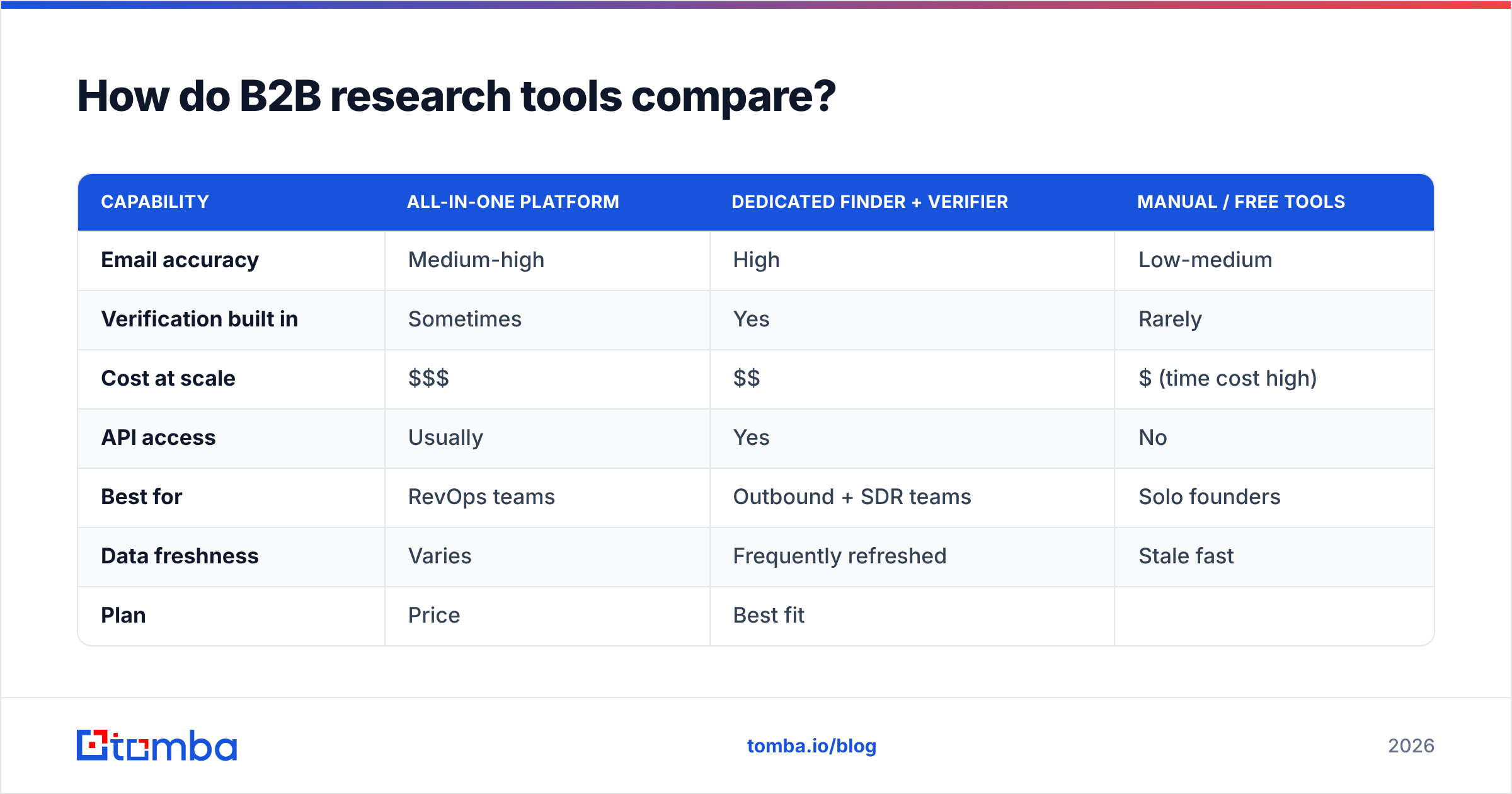
You'll generally combine a finder, a verifier, and a database. Here's how the core capabilities stack up across typical tooling categories so you can see where budget should go.
| Capability | All-in-one platform | Dedicated finder + verifier | Manual / free tools |
|---|---|---|---|
| Email accuracy | Medium-high | High | Low-medium |
| Verification built in | Sometimes | Yes | Rarely |
| Cost at scale | $$$ | $$ | $ (time cost high) |
| API access | Usually | Yes | No |
| Best for | RevOps teams | Outbound + SDR teams | Solo founders |
| Data freshness | Varies | Frequently refreshed | Stale fast |
The practical takeaway: a focused finder-plus-verifier setup usually beats a sprawling all-in-one for outbound teams, because accuracy and deliverability — not feature count — decide whether your emails land.
Here is how Tomba's plans map to research volume, for reference:
| Plan | Price | Best fit |
|---|---|---|
| Free | $0 (25 searches/mo) | Testing accuracy |
| Starter | $49/mo | Solo SDR or founder |
| Growth | $99/mo | Small outbound team |
| Pro | $249/mo | Scaling RevOps |
| Enterprise | Custom | High-volume + API |
You can see full Tomba pricing for credit limits per tier. Note the starter tier is $49/mo — budget for a verifier alongside it rather than assuming the finder alone is enough.
How do you verify B2B research data accuracy?#
You verify by testing, not by trusting the marketing page. Accuracy claims like "95%+" are meaningless without your own benchmark on your own segment.
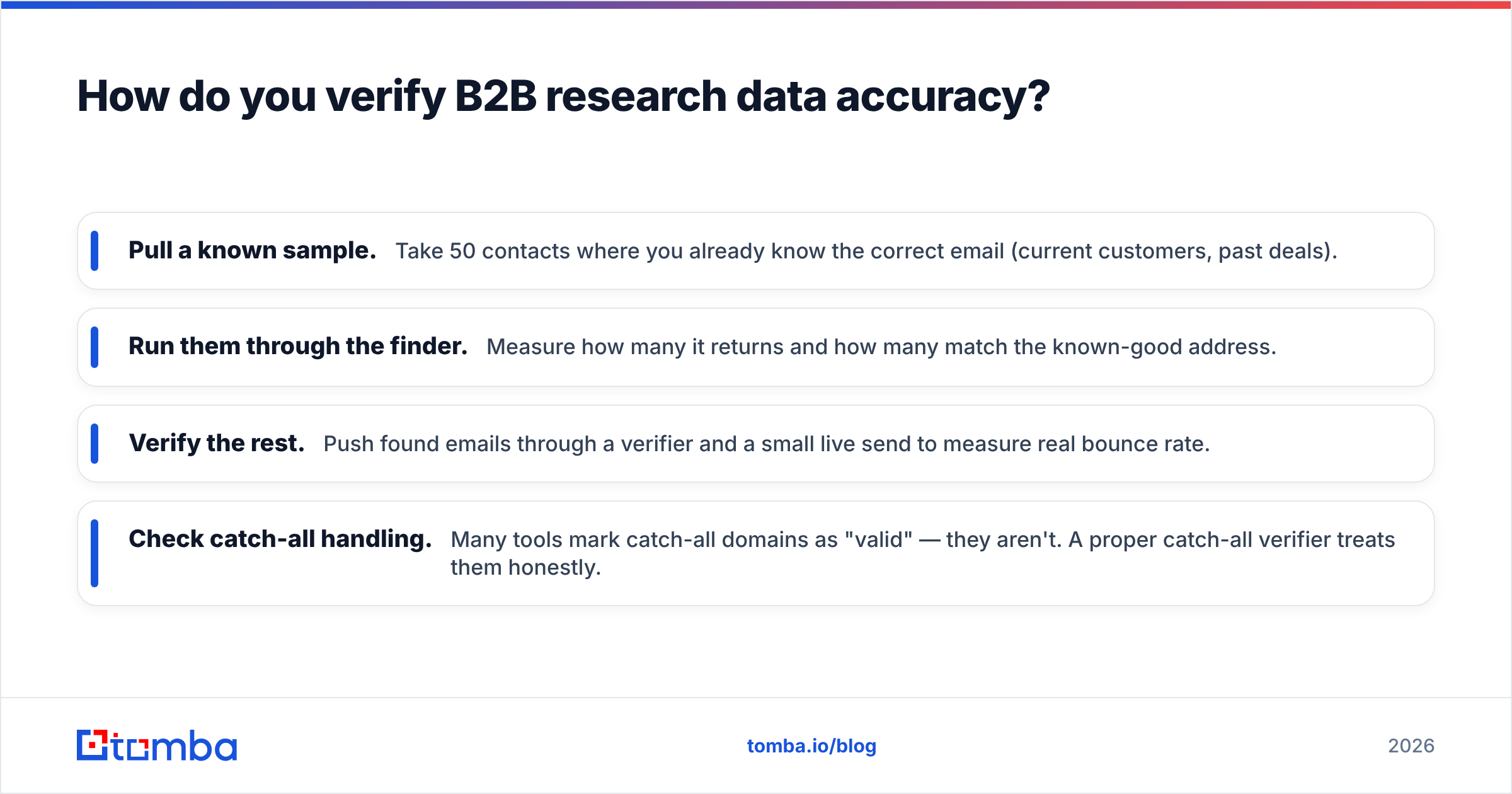
Run this quick test before committing to any tool:
- Pull a known sample. Take 50 contacts where you already know the correct email (current customers, past deals).
- Run them through the finder. Measure how many it returns and how many match the known-good address.
- Verify the rest. Push found emails through a verifier and a small live send to measure real bounce rate.
- Check catch-all handling. Many tools mark catch-all domains as "valid" — they aren't. A proper catch-all verifier treats them honestly.
A bounce rate under 2-3% on verified addresses is the bar. Anything higher and you're risking deliverability. This is also why a standalone email verification step earns its keep even when your finder claims to verify — independent confirmation catches what bundled checks miss.
For broader context on evaluating vendors, G2 and Capterra carry verified user reviews that surface real-world accuracy complaints the vendor pages won't show you.
What are the most common B2B research mistakes?#
The failures are predictable, which means they're avoidable.
- Volume over fit. A 10,000-row list that ignores the ICP produces noise and burns reputation. Smaller and accurate wins.
- Skipping verification. The single biggest deliverability killer. Every unverified send is a coin flip on your domain health.
- Ignoring the full committee. Emailing one champion when six people decide means stalled deals. Map the group early — Gartner's buying group research is a useful primer.
- Treating data as a one-time pull. Research is continuous. Re-verify before every major campaign because the list you trusted last quarter has already decayed.
- No system. Ad-hoc research can't be improved because it's never the same twice. Document the five stages and run them identically.
How do you scale B2B research without losing quality?#
You scale with automation on the mechanical steps and human judgment on the strategic ones. The trap is automating the wrong half.
Automate sourcing, enrichment, and verification. A bulk email finder plus API access lets you process thousands of accounts without manual lookups, and integrations push clean records straight into your CRM via tools like the HubSpot integration or Salesforce integration. Keep humans on ICP definition, account prioritization, and messaging — the parts that require context a machine can't infer.
For developer-led teams, the Tomba API lets you wire research directly into your own data pipeline, so enrichment and verification happen automatically as new accounts enter the system. That's how you keep quality constant while volume grows: the rules are codified, not re-decided every time.
A reasonable scaled motion looks like this: nightly job sources new accounts matching the ICP, enriches contacts, verifies emails, scores them, and drops the qualified tier into a review queue. Your team starts each morning with a clean, prioritized list instead of a research backlog.
Frequently asked questions#
How long should B2B research take per account? For a high-value target, 10-15 minutes of focused research is reasonable. For volume outbound, automate enrichment and verification so per-account human time drops to under a minute, reserved for prioritization.
Is free B2B research data good enough? For testing and very low volume, yes. The free email checker and similar tools work for spot checks. At scale, free tools cost you in time and bounces more than a paid plan costs in dollars.
How often should I re-verify my data? Before every major campaign, and at minimum quarterly. With 25-30% annual decay, a six-month-old list is already meaningfully wrong.
What's the difference between a finder and a verifier? A finder discovers an email address from a name and domain. A verifier confirms that address actually exists and can receive mail. You need both — finding without verifying is how you bounce.
Start your B2B research with accurate data#
The whole motion only works if the contact data is real. Stale lists waste sequences, hurt deliverability, and make every downstream step pointless. Start where accuracy is measurable: use the Tomba Email Finder to source verified professional emails by name, company, or domain, then confirm them before they ever hit a sequence. Run the 50-contact accuracy test on the free tier first — if the data holds up on your own segment, scale into a paid plan with confidence. Good research is a system, and the system starts with data you can trust.
Ready to find emails that actually work?
Join 150,000+ professionals who stopped guessing and started sending. Free credits on signup — no credit card required.
Get the Tomba newsletter
Practical outbound tactics and product updates — once every two weeks.
About the author