B2B Rocket Alternatives: 7 Better AI Sales Tools for 2026
B2B Rocket promises autonomous AI SDRs, but the data quality and pricing don't always hold up. Here are 7 B2B Rocket alternatives that actually book meetings in 2026.
B2B Rocket Alternatives: 7 Better AI Sales Tools for 2026
B2B Rocket sells a tempting story: switch on an autonomous AI SDR, walk away, and watch meetings land in your calendar. The reality is messier. Teams that pilot it often hit the same walls — thin contact data, generic AI copy, and pricing that climbs fast once you scale past the demo. If any of that sounds familiar, you're in the right place.
TL;DR#
- B2B Rocket is an AI SDR platform that automates prospecting, outreach, and meeting booking — but users frequently flag data accuracy and rigid pricing as deal-breakers.
- The best B2B Rocket alternatives split into three camps: data-first finders (Tomba, Apollo), sending engines (Instantly, Smartlead), and full AI-SDR suites (Artisan, Reply.io).
- If bad data is your bottleneck, fix the foundation first — verified emails beat a smarter sequence every time.
- Tomba is the most cost-effective starting point for accurate B2B contact data, with a free tier and plans from $49/mo.
- Use the comparison table below to match a tool to your actual constraint: data, deliverability, or automation.
What is B2B Rocket and why look for alternatives?#
B2B Rocket is an AI-powered sales automation platform built around the "AI agent" concept. You define an ideal customer profile, and its agents are meant to find leads, write personalized outreach, handle replies, and book qualified meetings with minimal human input. On paper it collapses the whole top-of-funnel into one dashboard.
So why do teams shop around? A few recurring reasons:
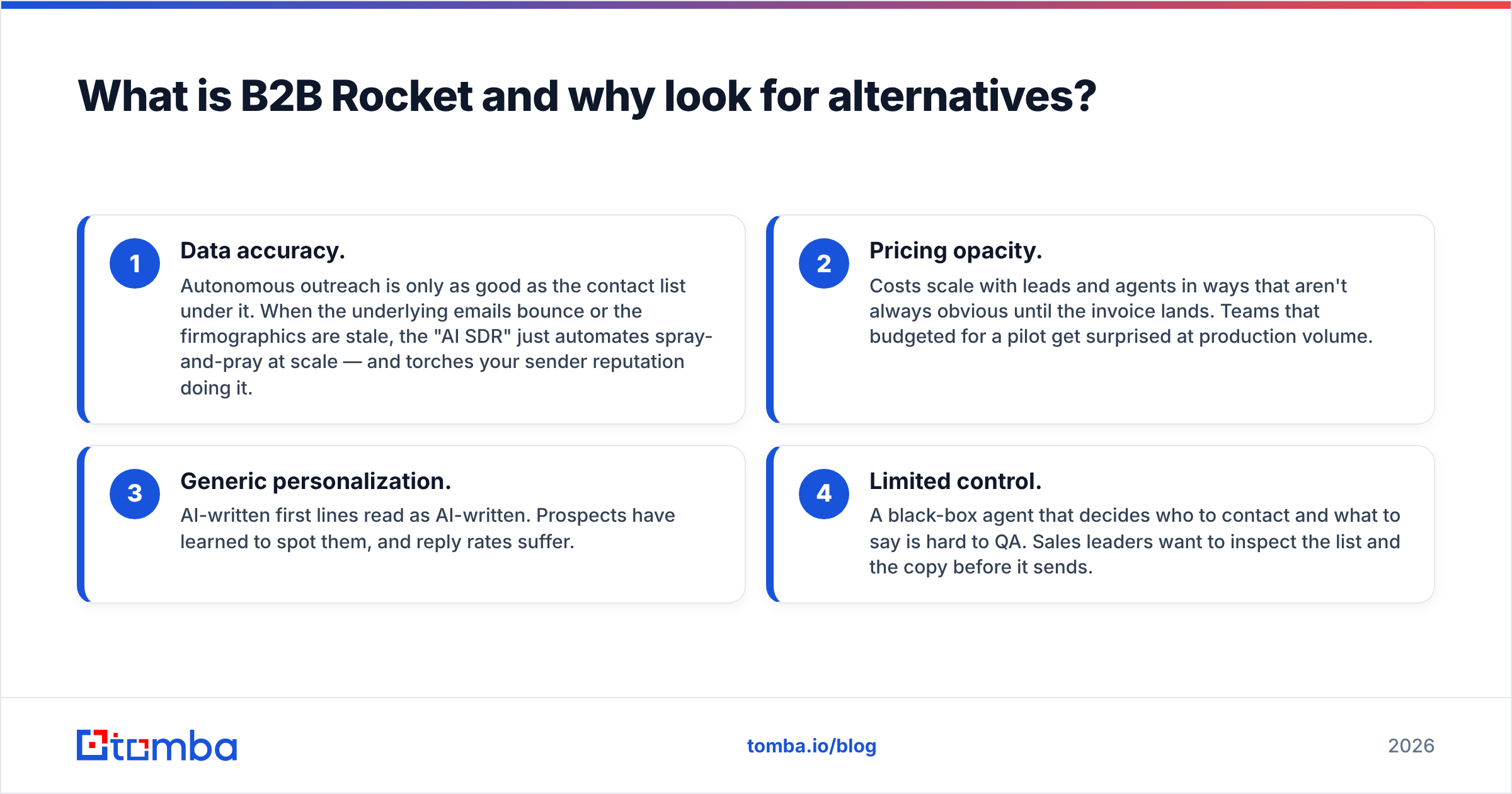
- Data accuracy. Autonomous outreach is only as good as the contact list under it. When the underlying emails bounce or the firmographics are stale, the "AI SDR" just automates spray-and-pray at scale — and torches your sender reputation doing it.
- Pricing opacity. Costs scale with leads and agents in ways that aren't always obvious until the invoice lands. Teams that budgeted for a pilot get surprised at production volume.
- Generic personalization. AI-written first lines read as AI-written. Prospects have learned to spot them, and reply rates suffer.
- Limited control. A black-box agent that decides who to contact and what to say is hard to QA. Sales leaders want to inspect the list and the copy before it sends.
None of this means B2B Rocket is a bad product — it means "set it and forget it" rarely survives contact with a real pipeline. The fix is usually to unbundle: own your data layer, own your sending, and add automation where it genuinely saves time.
How should you choose a B2B Rocket alternative?#
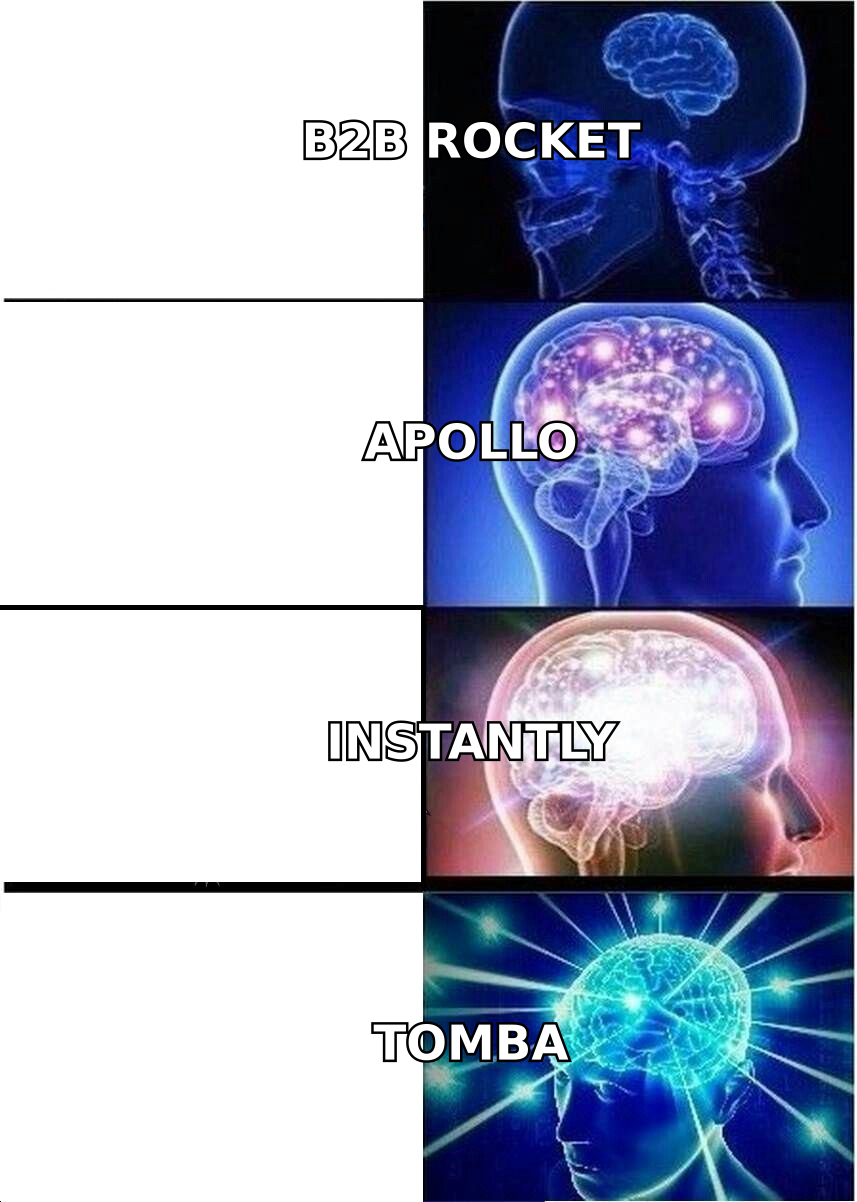
Conclusion first: pick the tool that fixes your actual bottleneck, not the one with the most features. Most outbound problems trace back to one of three layers.
- Data layer — Are your emails verified and your targeting accurate? If bounce rates are high, start here. Tools like a dedicated email finder and email verifier live in this layer.
- Delivery layer — Are good emails landing in the inbox? If your data is clean but replies are flat, you need warmup, inbox rotation, and deliverability tooling.
- Automation layer — Is manual work eating your reps' time? Once data and delivery are solid, sequencing and AI-SDR features multiply output instead of multiplying spam.
B2B Rocket tries to own all three at once. The strongest alternatives often win by being excellent at one and integrating cleanly with the rest. A surgical stack you control usually outperforms a bundled autopilot you don't.
Which are the best B2B Rocket alternatives in 2026?#
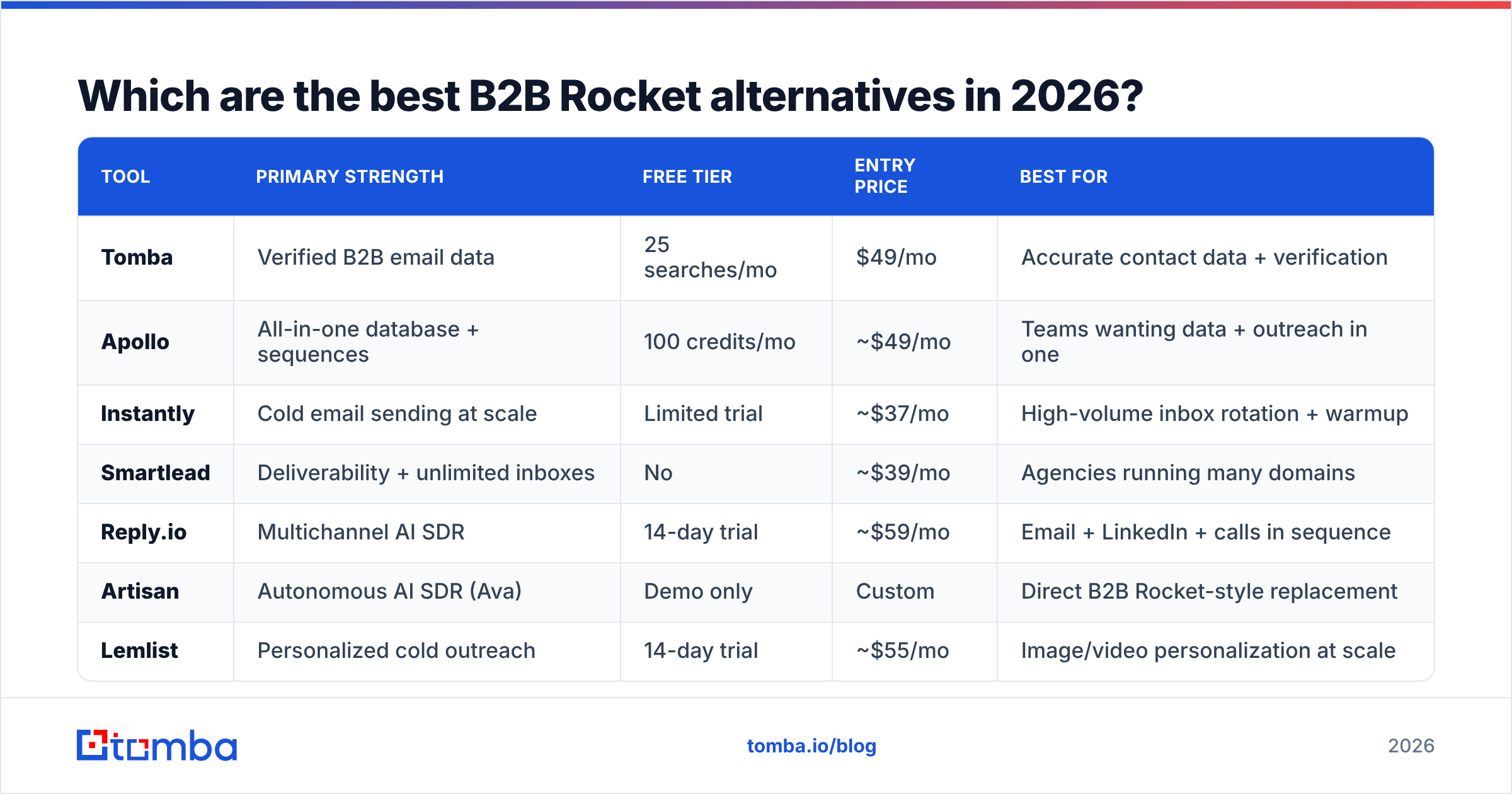
Here's the head-to-head. Prices reflect entry paid tiers as of 2026; verify current numbers on each vendor's site before you buy.
| Tool | Primary strength | Free tier | Entry price | Best for |
|---|---|---|---|---|
| Tomba | Verified B2B email data | 25 searches/mo | $49/mo | Accurate contact data + verification |
| Apollo | All-in-one database + sequences | 100 credits/mo | ~$49/mo | Teams wanting data + outreach in one |
| Instantly | Cold email sending at scale | Limited trial | ~$37/mo | High-volume inbox rotation + warmup |
| Smartlead | Deliverability + unlimited inboxes | No | ~$39/mo | Agencies running many domains |
| Reply.io | Multichannel AI SDR | 14-day trial | ~$59/mo | Email + LinkedIn + calls in sequence |
| Artisan | Autonomous AI SDR (Ava) | Demo only | Custom | Direct B2B Rocket-style replacement |
| Lemlist | Personalized cold outreach | 14-day trial | ~$55/mo | Image/video personalization at scale |
A few notes on how to read this table. If your problem is data, Tomba and Apollo are the realistic starting points — and Tomba's free tier lets you test accuracy before spending a dollar. If your problem is deliverability, Instantly and Smartlead are purpose-built for it. If you genuinely want the autonomous-agent experience B2B Rocket sells, Artisan and Reply.io are the closest like-for-like swaps.
1. Tomba — best for accurate B2B data#
Tomba is an email-finder and lead-enrichment platform, and it solves the problem most B2B Rocket users actually have: garbage in, garbage out. Instead of trusting an opaque agent's list, you find and verify contacts yourself.
- Email finder by name, domain, or company, plus domain search to pull every public address at a company.
- A built-in verifier and catch-all verifier to cut bounces before you send.
- Data enrichment and bulk email finder for list-building at volume.
- A clean email finder API, CLI, and Chrome extension so it slots into any stack — including the sending tools below.
Pricing: Free (25 searches/mo), Starter $49/mo, Growth $99/mo, Pro $249/mo, Enterprise custom. See full Tomba pricing for credit breakdowns. Tomba isn't a sending engine — pair it with Instantly or Smartlead and you've rebuilt B2B Rocket's value with parts you actually control.
2. Apollo — best all-in-one swap#
Apollo bundles a large B2B database with sequencing and a CRM, making it the most direct "one tool does everything" alternative. It's a reasonable B2B Rocket replacement if you want data and outreach under one login. The trade-off: database accuracy varies by region and seniority, and power features sit behind higher tiers. Many teams use Apollo for targeting and a dedicated finder to verify the contacts that matter. (See independent reviews on G2 before committing.)
3. Instantly — best for cold email volume#
Instantly focuses on the delivery layer: unlimited email accounts, automated warmup, and inbox rotation that keeps you out of spam at scale. It does almost nothing for data — you bring your own list. Feed it verified contacts from a quality finder and it becomes a deliverability workhorse. If your data is already clean and you just need to send, this is the pick.
4. Smartlead — best for agencies#
Smartlead is Instantly's closest rival, built for agencies juggling dozens of client domains. Unlimited inboxes, a master inbox, and strong deliverability controls make it ideal for multi-account operations. Like Instantly, it assumes you've already solved data quality elsewhere.

5. Reply.io — best multichannel AI SDR#

Reply.io is the closest to B2B Rocket's pitch while still giving you control. It runs AI-assisted sequences across email, LinkedIn, and calls, with an AI SDR layer for reply handling. You get automation without fully surrendering the wheel — you can still inspect and edit what goes out. For teams that liked B2B Rocket's concept but not its data, this is a strong middle ground. Tomba even offers a dedicated Reply.io alternative breakdown if you want the deep comparison.
6. Artisan — closest autonomous-agent replacement#
Artisan's "Ava" is the most literal B2B Rocket competitor: an AI SDR that researches, writes, and sends largely on its own. If you specifically want the hands-off agent experience, Artisan is the head-to-head swap. The same caution applies — autonomous sending amplifies whatever data quality sits underneath, so verify the contact source before you scale.
7. Lemlist — best for personalization#
Lemlist made its name on personalization: dynamic images, custom video thumbnails, and liquid-syntax variables that make cold email feel less cold. It's a sending-and-personalization tool, not a database, so it pairs best with an external finder. If your reply rates are dying from generic copy, Lemlist attacks that directly.
Is B2B Rocket worth it compared to these alternatives?#
Conclusion first: B2B Rocket is worth it only if its data and pricing fit your motion — and for many teams, an unbundled stack delivers more for less. Think of B2B Rocket like a meal-kit subscription: convenient, but you pay a premium and you can't swap the ingredients. Building your own stack is like cooking from a great grocery store — more steps, but you control quality and cost.
Here's the practical decision framework:
| Your situation | Best move |
|---|---|
| High bounce rates, bad targeting | Start at the data layer: Tomba |
| Clean data, poor inbox placement | Delivery layer: Instantly or Smartlead |
| Reps drowning in manual work | Automation layer: Reply.io or Apollo |
| You truly want hands-off agents | Direct swap: Artisan |
| Generic copy killing replies | Personalization: Lemlist |
The most common winning pattern in 2026 isn't one mega-tool — it's a finder for data, a sender for delivery, and light automation on top. You keep margins, you keep control, and you can swap any layer without re-platforming your whole funnel.
How do you migrate off B2B Rocket without losing momentum?#
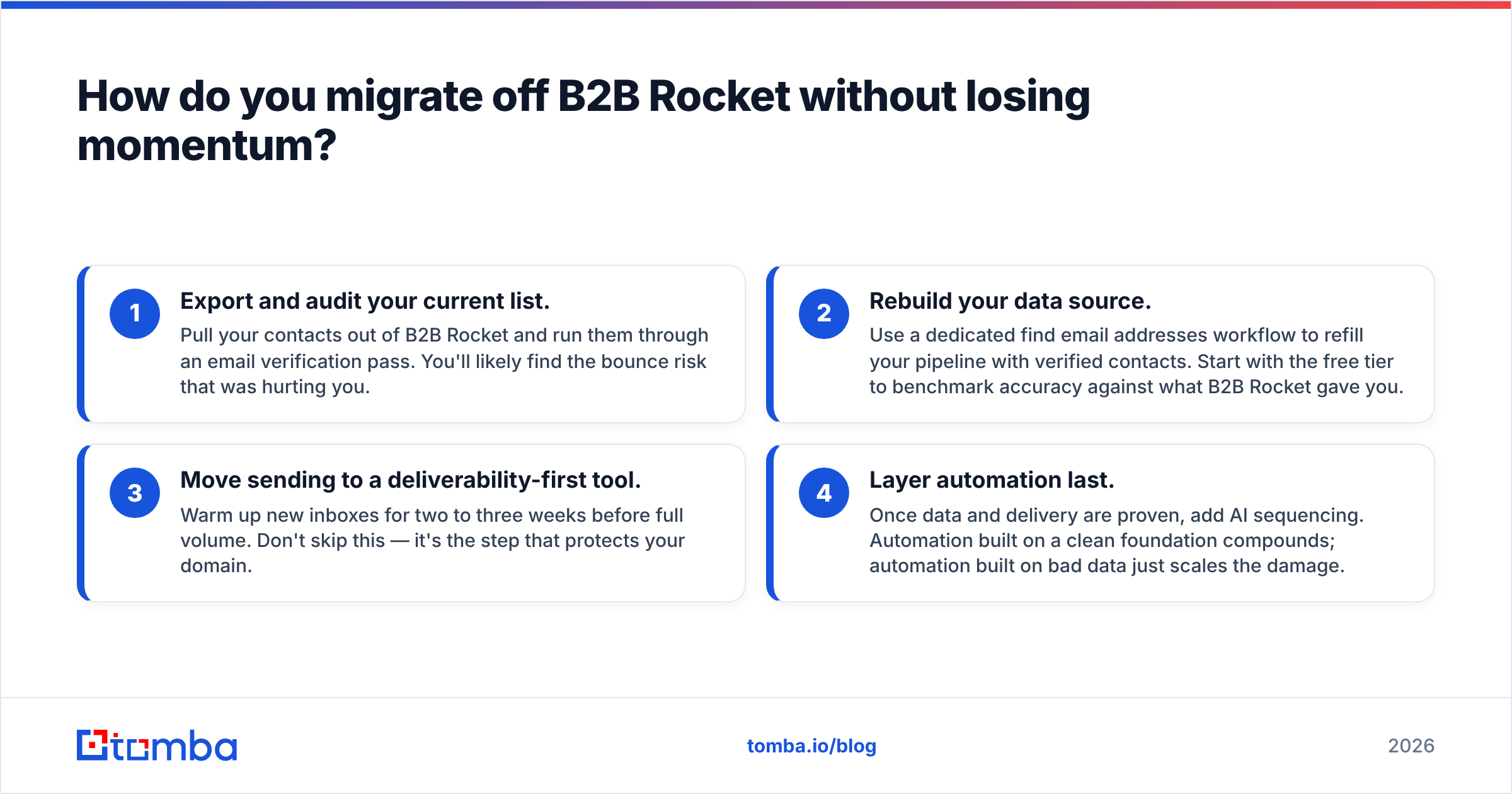
Switching tools mid-quarter scares people. It shouldn't — do it in four steps and you keep pipeline flowing.
- Export and audit your current list. Pull your contacts out of B2B Rocket and run them through an email verification pass. You'll likely find the bounce risk that was hurting you.
- Rebuild your data source. Use a dedicated find email addresses workflow to refill your pipeline with verified contacts. Start with the free tier to benchmark accuracy against what B2B Rocket gave you.
- Move sending to a deliverability-first tool. Warm up new inboxes for two to three weeks before full volume. Don't skip this — it's the step that protects your domain.
- Layer automation last. Once data and delivery are proven, add AI sequencing. Automation built on a clean foundation compounds; automation built on bad data just scales the damage.
This sequence matters because each layer depends on the one below it. Most teams who churn off B2B Rocket and still struggle made the mistake of swapping the agent without fixing the data underneath.
What about pricing — which alternative is most cost-effective?#
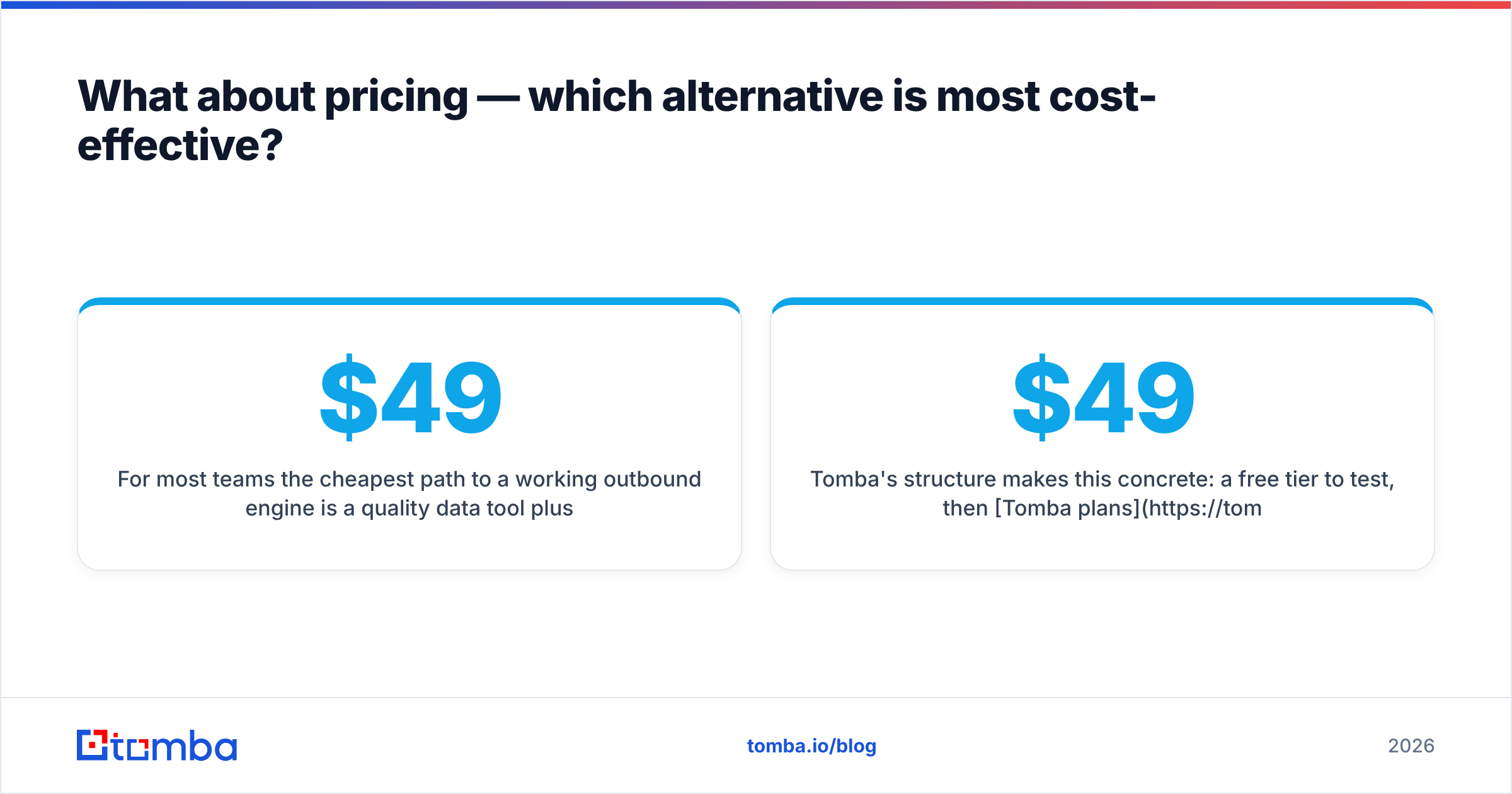
For most teams the cheapest path to a working outbound engine is a quality data tool plus a deliverability tool, both starting near $49/mo, instead of a single bundled platform priced on lead volume. You pay for what you use, and you can scale each piece independently.
Tomba's structure makes this concrete: a free tier to test, then Tomba plans at $49/mo (Starter), $99/mo (Growth), and $249/mo (Pro), with enterprise pricing for high-volume teams. Because you only add a sender once your data is proven, you avoid paying for automation that's spraying bad contacts — the exact trap that makes bundled AI-SDR pricing feel expensive.
The bottom line#
B2B Rocket's autonomous-SDR vision is appealing, but most teams that leave it do so for the same reason: the data underneath the automation wasn't good enough. Fix that first and the rest of your stack gets easier — and cheaper.
Start where the leverage is highest. Tomba's Email Finder gives you verified, accurate B2B contacts you can plug into any sending or automation tool — no black box, no surprise invoice. Try it free with 25 searches a month, benchmark the accuracy against whatever you're using now, and build an outbound engine you actually control. Your sender reputation will thank you.
// get started
Find, verify and enrich your first contacts today
Start on the free plan with 25 searches a month, then scale when your team is ready.
Free plan · No credit card required · GDPR & CCPA
// about the author