B2B Rocket Pros and Cons (2026): Honest Review & Verdict
A no-fluff 2026 breakdown of B2B Rocket's pros and cons — what its AI sales agents do well, where they fall short, pricing, and the data layer you still need.
B2B Rocket sells a tempting promise: autonomous AI agents that prospect, message, qualify, and book meetings while you sleep. That promise is also exactly why you should read the fine print before wiring it into your pipeline. This is a straight look at the b2b rocket pros and cons in 2026 — what the platform genuinely does well, where it quietly costs you, and the one layer it can't fix on its own.
TL;DR#
- What it is: B2B Rocket is an AI sales-automation platform built around "AI agents" that run end-to-end outbound — lead sourcing, personalized email, follow-ups, and meeting booking.
- Biggest pro: It compresses the SDR workflow into one dashboard, so a small team can run high-volume outbound without hiring.
- Biggest con: Autonomy is only as good as the data and deliverability underneath it — and that's where most users hit reply-rate and bounce problems.
- Pricing reality: It's a mid-to-premium spend; the autonomy is the value, not a bargain.
- The fix: Pair any AI sender with verified contact data. Feed it clean emails from a dedicated email finder and a real email verifier instead of trusting bundled lists.
What is B2B Rocket?#
B2B Rocket is an AI-driven outbound platform that markets "autonomous sales agents." Think of it like hiring a junior SDR who never sleeps: you give it a target persona, a value proposition, and a calendar, and the agent is supposed to find prospects, write tailored first-touch emails, handle replies, and drop booked meetings onto your calendar.
The pitch lands because outbound is expensive and repetitive. A human SDR costs salary, ramp time, and churn. B2B Rocket reframes that cost as a software subscription plus AI usage. For founders and lean teams, that math is seductive — which is precisely why the trade-offs deserve scrutiny rather than a free pass.
Under the hood, the platform bundles four jobs that used to live in separate tools: a lead database, an AI copywriter, a sending engine, and a meeting scheduler. Bundling is convenient. It is also where quality control gets murky, because you inherit whatever data and sending reputation the vendor gives you.
)
How do B2B Rocket's AI agents actually work?#
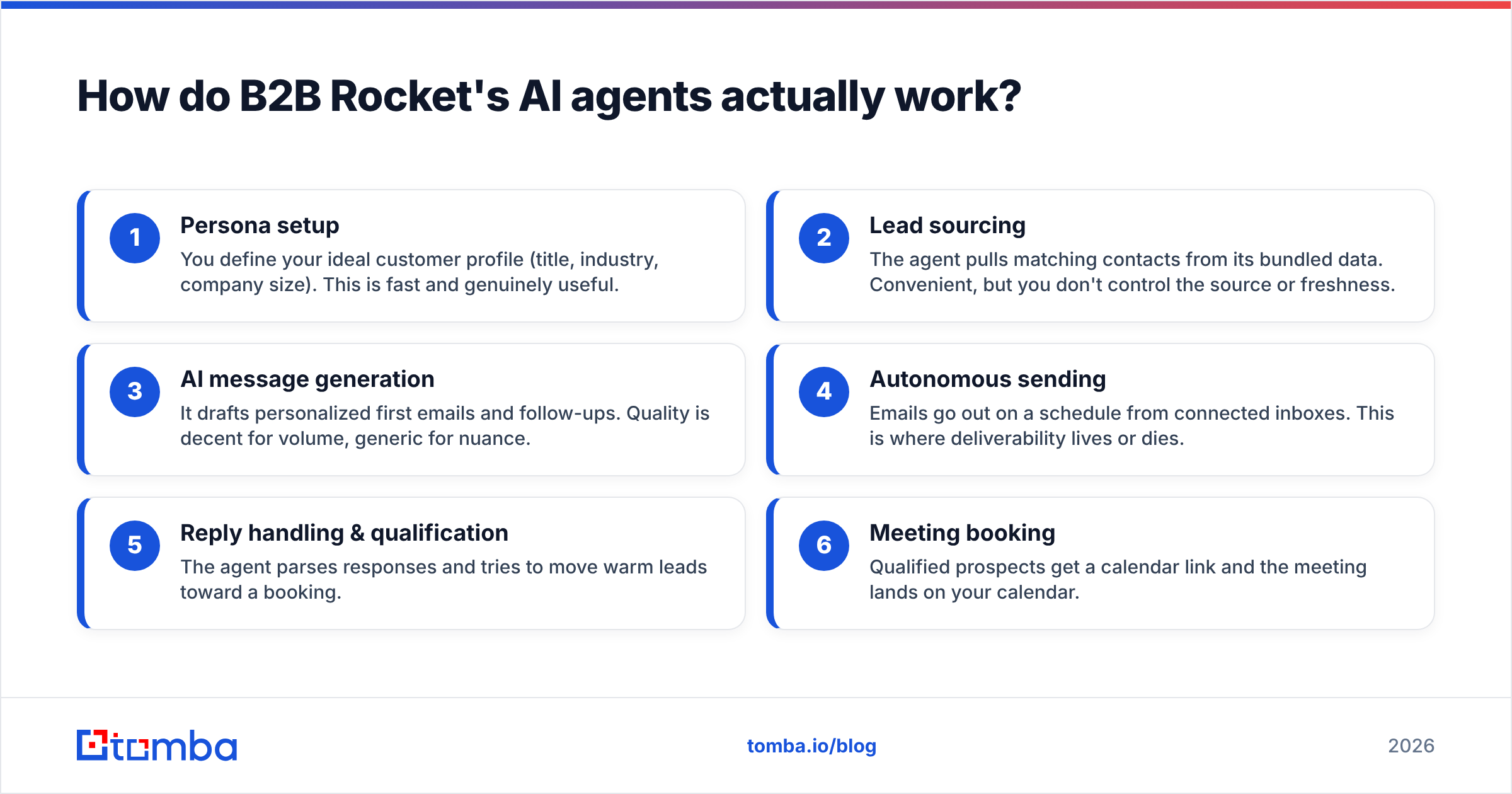
The core unit is the "agent." You configure it once, then it runs a loop. Here's the workflow most users experience, broken down so you can see where value is created and where risk enters.
- Persona setup — You define your ideal customer profile (title, industry, company size). This is fast and genuinely useful.
- Lead sourcing — The agent pulls matching contacts from its bundled data. Convenient, but you don't control the source or freshness.
- AI message generation — It drafts personalized first emails and follow-ups. Quality is decent for volume, generic for nuance.
- Autonomous sending — Emails go out on a schedule from connected inboxes. This is where deliverability lives or dies.
- Reply handling & qualification — The agent parses responses and tries to move warm leads toward a booking.
- Meeting booking — Qualified prospects get a calendar link and the meeting lands on your calendar.
Steps 1, 5, and 6 are where B2B Rocket shines. Steps 2 and 4 are where independent users report the most pain — stale contacts and inboxes that drift toward spam folders when volume scales.
What are the pros of B2B Rocket?#
Credit where it's due. The platform solves real problems, and dismissing it outright would be dishonest.
- End-to-end automation. You're not stitching together a finder, a sequencer, and a scheduler. One login covers the funnel, which lowers the operational tax on tiny teams.
- Speed to first campaign. You can go from signup to live outbound in an afternoon. For founders testing a market, that velocity matters.
- AI personalization at volume. The message generation is good enough to beat copy-paste blasts. It references prospect context and varies openers.
- Reply triage. Letting an agent sort "interested" from "not now" from "unsubscribe" saves real hours when reply volume climbs.
- Lower headcount pressure. One operator can supervise output that would normally need two or three SDRs, which is the entire financial argument for the tool.
If your bottleneck is "I have no outbound motion at all," B2B Rocket gets you to some motion quickly. That's a legitimate win for a stage-zero pipeline.
What are the cons of B2B Rocket?#
Now the honest part. Autonomy hides problems instead of surfacing them, and these are the issues that show up after week two.
- Data accuracy is a black box. You rarely know how fresh the bundled contacts are. Outdated emails mean hard bounces, and hard bounces wreck sender reputation.
- Deliverability risk scales with autonomy. An agent sending hundreds of emails from under-warmed inboxes is a fast track to the spam folder. The tool automates sending, not trust.
- Generic personalization ceiling. AI openers are fine until a prospect actually reads them. For high-ACV deals, "Hi {FirstName}, I saw {Company} is growing" doesn't move a VP.
- Less control over targeting precision. Bundled databases optimize for coverage, not for the surgically narrow list a niche seller needs.
- Cost stacks up. Between the platform fee and the inbox/warmup infrastructure you still need, the "cheaper than an SDR" claim gets thinner at scale.
- Reply quality varies. Automated qualification occasionally mislabels a hot lead as cold, and you only notice when the pipeline runs dry.
The pattern is consistent: B2B Rocket automates the labor of outbound but doesn't guarantee the inputs — and bad inputs at machine speed produce bad results at machine speed.
)
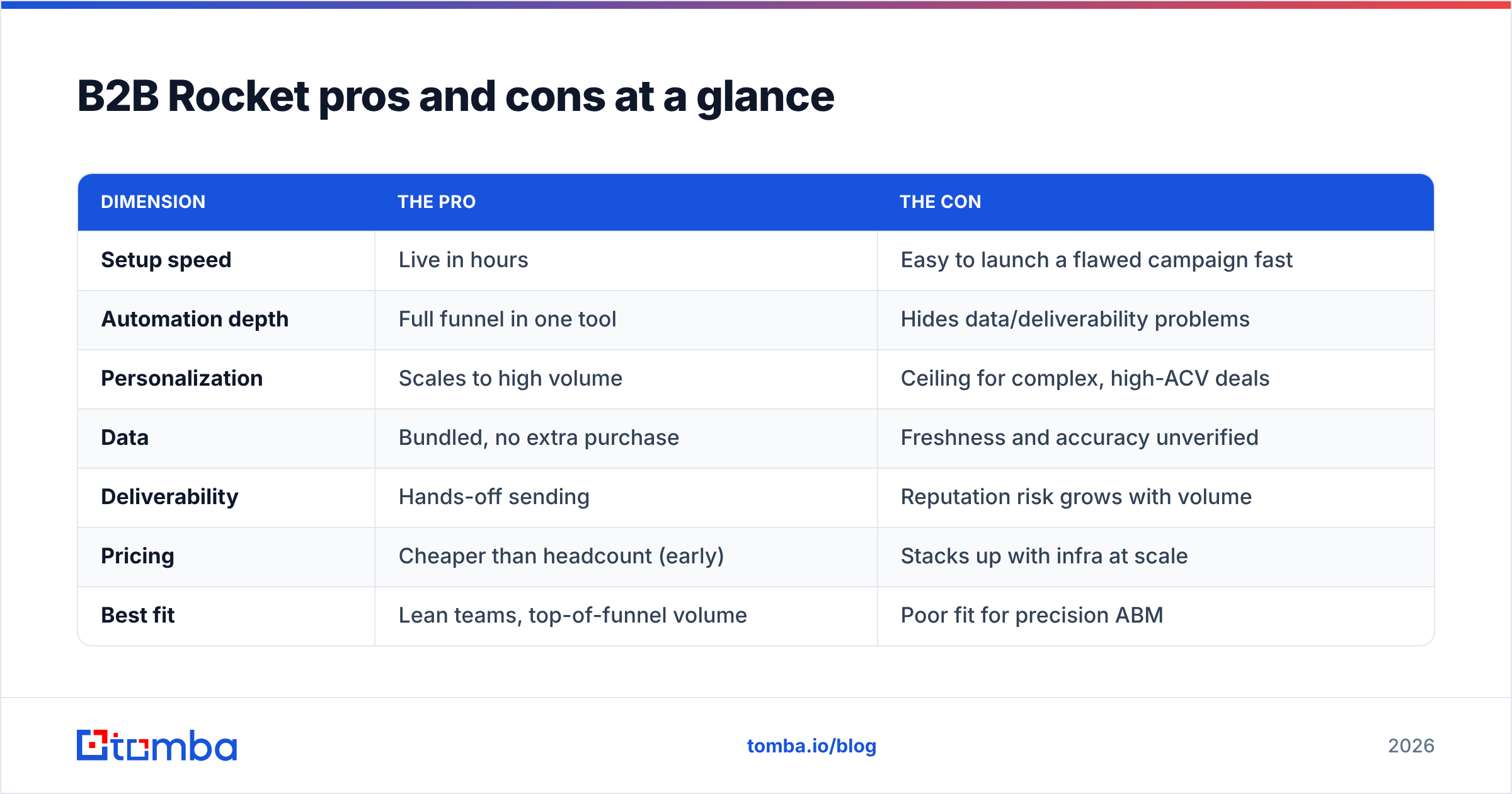
B2B Rocket pros and cons at a glance#
Here's the balanced scorecard so you can weigh it against your own situation rather than a marketing page.
| Dimension | The Pro | The Con |
|---|---|---|
| Setup speed | Live in hours | Easy to launch a flawed campaign fast |
| Automation depth | Full funnel in one tool | Hides data/deliverability problems |
| Personalization | Scales to high volume | Ceiling for complex, high-ACV deals |
| Data | Bundled, no extra purchase | Freshness and accuracy unverified |
| Deliverability | Hands-off sending | Reputation risk grows with volume |
| Pricing | Cheaper than headcount (early) | Stacks up with infra at scale |
| Best fit | Lean teams, top-of-funnel volume | Poor fit for precision ABM |
How does B2B Rocket compare to a modular stack?#
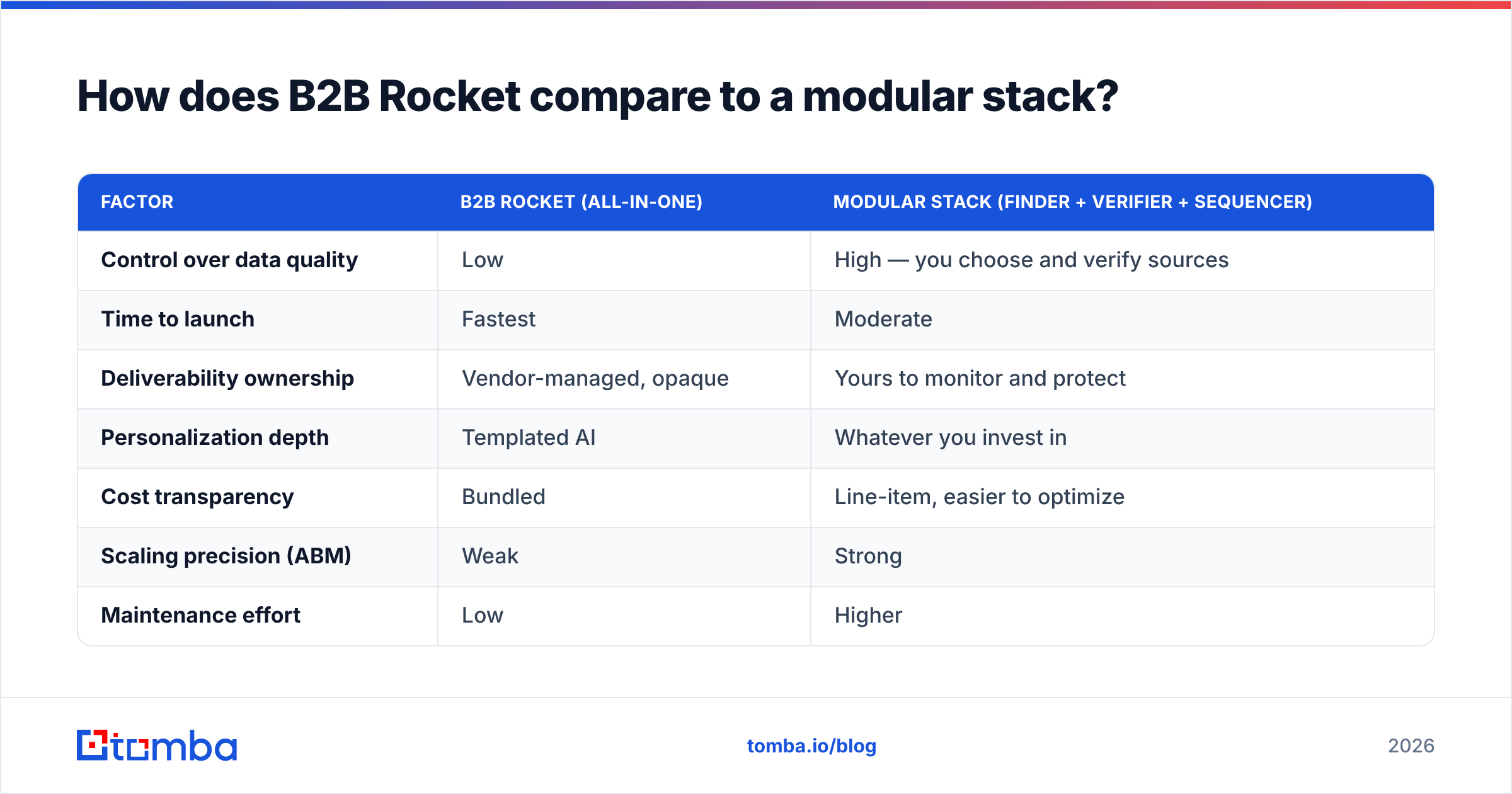
The real decision isn't "B2B Rocket: yes or no." It's "all-in-one autonomy versus a controlled, modular stack." Both are valid; they serve different teams.
| Factor | B2B Rocket (all-in-one) | Modular stack (finder + verifier + sequencer) |
|---|---|---|
| Control over data quality | Low | High — you choose and verify sources |
| Time to launch | Fastest | Moderate |
| Deliverability ownership | Vendor-managed, opaque | Yours to monitor and protect |
| Personalization depth | Templated AI | Whatever you invest in |
| Cost transparency | Bundled | Line-item, easier to optimize |
| Scaling precision (ABM) | Weak | Strong |
| Maintenance effort | Low | Higher |
A modular stack costs more attention but returns more control. If you're chasing 50 named accounts, control wins every time. If you're spraying a broad TAM and just need motion, the all-in-one convenience can be worth the opacity — provided you fix the data layer.
For teams evaluating the autonomous-agent category broadly, it's worth reading independent reviews on G2 and Capterra rather than relying solely on vendor claims; reply-rate and deliverability complaints tend to surface there first.
How much does B2B Rocket cost in 2026?#
B2B Rocket positions itself as a per-seat or usage-based SaaS spend that scales with the number of agents and the volume of contacts you process. Exact tiers shift, so confirm on their site — but the strategic point holds: you are paying for autonomy, and autonomy is a premium feature, not a discount.
The hidden cost is the supporting cast. To run AI outbound safely you also need warmed inboxes, domain authentication (SPF, DKIM, DMARC), and ideally a verification pass on every address before it's emailed. None of that is optional, and most of it sits outside the headline price.
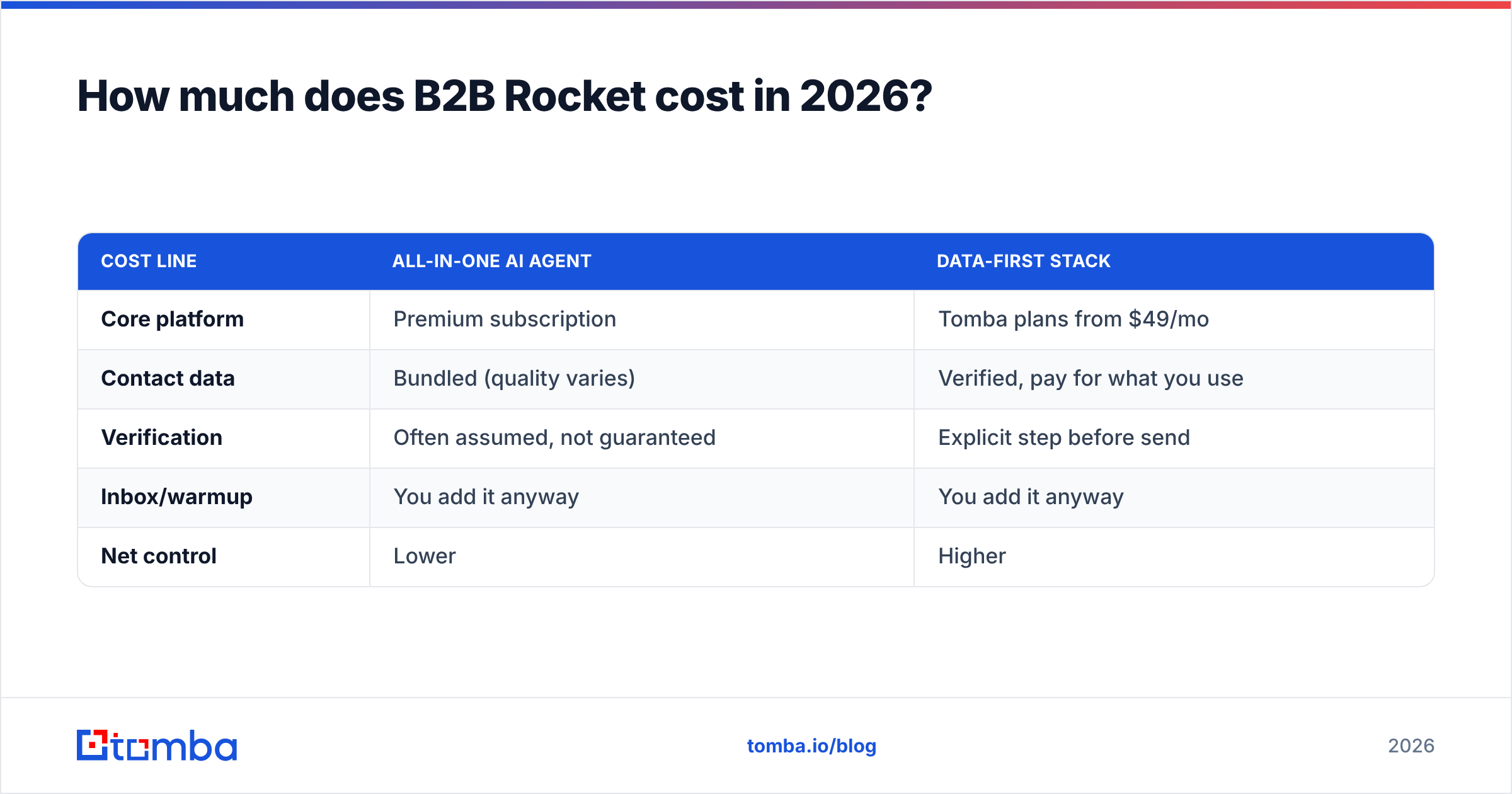
Here's a sober way to compare total cost of ownership against a data-first stack:
| Cost line | All-in-one AI agent | Data-first stack |
|---|---|---|
| Core platform | Premium subscription | Tomba plans from $49/mo |
| Contact data | Bundled (quality varies) | Verified, pay for what you use |
| Verification | Often assumed, not guaranteed | Explicit step before send |
| Inbox/warmup | You add it anyway | You add it anyway |
| Net control | Lower | Higher |
Note the anchor: a focused data tool starts at $49/mo (Starter), with a Free tier at 25 searches/month to test accuracy before you commit. That's not a like-for-like swap with a full autonomy suite — it's the input layer that makes any sender, autonomous or not, actually perform.
Who should use B2B Rocket — and who shouldn't?#
Use it if: you're a founder or a one-to-three person team with no existing outbound engine, you sell to a broad market, and you value speed over surgical precision. The autonomy genuinely buys back time you don't have.
Skip it if: you run account-based motions, sell high-ACV deals where every message must be sharp, or you already have a sequencer and just need better contacts. In those cases the bundled data and templated copy will cap your results, and you'll pay a premium for a ceiling.
A practical middle path exists too: use an autonomous tool for top-of-funnel volume, but never let it source and send on unverified data. Run your target list through a domain search to map real contacts at named accounts, verify each address, then feed clean inputs into whatever sends. You keep the speed and you remove the silent bounce problem.
What's the smartest fix for B2B Rocket's weak spot?#
Conclusion first: fix the data, and most of B2B Rocket's cons shrink. The autonomy isn't the problem — the inputs are.
The two failure modes that hurt users most are stale contacts (bounces) and weak targeting (low replies). Both are upstream of the AI agent. No amount of clever automation rescues an email sent to an address that no longer exists, and a hard-bounce spike will drag down email deliverability for every campaign on that domain — including the ones that were working.
That's the gap Tomba fills, and it's why pairing the two is more honest advice than "pick one." Use Tomba's Tomba Email Finder to source verified professional emails by name, company, or domain, lean on its email verifier and catch-all verifier to strip risky addresses before a single send, and you turn an opaque, bounce-prone list into a clean one. Whether your sender is an AI agent or a human, accurate data is the difference between booked meetings and a blocklisted domain.
Start free with 25 searches on the Free tier, confirm the accuracy on your own target accounts, and only scale spend once you've seen the bounce rate stay low. That's the data-first discipline that makes any outbound tool — B2B Rocket included — actually deliver on its promise.
Ready to find emails that actually work?
Join 150,000+ professionals who stopped guessing and started sending. Free credits on signup — no credit card required.
Get the Tomba newsletter
Practical outbound tactics and product updates — once every two weeks.
About the author