B2B Rocket Reviews 2026: Features, Pricing & Alternatives
An honest 2026 breakdown of B2B Rocket: what its AI sales agents actually do, real pricing, where users hit limits, and which alternatives win on data quality.
TL;DR
- B2B Rocket is an AI sales-agent platform that automates prospecting, outreach, and meeting booking — useful for teams that want a hands-off SDR layer, frustrating for teams that need clean, verified data first.
- The biggest recurring theme in B2B Rocket reviews is data quality: bounced sends and "AI-sounding" emails hurt deliverability when the underlying list is wrong.
- Pricing starts cheap on paper but scales with leads, AI agents, and add-ons; annual contracts are common.
- Best fit: small teams wanting an all-in-one autopilot. Weak fit: teams that already run a CRM and just need accurate contact data.
- Smartest stack for most users: pair a focused, verified data source like a dedicated email finder with whatever sending tool you trust — instead of betting your domain on one black-box agent.
If you have been comparing AI SDR tools, you have probably seen B2B Rocket pitched as a "set it and forget it" revenue machine. This review cuts through the marketing and looks at what the tool actually does, what real users praise and complain about, and where it fits next to alternatives in 2026.
What is B2B Rocket?#
B2B Rocket is an AI-powered sales automation platform built around "AI agents" that act like autonomous sales development reps. You define an ideal customer profile, the agent pulls a lead list, writes and sends outreach, handles replies, and tries to book meetings on your calendar — all with limited human input.
Think of it like hiring a junior SDR who never sleeps but also never asks clarifying questions. The upside is volume and consistency. The downside is that the agent only ever works with the data and instructions you hand it. If the contact list is stale or the messaging is generic, the AI scales those problems just as fast as it scales the good stuff.
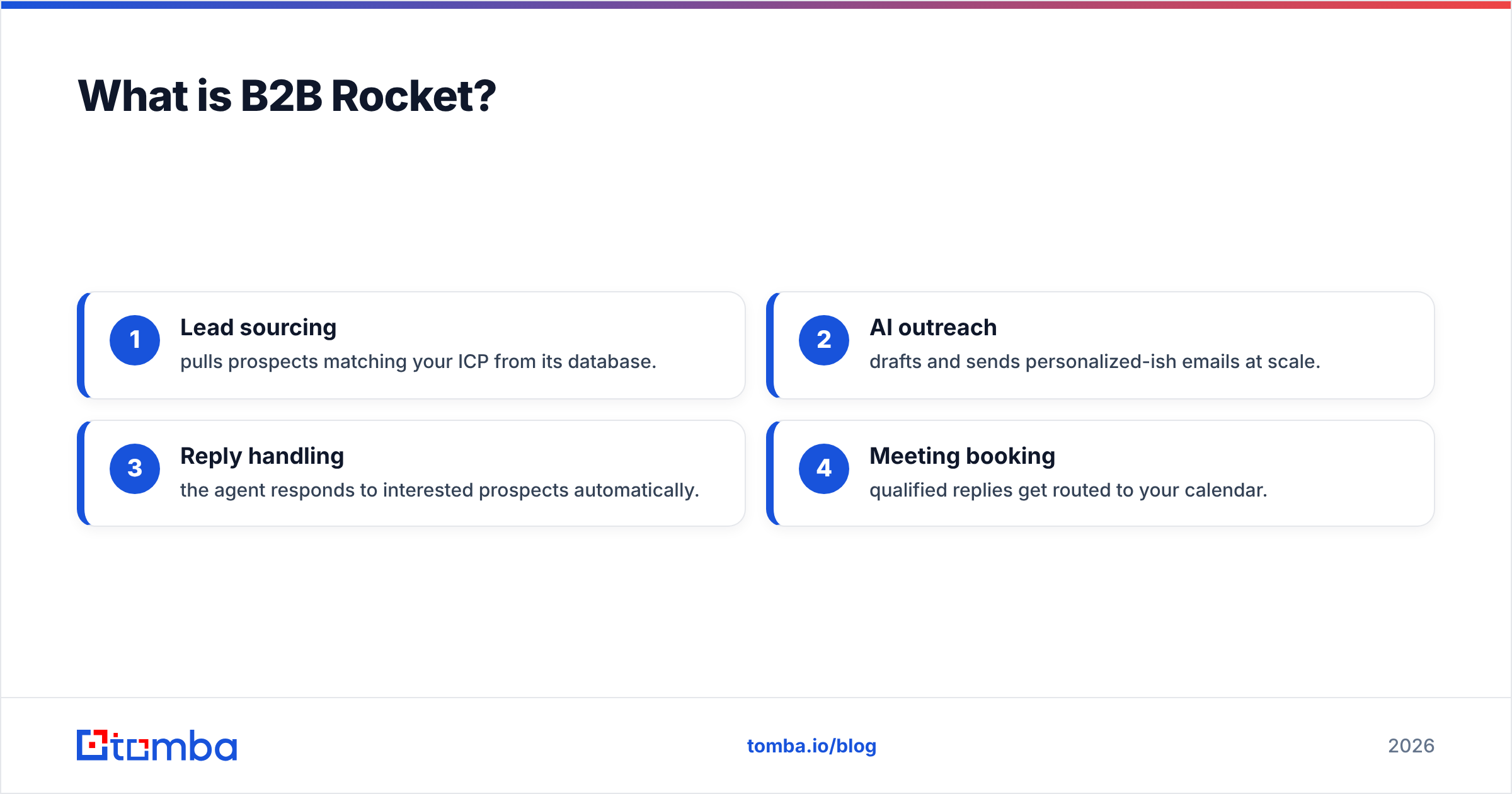
The platform typically bundles four jobs into one subscription:
- Lead sourcing — pulls prospects matching your ICP from its database.
- AI outreach — drafts and sends personalized-ish emails at scale.
- Reply handling — the agent responds to interested prospects automatically.
- Meeting booking — qualified replies get routed to your calendar.
That all-in-one design is the entire appeal. It is also the source of most criticism, because each of those four jobs is something specialized tools do better on their own.
What do B2B Rocket reviews say on G2 and Capterra?#
Pull up B2B Rocket on G2 and a few patterns show up across the review profiles. Here is the honest distribution, not a cherry-picked highlight reel.
What users like:
- Time savings. Solo founders and tiny teams love not babysitting outreach. The "agent runs while I sleep" promise lands for people with no SDR headcount.
- Low entry price. Compared to building an outbound stack from scratch, the starting tier feels approachable.
- Onboarding help. Several reviews mention responsive setup support.
What users complain about:
- Data accuracy. This is the single most common gripe. Bounced emails, wrong titles, and outdated companies show up enough that people stop trusting the lists. When your sends bounce, your sender reputation takes the hit — not the vendor's.
- Generic AI copy. Auto-written emails can read like auto-written emails, which depresses reply rates.
- Deliverability risk. Pushing high volume through AI agents without careful email deliverability hygiene can land you in spam.
- Contract friction. Some reviewers report annual commitments and refund difficulty.
None of this makes B2B Rocket a bad product. It makes it a tool whose results depend almost entirely on the quality of the data feeding it — a theme worth holding onto as we compare options.
How much does B2B Rocket cost in 2026?#
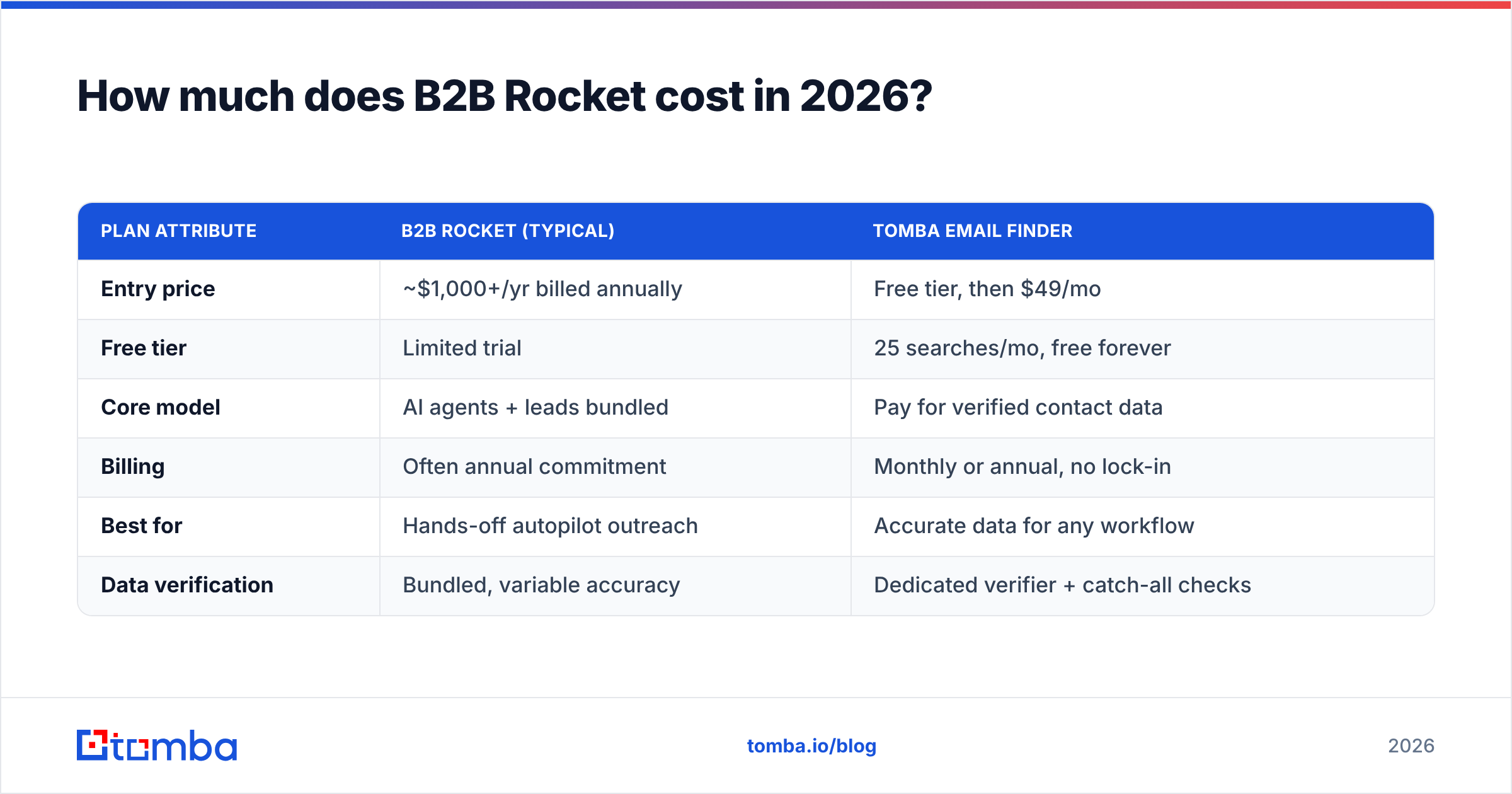
B2B Rocket's pricing is tier-based and scales with the number of leads and AI agents you run. Exact public numbers shift, so treat the table below as a structural comparison of how you pay rather than a guaranteed quote — always confirm on the official B2B Rocket site.
| Plan attribute | B2B Rocket (typical) | Tomba Email Finder |
|---|---|---|
| Entry price | ~$1,000+/yr billed annually | Free tier, then $49/mo |
| Free tier | Limited trial | 25 searches/mo, free forever |
| Core model | AI agents + leads bundled | Pay for verified contact data |
| Billing | Often annual commitment | Monthly or annual, no lock-in |
| Best for | Hands-off autopilot outreach | Accurate data for any workflow |
| Data verification | Bundled, variable accuracy | Dedicated verifier + catch-all checks |
The key takeaway: B2B Rocket sells you an outcome engine (leads in, meetings out), while a data-first tool sells you clean inputs you can route anywhere. If you already pay for a CRM, a sequencer, and a calendar tool, you may be paying B2B Rocket to re-bundle things you own — and inheriting its data accuracy ceiling in the process. Compare that against transparent Tomba pricing before committing to an annual contract.
Is B2B Rocket's data accurate enough for cold email?#
Short answer: it varies, and that variance is the whole problem. Cold outbound lives or dies on two numbers — bounce rate and reply rate — and both trace straight back to data quality.
Here is the mechanism most people miss. Mailbox providers like Google and Microsoft watch your bounce rate as a spam signal. A few percent of hard bounces and your sender reputation drops, which means even your good emails start landing in spam. So when an AI agent fires off thousands of messages against an unverified list, a bad list does not just waste sends — it quietly poisons your domain.
That is why experienced outbound teams separate the two jobs:
- Finding the right contact (name, role, company, email pattern).
- Verifying that the email is real and safe to send before it ever enters a sequence.
A focused email verifier plus a catch-all verifier catches the risky addresses an all-in-one agent will happily blast anyway. If you only fix one thing in your stack this year, make it this. Garbage in, spam folder out.
B2B Rocket vs the alternatives: which tool for which job?#
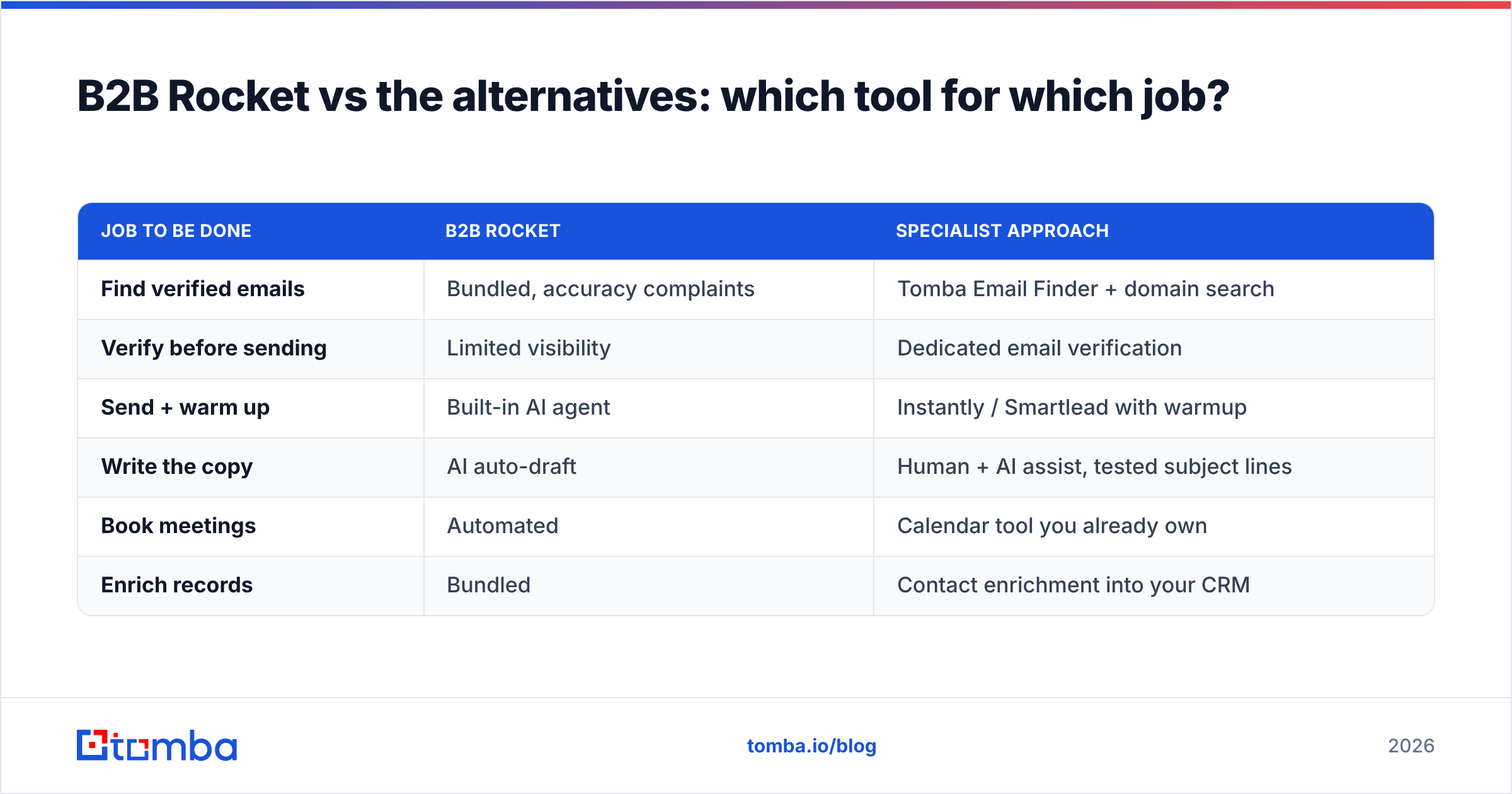
Because B2B Rocket bundles several functions, the fairest comparison is "what is the best tool for each job it tries to do." Most teams get better results assembling two or three specialists than buying one generalist.
| Job to be done | B2B Rocket | Specialist approach |
|---|---|---|
| Find verified emails | Bundled, accuracy complaints | Tomba Email Finder + domain search |
| Verify before sending | Limited visibility | Dedicated email verification |
| Send + warm up | Built-in AI agent | Instantly / Smartlead with warmup |
| Write the copy | AI auto-draft | Human + AI assist, tested subject lines |
| Book meetings | Automated | Calendar tool you already own |
| Enrich records | Bundled | Contact enrichment into your CRM |
The pattern is clear. B2B Rocket's strength is convenience; its weakness is that it is rarely the best at any single step. If your outbound is underperforming, the fix is almost never "more automation" — it is "better data and tighter targeting." You can feed verified leads from a bulk email finder into whatever sender you trust and keep full control over your domain reputation.
If you specifically want an AI-agent autopilot, B2B Rocket is a legitimate option in that category. Just go in knowing you are trading control for convenience.
Who should actually use B2B Rocket?#
Good fit:
- Solo founders or two-person teams with zero SDR capacity who need something running.
- Companies testing outbound as a channel before hiring reps.
- Teams that value one login over best-in-class results and have a domain they are willing to risk.
Poor fit:
- Teams that already own a CRM and sequencer and just need accurate contacts.
- Anyone in a high-deliverability-sensitivity situation (regulated industries, premium brands) where a spam-folder reputation hit is expensive.
- Data-driven RevOps teams who want to control verification, sender reputation, and segmentation themselves.
A simple test: if you cannot clearly state your ICP and your messaging in one paragraph, an AI agent will amplify that fuzziness, not fix it. Nail your targeting and your data first, then decide whether you even need the agent layer.
What is the smarter 2026 stack?#
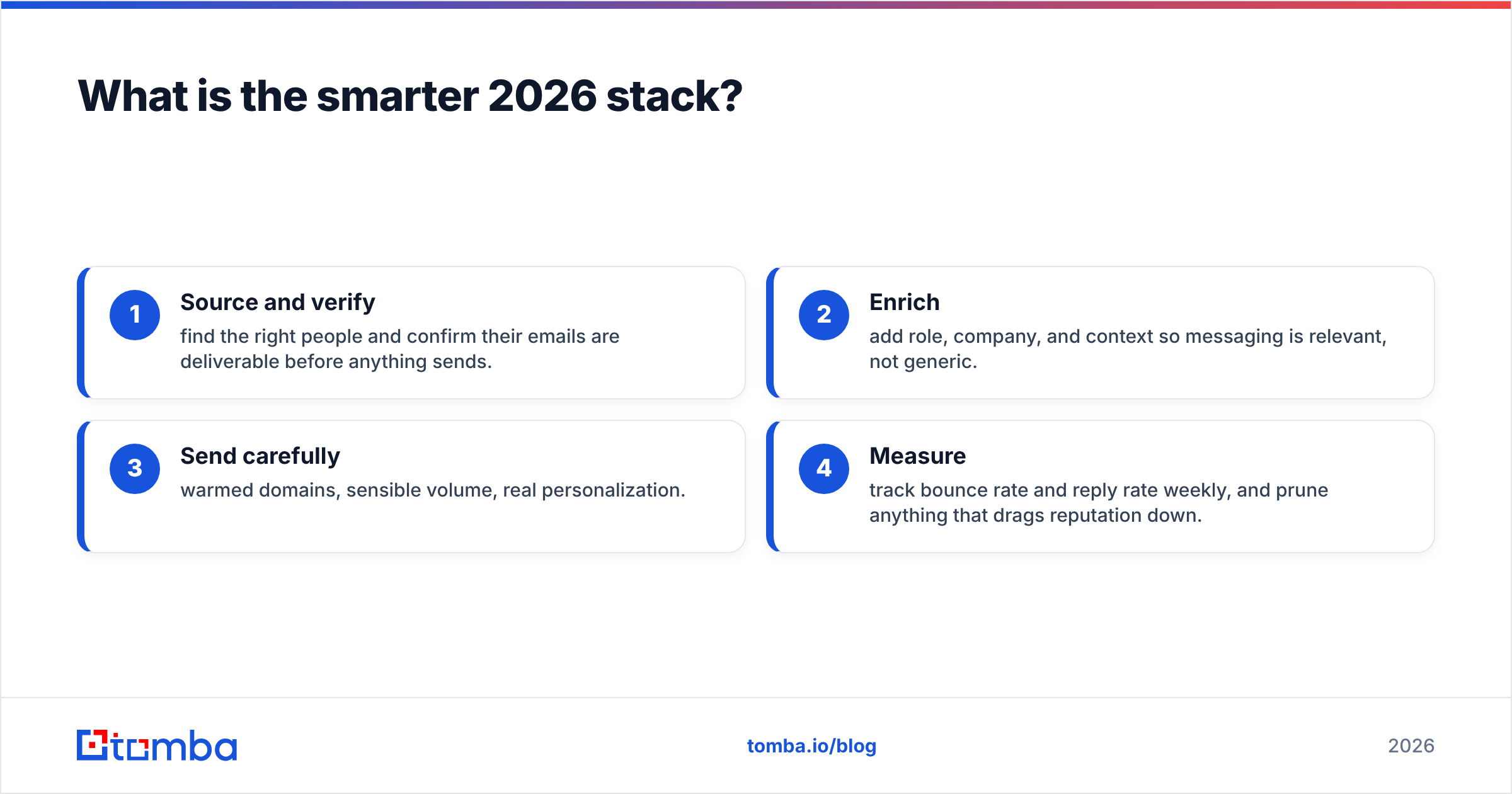
The teams winning at outbound in 2026 are not the ones with the most AI. They are the ones with the cleanest data and the most disciplined sending. A practical, control-first stack looks like this:
- Source and verify — find the right people and confirm their emails are deliverable before anything sends.
- Enrich — add role, company, and context so messaging is relevant, not generic.
- Send carefully — warmed domains, sensible volume, real personalization.
- Measure — track bounce rate and reply rate weekly, and prune anything that drags reputation down.
Notice that "buy an AI agent" is not step one. The agent is optional; the clean data is not. You can run this entire stack with specialized tools and keep every lever in your own hands — which is exactly what most disappointed B2B Rocket reviewers wish they had done from the start.
The bottom line on B2B Rocket reviews#
B2B Rocket is a competent all-in-one AI SDR platform that works best for tiny teams who value convenience over control and can tolerate variable data quality. The recurring complaints — bounces, generic copy, deliverability risk, annual lock-in — all flow from the same root cause: when one tool owns finding, verifying, writing, and sending, you inherit its weakest link everywhere.
If your real problem is "I need accurate contacts I can trust," you do not need an autopilot — you need a precision data engine. Start free with the Tomba Email Finder: find professional emails by name, domain, or company, verify them before they ever hit a sequence, and feed clean leads into whatever sending stack you already love. No annual contract, no black box, no betting your domain reputation on someone else's list. Grab 25 free searches a month and see how much your bounce rate drops when the data is finally right.
Ready to find emails that actually work?
Join 150,000+ professionals who stopped guessing and started sending. Free credits on signup — no credit card required.
Get the Tomba newsletter
Practical outbound tactics and product updates — once every two weeks.
About the author