B2B Rocket vs DiscoverOrg 2026: Which Sales Tool Wins?
B2B Rocket sells AI sales agents; DiscoverOrg sells B2B data (now ZoomInfo). Here's an honest 2026 breakdown of pricing, data, fit, and a leaner third option.
You typed "B2B Rocket vs DiscoverOrg" into a search bar expecting two products in the same category. They aren't. One is an AI agent that runs outbound for you; the other is a legacy B2B database brand that got swallowed by ZoomInfo years ago. Comparing them fairly means first untangling what each one actually is in 2026 — then deciding which problem you're solving.
TL;DR#
- B2B Rocket is an AI sales-agent platform: it prospects, emails, qualifies, and books meetings on autopilot. It's a motion, not a database.
- DiscoverOrg is no longer a standalone product. It was merged into ZoomInfo after the 2019 acquisition; "DiscoverOrg" today usually means ZoomInfo's data — premium, accurate, and expensive.
- These tools rarely compete head-to-head. You'd pick B2B Rocket to automate outreach and DiscoverOrg/ZoomInfo to source contact data.
- Both lock you into annual contracts and four- to five-figure spend. Neither has a meaningful free tier.
- If your core need is accurate, affordable contact data with month-to-month flexibility, a focused tool like Tomba covers the data layer at a fraction of the cost.
What is B2B Rocket?#
B2B Rocket is an AI sales-automation platform built around autonomous "AI agents." You define an ideal customer profile, plug in messaging, and the agent identifies prospects, sends personalized cold emails, handles replies, and schedules qualified meetings into your calendar. The pitch is replacing a chunk of the SDR function with software.
Think of it like hiring a tireless junior rep who never sleeps, never forgets a follow-up, and works for a flat monthly fee. The trade-off is the same as any junior rep: the output is only as good as the data and the script you hand it. If the underlying contact list is stale, the agent just sends polished emails to dead inboxes faster.
B2B Rocket bundles lead sourcing, an AI writer, email sending, and a meeting scheduler. That all-in-one convenience is the draw — and also the risk, because you're trusting one vendor for data quality, deliverability, and automation at once.
What is DiscoverOrg (and why people still search for it)?#
DiscoverOrg was one of the original premium B2B intelligence databases, known for human-verified org charts, direct dials, and deep technographic data aimed at enterprise sales teams. In 2019 DiscoverOrg acquired ZoomInfo and adopted the ZoomInfo brand. So when you evaluate "DiscoverOrg" in 2026, you're really evaluating ZoomInfo's data platform.
That history matters for two reasons. First, the data pedigree is genuinely strong — this is enterprise-grade intelligence. Second, the pricing and contract model reflect that legacy: annual commitments, seat-based licensing, and quotes that routinely land in five figures. You're buying depth, and you're paying enterprise rates for it.
DiscoverOrg/ZoomInfo is a data company. It does not run your outbound for you. You export contacts, push them into your CRM or sequencer, and your reps (or a tool like B2B Rocket) do the sending.
B2B Rocket vs DiscoverOrg: how do they actually compare?#
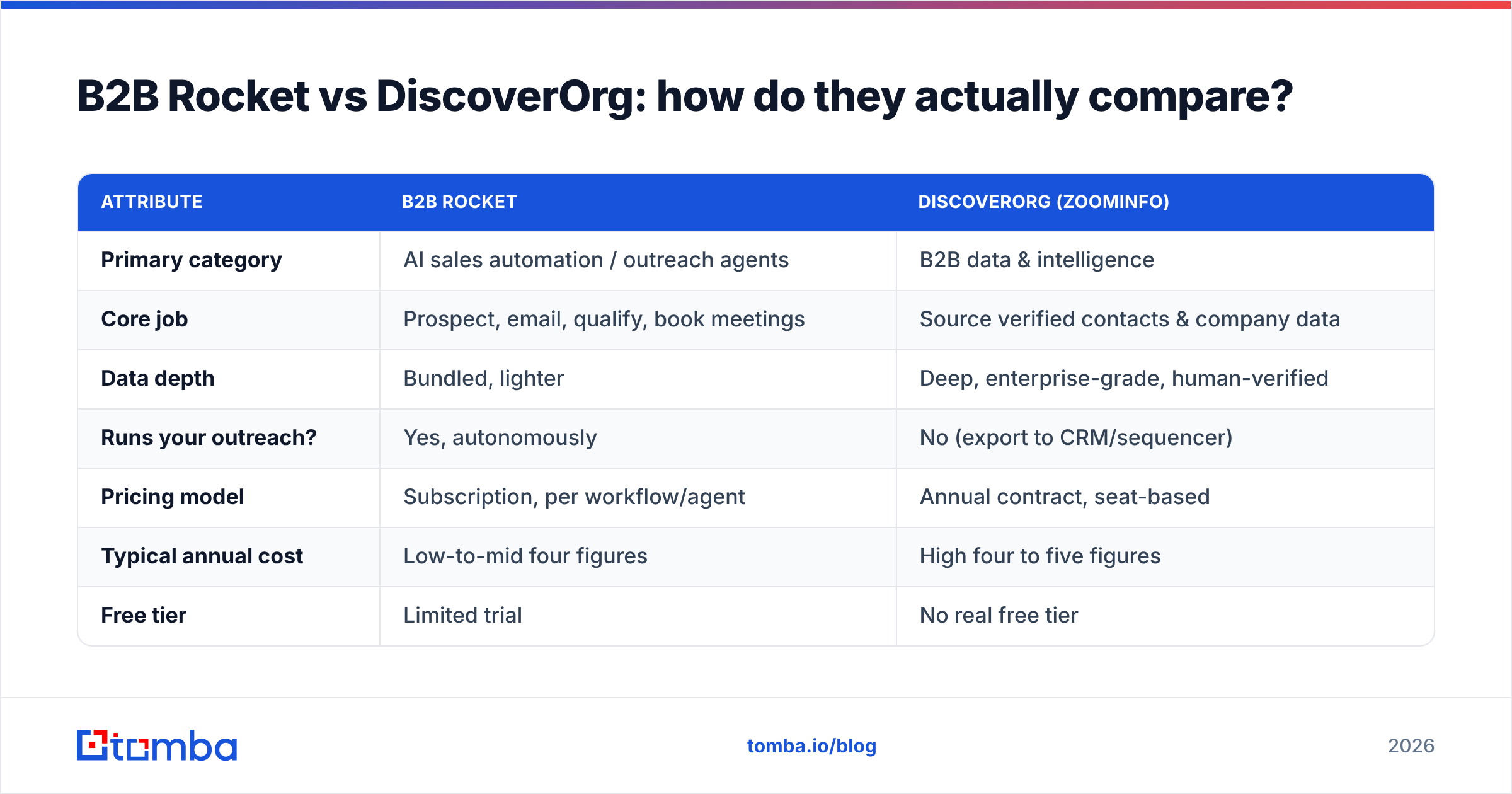
Here's the honest side-by-side. Note that they sit in different categories — automation versus data — which is exactly why most teams end up needing one of each, not one or the other.
| Attribute | B2B Rocket | DiscoverOrg (ZoomInfo) |
|---|---|---|
| Primary category | AI sales automation / outreach agents | B2B data & intelligence |
| Core job | Prospect, email, qualify, book meetings | Source verified contacts & company data |
| Data depth | Bundled, lighter | Deep, enterprise-grade, human-verified |
| Runs your outreach? | Yes, autonomously | No (export to CRM/sequencer) |
| Pricing model | Subscription, per workflow/agent | Annual contract, seat-based |
| Typical annual cost | Low-to-mid four figures | High four to five figures |
| Free tier | Limited trial | No real free tier |
| Best for | SMBs automating SDR work | Enterprise data & account intelligence |
| Contract flexibility | More flexible | Annual lock-in |
The pattern is clear: B2B Rocket competes with sequencers and AI SDR tools; DiscoverOrg competes with data providers. Searching one against the other usually means you haven't yet decided whether your bottleneck is doing the outreach or knowing who to reach.

Which one fits your outbound motion?#
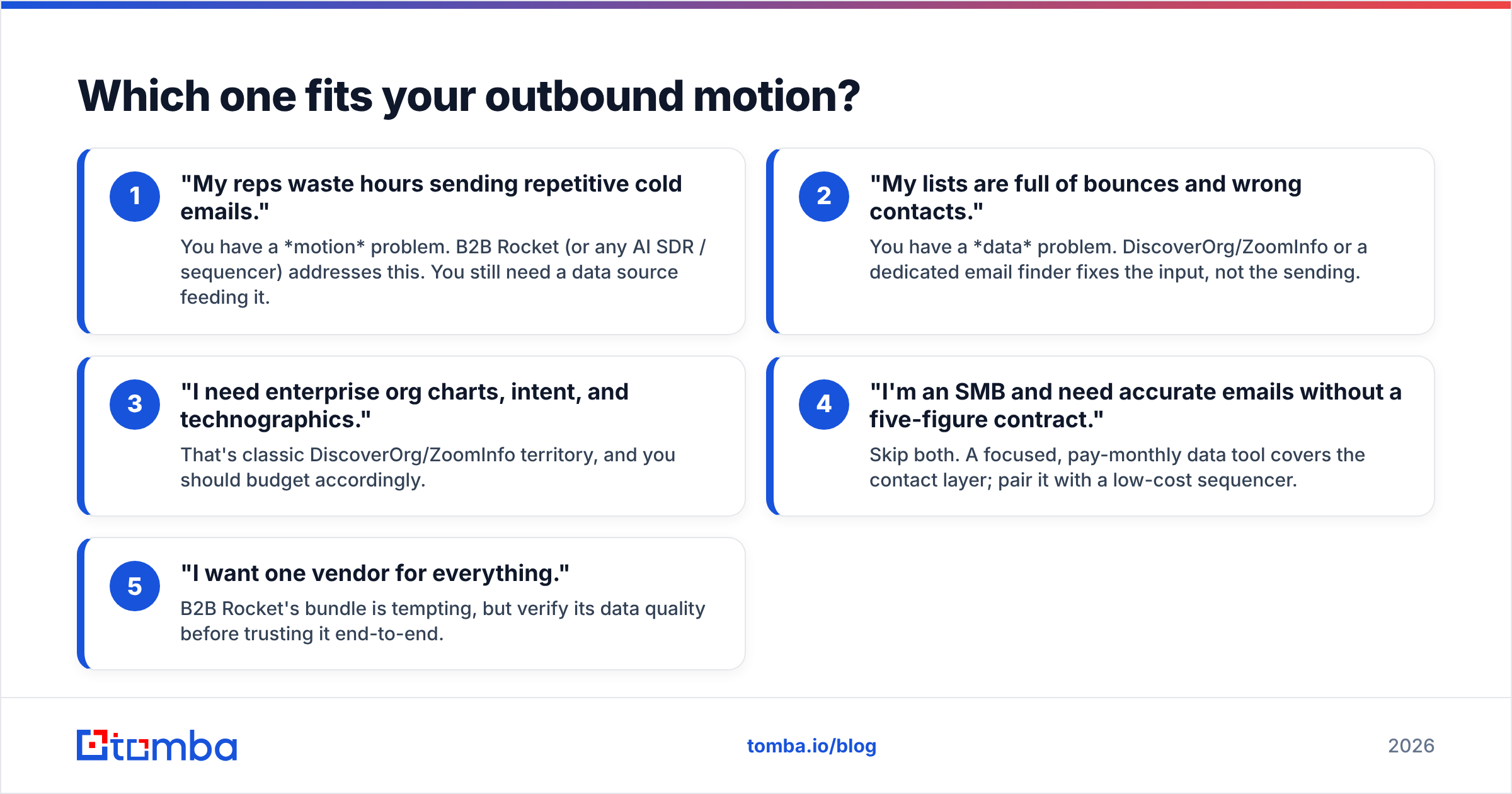
Use this quick decision framework instead of a feature checklist. Match the row that sounds most like your team.
- "My reps waste hours sending repetitive cold emails." — You have a motion problem. B2B Rocket (or any AI SDR / sequencer) addresses this. You still need a data source feeding it.
- "My lists are full of bounces and wrong contacts." — You have a data problem. DiscoverOrg/ZoomInfo or a dedicated email finder fixes the input, not the sending.
- "I need enterprise org charts, intent, and technographics." — That's classic DiscoverOrg/ZoomInfo territory, and you should budget accordingly.
- "I'm an SMB and need accurate emails without a five-figure contract." — Skip both. A focused, pay-monthly data tool covers the contact layer; pair it with a low-cost sequencer.
- "I want one vendor for everything." — B2B Rocket's bundle is tempting, but verify its data quality before trusting it end-to-end.
Most teams discover they need a clean data layer plus a sending layer. The mistake is paying enterprise prices for both when your volume doesn't justify it.
How much do B2B Rocket and DiscoverOrg cost in 2026?#
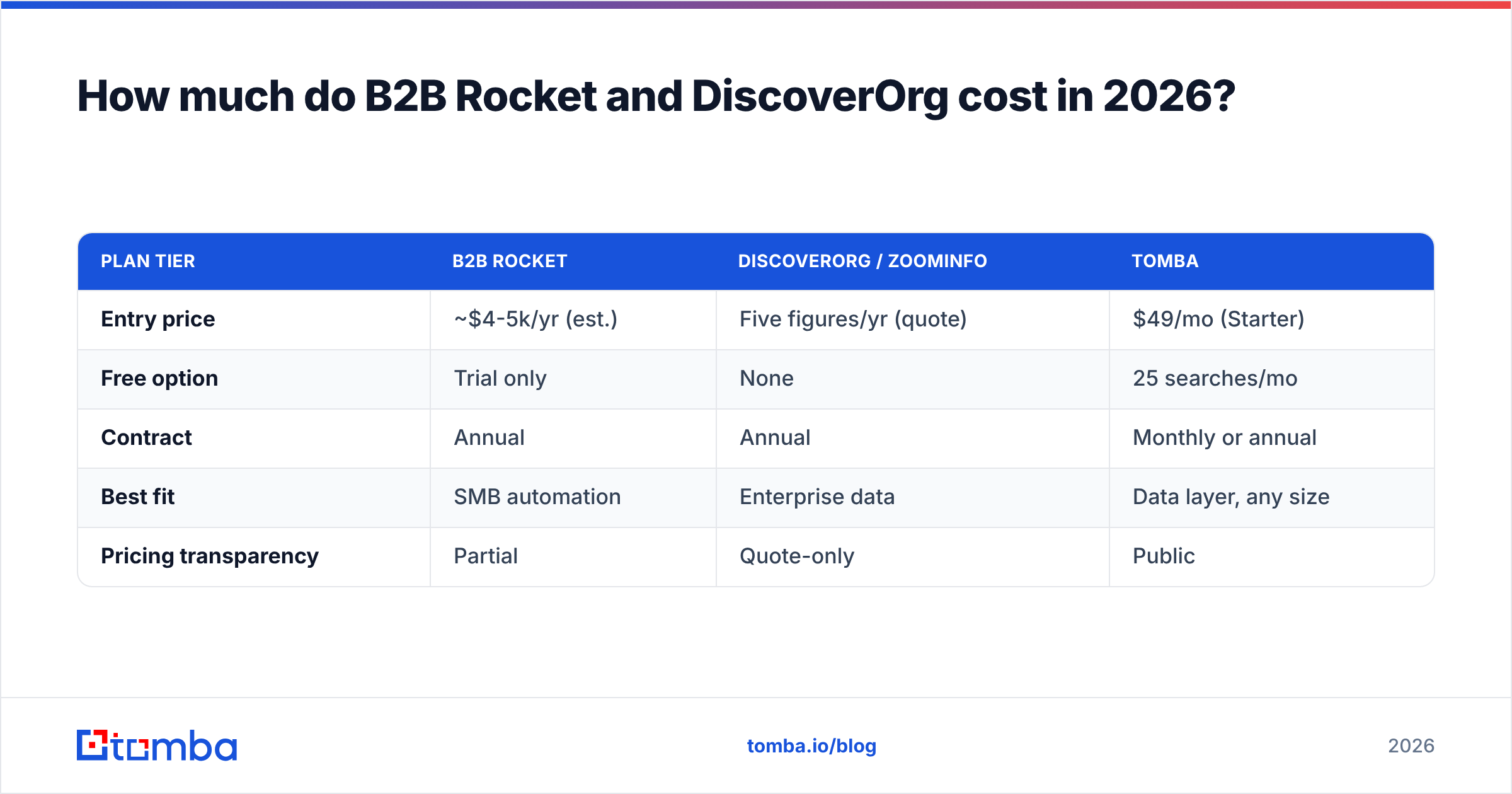
Neither vendor publishes fully transparent enterprise pricing, and both lean on annual contracts. B2B Rocket markets subscription tiers that start in the low-to-mid four figures per year depending on agent count and volume. DiscoverOrg/ZoomInfo quotes are negotiated, seat-based, and commonly start around five figures annually for a small team — more once you add intent data, integrations, or credits.
The hidden cost in both cases is commitment. Annual lock-in means you're paying through slow quarters, and ramping seats is a renewal conversation, not a toggle. For a lean team testing outbound, that's a heavy bet to place before you've proven the channel.
This is where a transparent, month-to-month data tool changes the math. Tomba pricing runs Free (25 searches/mo), Starter at $49/mo, Growth at $99/mo, and Pro at $249/mo — no annual handcuffs, no sales call to see a number.
| Plan tier | B2B Rocket | DiscoverOrg / ZoomInfo | Tomba |
|---|---|---|---|
| Entry price | ~$4-5k/yr (est.) | Five figures/yr (quote) | $49/mo (Starter) |
| Free option | Trial only | None | 25 searches/mo |
| Contract | Annual | Annual | Monthly or annual |
| Best fit | SMB automation | Enterprise data | Data layer, any size |
| Pricing transparency | Partial | Quote-only | Public |
What about data accuracy and deliverability?#
Accuracy is where bundled automation tools get exposed. An AI agent that fires 500 emails a day against unverified addresses will torch your sender reputation and land you in spam — fast. DiscoverOrg/ZoomInfo earns its premium largely because the underlying data is human-verified and refreshed, which keeps bounce rates low.
If you go the bundled route with B2B Rocket, treat its data as input to be validated, not gospel. Run new lists through an email verifier before any agent starts sending, and check catch-all domains separately, since those quietly inflate "valid" counts and bounce later.
The principle holds regardless of vendor: verify before you send. A clean list of 1,000 beats a noisy list of 10,000 every time, because deliverability compounds. One spam-trap hit can suppress an entire domain's inbox placement for weeks.
Is there a leaner alternative to both?#
Yes — if your real bottleneck is contact data rather than automation, you don't need a five-figure platform or a black-box AI agent. You need accurate emails, on demand, that you control.
Tomba is built around exactly that data layer. Its core is the Tomba Email Finder, backed by a domain search for finding every reachable contact at a company, plus data enrichment to fill in titles, companies, and social profiles on lists you already have. You pull verified contacts, then feed them into whatever sequencer or AI agent you prefer — including B2B Rocket, if you like its automation but not its data.
That separation is the point. Pairing a dedicated data tool with a dedicated sending tool gives you accuracy and flexibility, instead of betting your reputation on one vendor's weakest layer. It also keeps you off annual contracts while you're still proving the channel.
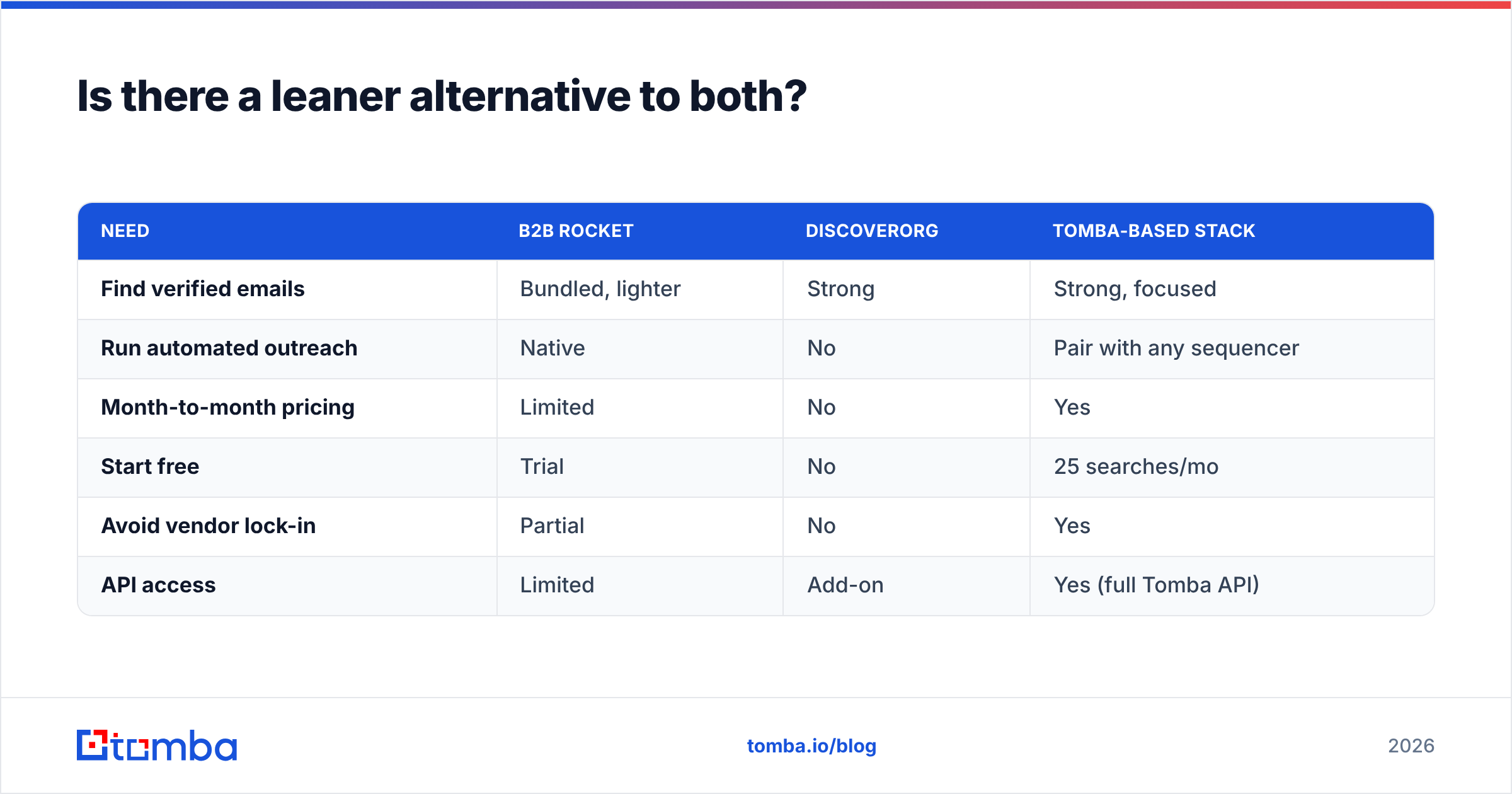
Here's how a Tomba-anchored data stack lines up against the two incumbents:
| Need | B2B Rocket | DiscoverOrg | Tomba-based stack |
|---|---|---|---|
| Find verified emails | Bundled, lighter | Strong | Strong, focused |
| Run automated outreach | Native | No | Pair with any sequencer |
| Month-to-month pricing | Limited | No | Yes |
| Start free | Trial | No | 25 searches/mo |
| Avoid vendor lock-in | Partial | No | Yes |
| API access | Limited | Add-on | Yes (full Tomba API) |
For teams that live in spreadsheets or a CRM, Tomba also plugs into the tools you already use — there's a HubSpot integration, a Google Sheets add-on, and a Chrome extension — so the data layer fits your workflow instead of replacing it.
Frequently asked questions#
Is DiscoverOrg the same as ZoomInfo? Effectively yes. DiscoverOrg acquired ZoomInfo in 2019 and rebranded under the ZoomInfo name. When you evaluate "DiscoverOrg" today, you're evaluating ZoomInfo's data platform. You can confirm current capabilities on the official ZoomInfo site or via reviews on G2.
Does B2B Rocket replace a data provider? Partially. It bundles lead sourcing, but the depth and verification standards differ from a dedicated data company. If accuracy matters, validate its lists with a separate verifier before sending.
Can I use B2B Rocket and a data tool together? Yes, and many teams do. Source and verify contacts with a focused data tool, then hand the clean list to B2B Rocket's agent for outreach. You get better data and automation.
Which is cheaper? For pure contact data, a transparent tool like Tomba (from $49/mo) undercuts both. B2B Rocket is cheaper than DiscoverOrg/ZoomInfo for automation, but you still need a data source feeding it.
Do either offer a free trial? B2B Rocket offers a limited trial; DiscoverOrg/ZoomInfo generally does not have a real free tier. Tomba offers a permanent free plan with 25 searches per month.
The bottom line#
B2B Rocket and DiscoverOrg aren't really rivals — one automates the sending, the other supplies the data. Decide which bottleneck is actually hurting you before you sign anything, because the wrong choice means paying enterprise rates for a problem you don't have.
If your gap is clean, accurate contact data without a five-figure annual contract, start with the Tomba Email Finder. Pull verified emails on the free plan, enrich what you already have, and feed a clean list into whatever outreach engine you choose. You keep control of your data layer, your reputation, and your budget — and you can always add automation on top once the channel proves itself.
Ready to find emails that actually work?
Join 150,000+ professionals who stopped guessing and started sending. Free credits on signup — no credit card required.
Get the Tomba newsletter
Practical outbound tactics and product updates — once every two weeks.
About the author