B2B Rocket vs Jeeva AI (2026): AI SDR Tools Compared
B2B Rocket vs Jeeva AI in 2026: an honest breakdown of AI SDR features, pricing, data quality, and which autonomous prospecting tool actually books meetings.
Both B2B Rocket and Jeeva AI promise the same thing: an autonomous AI "SDR" that finds prospects, writes outreach, and books meetings while you sleep. The pitch is seductive. The reality is more nuanced — and the tool you pick matters less than the data you feed it.
This is a neutral, hands-on comparison for sales and RevOps teams evaluating AI sales agents in 2026. We'll cover what each tool actually does, where pricing lands, how their data holds up, and the one variable that quietly decides whether either platform works at all.
TL;DR#
- B2B Rocket is a full-stack autonomous prospecting platform: AI agents that source leads, qualify, and run multi-step email + LinkedIn campaigns end to end.
- Jeeva AI positions itself as a fleaner, AI-native SDR suite with strong intent signals, inbox management, and a faster setup curve for smaller teams.
- Pricing favors Jeeva AI at the entry level; B2B Rocket scales better for high-volume outbound but gets expensive fast.
- Neither tool is a data company. Both rely on bundled or third-party contact data, and stale data is the #1 reason AI SDRs underperform.
- Best move for most teams: pair whichever agent you prefer with a dedicated, accurate email finder and email verifier so your AI isn't emailing dead inboxes.
What is B2B Rocket?#
B2B Rocket is an autonomous AI agent platform built around the idea of a "set it and forget it" sales rep. You define an ideal customer profile, connect your sending accounts, and the platform's agents handle sourcing, personalization, sending, reply handling, and meeting scheduling.
Its strength is breadth. B2B Rocket tries to own the entire top-of-funnel motion in one workflow, which appeals to founders and lean teams who don't want to stitch together five tools. The AI auto-responds to replies, qualifies interest, and pushes booked meetings to your calendar.
The trade-off is control. When one engine does everything, you have fewer levers to tune deliverability, segment messaging, or audit why a campaign flatlined. Power users often want more granular sequencing than an all-in-one agent exposes.
What is Jeeva AI?#
Jeeva AI is a newer, AI-native sales platform marketed around a roster of specialized "AI employees" — an AI SDR, an AI inbound rep, an AI researcher, and so on. The product leans on intent data and signal-based prospecting to decide who to contact and when, not just how to write the email.
Jeeva's appeal is speed and focus. Onboarding is generally lighter, the UI is cleaner, and the emphasis on signals (job changes, funding, hiring, tech installs) means you're theoretically reaching people at the right moment. For smaller GTM teams that want a modern AI sales technology layer without enterprise complexity, it's an easy on-ramp.
The trade-off is maturity. As a younger platform, its integration catalog and reporting depth are still filling out, and signal coverage varies by industry.
/blog/generated/memes/2026-06-17/b2b-rocket-vs-jeeva-ai-meme-1.png
B2B Rocket vs Jeeva AI: how do they compare?#
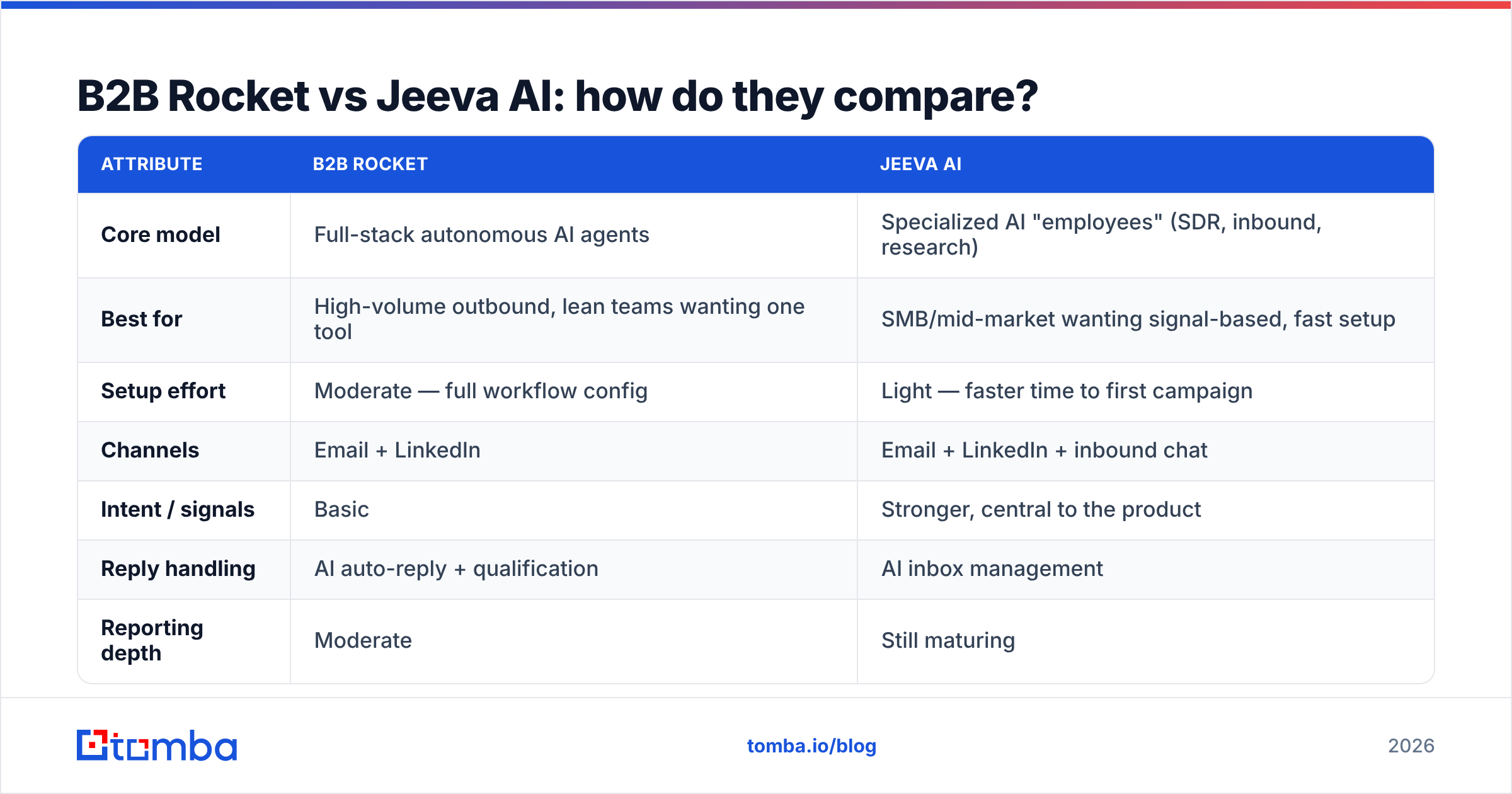
Here's the head-to-head on the attributes that actually change your outcomes. Treat exact prices as directional — both vendors run usage-based and custom tiers, so confirm on their sites before you buy.
| Attribute | B2B Rocket | Jeeva AI |
|---|---|---|
| Core model | Full-stack autonomous AI agents | Specialized AI "employees" (SDR, inbound, research) |
| Best for | High-volume outbound, lean teams wanting one tool | SMB/mid-market wanting signal-based, fast setup |
| Setup effort | Moderate — full workflow config | Light — faster time to first campaign |
| Channels | Email + LinkedIn | Email + LinkedIn + inbound chat |
| Intent / signals | Basic | Stronger, central to the product |
| Reply handling | AI auto-reply + qualification | AI inbox management |
| Reporting depth | Moderate | Still maturing |
| Entry pricing | Higher, scales with volume | Lower entry point |
| Data included | Bundled contact data | Bundled + intent data |
| Data accuracy control | Limited (closed pipeline) | Limited (closed pipeline) |
Where each one wins#
- Pick B2B Rocket if you want maximum automation across a large prospect volume and you're comfortable trading granular control for a single, hands-off pipeline.
- Pick Jeeva AI if you're a smaller team that values intent timing, a clean UI, and a faster path from signup to first booked meeting.
- Pick neither (yet) if your CRM is full of unverified contacts — an AI SDR pointed at bad data just burns your domain reputation faster.
- Pick both, briefly, if you can run a 2–4 week paid pilot on the same list and compare reply and meeting rates directly. That bake-off beats any review, including this one.
Is B2B Rocket better than Jeeva AI?#
Neither is universally "better" — they optimize for different buyers. B2B Rocket optimizes for volume and autonomy. Jeeva AI optimizes for timing and simplicity.
If you measure success purely by meetings booked per dollar at scale, B2B Rocket's all-in-one engine can win once you're sending thousands of touches a month. If you measure by reply quality and speed-to-value on a smaller, targeted list, Jeeva AI's signal-first approach often produces warmer conversations.
But here's the uncomfortable truth both vendors gloss over: the AI is the easy part now. Large language models write competent cold emails. What separates a campaign that books meetings from one that lands in spam is deliverability and data accuracy — and that's mostly upstream of either tool.
Why does data quality decide the winner?#
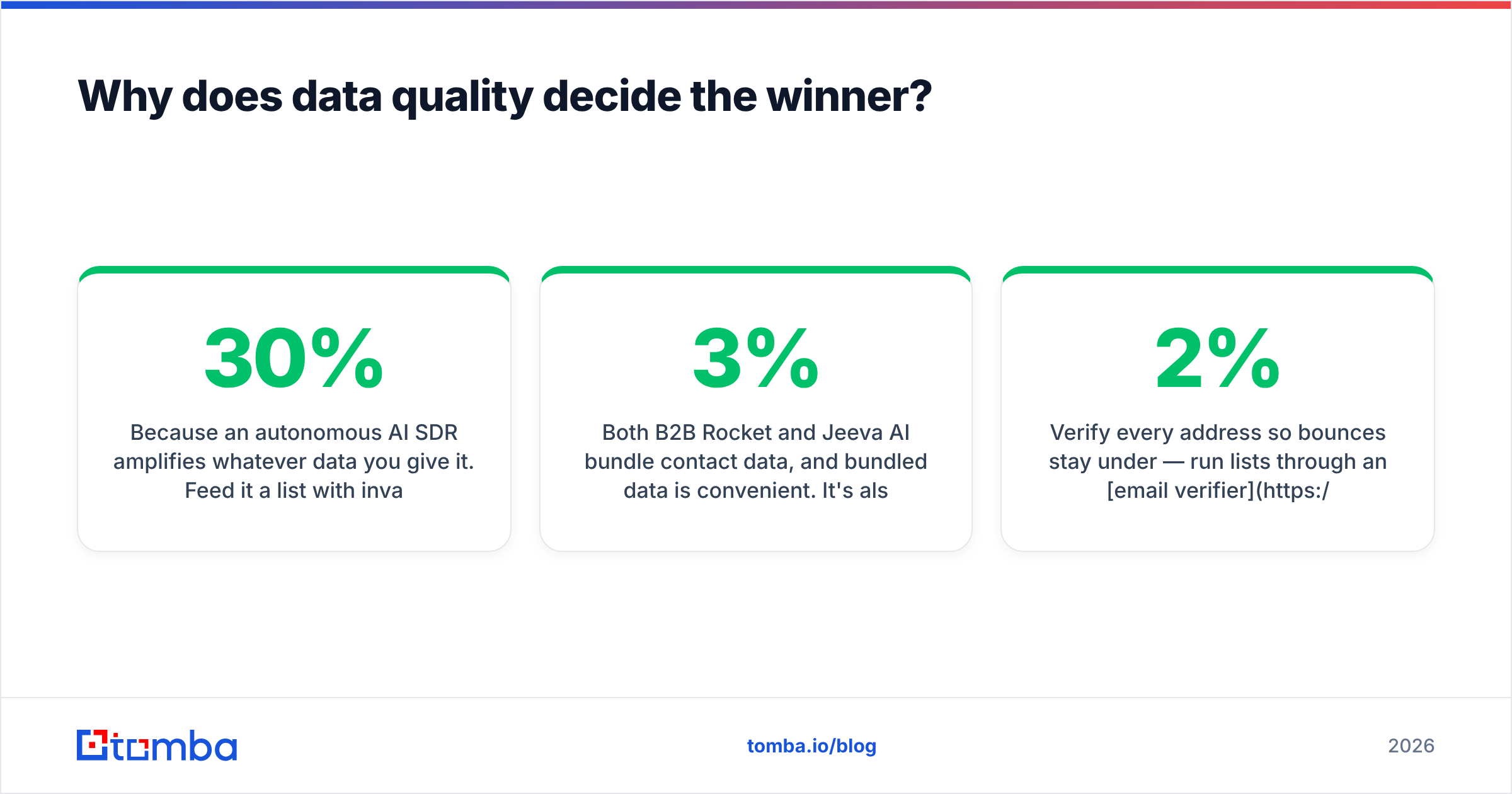
Because an autonomous AI SDR amplifies whatever data you give it. Feed it a list with 30% invalid emails and it will faithfully send to all of them — torching your sender reputation and getting your domain flagged before a single good prospect replies.
Both B2B Rocket and Jeeva AI bundle contact data, and bundled data is convenient. It's also a black box: you rarely know the source, the last-verified date, or the bounce rate before you hit send. According to email service providers, bounce rates above 2–3% start damaging deliverability, and AI tools sending at volume hit that ceiling fast on unverified lists.
/blog/generated/memes/2026-06-17/b2b-rocket-vs-jeeva-ai-meme-2.png
This is where a dedicated data layer earns its keep. Before any AI agent touches a contact, you want to:
- Find the right email with a tool that exposes confidence scores and sources, like Tomba's email finder.
- Verify every address so bounces stay under 2% — run lists through an email verifier first.
- Check catch-all domains that silently accept everything, using a catch-all verifier, so you're not flying blind on "valid-looking" addresses.
- Enrich the record with firmographics and role data via data enrichment so personalization is real, not guessed.
Do that, and either AI SDR performs dramatically better. Skip it, and the slickest agent on the market still emails ghosts.
How much do B2B Rocket and Jeeva AI cost?#
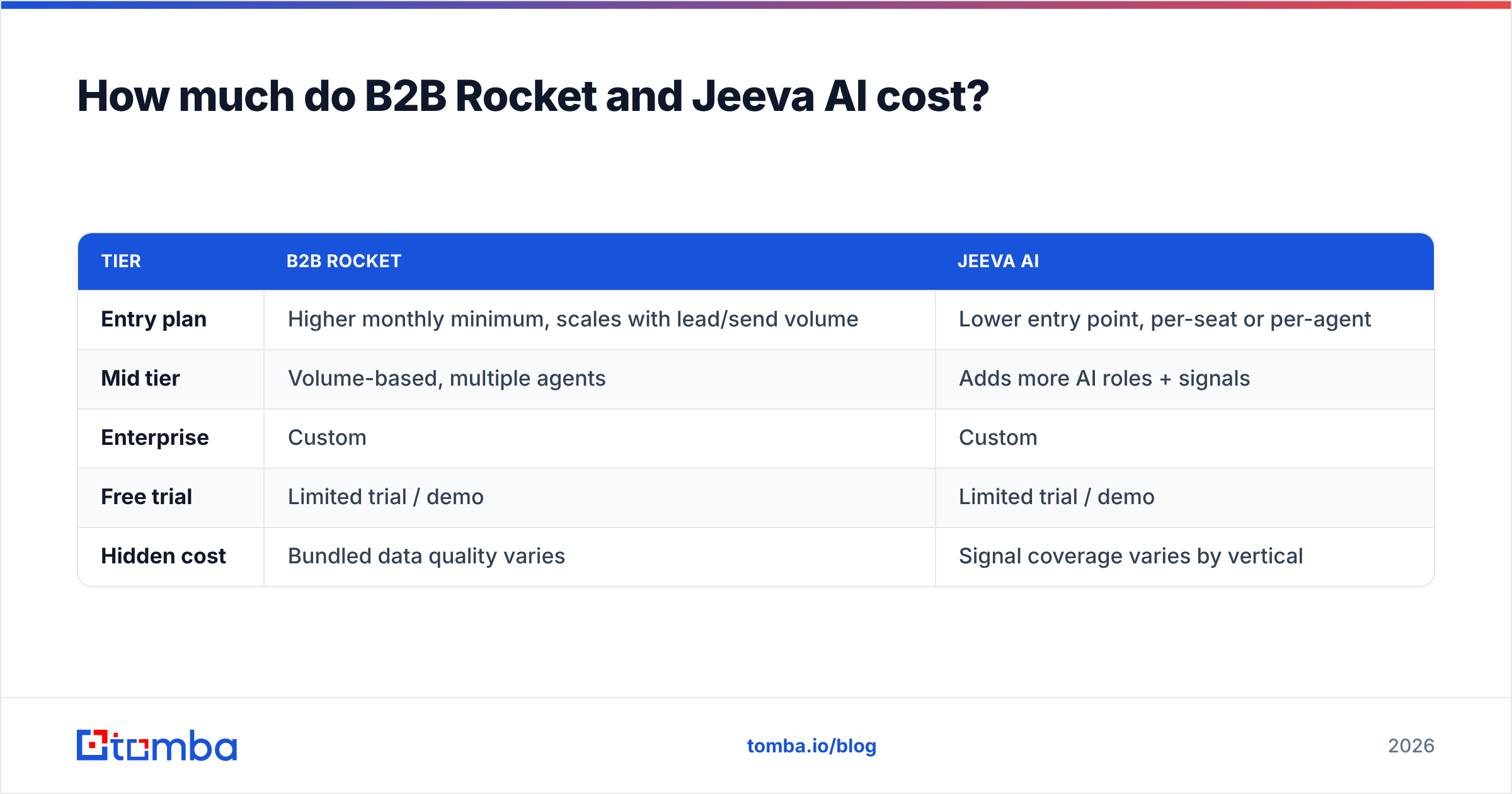
Both use tiered, usage-influenced pricing, and both push custom enterprise quotes. As a rough framing:
| Tier | B2B Rocket | Jeeva AI |
|---|---|---|
| Entry plan | Higher monthly minimum, scales with lead/send volume | Lower entry point, per-seat or per-agent |
| Mid tier | Volume-based, multiple agents | Adds more AI roles + signals |
| Enterprise | Custom | Custom |
| Free trial | Limited trial / demo | Limited trial / demo |
| Hidden cost | Bundled data quality varies | Signal coverage varies by vertical |
The number to watch isn't the sticker price — it's cost per booked meeting after bounces and spam losses. A cheaper tool that wastes 25% of its sends on dead inboxes is more expensive than a pricier one running on verified data. Compare that against a transparent data stack: Tomba's pricing starts free (25 searches/mo), with Starter at $49/mo and Growth at $99/mo, so verification rarely becomes the budget bottleneck.
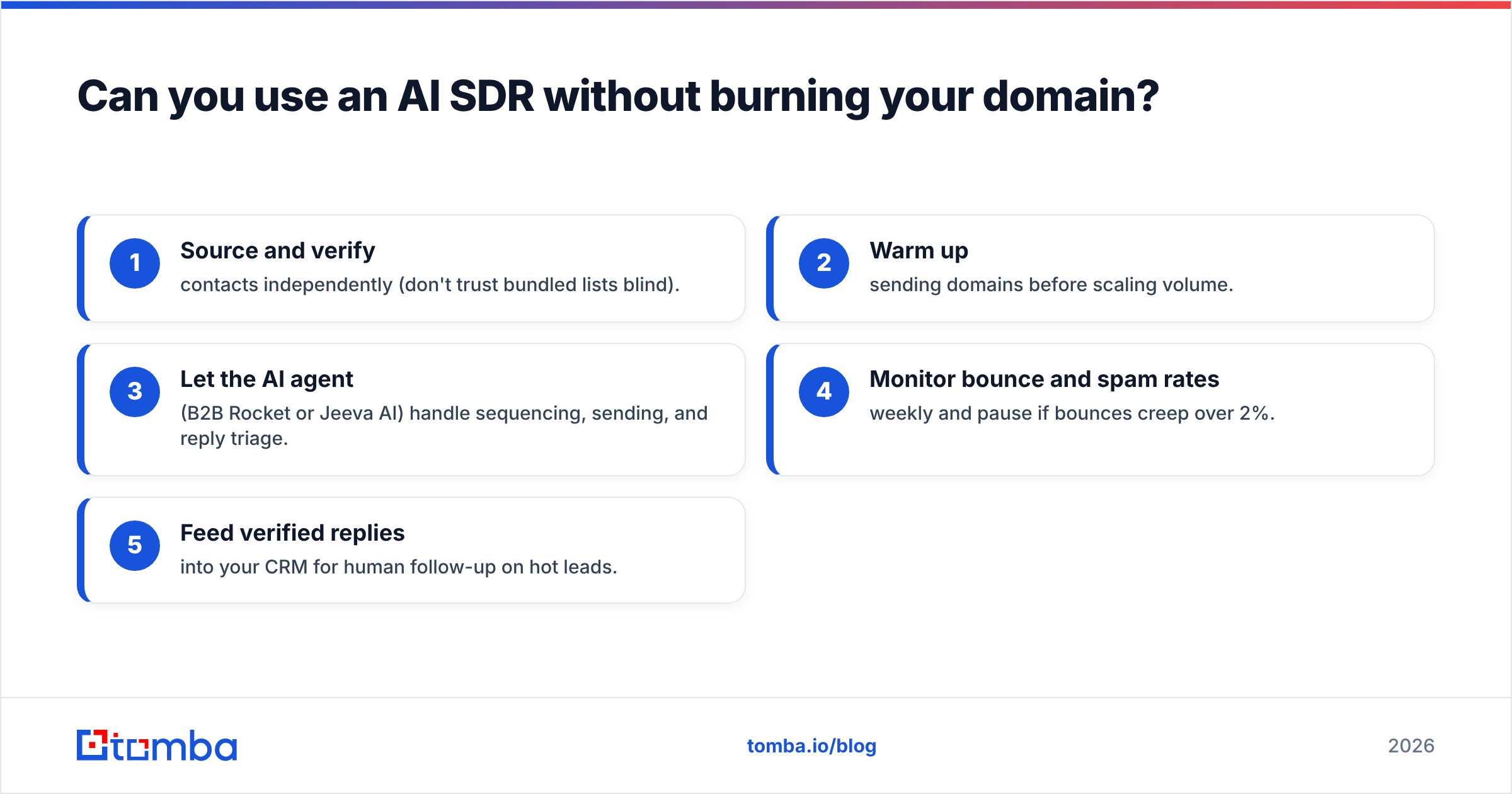
Can you use an AI SDR without burning your domain?#
Yes — if you treat the AI agent as the execution layer and keep data and deliverability as separate, controlled inputs. A reliable stack looks like this:
- Source and verify contacts independently (don't trust bundled lists blind).
- Warm up sending domains before scaling volume.
- Let the AI agent (B2B Rocket or Jeeva AI) handle sequencing, sending, and reply triage.
- Monitor bounce and spam rates weekly and pause if bounces creep over 2%.
- Feed verified replies into your CRM for human follow-up on hot leads.
This hybrid model is why many teams use an AI SDR and a standalone data provider rather than relying on one all-in-one black box. You can also pull verified contacts straight into your workflow with the bulk email finder or wire it into your sequencing tool through the Tomba API.
For broader context on how autonomous agents are reshaping pipeline generation, vendor-neutral resources like G2's sales AI category and HubSpot's sales research are worth scanning before you commit. And if you want the academic grounding on how these systems work, Wikipedia's overview of AI agents is a clean primer.
Which should you choose in 2026?#
Choose based on your motion, not the marketing:
- Lean team, high volume, hands-off: B2B Rocket. Let one engine run the funnel and accept less granular control.
- SMB/mid-market, timing-driven, fast start: Jeeva AI. Lean on intent signals and a cleaner setup.
- Either way: decouple your data. The AI agent is interchangeable; accurate, verified contact data is the durable advantage.
The vendors compete on AI sophistication, but in 2026 that's table stakes. The teams winning at outbound are the ones treating contact data as a first-class input — found, verified, and enriched before a single autonomous email goes out.
The bottom line#
B2B Rocket and Jeeva AI are both legitimate AI SDR platforms with real strengths: B2B Rocket for autonomous scale, Jeeva AI for signal-driven simplicity. Run a side-by-side pilot if you can, and pick the one whose control model matches how you sell.
Just don't make the mistake of judging either tool on a foundation of bad data. Before you point any AI agent at your list, run it through a dedicated email finder and verifier so every send hits a real, reachable inbox. Start free with Tomba's Email Finder — 25 searches a month, no card required — and give your AI SDR data it can actually convert.
// get started
Find, verify and enrich your first contacts today
Start on the free plan with 25 searches a month, then scale when your team is ready.
Free plan · No credit card required · GDPR & CCPA
// about the author