B2B Rocket vs ZoomInfo (2026): Which Sales Tool Wins?
B2B Rocket automates outreach with AI agents; ZoomInfo sells a massive contact database. Here's how the two compare on data, pricing, and fit in 2026.
You are comparing two tools that solve different halves of the same problem, and the marketing on both sites blurs that line. B2B Rocket is an AI-agent platform that runs outreach for you. ZoomInfo is a contact-and-company database you pull leads out of. Picking one over the other without understanding that split is how teams end up paying for software they never fully use.
This guide breaks down where each tool actually earns its price, where the overlap is thin, and what a leaner stack looks like in 2026.
TL;DR#
- B2B Rocket is an AI sales-automation platform: autonomous agents that find prospects, send sequences, and book meetings. You buy workflow, not raw data.
- ZoomInfo is an enterprise B2B data and intelligence platform. You buy coverage — contacts, intent signals, org charts — at an enterprise price (often $15K+/year).
- They overlap on lead sourcing but compete on almost nothing else: one automates the outreach, the other supplies the database.
- ZoomInfo wins on data depth and intent. B2B Rocket wins on hands-off execution for small teams. Neither is cheap, and both lock you into annual contracts.
- If your real bottleneck is just accurate contact data, a focused email finder plus an outreach tool beats paying enterprise rates for features you won't touch.
What is B2B Rocket?#
B2B Rocket is an AI-driven sales automation platform built around "AI agents" that handle the top of your funnel end to end. You define an ideal customer profile, the agent identifies matching prospects, personalizes a message, runs the email sequence, handles replies, and schedules qualified meetings into your calendar.
The pitch is autonomy. Instead of stitching together a data tool, a sequencer, and an SDR's time, you hand the whole motion to software. For a founder-led sales team or a lean startup without dedicated SDRs, that's genuinely appealing — the agent works nights and weekends and never forgets a follow-up.
The trade-off is control and data quality. B2B Rocket's prospect data is good enough to power outreach, but it isn't a research-grade database. You're trusting the agent's targeting and its email-deliverability hygiene, and AI personalization at scale can still read as templated if you don't supervise it.

What is ZoomInfo?#
ZoomInfo is the incumbent enterprise B2B data platform. Its core asset is one of the largest commercial contact-and-company databases on the market, layered with intent data (who's researching your category right now), technographics, org charts, and scoops on company changes.
Sales and marketing teams use ZoomInfo to build target lists, enrich their CRM, and time outreach around buying signals. It integrates deeply with Salesforce, HubSpot, Outreach, and the rest of the enterprise stack.
The catch is well documented: pricing is opaque, contracts are annual and steep (commonly $15,000–$40,000+ per year depending on seats and modules), and the value only materializes if you're running enough volume to justify it. For a five-person team, most of that platform sits idle.
B2B Rocket vs ZoomInfo: how do they compare?#
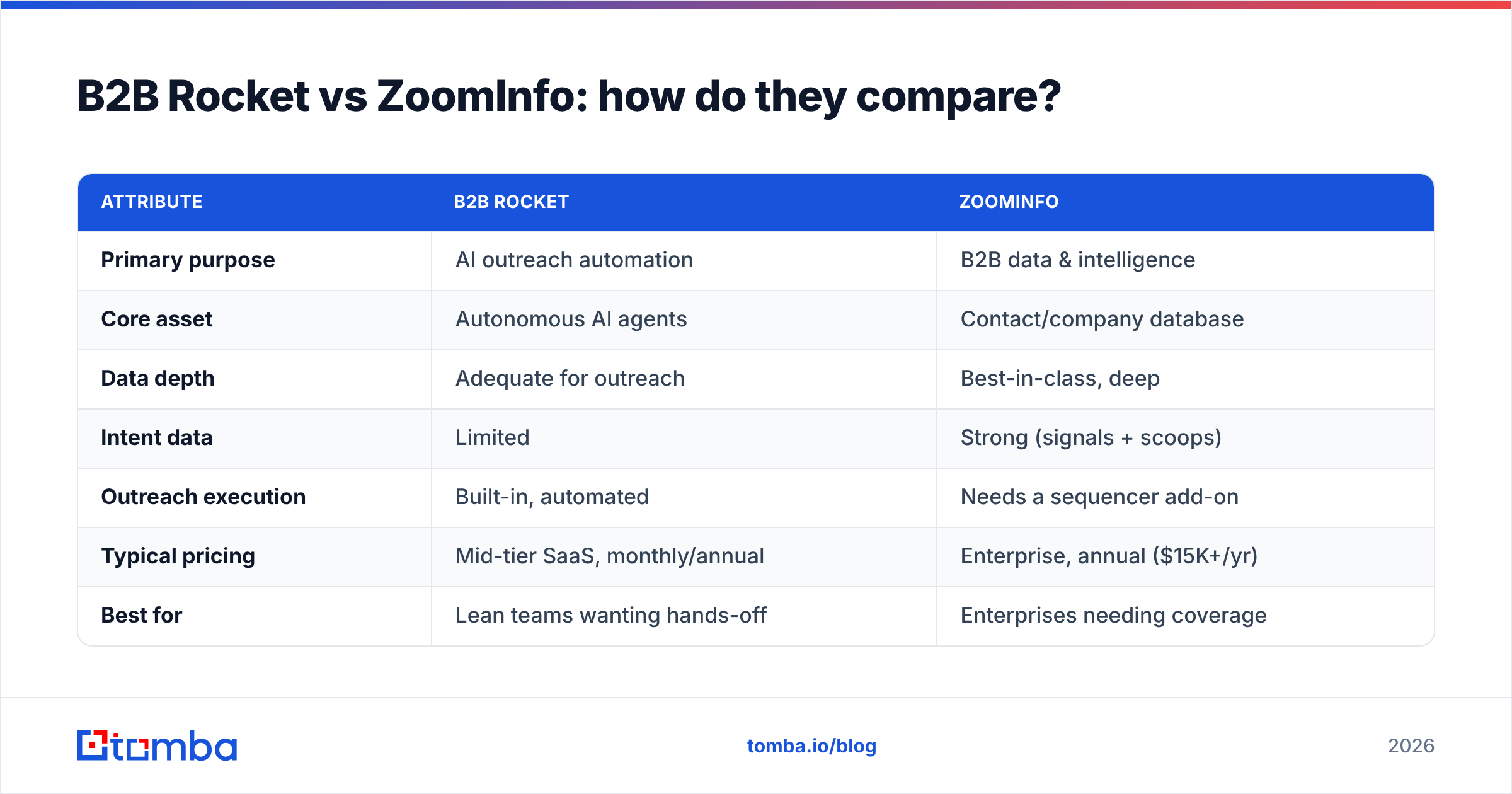
Here's the core split. Read it as "what am I actually buying," not "which logo is bigger."
| Attribute | B2B Rocket | ZoomInfo |
|---|---|---|
| Primary purpose | AI outreach automation | B2B data & intelligence |
| Core asset | Autonomous AI agents | Contact/company database |
| Data depth | Adequate for outreach | Best-in-class, deep |
| Intent data | Limited | Strong (signals + scoops) |
| Outreach execution | Built-in, automated | Needs a sequencer add-on |
| Typical pricing | Mid-tier SaaS, monthly/annual | Enterprise, annual ($15K+/yr) |
| Best for | Lean teams wanting hands-off | Enterprises needing coverage |
| Learning curve | Low | Moderate to high |
| Contract | Subscription | Annual, sales-led |
The honest summary: these tools are complements more often than competitors. ZoomInfo gives you the who; B2B Rocket gives you the doing. A large org might even run both — ZoomInfo for data, an automation layer on top.
Which one has better data accuracy?#
ZoomInfo wins on raw coverage and depth, but "more data" is not the same as "accurate data for your segment."
ZoomInfo's database is enormous and refreshed constantly, which is exactly what you want for enterprise account-based motions. But large databases carry stale records too — direct dials and emails for people who changed jobs six months ago. No vendor escapes decay; it's a function of database size and refresh cadence.
B2B Rocket's data is built to feed its own agents, so it's serviceable for outreach but not something you'd license as a standalone source of truth.
This is why the smartest teams treat data accuracy as a separate, verifiable step rather than a feature they assume. Before any sequence sends, run your list through an email verifier to strip catch-alls and dead addresses — that single step protects your sender reputation more than any data vendor's accuracy claim on a landing page. For a primer on why that matters, ZoomInfo and B2B Rocket both depend on clean email deliverability to work at all.

Which one is more affordable?#
Neither is a budget tool, but B2B Rocket is the cheaper entry point for small teams.
B2B Rocket runs on mid-tier SaaS pricing with monthly options, so a startup can start without a five-figure commitment. ZoomInfo is sold through annual, sales-negotiated contracts that routinely start in the five figures and climb with seats and add-on modules (intent, enrich, conversation intelligence).
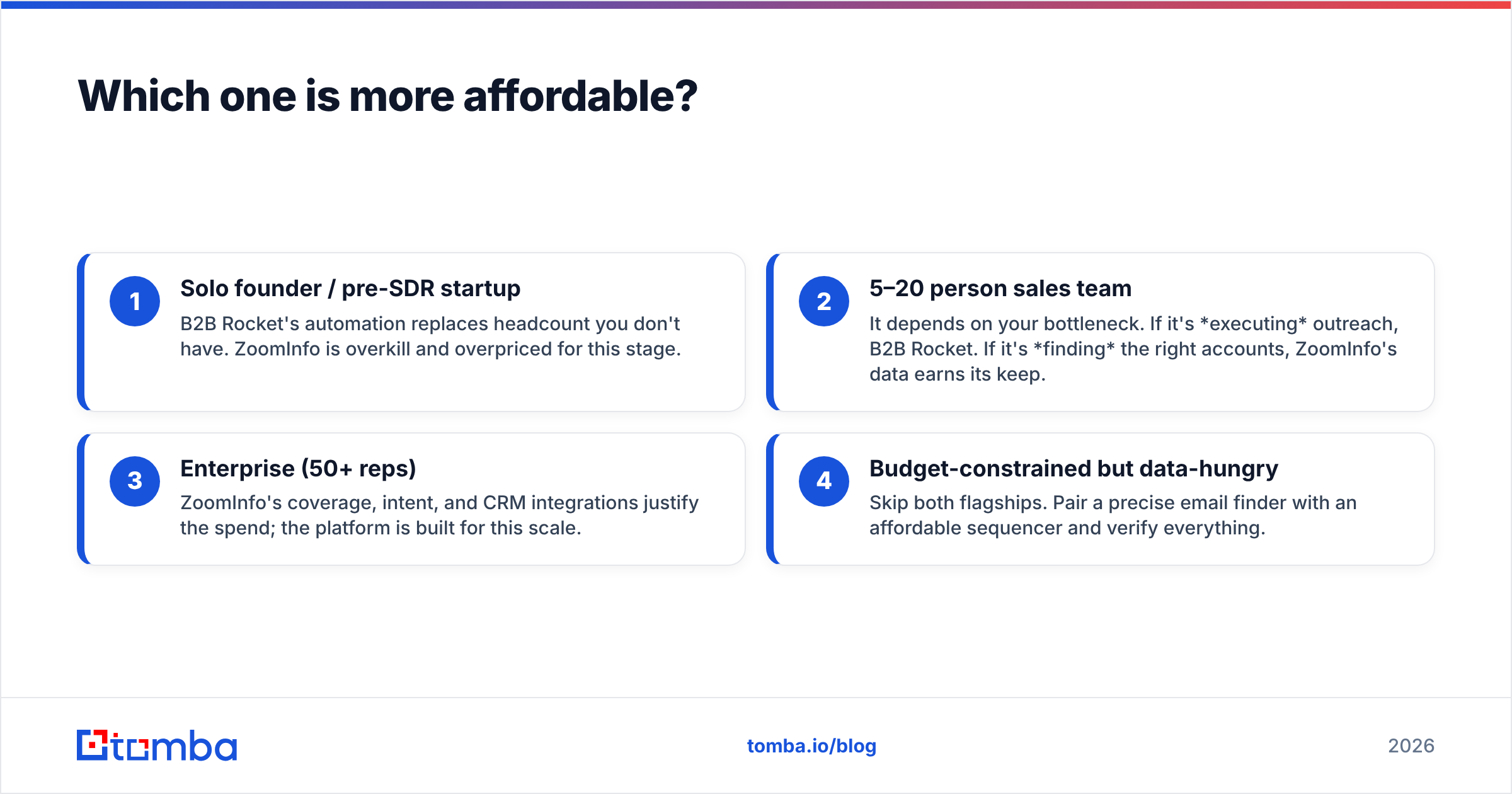
Here's how the cost logic actually breaks down by team profile:
- Solo founder / pre-SDR startup — B2B Rocket's automation replaces headcount you don't have. ZoomInfo is overkill and overpriced for this stage.
- 5–20 person sales team — It depends on your bottleneck. If it's executing outreach, B2B Rocket. If it's finding the right accounts, ZoomInfo's data earns its keep.
- Enterprise (50+ reps) — ZoomInfo's coverage, intent, and CRM integrations justify the spend; the platform is built for this scale.
- Budget-constrained but data-hungry — Skip both flagships. Pair a precise email finder with an affordable sequencer and verify everything.
That fourth path is where most teams overspend. You don't need a $15K/year intelligence platform to email 2,000 well-chosen prospects a month. You need accurate contacts and clean deliverability.
Can you replace either with a leaner stack?#
Yes — and for many teams that's the better call. The expensive part of both platforms is the bundle: you pay for modules you'll never open.
A focused alternative stack looks like this:
- Find contacts on demand — Use domain search to pull every verified email at a target company, or the email finder for named prospects. You pay per use, not per seat.
- Verify before you send — Catch-all and bounce filtering keeps you out of spam folders.
- Enrich what you have — Layer firmographics onto existing leads with data enrichment instead of renting an entire database.
- Add phone when needed — Pull direct dials with a phone finder for the accounts that warrant a call.
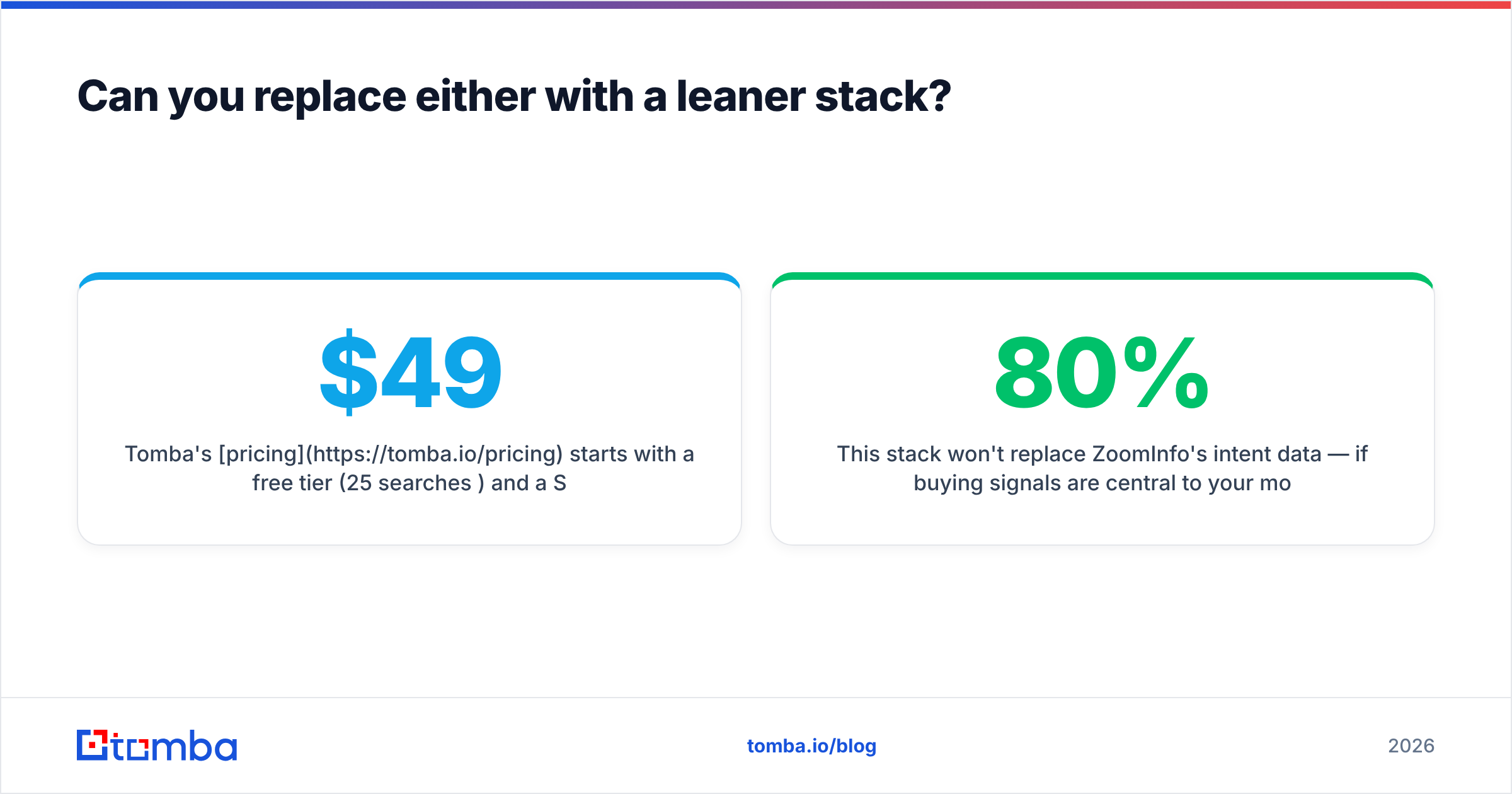
Tomba's pricing starts with a free tier (25 searches/mo) and a Starter plan at $49/mo, scaling to Growth at $99/mo and Pro at $249/mo. That's the difference between a tool you expense without thinking and a contract you have to defend to finance every renewal.
This stack won't replace ZoomInfo's intent data — if buying signals are central to your motion, that's ZoomInfo's moat. But it covers the 80% use case (find, verify, reach) at a fraction of the cost.
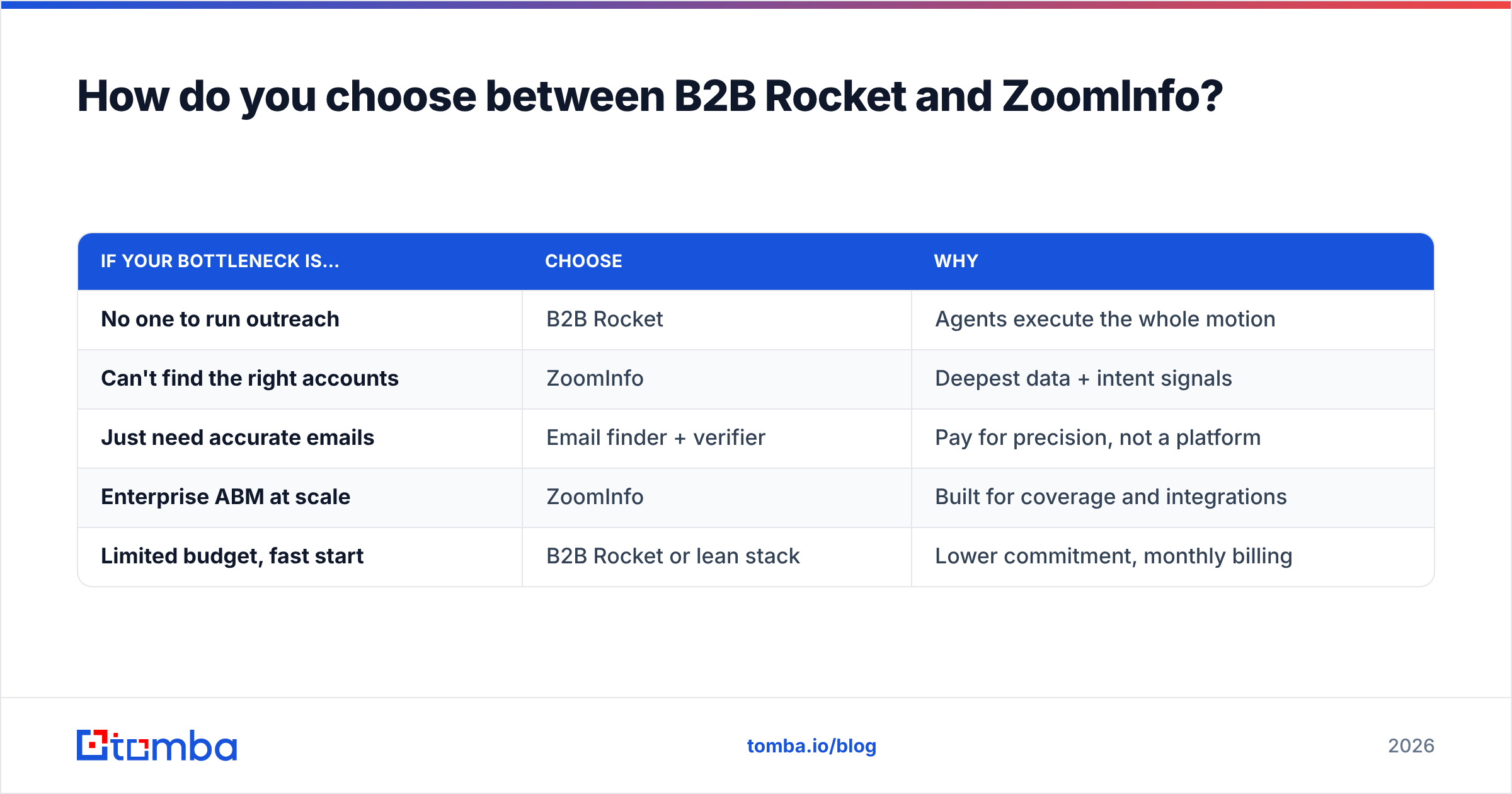
How do you choose between B2B Rocket and ZoomInfo?#
Start with your actual bottleneck, not the feature list.
| If your bottleneck is… | Choose | Why |
|---|---|---|
| No one to run outreach | B2B Rocket | Agents execute the whole motion |
| Can't find the right accounts | ZoomInfo | Deepest data + intent signals |
| Just need accurate emails | Email finder + verifier | Pay for precision, not a platform |
| Enterprise ABM at scale | ZoomInfo | Built for coverage and integrations |
| Limited budget, fast start | B2B Rocket or lean stack | Lower commitment, monthly billing |
Three questions settle it for most teams:
- Do you have people to send the outreach? If no, B2B Rocket's automation is the value. If yes, you mainly need data and can pair it with your existing sequencer.
- Is intent data central to your strategy? If yes, ZoomInfo is hard to beat. If no, you're overpaying for it.
- What's your monthly volume? Under a few thousand contacts, neither flagship pencils out against a focused finder-plus-verifier stack.
You can validate vendor claims yourself before committing — read recent practitioner reviews on G2 rather than trusting either homepage, and always run a trial against your own segment.
The bottom line#
B2B Rocket and ZoomInfo aren't really rivals — one automates outreach, the other supplies data. Pick B2B Rocket if your team is small and execution is the gap. Pick ZoomInfo if you're an enterprise that lives on data depth and intent signals and can absorb the annual contract.
But if you strip the question down to what most sales teams actually struggle with — getting accurate, verified contact data into a campaign — neither flagship is the most efficient buy. A precise email finder you pay for by usage solves the core problem without the platform tax.
That's exactly what the Tomba Email Finder is built for: find verified professional emails by name, company, or domain, confirm they're deliverable, and feed them straight into whatever outreach tool you already run. Start free with 25 searches a month, scale to a $49/mo Starter plan when you're ready, and keep your budget pointed at pipeline instead of shelfware. Try Tomba's email finder and build your next list in minutes.
// get started
Find, verify and enrich your first contacts today
Start on the free plan with 25 searches a month, then scale when your team is ready.
Free plan · No credit card required · GDPR & CCPA
// about the author