B2B Sales in 2026: Strategy, Process & Tools Guide
B2B sales in 2026 is data-driven, multi-threaded, and faster than ever. Here's the modern process, the metrics that matter, and the stack that wins deals.
B2B Sales in 2026: Strategy, Process & Tools Guide
B2B sales is the practice of selling products or services from one business to another, where deals are larger, buying committees are bigger, and the sales cycle is measured in weeks or months — not minutes. If you still run it like a numbers game of cold calls and spray-and-pray email, 2026 will be a hard year. The buyers changed, and the process that wins them changed with it.
This guide breaks down what B2B sales actually looks like now: the stages, the metrics, the tech stack, and the tactics that separate teams hitting quota from teams blaming the market.
TL;DR#
- B2B sales = selling to organizations, with multiple decision-makers, higher deal values, and longer cycles than B2C.
- The modern process has seven stages: ICP definition → prospecting → qualification → discovery → proposal → negotiation → close (and expansion).
- Clean, verified contact data is the foundation — bad data quietly kills more pipelines than bad pitches.
- Track win rate, sales-cycle length, pipeline coverage, and response rate, not just total activity.
- The winning 2026 stack pairs an accurate email finder, a sequencer, a CRM, and an enrichment layer.
What is B2B sales and how is it different from B2C?#
B2B sales targets companies; B2C targets individual consumers. That single difference cascades into everything else about how you sell.
In B2C, one person usually decides in one sitting. In B2B, you're selling to a buying committee — Gartner's research has repeatedly shown that a typical B2B purchase involves six to ten decision-makers, each arriving with their own information and priorities. You don't close a person; you build consensus across a group that may never be in the same room.
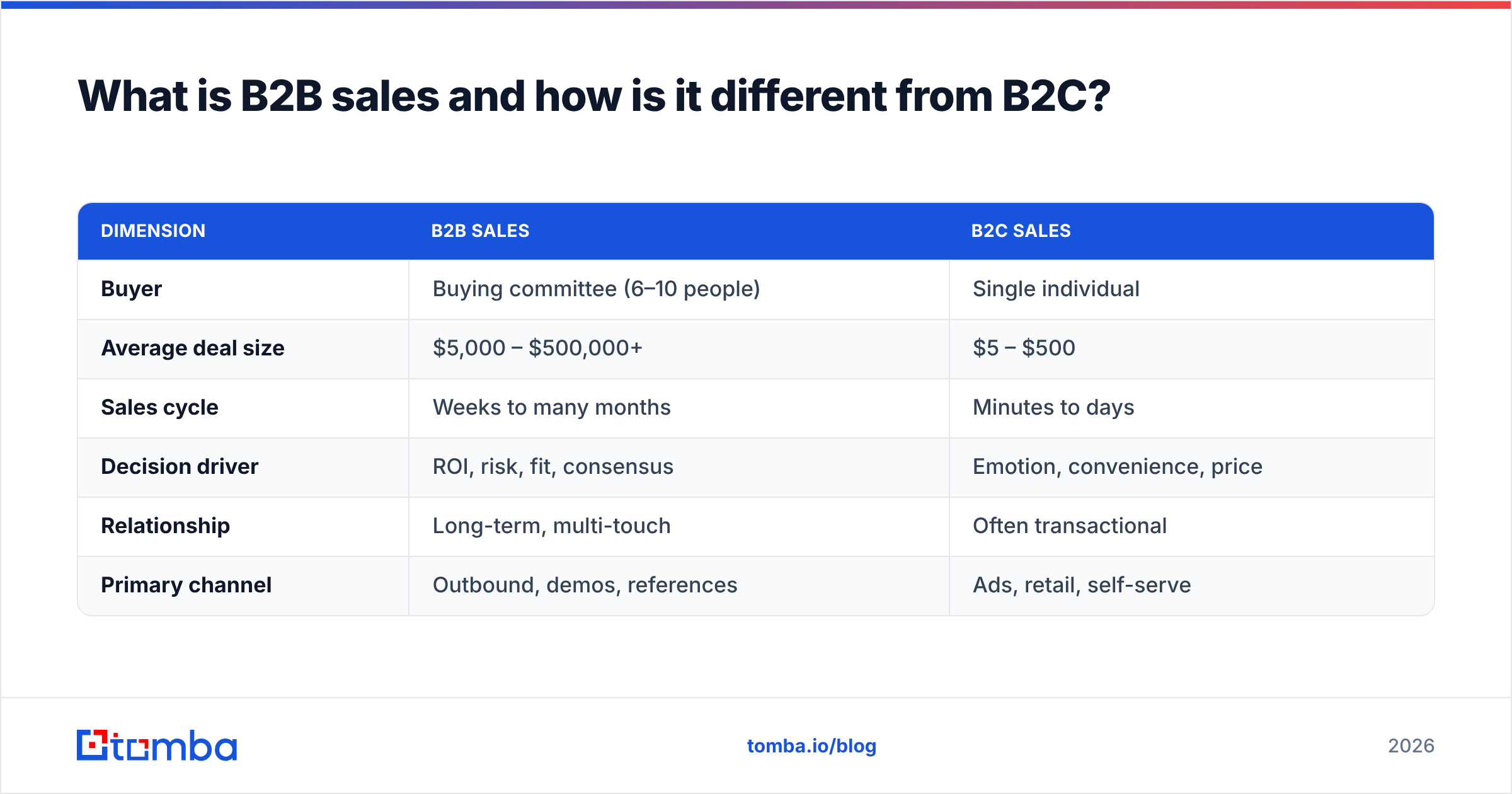
Here's how the two models compare on the dimensions that actually shape your day-to-day:
| Dimension | B2B sales | B2C sales |
|---|---|---|
| Buyer | Buying committee (6–10 people) | Single individual |
| Average deal size | $5,000 – $500,000+ | $5 – $500 |
| Sales cycle | Weeks to many months | Minutes to days |
| Decision driver | ROI, risk, fit, consensus | Emotion, convenience, price |
| Relationship | Long-term, multi-touch | Often transactional |
| Primary channel | Outbound, demos, references | Ads, retail, self-serve |
The takeaway: B2B rewards patience, precision, and process. You can't brute-force a committee. You earn the deal by reaching the right people with the right message at the right moment — and that starts with knowing exactly who those people are.
What does the modern B2B sales process look like?#
The process is a funnel, but a disciplined one. Skipping a stage doesn't speed you up; it just moves the failure later, where it's more expensive.
- Define your ICP and buyer personas. Your Ideal Customer Profile describes the company (industry, size, tech stack, growth signals). Personas describe the people on the committee. Get this wrong and every downstream activity is wasted motion.
- Prospect and build a target list. Identify accounts that match the ICP, then find the actual humans inside them. This is where data quality makes or breaks you — guessed email addresses bounce and torch your sender reputation.
- Qualify against a framework. Use MEDDIC, BANT, or SPICED to confirm budget, authority, need, and timing before you invest discovery hours.
- Run discovery. Ask questions, map pain to impact, and identify your champion and your economic buyer.
- Present a tailored proposal. Tie your solution to the specific business outcomes you uncovered — not a generic feature dump.
- Negotiate. Defend value instead of cutting price. Trade concessions for commitments (longer terms, case studies, faster start dates).
- Close and expand. Sign the deal, then set up the land-and-expand motion. In B2B, the second sale to an existing account is cheaper and faster than the first.
The single most common failure point is stage two. Reps spend hours hand-building lists, copy-pasting from LinkedIn, and guessing email patterns. The fix isn't more hours — it's better tooling. A domain search returns every known email on a company's domain in seconds, with the role and confidence score attached, so you start discovery with verified contacts instead of a bounce list.
Why does data quality decide B2B sales outcomes?#
Because everything compounds on top of it. The conclusion first: your pipeline is only as good as the contact data underneath it. A flawless sequence sent to a dead inbox converts at zero.
Think of your prospect list like the foundation of a building. You can hire the best architects (copywriters) and contractors (SDRs), but if the foundation is cracked, the whole thing comes down — slowly, then all at once. Decayed B2B data is that crack. Industry estimates consistently put B2B data decay at roughly 2–3% per month as people change jobs, companies get acquired, and domains shift. Left alone, a list you bought in January is meaningfully wrong by summer.
Two failure modes follow from bad data:
- Hard bounces wreck deliverability. Mailbox providers read high bounce rates as a spam signal. A few bad sends and your good emails start landing in spam too. Protecting your sender reputation means verifying before you send, every time.
- Wasted rep time. Every minute an SDR spends chasing a wrong number or a bounced address is a minute not spent talking to a real buyer.
The fix is a two-step discipline: find emails from a source that scores confidence, then run them through an email verifier before they ever enter a sequence. For catch-all domains — the ones that accept everything and confirm nothing — a dedicated catch-all verifier tells you whether a mailbox is actually live.
What metrics actually matter in B2B sales?#
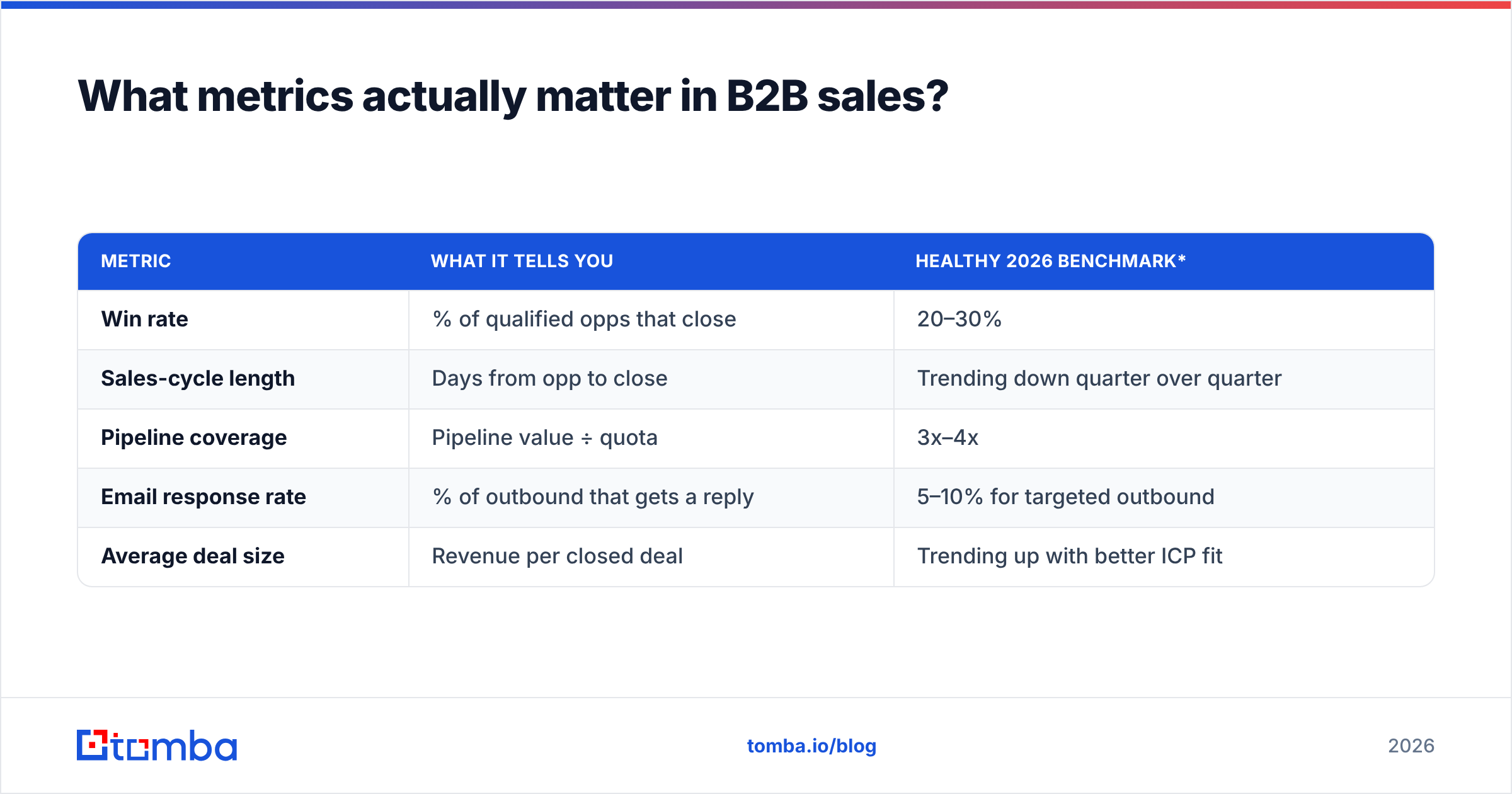
Activity metrics (calls made, emails sent) feel productive but tell you almost nothing about whether you'll hit the number. Outcome metrics do. Here are the ones worth a dashboard:
| Metric | What it tells you | Healthy 2026 benchmark* |
|---|---|---|
| Win rate | % of qualified opps that close | 20–30% |
| Sales-cycle length | Days from opp to close | Trending down quarter over quarter |
| Pipeline coverage | Pipeline value ÷ quota | 3x–4x |
| Email response rate | % of outbound that gets a reply | 5–10% for targeted outbound |
| Average deal size | Revenue per closed deal | Trending up with better ICP fit |
*Benchmarks vary widely by segment and price point — track your trend, not someone else's absolute.
The most underrated metric here is response rate. It's the earliest honest signal of whether your targeting and messaging work. If you're sending hundreds of emails and getting silence, the problem is almost always one of two things: you're reaching the wrong people, or you're reaching the right people with the wrong message. Fix targeting first — it's cheaper.
How do you build a high-converting B2B prospecting motion?#
Prospecting is where most of the leverage lives. A tight motion looks like this:
- Start from signals, not seats. Don't email everyone with a title. Prioritize accounts showing intent — hiring for relevant roles, adopting complementary tech, recent funding. These convert multiples higher than cold accounts.
- Multi-thread from day one. Single-threaded deals die when your one contact leaves or goes quiet. Reach the champion, the economic buyer, and at least one influencer in parallel.
- Verify before you send. Non-negotiable. Run every address through verification so your bounce rate stays under 2%.
- Sequence across channels. Email, phone, and LinkedIn together outperform any single channel. Pull verified B2B phone numbers with a phone finder so your callers aren't dialing dead lines.
The mechanics matter, but so does the source. Buying a bulk list off a sketchy vendor is the fastest way to a blacklisted domain. Building your list from a transparent, well-sourced B2B database — where you can see where the data came from — keeps both your deliverability and your conscience intact.
What does the winning B2B sales tech stack look like in 2026?#
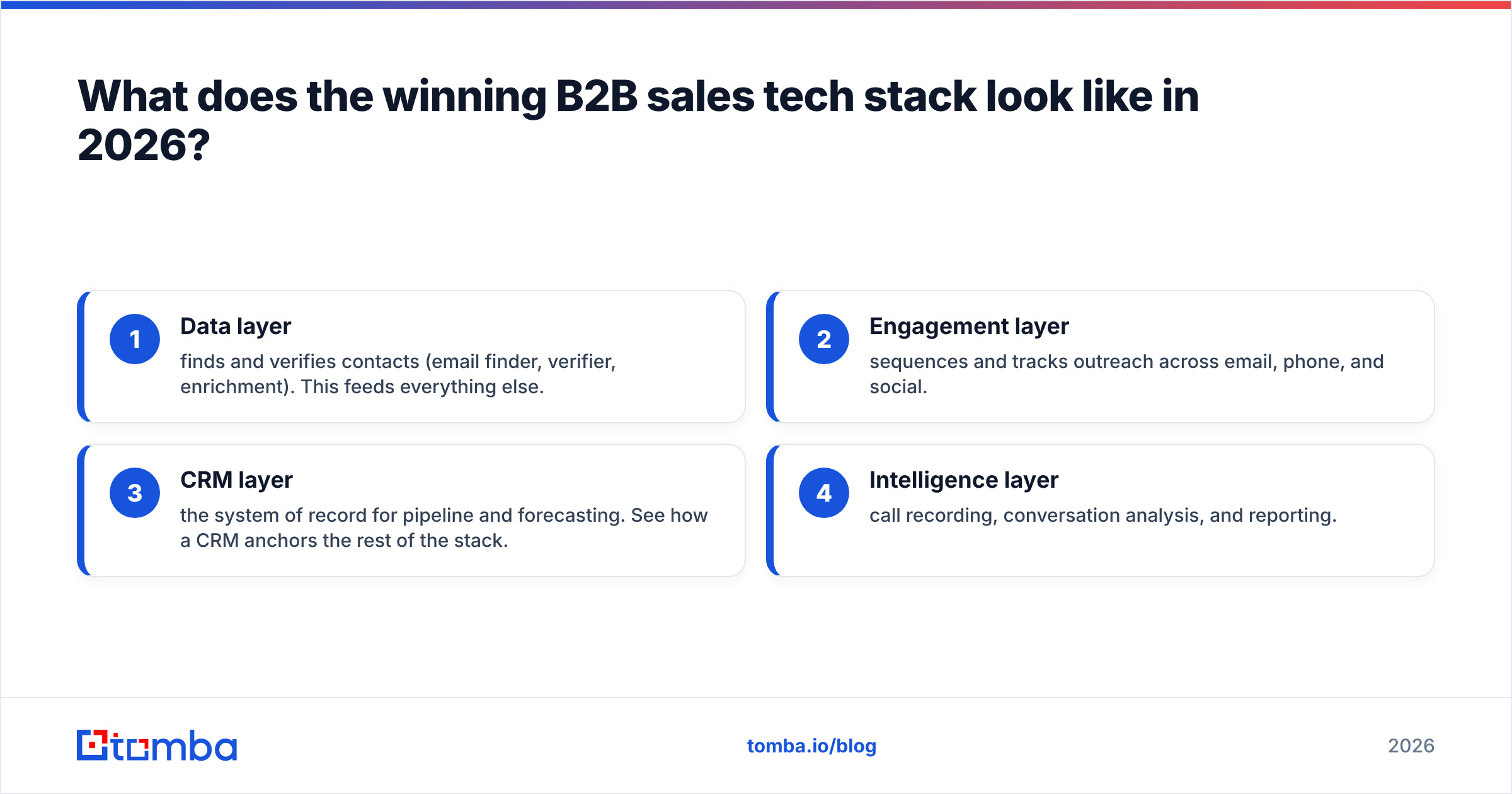
You don't need 30 tools. You need four layers that talk to each other:
- Data layer — finds and verifies contacts (email finder, verifier, enrichment). This feeds everything else.
- Engagement layer — sequences and tracks outreach across email, phone, and social.
- CRM layer — the system of record for pipeline and forecasting. See how a CRM anchors the rest of the stack.
- Intelligence layer — call recording, conversation analysis, and reporting.
The mistake teams make is over-investing in layers two through four while starving layer one. A best-in-class sequencer firing at unverified contacts is an expensive way to hurt your reputation. Get the data layer right first, then layer engagement and intelligence on top.
For the engagement and CRM layers, established platforms like HubSpot and Salesforce dominate for good reason, and review sites like G2 are worth scanning for honest user feedback before you commit budget. For the data layer, the bar is accuracy and verification depth — which is exactly where a purpose-built tool earns its keep over a bundled add-on.
How do you keep a B2B pipeline healthy over time?#
A pipeline isn't a one-time build; it's a system you maintain. Three habits keep it from rotting:
- Re-verify on a cadence. Given 2–3% monthly decay, re-run your active contacts through verification quarterly. Use bulk verify to do thousands at once instead of one at a time.
- Enrich continuously. Job changes are signals, not just data hygiene — your champion moving to a new company is a warm lead at two accounts. Continuous data enrichment surfaces those moves automatically.
- Inspect, don't just hope. Hold weekly pipeline reviews where every stuck deal gets a next step or gets killed. A clean pipeline of 10 real deals forecasts better than a bloated one of 40 maybes.
This is the unglamorous part of B2B sales, and it's exactly why most teams skip it. The ones who don't skip it are the ones whose forecasts hold up.
What are the biggest B2B sales mistakes to avoid?#
- Selling to one person. Single-threaded deals are fragile. Multi-thread or lose.
- Pitching before discovery. You can't tailor a proposal to pain you never uncovered.
- Treating price as the lever. Discounting trains buyers to wait for discounts. Defend value instead.
- Ignoring data hygiene. The quiet killer. Bounces and dead numbers don't show up as a line item, but they bleed your results every day.
- Confusing activity with progress. 200 emails to the wrong list is worse than 20 to the right one — it actively damages your domain.
Where should you start?#
If your B2B sales engine is sputtering, fix the foundation before you touch the funnel. The fastest, highest-leverage move in 2026 is upgrading your data layer: find the right people, verify their contact details, and stop torching your sender reputation on guessed addresses.
That's exactly what the Tomba Email Finder is built for. Search by name, company, or domain to get verified professional emails with confidence scores, then layer in verification, phone lookup, and enrichment from the same platform. The free tier gives you 25 searches a month to test it, and paid plans start at $49/mo (Starter), $99/mo (Growth), and $249/mo (Pro) — with bulk tools and an API when you're ready to scale. Build your next target list on data you can trust, and let your reps spend their hours selling instead of guessing. Start finding verified emails with Tomba.
// get started
Find, verify and enrich your first contacts today
Start on the free plan with 25 searches a month, then scale when your team is ready.
Free plan · No credit card required · GDPR & CCPA
// about the author