B2B Sales Funnel Stages: The 2026 Guide to Converting Leads
A practical 2026 breakdown of every B2B sales funnel stage, the metrics that matter at each step, and how to stop leads leaking before they close.
Most B2B deals don't die at the close. They die quietly, three stages earlier, when a rep chases a lead that was never a real fit or emails an address that bounces. If you want to fix conversion, you fix the funnel stage by stage — not the closing script.
This guide walks through every B2B sales funnel stage as it actually works in 2026, the numbers to watch at each one, where revenue leaks, and the concrete moves that plug the holes.
TL;DR#
- The modern B2B sales funnel has six core stages: Awareness, Interest, Consideration, Intent, Evaluation, and Purchase — plus a post-sale loop most teams ignore.
- Each stage has its own conversion metric and its own failure mode. Treating the funnel as one number hides where you're actually losing deals.
- The biggest, cheapest win is usually at the top: feeding the funnel clean, verified contact data so reps don't waste cycles on bad leads.
- A leaky middle (Consideration → Intent) almost always traces back to weak qualification, not weak demos.
- Track stage-to-stage conversion rates and velocity, not just the headline win rate, and you'll know exactly which stage to fix first.
What is a B2B sales funnel?#
A B2B sales funnel is the staged journey a business buyer takes from first hearing about you to becoming a paying customer. Think of it like an airport: a crowd arrives at the entrance (awareness), passes through check-in, security, and boarding (qualification and evaluation), and only a fraction actually fly (purchase). Each checkpoint filters people out — by design.
The "funnel" shape matters because volume shrinks at every step. If 1,000 people enter at the top and 20 buy, your job isn't to obsess over those final 20 — it's to understand why 980 dropped, and at which gate.
B2B funnels differ from B2C in three ways: more decision-makers (the average buying group is 6–10 people, per Gartner), longer cycles, and higher deal values. That means qualification and multi-threading inside the funnel matter far more than impulse.
What are the B2B sales funnel stages?#
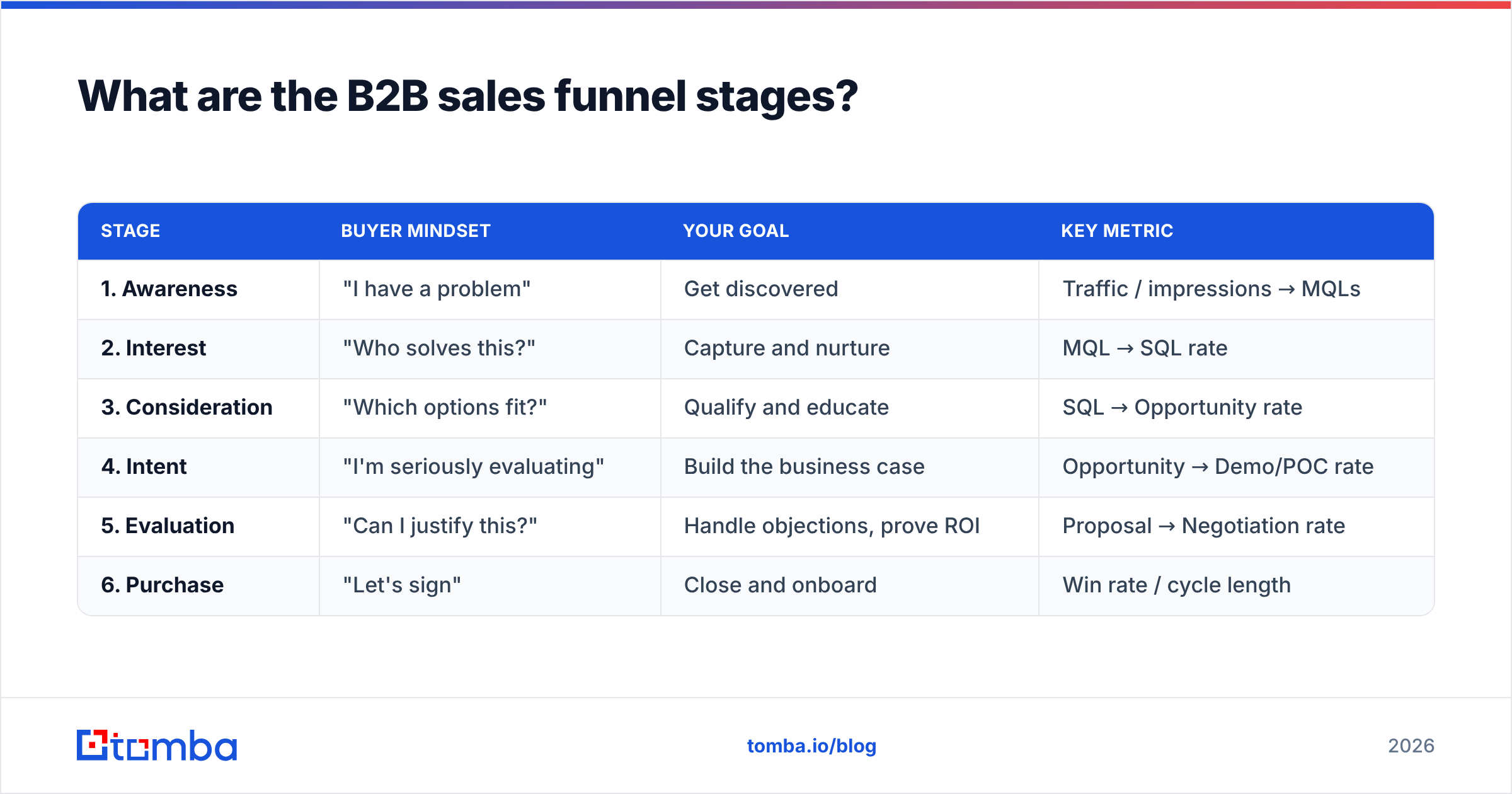
Here are the six stages, what the buyer is doing, and the single metric that tells you whether the stage is healthy.
| Stage | Buyer mindset | Your goal | Key metric |
|---|---|---|---|
| 1. Awareness | "I have a problem" | Get discovered | Traffic / impressions → MQLs |
| 2. Interest | "Who solves this?" | Capture and nurture | MQL → SQL rate |
| 3. Consideration | "Which options fit?" | Qualify and educate | SQL → Opportunity rate |
| 4. Intent | "I'm seriously evaluating" | Build the business case | Opportunity → Demo/POC rate |
| 5. Evaluation | "Can I justify this?" | Handle objections, prove ROI | Proposal → Negotiation rate |
| 6. Purchase | "Let's sign" | Close and onboard | Win rate / cycle length |
The stages below break each of these down with the failure mode to watch for.
Stage 1 — Awareness#
The prospect realizes they have a problem and starts looking. They're not thinking about you yet; they're searching symptoms. Your levers here are SEO content, paid ads, events, and outbound prospecting that interrupts the right accounts.
Failure mode: attracting the wrong audience. High traffic with low marketing qualified lead conversion means your top-of-funnel message is pulling in people who will never buy. Fix the targeting before you spend more on volume.
Stage 2 — Interest#
Now they're engaging — downloading a guide, following you, replying to a cold email. This is where you capture contact details and begin nurturing. For outbound teams, this is also where building an accurate contact list pays off, because every wrong email or stale phone number is a lead that silently exits the funnel.
This is the stage where clean data separates teams that hit quota from teams that grind. Verified contacts mean your nurture sequences actually reach a human.
Stage 3 — Consideration#
The buyer is comparing approaches and shortlisting vendors. They're reading comparison posts, reviews on G2, and case studies. Your job is to educate honestly and qualify hard. Use a framework — BANT, MEDDIC, or your own — to separate tire-kickers from real opportunities.
Failure mode: passing unqualified leads to sales. When marketing celebrates lead volume and sales complains about lead quality, this stage is broken.
Stage 4 — Intent#
The prospect signals they're serious: they request a demo, loop in colleagues, or ask about pricing. Multi-threading begins — you're now selling to a committee, not a person. Map the buying group and find every stakeholder's contact info early.
Stage 5 — Evaluation#
Procurement, security review, ROI modeling, and the dreaded "let me run it past my boss." Deals stall here more than anywhere. Arm your champion with the materials to sell internally on your behalf, and keep momentum with clear next steps and deadlines.
Stage 6 — Purchase#
Contracts, signatures, onboarding. The deal isn't truly closed until the customer is live and seeing value — so hand off cleanly to customer success and start the expansion loop.
How do you measure each funnel stage?#
Measure stage-to-stage conversion and velocity, not just the final win rate. One blended number hides the leak.
Here's a worked example so you can see how to read the funnel diagnostically:
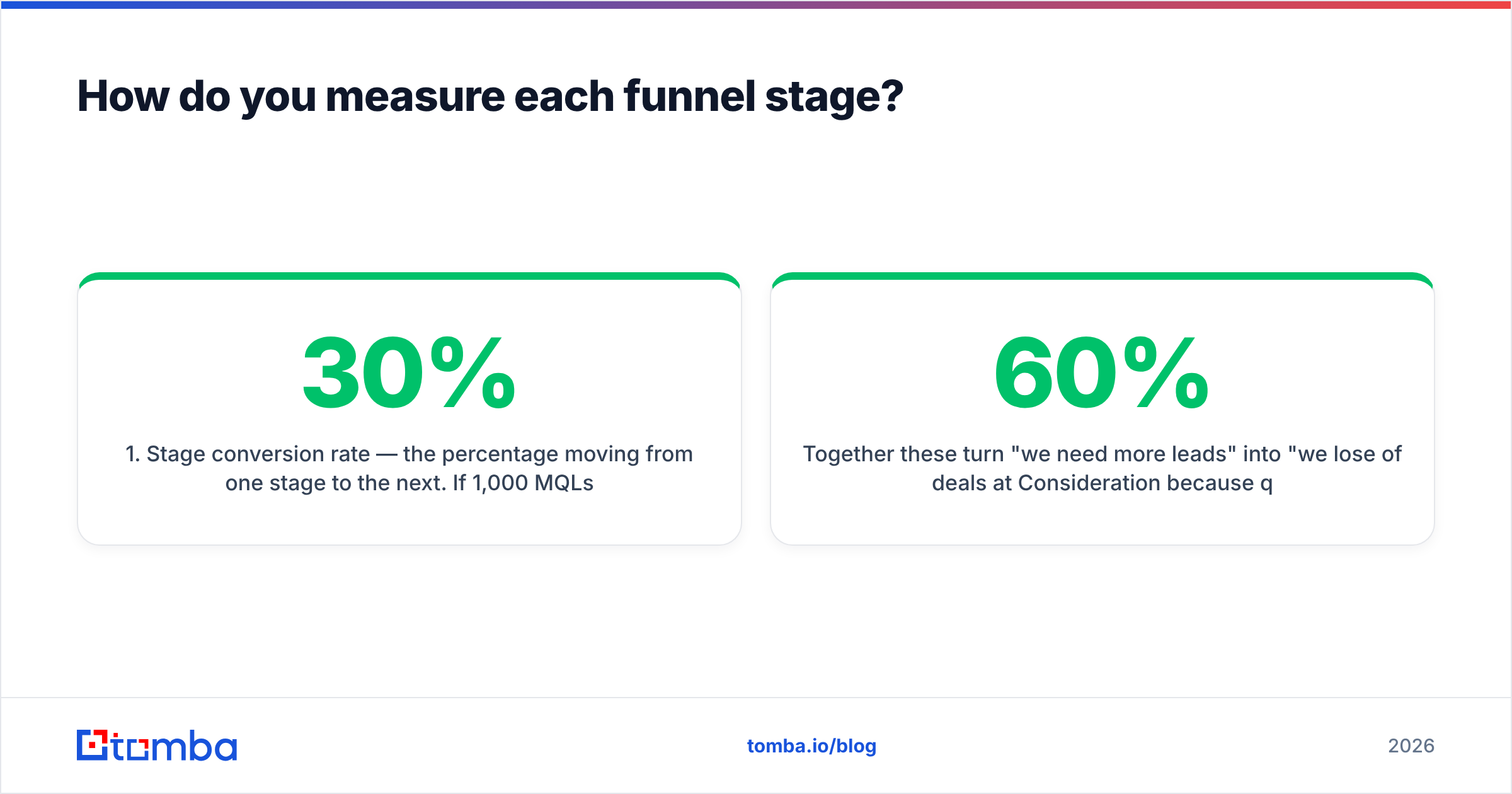
- Stage conversion rate — the percentage moving from one stage to the next. If 1,000 MQLs become 300 SQLs, that's a 30% MQL→SQL rate. Benchmark each transition against your own history, not industry averages that rarely match your motion.
- Velocity — how many days a deal spends in each stage. A stage where deals sit twice as long as the rest is your bottleneck, even if its conversion rate looks fine.
- Drop-off cost — multiply lost deals at each stage by average deal value. This tells you which leak is worth fixing first in dollars, not percentages.
- Source-to-stage attribution — track which lead sources convert deepest. A channel with great top-of-funnel volume but no stage-4 conversions is a vanity channel.
- Win rate by stage entered — deals that reach Evaluation should close far more often than fresh SQLs. If they don't, your earlier qualification is too loose.
- Pipeline coverage — total open pipeline divided by quota. Below 3x and the math rarely works once you apply real conversion rates.
Together these turn "we need more leads" into "we lose 60% of deals at Consideration because qualification is weak" — a fixable statement.
Where do B2B funnels leak the most?#
The two most expensive leaks are a poisoned top and a soft middle.
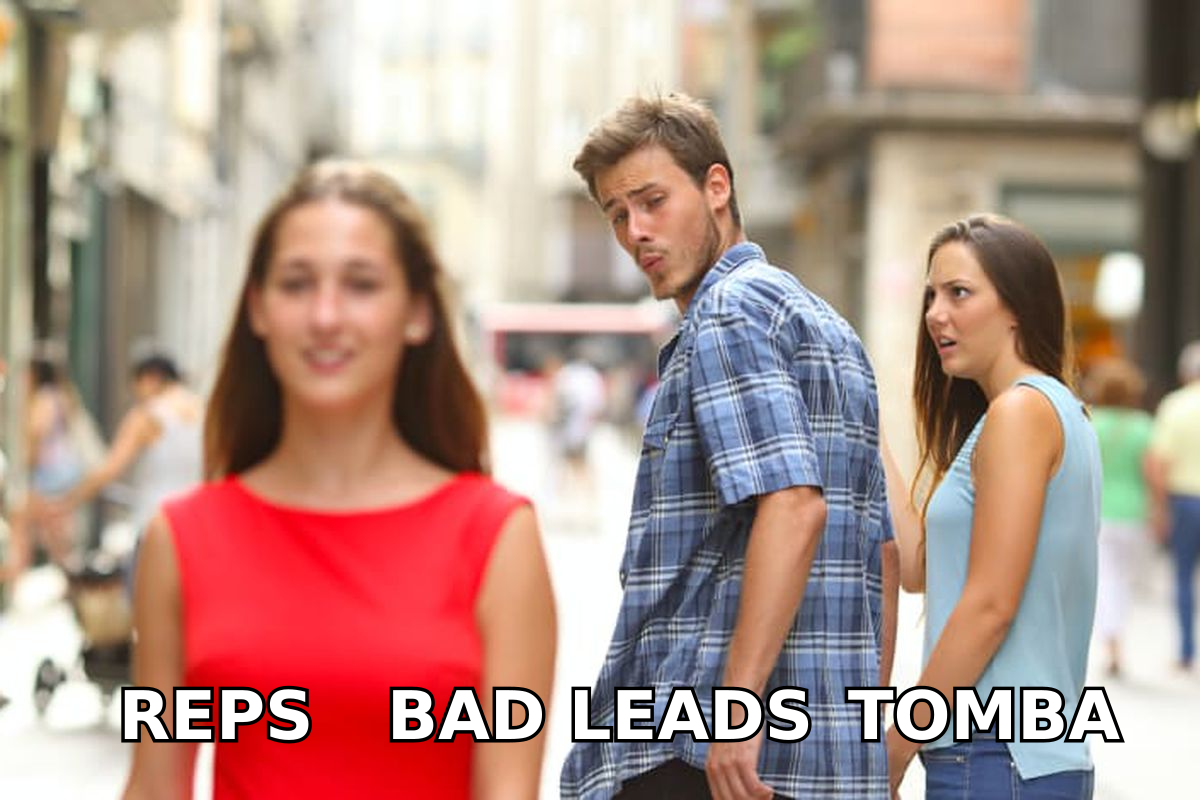
A poisoned top means you're filling the funnel with bad-fit or unreachable contacts. No amount of closing skill recovers a lead whose email bounces or whose company can't afford you. This is why disciplined teams verify data before it ever enters a sequence — and why your response rate is a leading indicator of data quality, not just copy quality.
A soft middle (Consideration → Intent) means reps are advancing deals that aren't real. The cure is harder qualification, not flashier demos. Define explicit exit criteria for each stage — what must be true before a deal moves forward — and enforce them in your CRM.
How do you optimize the top of the funnel?#
Feed it clean, targeted, verified contact data — that single change lifts every downstream stage at once.
Most funnel optimization advice fixates on conversion-rate tweaks deep in the pipeline. But if your top-of-funnel list is 30% inaccurate, you're paying reps to chase ghosts. Garbage in, garbage out — the funnel can only convert the contacts you actually put into it.
Three practical moves:
- Build lists from verified sources. Use a tool that finds and confirms professional emails by company domain rather than scraping guesses. Tomba's email finder and domain search pull contacts tied to real companies, and the email verifier catches dead addresses before they bounce.
- Multi-thread early. Don't enter the funnel with one contact at a target account. Find the whole buying group so a single champion leaving doesn't kill the deal.
- Enrich what you already have. Old CRM records decay roughly 30% a year as people change jobs. Periodic data enrichment keeps existing leads reachable instead of letting them silently expire.
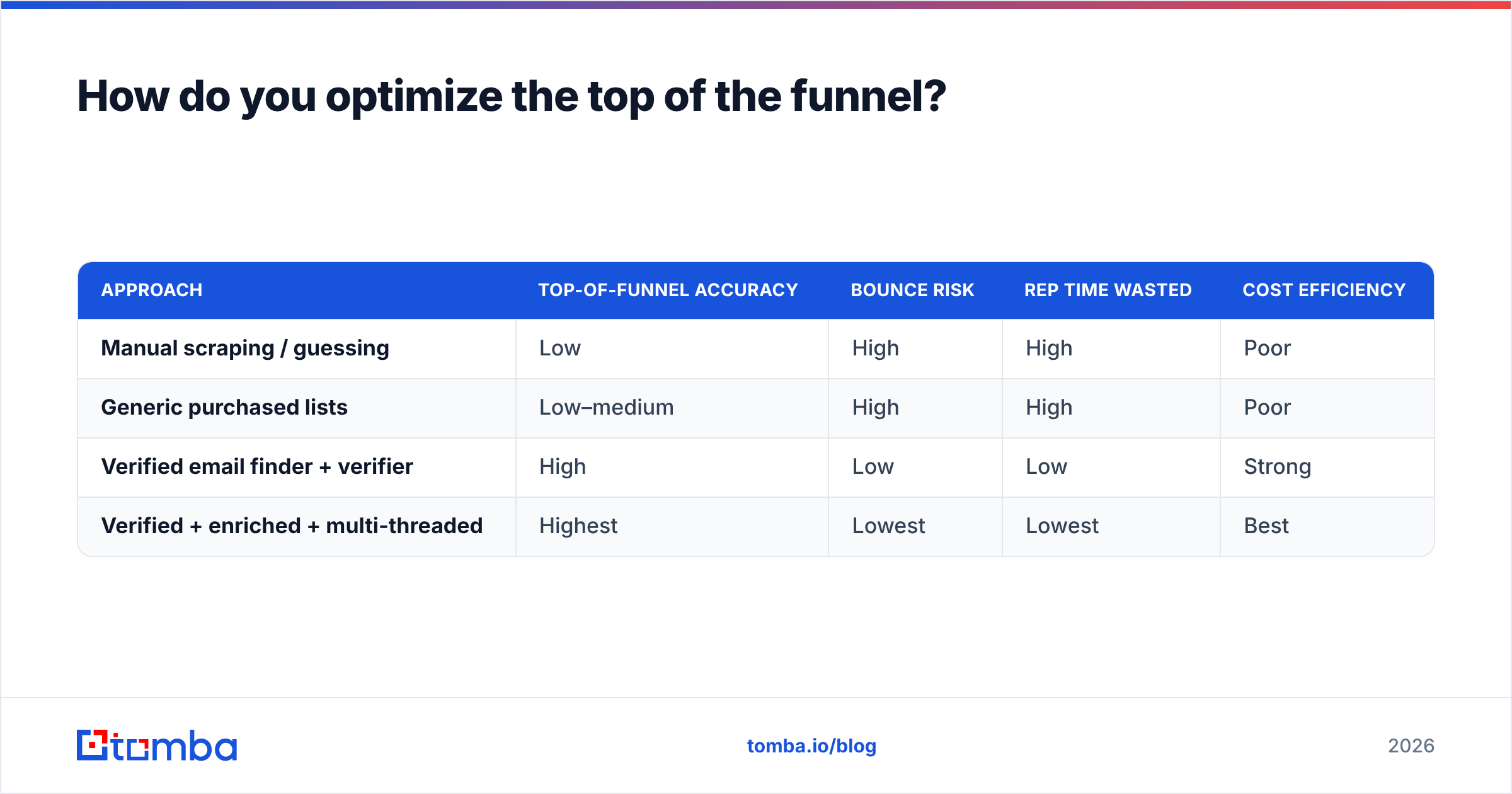
How does data quality compare across funnel approaches?#
| Approach | Top-of-funnel accuracy | Bounce risk | Rep time wasted | Cost efficiency |
|---|---|---|---|---|
| Manual scraping / guessing | Low | High | High | Poor |
| Generic purchased lists | Low–medium | High | High | Poor |
| Verified email finder + verifier | High | Low | Low | Strong |
| Verified + enriched + multi-threaded | Highest | Lowest | Lowest | Best |
The pattern is consistent: the more you invest in clean data at the top, the less effort each downstream stage demands. Verification at Stage 2 prevents wasted demos at Stage 4.
How long should each stage take?#
It depends on deal size, but the rule is simple: track your own baseline, then attack the longest stage.
For a mid-market SaaS deal, a healthy split might look like a few weeks in Consideration, a couple in Intent, and the longest stretch in Evaluation where procurement and security live. An enterprise deal can run two to four times longer at every stage. What matters isn't matching someone else's numbers — it's spotting the stage where your deals stall relative to the rest, then removing that specific friction.
Velocity and conversion interact. A stage can have a great conversion rate but kill your quarter by sitting too long. Speeding up a slow Evaluation stage — by pre-empting security questionnaires or pre-building ROI cases — often adds more revenue than squeezing another few points of win rate.
What tools support each funnel stage?#
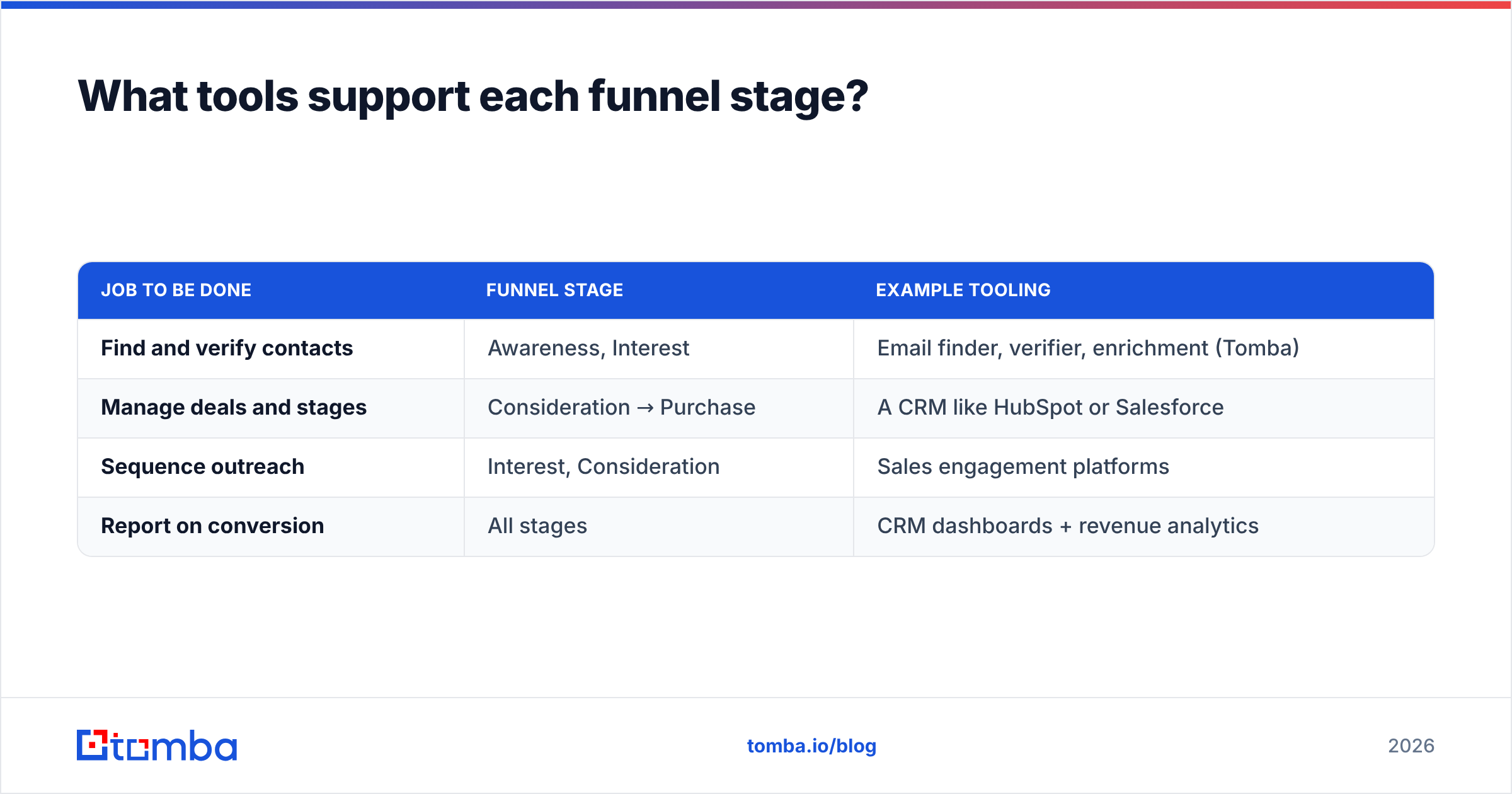
You don't need a 12-tool stack. You need coverage across three jobs: find buyers, manage the pipeline, and keep data clean.
| Job to be done | Funnel stage | Example tooling |
|---|---|---|
| Find and verify contacts | Awareness, Interest | Email finder, verifier, enrichment (Tomba) |
| Manage deals and stages | Consideration → Purchase | A CRM like HubSpot or Salesforce |
| Sequence outreach | Interest, Consideration | Sales engagement platforms |
| Report on conversion | All stages | CRM dashboards + revenue analytics |
For the data layer specifically, Tomba covers the top of the funnel end to end. See Tomba pricing for plan details — there's a free tier with 25 searches a month, then Starter at $49/mo, Growth at $99/mo, and Pro at $249/mo, plus a custom Enterprise tier. Connect it to your CRM through the available integrations so verified contacts flow straight into the right funnel stage.
For pipeline management itself, lean on your CRM's native staging — both HubSpot and Salesforce let you define custom stages with exit criteria, which is exactly what you need to stop the soft-middle leak.
How do you fix a broken funnel stage by stage?#
Diagnose with conversion data, then fix the single worst stage before touching anything else.
- If Awareness → Interest is weak: your targeting or message is off. Tighten your ideal customer profile and rebuild lists from verified data instead of buying volume.
- If Interest → Consideration is weak: your nurture isn't reaching people, or it's reaching the wrong ones. Verify your list and segment it.
- If Consideration → Intent is weak: qualification is too loose. Add hard exit criteria and stop advancing deals on optimism.
- If Intent → Evaluation is weak: you're single-threaded. Map and contact the full buying committee.
- If Evaluation → Purchase is weak: you're not enabling your champion. Build the internal business case for them and create urgency with real deadlines.
Fix one stage, re-measure, then move to the next worst. Trying to fix all six at once just spreads effort thin and tells you nothing about what actually worked.
Put a clean funnel into practice#
Every stage of your B2B sales funnel sits on top of one thing: knowing who your buyers are and being able to reach them. A leak at the top quietly drains every stage below it, no matter how good your reps are.
Start where the leverage is highest. Use the Tomba Email Finder to build verified, targeted contact lists for the top of your funnel, run them through the verifier so nothing bounces, and feed only real, reachable buyers into your pipeline. Clean data in means more deals out — and a funnel you can actually trust the numbers on. Spin up the free tier, find your first 25 contacts, and watch your stage-to-stage conversion climb.
// get started
Find, verify and enrich your first contacts today
Start on the free plan with 25 searches a month, then scale when your team is ready.
Free plan · No credit card required · GDPR & CCPA
Get the Tomba newsletter
Product and data updates
// about the author