B2B Sales Funnel Template: Stages & Examples for 2026
A copy-ready B2B sales funnel template with every stage, exit criteria, and conversion benchmark you need to stop leaking deals in 2026.
You can have the best reps in your market and still miss quota if your funnel is a guess. A real B2B sales funnel template turns "I think this deal is warm" into "this deal cleared stage 3 exit criteria on Tuesday." This guide hands you that template — stages, definitions, exit gates, benchmarks, and the data stack that keeps it from drying up.
TL;DR#
- A B2B sales funnel template is a documented set of stages, each with a clear entry trigger, exit criteria, and owner — so forecasting stops being fiction.
- The six core stages: Awareness → Lead → MQL → SQL → Opportunity → Customer, plus a post-sale expansion loop.
- Define every stage by buyer behavior and evidence, not rep optimism. "Demo booked" is a stage; "feels interested" is not.
- Benchmark each conversion step so you know where deals actually leak — most B2B funnels lose the most volume between MQL and SQL.
- A funnel is only as good as the contact data feeding it. Bad emails and stale leads kill conversion before stage 1.
What is a B2B sales funnel template?#
A B2B sales funnel template is a reusable framework that maps how a stranger becomes a paying customer, broken into named stages with rules for entering and leaving each one. Think of it like a flight checklist: pilots do not "feel" ready for takeoff, they confirm every item. Your funnel template is the checklist that confirms a deal is truly ready to advance.
The difference between a funnel template and a vague "pipeline" is enforcement. A template specifies:
- The stage name — shared language across sales, marketing, and RevOps.
- The entry trigger — the event that puts a deal into this stage.
- The exit criteria — the evidence required to move forward.
- The owner — who is accountable while the deal sits here.
- The target conversion rate — what "healthy" looks like at this step.
Without those five fields, two reps will define "qualified" two different ways, your forecast will swing 40% week to week, and you will never know which stage is leaking. With them, your funnel becomes a diagnostic tool instead of a wishlist.
What are the stages of a B2B sales funnel?#
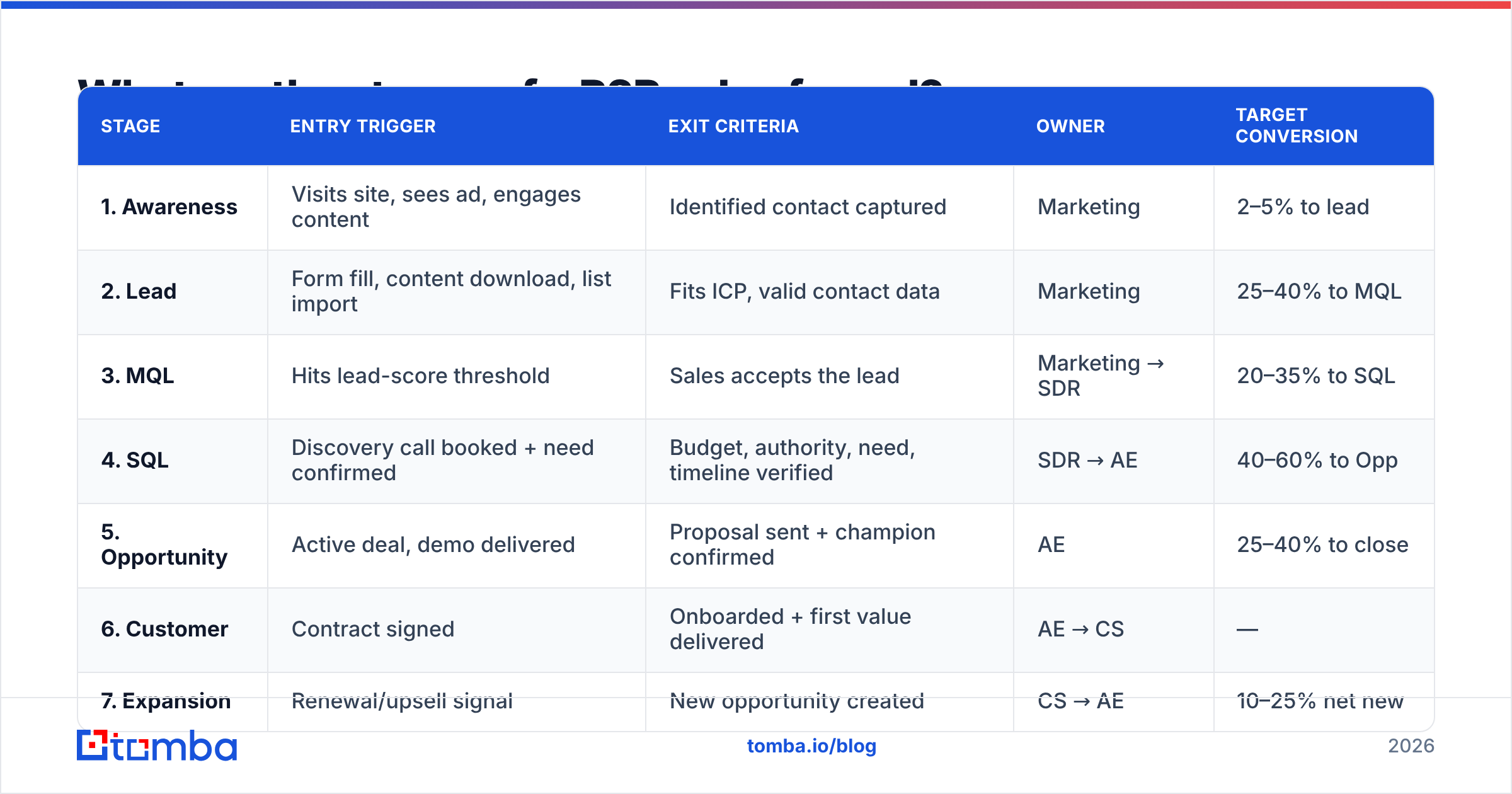
Most effective B2B funnels run six stages plus an expansion loop. Here is the full template you can copy directly into your CRM.
| Stage | Entry trigger | Exit criteria | Owner | Target conversion |
|---|---|---|---|---|
| 1. Awareness | Visits site, sees ad, engages content | Identified contact captured | Marketing | 2–5% to lead |
| 2. Lead | Form fill, content download, list import | Fits ICP, valid contact data | Marketing | 25–40% to MQL |
| 3. MQL | Hits lead-score threshold | Sales accepts the lead | Marketing → SDR | 20–35% to SQL |
| 4. SQL | Discovery call booked + need confirmed | Budget, authority, need, timeline verified | SDR → AE | 40–60% to Opp |
| 5. Opportunity | Active deal, demo delivered | Proposal sent + champion confirmed | AE | 25–40% to close |
| 6. Customer | Contract signed | Onboarded + first value delivered | AE → CS | — |
| 7. Expansion | Renewal/upsell signal | New opportunity created | CS → AE | 10–25% net new |
This is the spine. The rest of the post explains how to make each stage do real work.
Stage 1–2: Awareness to Lead#
Awareness is the widest part of the funnel and the least controllable. Your job here is not to sell — it is to capture an identifiable contact you can act on later. The exit criterion is brutal but simple: do you have a name and a way to reach them? An anonymous visitor is not a lead. A LinkedIn profile with no verified email is barely a lead.
This is exactly where most templates silently break. Marketing reports "3,000 leads this month," but 600 are duplicates, 400 have role-based catch-all addresses, and 300 bounce. Run new contacts through an email verifier before they ever count as a stage-2 lead, and the rest of your funnel math stops lying to you.
Stage 3: MQL — the most abused stage#
A Marketing Qualified Lead has shown enough behavioral intent (pricing-page visits, demo requests, repeated content engagement) to justify sales attention. The classic failure is treating any form fill as an MQL. Define a numeric score threshold and a fit filter, and hold the line. If sales rejects more than 40% of your MQLs, your scoring model is broken, not your reps.
Stage 4: SQL — where qualification gets real#
A Sales Qualified Lead has been worked by a human who confirmed there is a genuine need and a path to a decision. The most reliable exit criterion remains a version of BANT or MEDDIC: you can name the budget range, the decision-maker, the specific pain, and a realistic timeline. If you can't fill those in, the deal is not an SQL — it is hope.
How do you build a B2B sales funnel template step by step?#
Follow this sequence. Each step depends on the one before it, so don't skip.
- Map your actual buyer journey first. Interview five recent customers. Document the real path they took, not the path you wish they took. Your stages should mirror reality.
- Define exit criteria as evidence, not feelings. Every stage advance must be tied to an observable event: "demo delivered," "proposal sent," "security review passed."
- Assign one owner per stage. Shared accountability is no accountability. Marketing owns 1–3, SDRs bridge 3–4, AEs own 4–6, CS owns 7.
- Set a conversion target for every step. Use the benchmarks in the table above as a starting point, then replace them with your own trailing-90-day numbers.
- Instrument the data. Decide which CRM fields are required to advance. Make the exit criteria literally un-skippable with required fields or stage-gate automation.
- Review weekly and fix the worst leak. Find the single stage with the worst conversion rate and run one experiment against it. Repeat.
The discipline that separates teams who hit forecast from those who don't is step 2. "Surface assumptions, then verify" applies to deals as much as to code: if a rep can't show the evidence, the deal doesn't move.
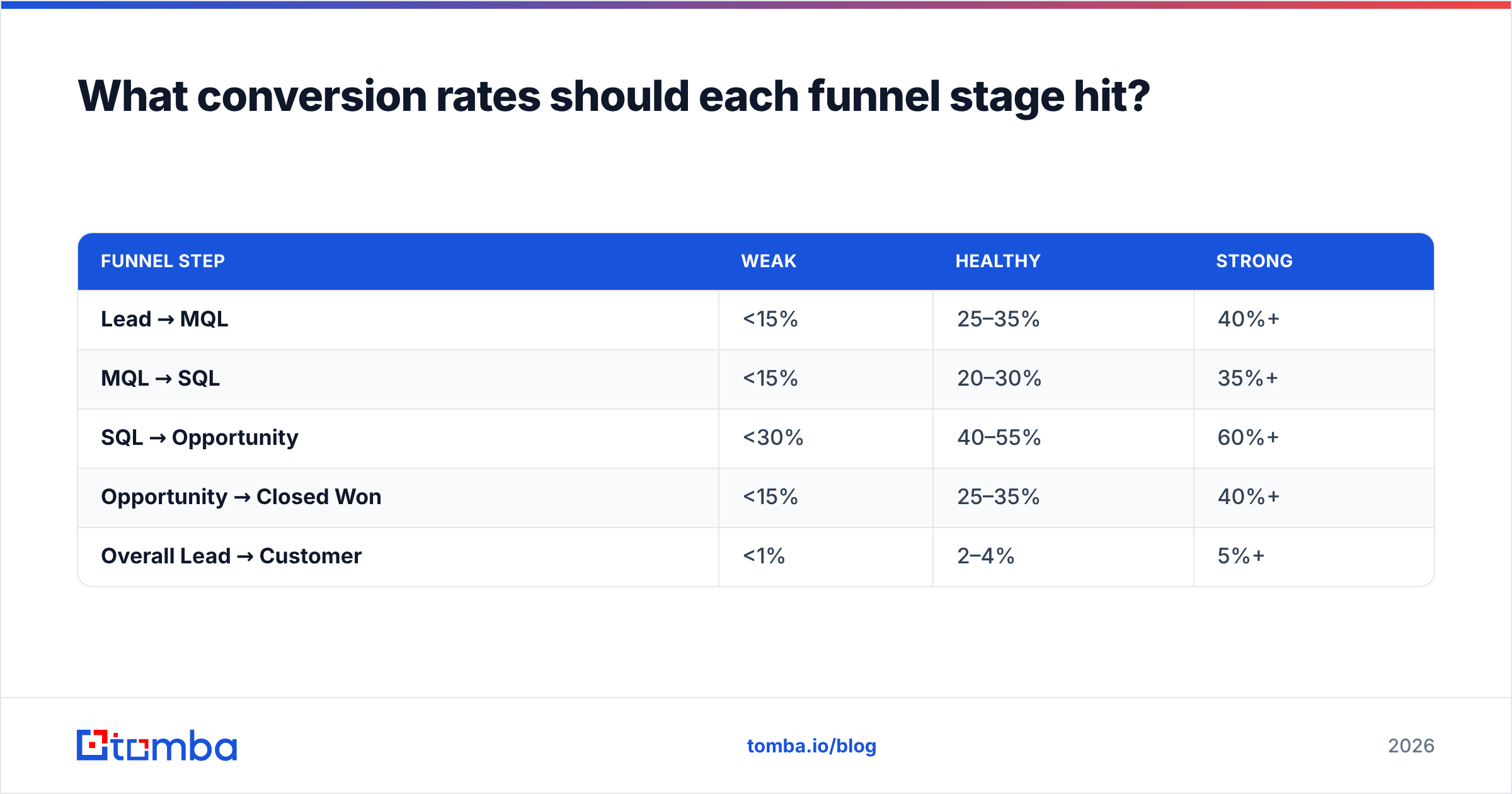
What conversion rates should each funnel stage hit?#
Benchmarks vary wildly by motion (PLG vs. enterprise, inbound vs. outbound), so treat these as reference points, not laws. The pattern that holds across nearly every B2B team: the biggest, most expensive leak sits between MQL and SQL.
| Funnel step | Weak | Healthy | Strong |
|---|---|---|---|
| Lead → MQL | <15% | 25–35% | 40%+ |
| MQL → SQL | <15% | 20–30% | 35%+ |
| SQL → Opportunity | <30% | 40–55% | 60%+ |
| Opportunity → Closed Won | <15% | 25–35% | 40%+ |
| Overall Lead → Customer | <1% | 2–4% | 5%+ |
If your overall lead-to-customer rate is under 1%, do not blame closing skills first. Walk back up the funnel. Nine times out of ten the leak is at the top: you are pouring unqualified or unreachable contacts into stage 1, and no amount of AE talent fixes a poisoned input. For a deeper definition of how to measure the close step itself, see the win rate breakdown.
How is a B2B funnel different from a B2C funnel?#
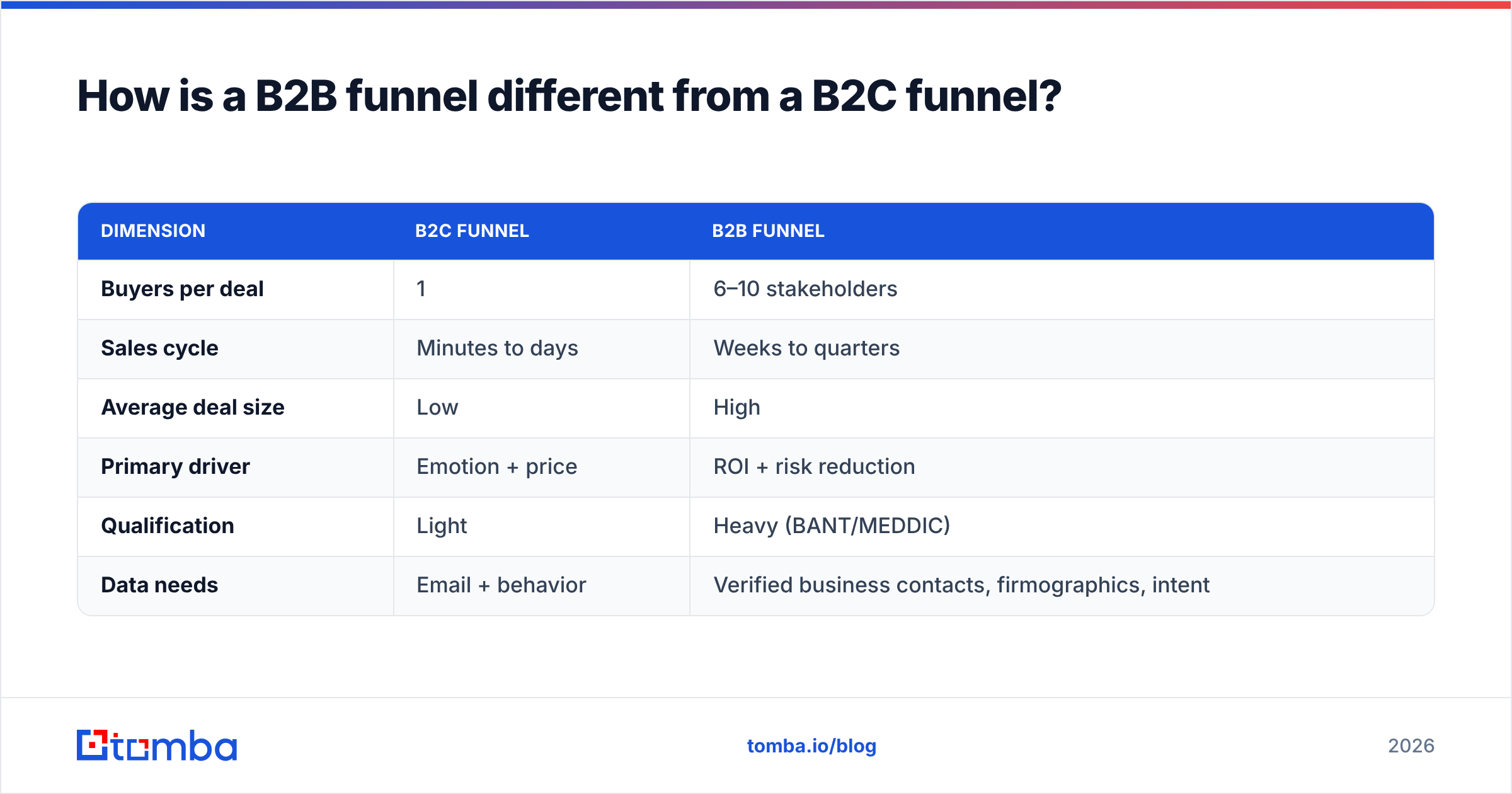
The shapes look similar; the mechanics are not. A B2C funnel optimizes for volume and speed across a single buyer. A B2B funnel optimizes for a multi-stakeholder, longer, evidence-driven decision.
| Dimension | B2C funnel | B2B funnel |
|---|---|---|
| Buyers per deal | 1 | 6–10 stakeholders |
| Sales cycle | Minutes to days | Weeks to quarters |
| Average deal size | Low | High |
| Primary driver | Emotion + price | ROI + risk reduction |
| Qualification | Light | Heavy (BANT/MEDDIC) |
| Data needs | Email + behavior | Verified business contacts, firmographics, intent |
This is why a B2B template needs more stages and stricter gates. You are not convincing one person to buy a $40 product; you are guiding a buying committee through a procurement process. Your funnel has to track who the champion is, who the economic buyer is, and whether the contact data for each of them is even accurate. That last point is where most teams quietly fail.
What data and tools keep the funnel full?#
A perfect funnel template with garbage inputs still produces garbage. The funnel is a machine, and contact data is its fuel. Three data layers matter most:
- Top-of-funnel sourcing. You need a reliable way to find ICP-matched contacts and their reachable emails. A domain-level find emails by domain workflow lets you pull every relevant contact at a target account, not just the one person who filled out a form.
- Validation before entry. Every contact should be verified before it counts as a lead. Catch-all domains, role accounts, and typos inflate your top-of-funnel numbers and crater deliverability downstream.
- Enrichment at qualification. Before a rep wastes a discovery call, enrich the record with firmographics and seniority so you can score fit accurately. Good data enrichment means your SQL stage rejects the wrong-fit accounts automatically.
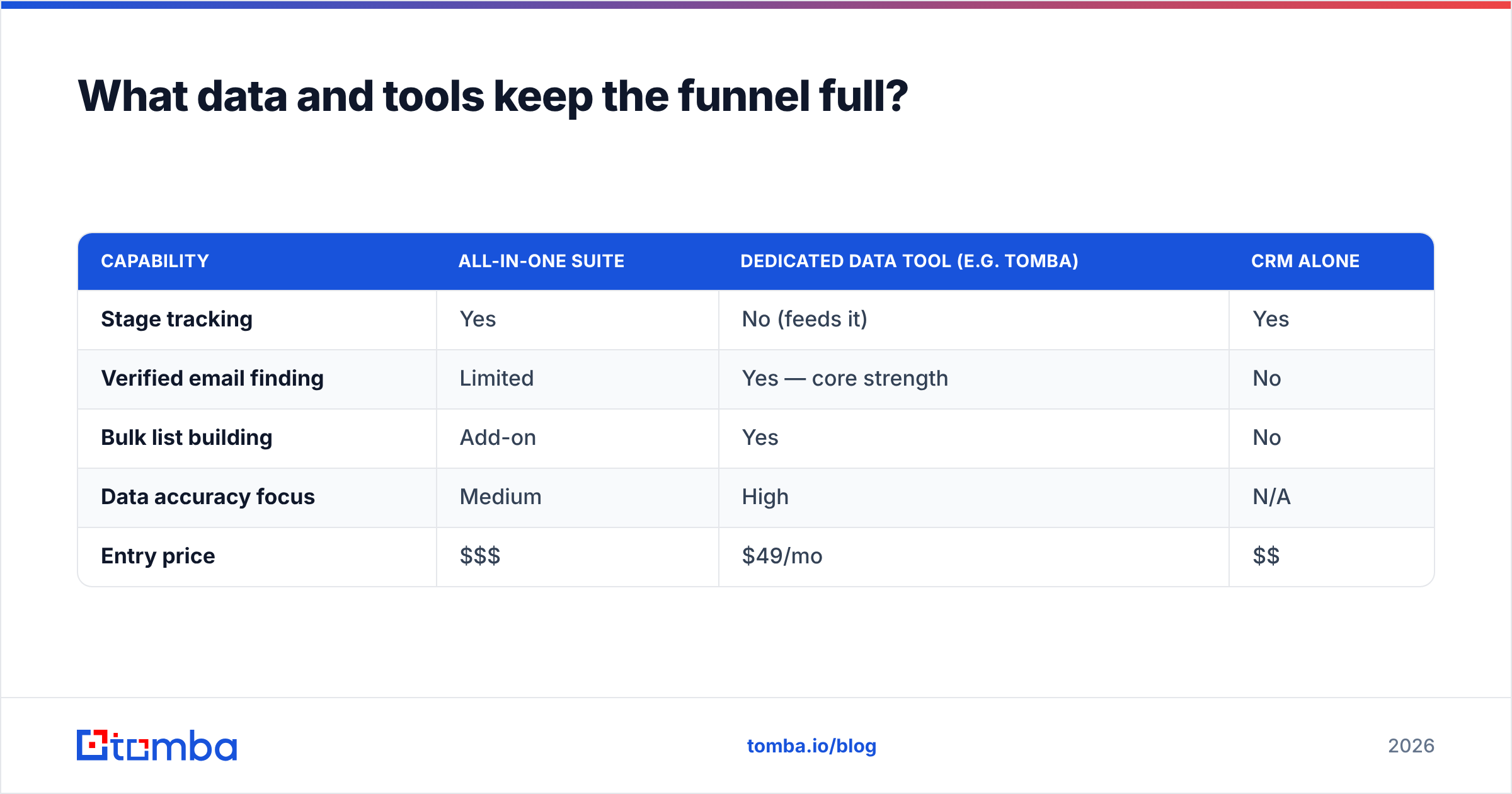
For tooling, you generally have three buckets: an all-in-one sales platform, a dedicated data provider, and a CRM to hold it all. Here is how the common categories compare for funnel-building specifically.
| Capability | All-in-one suite | Dedicated data tool (e.g. Tomba) | CRM alone |
|---|---|---|---|
| Stage tracking | Yes | No (feeds it) | Yes |
| Verified email finding | Limited | Yes — core strength | No |
| Bulk list building | Add-on | Yes | No |
| Data accuracy focus | Medium | High | N/A |
| Entry price | $$$ | $49/mo | $$ |
You don't need to rip out your CRM. You need to make sure the contacts entering stage 1 are real. Tools like HubSpot or Salesforce hold the funnel; a focused email-finding layer keeps it fed with reachable people. For an objective view of how the data tools stack up, vendor-neutral review sites like G2 are a reasonable starting point.
Common mistakes that break the funnel template#
Even a well-designed template fails in predictable ways. Watch for these:
- Vanity-stage inflation. Counting form fills as MQLs. If marketing's "lead" number is triple what sales recognizes, your gates are too loose.
- No exit criteria. Reps advancing deals on optimism. Require evidence in a CRM field before stage change.
- Skipped data hygiene. Importing a purchased list straight into stage 2 without verification. You will torch your sender reputation and your forecast.
- One-and-done design. Building the template once and never tuning conversion targets against real data.
- Ignoring the post-sale loop. Forgetting that expansion revenue is often cheaper than net-new. Stage 7 deserves the same rigor as stage 4.
The throughline is discipline. A funnel template is a contract between teams about what each stage means. The moment people stop honoring the exit criteria, the template becomes decoration.
How often should you review and update the template?#
Review conversion data weekly, restructure the template quarterly. Weekly reviews catch leaks fast — you spot that SQL-to-Opportunity dropped from 50% to 30% and you investigate now, not at the end of the quarter. Quarterly restructures let you respond to bigger shifts: a new ICP, a changed buying process, a new product line that needs its own stage.
A practical cadence:
- Weekly: Pull stage-by-stage conversion. Fix the worst leak.
- Monthly: Audit data quality — bounce rate, duplicate rate, enrichment coverage.
- Quarterly: Re-baseline your conversion targets and re-interview recent customers to confirm the stages still match reality.
This rhythm keeps the template alive instead of letting it ossify into a slide nobody trusts.
Build a funnel that fills itself#
A B2B sales funnel template gives you the stages, the gates, and the benchmarks — but it only converts if reachable, verified contacts actually enter at the top. That is the part teams underinvest in, and it is the cheapest leak to fix.
Start your stage-1 inputs with Tomba Email Finder. Find ICP-matched professional emails by domain, name, or company, verify them before they ever count as a lead, and feed your funnel contacts that are real on day one. The free tier gives you 25 searches a month to test it against your own list, and paid plans start at $49/mo — see full Tomba pricing to match a plan to your funnel volume. Build the template, then keep it full with data you can trust.
// get started
Find, verify and enrich your first contacts today
Start on the free plan with 25 searches a month, then scale when your team is ready.
Free plan · No credit card required · GDPR & CCPA
// about the author