B2B Sales Leads in 2026: How to Find and Qualify Them
A practical 2026 playbook for sourcing, qualifying, and converting B2B sales leads — the channels that still work, the frameworks that filter noise, and the tools that fill your pipeline.
TL;DR
- B2B sales leads are companies or individuals who match your ideal customer profile (ICP) and have shown — or are likely to show — buying intent.
- The win in 2026 is not "more leads," it's fewer, better leads: tight ICP, verified contact data, and a qualification gate before reps ever touch them.
- Purchased lists and scraped data decay 22–30% per year. Real-time finding and verification beat static databases every time.
- A repeatable lead engine has four parts: define ICP, source contacts, verify and enrich, then score and route.
- Tools like an email finder and email verifier turn a name and a domain into a deliverable, sales-ready contact in seconds.
What are B2B sales leads, exactly?#
A B2B sales lead is a person or organization that could realistically buy what you sell. That's the whole definition — and most teams get it wrong by skipping the word realistically.
Think of leads like fruit on a tree. A "contact" is any piece of fruit you can see. A "lead" is fruit that's actually ripe enough to pick. Pointing a ladder at every piece on the tree wastes the whole afternoon. The job is to identify ripeness before you climb.
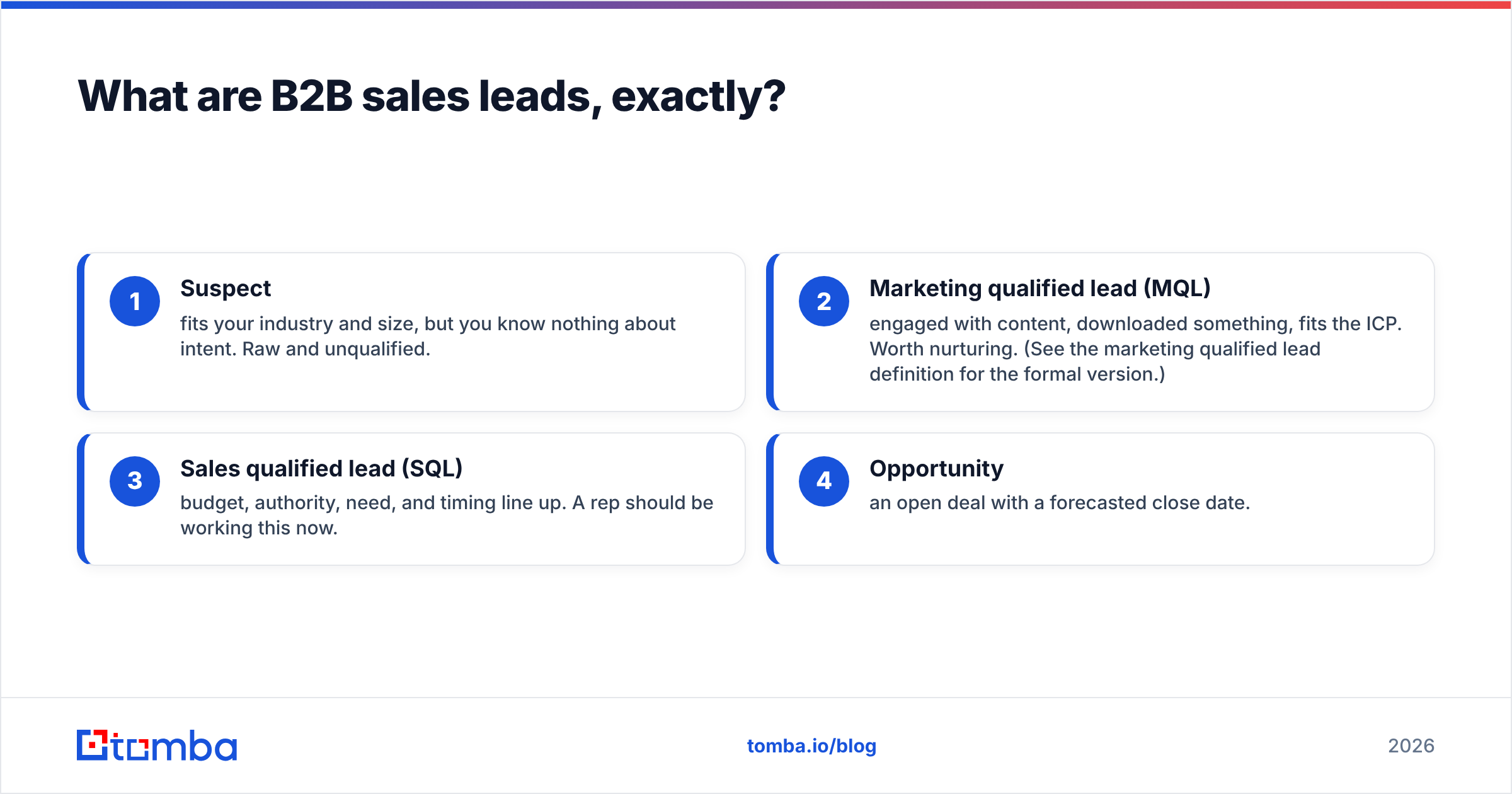
In practice, leads fall into a few buckets:
- Suspect — fits your industry and size, but you know nothing about intent. Raw and unqualified.
- Marketing qualified lead (MQL) — engaged with content, downloaded something, fits the ICP. Worth nurturing. (See the marketing qualified lead definition for the formal version.)
- Sales qualified lead (SQL) — budget, authority, need, and timing line up. A rep should be working this now.
- Opportunity — an open deal with a forecasted close date.
Most of the pain in B2B sales comes from treating suspects like SQLs. You burn rep hours, torch your sender reputation with bad email, and skew your pipeline math. The rest of this guide is about not doing that.
Where do the best B2B sales leads actually come from?#
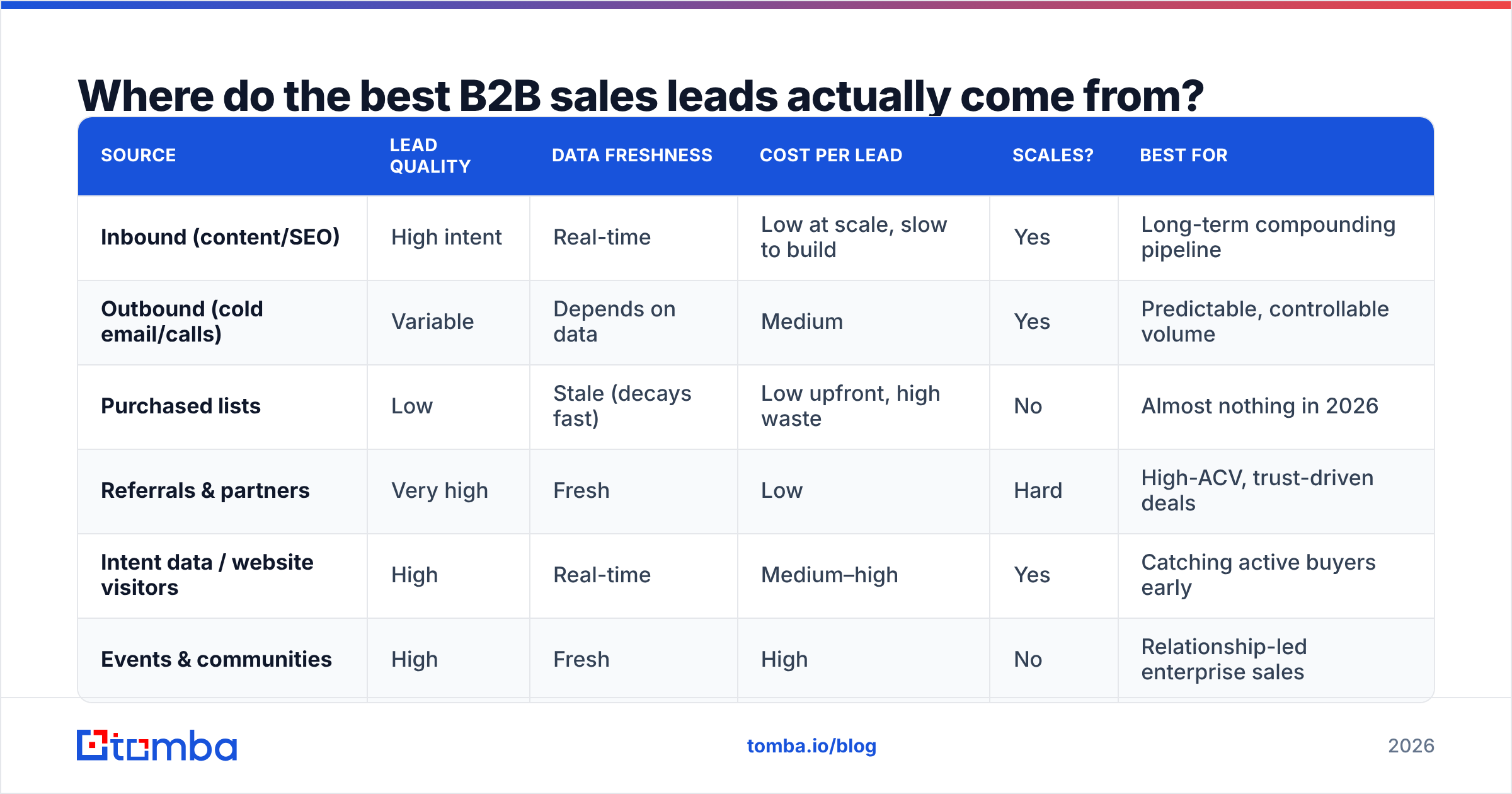
There's no single best channel — there's the best mix for your motion. Here's how the major sources compare on the attributes that matter when you're building a 2026 pipeline.
| Source | Lead quality | Data freshness | Cost per lead | Scales? | Best for |
|---|---|---|---|---|---|
| Inbound (content/SEO) | High intent | Real-time | Low at scale, slow to build | Yes | Long-term compounding pipeline |
| Outbound (cold email/calls) | Variable | Depends on data | Medium | Yes | Predictable, controllable volume |
| Purchased lists | Low | Stale (decays fast) | Low upfront, high waste | No | Almost nothing in 2026 |
| Referrals & partners | Very high | Fresh | Low | Hard | High-ACV, trust-driven deals |
| Intent data / website visitors | High | Real-time | Medium–high | Yes | Catching active buyers early |
| Events & communities | High | Fresh | High | No | Relationship-led enterprise sales |
The pattern is clear: freshness and intent beat raw volume. A purchased list looks cheap until you count the bounces, the spam complaints, and the reps' wasted hours. Outbound only works when the underlying data is accurate — which is why sourcing and verification are inseparable.
A strong 2026 stack usually runs two engines in parallel: inbound to capture demand that already exists, and outbound to create demand on your terms. Outbound is where data tooling earns its keep, because you control exactly who enters the funnel.
A note on buying lists#
Buying a static list of "50,000 B2B contacts" is the single most common way to waste a quarter. Those records were scraped once, sold many times, and never re-verified. People change jobs every 2–3 years, so a two-year-old list is roughly half wrong. You're better off finding 500 current contacts that match your ICP than renting 50,000 ghosts.
How do you build a repeatable B2B lead engine?#
Conclusion first: a lead engine is a four-stage assembly line — define, source, verify, score — and every stage exists to protect the next one. Skip a stage and the cost shows up downstream as wasted rep time.
1. Define the ICP. Write down firmographics (industry, headcount, revenue, geography, tech stack) and the buyer persona (title, department, the pain you solve). This is your filter for everything else. Vague ICP = noisy pipeline.
2. Source the contacts. Find the people at companies that match. Use domain search to pull every known email pattern and contact at a target company, or work from a list of names and let an email finder resolve each address. For account-based plays, start with the company and work down to the right titles.
3. Verify and enrich. Before a single send, confirm the address is deliverable and add context — role, seniority, LinkedIn, phone. An email verifier catches invalid and risky addresses; data enrichment fills the gaps your reps need to personalize. This is the stage that protects your sender reputation.
4. Score and route. Rank leads against the ICP and observed intent, then route only the qualified ones to reps. Everything below the bar goes to nurture, not to a person's calendar.
Run this loop weekly and your pipeline stops being a feast-or-famine guessing game. The leads that reach a rep are already current, deliverable, and on-profile.
How do you qualify a B2B sales lead so reps don't waste time?#
Use a framework, not a gut feeling. The two most durable ones:
- BANT — Budget, Authority, Need, Timing. Simple, fast, great for transactional deals.
- MEDDIC — Metrics, Economic buyer, Decision criteria, Decision process, Identify pain, Champion. Heavier, better for complex enterprise cycles.
Whichever you pick, encode it as a gate, not a suggestion. A lead doesn't become an SQL because a rep "feels good" about it; it becomes an SQL when it clears the gate. That discipline is what keeps your forecast honest and your win rate from sliding.
Scoring tip: weight fit and intent separately. A perfect-fit account with zero engagement is a nurture target. A poor-fit account hammering your pricing page is a curiosity, not a deal. The leads worth a rep's hour score high on both axes.
What data quality do B2B sales leads need before outreach?#
Three things, in order: the contact has to be real, current, and deliverable. Miss any one and the outreach either bounces or lands in front of the wrong person.
Here's why this matters more in 2026 than it did even two years ago. Mailbox providers — Google and Microsoft especially — now score senders aggressively. A bounce rate above ~2% or a spike in spam complaints can quietly tank your inbox placement for every campaign, not just the bad one. Bad data doesn't just waste the lead in front of you; it poisons the well for the good ones behind it. Google's own sender guidelines spell out how unauthenticated, high-complaint mail gets throttled.
So the verification step isn't optional hygiene — it's the thing standing between you and a deliverability cliff. A practical pre-send checklist:
- Syntax + domain valid — the address is well-formed and the domain accepts mail.
- Mailbox exists — SMTP confirms the inbox is real, not a guess.
- Catch-all flagged — domains that accept everything need separate handling; a catch-all verifier tells you which addresses are genuinely risky.
- Role/disposable filtered — strip
info@,sales@, and throwaway domains from cold sequences.
Running a bulk verify pass before every campaign keeps your list clean at scale. It's the cheapest insurance you'll buy all quarter. For the full picture on what protects inbox placement, the email deliverability glossary entry is a solid primer.
Which tools help you find and verify B2B sales leads?#
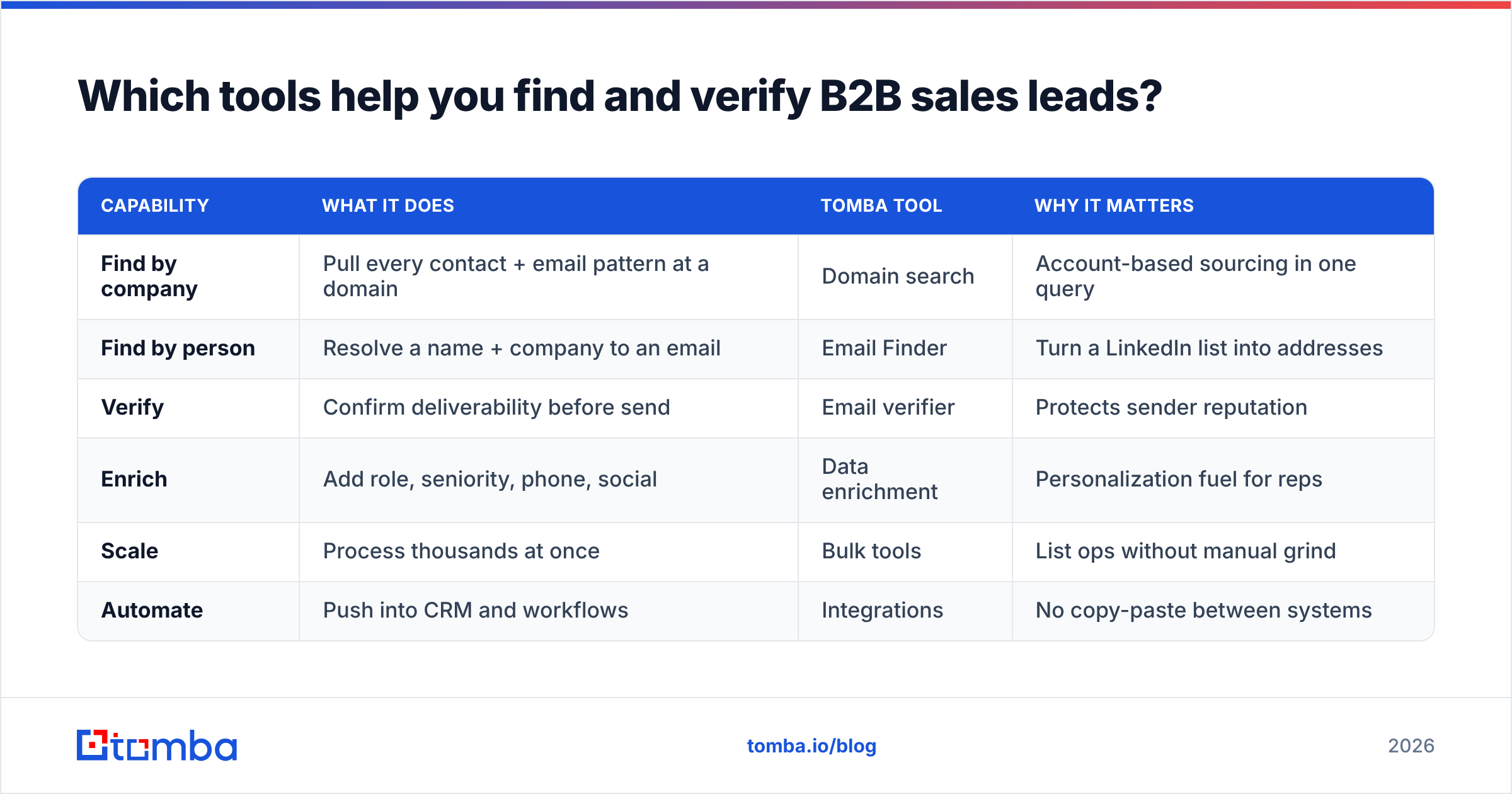
You need three capabilities — finding, verifying, and enriching — and you want them to share one source of truth so a contact flows cleanly from "discovered" to "sales-ready."
| Capability | What it does | Tomba tool | Why it matters |
|---|---|---|---|
| Find by company | Pull every contact + email pattern at a domain | Domain search | Account-based sourcing in one query |
| Find by person | Resolve a name + company to an email | Email Finder | Turn a LinkedIn list into addresses |
| Verify | Confirm deliverability before send | Email verifier | Protects sender reputation |
| Enrich | Add role, seniority, phone, social | Data enrichment | Personalization fuel for reps |
| Scale | Process thousands at once | Bulk tools | List ops without manual grind |
| Automate | Push into CRM and workflows | Integrations | No copy-paste between systems |
The advantage of a single platform is continuity. You find a contact, verify it, enrich it, and sync it to your CRM without exporting CSVs four times. For teams already living in HubSpot or Salesforce, the HubSpot integration and Salesforce integration keep the lead record current automatically.
Cost-wise, real-time finding scales sanely. Tomba's pricing runs Free (25 searches/mo), Starter at $49/mo, Growth at $99/mo, and Pro at $249/mo — you can check the current breakdown on the Tomba pricing page. Compared with the sunk cost of a stale purchased list, paying per current, verified contact is the cheaper math by a wide margin.
How many B2B sales leads do you actually need?#
Work backward from revenue, not forward from activity. This is the single most useful habit a lead engine can build.
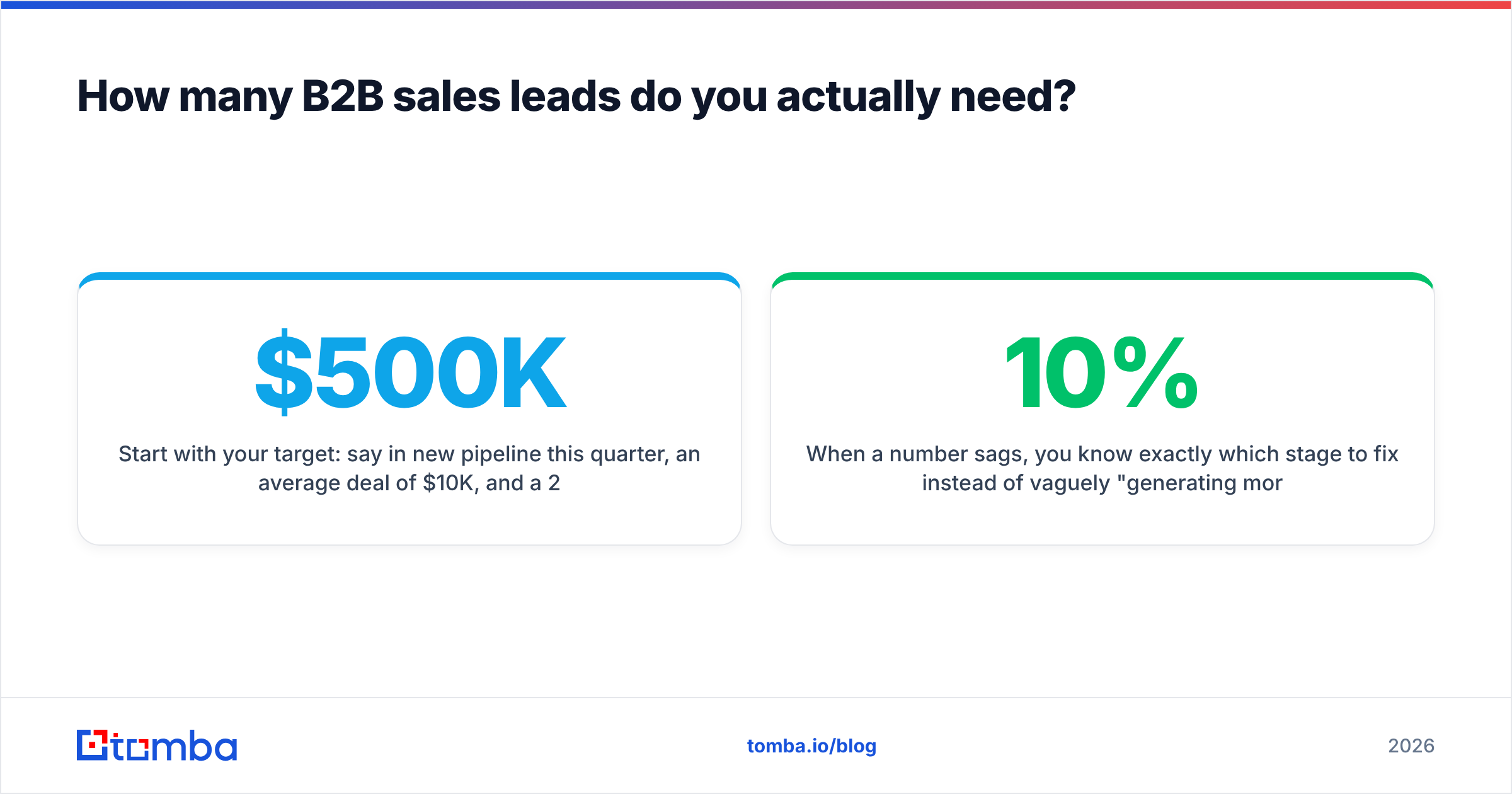
Start with your target: say $500K in new pipeline this quarter, an average deal of $10K, and a 20% close rate from SQL. That's 50 closed deals needed → 250 SQLs. If 1 in 4 qualified leads becomes an SQL, you need ~1,000 qualified leads. If your sourced-to-qualified rate is 40%, you need ~2,500 sourced contacts.
Now the quality point lands hard: those 2,500 contacts have to be real and deliverable, or the funnel math breaks at the very first stage. Source 2,500 ghosts and you'll be lucky to qualify 400. This is exactly why verification sits upstream — it protects every conversion rate below it.
Track these four numbers monthly:
- Sourced → Qualified — is your ICP tight enough?
- Qualified → SQL — is your scoring gate calibrated?
- SQL → Opportunity — are reps working the right leads?
- Opportunity → Won — is the response rate and messaging landing?
When a number sags, you know exactly which stage to fix instead of vaguely "generating more leads." Most teams over-invest in volume and under-invest in the conversion rates — a 10% lift in qualified-to-SQL is worth more than doubling raw sourcing.
What's the biggest mistake teams make with B2B sales leads?#
Confusing volume with progress. A dashboard showing 10,000 "leads" feels like winning right up until you notice 9,200 of them will never buy, half the emails bounce, and your reps are exhausted chasing noise.
The fix is a mindset shift: treat lead generation as a quality pipeline with a verification gate, not a quantity contest. Fewer, current, on-ICP, deliverable contacts will out-convert a giant stale list every single quarter. You'll send less email, protect your domain, and give reps a list they actually trust.
The second mistake is letting data rot. Even a great list decays — people switch jobs, companies rebrand, domains change. Re-verify before each campaign and re-enrich quarterly. A lead engine is a living system, not a one-time purchase.
Where should you start?#
Start at the top of the assembly line: get your sourcing and verification right, and everything downstream improves on its own.
If you're building or rebuilding your B2B lead engine in 2026, the fastest first win is turning your target account list into verified, ready-to-contact people. Use the Tomba Email Finder to resolve names and domains into professional emails, run them through the email verifier to strip the bounces, and sync the survivors straight into your CRM. You can test the whole flow on the free tier (25 searches/mo) before committing, and scale into a paid plan once it's filling your pipeline. Spin up fewer, better leads — and let your reps spend their hours on buyers who actually pick up.
// get started
Find, verify and enrich your first contacts today
Start on the free plan with 25 searches a month, then scale when your team is ready.
Free plan · No credit card required · GDPR & CCPA
// about the author