B2B Sales Tech Stack 2026: Tools, Costs & What to Buy
A no-fluff guide to building a B2B sales tech stack in 2026 — the five layers that matter, what each tool actually costs, and how to avoid paying for shelfware.
TL;DR
- B2B sales tech is the layered set of tools — data, engagement, CRM, intelligence, and enablement — that turns a target market into booked revenue. Most teams over-buy on engagement and under-invest on data quality.
- A lean, high-performing stack in 2026 needs five layers, not fifteen logos. Bad contact data quietly breaks every layer above it.
- Expect to spend roughly $80–$250 per rep per month on a focused stack; bloated stacks hit $600+ with no extra pipeline to show for it.
- Buy data and verification first, outreach second, AI assistants last. The order matters more than the brands.
- Tomba covers the data layer — finding and verifying business emails by domain, name, or company — so the rest of your stack runs on contacts that actually deliver.
What is B2B sales tech?#
B2B sales tech is the collection of software a revenue team uses to find buyers, reach them, manage the relationship, and forecast the outcome. Think of it like a kitchen: the CRM is the fridge where everything is stored, the data tools are your grocery supply, outreach platforms are the stove, and analytics is the thermometer that tells you whether the dish is actually cooked.
The category exploded over the last decade. G2 now lists thousands of sales products across dozens of sub-categories, and the average B2B team juggles ten or more tools. That sprawl is the core problem in 2026: more logos rarely means more pipeline. The teams that win treat their stack as a system with clear layers, where each tool feeds clean inputs to the next.
The single most common failure is starting at the wrong end. Teams buy a slick outreach sequencer or an AI SDR before they have accurate contact data, then wonder why open rates crater and domains get blacklisted. Garbage in, garbage out — and in cold outreach, garbage also damages your sender reputation.
)
What are the layers of a modern B2B sales stack?#
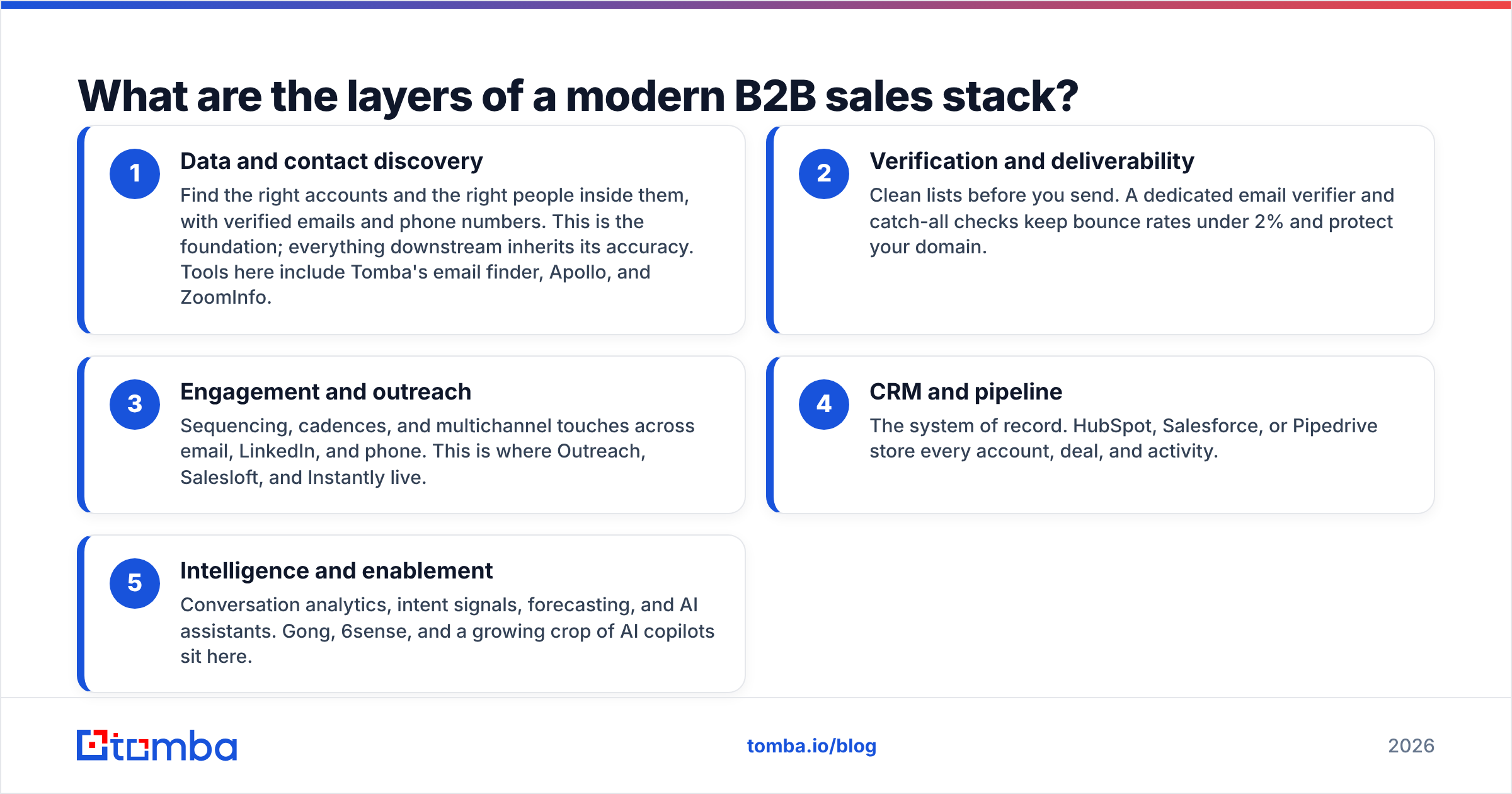
A practical 2026 stack has five layers. You can run a serious outbound motion with one tool in each. Anything beyond that should earn its seat.
- Data and contact discovery — Find the right accounts and the right people inside them, with verified emails and phone numbers. This is the foundation; everything downstream inherits its accuracy. Tools here include Tomba's email finder, Apollo, and ZoomInfo.
- Verification and deliverability — Clean lists before you send. A dedicated email verifier and catch-all checks keep bounce rates under 2% and protect your domain.
- Engagement and outreach — Sequencing, cadences, and multichannel touches across email, LinkedIn, and phone. This is where Outreach, Salesloft, and Instantly live.
- CRM and pipeline — The system of record. HubSpot, Salesforce, or Pipedrive store every account, deal, and activity.
- Intelligence and enablement — Conversation analytics, intent signals, forecasting, and AI assistants. Gong, 6sense, and a growing crop of AI copilots sit here.
The order is also the priority order for spending. If your budget is tight, fund layers one and two completely before touching layer five. An AI assistant writing flawless emails to unverified addresses is an expensive way to land in spam.
How much does a B2B sales tech stack cost in 2026?#
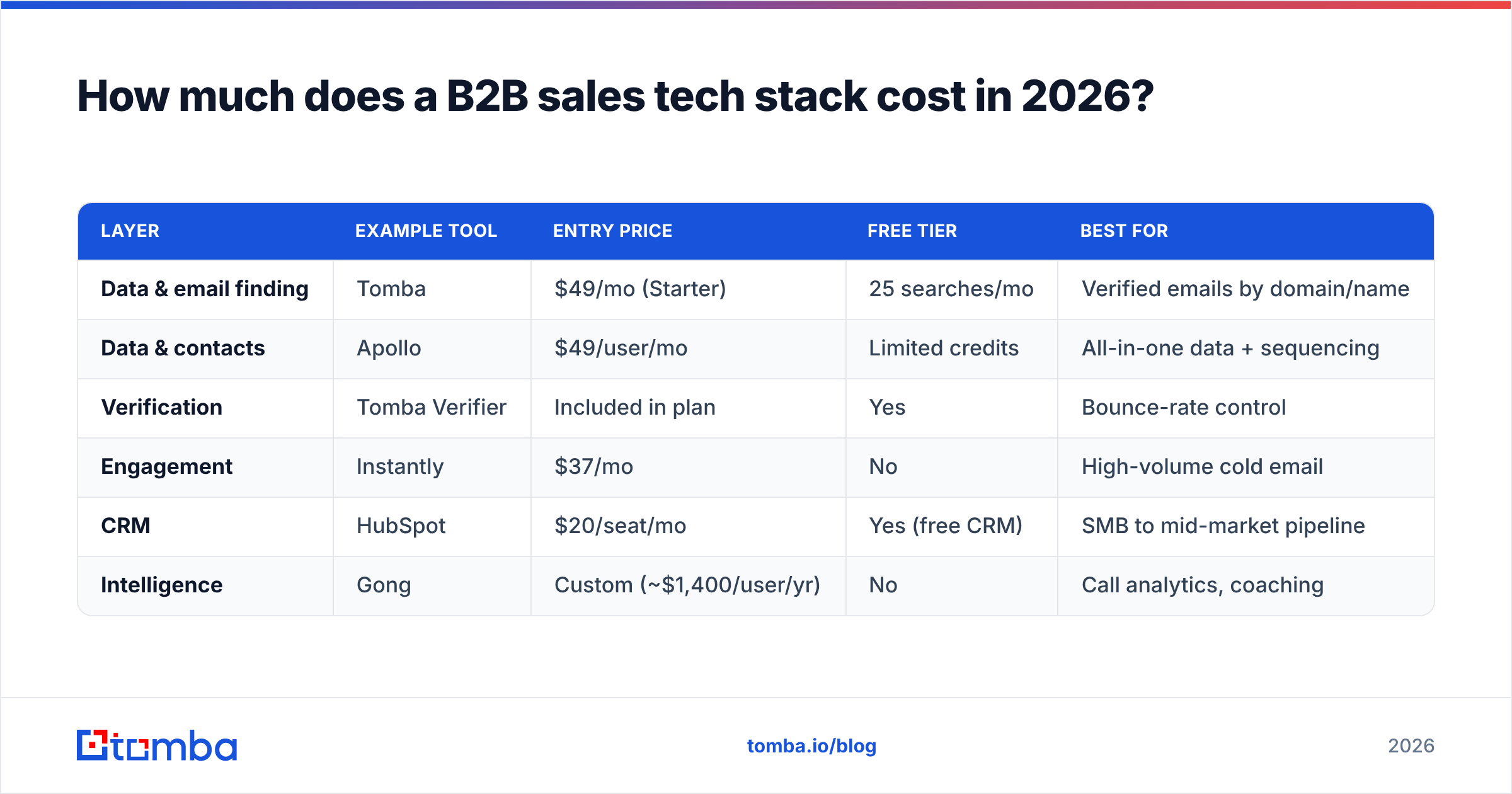
Cost scales with seats and data volume, not feature count. Here is a realistic per-tool comparison for a mid-market outbound team, using published 2026 entry pricing where available.
| Layer | Example tool | Entry price | Free tier | Best for |
|---|---|---|---|---|
| Data & email finding | Tomba | $49/mo (Starter) | 25 searches/mo | Verified emails by domain/name |
| Data & contacts | Apollo | $49/user/mo | Limited credits | All-in-one data + sequencing |
| Verification | Tomba Verifier | Included in plan | Yes | Bounce-rate control |
| Engagement | Instantly | $37/mo | No | High-volume cold email |
| CRM | HubSpot | $20/seat/mo | Yes (free CRM) | SMB to mid-market pipeline |
| Intelligence | Gong | Custom (~$1,400/user/yr) | No | Call analytics, coaching |
A focused five-layer stack for a small team lands around $80–$250 per rep per month. The bloat trap is buying overlapping tools — two data providers, three sequencers, a separate verifier you forgot you already had bundled — which pushes spend past $600 per rep with no measurable lift. Check Tomba pricing against whatever bundle you are evaluating; the data layer is usually where teams overpay for redundant credits.
A useful rule: every tool should map to a layer, and every layer should have exactly one primary tool. If you can't name the layer a subscription serves, cancel it.
Why does data quality decide everything else?#
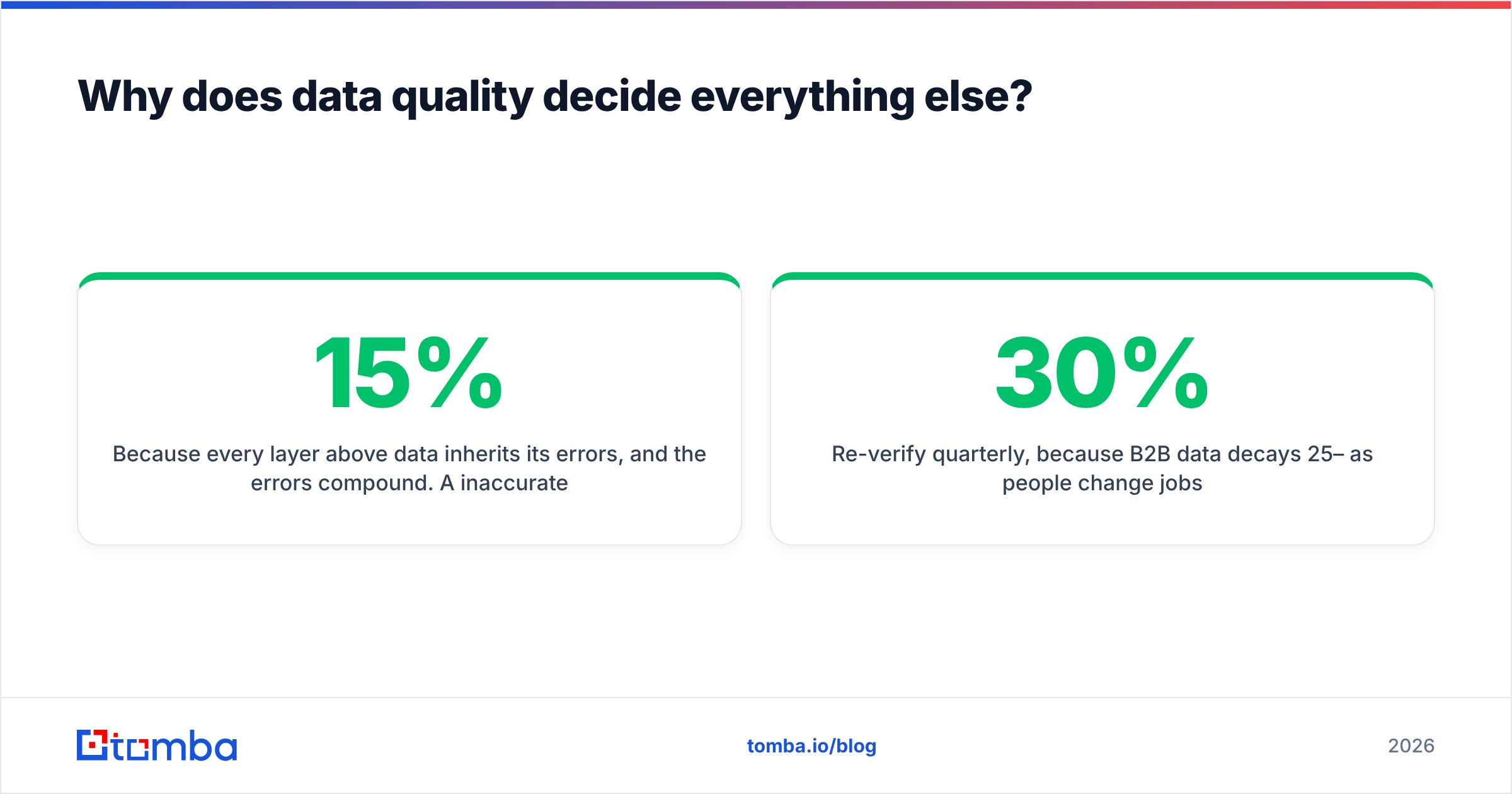
Because every layer above data inherits its errors, and the errors compound. A 15% inaccurate contact list doesn't cost you 15% of pipeline — it costs you bounced sends, a damaged sender reputation, throttled deliverability, and reps wasting hours on dead records. The downstream tax is far larger than the upstream error.
This is why email deliverability starts with data hygiene, not warmup tricks. Mailbox providers judge you on bounce rate, spam complaints, and engagement. Sending to unverified or catch-all addresses spikes bounces and tanks your domain reputation before a single warmup tool can help.
A clean data workflow looks like this:
- Find contacts by domain or name through an email finder rather than guessing patterns.
- Verify every address with SMTP-level checks before it enters a sequence.
- Handle catch-alls explicitly with a catch-all verifier instead of treating them as valid.
- Enrich records with title, company, and phone so reps personalize without manual research.
- Re-verify quarterly, because B2B data decays 25–30% per year as people change jobs.
Get this layer right and your open rates, reply rates, and forecast accuracy all improve at once — without buying anything new.
)
How do you choose between all-in-one platforms and best-of-breed tools?#
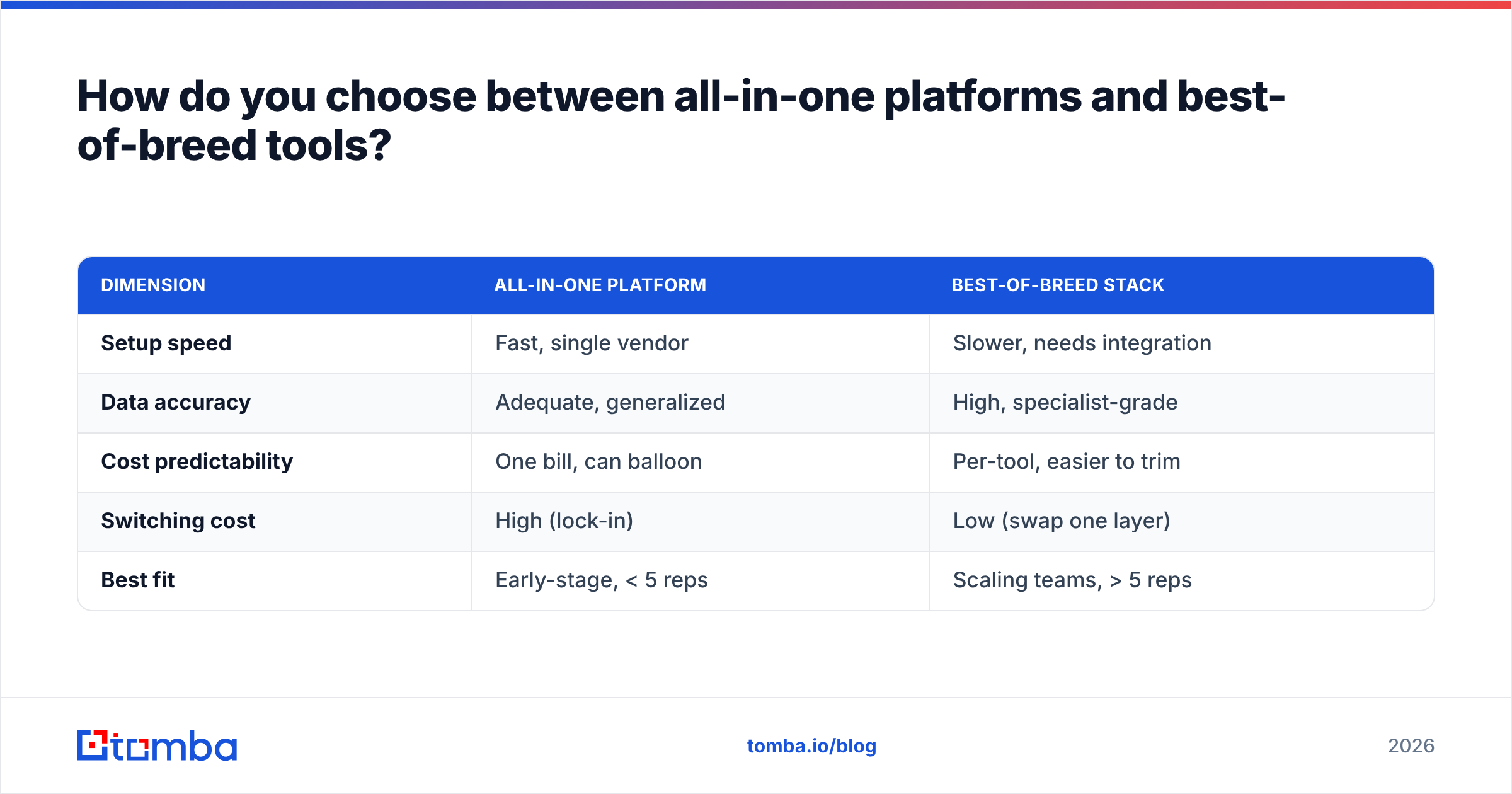
The trade-off is convenience versus depth. All-in-one platforms like Apollo bundle data, sequencing, and basic CRM, which is appealing for a small team that wants one login and one invoice. Best-of-breed stacks pair specialists — a dedicated data provider, a dedicated sequencer, a dedicated CRM — which costs more coordination but usually wins on quality in each layer.
Here is how the two approaches compare on the dimensions that matter:
| Dimension | All-in-one platform | Best-of-breed stack |
|---|---|---|
| Setup speed | Fast, single vendor | Slower, needs integration |
| Data accuracy | Adequate, generalized | High, specialist-grade |
| Cost predictability | One bill, can balloon | Per-tool, easier to trim |
| Switching cost | High (lock-in) | Low (swap one layer) |
| Best fit | Early-stage, < 5 reps | Scaling teams, > 5 reps |
For most teams scaling past a handful of reps, a hybrid works best: a specialist data layer feeding an all-in-one engagement-plus-CRM platform. You get accurate contacts where it counts and a single workflow where it helps. Tools like the Tomba API and native integrations make this hybrid practical — verified contacts flow straight into HubSpot, Salesforce, or your sequencer without CSV gymnastics.
Whatever you choose, validate it on independent review sites. Cross-check vendor claims against G2 and Capterra before you sign, and read the actual data-coverage methodology rather than the marketing headline.
What role does AI play in the 2026 sales stack?#
AI moved from novelty to plumbing. The useful applications cluster in three buckets: research and enrichment (summarizing accounts, surfacing intent), content generation (drafting first-touch emails and call follow-ups), and analytics (scoring deals, predicting churn, flagging at-risk forecasts). HubSpot's research and similar industry reports show adoption is now mainstream across mid-market teams.
The trap is treating AI as a strategy instead of a layer. An AI SDR that auto-sends to bad data scales your mistakes. AI is a multiplier — it amplifies whatever you feed it. Pair it with a clean data foundation and it saves real hours; bolt it onto a broken stack and it produces confident, well-written failure at volume.
The pragmatic 2026 move: use AI for research and drafting where a human still reviews, lean on analytics for forecasting, and keep humans on relationship-defining moments. Let the data and verification layers stay deterministic — you want certainty, not creativity, about whether an email address exists.
How do you avoid sales-tech bloat?#
Run an annual stack audit with three questions per tool: Which layer does it serve? What metric did it move in the last quarter? Could an existing tool cover this? Anything that fails two of the three is a cancellation candidate.
A few concrete guardrails:
- One primary tool per layer. Redundancy is the most common source of waste.
- Tie every renewal to a metric. No metric, no renewal.
- Centralize data spend. Scattered credit purchases across tools cost more than one bulk plan.
- Watch integration debt. Each connection is a maintenance cost; favor tools with native, supported integrations.
Bloat isn't just a budget problem — it's an adoption problem. Reps use fewer tools well rather than many tools poorly. A tight stack that everyone actually uses beats a comprehensive one that sits idle.
Frequently asked questions#
What is the minimum viable B2B sales stack? A data-and-verification tool, an engagement platform, and a CRM. Three layers, three tools, and you can run a real outbound motion. Add intelligence and AI only once those three are humming.
Should startups buy enterprise tools early? Usually no. Enterprise platforms like Gong or 6sense deliver value at scale you don't have yet. Start with a free CRM, a focused email finder, and a lightweight sequencer, then upgrade layers as volume justifies it.
How often should I clean my contact data? Quarterly at minimum. B2B data decays 25–30% annually, so a list verified in January is meaningfully stale by summer. Build re-verification into your workflow rather than treating it as a one-time project.
Does more tooling mean more pipeline? No. Past the five core layers, additional tools correlate with cost, not closed revenue. The lever is data quality and process discipline, not logo count.
Building your stack the right way#
Start at the foundation. Before you compare sequencers or AI copilots, make sure the contacts entering your funnel are real, verified, and enriched — because every dollar you spend above the data layer is wasted on a bad address. Tomba's Email Finder finds professional emails by domain, name, or company and verifies them before they ever reach your outreach tool, with a free tier to test on your own target accounts and Starter plans from $49/mo when you scale. Get the data layer right first, and the rest of your 2026 sales tech stack finally has something solid to stand on.
// get started
Find, verify and enrich your first contacts today
Start on the free plan with 25 searches a month, then scale when your team is ready.
Free plan · No credit card required · GDPR & CCPA
// about the author