B2B Sales Trends 2026: 9 Shifts That Move Revenue Now
The B2B sales trends shaping 2026 — AI SDRs, signal-based selling, buying committees, and data hygiene — plus what to actually do about each.
TL;DR
- AI now handles research, drafting, and routing — but reps win on judgment, timing, and relationships. The teams that pair both outperform either alone.
- Signal-based selling has replaced volume-first outbound. You reach fewer people, but you reach the right ones at the right moment.
- Buying committees grew, not shrank. The average B2B deal now involves 6–10 stakeholders, so multithreading is no longer optional.
- Data decay is the silent killer. Roughly 30% of B2B contact data goes stale each year, and bad data quietly wrecks every other trend on this list.
- The fix is boring and powerful: accurate contact data, verified before you send, enriched with context. That is where pipeline actually starts.
What are the biggest B2B sales trends in 2026?#
The short version: selling got smarter, not louder. The teams pulling ahead in 2026 stopped chasing volume and started chasing precision — fewer touches, better targeting, cleaner data, and AI doing the grunt work so humans can do the human work.
That sounds simple. In practice it reorganizes how you staff, what tools you buy, and which metrics you trust. Below are the nine shifts worth your attention, ranked by how directly they move revenue — and what to do about each one this quarter, not "someday."
Most of these trends share a hidden dependency: they only work if the underlying contact and account data is accurate. We will come back to that, because it is the trend everyone underrates.
Trend 1: AI does the research, humans close the deal#
Generative AI moved from novelty to default. In 2026, expecting a rep to manually research 50 accounts a day is like expecting an accountant to use an abacus. AI summarizes a prospect's funding, tech stack, recent hires, and news in seconds, then drafts a first-pass message.
But here is the nuance the hype missed: AI-written cold email at scale is getting filtered, ignored, and penalized. Buyers can smell a template. The winning pattern is AI-assisted, human-finished — AI gathers context and proposes angles, the rep adds the one specific, true detail that proves a person actually paid attention.
What to do: Use AI for the 80% that is mechanical (research, list-building, first drafts, CRM data entry) and protect the 20% that is judgment (which angle, which timing, which stakeholder, what to actually say).
Trend 2: Signal-based selling beats spray-and-pray#
The volume era is over. Mailbox providers tightened bulk-sending rules, and prospects' tolerance for irrelevant outreach hit zero. The replacement is signal-based selling: you act on a trigger — a funding round, a job change, a new tool in their stack, a website visit — instead of blasting a static list.
Signals turn "Hi {FirstName}" into "Congrats on the Series B — teams usually rethink X right after that raise." One is noise. The other is a conversation.
To run signals well you need two things working together: a reliable way to detect the trigger, and an accurate way to reach the person behind it. A great signal with a bounced email address is worth nothing. This is why a connected stack — intent data plus a dependable email finder plus enrichment — beats a pile of disconnected point tools.
Trend 3: Buying committees got bigger, so multithreading is mandatory#
Single-threaded deals die when your champion changes jobs — and in 2026, people change jobs constantly. The typical B2B purchase now pulls in 6 to 10 stakeholders across functions: the user, the economic buyer, IT, security, finance, and at least one skeptic.
If you are only talking to one contact, you are one reorg away from a closed-lost. Multithreading — mapping and engaging the full committee — is now a core competency, not a nice-to-have. That means you need contact data for the whole account, not just the one name your SDR found on LinkedIn.
Tools like domain search let you pull every reachable contact at a target company so you can map the committee before the first call, instead of discovering hidden decision-makers in week six.
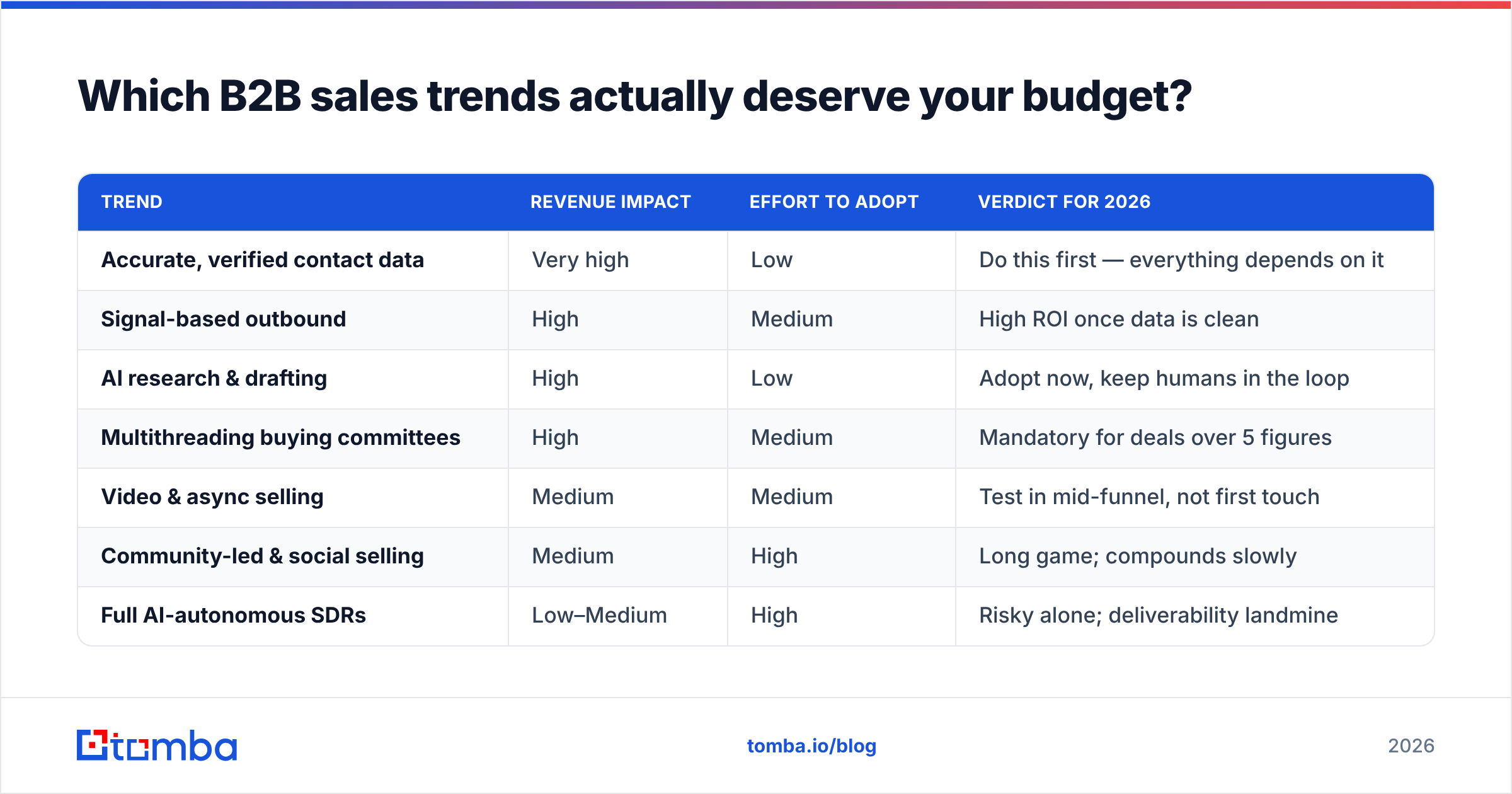
Which B2B sales trends actually deserve your budget?#
Not all trends are equal. Some change how you work; others just change the slide deck. Here is an honest read on where 2026 budget produces return versus where it produces noise.
| Trend | Revenue impact | Effort to adopt | Verdict for 2026 |
|---|---|---|---|
| Accurate, verified contact data | Very high | Low | Do this first — everything depends on it |
| Signal-based outbound | High | Medium | High ROI once data is clean |
| AI research & drafting | High | Low | Adopt now, keep humans in the loop |
| Multithreading buying committees | High | Medium | Mandatory for deals over 5 figures |
| Video & async selling | Medium | Medium | Test in mid-funnel, not first touch |
| Community-led & social selling | Medium | High | Long game; compounds slowly |
| Full AI-autonomous SDRs | Low–Medium | High | Risky alone; deliverability landmine |
| Pure cold-call volume plays | Low | High | Diminishing returns; pair with signals |
The pattern is hard to miss: the cheapest, highest-impact move sits at the top, and it is the least glamorous one. Clean data beats every shiny tactic stacked on top of dirty data.
Trend 4: Deliverability is now a sales metric, not an IT problem#
In 2026, your sender reputation is part of your pipeline. Stricter authentication requirements and aggressive spam filtering mean that a sloppy list can torch your domain's ability to land in any inbox — including warm ones.
The two habits that protect you: verify every address before you send, and never email a list you have not cleaned. An email verifier catches invalid and risky addresses before they generate bounces, and bounce rate is the single fastest way to wreck sender reputation. Treat verification as a pre-send firewall, not an afterthought.
If you want the deeper mechanics, the fundamentals of email deliverability haven't changed — but the penalties for ignoring them have gotten harsher.
Trend 5: Data decay quietly breaks everything else#
Here is the trend nobody puts on a keynote slide: B2B data rots. Industry estimates put contact data decay around 30% per year — people switch jobs, companies rebrand, domains change. A list you bought 18 months ago is closer to fiction than fact.
This is why data hygiene is the foundation under every other trend. Your AI research is wrong if the company data is stale. Your signals fire on people who left. Your multithreading map points at ghosts. According to analyst research summarized by firms like Gartner, data quality remains one of the top blockers to sales productivity.
What to do: build refresh into your workflow. Re-verify before campaigns, enrich on a schedule, and treat your CRM as a living system. Ongoing data enrichment keeps records current instead of letting them quietly decay into liability.
Trend 6: Personalization at scale — the right way#
"Personalization at scale" became a punchline because most teams did it badly: mail-merge a city name and call it personal. In 2026, real personalization means relevance, not name-dropping. It means referencing a problem the prospect actually has, tied to something true about their company.
AI makes this feasible at volume — but only when it is fed accurate, enriched inputs. Generic AI plus generic data equals generic spam, just faster. Specific AI plus enriched data equals messages that feel hand-written because they essentially are.
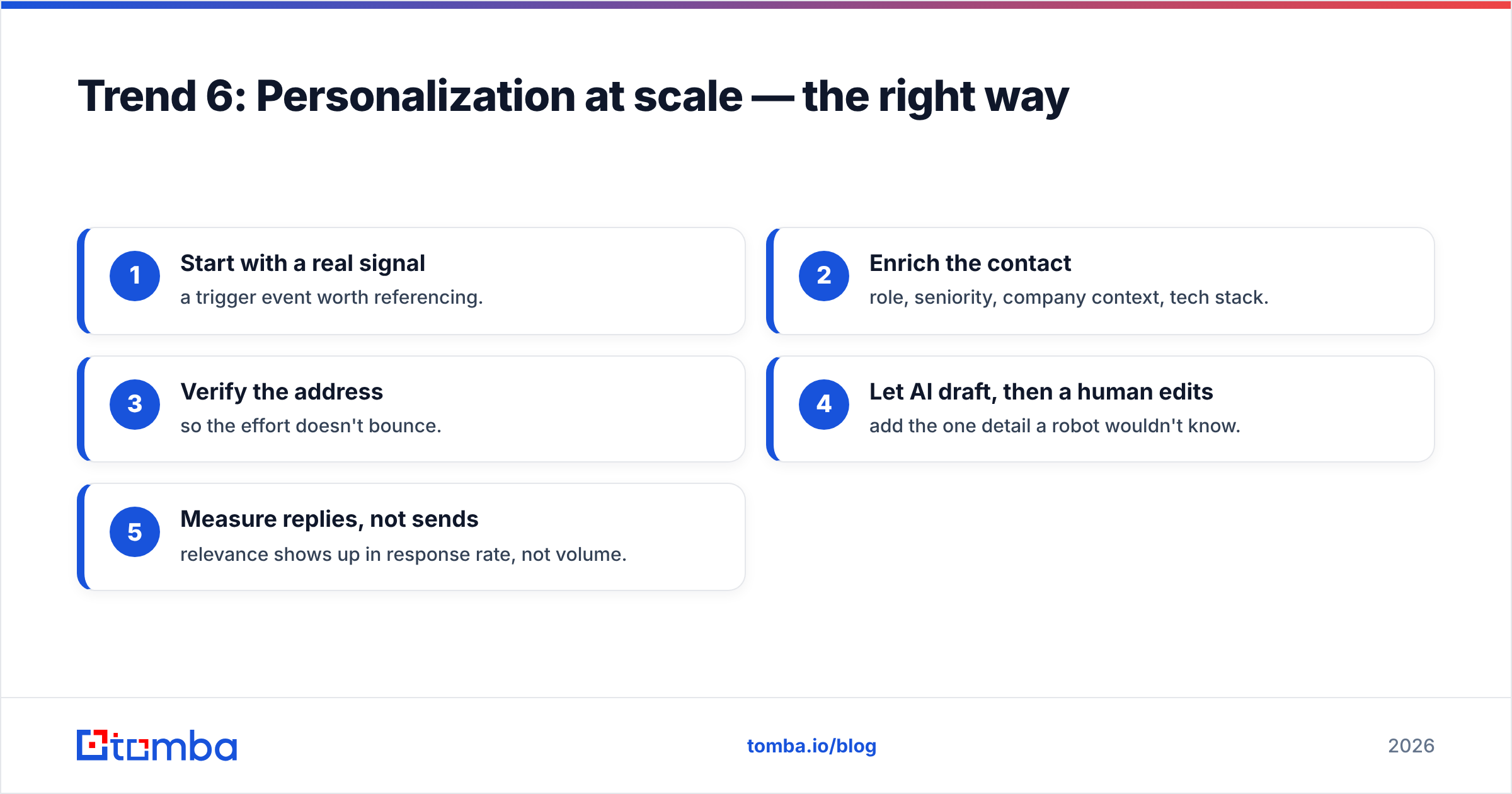
The practical recipe:
- Start with a real signal — a trigger event worth referencing.
- Enrich the contact — role, seniority, company context, tech stack.
- Verify the address — so the effort doesn't bounce.
- Let AI draft, then a human edits — add the one detail a robot wouldn't know.
- Measure replies, not sends — relevance shows up in response rate, not volume.
Trend 7: The rise of the full-funnel rep and RevOps#
Specialist silos are softening. The hard SDR-to-AE handoff that lost context at every step is giving way to leaner, full-funnel reps backed by strong revenue operations. RevOps owns the data, the tooling, and the definitions so reps spend time selling instead of fighting their stack.
This matters because trends 1 through 6 all create operational complexity. Someone has to own the signals, the enrichment cadence, the deliverability monitoring, and the AI guardrails. In 2026, that someone is RevOps — and the teams with mature RevOps functions adopt every other trend faster.
Trend 8: Phone is back — but only with the right number#
Cold calling never died; bad cold calling did. With inboxes crowded, a well-timed call to the right person at the right moment cuts through. The catch is the same as everywhere else: you need an accurate number, not a 2019 switchboard line.
Mobile-direct numbers, validated before dialing, turn calling from a coin flip into a channel. A phone finder plus a phone validator keeps your dial lists current so reps aren't burning hours on dead numbers. Pair the call with an email touch on the same signal and you get a multichannel sequence that actually connects.
Trend 9: Buyers self-educate, so sellers must add insight#
By the time a B2B buyer talks to you in 2026, they have already done most of their research. They don't need a feature walkthrough they could find on your website. They need insight — a perspective on their problem they couldn't get alone.
This reframes the rep's job from "information provider" to "insight provider." The reps who win bring data, benchmarks, and a point of view. That requires knowing the account cold before the conversation, which loops back, again, to research and enrichment quality.
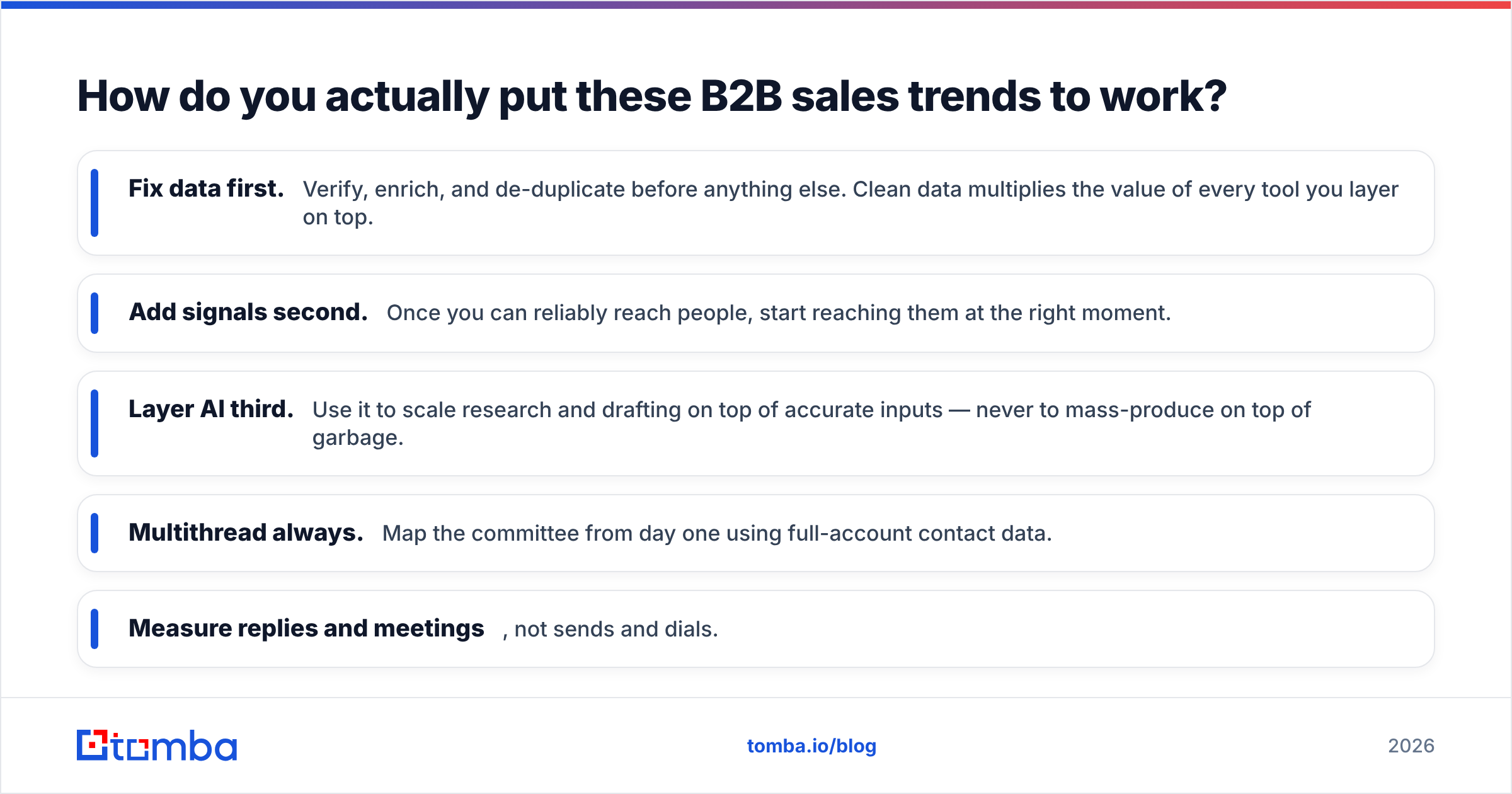
How do you actually put these B2B sales trends to work?#
Start from the bottom of the stack and build up. Most teams do it backwards — they buy the AI sequencer before they fix the data feeding it, and wonder why results stall.
Here's the order that compounds:
- Fix data first. Verify, enrich, and de-duplicate before anything else. Clean data multiplies the value of every tool you layer on top.
- Add signals second. Once you can reliably reach people, start reaching them at the right moment.
- Layer AI third. Use it to scale research and drafting on top of accurate inputs — never to mass-produce on top of garbage.
- Multithread always. Map the committee from day one using full-account contact data.
- Measure replies and meetings, not sends and dials.
If you only change one thing this quarter, make it data accuracy. Every trend on this list — AI, signals, personalization, phone, multithreading — degrades to noise without it, and quietly outperforms expectations with it. You can see how Tomba sources and maintains its records on the data sources page, and compare options on Tomba pricing, which starts free (25 searches/month) and scales to a $49/month Starter plan.
The bottom line#
The 2026 B2B sales trends all point the same direction: precision over volume, relevance over reach, and accurate data over guesswork. AI is an accelerator, not a substitute. Signals beat blasts. Committees beat single threads. And underneath all of it, clean contact data is the difference between a strategy that compounds and one that quietly leaks pipeline.
If you want to act on these trends instead of just reading about them, start where the impact is highest and the effort is lowest: getting accurate, verified contact data into your workflow. The Tomba Email Finder finds professional email addresses by domain, name, or company — verified before you ever hit send — so your AI, your signals, and your reps are all working from data that's actually real. Start free, and build the rest of your 2026 motion on a foundation that doesn't decay out from under you.
// get started
Find, verify and enrich your first contacts today
Start on the free plan with 25 searches a month, then scale when your team is ready.
Free plan · No credit card required · GDPR & CCPA
// about the author