What Does a B2B Salesman Do in 2026? Skills & Process
The modern B2B salesman isn't a smooth talker with a Rolodex. Here's the skills, daily process, and tech stack that actually close deals in 2026.
(title rendered separately)
The job title "B2B salesman" hides a role that has changed more in the last five years than in the previous fifty. The person who once won deals with a firm handshake and a thick contact book now runs a data-driven process, juggles six tools before lunch, and is measured on metrics that didn't exist a decade ago.
This guide breaks down what a B2B salesman actually does in 2026 — the skills that matter, the daily process that produces pipeline, the stack behind it, and the numbers that tell you whether any of it is working.
TL;DR#
- A B2B salesman sells products or services to other businesses, where deals are larger, cycles are longer, and multiple decision-makers are involved.
- The role has shifted from relationship-only selling to a research-heavy, process-driven discipline backed by accurate contact data.
- Top reps spend most of their week on prospecting, discovery, and follow-up — not pitching.
- The modern stack is built around four layers: data, outreach, CRM, and analytics. Bad data at the bottom poisons everything above it.
- Accuracy beats volume. Verified contacts and tight targeting consistently outperform spray-and-pray lists.
What is a B2B salesman?#
A B2B (business-to-business) salesman sells to organizations rather than individual consumers. Instead of convincing one shopper to buy a $40 product, you're convincing a buying committee — often five to ten people — to commit budget to a $40,000 contract that affects their whole team.
Think of it like the difference between selling lemonade on the corner and catering a corporate event. The lemonade stand is one decision, one buyer, instant cash. The catering deal involves a procurement lead, a finance approver, an office manager, and a skeptical executive who's been burned before. The B2B salesman's job is to guide all of them to "yes."
That structural difference shapes everything:
- Longer sales cycles — weeks to months, sometimes a full year for enterprise deals.
- Multiple stakeholders — you sell to a committee, not a person.
- Higher deal value — fewer transactions, but each one matters far more.
- Rational + emotional buying — buyers need an ROI case and the confidence that they won't get blamed if it fails.
- Relationship continuity — the deal isn't the end; renewals and expansion depend on the relationship you build.
)
What does a B2B salesman actually do all day?#
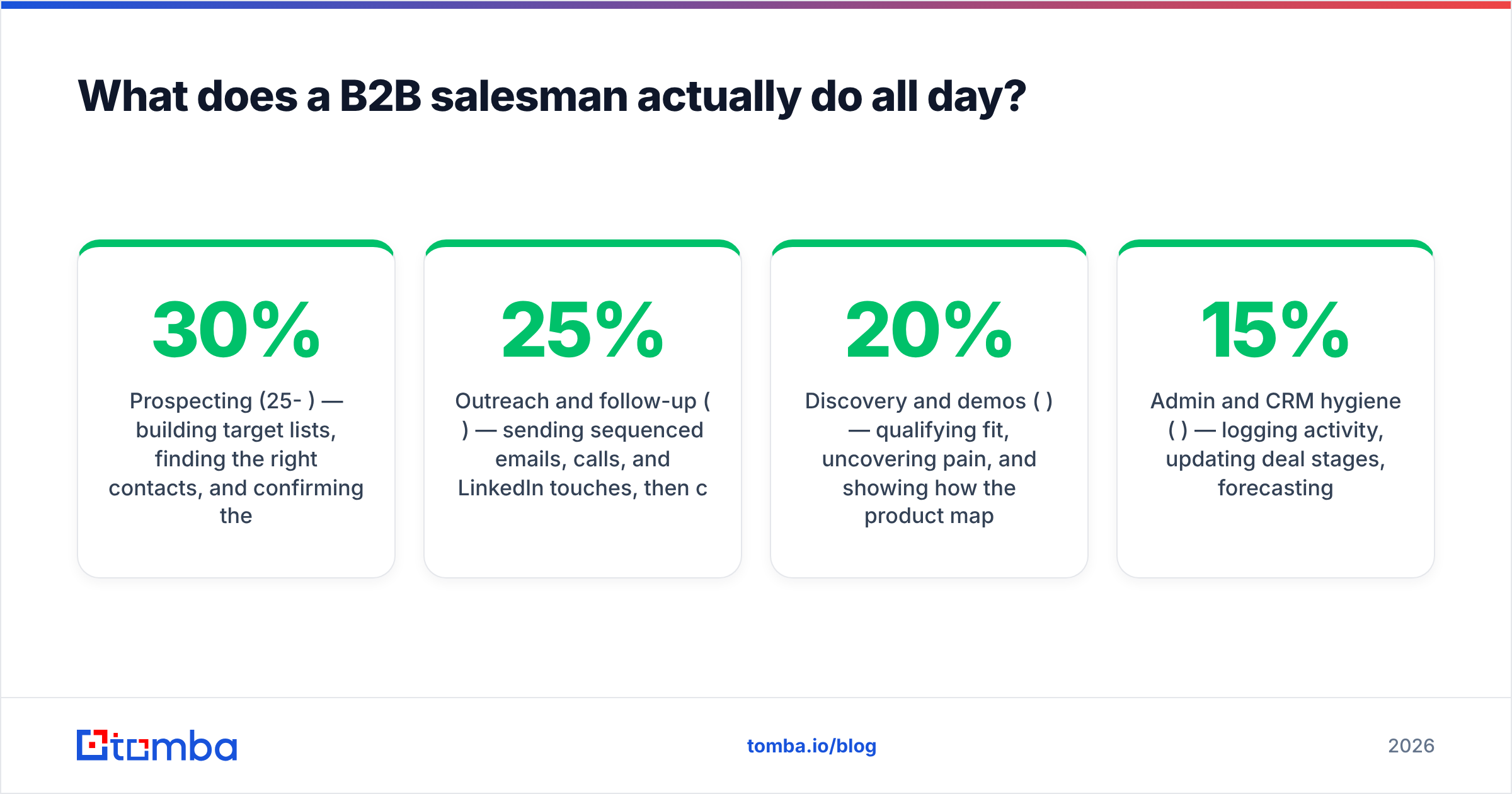
The cliché is that salespeople "pitch." In reality, pitching is a small slice of the week. Here's where a productive B2B salesman's time actually goes:
- Prospecting (25-30%) — building target lists, finding the right contacts, and confirming their details are accurate before outreach.
- Outreach and follow-up (25%) — sending sequenced emails, calls, and LinkedIn touches, then chasing the 80% of replies that only come after the third or fourth attempt.
- Discovery and demos (20%) — qualifying fit, uncovering pain, and showing how the product maps to it.
- Admin and CRM hygiene (15%) — logging activity, updating deal stages, forecasting.
- Learning and internal coordination (10%) — product training, deal reviews, looping in sales engineers or leadership.
The reps who win aren't the ones who pitch hardest. They're the ones who prospect into the right accounts with clean data and follow up relentlessly. A great pitch to the wrong person is still a wasted hour.
What skills does a modern B2B salesman need?#
The skill set has broadened. Charisma still helps, but it's now table stakes rather than the differentiator. Here are the capabilities that separate top performers in 2026:
- Research and account intelligence — understanding a prospect's business, triggers, and tech stack before the first touch.
- Written communication — most early outreach is text. A rep who writes tight, specific cold emails outperforms a smooth talker who can't get a meeting. Tools like a subject line generator help, but the thinking has to be yours.
- Data literacy — reading dashboards, knowing your conversion rates by stage, and adjusting based on numbers instead of gut feel.
- Discovery and listening — asking sharp questions and shutting up. The best reps talk less than half the time on discovery calls.
- Resilience and process discipline — the ability to run the same sequence on the 50th prospect with the same energy as the first.
- Tool fluency — being comfortable across a stack of data, outreach, and CRM tools without drowning in tab-switching.
What does the B2B sales process look like?#
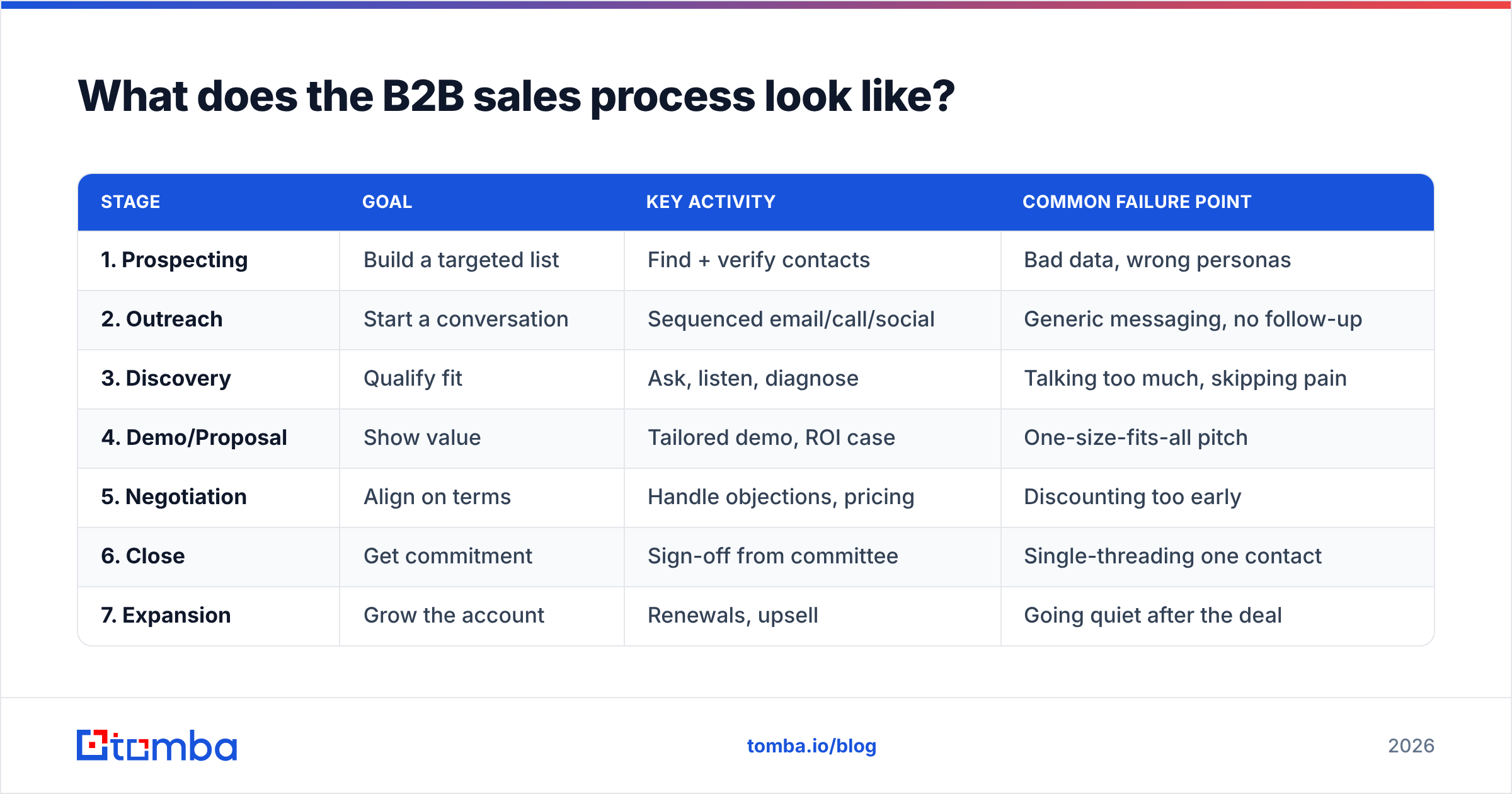
Most modern B2B teams run a version of this seven-stage pipeline. The exact names vary, but the shape is consistent across revenue operations teams.
| Stage | Goal | Key activity | Common failure point |
|---|---|---|---|
| 1. Prospecting | Build a targeted list | Find + verify contacts | Bad data, wrong personas |
| 2. Outreach | Start a conversation | Sequenced email/call/social | Generic messaging, no follow-up |
| 3. Discovery | Qualify fit | Ask, listen, diagnose | Talking too much, skipping pain |
| 4. Demo/Proposal | Show value | Tailored demo, ROI case | One-size-fits-all pitch |
| 5. Negotiation | Align on terms | Handle objections, pricing | Discounting too early |
| 6. Close | Get commitment | Sign-off from committee | Single-threading one contact |
| 7. Expansion | Grow the account | Renewals, upsell | Going quiet after the deal |
Notice that stage one feeds everything downstream. If your prospecting list is full of guessed email addresses and outdated job titles, your outreach bounces, your discovery calls never get booked, and your close rate craters. This is why serious teams treat contact data as the foundation, not an afterthought.
Why does contact data make or break a B2B salesman?#
Conclusion first: a B2B salesman is only as good as the data they prospect into. Everything else is leverage applied on top of that base.
Here's the chain reaction. A rep finds a promising account. They guess the decision-maker's email using a common pattern — first.last@company.com. It bounces. Now the rep has burned a real opportunity and damaged their sender reputation, which quietly tanks deliverability for every other prospect on the domain. One bad guess creates a ripple of invisible failures.
Accurate data does the opposite. Verified emails mean lower bounce rates, healthier email deliverability, and outreach that actually lands in the inbox. That's why the prospecting layer of the stack deserves real investment.
)
There are a few ways a B2B salesman sources contacts, each with trade-offs:
- Manual research — accurate but painfully slow; you'll find a dozen contacts an hour at best.
- Buying static lists — fast and cheap, but lists decay roughly 2-3% per month as people change jobs, so half your list is stale within a year.
- Email finder tools — find and verify contacts on demand, by name or domain, with verification baked in. This is where most modern teams land. You can use an email finder to pull a verified address in seconds, then run a domain search to map every relevant contact at a target company.
What tools belong in a B2B salesman's stack?#
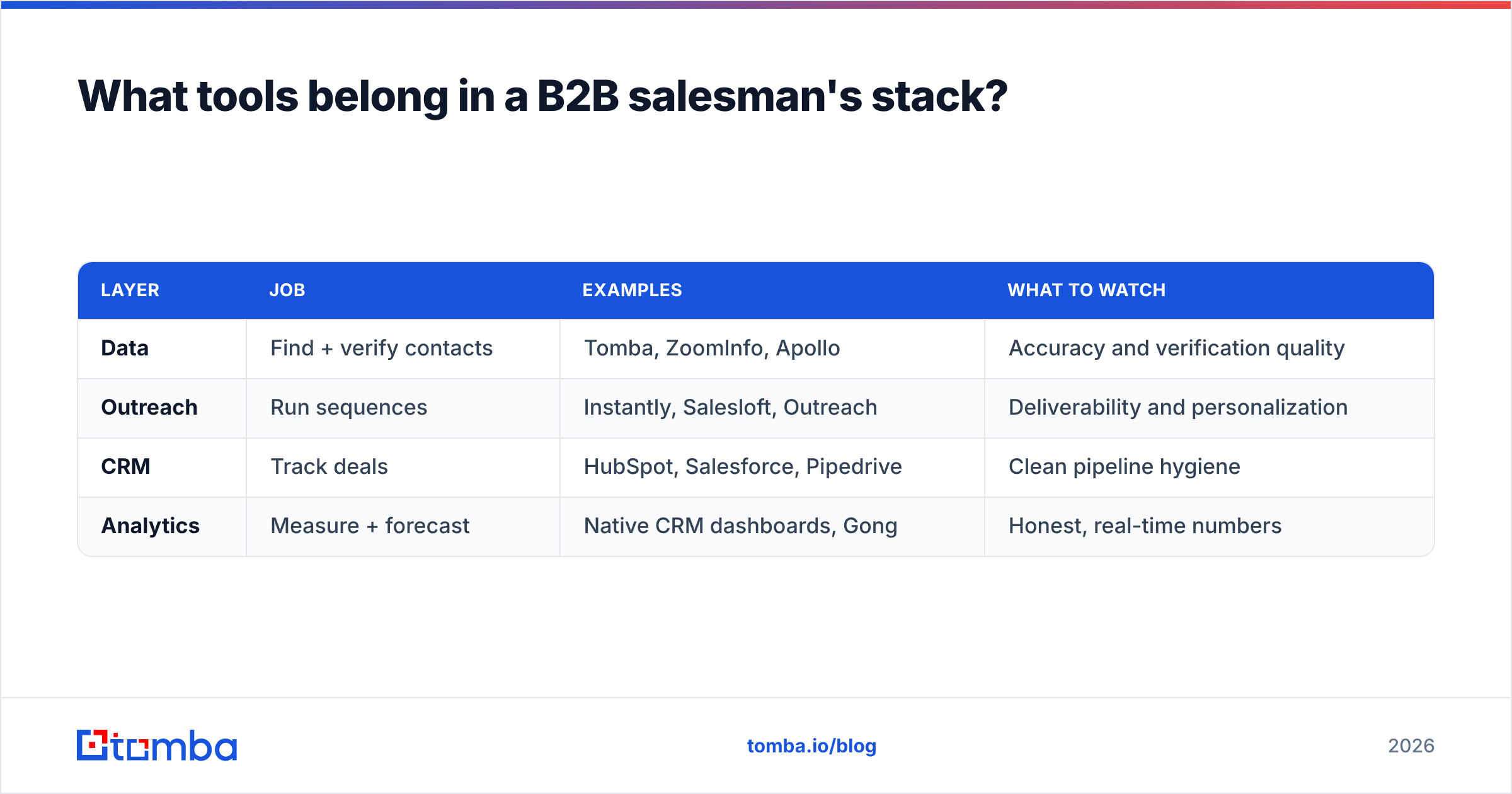
The modern stack has four layers. You don't need the most expensive option in each — you need the layers to connect cleanly so data flows from prospecting into outreach into your CRM without manual copy-paste.
| Layer | Job | Examples | What to watch |
|---|---|---|---|
| Data | Find + verify contacts | Tomba, ZoomInfo, Apollo | Accuracy and verification quality |
| Outreach | Run sequences | Instantly, Salesloft, Outreach | Deliverability and personalization |
| CRM | Track deals | HubSpot, Salesforce, Pipedrive | Clean pipeline hygiene |
| Analytics | Measure + forecast | Native CRM dashboards, Gong | Honest, real-time numbers |
A few practical notes on building it:
- Start with data, not outreach. A great sequencer firing at bad contacts just helps you fail faster.
- Verify before you send. Run new lists through an email verifier to catch dead addresses before they bounce.
- Keep the CRM the source of truth. Every tool should write back to it. Review platforms like G2 for integration depth before committing.
- Don't over-buy. Most reps use 20% of the features in enterprise platforms while paying for 100%. Match the tool to your actual motion.
Is the B2B salesman role dying because of AI?#
No — but it's being reshaped, and the reps who ignore that will get left behind.
AI is excellent at the repetitive, data-heavy parts of the job: drafting first-pass emails, enriching contact records, summarizing calls, and flagging which accounts show buying signals. According to research from analysts like Gartner, the trend is toward AI handling routine tasks while humans focus on judgment, relationships, and complex negotiation.
What AI can't replace is the part that was always the real job: building trust with a nervous buying committee, reading the room on a tense negotiation call, and knowing when to push versus when to wait. The B2B salesman of 2026 uses AI as an exoskeleton — more reach, more speed, more leverage — not as a replacement for the human at the center of the deal.
The practical takeaway: let automation handle the grunt work of finding and verifying contacts, then spend your reclaimed hours on conversations that actually require a human.
What metrics measure a good B2B salesman?#
Activity alone is vanity. These are the numbers that actually tell you whether a B2B salesman is effective:
- Reply rate — are your messages landing and resonating? Track it against your response rate benchmarks.
- Meeting-booked rate — the real output of prospecting; replies that don't convert to calendar time don't pay rent.
- Win rate — what share of qualified opportunities you close. A healthy win rate reveals whether you're chasing the right deals.
- Average deal size — are you moving upmarket or stuck in small accounts?
- Sales cycle length — shorter cycles mean more deals per quarter from the same effort.
- Pipeline coverage — do you have 3-4x your quota in active pipeline? If not, you're behind before the quarter starts.
The rep who obsesses over "calls made" without watching downstream conversion is busy, not productive. Tie every activity metric to a revenue outcome.
How do you become a better B2B salesman fast?#
If you want to improve in the next 30 days without waiting for a personality transplant, focus here:
- Tighten your target list. Cut it in half. Go deeper on accounts that actually fit your ideal customer profile instead of blasting everyone.
- Verify every contact. Stop guessing emails. Find and confirm addresses before you send so your deliverability stays clean.
- Build a real follow-up sequence. Most deals are won between touch three and seven. If you stop at one, you're leaving the majority of your pipeline on the table.
- Write like a human. Specific, short, and about their problem — not your product's feature list.
- Review your numbers weekly. Find the leakiest stage in your funnel and fix that one thing.
None of this requires charisma. It requires a process and clean inputs — which is exactly why the role rewards discipline over personality in 2026.
The bottom line for the modern B2B salesman#
The B2B salesman who wins today isn't the loudest in the room. They're the one with the cleanest data, the tightest process, and the discipline to follow up when everyone else gives up. The handshake still matters — but it only happens after accurate prospecting gets you in the door.
That foundation starts with knowing exactly who to contact and how to reach them. Tomba's Email Finder lets you find and verify professional email addresses by name, company, or domain — so your outreach lands, your reputation stays intact, and your pipeline fills with real conversations instead of bounces. Start free with 25 searches a month, and check the full Tomba pricing when you're ready to scale: Starter is $49/mo, Growth $99/mo, and Pro $249/mo. Build your process on accurate data, and the rest of the job gets a whole lot easier.
// get started
Find, verify and enrich your first contacts today
Start on the free plan with 25 searches a month, then scale when your team is ready.
Free plan · No credit card required · GDPR & CCPA
// about the author