Bad Leads in 2026: How to Spot, Fix, and Prevent Them
Bad leads quietly drain your pipeline, tank deliverability, and burn rep time. Here's how to spot, score, and stop them in 2026.
TL;DR
- Bad leads are contacts that can never realistically buy from you — wrong role, wrong company, fake or invalid data, or zero intent — and they cost you far more than the empty rows suggest.
- They damage three things at once: rep productivity, forecast accuracy, and email deliverability (bouncing into spam traps quietly kills your sender reputation).
- Most bad leads are preventable at the source: tighten your ICP, validate form input, and verify every email and phone number before it enters the CRM.
- A simple lead-scoring model plus routine list hygiene removes 60–80% of the noise without buying new tools.
- Verifying contact data up front — with an email verifier and clean enrichment — is the cheapest fix you can make this quarter.
What exactly counts as a bad lead?#
A bad lead is any contact that has effectively zero probability of becoming revenue, no matter how well you sell. The trap is that "bad" is not one problem — it's at least four, and they need different fixes.
The fastest way to clean a pipeline is to stop treating "bad leads" as a single bucket. Sort them first, then act:
- Invalid-data leads — the email bounces, the phone is disconnected, or the name is gibberish ("asdf@test.com"). Nothing downstream works because the contact channel is broken.
- Wrong-fit leads — real person, real company, but they're a student, a competitor, a job-seeker, or a 3-person shop when you sell to 500-seat enterprises. The data is clean; the targeting is wrong.
- Wrong-role leads — right company, right size, but you're talking to an intern with no budget while the actual decision-maker never sees your message.
- No-intent leads — perfect fit on paper, but they downloaded one PDF in 2024 and have shown no signal since. Not bad forever, just bad now.
Each type leaks money differently. Invalid-data leads wreck deliverability. Wrong-fit leads waste discovery calls. Wrong-role leads stall deals at "let me check with my boss." No-intent leads inflate your pipeline and wreck the forecast. Lumping them together is why "clean your list" never seems to stick.
Why are bad leads so expensive?#
The real cost of a bad lead is the time and reputation it consumes, not the storage it takes up. A 50,000-row list that's 30% junk feels like an asset. It behaves like a liability.
Here's where the money actually goes:
- Rep hours. If an SDR works 40 accounts a day and a third are unreachable or unqualified, you're paying full salary for roughly 27 real attempts. Across a team, that's entire headcount worth of wasted effort.
- Deliverability damage. This is the silent one. Every hard bounce and every hit on a spam trap tells inbox providers your sender is careless. Mailbox providers like Google explicitly weigh bounce rates and spam complaints when deciding whether your mail reaches the inbox or the junk folder. Bad leads don't just fail to convert — they poison the leads that would have converted.
- Forecast distortion. Bad leads sit in early pipeline stages, inflating top-of-funnel numbers that never materialize. RevOps builds plans on phantom demand, and quarter-end always "surprises" everyone.
- Morale. Reps who dial dead numbers all morning stop trusting the list — and a distrusted list gets worked half-heartedly, which makes even the good leads underperform.
According to Gartner research on sales productivity, reps already spend a minority of their week actually selling. Bad data is one of the largest taxes on the time they do have.
How do you spot bad leads before they spread?#
Spot them at three checkpoints: at entry, in the database, and in engagement behavior. Catching a bad lead at entry costs a fraction of catching it after a rep has worked it.
A quick triage table#
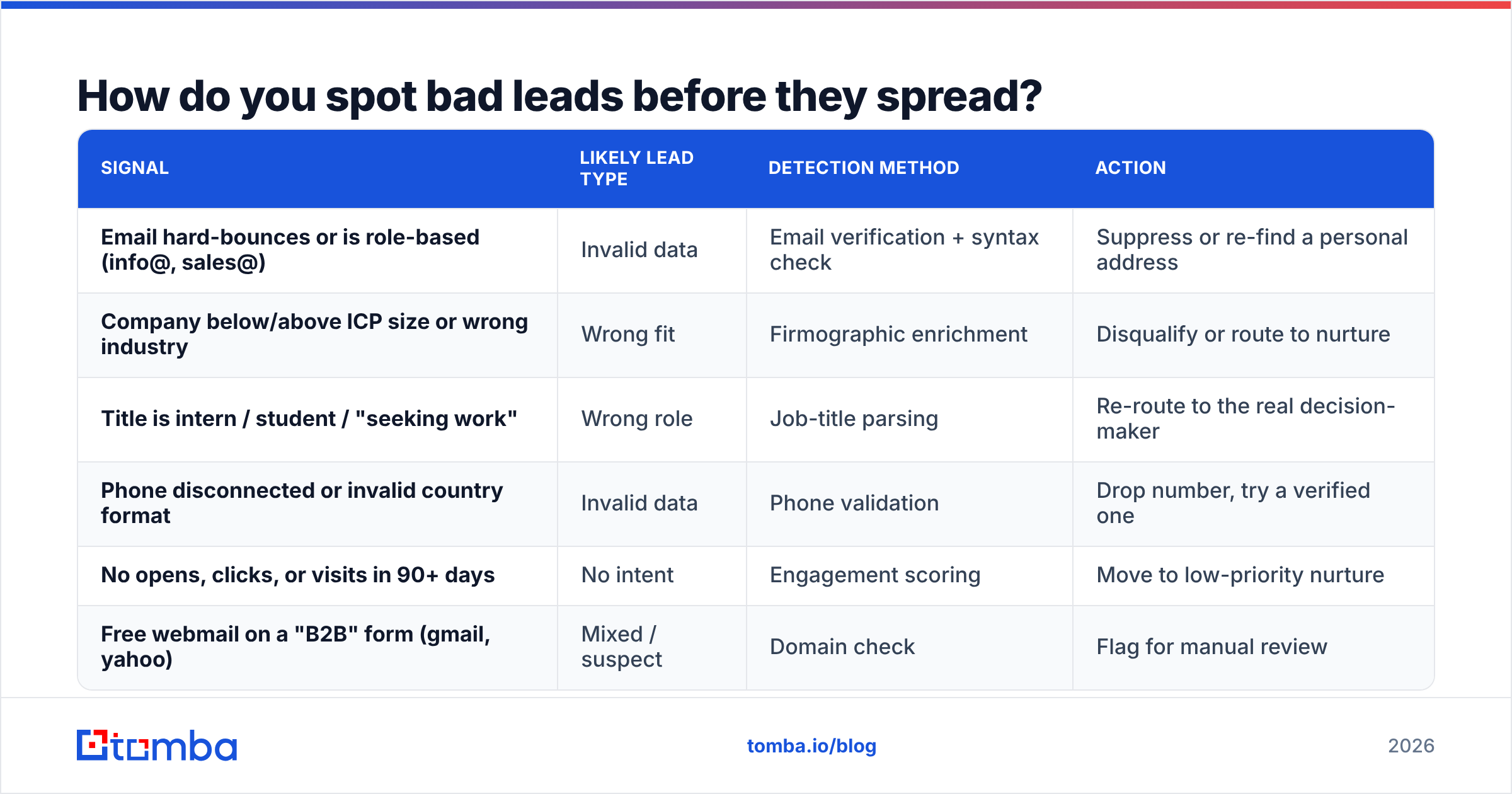
Use this to classify what you already have. Most teams can run it in an afternoon against a CRM export.
| Signal | Likely lead type | Detection method | Action |
|---|---|---|---|
| Email hard-bounces or is role-based (info@, sales@) | Invalid data | Email verification + syntax check | Suppress or re-find a personal address |
| Company below/above ICP size or wrong industry | Wrong fit | Firmographic enrichment | Disqualify or route to nurture |
| Title is intern / student / "seeking work" | Wrong role | Job-title parsing | Re-route to the real decision-maker |
| Phone disconnected or invalid country format | Invalid data | Phone validation | Drop number, try a verified one |
| No opens, clicks, or visits in 90+ days | No intent | Engagement scoring | Move to low-priority nurture |
| Free webmail on a "B2B" form (gmail, yahoo) | Mixed / suspect | Domain check | Flag for manual review |
The point of the table is that detection method is a tool you can automate, not a judgment call you make per row. Once each signal maps to a check, list hygiene becomes a pipeline step instead of a quarterly cleanup project.
Validate at the source#
The cheapest bad lead is the one that never enters your system. Add three guards to every web form and import:
- Syntax and MX validation so "john@gmial.com" gets caught before submission.
- Disposable-domain blocking to stop "mailinator" style throwaways.
- Required business email on B2B forms, with a clear message rather than a silent reject.
If you're importing a purchased or scraped list, treat the entire file as untrusted and run it through bulk verification before a single row touches your sequences. A bulk email verifier does this in one pass and tells you exactly which rows are safe to send to.
How do you score leads so the bad ones sort themselves out?#
Lead scoring is a thermostat, not a wall. Instead of a hard "in or out" gate, you assign points so good leads rise and bad ones sink automatically — and the threshold can flex with how much pipeline you actually need this month.
A workable model uses two axes:
- Fit (firmographic): Does this contact match your ICP? Score company size, industry, region, and role. A VP of Engineering at a 300-person SaaS firm scores high; a freelancer scores low.
- Intent (behavioral): Has this contact shown buying signals? Score pricing-page visits, demo requests, repeat opens, and content downloads. Recency matters — weight the last 30 days heavily.
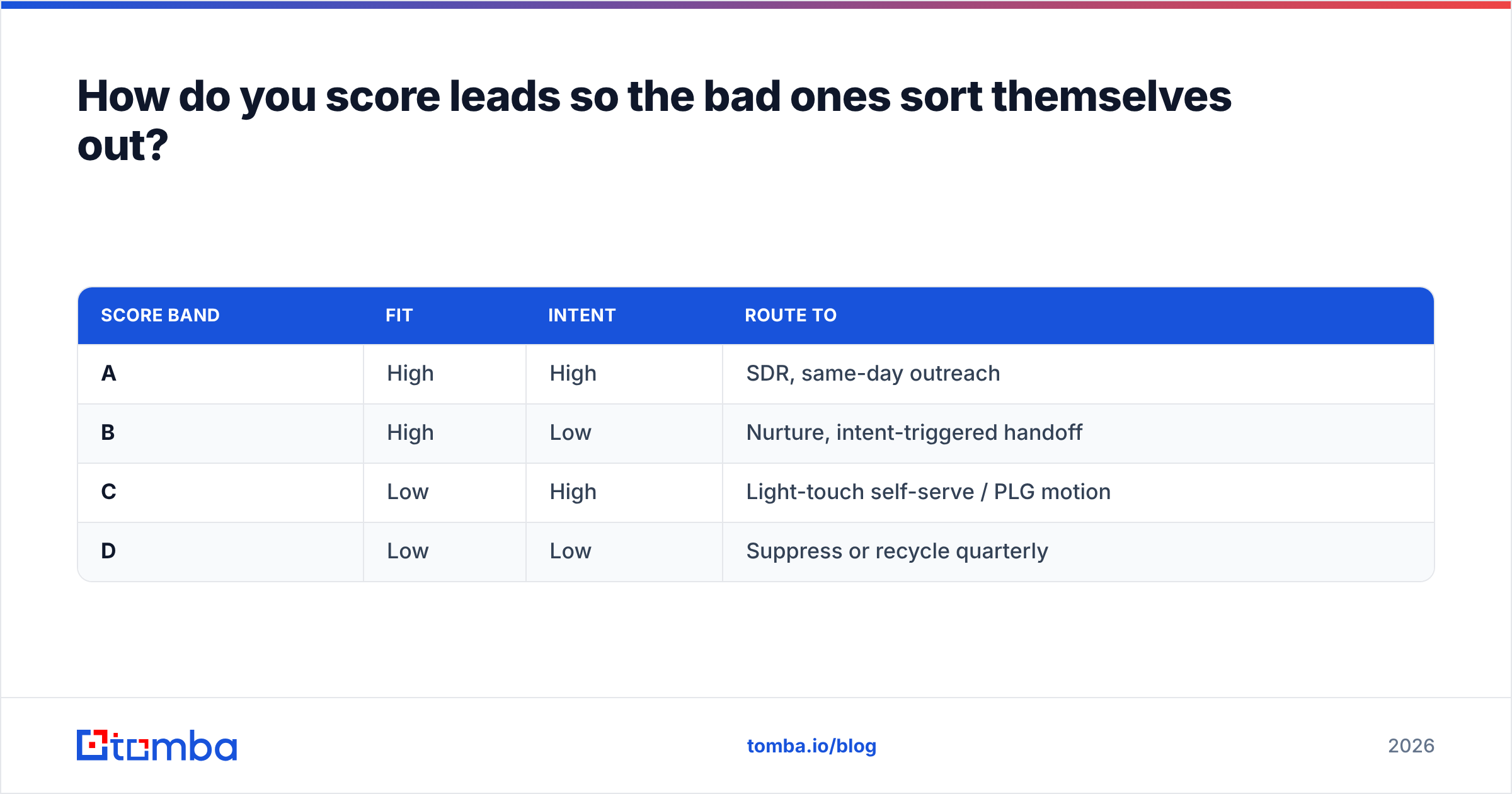
Multiply or stack the two, then set a routing rule:
| Score band | Fit | Intent | Route to |
|---|---|---|---|
| A | High | High | SDR, same-day outreach |
| B | High | Low | Nurture, intent-triggered handoff |
| C | Low | High | Light-touch self-serve / PLG motion |
| D | Low | Low | Suppress or recycle quarterly |
This is also where data quality and scoring intersect. A lead can't earn an accurate fit score if its firmographic data is missing or wrong, which is why contact enrichment belongs before scoring, not after. Garbage in, garbage score.
If you want the textbook definition of where a scored lead becomes sales-ready, the marketing qualified lead threshold is the line your A and B bands should map to.
Is buying a lead list a shortcut or a trap?#
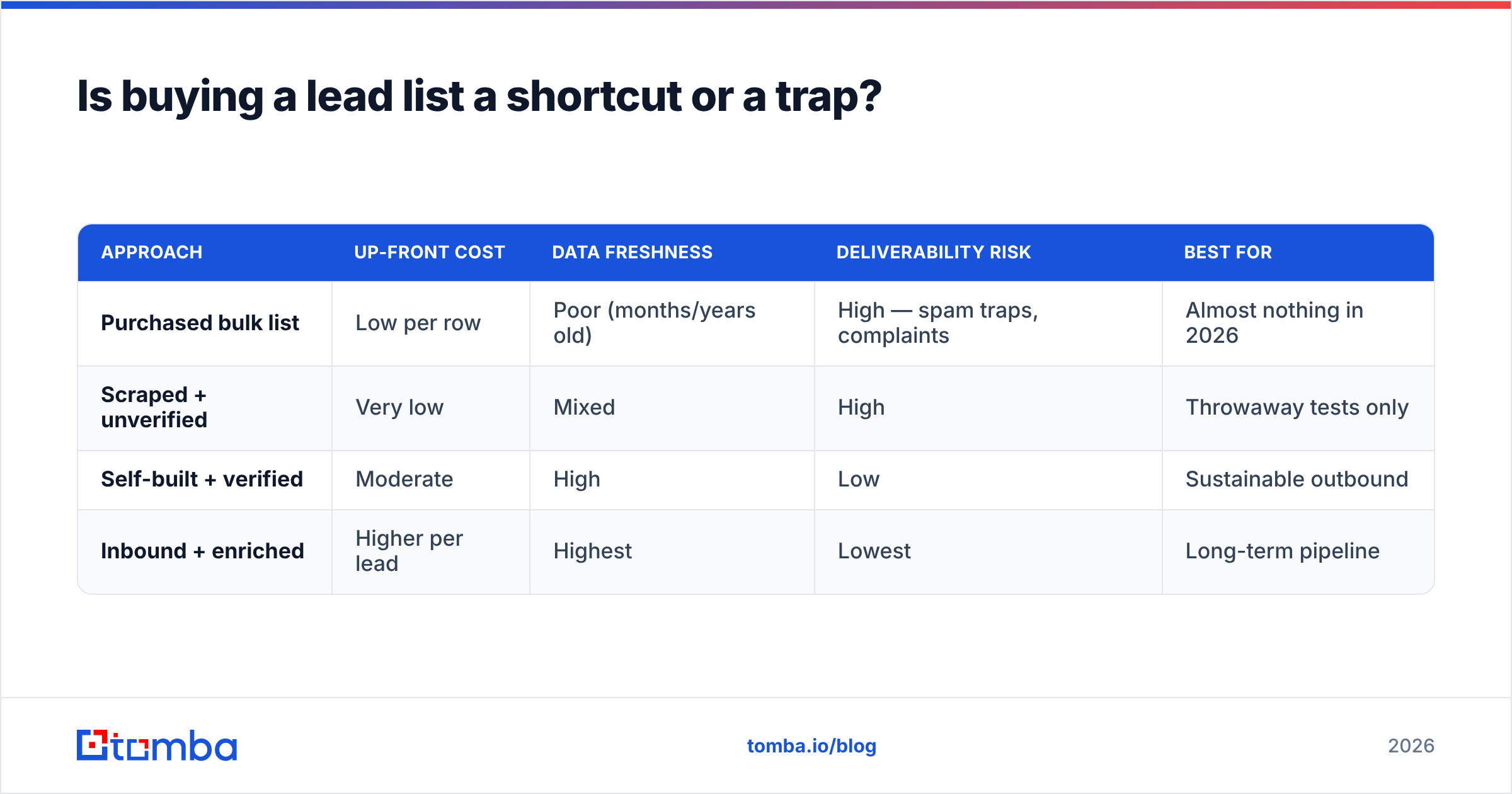
Usually a trap — and it's the single fastest way to manufacture bad leads at scale. Purchased lists are stale the moment they're sold, frequently shared across dozens of buyers, and stuffed with spam traps that exist specifically to catch senders who didn't verify.
The honest comparison looks like this:
| Approach | Up-front cost | Data freshness | Deliverability risk | Best for |
|---|---|---|---|---|
| Purchased bulk list | Low per row | Poor (months/years old) | High — spam traps, complaints | Almost nothing in 2026 |
| Scraped + unverified | Very low | Mixed | High | Throwaway tests only |
| Self-built + verified | Moderate | High | Low | Sustainable outbound |
| Inbound + enriched | Higher per lead | Highest | Lowest | Long-term pipeline |
If you do inherit a list you didn't build, do not send to it cold. Re-verify every address, strip role-based and catch-all-risky domains, and warm into it slowly. A catch-all verifier helps you separate the catch-all domains that are genuinely deliverable from the ones that will silently swallow your mail and tank your stats.

How do you prevent bad leads from coming back?#
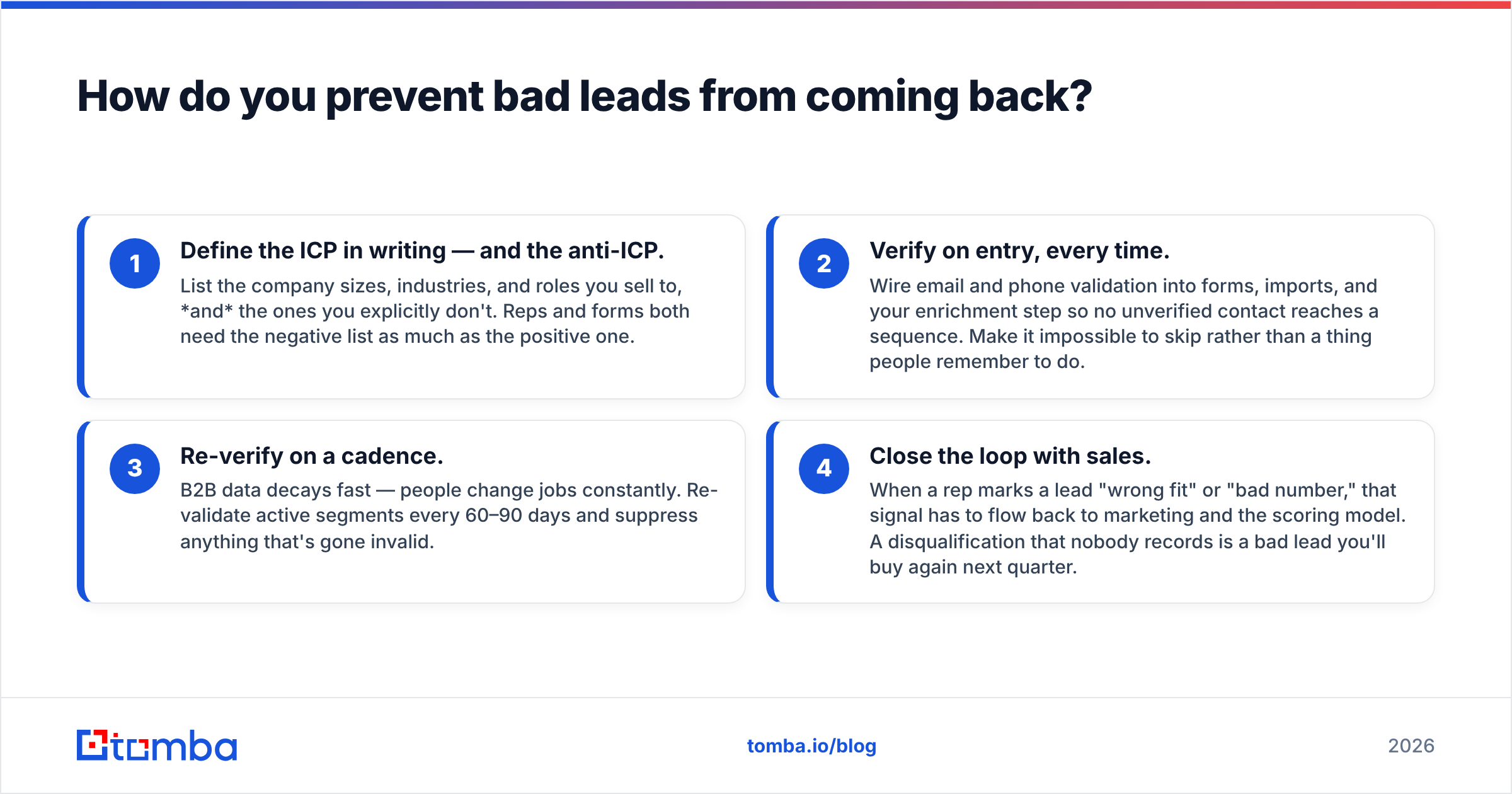
Prevention is a process, not a one-time scrub. The teams that stay clean build four habits and never skip them.
- Define the ICP in writing — and the anti-ICP. List the company sizes, industries, and roles you sell to, and the ones you explicitly don't. Reps and forms both need the negative list as much as the positive one.
- Verify on entry, every time. Wire email and phone validation into forms, imports, and your enrichment step so no unverified contact reaches a sequence. Make it impossible to skip rather than a thing people remember to do.
- Re-verify on a cadence. B2B data decays fast — people change jobs constantly. Re-validate active segments every 60–90 days and suppress anything that's gone invalid.
- Close the loop with sales. When a rep marks a lead "wrong fit" or "bad number," that signal has to flow back to marketing and the scoring model. A disqualification that nobody records is a bad lead you'll buy again next quarter.
Bake these into your revenue operations rhythm and the junk stops accumulating. The list gets smaller and better over time instead of bigger and worse.
What metrics tell you it's working?#
Track these monthly. If they move the right way, your data-quality work is paying off:
- Bounce rate trending under 2% (anything above 3–4% is a deliverability emergency).
- Connect rate on phones rising as invalid numbers get purged.
- MQL-to-SQL conversion climbing because the leads handed off are genuinely qualified.
- Sequence reply rate improving even without copy changes — clean lists simply land in more inboxes.
- Cost per qualified opportunity falling as reps stop spending time on dead rows.
What's the fastest way to clean a list you already have?#
Run this five-step pass on your current database before you spend a dollar on new leads:
- Export and dedupe. Remove exact and fuzzy duplicates first so you don't verify the same person three times.
- Verify every email and tag the results: valid, invalid, catch-all, role-based. Suppress invalid immediately.
- Validate phone numbers and drop disconnected or wrong-format entries before your dialer ever touches them.
- Enrich the survivors with current title, company, and size so your scoring has real inputs.
- Score and route using the fit/intent model above, then suppress the D band into a quarterly recycle list.
A team can run this in a day for a mid-size list and immediately reclaim the rep hours that were vanishing into dead contacts. It also resets your deliverability baseline so your next campaign isn't dragging the sins of the old list behind it.
Where does a clean source beat constant cleanup?#
The best long-term move is to fix the intake, not just the database. If the contacts entering your CRM are already verified, scoring and hygiene get dramatically easier — you're maintaining quality instead of manufacturing it.
That's exactly where a verified email finder earns its keep. Instead of buying stale lists and praying, you find current, deliverable addresses for the exact people who match your ICP, with verification built into the lookup. Pair it with the domain search to map every relevant contact at a target account, and you replace guesswork with a repeatable, clean intake.
You can compare what each plan includes on the Tomba pricing page — the Free tier gives you 25 searches a month to test the data against your own list before committing, with Starter at $49/mo when you're ready to scale.
The bottom line#
Bad leads aren't a list problem you solve once — they're a data-quality discipline you maintain. Sort them by type, validate at the source, score on fit and intent, and re-verify on a cadence. Do that, and your pipeline gets smaller, your forecast gets honest, and your deliverability climbs back to where it should be.
If you want to stop importing junk and start with contacts that are verified before they ever hit your CRM, put the Tomba Email Finder in front of your intake. Find the right person, at the right company, with a deliverable address — and let your scoring model work on data that's actually worth scoring. Start free with 25 searches and clean the source instead of forever cleaning the database.
// get started
Find, verify and enrich your first contacts today
Start on the free plan with 25 searches a month, then scale when your team is ready.
Free plan · No credit card required · GDPR & CCPA
// about the author