Balto Pricing, Reviews, Pros and Cons (2026 Guide)
Balto promises real-time AI call guidance, but is it worth a custom-quote price? A neutral breakdown of Balto pricing, reviews, pros and cons for 2026.
Balto sells one promise: tell your agents the right thing to say while they are still on the call, not in a coaching session three days later. If you run a contact center or a high-volume phone team, that promise is attractive — and the pricing is famously hard to pin down. This guide breaks down Balto pricing, reviews, pros and cons so you can decide whether the real-time guidance category fits your team before you sit through a sales demo.
TL;DR#
- Balto is real-time call guidance — AI that listens live and nudges agents with checklists, prompts, and objection responses mid-conversation.
- Pricing is quote-only. Balto does not publish per-seat numbers; expect a custom annual contract priced per agent seat, typically landing in the mid-to-high range for conversation-intelligence tools.
- Reviews are strong on impact, mixed on setup. Users praise script adherence and ramp time; common complaints are configuration effort and prompt-tuning maintenance.
- It solves a narrow problem well. Balto is for live coaching, not lead generation. You still need accurate contact data feeding the dialer before guidance matters.
- Best paired with clean data. Real-time guidance on a bad phone list just helps agents fail faster.
What is Balto and who is it for?#
Balto is a real-time guidance platform for contact centers and phone sales teams. It connects to your softphone or telephony stack, transcribes the conversation as it happens, and surfaces on-screen prompts the moment they are relevant: a checklist item the agent skipped, a competitor mention that needs a battlecard, a compliance line that must be read verbatim.
The core idea is "in the moment" coaching. Traditional QA reviews calls after the fact, so feedback arrives too late to save the deal that prompted it. Balto's pitch is that guidance delivered during the live call changes the outcome of that call, not the next one.
It is built for environments with repeatable conversations at volume — inbound support, outbound sales, collections, healthcare intake, insurance. If your reps have ten genuinely different conversations a day, real-time guidance has little to lock onto. If they have the same five conversations a hundred times, it has a lot.
You can read more about how live coaching fits into the broader AI sales technology stack, but the short version: Balto sits at the conversation layer, downstream of whoever supplied the contact and the reason to call.
What does Balto actually do?#
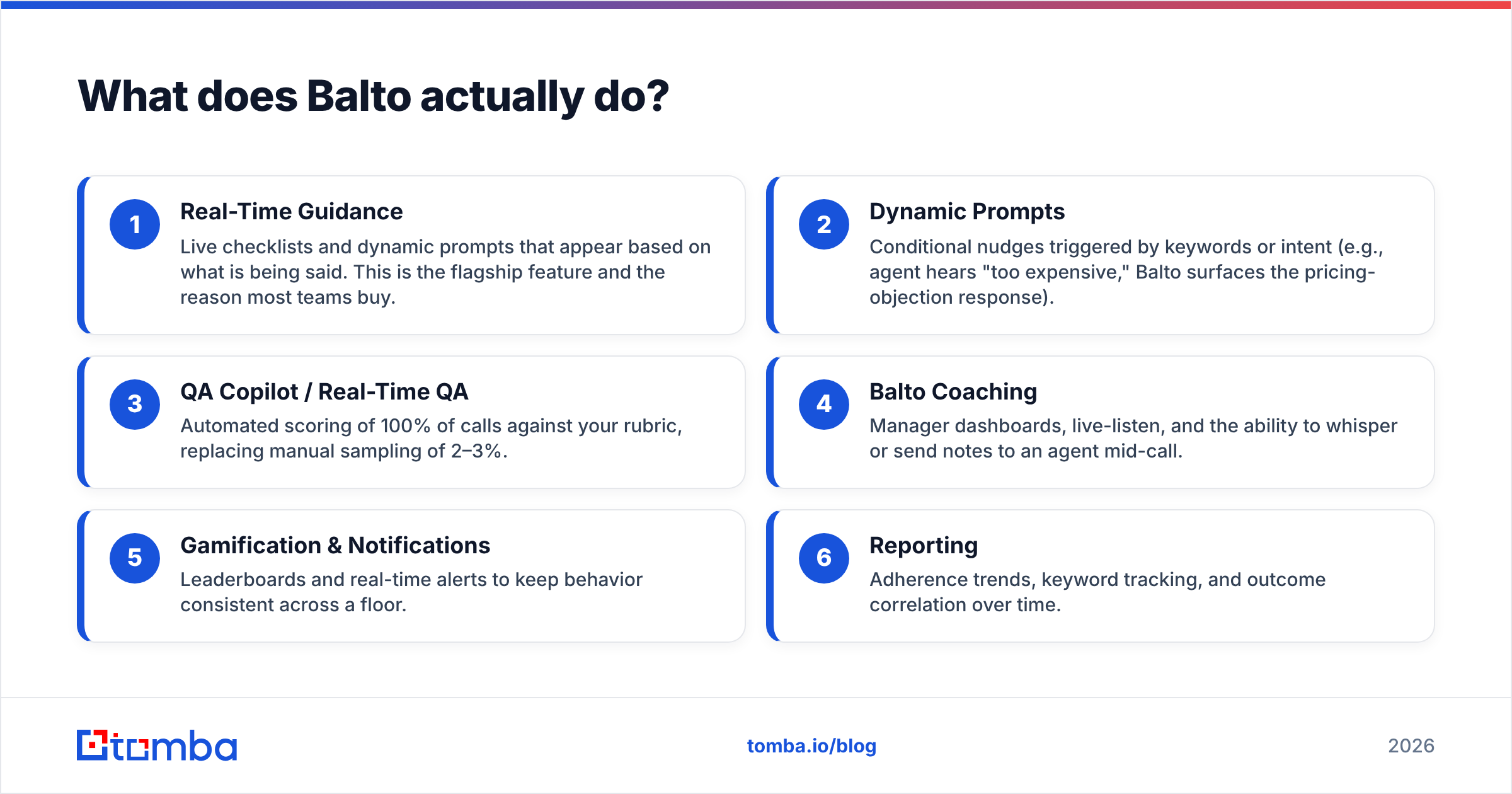
Balto's feature set clusters into a few capabilities. Here is the honest breakdown of what you are paying for:
- Real-Time Guidance — Live checklists and dynamic prompts that appear based on what is being said. This is the flagship feature and the reason most teams buy.
- Dynamic Prompts — Conditional nudges triggered by keywords or intent (e.g., agent hears "too expensive," Balto surfaces the pricing-objection response).
- QA Copilot / Real-Time QA — Automated scoring of 100% of calls against your rubric, replacing manual sampling of 2–3%.
- Balto Coaching — Manager dashboards, live-listen, and the ability to whisper or send notes to an agent mid-call.
- Gamification & Notifications — Leaderboards and real-time alerts to keep behavior consistent across a floor.
- Reporting — Adherence trends, keyword tracking, and outcome correlation over time.
The thing to notice: every one of these features assumes the call is already happening with the right person. Balto improves the conversation. It does nothing for the list of numbers your dialer works through. That distinction matters when you scope the spend.
How much does Balto cost in 2026?#
Short answer: Balto does not publish pricing, and there is no free tier or transparent per-seat number. Every deal goes through sales as a custom, usually annual, per-seat contract. That is the single most important fact for budgeting.
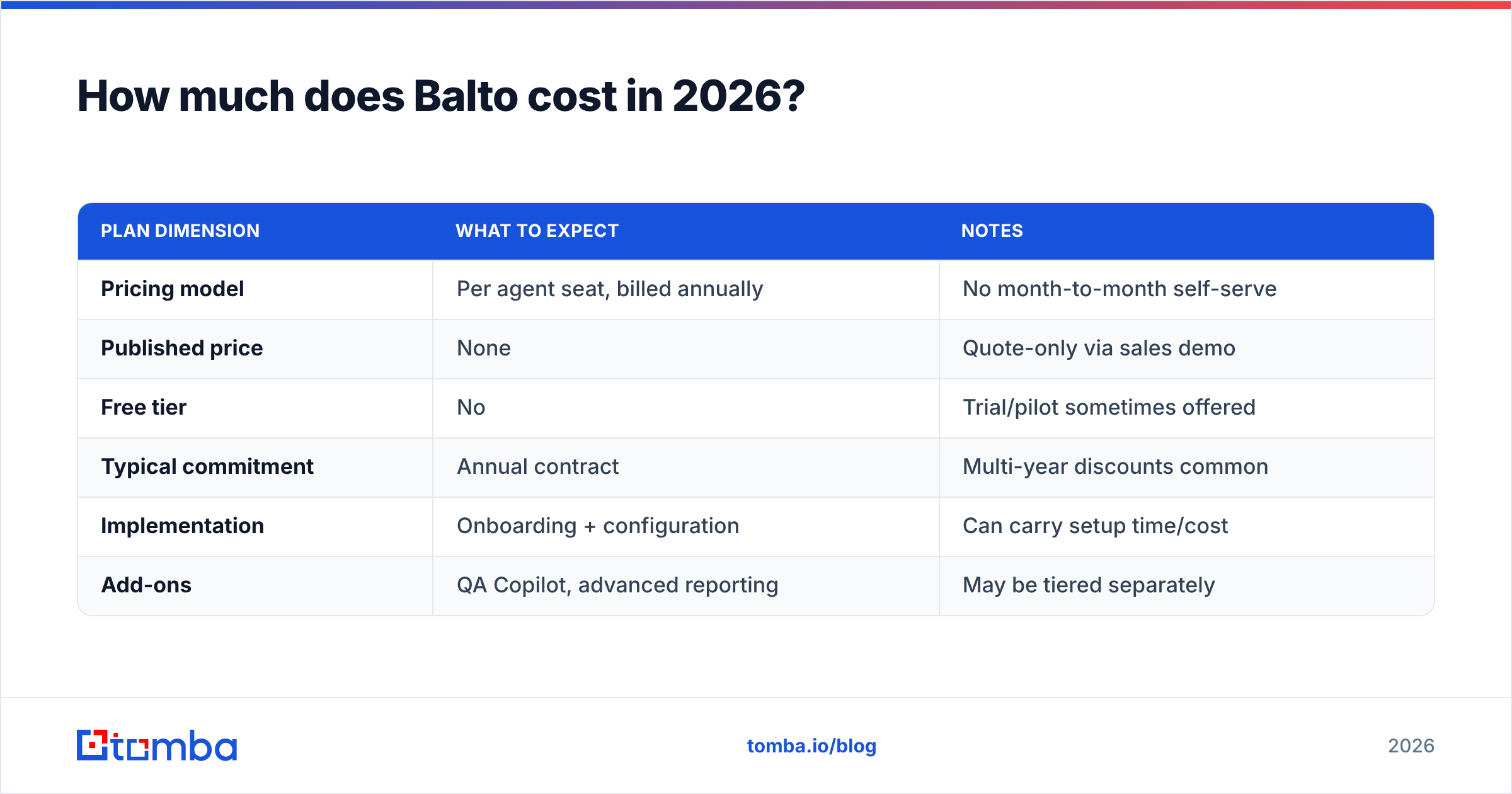
Based on user reports across review sites and the general conversation-intelligence market, here is a realistic — but unofficial — framing. Treat these as directional, not quotes:
| Plan dimension | What to expect | Notes |
|---|---|---|
| Pricing model | Per agent seat, billed annually | No month-to-month self-serve |
| Published price | None | Quote-only via sales demo |
| Free tier | No | Trial/pilot sometimes offered |
| Typical commitment | Annual contract | Multi-year discounts common |
| Implementation | Onboarding + configuration | Can carry setup time/cost |
| Add-ons | QA Copilot, advanced reporting | May be tiered separately |
Because the number is negotiated, two teams of the same size can pay very different rates. Seat count, contract length, and which modules you enable (guidance only vs. guidance plus QA Copilot) all move the price. If you want a clean comparison against transparent tools, note how unusual quote-only pricing is — a tool like Tomba publishes every tier on its Tomba pricing page, from a free plan up to Enterprise, so you know the cost before a call. Balto requires the call first.
Budgeting tip: ask three questions in the demo — (1) price per seat at your exact headcount, (2) what is included vs. add-on, and (3) the renewal uplift. The third one is where quote-based tools often surprise buyers.
What do Balto reviews say?#
Balto holds solid ratings on the major B2B review platforms, and the themes are consistent enough to trust. You can scan current scores yourself on G2 and validate the vendor claims against Balto's official site, but here is the distilled pattern.
What reviewers consistently praise:
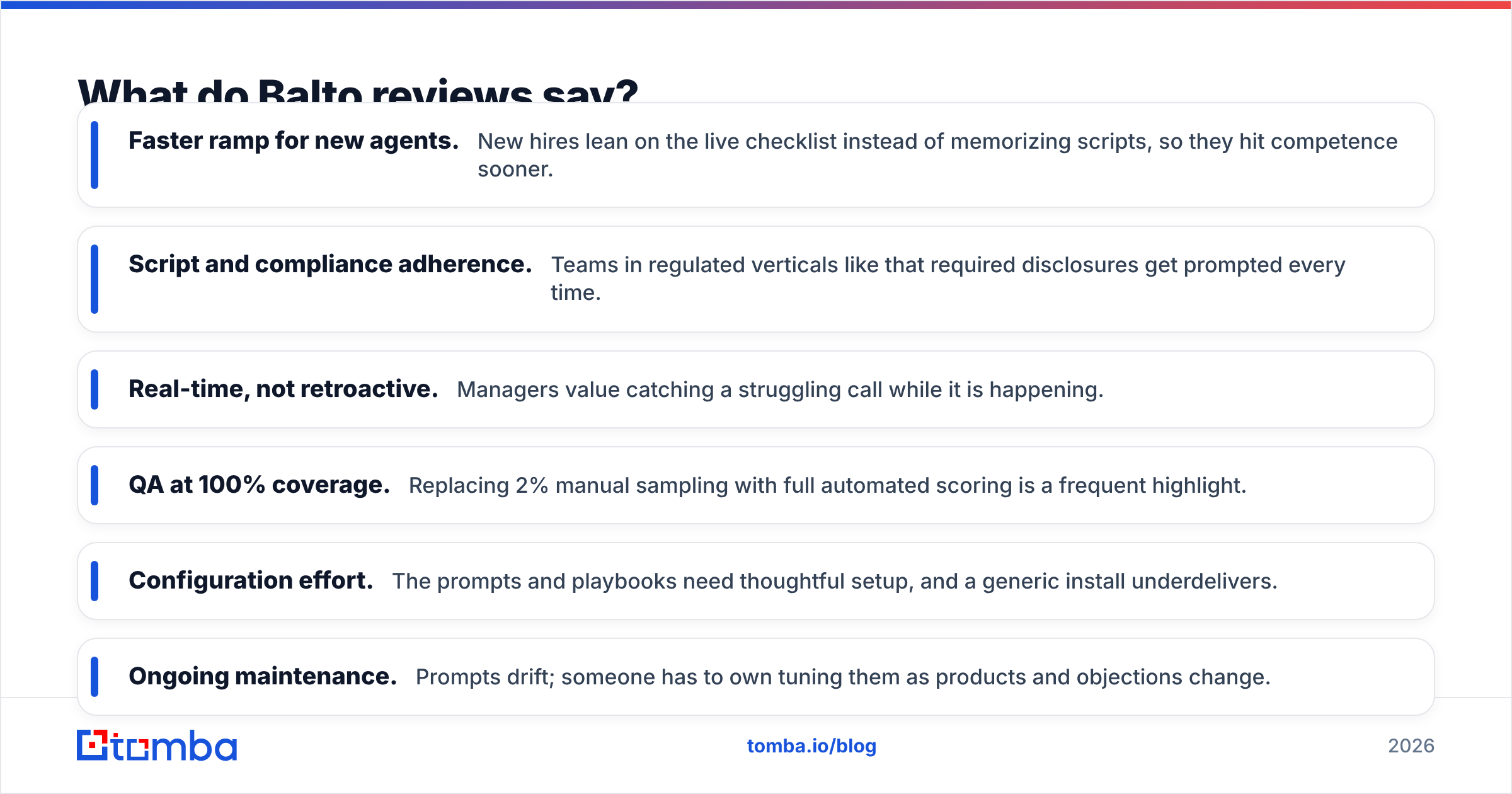
- Faster ramp for new agents. New hires lean on the live checklist instead of memorizing scripts, so they hit competence sooner.
- Script and compliance adherence. Teams in regulated verticals like that required disclosures get prompted every time.
- Real-time, not retroactive. Managers value catching a struggling call while it is happening.
- QA at 100% coverage. Replacing 2% manual sampling with full automated scoring is a frequent highlight.
What reviewers consistently flag:
- Configuration effort. The prompts and playbooks need thoughtful setup, and a generic install underdelivers.
- Ongoing maintenance. Prompts drift; someone has to own tuning them as products and objections change.
- On-screen distraction. A minority of agents find live prompts intrusive until they adjust.
- Opaque pricing. The quote-only model frustrates buyers who want to compare quickly.
The signal across reviews is that Balto works when a team invests in configuration and assigns an owner. It disappoints when bought as a plug-and-play fix and left on defaults.
What are the pros and cons of Balto?#
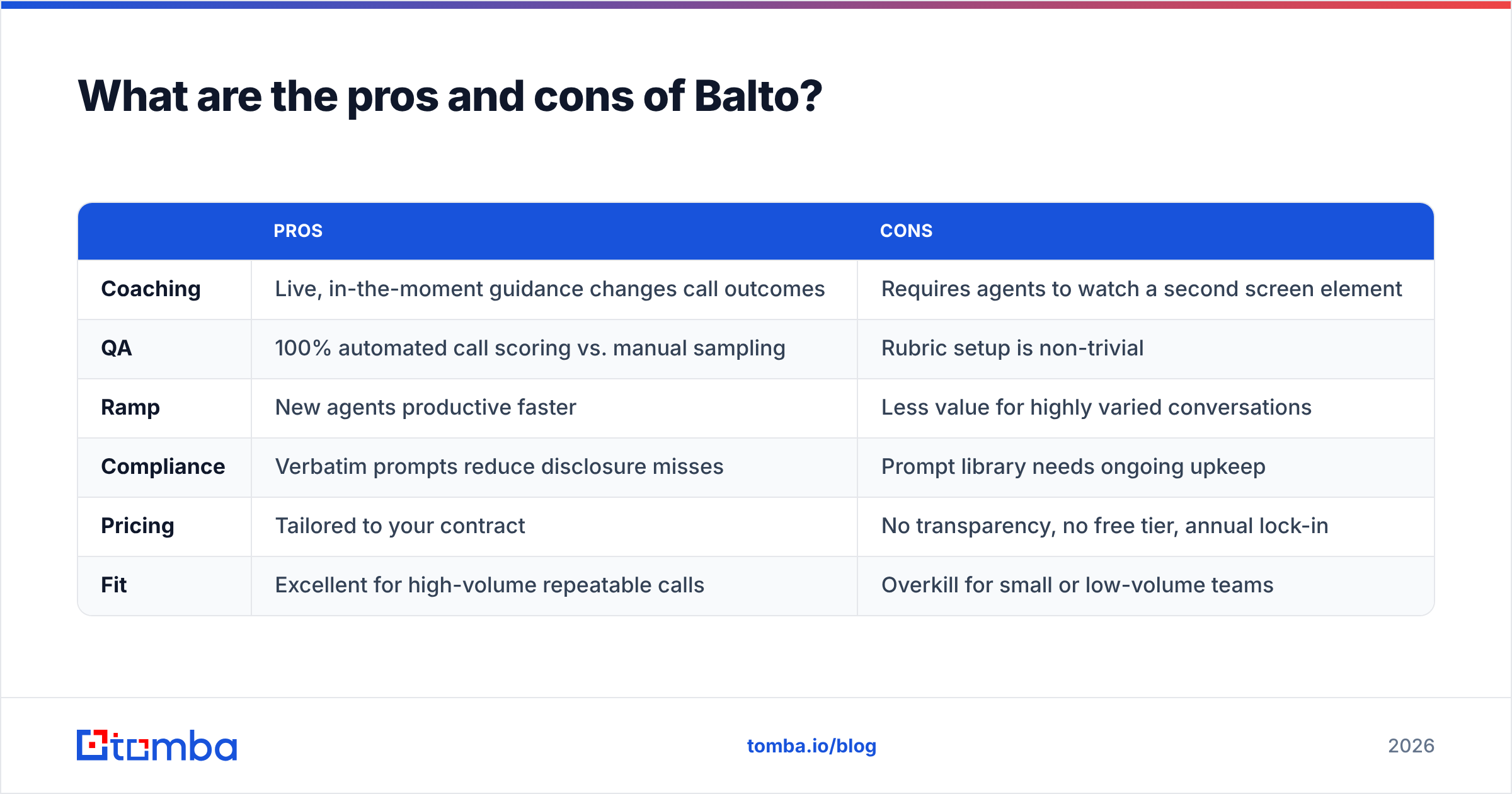
Here is the balanced view, stripped of marketing.
| Pros | Cons | |
|---|---|---|
| Coaching | Live, in-the-moment guidance changes call outcomes | Requires agents to watch a second screen element |
| QA | 100% automated call scoring vs. manual sampling | Rubric setup is non-trivial |
| Ramp | New agents productive faster | Less value for highly varied conversations |
| Compliance | Verbatim prompts reduce disclosure misses | Prompt library needs ongoing upkeep |
| Pricing | Tailored to your contract | No transparency, no free tier, annual lock-in |
| Fit | Excellent for high-volume repeatable calls | Overkill for small or low-volume teams |
The honest summary: Balto is a strong tool for a specific shape of team — high call volume, repeatable conversations, a manager willing to own configuration, and a budget that tolerates quote-based annual contracts. For a five-rep team making varied calls, the configuration overhead and pricing model are hard to justify.
Is Balto worth it, or do you have a data problem first?#
Here is the trap teams fall into: they buy real-time guidance to fix poor call performance, when the actual problem is upstream. Guidance optimizes the conversation. It cannot fix a list of wrong numbers, disconnected lines, or contacts who were never the decision-maker.

Think of it like a GPS in a car with an empty tank. The directions are perfect; you still are not going anywhere. If your reps spend half their dials reaching dead numbers and gatekeepers, Balto will coach them beautifully through conversations that were never going to convert.
Before — or alongside — any conversation-intelligence purchase, fix the inputs:
- Accurate phone numbers. A phone finder and phone validator keep your dialer working live lines instead of dead ones.
- Verified email for follow-up. Calls rarely close in one touch; an email verifier protects the follow-up sequence from bounces.
- Right person, right company. Reaching the actual decision-maker beats coaching a perfect pitch to the wrong contact.
Get the data right and Balto's guidance compounds. Get it wrong and you have bought an expensive way to keep talking to the wrong people.
How does Balto compare to alternatives?#
Balto competes with other conversation-intelligence and real-time guidance vendors. The category includes post-call analytics tools (which review after the fact) and live-guidance tools (which intervene during the call). Balto is firmly in the live-guidance camp, which is its main differentiator against analytics-first competitors.
When you evaluate, separate the categories cleanly:
- Real-time guidance (Balto's lane): nudges during the live call. Best for adherence and ramp.
- Post-call conversation analytics: trends, coaching, and insights after the call. Best for strategy and QA at scale.
- Dialer-native coaching: lightweight whisper/listen built into your phone system. Cheapest, least sophisticated.
The right pick depends on whether you need to change the current call (guidance) or learn from past calls (analytics). Many large teams run both. For a deeper view of how research firms segment this space, Gartner's conversation-intelligence coverage is a useful neutral reference.
Whatever you choose, the data principle holds. Every tool in this category assumes you have already reached a real, reachable, relevant human — and that is a sourcing and enrichment job, handled before the call connects. Clean data enrichment on the front end is what makes the back end worth paying for.
Who should buy Balto — and who should skip it?#
Buy Balto if:
- You run 20+ agents on repeatable, high-volume calls.
- Compliance or script adherence is a real risk in your vertical.
- You have someone who will own prompt configuration and tuning.
- An annual, quote-based contract fits your procurement process.
Skip Balto (for now) if:
- Your team is small or your conversations are highly varied.
- Your bigger leak is bad contact data, not poor talk tracks.
- You need transparent, self-serve pricing to move fast.
- You want results without dedicating configuration time.
For most teams that are still leaking dials to bad numbers, the highest-ROI first move is not real-time coaching — it is fixing the list. Guidance is a multiplier, and a multiplier on a broken input stays broken.
The bottom line on Balto pricing, reviews, pros and cons#
Balto is a legitimately good real-time guidance tool with a narrow, well-defined sweet spot: high-volume, repeatable phone conversations where adherence and ramp time matter and someone owns the configuration. Reviews back that up. The friction points are the quote-only pricing, the annual commitment, and the ongoing tuning effort — none of which are dealbreakers if your team matches the profile.
But guidance is the second problem to solve, not the first. The fastest, cheapest win for most phone teams is making sure every dial reaches a real, verified contact. If your reps are burning time on disconnected numbers and wrong people, start there. Use Tomba's Email Finder to source verified professional contacts by name, domain, or company — and pair it with the phone finder and verifier so your dialer works live lines instead of dead ends. Fix the inputs first, and any conversation-intelligence tool you buy next will earn its price. Start free with 25 searches a month and scale up only when the data is paying you back.
Ready to find emails that actually work?
Join 150,000+ professionals who stopped guessing and started sending. Free credits on signup — no credit card required.
Get the Tomba newsletter
Practical outbound tactics and product updates — once every two weeks.
About the author