BANT Framework Explained: Qualify B2B Leads Faster in 2026
BANT is the 50-year-old qualification framework that still decides which deals are worth your time. Here's how to run it in 2026 — and where it breaks.
TL;DR
- BANT stands for Budget, Authority, Need, Timeline — a four-part checklist IBM created in the 1960s to decide which prospects deserve a rep's time.
- It still works in 2026 as a fast triage filter, but rigid "checkbox BANT" loses deals in committee-driven, product-led buying.
- The modern move is flexible BANT: lead with Need, treat Budget and Timeline as conversations, and map every Authority on the buying committee.
- BANT only matters if you're talking to real people at real companies — qualification fails fast when your contact data is stale.
- Pair BANT scoring with accurate contact data (verified emails, direct phone numbers, enriched firmographics) so you qualify humans, not guesses.
What is the BANT framework?#
BANT is a sales qualification framework that scores a prospect on four questions: Do they have the Budget, the Authority to buy, a genuine Need, and a Timeline for acting? If a lead clears all four, it's "qualified" and worth pursuing. If it fails one or more, you deprioritize it.
Think of BANT like a bouncer at a club checking four things at the door — ID, dress code, guest list, and capacity. The bouncer isn't being rude; they're protecting a limited resource (space inside). Your reps' calendar is that limited resource. BANT decides who gets past the velvet rope.
The framework came out of IBM in the 1960s and has outlived nearly every sales methodology invented since. The reason is simple: it's memorable, it's fast, and it forces a rep to ask the questions that actually predict whether a deal closes. You can teach BANT to a new SDR in ten minutes.

What does each letter in BANT stand for?#
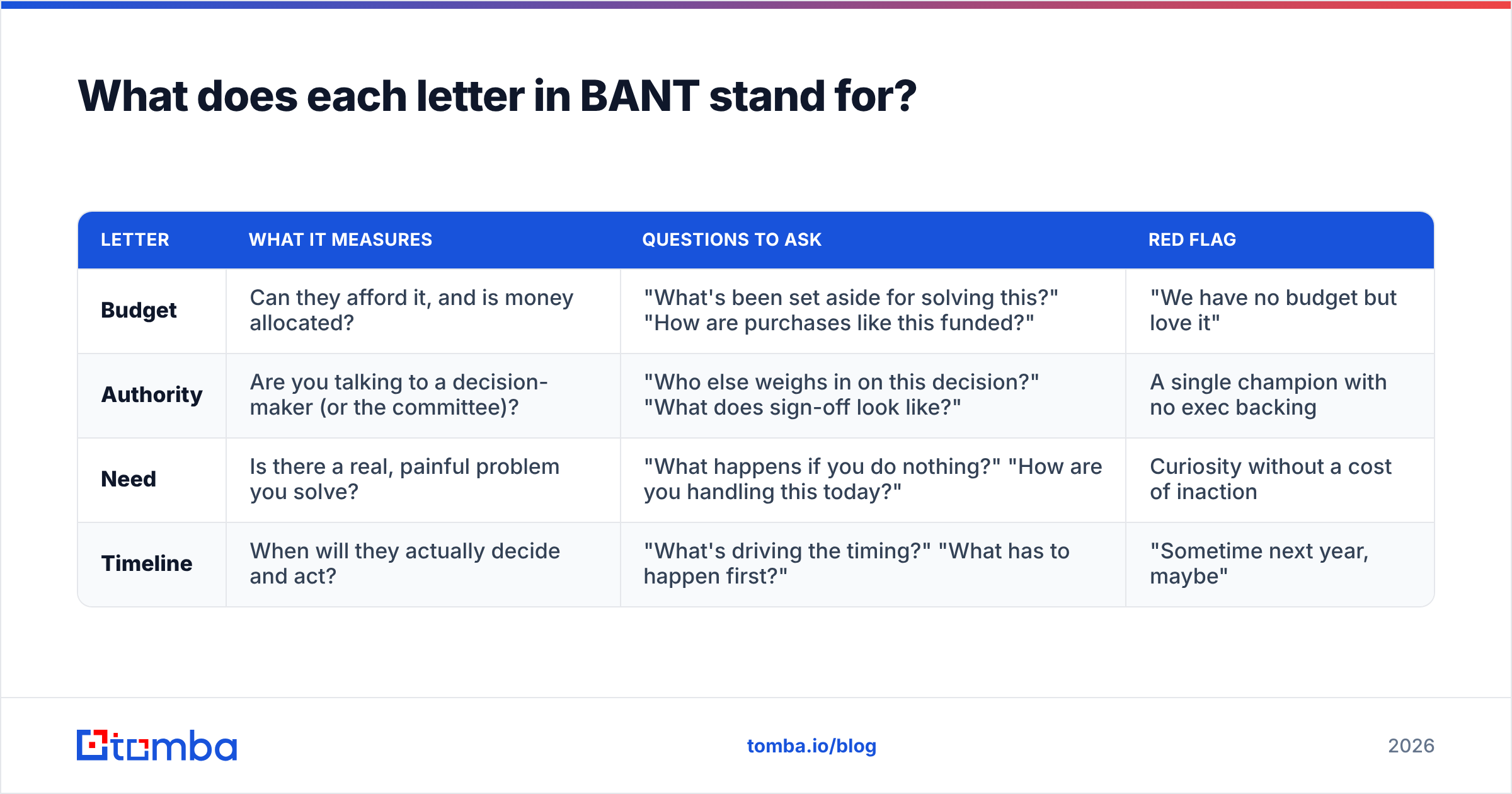
Here's the core of the framework. Each letter is a qualification dimension with its own diagnostic questions and red flags.
| Letter | What it measures | Questions to ask | Red flag |
|---|---|---|---|
| Budget | Can they afford it, and is money allocated? | "What's been set aside for solving this?" "How are purchases like this funded?" | "We have no budget but love it" |
| Authority | Are you talking to a decision-maker (or the committee)? | "Who else weighs in on this decision?" "What does sign-off look like?" | A single champion with no exec backing |
| Need | Is there a real, painful problem you solve? | "What happens if you do nothing?" "How are you handling this today?" | Curiosity without a cost of inaction |
| Timeline | When will they actually decide and act? | "What's driving the timing?" "What has to happen first?" | "Sometime next year, maybe" |
The order matters less than the coverage. A lead that's strong on Need and Timeline but vague on Budget is still worth a follow-up call — money problems get solved when the pain is real. A lead with Budget but no Need is a tire-kicker who will waste a month of your quarter.
Is BANT still relevant in 2026?#
Short answer: yes as a triage tool, no as a rigid gate. BANT is excellent for the first 15 minutes of qualifying inbound volume. It falls apart when teams treat it as a pass/fail checkbox in modern B2B buying.
Three things changed since IBM's salesforce roamed corporate America:
- Buying committees exploded. Gartner's research pegs the typical B2B buying group at six to ten stakeholders. "Authority" is no longer one person — it's a map. (Gartner on the B2B buying journey.)
- Product-led growth flipped the funnel. Users adopt a free tier first, then budget appears later. Hard "Budget" gating kills deals that would have self-funded.
- Buyers self-educate. By the time a prospect talks to sales, much of the "Need" discovery already happened on your site, on G2, and in peer Slack groups.
So BANT isn't dead. It's been promoted from gatekeeper to scoring input. You still want the four data points — you just don't reject a lead the instant one is missing.
How do you actually run a BANT qualification call?#
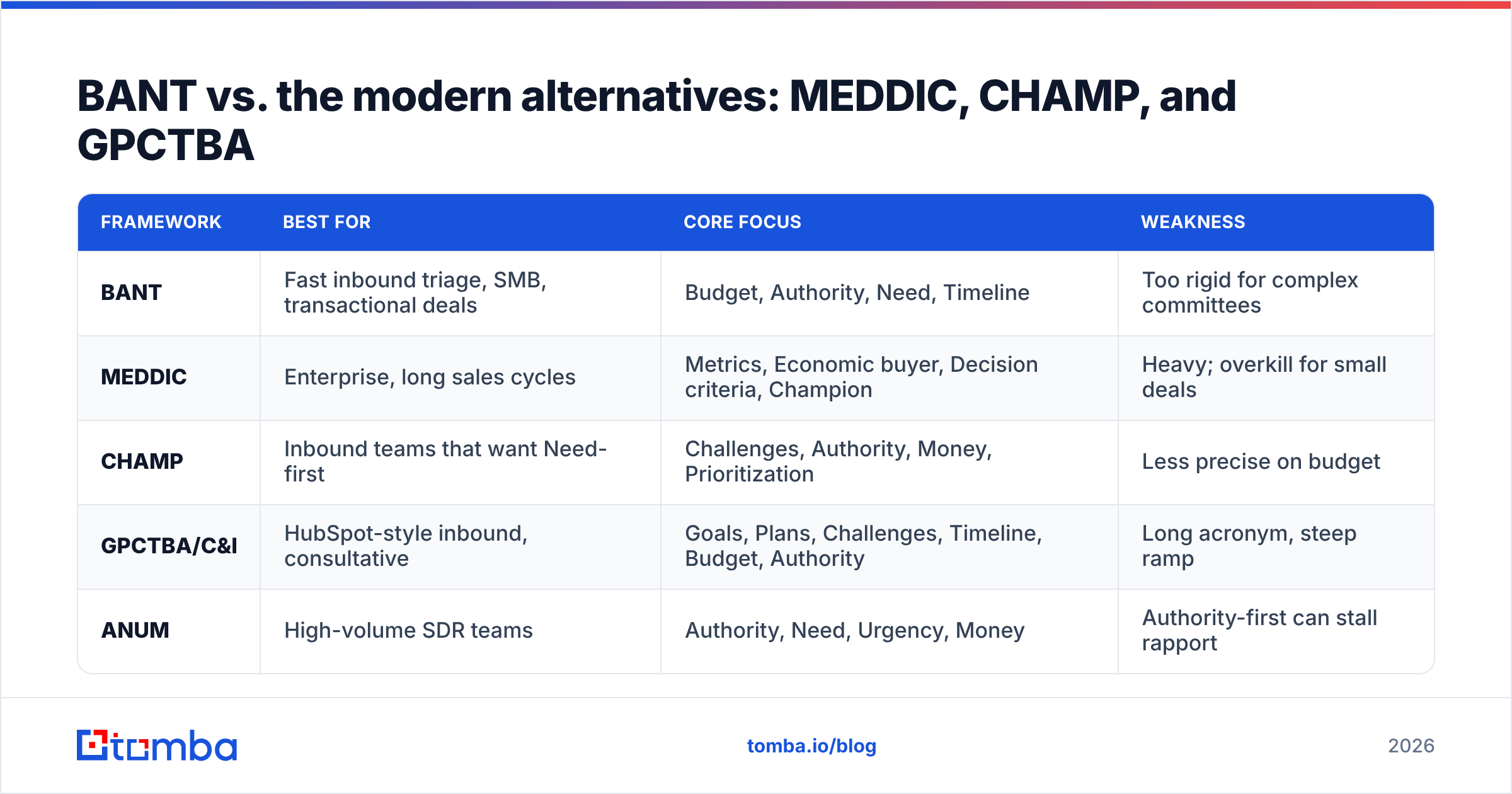
Don't interrogate. The fastest way to blow a discovery call is to march through B-A-N-T like a customs form. Weave the four into a natural conversation that starts with Need, because Need is the only dimension that earns you the right to ask the other three.
A simple flow that works:
- Open on Need. "Walk me through what prompted you to look at this now." You'll often hear Timeline and a hint of Budget inside the answer.
- Quantify the pain. "What's this costing you per month?" This converts a vague need into a budget justification you can use later.
- Map Authority sideways, not up. Instead of "Are you the decision-maker?" (which makes people defensive), ask "Who else will want a say in this?"
- Pin the Timeline to an event. "Is there a renewal, a board meeting, or a launch driving the date?" Timelines tied to events are real; timelines tied to "soon" are not.
- Confirm Budget last. By now you've built enough value that the money question feels collaborative, not transactional.
One non-obvious rule: log what you learn against the right contact record. If your CRM shows a single "info@" address for the account, you don't actually know who you spoke to. Clean, enriched contact records are what make BANT notes useful three weeks later. Tools like data enrichment fill in the title, seniority, and department so your Authority notes mean something.
BANT vs. the modern alternatives: MEDDIC, CHAMP, and GPCTBA#
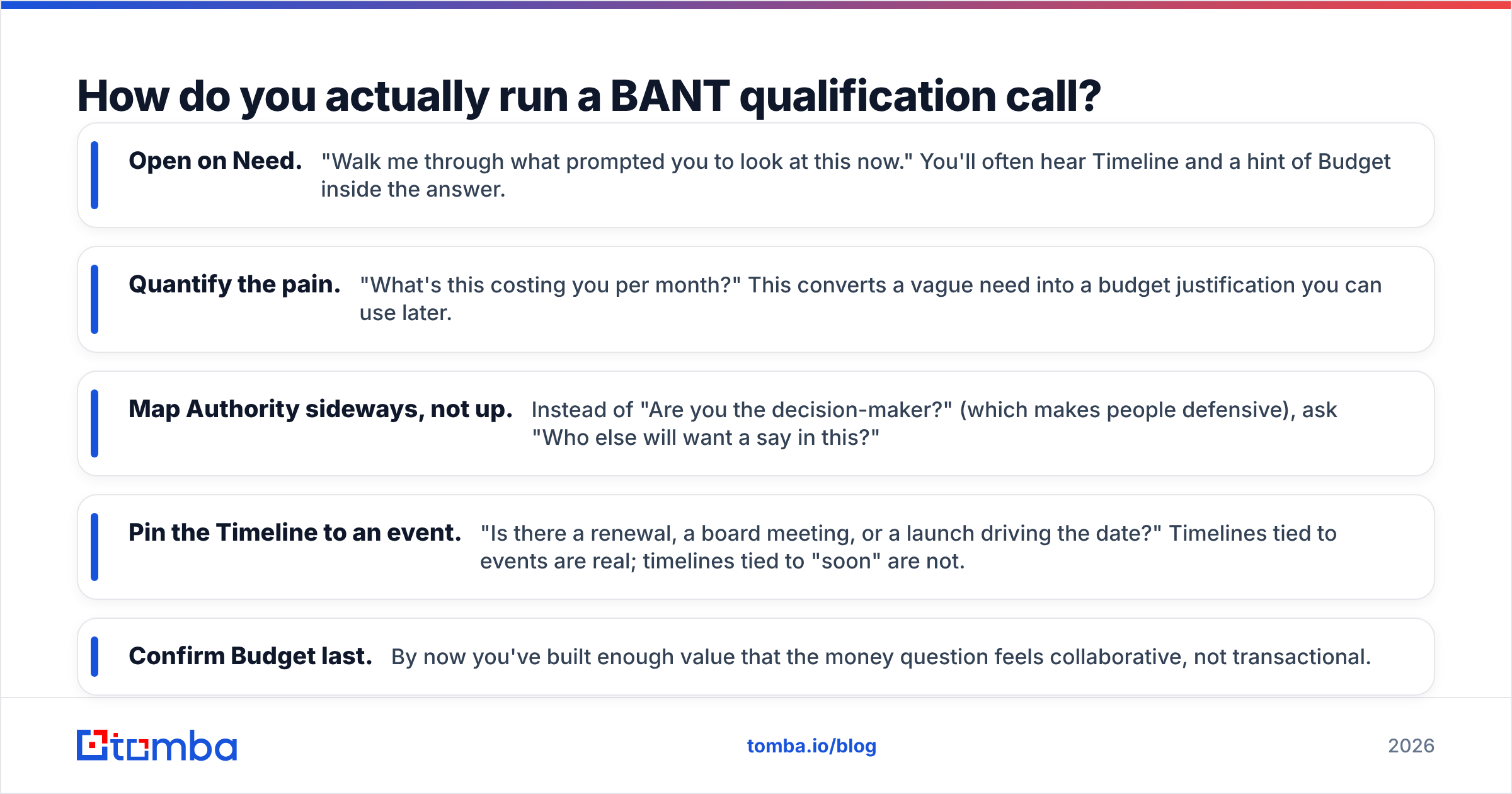
BANT has competitors. Each was built to patch a perceived BANT weakness. Here's an honest comparison so you pick the right one for your motion.
| Framework | Best for | Core focus | Weakness |
|---|---|---|---|
| BANT | Fast inbound triage, SMB, transactional deals | Budget, Authority, Need, Timeline | Too rigid for complex committees |
| MEDDIC | Enterprise, long sales cycles | Metrics, Economic buyer, Decision criteria, Champion | Heavy; overkill for small deals |
| CHAMP | Inbound teams that want Need-first | Challenges, Authority, Money, Prioritization | Less precise on budget |
| GPCTBA/C&I | HubSpot-style inbound, consultative | Goals, Plans, Challenges, Timeline, Budget, Authority | Long acronym, steep ramp |
| ANUM | High-volume SDR teams | Authority, Need, Urgency, Money | Authority-first can stall rapport |
The pattern is clear: enterprise motions trend toward MEDDIC, inbound and SMB motions stay close to BANT or CHAMP. (HubSpot's qualification breakdown is a solid neutral primer if you want to go deeper.)
You don't have to be a purist. Many high-performing teams in 2026 run "BANT as the floor, MEDDIC for deals over $50K." Use BANT to decide who gets a call, then layer MEDDIC's Champion and Metrics work onto the deals that survive.

How do you score and weight BANT?#
Turn the four letters into a number so qualification is consistent across reps. A simple, defensible model: score each dimension 0–3, weight by what predicts revenue in your data, and qualify above a threshold.
A starter weighting that works for most B2B teams:
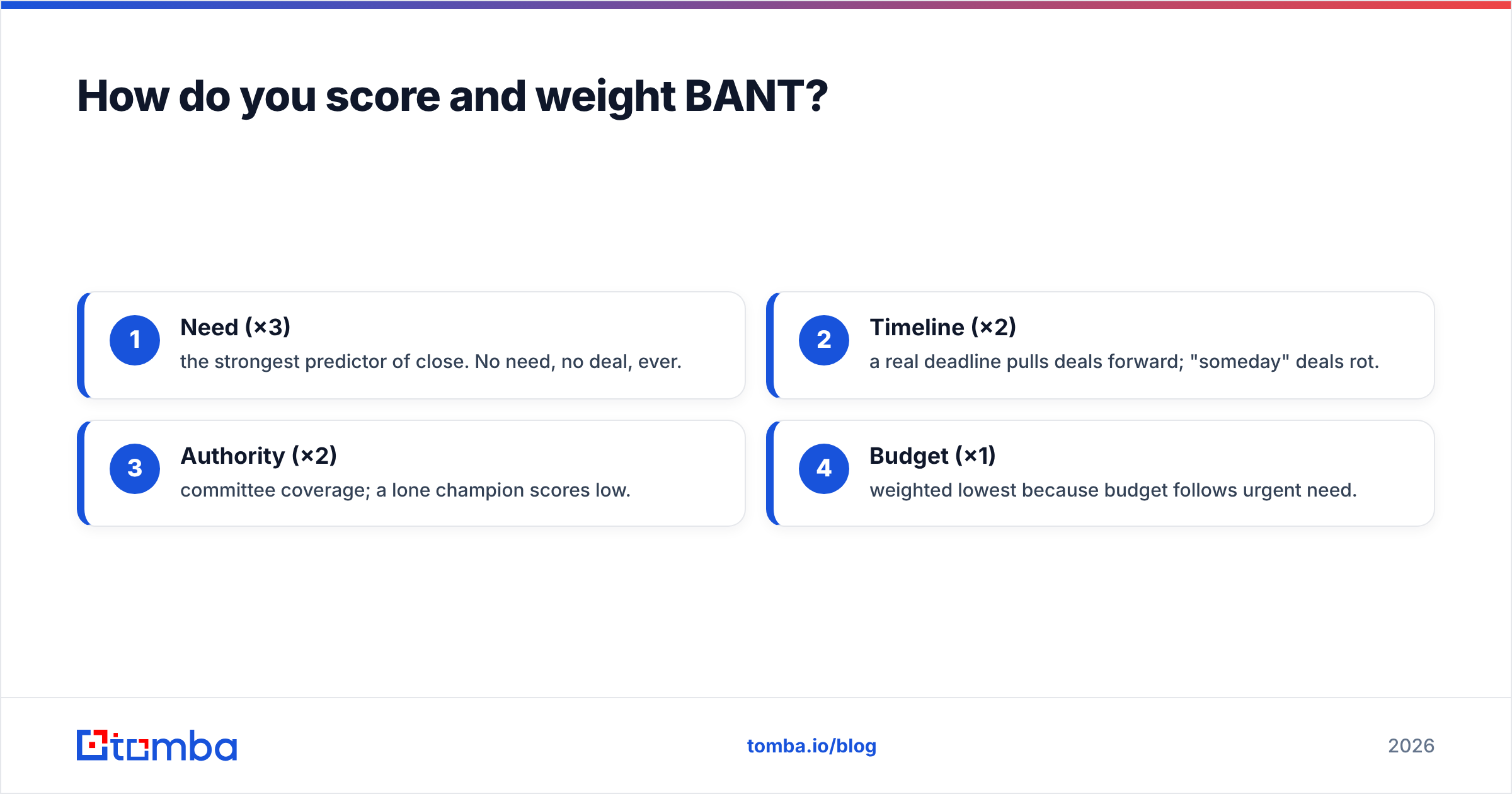
- Need (×3) — the strongest predictor of close. No need, no deal, ever.
- Timeline (×2) — a real deadline pulls deals forward; "someday" deals rot.
- Authority (×2) — committee coverage; a lone champion scores low.
- Budget (×1) — weighted lowest because budget follows urgent need.
Multiply, sum, and set a qualification line — say, 18 out of a possible 24. Anything above goes to an AE; anything below gets nurtured. Revisit the weights every quarter against closed-won data. If your won deals consistently had weak budget signals early, you've just proven Budget deserves a low weight. This is exactly the kind of feedback loop a good lead scoring process needs.
The trap here is scoring leads you can't actually reach. A 22/24 lead is worthless if the email bounces and the phone number is a dead switchboard. Run your list through an email verifier before scoring so your pipeline reflects contactable humans, not optimistic guesses.
Where does BANT break — and how do you fix it?#
BANT's failure modes are predictable. Here are the four that cost the most, with the fix for each.
- Single-threading on Authority. You qualify one enthusiastic champion, the deal looks great, then it dies in a committee you never knew existed. Fix: map every stakeholder early. Use a phone finder and LinkedIn data to identify and reach the economic buyer, not just your champion.
- Killing PLG deals on Budget. A user on your free tier says "no budget" and a rep disqualifies them — three months before they expense the team plan. Fix: treat Budget as a future state, not a gate, for product-led leads.
- Fake timelines. "Q3" sounds concrete but means nothing without a driving event. Fix: always anchor Timeline to a renewal, launch, audit, or board cycle.
- Garbage-in qualification. Reps spend the call qualifying a contact whose title, company size, and seniority are wrong in the CRM. Fix: enrich and verify before the call. Accurate firmographics make Budget and Authority answers far easier to judge.
Notice that two of the four fixes are data problems, not technique problems. You can run flawless BANT calls and still lose if you're qualifying the wrong person at the wrong company. That's why qualification frameworks and contact-data quality are two sides of the same coin.
How does contact data make BANT actually work?#
BANT scores a relationship between a seller and a specific buyer. If you don't know who that buyer is — their real role, their real email, their real phone — every BANT answer is built on sand.
Concretely, accurate data improves each letter:
- Budget gets easier to estimate when you know company size, funding stage, and tech stack (enriched firmographics).
- Authority becomes a map instead of a guess when you can find every relevant decision-maker by department and seniority.
- Need sharpens when enrichment tells you what tools they already use and where the gaps are.
- Timeline is more reliable when you reach the right person fast, before the window closes.
This is where a contact-data platform earns its place in the qualification stack. Use a domain search to pull every reachable contact at a target account, find email addresses for the specific decision-makers your BANT map identified, and verify them so your outreach lands. Check the full Tomba pricing if you want to see how the credits map to your volume — the Free tier (25 searches/month) is enough to test the workflow before you commit.
BANT qualification checklist for 2026#
Use this as a pre-call and post-call gut check:
- Need — Is there a quantified cost of inaction? (Not just interest.)
- Authority — Have I mapped all stakeholders, not just my champion?
- Budget — Do I understand how purchases get funded here, even if no number exists yet?
- Timeline — Is the date tied to a real event?
- Data — Is every contact in this deal verified and enriched?
- Score — Does this lead clear our weighted threshold?
- Next step — Is there a committed, calendared next action?
If you can't answer all seven, you haven't qualified the lead — you've just had a nice chat.
The bottom line#
BANT survived 60 years because it asks the right four questions in the right order of importance. In 2026, the winning teams keep the discipline of BANT but drop the rigidity — leading with Need, mapping Authority as a committee, and treating Budget and Timeline as conversations rather than gates.
But the framework is only as good as the data underneath it. You cannot qualify a buyer you can't identify or reach. Start by making sure every contact in your pipeline is real and reachable: use the Tomba Email Finder to find and verify the professional emails of the exact decision-makers your BANT map calls for, enrich them with titles and seniority, and feed clean data into your scoring. Qualify humans, not guesses — and watch your win rate follow.
Ready to find emails that actually work?
Join 150,000+ professionals who stopped guessing and started sending. Free credits on signup — no credit card required.
Get the Tomba newsletter
Practical outbound tactics and product updates — once every two weeks.
About the author