BANT by IBM: The Sales Qualification Framework for 2026
IBM created BANT decades ago, and it still decides which leads get your time. Here is how Budget, Authority, Need, and Timeline work in 2026 — and where it quietly breaks.
TL;DR
- BANT IBM stands for Budget, Authority, Need, and Timeline — a lead-qualification checklist IBM popularized decades ago and still one of the most used frameworks in B2B sales.
- It works best for fast, transactional deals where buyers know their problem and have money to spend. It struggles with complex, multi-stakeholder, consensus-driven purchases.
- Modern teams reorder BANT to lead with Need, treat Budget as a conversation rather than a gate, and map Authority to a full buying committee.
- BANT only works if your contact data is right — you cannot qualify Authority if you are emailing the wrong person.
- Pair BANT with newer frameworks like MEDDIC or CHAMP for enterprise deals, and feed it accurate contact data so reps spend time on real opportunities.
What is BANT and why does IBM get the credit?#
BANT is a sales-qualification framework built on four questions: does the prospect have the Budget, the Authority to buy, a genuine Need, and a Timeline for purchasing? If a lead checks the boxes, it is "qualified" and worth a rep's time. If it does not, the rep disqualifies or nurtures it instead of chasing a dead end.
Think of BANT like a bouncer at a club door. Before anyone gets in, the bouncer runs a quick four-part check. No ID, no entry. BANT does the same thing for your pipeline — it stops unqualified leads from clogging the room your closers actually work in.
The framework is credited to IBM, which formalized it as part of its sales methodology and trained generations of reps to use it. Because IBM's sales org was enormous and influential, "BANT IBM" became shorthand for the original, by-the-book version of the framework. It later spread across the entire B2B world and now shows up in CRMs, sales playbooks, and onboarding decks everywhere.
What does each letter in BANT IBM actually mean?#
Here is the core of the framework. Each letter is a qualification dimension, and strong reps probe all four during discovery — not as an interrogation, but woven into a natural conversation.
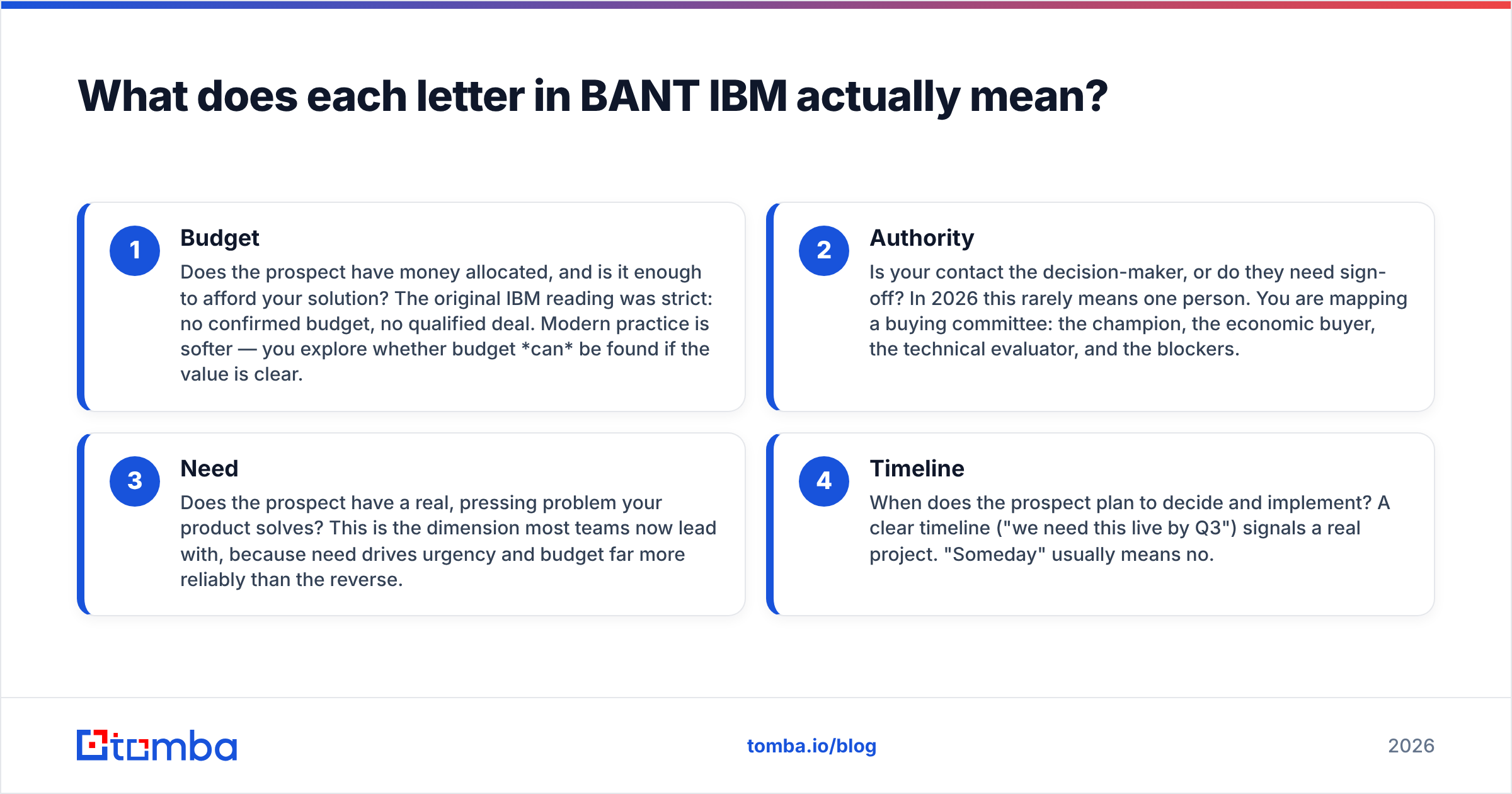
- Budget — Does the prospect have money allocated, and is it enough to afford your solution? The original IBM reading was strict: no confirmed budget, no qualified deal. Modern practice is softer — you explore whether budget can be found if the value is clear.
- Authority — Is your contact the decision-maker, or do they need sign-off? In 2026 this rarely means one person. You are mapping a buying committee: the champion, the economic buyer, the technical evaluator, and the blockers.
- Need — Does the prospect have a real, pressing problem your product solves? This is the dimension most teams now lead with, because need drives urgency and budget far more reliably than the reverse.
- Timeline — When does the prospect plan to decide and implement? A clear timeline ("we need this live by Q3") signals a real project. "Someday" usually means no.
A useful habit: score each dimension instead of treating BANT as pass/fail. A lead that is strong on Need and Timeline but soft on Budget is a different play than one with Budget but no urgency. This nuance is exactly what good lead qualification is built on.
Is BANT still relevant in 2026?#
Yes — but with caveats. BANT survives because it is simple, fast, and easy to teach. A new rep can learn it in an afternoon and apply it on the next call. For high-velocity, lower-complexity deals (SMB SaaS, transactional sales, inbound-heavy motions), classic BANT is often all you need.
The criticism is that BANT is seller-centric and rigid. It was designed in an era when the salesperson controlled information and buyers were less educated. Today, research from Gartner shows B2B buyers complete most of their journey before talking to sales, and purchases involve six to ten stakeholders. Leading with "what's your budget?" on a first call now reads as tone-deaf.
That is why most modern teams use a reordered, value-first version — sometimes called NBAT (Need first) — and reserve strict budget gating for late-stage qualification. BANT becomes a flexible checklist rather than a sequential gate.
How does BANT IBM compare to other qualification frameworks?#
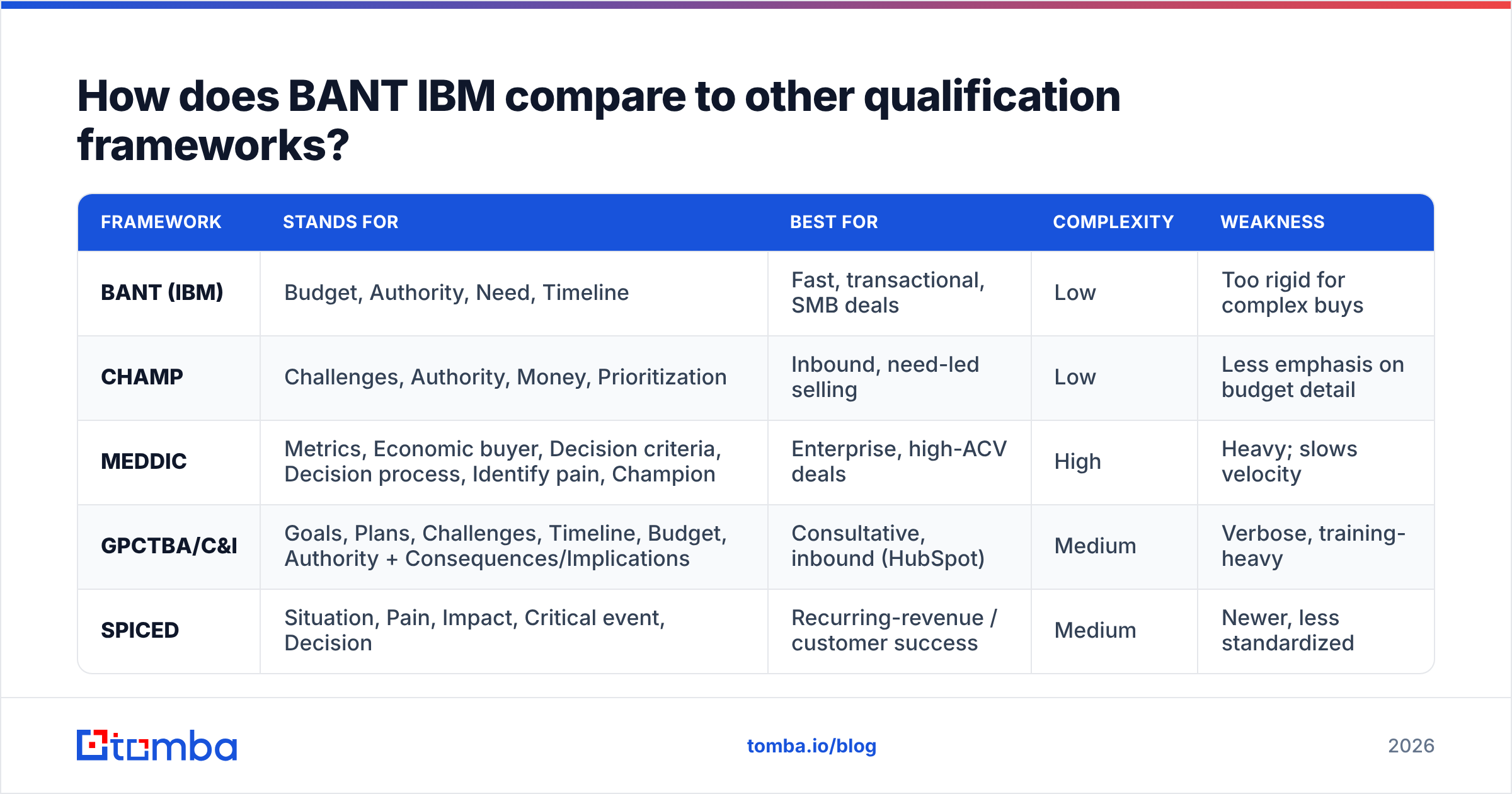
BANT is not the only game in town. Here is how it stacks up against the frameworks most often used alongside or instead of it.
| Framework | Stands for | Best for | Complexity | Weakness |
|---|---|---|---|---|
| BANT (IBM) | Budget, Authority, Need, Timeline | Fast, transactional, SMB deals | Low | Too rigid for complex buys |
| CHAMP | Challenges, Authority, Money, Prioritization | Inbound, need-led selling | Low | Less emphasis on budget detail |
| MEDDIC | Metrics, Economic buyer, Decision criteria, Decision process, Identify pain, Champion | Enterprise, high-ACV deals | High | Heavy; slows velocity |
| GPCTBA/C&I | Goals, Plans, Challenges, Timeline, Budget, Authority + Consequences/Implications | Consultative, inbound (HubSpot) | Medium | Verbose, training-heavy |
| SPICED | Situation, Pain, Impact, Critical event, Decision | Recurring-revenue / customer success | Medium | Newer, less standardized |
The practical takeaway: use BANT for speed, MEDDIC for enterprise rigor, and CHAMP or HubSpot's GPCTBA/C&I when you want to lead with the buyer's challenges. Many teams run BANT at the top of the funnel and switch to MEDDIC once a deal enters the pipeline.
How do you actually run a BANT qualification call?#
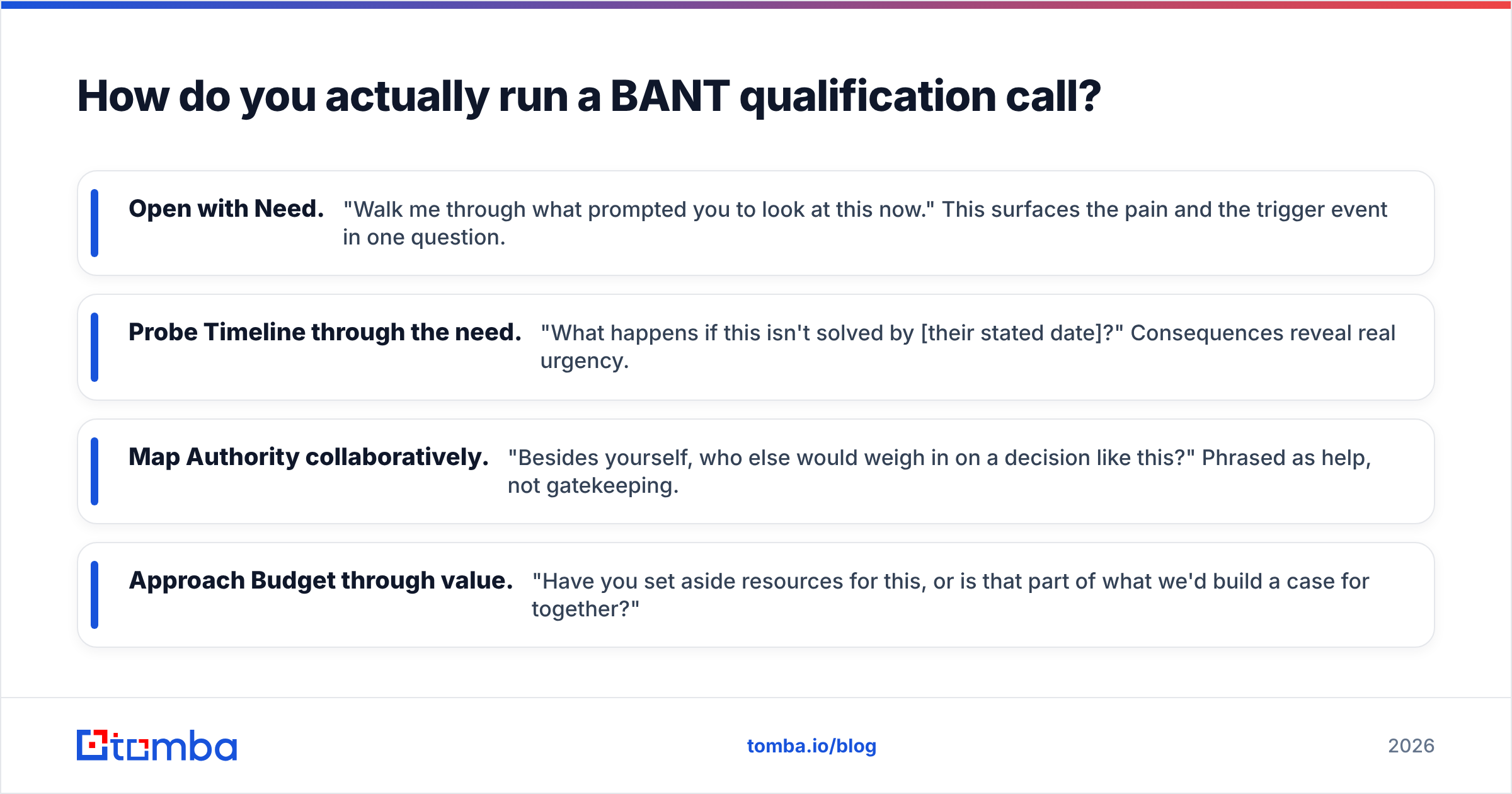
You do not march through B-A-N-T like a form. You let the four threads emerge through good discovery questions. Here is a field-tested sequence.
- Open with Need. "Walk me through what prompted you to look at this now." This surfaces the pain and the trigger event in one question.
- Probe Timeline through the need. "What happens if this isn't solved by [their stated date]?" Consequences reveal real urgency.
- Map Authority collaboratively. "Besides yourself, who else would weigh in on a decision like this?" Phrased as help, not gatekeeping.
- Approach Budget through value. "Have you set aside resources for this, or is that part of what we'd build a case for together?"
Score each thread 0–3 as you go. A deal that totals 9–12 is hot; 5–8 needs nurturing; below 5 should be disqualified or recycled to marketing. Logging these scores in your CRM turns BANT from a gut feeling into a repeatable lead-scoring system you can coach against and improve over time.
Why does BANT fail when your data is wrong?#
Here is the part most BANT guides skip: the framework is only as good as your contact data. Every BANT dimension assumes you are talking to the right person at the right company. Get that wrong and the whole exercise collapses.
- You cannot qualify Authority if you do not know who the decision-maker is or how to reach them.
- You cannot assess Budget or Need if you are emailing a generic info@ inbox that never reaches a human.
- You waste Timeline on bounced emails and disconnected numbers instead of live conversations.
This is where qualification quietly dies — not on the call, but before it, in a list full of stale or guessed contacts. If half your outreach bounces, your reps burn their hours on data cleanup instead of selling, and your BANT scoring is built on noise.
The fix is to qualify your data before you qualify the lead. Build target lists with verified, current contacts so that by the time a rep runs BANT, they already know they are speaking with a real, reachable buyer. Tools like the Tomba Email Finder and an email verifier do this work upfront — surfacing the right decision-maker's address and confirming it is deliverable before anyone picks up the phone. Accurate contact data is the silent fifth letter of BANT.
What are the most common BANT IBM mistakes?#
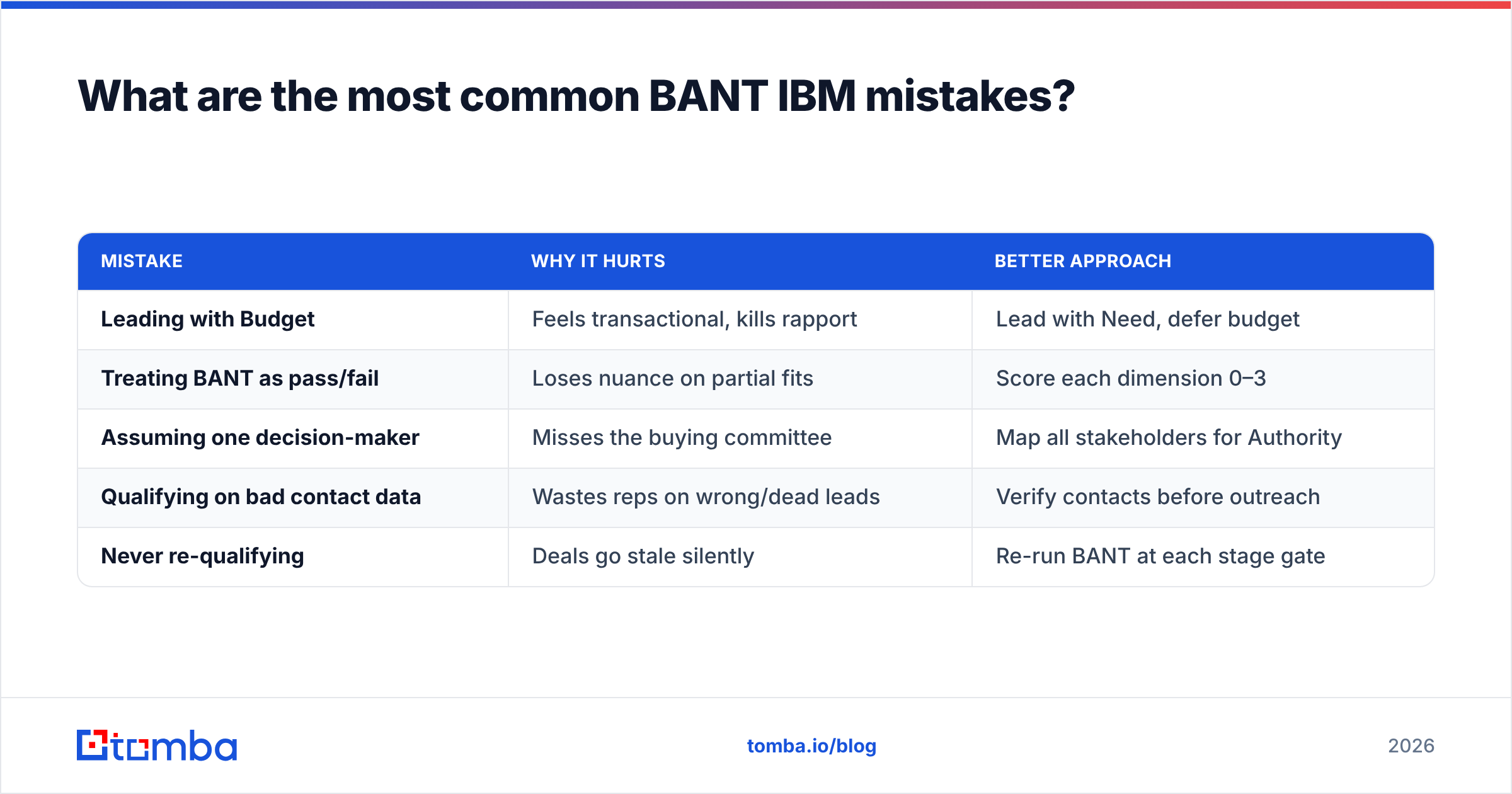
Even teams that swear by BANT misuse it. Watch for these traps.
| Mistake | Why it hurts | Better approach |
|---|---|---|
| Leading with Budget | Feels transactional, kills rapport | Lead with Need, defer budget |
| Treating BANT as pass/fail | Loses nuance on partial fits | Score each dimension 0–3 |
| Assuming one decision-maker | Misses the buying committee | Map all stakeholders for Authority |
| Qualifying on bad contact data | Wastes reps on wrong/dead leads | Verify contacts before outreach |
| Never re-qualifying | Deals go stale silently | Re-run BANT at each stage gate |
The throughline: BANT is a living check, not a one-time stamp. Budgets shift, champions leave, priorities change. Re-qualify as the deal moves, and keep your contact records current with ongoing data enrichment so a job change does not blindside you mid-cycle.
How does BANT fit into a modern outbound motion?#
In a 2026 outbound stack, BANT sits in the middle — after data, before forecasting.
The sequence looks like this: you start with a clean, enriched list of accounts and verified contacts. Your SDRs run light qualification on first touch to confirm Need and rough Timeline. AEs then apply full BANT (or MEDDIC for enterprise) during discovery, scoring each dimension. Qualified deals move to pipeline with a BANT score attached, which feeds cleaner forecasting and better response-rate analysis.
The framework also keeps marketing and sales honest about what "qualified" means. When both teams agree that an MQL needs a real Need plus a plausible Timeline before it becomes an SQL, the handoff stops being a fight. BANT becomes the shared language — and a verified B2B database becomes the shared source of truth underneath it.
Quick answers: BANT IBM FAQ#
What does BANT stand for? Budget, Authority, Need, and Timeline — four dimensions for qualifying whether a sales lead is worth pursuing.
Did IBM invent BANT? IBM is credited with formalizing and popularizing BANT as part of its sales methodology, which is why it is often called "BANT IBM." It spread across B2B sales from there.
Is BANT outdated? Not outdated, but often misapplied. The rigid, budget-first version is dated; a flexible, need-first version remains highly effective for many deals.
What is better than BANT? Nothing is universally "better." MEDDIC suits complex enterprise deals; CHAMP and GPCTBA/C&I suit inbound, need-led selling. BANT wins on speed and simplicity.
How is BANT scored? Best practice is to rate each of the four dimensions 0–3 and total them, rather than treating the lead as a binary pass or fail.
Put BANT to work with the right data#
BANT IBM is still one of the fastest ways to decide which leads deserve your reps' attention — but only when the contacts behind those leads are real, reachable, and current. The framework qualifies the opportunity; your data has to qualify the person first.
Start there. Use the Tomba Email Finder to find and verify the decision-makers at your target accounts, so every BANT call lands with someone who can actually say yes. Check the Tomba pricing plans — a free tier with 25 searches per month, Starter at $49/mo, and Growth at $99/mo — and stop running your qualification framework on guesswork. Qualify the data, then qualify the lead.
// get started
Find, verify and enrich your first contacts today
Start on the free plan with 25 searches a month, then scale when your team is ready.
Free plan · No credit card required · GDPR & CCPA
// about the author