BANT Qualification in 2026: The Complete B2B Sales Framework
BANT qualification still works in 2026 — if you modernize it. Here's how Budget, Authority, Need, and Timeline score leads, where it breaks, and what to pair it with.
TL;DR
- BANT qualification scores a prospect on four factors — Budget, Authority, Need, and Timeline — to decide whether a lead is worth your reps' time.
- It was built by IBM decades ago for one-to-one selling, so the rigid "all four or disqualify" version fails on modern committee-based B2B deals.
- The 2026 version treats BANT as a weighted scorecard, not a gate: Need leads, Authority becomes "champion + buying group," and Timeline ties to a compelling event.
- BANT works best as the first filter in your funnel, handing qualified leads to deeper frameworks like MEDDIC for complex deals.
- Good qualification starts with good data. If your contact list is full of wrong titles and dead emails, no framework will save you.
What is BANT qualification?#
BANT qualification is a sales framework that decides whether a lead is worth pursuing by checking four boxes: Budget, Authority, Need, and Timeline. If a prospect has money to spend, the power to spend it, a real problem you solve, and a deadline to act — they qualify. If they're missing too many, you disqualify and move on.
Think of BANT like a bouncer at a club checking IDs. The bouncer isn't deciding whether you'll have a good night; they're making a fast, repeatable call on whether you belong inside at all. That's BANT's job — it's a triage tool, not a deal-closing playbook. It tells a rep where to spend the next hour, not how to win the contract.
IBM created BANT in the mid-20th century, and it spread because it's brutally simple. Any rep can hold four letters in their head on a discovery call. That simplicity is also its weakness in 2026, where the average B2B purchase involves 6 to 10 decision-makers and budgets that get assembled mid-cycle rather than pre-approved.
What does each letter in BANT stand for?#
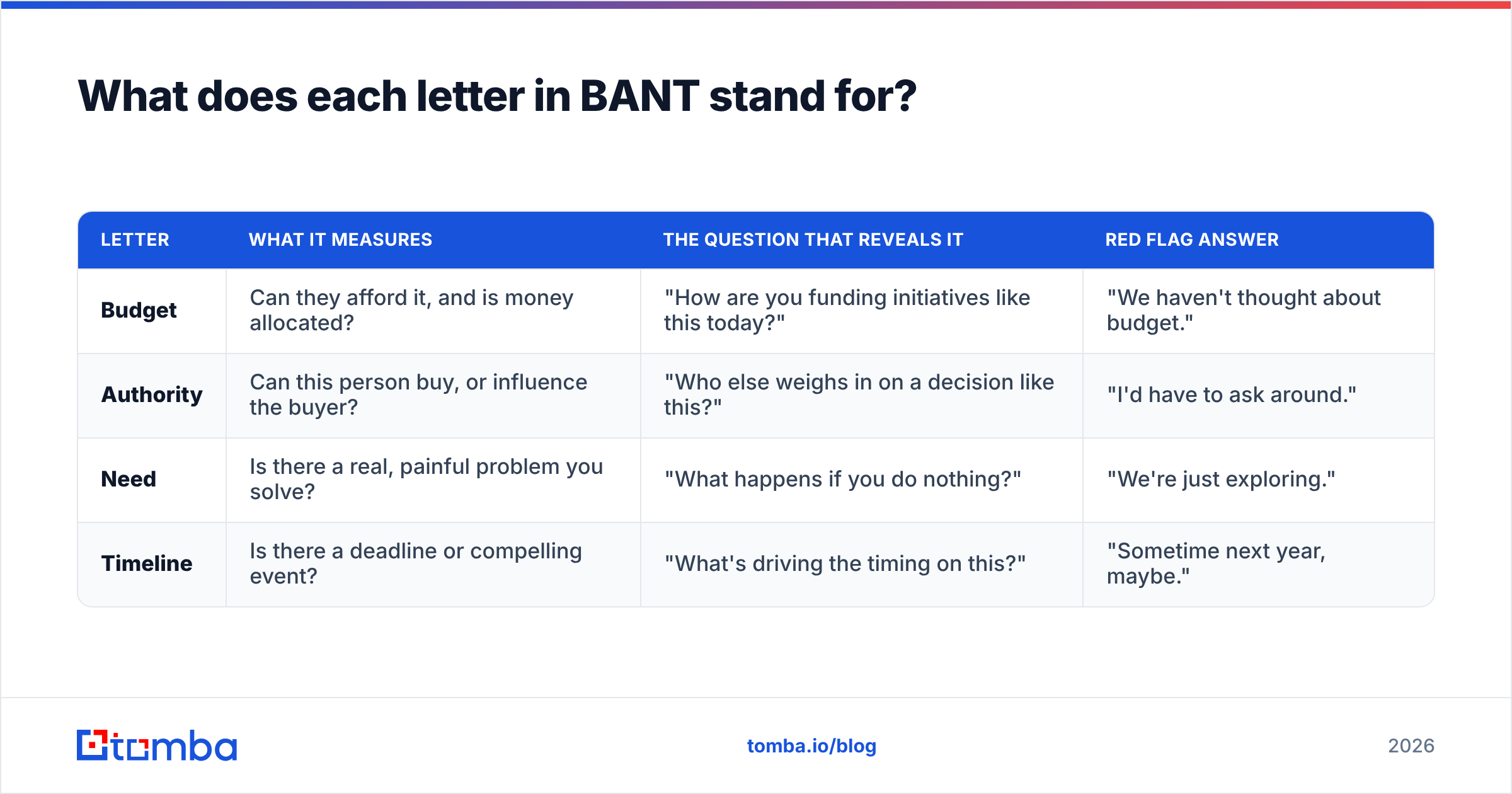
Here's the breakdown, plus the question that actually surfaces each signal on a call.
| Letter | What it measures | The question that reveals it | Red flag answer |
|---|---|---|---|
| Budget | Can they afford it, and is money allocated? | "How are you funding initiatives like this today?" | "We haven't thought about budget." |
| Authority | Can this person buy, or influence the buyer? | "Who else weighs in on a decision like this?" | "I'd have to ask around." |
| Need | Is there a real, painful problem you solve? | "What happens if you do nothing?" | "We're just exploring." |
| Timeline | Is there a deadline or compelling event? | "What's driving the timing on this?" | "Sometime next year, maybe." |
Notice the questions are open-ended. The fastest way to ruin BANT is to interrogate a prospect with yes/no checkboxes — "Do you have budget? Do you have authority?" That turns discovery into a customs inspection and kills rapport. Skilled reps weave these signals into a normal conversation and score them afterward.
Budget#
Budget is whether the money exists and whether your prospect can access it. In modern deals, the honest answer is often "there's no line item yet, but there's appetite." That's not an automatic disqualification — it's a signal that you'll need to help build the business case. The real disqualifier is when the cost of your solution is an order of magnitude beyond anything they could plausibly fund.
Authority#
Authority used to mean "are you the decision-maker?" In 2026, that question is almost obsolete. You're rarely talking to the sole buyer. The useful reframe: is this person a champion who can navigate the buying group? A motivated mid-level manager who can get you to the CFO is worth more than a disengaged VP.
Need#
Need is the strongest of the four, and most modern sellers weight it heaviest. A prospect with urgent, expensive pain will find budget, find authority, and compress their timeline. No need means no deal, no matter how clean the other three look.
Timeline#
Timeline separates "interested" from "buying." The best timelines attach to a compelling event — a contract renewal, a compliance deadline, a funding round, a product launch. "We'd like to fix this eventually" is not a timeline; it's a wish.
Is BANT still relevant in 2026?#
Yes — but only the modernized version. The classic "fail any letter, disqualify the lead" rule throws away too many winnable deals in today's market.
The original BANT assumed a single buyer with pre-approved budget making a top-down decision. That world is mostly gone. Today's reality looks like this:
- Budgets form mid-cycle. Buyers increasingly fund projects after they're convinced, not before. Disqualifying on "no budget yet" kills deals you could have built.
- Authority is distributed. The B2B buying group spans champions, blockers, end users, and finance. One person rarely holds all the power.
- Need is researched before you arrive. Buyers self-educate for months before talking to sales, so "Need" is often already established — your job is to sharpen and quantify it.
- Timelines slip. Economic caution means "this quarter" becomes "next quarter" routinely. Timeline is a signal to weigh, not a hard gate.
The fix isn't to abandon BANT — it's to treat it as a weighted scorecard instead of a pass/fail gate. Score each factor 0–3, weight Need and Timeline highest, and route leads by total score rather than disqualifying on a single miss.

How does BANT compare to other qualification frameworks?#
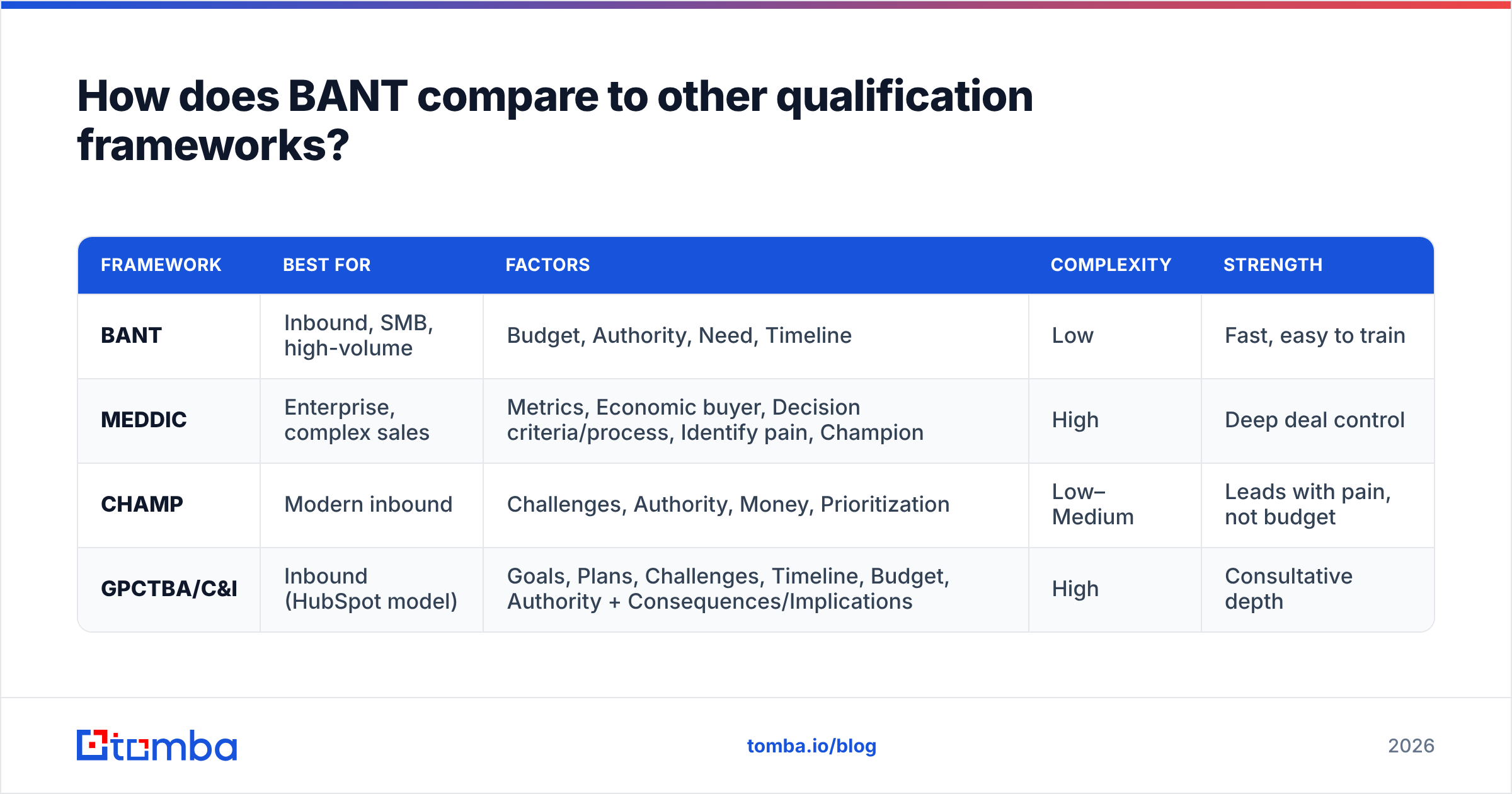
BANT is the lightweight option. For complex, high-value deals, heavier frameworks capture more nuance. Here's how the main players stack up.
| Framework | Best for | Factors | Complexity | Strength |
|---|---|---|---|---|
| BANT | Inbound, SMB, high-volume | Budget, Authority, Need, Timeline | Low | Fast, easy to train |
| MEDDIC | Enterprise, complex sales | Metrics, Economic buyer, Decision criteria/process, Identify pain, Champion | High | Deep deal control |
| CHAMP | Modern inbound | Challenges, Authority, Money, Prioritization | Low–Medium | Leads with pain, not budget |
| GPCTBA/C&I | Inbound (HubSpot model) | Goals, Plans, Challenges, Timeline, Budget, Authority + Consequences/Implications | High | Consultative depth |
A practical pattern: use BANT as the front-door filter to decide who gets a real conversation, then graduate qualified opportunities into MEDDIC once a deal is live. BANT answers "should I spend time here?" MEDDIC answers "how do I win this specific deal?" They're complementary, not competing. HubSpot's own sales qualification guidance makes the same point: BANT is a starting framework, not the whole methodology.
If you want a refresher on adjacent concepts like lead stages and scoring, Tomba's B2B glossary breaks down the terms most teams use alongside BANT.
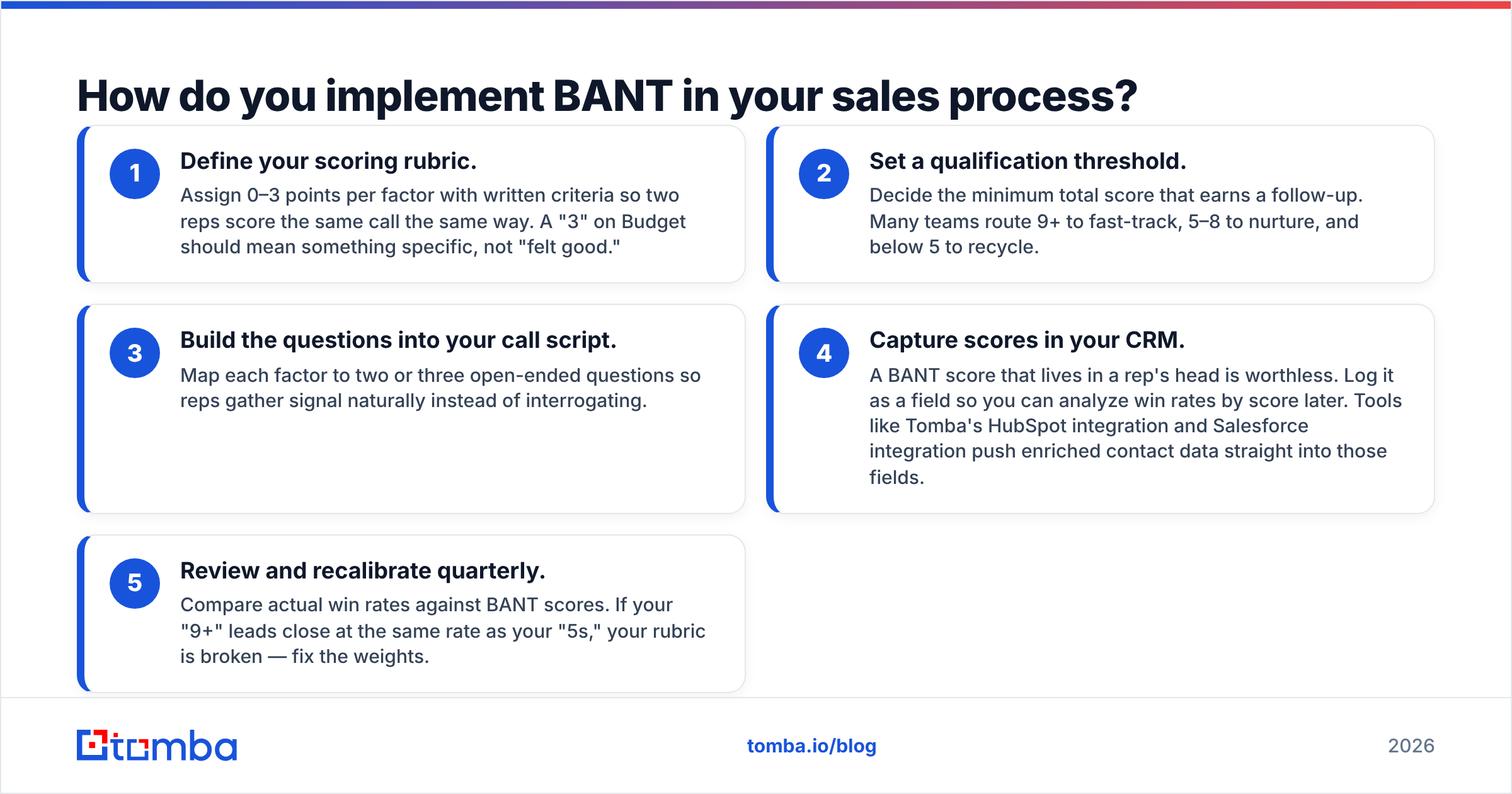
How do you implement BANT in your sales process?#
Turn the four letters into a repeatable workflow, not a vibe check. Here's a five-step rollout.
- Define your scoring rubric. Assign 0–3 points per factor with written criteria so two reps score the same call the same way. A "3" on Budget should mean something specific, not "felt good."
- Set a qualification threshold. Decide the minimum total score that earns a follow-up. Many teams route 9+ to fast-track, 5–8 to nurture, and below 5 to recycle.
- Build the questions into your call script. Map each factor to two or three open-ended questions so reps gather signal naturally instead of interrogating.
- Capture scores in your CRM. A BANT score that lives in a rep's head is worthless. Log it as a field so you can analyze win rates by score later. Tools like Tomba's HubSpot integration and Salesforce integration push enriched contact data straight into those fields.
- Review and recalibrate quarterly. Compare actual win rates against BANT scores. If your "9+" leads close at the same rate as your "5s," your rubric is broken — fix the weights.
The data layer matters more than most teams admit. BANT assumes you're talking to the right person at the right company. If your prospecting list is riddled with outdated titles, you'll burn the Authority question every call. Clean, current contact data — accurate names, roles, and verified emails — is what makes the Authority and Need checks meaningful in the first place.
Where does BANT break down — and how do you fix it?#
BANT fails in predictable ways. Knowing them lets you patch the framework before it costs you deals.
- It over-weights Budget. Leading with money disqualifies prospects who'd fund the project once convinced. Fix: lead with Need, treat Budget as a later-stage confirmation.
- It assumes a single buyer. Real deals have committees. Fix: reframe Authority as "champion strength + buying-group map."
- It's a snapshot, not a movie. A lead can be unqualified in January and red-hot in March. Fix: re-score on a cadence; don't bury "not now" leads forever.
- It rewards order-taking. Reps tempted to only chase pre-qualified, ready-to-buy leads miss the larger market of latent demand. Fix: use BANT to prioritize, not to exclude everyone who isn't ready today.
- Garbage data poisons every letter. Wrong contact, wrong company size, wrong everything. Fix: verify and enrich before you ever score.
That last point is where many qualification programs quietly fail. You can have a flawless rubric and still waste your reps' time if the leads feeding it are wrong. Accurate data enrichment — confirming the person's real role, company headcount, and reachable contact details — is the foundation BANT sits on. Pair it with email verification so the qualified leads you score are actually reachable, and your connect rates stop bleeding out on bounces.
What does a good BANT score look like in practice?#
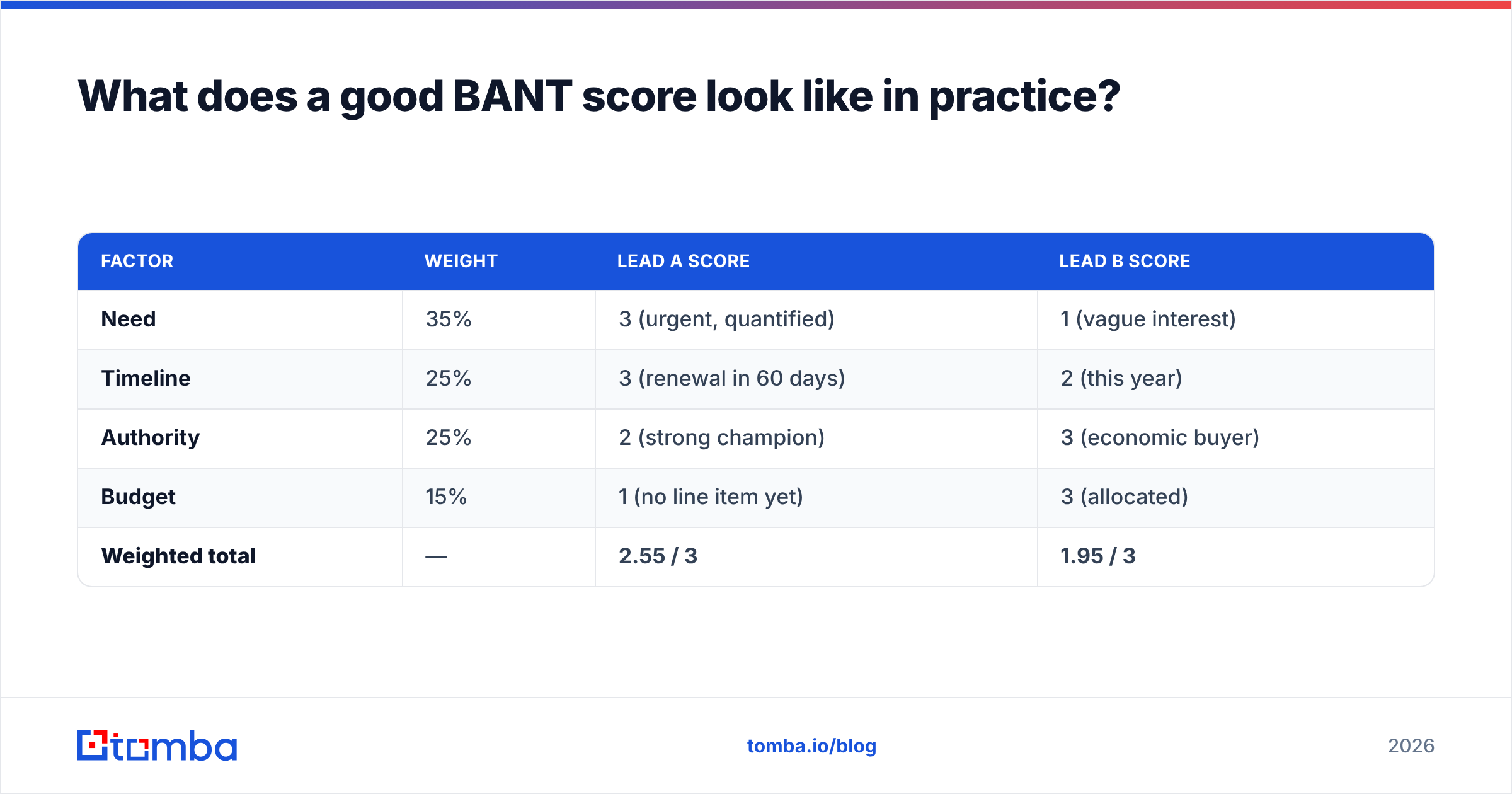
A useful BANT score is contextual, weighted, and tied to action. Here's a simplified example of a weighted scorecard a team might use for a $25k–$50k SaaS deal.
| Factor | Weight | Lead A score | Lead B score |
|---|---|---|---|
| Need | 35% | 3 (urgent, quantified) | 1 (vague interest) |
| Timeline | 25% | 3 (renewal in 60 days) | 2 (this year) |
| Authority | 25% | 2 (strong champion) | 3 (economic buyer) |
| Budget | 15% | 1 (no line item yet) | 3 (allocated) |
| Weighted total | — | 2.55 / 3 | 1.95 / 3 |
Lead A "fails" classic BANT on Budget but scores higher overall because urgent, deadline-driven Need is what actually moves deals. A rigid pass/fail gate would have you chasing Lead B and parking Lead A — exactly backward. The weighted model surfaces the right priority.
This is the whole argument for modernizing BANT: the framework's letters are still the right signals, but treating them as a weighted score instead of four yes/no gates aligns it with how buying actually happens in 2026.
Frequently asked questions#
Is BANT outdated? The rigid pass/fail version is. The weighted-scorecard version, with Need and Timeline leading, is very much alive and used across high-volume inbound teams.
What's the difference between BANT and MEDDIC? BANT is a fast top-of-funnel filter (four factors). MEDDIC is a deep deal-management methodology (six factors) for complex enterprise sales. Use BANT to qualify in, MEDDIC to win.
Should SDRs or AEs run BANT? Usually SDRs, as the first filter before booking a meeting. AEs then re-qualify and often layer a heavier framework on live opportunities.
Does BANT work for inbound leads? Yes, and it's arguably best there — inbound leads already signaled Need, so you're mostly confirming Authority, Timeline, and fit.
Start with leads worth qualifying#
No qualification framework can rescue a bad list. BANT, MEDDIC, CHAMP — all of them assume you're scoring real people at real companies with reachable contact details. Get the data wrong and every discovery call starts on a lie.
That's where Tomba's Email Finder earns its place in your stack. Before you score a single lead on Budget or Authority, you need the right contact at the right company — verified, current, and reachable. Tomba finds professional email addresses by name, company, or domain, verifies them so you skip the bounces, and enriches the record with the role and company data your BANT rubric depends on. Plans start free with 25 searches a month and scale from $49/mo — see Tomba pricing for the full breakdown. Feed your qualification framework clean data, and BANT finally does the job it was built for.
// get started
Find, verify and enrich your first contacts today
Start on the free plan with 25 searches a month, then scale when your team is ready.
Free plan · No credit card required · GDPR & CCPA
// about the author