BANT Questions: The 2026 Sales Qualification Playbook
The exact BANT questions to score budget, authority, need, and timeline on every call — plus scripts, a scoring table, and modern fixes for where BANT breaks in 2026.
BANT Questions That Actually Qualify in 2026
Most reps don't lose deals because they can't sell. They lose deals because they spend three calls on a prospect who never had budget, never had authority, and never had a real timeline. BANT questions are how you find that out in the first ten minutes instead of the third week.
This guide gives you the exact BANT questions to ask, scripts for each letter, a scoring rubric you can drop into your CRM, and an honest look at where the framework breaks — and what to do about it.
TL;DR#
- BANT stands for Budget, Authority, Need, and Timeline — a qualification framework IBM created to score whether a lead is worth pursuing.
- Good BANT questions are open-ended and conversational, not an interrogation checklist. Lead with Need, not Budget.
- Score each letter 0–2 and set a threshold (e.g. 5+ of 8) before a lead advances to a demo or proposal.
- BANT alone is weak for modern committee-based buying; pair it with MEDDIC-style multithreading and accurate contact data.
- Qualification is only as good as the people you reach — verified emails and direct dials keep your BANT calls aimed at real decision-makers.
What is BANT and why does it still matter?#
BANT is a lead qualification framework built on four questions: does the prospect have the Budget, the Authority to spend it, a genuine Need for your product, and a Timeline for buying? Originated at IBM decades ago, it survives because it is fast — you can roughly qualify a lead in a single discovery call.
Think of BANT like a bouncer at a club door. You're not deciding whether someone is a good person; you're deciding whether they belong inside right now. The bouncer checks four things quickly and waves people through or turns them away. BANT does the same for your pipeline so your calendar fills with deals that can actually close this quarter.
The risk is treating BANT as a rigid checklist. Buyers can smell a rep ticking boxes. The skill is weaving these four threads into a normal conversation.
What does BANT stand for, exactly?#
Here is the core concept broken into its four components, with what each one is really measuring:
- Budget — Does the prospect have money allocated, or the ability to get it? You're measuring financial viability, not just a number. A prospect with no budget but strong executive sponsorship can still find funds.
- Authority — Who signs, who influences, and who can veto? In 2026 this is rarely one person. You're mapping a buying committee, not finding a single "decision-maker."
- Need — Is there a real, pressing problem your product solves? Strong need is the engine of every deal; weak need means the buyer stalls the moment a fire drill pops up elsewhere.
- Timeline — When does the prospect plan to decide and implement? A compelling event (contract expiry, compliance deadline, new hire) turns a vague timeline into a real one.
A useful mental rule: Need and Timeline tell you if a deal is real; Budget and Authority tell you how big and how fast it can close.
What are the best BANT questions to ask on a call?#
Below are field-tested BANT questions grouped by letter. Don't read them in order like a script — pull the right one when the conversation opens the door.
Budget questions#
- "How are you currently funding this kind of initiative?"
- "Many teams your size invest somewhere between X and Y for this. Does that range fit how you're thinking about it?"
- "If we prove the ROI, is there budget you can pull from this year, or would this be a next-cycle planning item?"
- "Who controls the budget line this would come out of?"
The anchored-range question ("between X and Y") is far better than the blunt "What's your budget?" — it gives the buyer a frame and surfaces sticker shock early.
Authority questions#
- "Besides yourself, who else weighs in on a decision like this?"
- "Walk me through how a purchase like this normally gets approved on your side."
- "If you and I agreed this was a fit, what would the next internal conversation look like?"
- "Has your team bought something similar before? What did that process involve?"
These uncover the buying committee without the awkward "Are you the decision-maker?" — a question that insults influencers and makes champions defensive.
Need questions#
- "What pushed you to take this call now, as opposed to six months ago?"
- "What does this problem cost you today — in hours, dollars, or missed revenue?"
- "What have you already tried, and why didn't it stick?"
- "If nothing changes, what happens in two quarters?"
The "why now" question is the single most valuable BANT question you can ask. It reveals the compelling event that drives both Need and Timeline.
Timeline questions#
- "When do you need a solution live and working — not just signed?"
- "Is there an event or deadline tied to this — a renewal, audit, launch, or board meeting?"
- "What has to happen internally between today and a signed agreement?"
- "Realistically, is this a this-quarter project or a planning-for-next-year project?"
How do you score BANT questions consistently?#
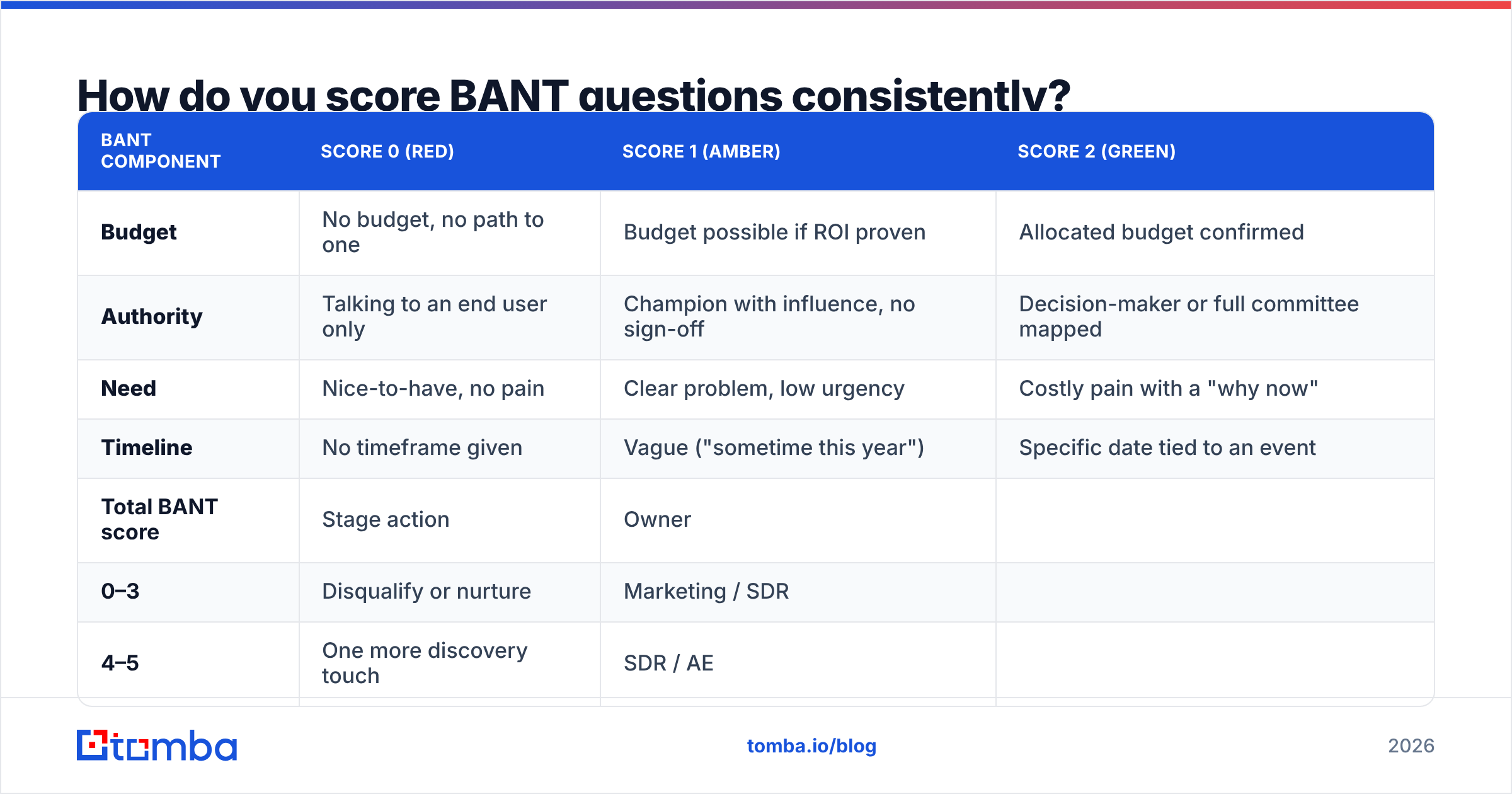
Asking good questions is half the job; scoring the answers the same way across your team is the other half. Use a simple 0–2 scale per letter, for a maximum of 8.
| BANT component | Score 0 (red) | Score 1 (amber) | Score 2 (green) |
|---|---|---|---|
| Budget | No budget, no path to one | Budget possible if ROI proven | Allocated budget confirmed |
| Authority | Talking to an end user only | Champion with influence, no sign-off | Decision-maker or full committee mapped |
| Need | Nice-to-have, no pain | Clear problem, low urgency | Costly pain with a "why now" |
| Timeline | No timeframe given | Vague ("sometime this year") | Specific date tied to an event |
Set a threshold that matches your sales motion. A common rule for mid-market B2B:
| Total BANT score | Stage action | Owner |
|---|---|---|
| 0–3 | Disqualify or nurture | Marketing / SDR |
| 4–5 | One more discovery touch | SDR / AE |
| 6–7 | Advance to demo | AE |
| 8 | Fast-track to proposal | AE |
Logging these scores in your CRM turns BANT from a gut feeling into pipeline data you can forecast against. If you're still defining stages, our sales process and pipeline notes pair well with this rubric.
Is BANT better than MEDDIC or SPIN in 2026?#
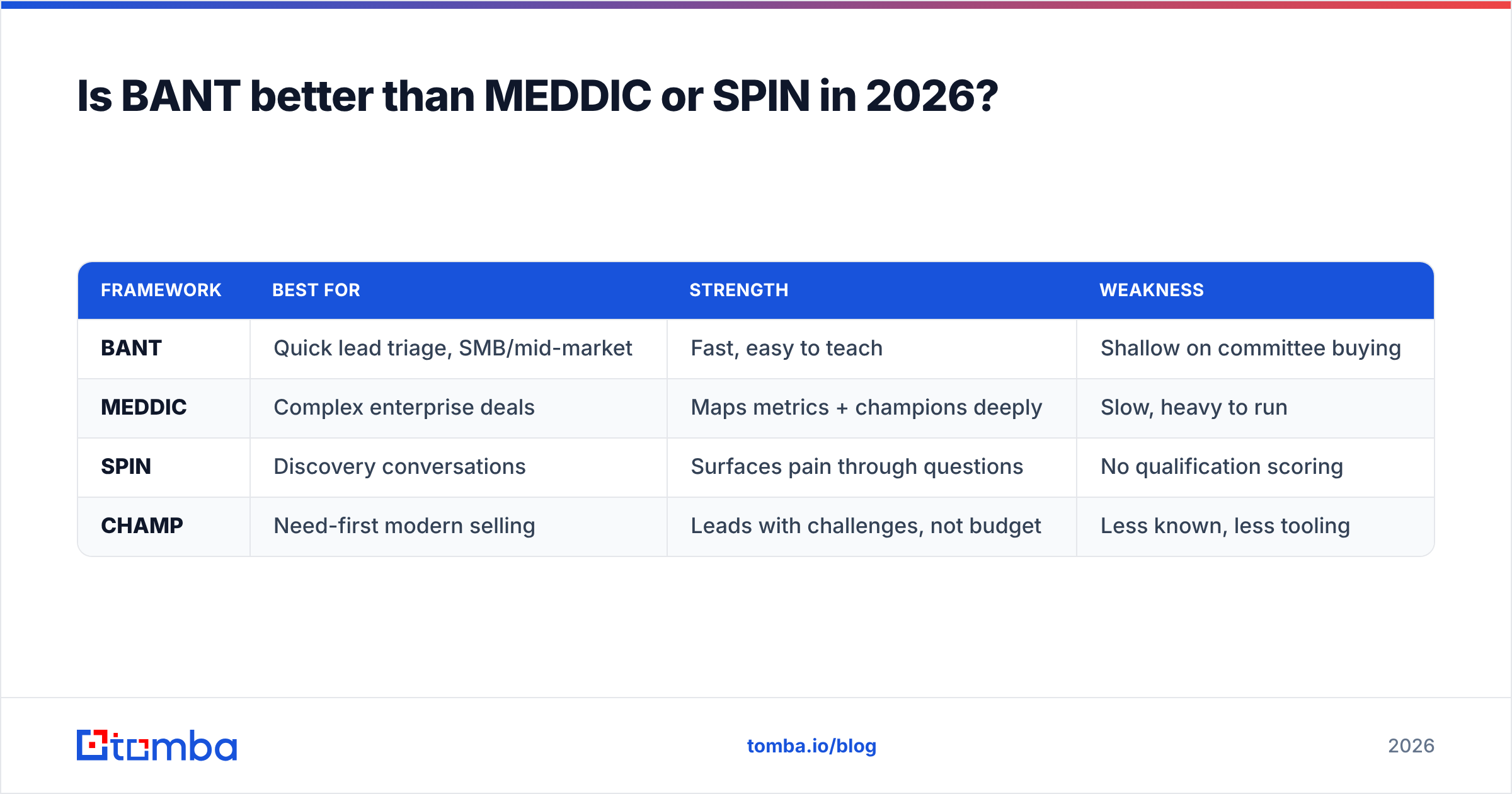
No single framework wins — they solve different problems. BANT is fast and great for early triage; MEDDIC is deeper and built for complex, multi-stakeholder enterprise deals; SPIN is a questioning technique rather than a scoring model.
| Framework | Best for | Strength | Weakness |
|---|---|---|---|
| BANT | Quick lead triage, SMB/mid-market | Fast, easy to teach | Shallow on committee buying |
| MEDDIC | Complex enterprise deals | Maps metrics + champions deeply | Slow, heavy to run |
| SPIN | Discovery conversations | Surfaces pain through questions | No qualification scoring |
| CHAMP | Need-first modern selling | Leads with challenges, not budget | Less known, less tooling |
The 2026 reality: buying committees average 6–10 people, and Gartner research has long shown buyers spend most of their journey not talking to sales. That breaks the original BANT assumption of one authority figure you qualify on one call. The fix isn't to abandon BANT — it's to multithread it. Run BANT questions across several contacts, not one, and treat "Authority" as a map you build over time.
Where does BANT break, and how do you fix it?#
BANT has three honest weaknesses. Name them so you can work around them.
- It's seller-centric. BANT asks "is this lead good for me?" not "how do I help this buyer?" Reframe every question around the prospect's outcome, not your quota.
- It over-weights budget. Leading with budget kills deals that could find money once value is clear. Always qualify Need first; budget conversations land better after the buyer feels the pain.
- It assumes a single decision-maker. Modern deals don't work that way. Layer in champion-and-committee mapping from MEDDIC.
There's a fourth, quieter failure that has nothing to do with the framework: you can run flawless BANT on the wrong person. If your contact data is stale, you'll spend a perfect discovery call qualifying an end user who left the company eight months ago. Qualification quality is capped by contact quality.
How does data quality change your BANT results?#
Garbage contacts in, garbage qualification out. The "Authority" letter especially depends on reaching the right humans — the budget owner, the champion, the technical evaluator. That's a data problem before it's a conversation problem.
Three concrete ways better data sharpens BANT:
- Reach real decision-makers. Use a domain search to map everyone at the account, then build your authority picture before the first call instead of guessing on it.
- Skip dead leads. Running your list through an email verifier before outreach means your BANT calls happen with people who actually exist and still work there.
- Multithread efficiently. When BANT reveals a committee, you need the other stakeholders' contact details fast. A bulk email finder turns "I need to loop in our CFO" into an email in seconds, not a week of LinkedIn back-and-forth.
For pricing on these, see the Tomba pricing page — the Free tier (25 searches/mo) is enough to test the workflow before you commit to Starter at $49/mo.
What does a full BANT call flow look like?#
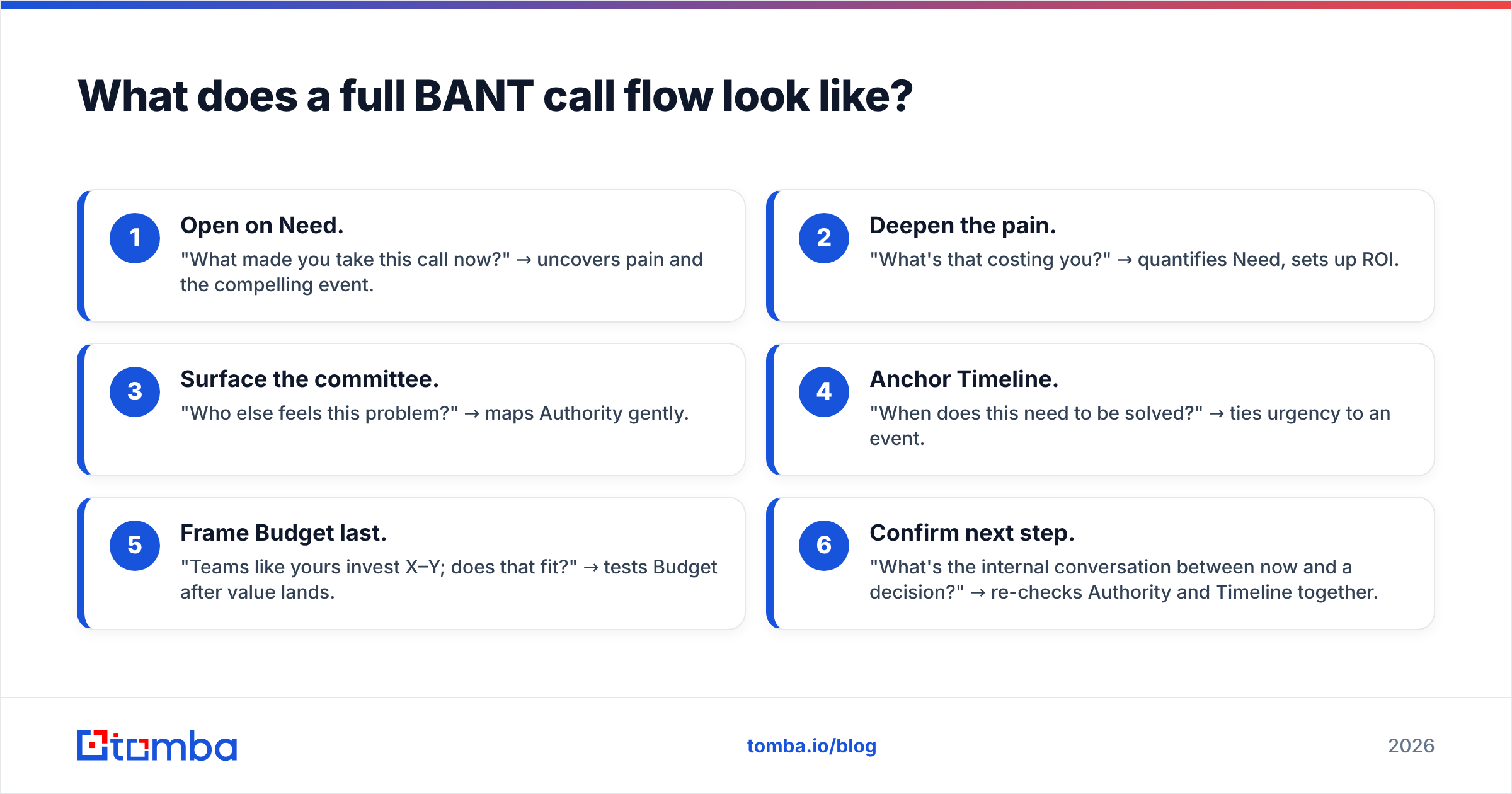
Here's a natural sequence that hits all four letters without feeling like an audit. Notice it opens on Need, not Budget.
- Open on Need. "What made you take this call now?" → uncovers pain and the compelling event.
- Deepen the pain. "What's that costing you?" → quantifies Need, sets up ROI.
- Surface the committee. "Who else feels this problem?" → maps Authority gently.
- Anchor Timeline. "When does this need to be solved?" → ties urgency to an event.
- Frame Budget last. "Teams like yours invest X–Y; does that fit?" → tests Budget after value lands.
- Confirm next step. "What's the internal conversation between now and a decision?" → re-checks Authority and Timeline together.
Reps who follow this order report higher conversion than those who lead with budget, because the buyer feels understood before they're asked to talk money. According to HubSpot's sales research, establishing relevance and trust early is one of the strongest predictors of whether a discovery call advances.
How do you write BANT questions into a repeatable script?#
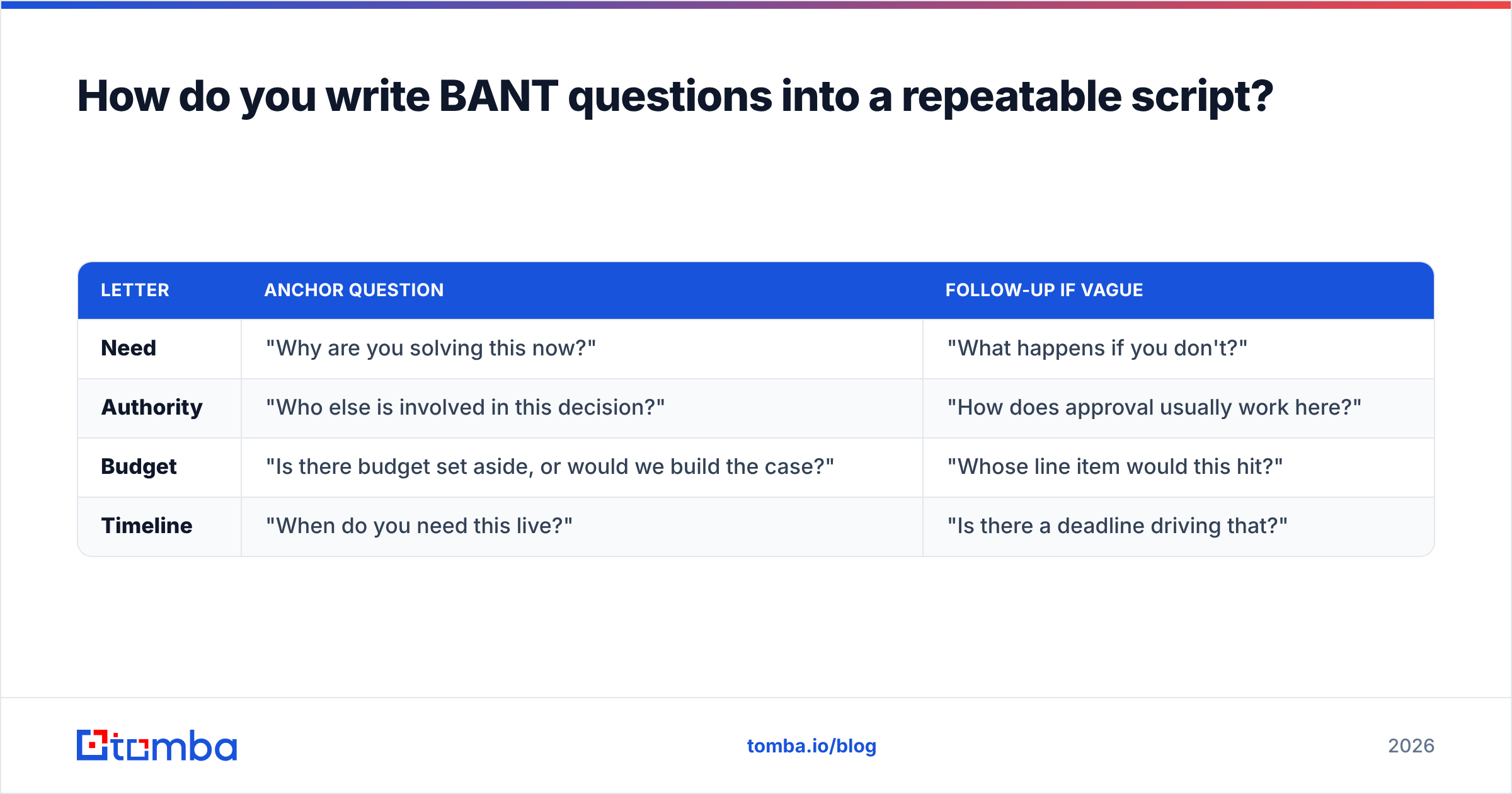
Build a one-page call card your whole team uses. Keep it to one anchor question per letter plus one follow-up. The goal is consistency, not robotic delivery.
| Letter | Anchor question | Follow-up if vague |
|---|---|---|
| Need | "Why are you solving this now?" | "What happens if you don't?" |
| Authority | "Who else is involved in this decision?" | "How does approval usually work here?" |
| Budget | "Is there budget set aside, or would we build the case?" | "Whose line item would this hit?" |
| Timeline | "When do you need this live?" | "Is there a deadline driving that?" |
Store the answers as structured fields in your CRM so you can report on win rates by BANT score over time. After a quarter, you'll know exactly which letter most predicts a closed-won deal for your product — and you can coach to it.
Common BANT mistakes to avoid#
- Interrogating instead of conversing. If your prospect feels processed, you've lost them. Blend questions into dialogue.
- Disqualifying too early on budget. No budget today ≠ no deal. Strong need finds money.
- Trusting one contact's "I decide this." Verify authority by asking how past purchases happened.
- Logging nothing. A BANT call with no recorded scores can't improve your forecasting.
- Qualifying stale leads. Re-verify contact data before you invest call time.
Frequently asked questions#
What does BANT stand for? Budget, Authority, Need, and Timeline — the four factors you assess to decide whether a lead is worth pursuing.
Is BANT outdated? Not outdated, but incomplete for complex deals. It works well for fast triage; pair it with committee mapping for enterprise sales.
Should I lead with budget questions? No. Lead with Need. Budget questions land far better once the buyer feels the pain and sees the value.
How many BANT questions should I ask? One strong anchor question per letter, plus follow-ups as needed. Four to eight well-placed questions cover it.
Put your BANT questions in front of the right people#
Great BANT questions are wasted on the wrong contact. Before your next round of discovery calls, build a clean list of the actual budget owners, champions, and committee members at your target accounts — with verified, deliverable emails. Start with the Tomba Email Finder to turn a company domain and a name into a real, reachable inbox, so every BANT call you run is aimed at someone who can actually say yes. Qualify smarter by reaching better.
// get started
Find, verify and enrich your first contacts today
Start on the free plan with 25 searches a month, then scale when your team is ready.
Free plan · No credit card required · GDPR & CCPA
// about the author