BANT Score Explained: How to Qualify Leads Faster in 2026
The BANT score turns gut-feel qualification into a repeatable number. Here's how to calculate it, weight each factor, and feed it clean data in 2026.
You have 200 leads in your pipeline and time to call maybe 30 today. Which 30? If your answer is "whichever ones replied last" or "the logos I recognize," you are leaving revenue on the table. A BANT score replaces that gut feel with a number you can sort, filter, and defend in a forecast review.
TL;DR#
- BANT score is a numeric rating of a lead across four factors: Budget, Authority, Need, and Timeline.
- You assign points to each factor (commonly 0–25 each, 100 total), then route or prioritize based on the sum.
- BANT is fast and rep-friendly, but it is weaker on modern buying committees than MEDDIC or CHAMP — so many teams blend them.
- The score is only as good as the contact data behind it. Garbage authority data means garbage qualification.
- In 2026, the winning move is automating the data layer (who the buyer is, where they work, how to reach them) so reps spend their time judging, not researching.
What is a BANT score?#
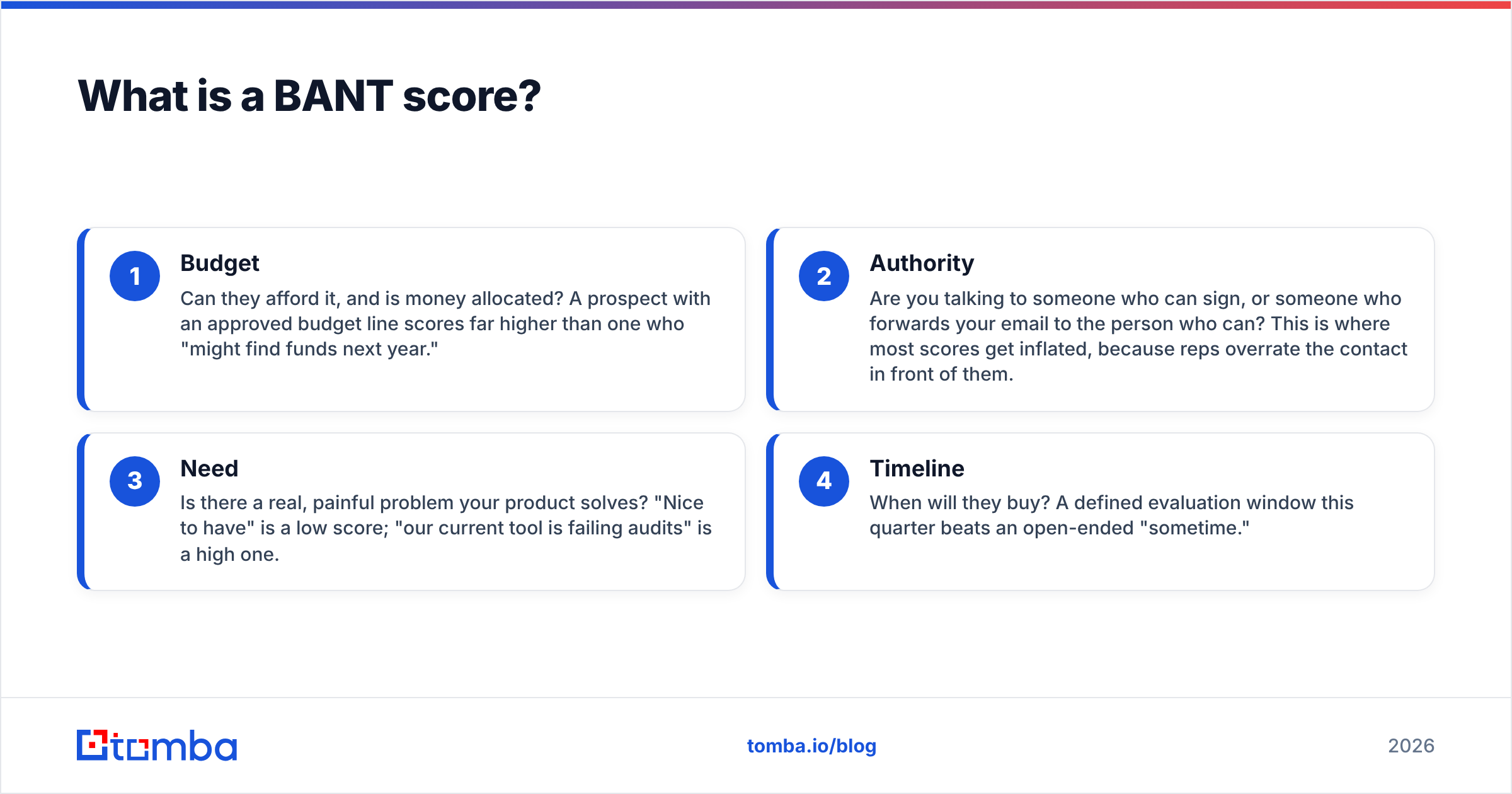
A BANT score is a single number that tells you how qualified a lead is, built from four classic sales questions. IBM created the BANT framework decades ago, and it survives because it maps to how deals actually die: no money, no decision-maker, no real problem, or no urgency.
Here is what each letter measures:
- Budget — Can they afford it, and is money allocated? A prospect with an approved budget line scores far higher than one who "might find funds next year."
- Authority — Are you talking to someone who can sign, or someone who forwards your email to the person who can? This is where most scores get inflated, because reps overrate the contact in front of them.
- Need — Is there a real, painful problem your product solves? "Nice to have" is a low score; "our current tool is failing audits" is a high one.
- Timeline — When will they buy? A defined evaluation window this quarter beats an open-ended "sometime."
Instead of a yes/no on each, the modern BANT score assigns points. That turns four soft judgments into one hard number you can rank a list by. If you want the precise definition of where a scored lead sits relative to a marketing qualified lead, BANT is the bridge: it is how sales decides whether marketing's MQL is worth a call.
)
How do you calculate a BANT score?#
Assign each factor a point band, total them, and set thresholds for action. The most common setup is 25 points per factor for a 100-point scale, but you can weight factors to match your deal.
A simple, unweighted scoring rubric looks like this:
- Budget (0–25) — 25 if budget is confirmed and sized to your price, 15 if a budget exists but is unconfirmed, 5 if they are "exploring," 0 if there is no money.
- Authority (0–25) — 25 for the economic buyer, 15 for a strong champion with influence, 5 for an end user with no pull, 0 for an unknown contact.
- Need (0–25) — 25 for an urgent, quantified pain, 15 for a clear but non-urgent need, 5 for mild curiosity, 0 for no fit.
- Timeline (0–25) — 25 for a buying decision this quarter, 15 for this half, 5 for "next year," 0 for none.
Then set thresholds:
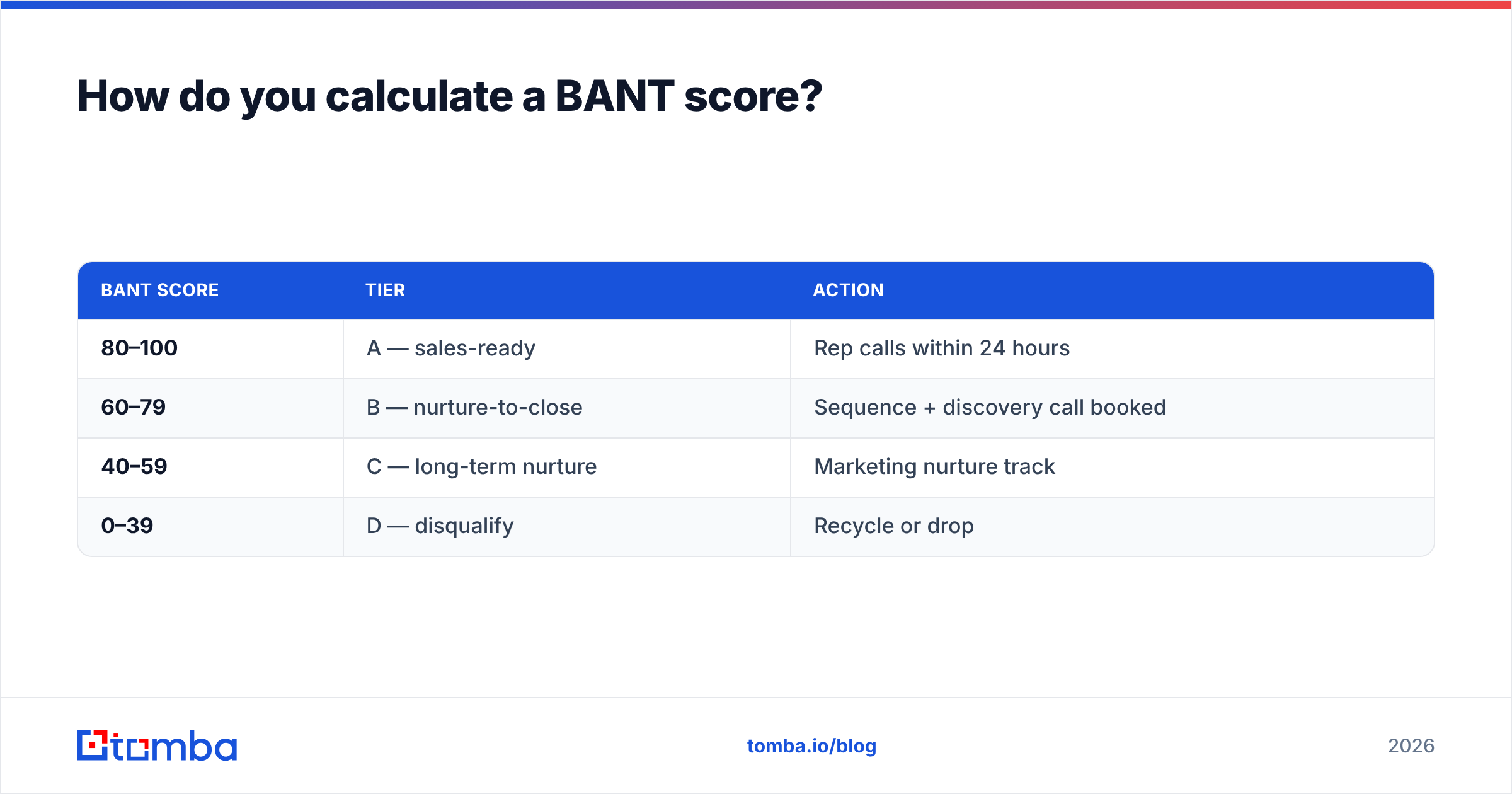
| BANT score | Tier | Action |
|---|---|---|
| 80–100 | A — sales-ready | Rep calls within 24 hours |
| 60–79 | B — nurture-to-close | Sequence + discovery call booked |
| 40–59 | C — long-term nurture | Marketing nurture track |
| 0–39 | D — disqualify | Recycle or drop |
The thresholds matter more than the exact points. The goal is consistency: two reps scoring the same lead should land within a tier of each other. Document the rubric, put it in your CRM, and review it quarterly against closed-won data to see if your "A" leads actually close.
Should you weight the four factors?#
Yes, if one factor predicts your wins more than the others. A self-serve SaaS product with a $50/month price barely cares about budget but lives and dies on need and timeline. An enterprise deal with a six-figure ACV cares enormously about authority and budget. Re-weight so the total still hits 100 — for example, Authority 35, Budget 30, Need 20, Timeline 15. Back the weights with your own win rate data, not opinion.
Why does BANT still matter in 2026?#
BANT survives because it is fast, teachable, and good enough for the first pass. According to HubSpot's sales research, reps spend a large share of their week on non-selling work — and unqualified leads are a big reason. A lightweight scoring model that any new rep can apply in a 15-minute discovery call is worth more than a perfect framework nobody uses.
The criticism of BANT is real, though. Modern B2B purchases involve buying committees — Gartner research puts the typical group at six to ten stakeholders. A single "Authority" score struggles to capture that. The fix is not to abandon BANT; it is to treat the Authority factor as a committee map, not a single name, and to enrich every contact so you actually know who sits on that committee.
That data problem is where most BANT scores quietly fail. A rep marks Authority as 25 because the person was friendly on the call — but that person is an analyst three rungs below the buyer. Clean firmographic and contact data is what keeps the score honest.
)
BANT vs other qualification frameworks?#
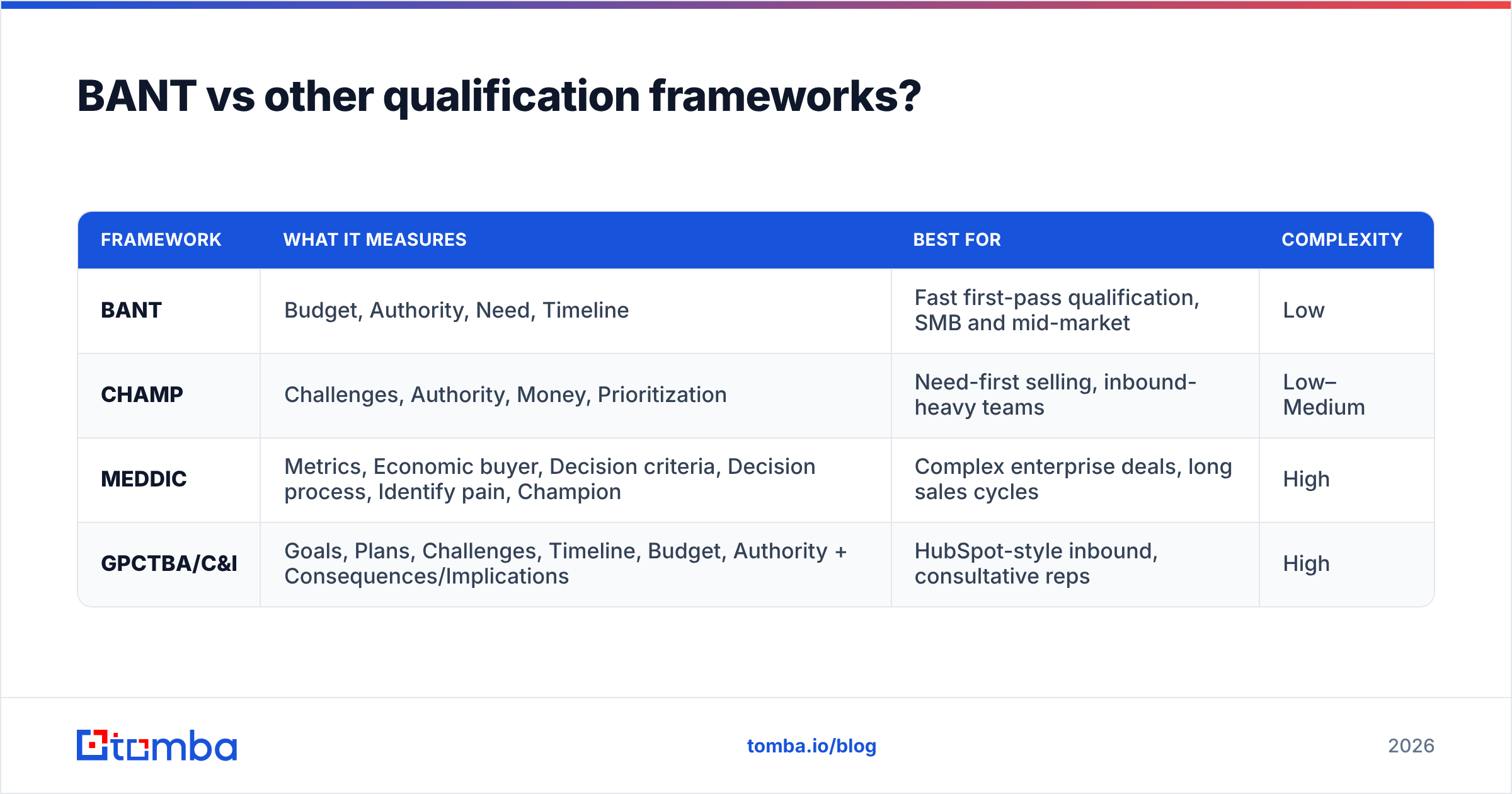
BANT is the simplest of the major frameworks. Here is how it stacks up against MEDDIC and CHAMP, the two it is most often compared to.
| Framework | What it measures | Best for | Complexity |
|---|---|---|---|
| BANT | Budget, Authority, Need, Timeline | Fast first-pass qualification, SMB and mid-market | Low |
| CHAMP | Challenges, Authority, Money, Prioritization | Need-first selling, inbound-heavy teams | Low–Medium |
| MEDDIC | Metrics, Economic buyer, Decision criteria, Decision process, Identify pain, Champion | Complex enterprise deals, long sales cycles | High |
| GPCTBA/C&I | Goals, Plans, Challenges, Timeline, Budget, Authority + Consequences/Implications | HubSpot-style inbound, consultative reps | High |
The practical read: start with BANT, graduate to MEDDIC as deals get bigger. CHAMP is BANT reordered to lead with the customer's challenge instead of your budget question, which feels less salesy on a first call. You can read more on how these frameworks compare in vendor playbooks from Salesforce. Many teams run a BANT score for routing and a MEDDIC checklist for deals that pass a threshold.
When should you not use BANT?#
Skip pure BANT when budget is genuinely unknowable early — common in product-led growth, where users adopt first and buy later. Leading with "what's your budget?" on someone who just signed up for a free trial kills the relationship. In those motions, score Need and Timeline heavily and treat Budget as a late-stage confirmation, not a gate.
How do you improve your BANT score accuracy?#
Fix the data layer first. A scoring model is a calculator; if the inputs are wrong, a more elaborate formula just produces a more confident wrong answer. Three inputs drive BANT accuracy:
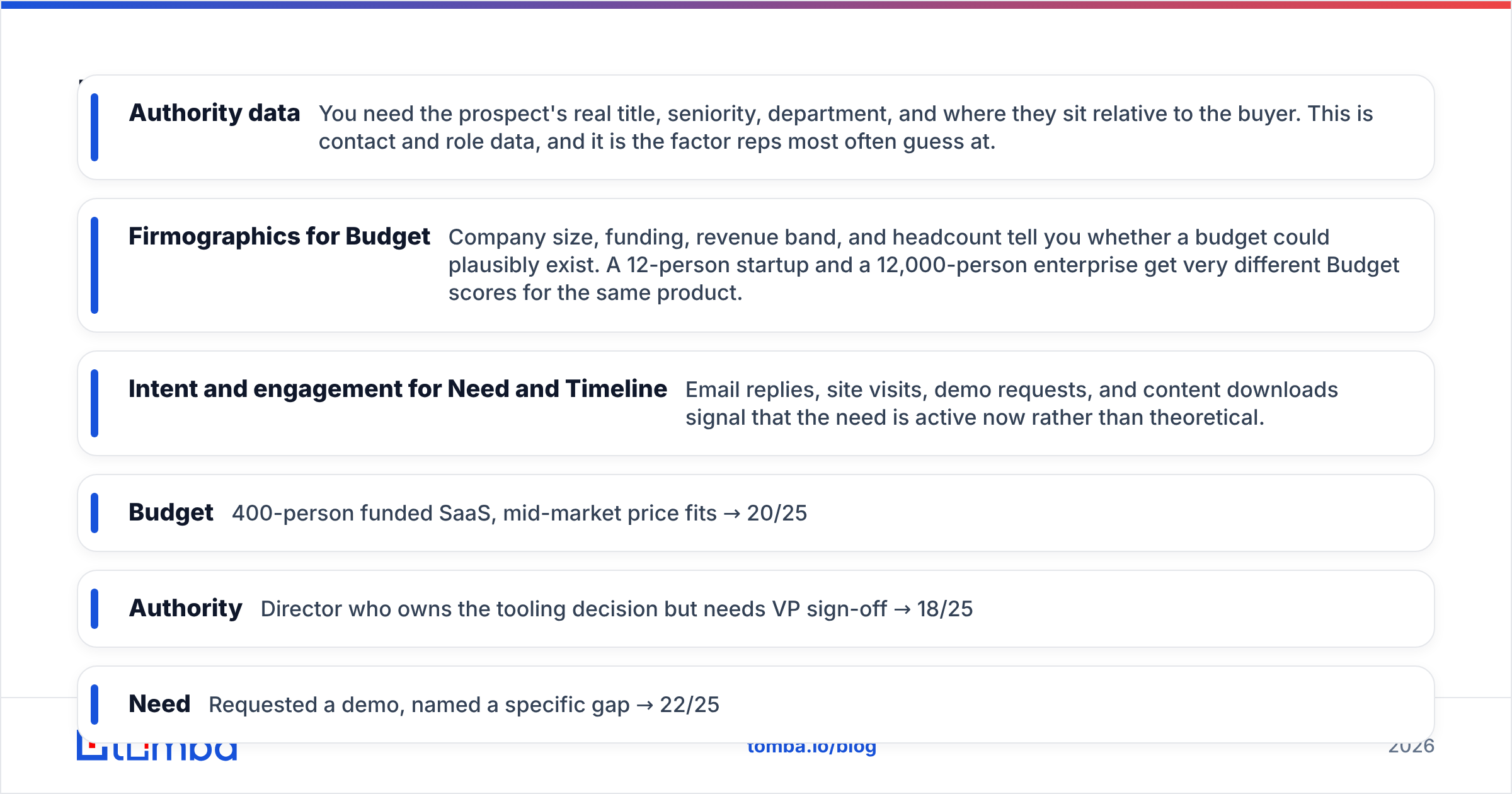
- Authority data — You need the prospect's real title, seniority, department, and where they sit relative to the buyer. This is contact and role data, and it is the factor reps most often guess at.
- Firmographics for Budget — Company size, funding, revenue band, and headcount tell you whether a budget could plausibly exist. A 12-person startup and a 12,000-person enterprise get very different Budget scores for the same product.
- Intent and engagement for Need and Timeline — Email replies, site visits, demo requests, and content downloads signal that the need is active now rather than theoretical.
The cheapest accuracy win is enriching every lead the moment it enters your CRM. Instead of a rep spending ten minutes on LinkedIn to confirm a title, data enrichment fills in the firmographic and role fields automatically, so the Authority and Budget scores start from facts. And before a rep ever dials, you need a working email — which is where an email finder closes the gap between "scored lead" and "contacted lead."
A worked BANT example#
Say a marketing automation lead comes in: Director of Demand Gen at a 400-person SaaS company, requested a demo, current contract renews in 60 days.
- Budget: 400-person funded SaaS, mid-market price fits → 20/25
- Authority: Director who owns the tooling decision but needs VP sign-off → 18/25
- Need: Requested a demo, named a specific gap → 22/25
- Timeline: Contract renews in 60 days, hard deadline → 23/25
Total: 83 → Tier A. Rep calls within 24 hours. Notice that every one of those scores depends on data — title, company size, renewal date — that should be in your CRM before the rep opens the record, not researched mid-call.
What are the common BANT scoring mistakes?#
The same errors show up across teams:
- Scoring the contact, not the account. A friendly champion is not the same as authority. Score the buying committee, not your favorite call.
- Treating Budget as a gate too early. In PLG and inbound motions, asking for budget first poisons the call. Move it later.
- Letting scores go stale. A Tier A lead from 90 days ago that never closed is not Tier A anymore. Decay the score or re-qualify.
- No calibration. If reps never compare scores against closed-won outcomes, the rubric drifts into fiction. Audit quarterly.
- Bad contact data. You cannot score Authority you cannot verify. Reps inflate the number to avoid leaving it blank.
That last point is the quiet killer. A BANT score built on guessed titles and stale emails produces a clean-looking pipeline that misses forecast. The fix is structural: make accurate contact data the default state of every lead, not a manual research task.
Conclusion: score the lead, but feed it real data#
A BANT score is the fastest way to turn a messy lead list into a ranked call sheet — but it is downstream of your data. Get Budget, Authority, Need, and Timeline from facts, and the score earns its place in your forecast. Guess at them, and you have automated your gut feeling.
That is the part you can fix today. Before your reps score a single lead, give them verified contacts to score: Tomba's Email Finder turns a name and a domain into a confirmed professional email, so the Authority and contact layer of your BANT score starts from real data instead of a placeholder. Pair it with enrichment, plug it into your CRM, and let your reps spend their time qualifying — not researching. Check the Tomba pricing plans, including a free tier to test it against your current lead list.
Ready to find emails that actually work?
Join 150,000+ professionals who stopped guessing and started sending. Free credits on signup — no credit card required.
Get the Tomba newsletter
Practical outbound tactics and product updates — once every two weeks.
About the author