BANT vs MEDDIC: Which Sales Qualification Wins in 2026?
BANT vs MEDDIC, head to head: which qualification framework actually fits your deal size, sales cycle, and team in 2026? A neutral breakdown with a side-by-side table.
TL;DR
- BANT (Budget, Authority, Need, Timing) is a fast, lightweight qualification checklist built for high-volume, transactional deals.
- MEDDIC (Metrics, Economic buyer, Decision criteria, Decision process, Identify pain, Champion) is a deeper framework built for complex, multi-stakeholder enterprise deals.
- Neither is "better" in the abstract — BANT wins on speed and SMB velocity; MEDDIC wins on forecast accuracy and large-ACV control.
- Many high-performing teams run a hybrid: BANT to triage inbound fast, MEDDIC to govern deals above a revenue threshold.
- Whichever you pick, qualification only works on accurate contact data — you can't score an economic buyer you can't reach.
What are BANT and MEDDIC?#
BANT and MEDDIC are both sales qualification frameworks — structured checklists reps use to decide whether a prospect is worth pursuing and how to advance the deal. The difference is depth and intent.
BANT was created at IBM decades ago and popularized through modern inbound playbooks like HubSpot's sales methodology. It asks four blunt questions:
- Budget — Can they afford it?
- Authority — Are you talking to a decision-maker?
- Need — Do they have a problem you solve?
- Timing — When will they buy?
MEDDIC (sometimes extended to MEDDICC or MEDDPICC) emerged at PTC in the 1990s for selling complex, six-figure software. It trades speed for rigor across six dimensions:
- Metrics — The quantifiable economic impact of solving the problem.
- Economic buyer — The person who controls the money, not just the user.
- Decision criteria — The formal and informal yardsticks the buyer uses.
- Decision process — The actual steps, approvals, and timeline to a signature.
- Identify pain — The specific, urgent business pain driving the purchase.
- Champion — An internal advocate with influence who sells for you when you're not in the room.
Here's the simplest analogy: BANT is the bouncer at the door checking IDs — quick yes/no, keep the line moving. MEDDIC is the detective who maps the whole building before deciding the case is winnable. One optimizes throughput; the other optimizes certainty.

How do BANT and MEDDIC compare side by side?#
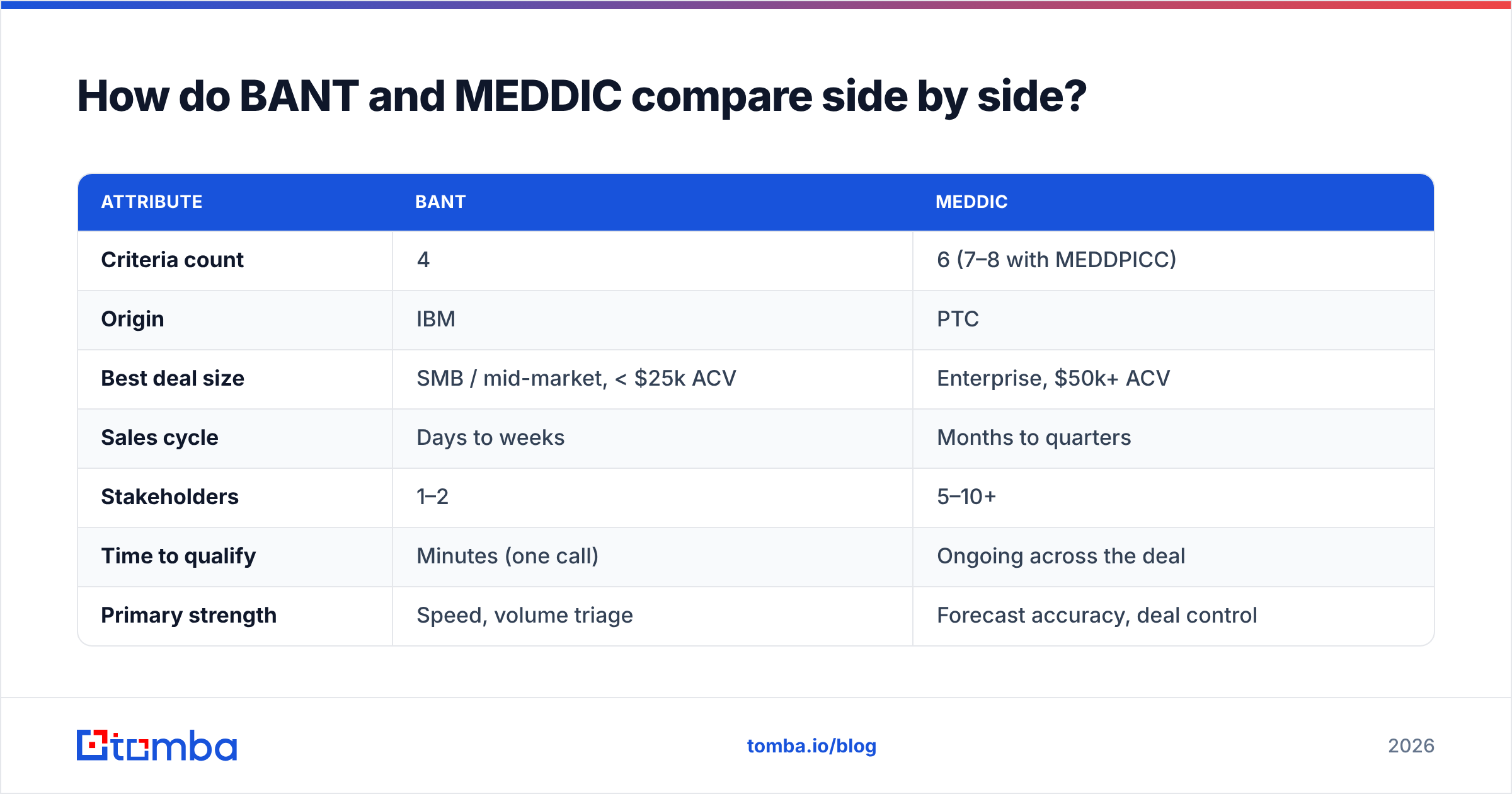
The fastest way to see the trade-offs is a direct comparison across the attributes that actually change your win rate.
| Attribute | BANT | MEDDIC |
|---|---|---|
| Criteria count | 4 | 6 (7–8 with MEDDPICC) |
| Origin | IBM | PTC |
| Best deal size | SMB / mid-market, < $25k ACV | Enterprise, $50k+ ACV |
| Sales cycle | Days to weeks | Months to quarters |
| Stakeholders | 1–2 | 5–10+ |
| Time to qualify | Minutes (one call) | Ongoing across the deal |
| Primary strength | Speed, volume triage | Forecast accuracy, deal control |
| Primary weakness | Misses complex buying groups | Heavy, slow, training-intensive |
| Forecast reliability | Moderate | High |
| Ramp time for new reps | Low (hours) | High (weeks) |
Read this table as a fit map, not a scoreboard. If your average deal closes in two calls, MEDDIC's six dimensions are overhead you'll never recoup. If your average deal involves a procurement committee and a security review, BANT's four questions will leave you blindsided in week eight by a stakeholder you never identified.
Is MEDDIC better than BANT for complex deals?#
Yes — for genuinely complex, high-value deals, MEDDIC is the stronger framework, and the reason is structural.
BANT assumes a buyer. MEDDIC assumes a buying group. According to Gartner research on B2B buying, a typical complex purchase now involves six to ten decision-makers, each armed with their own information. BANT's "Authority" question — "are you talking to the decision-maker?" — quietly collapses that entire group into one person who, in enterprise, rarely exists. There is no single decision-maker; there's an economic buyer, several influencers, a procurement gatekeeper, and a technical evaluator.
MEDDIC forces you to map that reality:
- Metrics make your business case quantifiable, so it survives being relayed to executives you never meet.
- Economic buyer separates the person who likes your demo from the person who signs.
- Decision process exposes the legal, security, and procurement steps that silently kill "verbally committed" deals.
- Champion gives you a human who carries the deal internally when the cycle stalls.
The cost is real: MEDDIC takes weeks to train, demands disciplined CRM hygiene, and slows early-stage velocity. For a transactional SMB motion, that's a tax with no return. This is exactly why blindly upgrading a fast-moving inbound team to MEDDIC often lowers output — you've bolted a freight-train process onto a delivery-bike business.
When should you use BANT instead?#
Use BANT when speed and volume matter more than depth. It's the right call when:
- Deal sizes are small and the cost of a wrong "yes" is low.
- Sales cycles are short — a few calls, not a few quarters.
- Inbound volume is high and reps need to triage hundreds of leads weekly.
- The buying group is tiny — a founder, an office manager, a single department head.
- New reps need to ramp fast without weeks of methodology training.
BANT shines as a first-pass filter. Even MEDDIC-driven enterprise teams often use a BANT-style gut check to decide whether a lead is worth the heavier qualification investment at all. Think of it as triage in an ER: BANT decides who gets seen; MEDDIC is the full workup for the patients who need surgery.
There's also a data dependency people forget. BANT's "Timing" and "Budget" answers are only as good as the person giving them. If you qualified the wrong contact — a junior user instead of a buyer — your BANT score is fiction. That's why qualification has to sit on top of clean prospect data, not the other way around. Routing a lead to the right marketing qualified lead definition means nothing if the email and title attached to that lead are wrong.
What are the pros and cons of each framework?#
A balanced view, because the honest answer is "it depends on your motion."
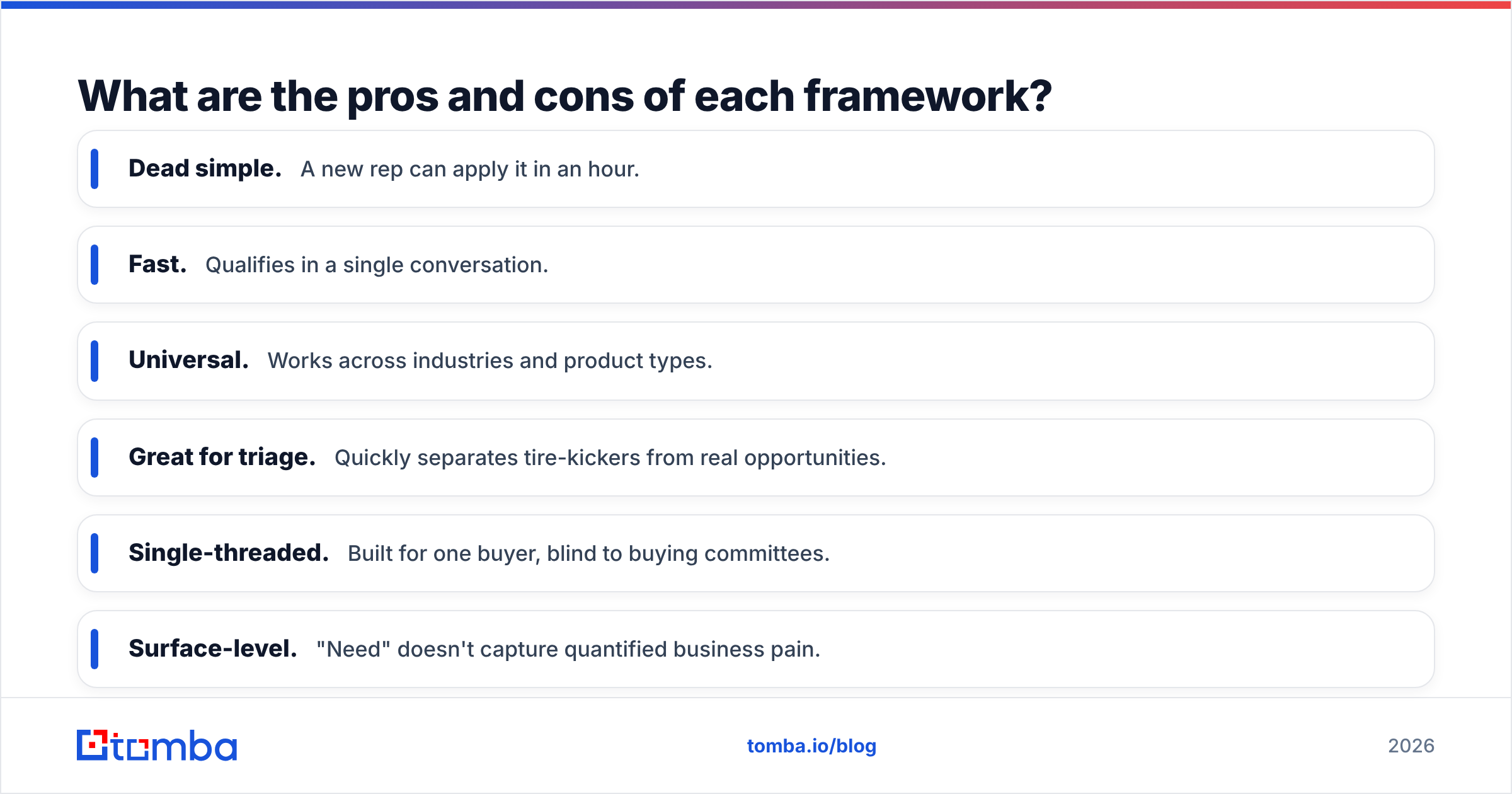
BANT — pros
- Dead simple. A new rep can apply it in an hour.
- Fast. Qualifies in a single conversation.
- Universal. Works across industries and product types.
- Great for triage. Quickly separates tire-kickers from real opportunities.
BANT — cons
- Single-threaded. Built for one buyer, blind to buying committees.
- Surface-level. "Need" doesn't capture quantified business pain.
- Easy to game. Prospects say "yes, budget exists" to be polite.
- Weak forecasting. A pipeline full of BANT-passed deals still slips.
MEDDIC — pros
- Forecast accuracy. Decision process and economic buyer expose real close probability.
- Deal control. Champions and metrics keep momentum through long cycles.
- Multi-threaded. Designed for committees and competing criteria.
- Coaching-friendly. Managers can inspect exactly where a deal is weak.
MEDDIC — cons
- Heavy. Six-plus dimensions to maintain per deal.
- Slow to ramp. Weeks of training and reinforcement.
- CRM-dependent. Falls apart without disciplined data entry.
- Overkill for SMB. Wasted effort on transactional deals.
The pattern is consistent: BANT optimizes for how many deals you can process; MEDDIC optimizes for how confidently you can call the ones that matter. Your win rate tells you which problem you actually have. If you're losing late-stage enterprise deals to "no decision," that's a MEDDIC gap. If you're drowning in unqualified inbound, that's a BANT job.
Can you combine BANT and MEDDIC?#
Yes, and most mature revenue orgs do exactly that. The hybrid model isn't a compromise — it's a tiered system that matches qualification depth to deal value.
A common implementation looks like this:
- BANT at the top of funnel. Every inbound lead and cold reply gets a fast BANT pass to decide whether it's worth a discovery call at all.
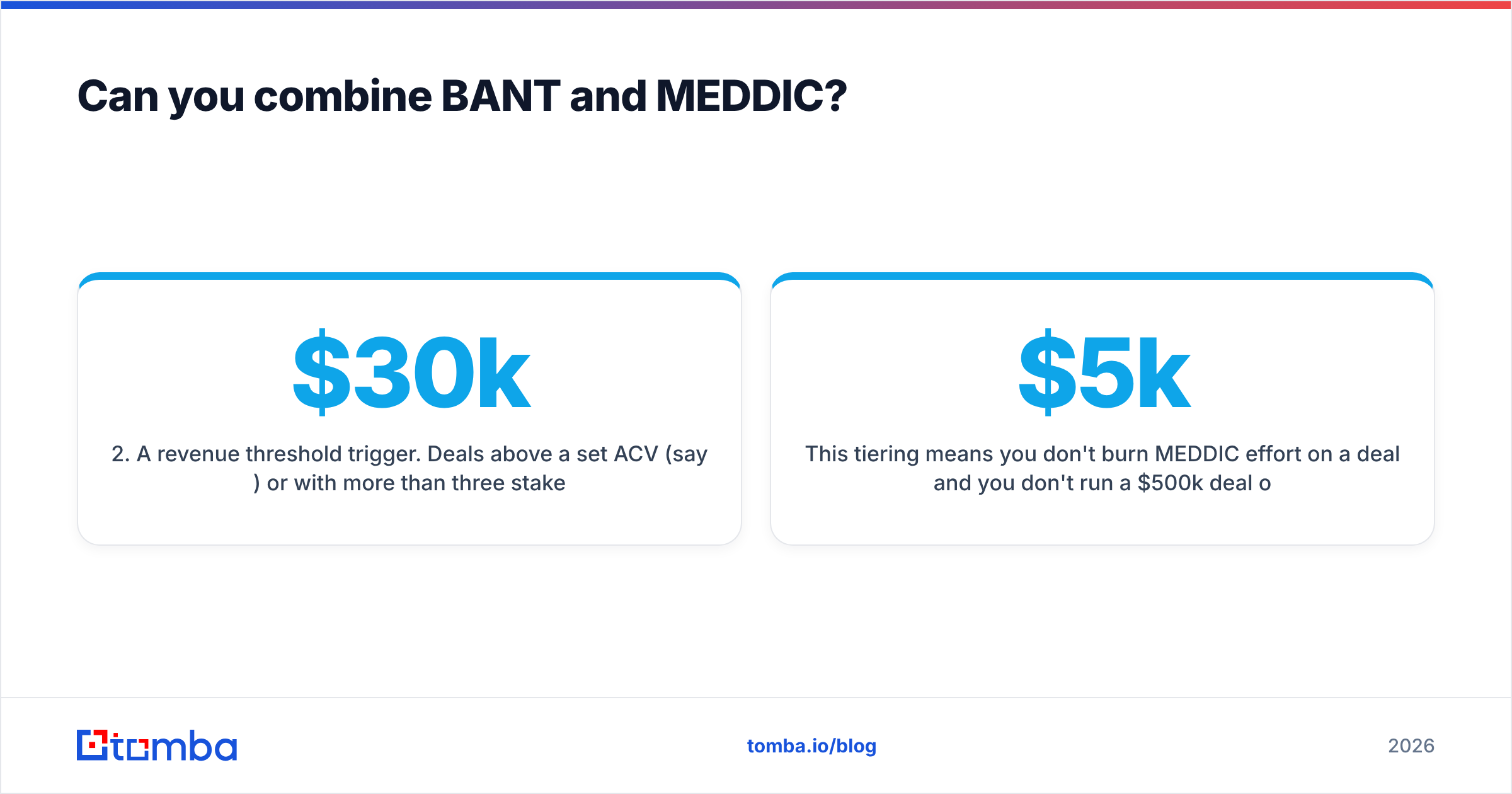
- A revenue threshold trigger. Deals above a set ACV (say $30k) or with more than three stakeholders graduate to MEDDIC.
- MEDDIC for the graduated deals. Reps build out metrics, identify the economic buyer, and develop a champion across the full cycle.
- Forecast by framework. Leadership weights MEDDIC-qualified deals more heavily in the forecast than BANT-only deals.
This tiering means you don't burn MEDDIC effort on a $5k deal and you don't run a $500k deal on four shallow questions. It also creates a clean handoff between SDRs (who can live in BANT) and AEs (who own MEDDIC) — a structure that maps neatly onto most sales process and pipeline stages already in your CRM.
The hybrid only works, though, if the data feeding both stages is trustworthy. MEDDIC's "economic buyer" and "champion" are people — and identifying, reaching, and enriching those people is the unglamorous prerequisite that determines whether your framework produces real forecasts or expensive guesswork.
How does data quality make or break either framework?#
Qualification is a reasoning layer; it assumes the facts underneath are correct. Both BANT and MEDDIC quietly depend on knowing who the contacts are and how to reach them — and that's where most pipelines leak before any framework is even applied.
Consider the failure modes:
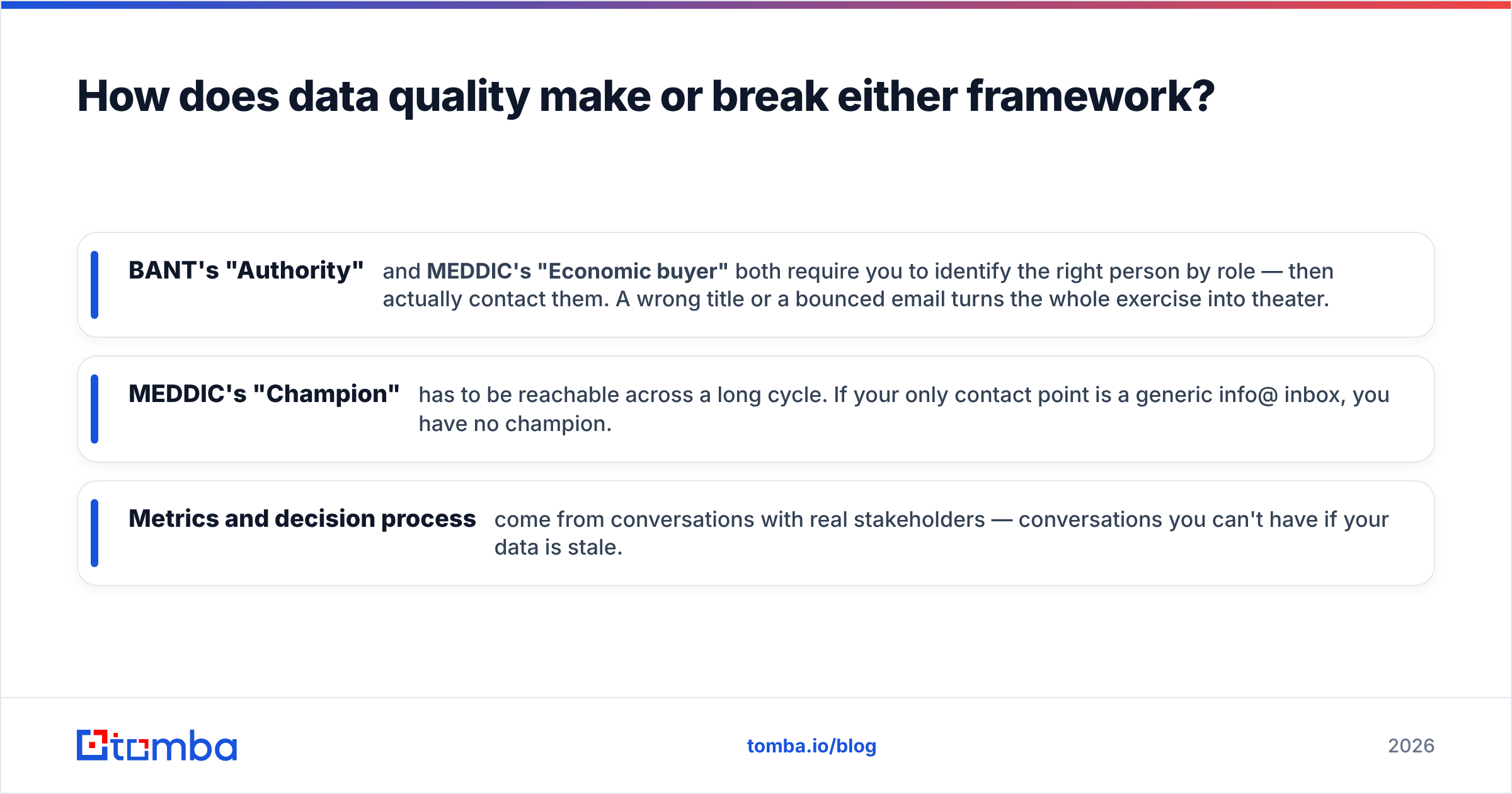
- BANT's "Authority" and MEDDIC's "Economic buyer" both require you to identify the right person by role — then actually contact them. A wrong title or a bounced email turns the whole exercise into theater.
- MEDDIC's "Champion" has to be reachable across a long cycle. If your only contact point is a generic info@ inbox, you have no champion.
- Metrics and decision process come from conversations with real stakeholders — conversations you can't have if your data is stale.
This is why qualification frameworks and contact data are two halves of the same machine. Before a rep ever opens a BANT checklist or a MEDDIC scorecard, they need verified email addresses for the right decision-makers. Tools like the Tomba Email Finder and ongoing data enrichment close that gap — turning a half-known account into a mapped buying group with reachable contacts. Independent reviews on platforms like G2 consistently rank reachability and accuracy as the top differentiators between email-finding tools, and for good reason: a framework applied to bad data produces confident, wrong forecasts.
Put bluntly: MEDDIC on dirty data is worse than BANT on clean data, because it gives you false precision. Fix the inputs first.
Which should you choose in 2026?#
Decide by deal shape, not by trend. Run this quick decision logic:
| Your situation | Recommended framework |
|---|---|
| High-volume inbound, SMB, short cycle | BANT |
| Enterprise, multi-stakeholder, long cycle | MEDDIC |
| Mixed motion (SMB + enterprise) | Hybrid (BANT → MEDDIC threshold) |
| New team, limited training bandwidth | BANT now, layer MEDDIC later |
| Forecast accuracy is your #1 pain | MEDDIC |
| Lead volume overwhelming reps | BANT triage first |
The frameworks aren't rivals — they're tools sized for different jobs. BANT is a pocketknife; MEDDIC is a full toolbox. Carry what the work requires.
And whichever you adopt, remember the foundation underneath both: you can only qualify a buyer you can actually identify and reach. Start by building a clean, verified list of the right decision-makers with the Tomba Email Finder — accurate emails, titles, and enrichment for the exact economic buyers and champions your framework is built to evaluate. Get the data right, and BANT or MEDDIC finally tells you the truth about your pipeline. Spin up a free Tomba account (25 searches a month, no card), point it at your target accounts, and let your qualification framework run on facts instead of guesses.
Ready to find emails that actually work?
Join 150,000+ professionals who stopped guessing and started sending. Free credits on signup — no credit card required.
Get the Tomba newsletter
Practical outbound tactics and product updates — once every two weeks.
About the author