Basho Emails in 2026: The Personalized Cold Email Playbook
Basho emails are hyper-personalized, account-based cold emails built on real research. Here's the structure, templates, and data stack that turns them into booked meetings in 2026.
TL;DR
- A basho email is a short, deeply personalized cold email built on specific research about one buyer or account — the opposite of a mass blast.
- The format trades volume for relevance: fewer sends, higher reply rates, and warmer first meetings.
- A repeatable basho email has four parts — a researched hook, a relevance bridge, a single value point, and a soft, specific call to action.
- Personalization only scales when your contact data is clean. Bad emails bounce before the buyer ever reads your research.
- Use research signals (funding, hiring, product launches) plus accurate contact data to write basho emails that book meetings instead of getting ignored.
What is a basho email?#
A basho email is a hyper-personalized cold email aimed at a single, high-value prospect, grounded in research that proves you actually understand their world. Think of it like showing up to a dinner party with a gift the host genuinely wants, instead of handing out the same branded pen to everyone in the room. The technique is named after a sales sequence popularized in account-based selling, and the core idea has not changed: relevance beats reach.
Where a typical cold email reads like it was copied to 5,000 people, a basho email reads like it was written for exactly one. It references a recent funding round, a job posting, a podcast the prospect appeared on, or a measurable problem their team is clearly facing. Because the message is specific, the buyer's brain registers it as a real human reaching out — not another automated pitch to delete.
The trade-off is obvious. Basho emails take longer to write. You cannot send 1,000 a day. But in 2026, with inboxes more crowded and spam filters more aggressive than ever, the math increasingly favors the rep who sends 30 sharp emails over the rep who sprays 3,000 generic ones.

How is a basho email different from a regular cold email?#
The difference is research depth and targeting. A regular cold email leans on a template and a merge field. A basho email leans on a specific, verifiable observation about the prospect that no template can fake.
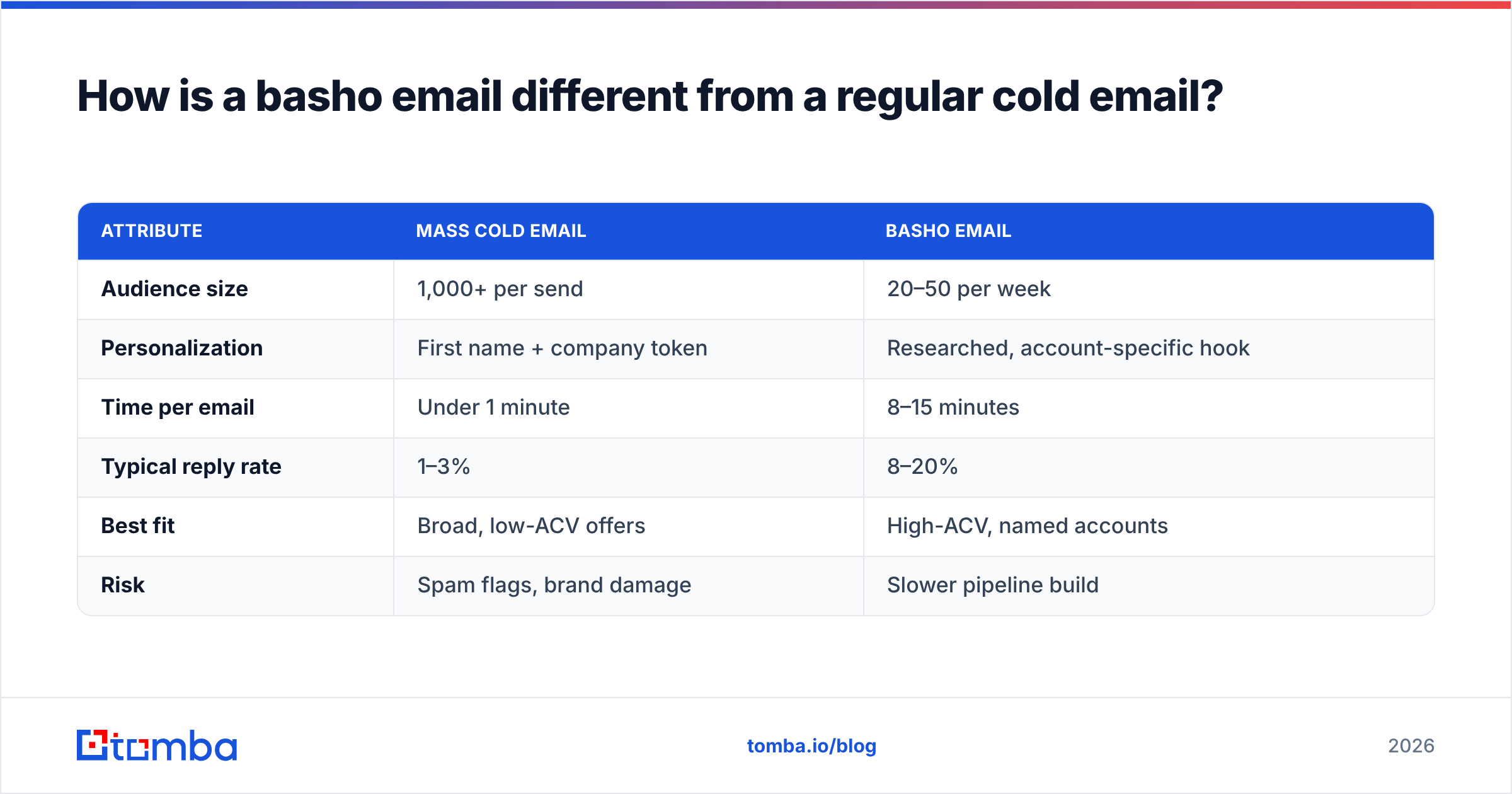
Here is how the two approaches compare across the metrics that actually matter:
| Attribute | Mass cold email | Basho email |
|---|---|---|
| Audience size | 1,000+ per send | 20–50 per week |
| Personalization | First name + company token | Researched, account-specific hook |
| Time per email | Under 1 minute | 8–15 minutes |
| Typical reply rate | 1–3% | 8–20% |
| Best fit | Broad, low-ACV offers | High-ACV, named accounts |
| Risk | Spam flags, brand damage | Slower pipeline build |
Notice the volume gap. Basho is not a replacement for every outbound motion — it is a precision tool for accounts worth real effort. A self-serve $30/month product rarely justifies 12 minutes of research per contact. A $90,000 enterprise deal absolutely does. Most strong teams run both: automated sequences for the long tail, basho emails for the named target list.
The other difference is tone. Mass emails sound like marketing. Basho emails sound like a peer. You are not "reaching out to explore synergies" — you noticed they just hired three SDRs and you have a specific thought about ramping them faster.
What are the parts of a basho email?#
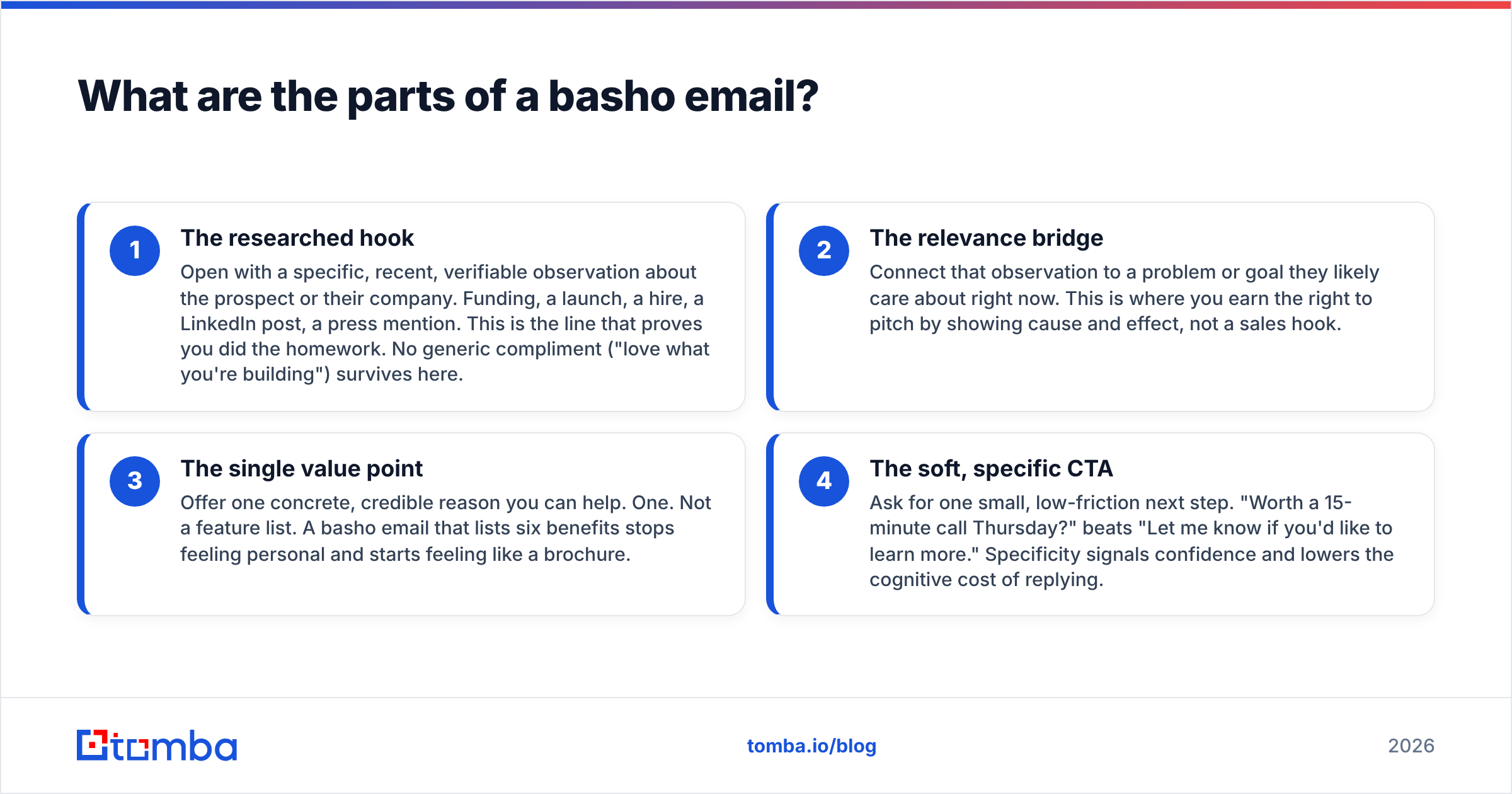
Every effective basho email follows the same four-part skeleton. The research changes; the structure does not. Treat these as the load-bearing walls of the message:
- The researched hook — Open with a specific, recent, verifiable observation about the prospect or their company. Funding, a launch, a hire, a LinkedIn post, a press mention. This is the line that proves you did the homework. No generic compliment ("love what you're building") survives here.
- The relevance bridge — Connect that observation to a problem or goal they likely care about right now. This is where you earn the right to pitch by showing cause and effect, not a sales hook.
- The single value point — Offer one concrete, credible reason you can help. One. Not a feature list. A basho email that lists six benefits stops feeling personal and starts feeling like a brochure.
- The soft, specific CTA — Ask for one small, low-friction next step. "Worth a 15-minute call Thursday?" beats "Let me know if you'd like to learn more." Specificity signals confidence and lowers the cognitive cost of replying.
Keep the whole thing under 120 words. The discipline of brevity forces you to cut everything that is not personal. If a sentence could appear in an email to any other prospect, delete it.
How do you research a basho email?#
You research a basho email by collecting trigger signals — events that suggest a prospect has a problem your product solves, right now. Timing is the multiplier. The same message lands very differently the week after a company raises a Series B versus six quiet months later.
High-signal research sources worth checking before you write:
- Funding and growth events — A new raise means new budget and new pressure to grow. Crunchbase, press releases, and the company newsroom surface these fast.
- Hiring signals — Open roles reveal priorities. Ten new sales hires means a scaling motion; a "Head of Data" opening means a data problem they are actively trying to fix.
- Executive content — A prospect's recent LinkedIn post, podcast appearance, or conference talk gives you their exact words and current obsessions. Quoting them back is the highest-converting hook there is.
- Product and GTM changes — A new product line, a market expansion, or a pricing change all create work — and work creates needs.
- Tech stack shifts — Tools they recently adopted (or dropped) tell you where the gaps are.
Tools like Gartner research and vendor blogs are useful for industry context, but the gold is account-specific. The goal is one sentence so specific the prospect thinks, "How did they know that?" If you read major sales playbooks from HubSpot or Salesforce, the through-line is identical: relevance, not volume, drives reply rates.
Why does contact data quality decide whether basho emails work?#
Because the best basho email in the world is worthless if it bounces. You can spend 15 minutes crafting the perfect message, and if the email address is wrong, the buyer never sees a word of it — and your sending domain takes a reputation hit for the dead send.
This is the part most "basho email" guides skip. Personalization and deliverability are not separate problems; they are the same problem. A research-heavy, low-volume motion means every single send counts. A 30% bounce rate on a 3,000-email blast is survivable noise. A 30% bounce rate on your 40 hand-picked dream accounts is a catastrophe — those are the accounts you cannot afford to burn.
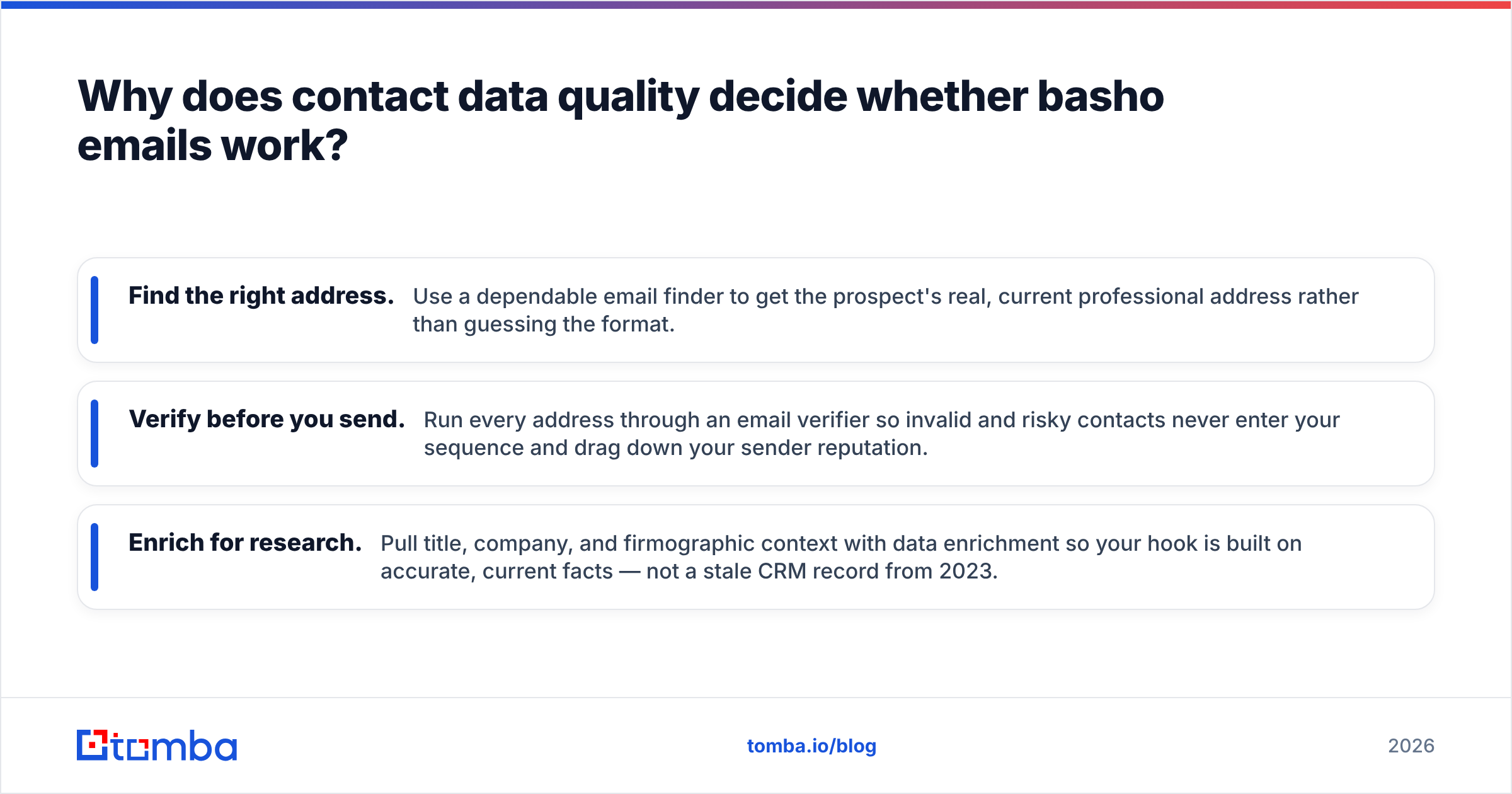
Three data fundamentals protect your basho sends:
- Find the right address. Use a dependable email finder to get the prospect's real, current professional address rather than guessing the format.
- Verify before you send. Run every address through an email verifier so invalid and risky contacts never enter your sequence and drag down your sender reputation.
- Enrich for research. Pull title, company, and firmographic context with data enrichment so your hook is built on accurate, current facts — not a stale CRM record from 2023.
Clean data also improves your response rate indirectly: when you reach the actual decision-maker instead of a generic info@ inbox, your researched message lands where it can convert.
Can you give a basho email template?#
Yes. Here is a four-part template that maps directly to the structure above. Fill the brackets with real research — never ship it with the placeholders intact.
Subject: [specific observation] + a quick idea
Hi [First name],
Saw that [company] just [specific trigger event — raised $20M, launched X, posted three SDR roles]. Congrats — that usually means [logical consequence: the team is about to scale outbound fast].
When teams hit that stage, [specific problem your product solves] tends to slow things down. We helped [comparable company] [specific, credible result] without [common painful trade-off].
Worth a 15-minute call [specific day] to see if it maps to your situation?
[Your name]
A few rules that separate a real basho email from a template with merge fields:
- The subject line must reference the research, not the product. "Your Series B + a quick idea" gets opened; "Boost your pipeline 3x" gets filtered.
- The result you cite should be from a genuinely comparable company. A logo the prospect respects is worth more than a vague percentage.
- Cut every adjective you can. "Revolutionary," "world-class," and "cutting-edge" all read as filler and quietly lower trust.
If you want a starting library to adapt, browse vetted cold email templates and rewrite each one around a single researched hook before sending. Reviewing public swipe files on G2 can also help you benchmark structure, but the personalization has to be yours.
How do you scale basho emails without losing personalization?#
You scale basho emails by systematizing the research, not the message. The mistake teams make is trying to automate the personal part — which produces those uncanny "I noticed you work at {{company}}" emails that fool no one. Instead, automate everything around the personal part so reps spend their minutes where it counts.
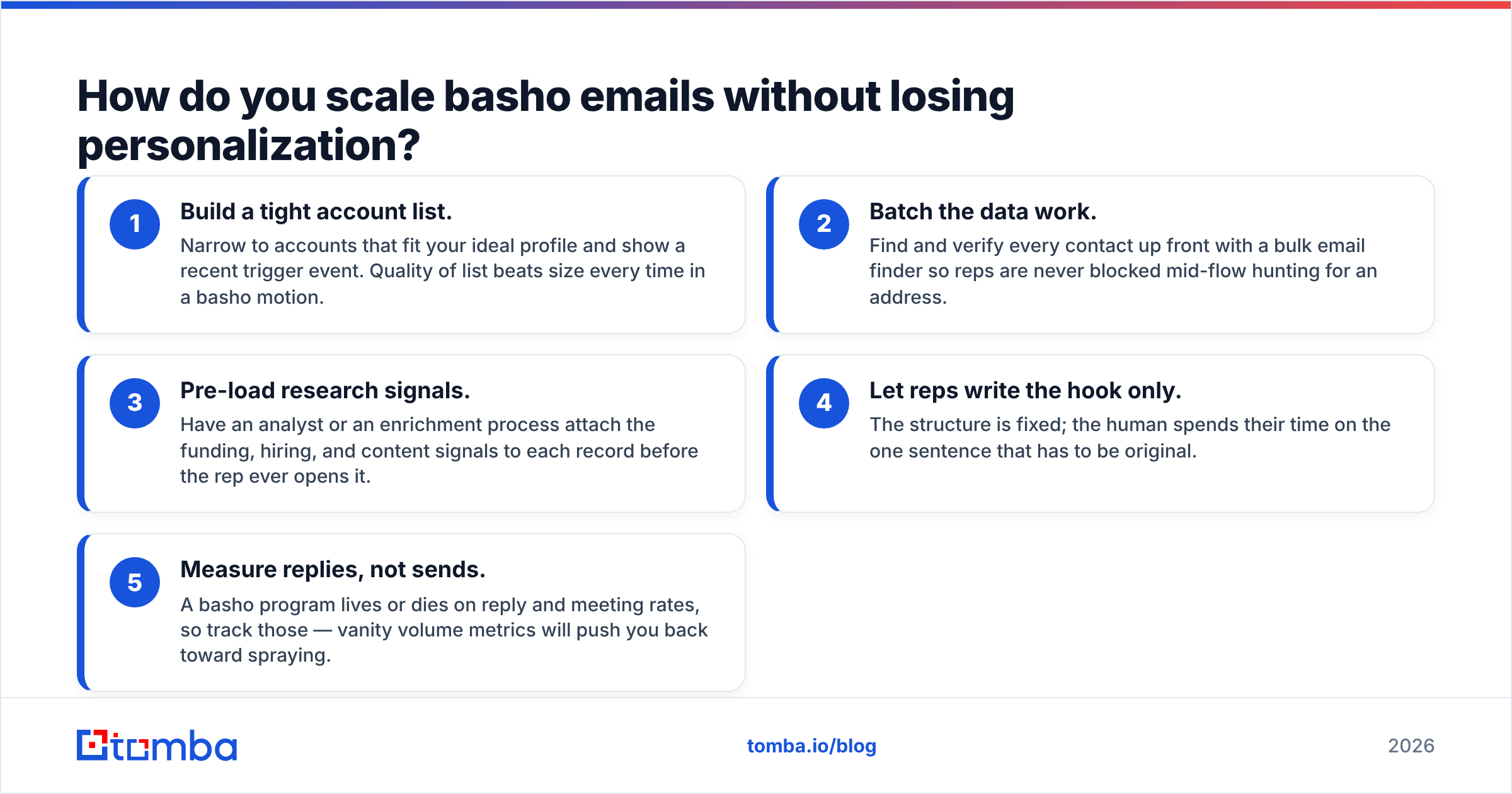
A practical workflow:
- Build a tight account list. Narrow to accounts that fit your ideal profile and show a recent trigger event. Quality of list beats size every time in a basho motion.
- Batch the data work. Find and verify every contact up front with a bulk email finder so reps are never blocked mid-flow hunting for an address.
- Pre-load research signals. Have an analyst or an enrichment process attach the funding, hiring, and content signals to each record before the rep ever opens it.
- Let reps write the hook only. The structure is fixed; the human spends their time on the one sentence that has to be original.
- Measure replies, not sends. A basho program lives or dies on reply and meeting rates, so track those — vanity volume metrics will push you back toward spraying.
Done this way, a single rep can ship 15–25 genuinely personalized basho emails a day. That is not 1,000 — but at an 8–20% reply rate on your best-fit accounts, it builds more qualified pipeline than the blast ever did.
Are basho emails worth it in 2026?#
Yes, for high-value accounts. As AI-generated outbound floods inboxes and filters get stricter, the generic cold email is in steep decline. The messages that still get replies are the ones that prove a human did specific work. Basho emails are that proof, in writing.
The honest caveat: basho is not a volume play, and it is not free. It demands research time, disciplined writing, and — critically — a clean contact data foundation so your effort actually reaches the inbox. Skip the data layer and you are crafting beautiful messages that bounce into the void.
If you want to run a basho motion that actually connects, start with the contacts. Use the Tomba Email Finder to get accurate, verified professional emails for every account on your dream list, then enrich each record so your researched hooks are built on current facts. Personalization is the strategy; reliable data is what lets it land. Check Tomba pricing — including a free tier of 25 searches a month — and put your next 40 basho emails in front of the people who can actually say yes.
// get started
Find, verify and enrich your first contacts today
Start on the free plan with 25 searches a month, then scale when your team is ready.
Free plan · No credit card required · GDPR & CCPA
// about the author