BD Meaning in Business: Roles, Skills & Strategy 2026
BD means business development: the work of finding partnerships, markets, and revenue paths that pure sales can't. Here's what BD really does in 2026.
BD means business development. It's the function that grows a company through new markets, partnerships, and revenue paths. Day-to-day selling doesn't cover that kind of work. If you've searched for the BD meaning business teams actually use, this guide clears it up. Maybe you saw "BD" on a LinkedIn title or an org chart and weren't sure what it meant. You're in the right place.
TL;DR#
- BD = Business Development. It's the long-game work of opening new markets, channels, and partnerships. It's not just closing deals this quarter.
- BD is not sales. Sales turns known demand into revenue. BD creates the relationships that make future revenue possible.
- Core BD activities: market research, partnership building, lead generation, strategic positioning, and pipeline creation.
- BD lives at the top of the funnel. That means clean contact data and accurate prospect lists are the foundation everything else sits on.
- The modern BD stack blends research tools, a CRM, and an email-finding layer like Tomba Email Finder.
BD meaning business: what does BD stand for?#
BD stands for business development. That's the simple BD meaning business leaders use every day. In practice, it's the set of activities, partnerships, and strategies a company uses to create long-term value. That value can come from new customers. It just as often comes from new markets, new channels, joint ventures, reseller deals, or product partnerships.
Think of BD like the scouting department of a sports team. Sales is the team that plays and wins games this season. BD is the scout who travels the world to find the next generation of talent. The scout builds relationships with academies and secures the deals that keep the team winning five years from now. Both matter. But they work on different clocks.
The term gets used loosely. At a startup, "BD" might mean a generalist who does prospecting, demos, and partnerships all at once. At an enterprise, BD might be a strategy team that never touches a sales quota. The common thread stays the same: BD is about growth that doesn't already exist.
Is BD the same as sales?#
No. Confusing the two is the most common mistake people make. They overlap, they share tools, and they often sit in the same org. But their jobs are very different.
Sales is responsible for converting existing demand. A salesperson takes qualified opportunities and turns them into signed contracts. Their success is measured in closed deals, quota attainment, and win rate.
Business development is responsible for creating the conditions for demand. A BD pro finds untapped markets. They build the partnership that opens a new channel. Or they generate the early pipeline that sales will later close. Their success is measured in qualified pipeline, partnerships signed, and market entry.

Here's the simplest way to remember it: sales asks "how do we close this deal?" while BD asks "what deals should even exist?"
How does BD differ from sales, marketing, and account management?#
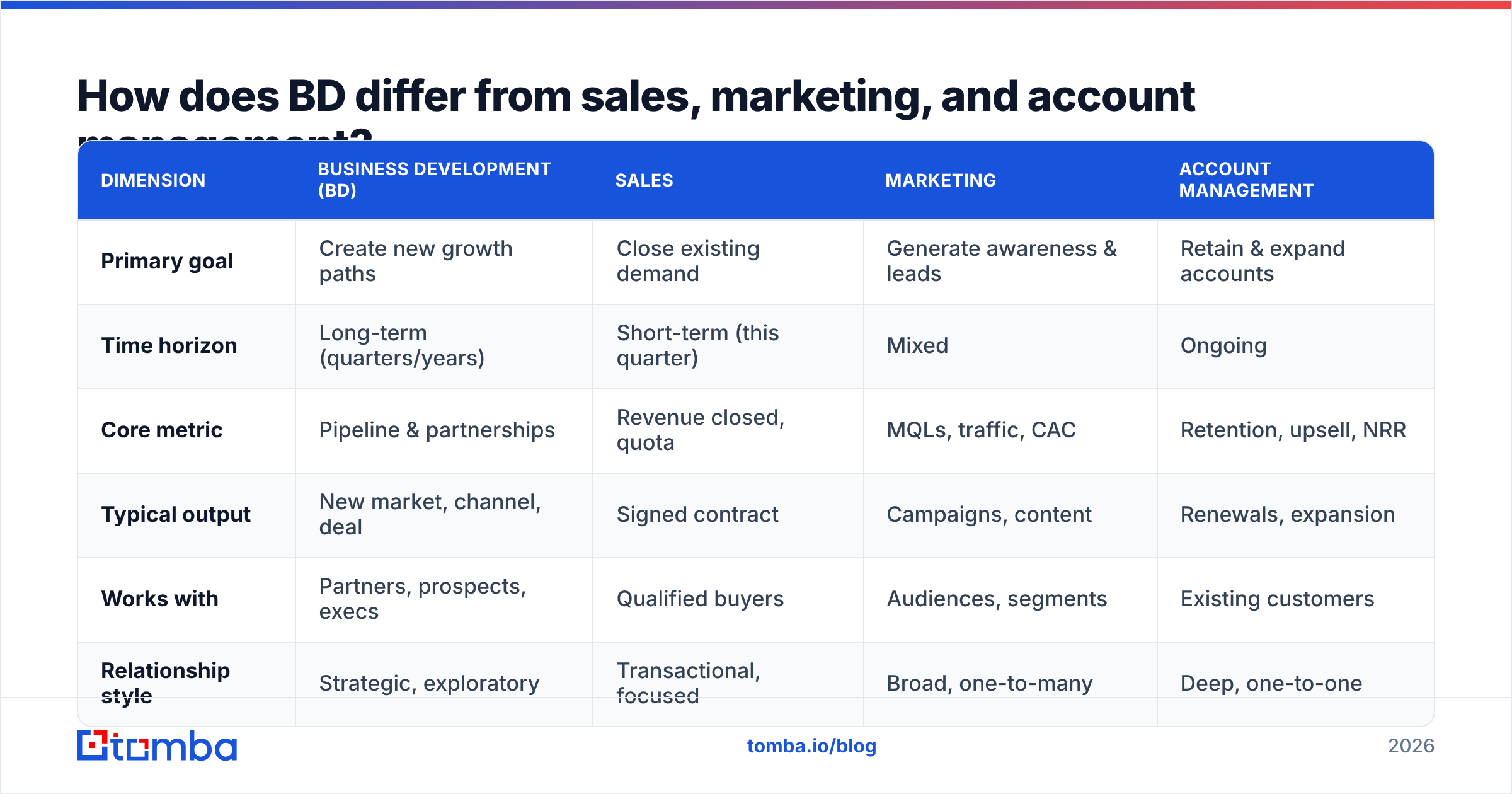
BD is easy to blur with the functions next to it. This table breaks down where each one lives and what it owns.
| Dimension | Business Development (BD) | Sales | Marketing | Account Management |
|---|---|---|---|---|
| Primary goal | Create new growth paths | Close existing demand | Generate awareness & leads | Retain & expand accounts |
| Time horizon | Long-term (quarters/years) | Short-term (this quarter) | Mixed | Ongoing |
| Core metric | Pipeline & partnerships | Revenue closed, quota | MQLs, traffic, CAC | Retention, upsell, NRR |
| Typical output | New market, channel, deal | Signed contract | Campaigns, content | Renewals, expansion |
| Works with | Partners, prospects, execs | Qualified buyers | Audiences, segments | Existing customers |
| Relationship style | Strategic, exploratory | Transactional, focused | Broad, one-to-many | Deep, one-to-one |
A healthy go-to-market motion needs all four. Marketing fills the top of the funnel with awareness. BD opens new funnels entirely. Sales converts the qualified ones. Account management grows the customers you already won. For the broader framework, revenue operations is the discipline that aligns them.
What does a business development role actually do?#
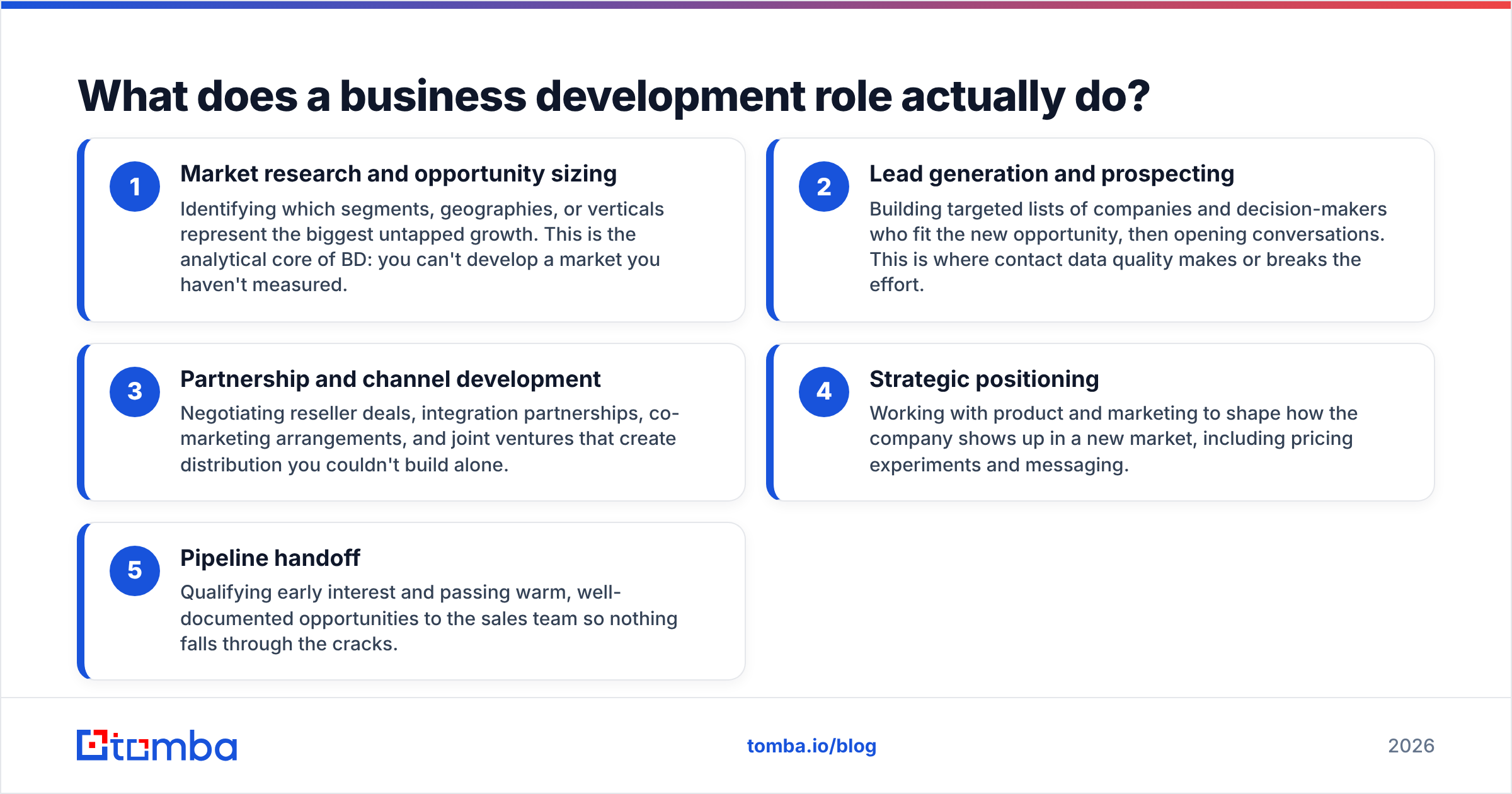
A BD pro's week is a mix of research, outreach, and relationship-building. The tasks vary by company stage. But most BD work falls into five buckets:
- Market research and opportunity sizing — You identify which segments, regions, or verticals hold the biggest untapped growth. This is the analytical core of BD. You can't develop a market you haven't measured.
- Lead generation and prospecting — You build targeted lists of companies and decision-makers who fit the new opportunity. Then you open conversations. Contact data quality makes or breaks this effort.
- Partnership and channel development — You negotiate reseller deals, integration partnerships, co-marketing, and joint ventures. These create distribution you couldn't build alone.
- Strategic positioning — You work with product and marketing to shape how the company shows up in a new market. That includes pricing experiments and messaging.
- Pipeline handoff — You qualify early interest and pass warm, well-documented opportunities to sales. Nothing should fall through the cracks.
The first two buckets are where most BD time goes. They're also where the right tooling pays off fastest.
What skills make a strong BD professional?#
BD attracts generalists because it rewards range. The strongest people in the role tend to combine these traits:
- Curiosity and research instinct. Great BD starts with seeing an opportunity others missed. That means reading markets, competitors, and signals all the time.
- Communication and relationship-building. Partnerships and early deals are built on trust, often over months. You need to be at ease with long, non-transactional talks.
- Commercial judgment. You have to know which opportunities are worth chasing and which are shiny distractions. That choice separates a BD team that drives growth from one that burns runway.
- Data fluency. Modern BD is measured. You need to be comfortable with CRMs, funnel metrics, and pulling clean prospect data at scale.
- Resilience. BD involves a lot of unanswered emails and slow deals. The people who thrive treat rejection as routine, not personal.
According to HubSpot's sales research, persistence and personalization separate top performers from the rest. Both are squarely BD traits.
What does the BD process look like step by step?#
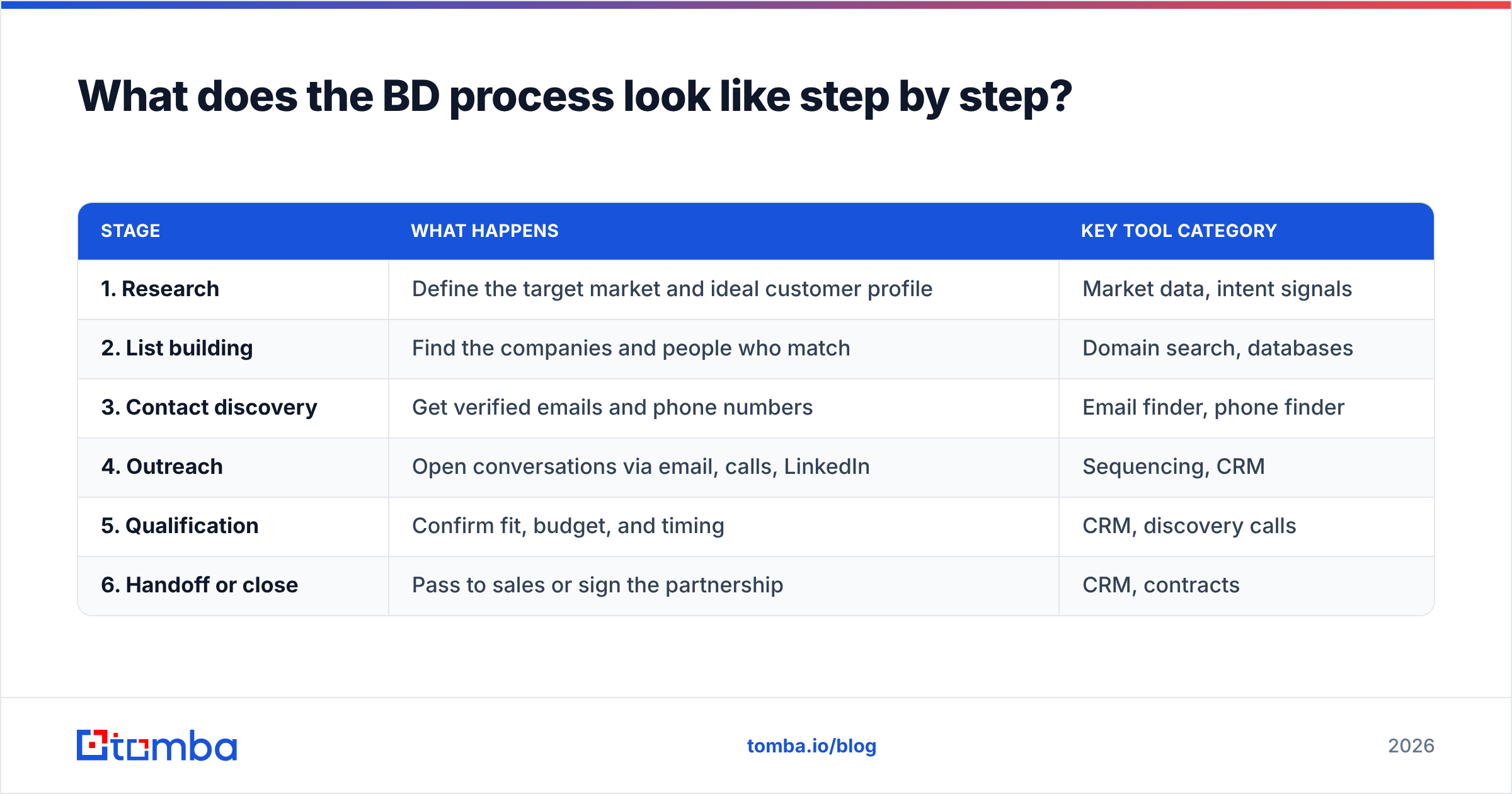
Most effective BD programs follow a repeatable cycle. It's not rigid. But a framework keeps the work from becoming random outreach.
| Stage | What happens | Key tool category |
|---|---|---|
| 1. Research | Define the target market and ideal customer profile | Market data, intent signals |
| 2. List building | Find the companies and people who match | Domain search, databases |
| 3. Contact discovery | Get verified emails and phone numbers | Email finder, phone finder |
| 4. Outreach | Open conversations via email, calls, LinkedIn | Sequencing, CRM |
| 5. Qualification | Confirm fit, budget, and timing | CRM, discovery calls |
| 6. Handoff or close | Pass to sales or sign the partnership | CRM, contracts |
Stages 2 and 3 are the data layer of BD. They're where teams quietly lose the most efficiency. If your list is full of outdated emails, every downstream stage suffers. Outreach bounces, reps waste hours, and your sender reputation takes a hit. That's why data enrichment and verification belong at the front of the process. They shouldn't be an afterthought.

What tools power business development in 2026?#
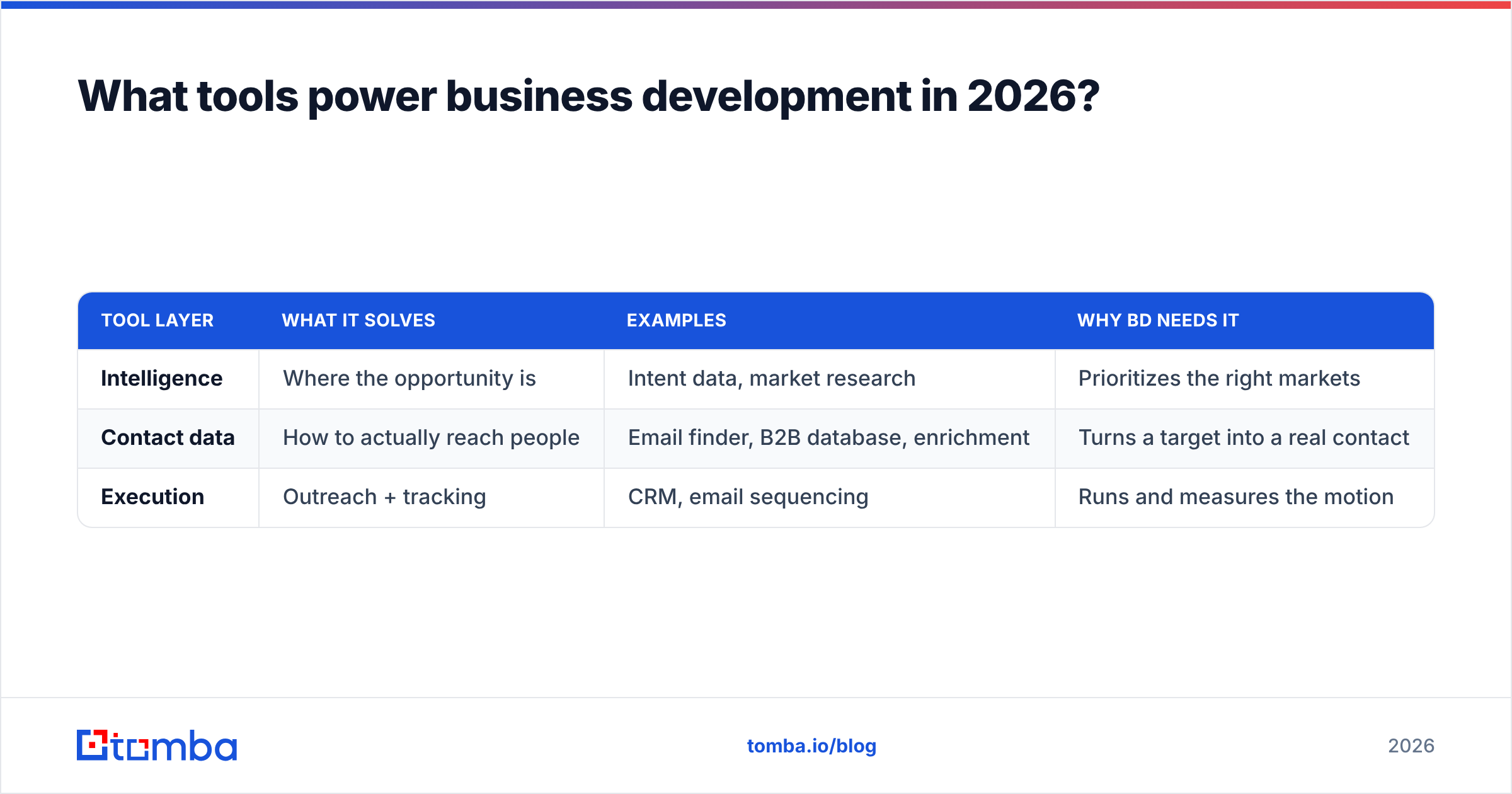
The modern BD stack has three layers: intelligence (who to target), data (how to reach them), and execution (the outreach and CRM). Here's how the categories compare.
| Tool layer | What it solves | Examples | Why BD needs it |
|---|---|---|---|
| Intelligence | Where the opportunity is | Intent data, market research | Prioritizes the right markets |
| Contact data | How to actually reach people | Email finder, B2B database, enrichment | Turns a target into a real contact |
| Execution | Outreach + tracking | CRM, email sequencing | Runs and measures the motion |
You can spend heavily on intelligence and execution. But if the middle layer is weak, the whole stack underperforms. A reliable contact-data layer is the cheapest, highest-leverage upgrade most BD teams can make. Tomba sits in that middle layer. It has a free tier (25 searches/month) and paid plans from $49/month — see full Tomba pricing for the breakdown.
For the execution layer, established CRMs like Salesforce dominate enterprise BD. Lighter tools fit early-stage teams. The point isn't which logo you pick. It's that your contact data flows cleanly into whatever system runs your pipeline.
How is BD measured?#
BD metrics look different from sales metrics. The work is earlier-stage and longer-cycle. Common KPIs include:
- Qualified pipeline created — the dollar value of new opportunities BD has sourced and qualified.
- Partnerships or channels signed — count and projected revenue impact of new deals.
- Meetings or conversations booked — a leading indicator of future pipeline.
- Conversion to sales-accepted opportunity — how much of BD's output sales actually takes and pursues.
- Market penetration — share captured in a new segment over time.
Analysts like Gartner increasingly push B2B teams to measure BD on pipeline contribution, not vanity activity counts. The lesson is clear. Track outcomes like qualified pipeline and signed partnerships, not just effort like emails sent.
Common BD mistakes to avoid#
Even experienced teams trip over the same issues:
- Treating BD like sales. Pushing for a fast close on a relationship that needs months of trust kills partnership deals.
- Skipping data hygiene. Running outreach on unverified lists tanks deliverability and wastes rep time. Verify before you send.
- Chasing every shiny opportunity. Without commercial judgment, BD spreads thin and develops nothing. Focus beats breadth.
- No clean handoff. A great opportunity dropped in a messy handoff is lost revenue. Document everything in your CRM.
Frequently asked questions#
What does BD stand for in business? BD stands for business development. It's the function focused on long-term growth through new markets, partnerships, and pipeline creation.
Is BD a sales job? Not exactly. BD overlaps with sales but focuses on creating new growth, not closing existing demand. Many BD roles do involve prospecting and early-stage selling.
What is a BD manager? A business development manager owns the strategy and execution of growth initiatives. That means identifying markets, building partnerships, generating pipeline, and often managing a small BD team.
Do BD professionals need email-finding tools? Yes. Building accurate target lists and reaching verified contacts is core to BD. That's why an email verifier and finder are standard parts of the stack.
Start your BD motion with better data#
Business development lives or dies on the quality of the contacts you reach. You can have the sharpest market thesis and the best partnership pitch. But if your emails bounce and your phone numbers are wrong, the motion stalls before it starts. That's the real BD meaning business owners learn the hard way. Tomba Email Finder gives BD teams verified professional emails by name, domain, or company. Your research turns into real conversations instead of dead ends. Start free with 25 searches a month. Then scale to a Starter plan at $49/month when your pipeline grows. Build your target list, verify it, and put your BD strategy on a foundation that delivers.
// get started
Find, verify and enrich your first contacts today
Start on the free plan with 25 searches a month, then scale when your team is ready.
Free plan · No credit card required · GDPR & CCPA
// about the author