BDR AI in 2026: How AI BDRs Are Reshaping B2B Sales
AI BDRs are everywhere in 2026 — but do they actually book meetings? A neutral look at how BDR AI works, what it costs, and where human reps still win.
BDR AI in 2026: How AI BDRs Are Reshaping B2B Sales
The pitch is hard to ignore: an AI that researches accounts, writes personalized emails, handles replies, and books meetings — all while you sleep, all for a fraction of a salaried rep. In 2026, "BDR AI" has gone from a novelty in demo videos to a line item in real go-to-market budgets. But the gap between the marketing and the results is still wide, and it usually comes down to one unglamorous thing: the data underneath.
This guide breaks down what BDR AI actually does, where it works, where it quietly fails, and how to deploy it without lighting your domain reputation on fire.
TL;DR#
- BDR AI (also called AI SDRs or autonomous sales agents) automates research, list-building, copy, and follow-up that a human business development rep would normally do.
- It is excellent at volume and consistency, mediocre at judgment and nuance, and completely dependent on the quality of contact data you feed it.
- Pricing in 2026 ranges from roughly $0 add-ons inside existing CRMs to $1,000–$3,000+/month for full autonomous-agent platforms.
- The biggest failure mode is not bad AI — it's bad email data triggering bounces, spam traps, and domain blacklisting.
- The winning setup is hybrid: AI handles the grind, humans handle strategy and high-value conversations, and a verified data layer keeps deliverability intact.
What is BDR AI?#
BDR AI is software that performs the core tasks of a business development representative using large language models and automation instead of a person. Think of it like cruise control for outbound: you still steer (set the targets, the offer, the guardrails), but the system holds the speed on the repetitive parts.
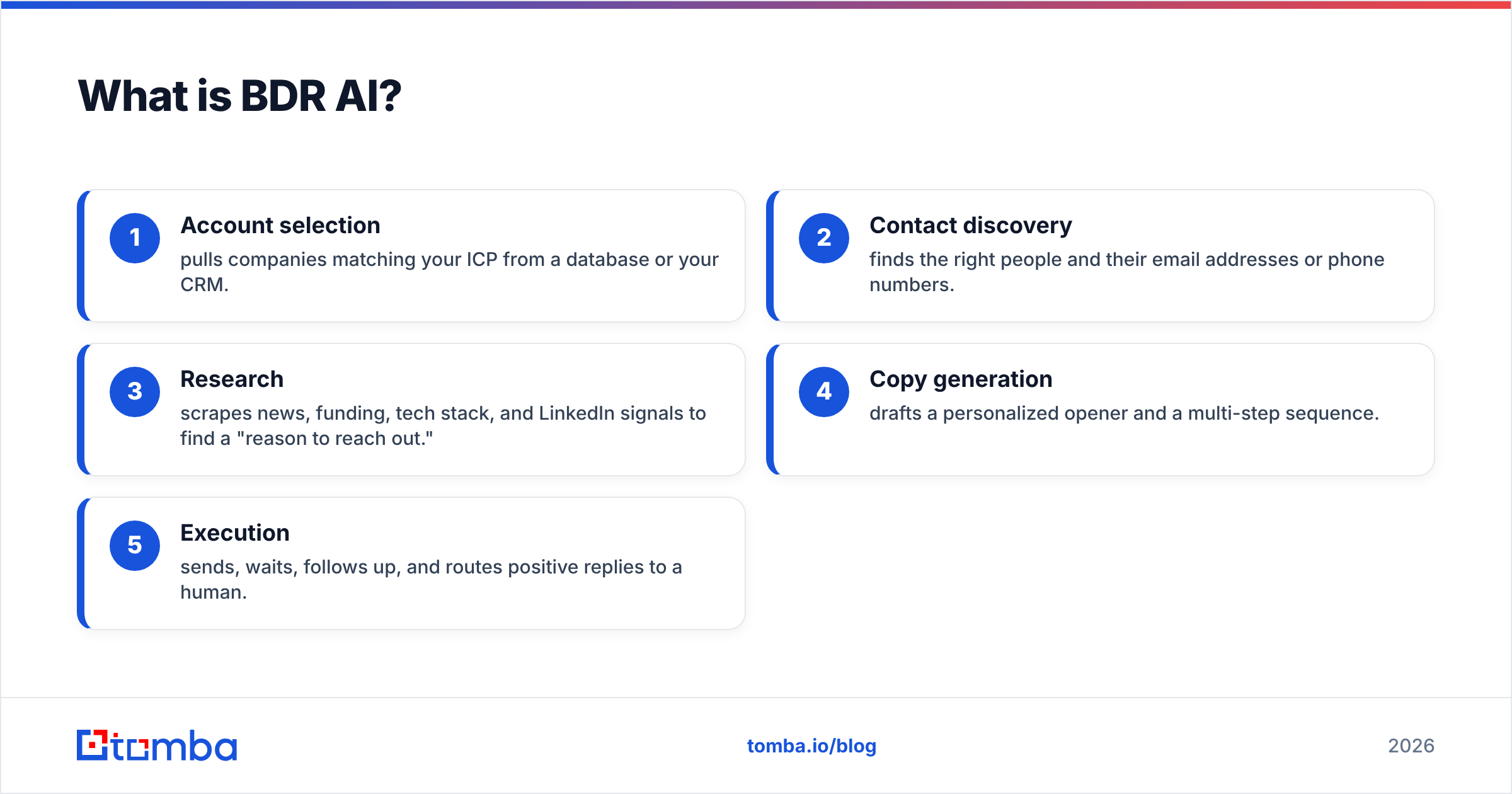
A traditional BDR builds a target list, finds contact details, researches each account, writes a first-touch email, sends follow-ups, qualifies replies, and books the meeting. A modern BDR AI tool attempts the same loop:
- Account selection — pulls companies matching your ICP from a database or your CRM.
- Contact discovery — finds the right people and their email addresses or phone numbers.
- Research — scrapes news, funding, tech stack, and LinkedIn signals to find a "reason to reach out."
- Copy generation — drafts a personalized opener and a multi-step sequence.
- Execution — sends, waits, follows up, and routes positive replies to a human.
The difference between a tool that books meetings and one that burns your domain is almost never the copy. It's steps 2 and 3 — whether the contact data is real and the research is accurate.
How does an AI BDR actually work?#
Under the hood, most BDR AI platforms chain together the same building blocks. Understanding the stack tells you exactly where things break.
- Data layer. The source of companies, people, emails, and phone numbers. This is the foundation — and the most common point of failure. If the email is wrong, nothing downstream matters.
- Enrichment layer. Adds context: job title changes, funding rounds, hiring signals, technologies in use. Good data enrichment is what makes "personalization at scale" more than a slogan.
- Reasoning layer. The LLM that decides what to say and how to say it, given the research and your offer.
- Orchestration layer. Sending infrastructure, mailbox rotation, throttling, and reply detection that keeps you out of spam.
- Human handoff. Where a positive reply gets escalated to a real person to close.
Here's the uncomfortable truth most vendors won't lead with: the reasoning layer is now a commodity. Every tool uses comparable models. The durable advantage is the data and orchestration layers — and those are the parts buyers tend to ignore during a flashy demo.
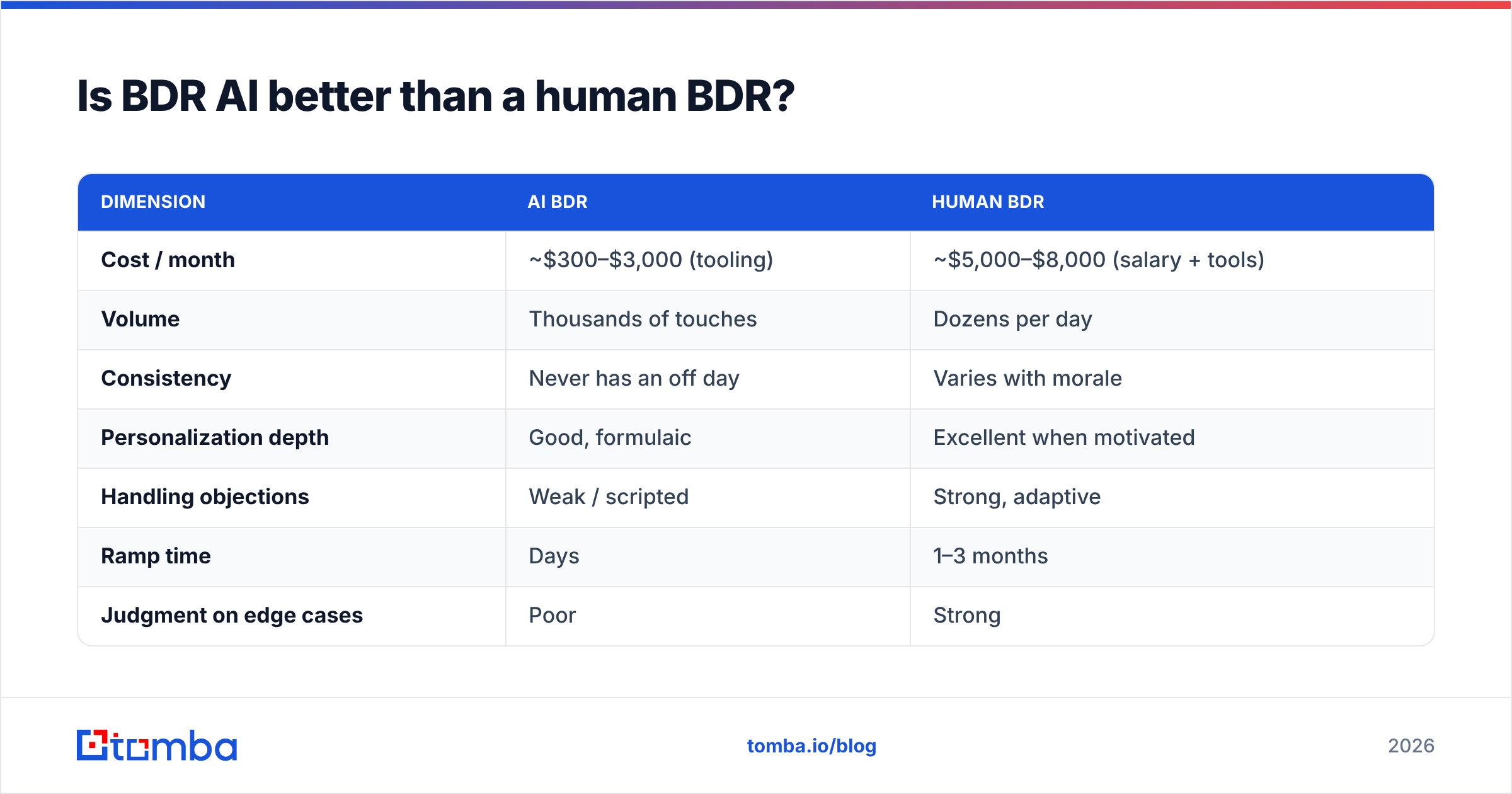
Is BDR AI better than a human BDR?#
Neither wins outright. They're good at different things, and the smart play in 2026 is to stop framing it as a cage match.
| Dimension | AI BDR | Human BDR |
|---|---|---|
| Cost / month | ~$300–$3,000 (tooling) | ~$5,000–$8,000 (salary + tools) |
| Volume | Thousands of touches | Dozens per day |
| Consistency | Never has an off day | Varies with morale |
| Personalization depth | Good, formulaic | Excellent when motivated |
| Handling objections | Weak / scripted | Strong, adaptive |
| Ramp time | Days | 1–3 months |
| Judgment on edge cases | Poor | Strong |
| Dependence on data quality | Total | High but recoverable |
The pattern is clear. AI wins on cost, speed, and consistency. Humans win on nuance, objection handling, and knowing when an account is worth breaking the script for. According to Gartner's sales research, buyers increasingly resent generic outreach — which means volume without relevance actively hurts you. AI gives you the volume; only good data and good targeting make that volume relevant.
What does BDR AI cost in 2026?#
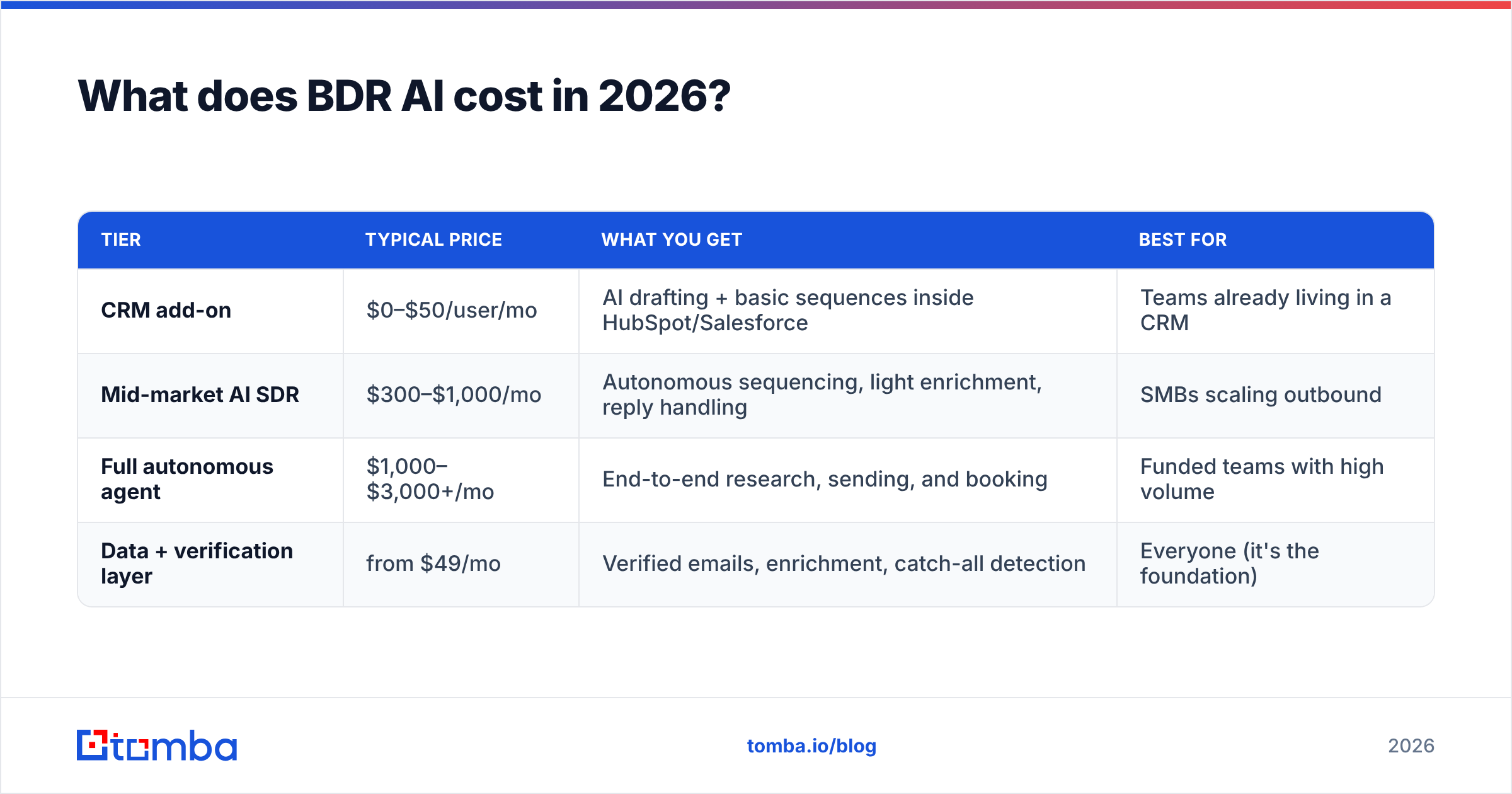
Pricing splits into three tiers, and the cheapest option is rarely the cheapest in practice once you factor in wasted sends and damaged reputation.
| Tier | Typical price | What you get | Best for |
|---|---|---|---|
| CRM add-on | $0–$50/user/mo | AI drafting + basic sequences inside HubSpot/Salesforce | Teams already living in a CRM |
| Mid-market AI SDR | $300–$1,000/mo | Autonomous sequencing, light enrichment, reply handling | SMBs scaling outbound |
| Full autonomous agent | $1,000–$3,000+/mo | End-to-end research, sending, and booking | Funded teams with high volume |
| Data + verification layer | from $49/mo | Verified emails, enrichment, catch-all detection | Everyone (it's the foundation) |
That last row matters most. A $2,000/month AI agent firing at unverified emails will bounce its way onto blacklists within weeks. A modest Tomba plan — Free (25 searches), Starter at $49/mo, Growth at $99/mo — sits underneath any BDR AI stack and protects the expensive parts from themselves.
Where does BDR AI fail?#
Most BDR AI disappointments trace back to a handful of predictable problems. None of them are about the AI being "not smart enough."
1. Bad email data. This is the silent killer. AI BDRs send at scale, so a 15% bad-email rate doesn't mean 15% waste — it means a flood of bounces that tanks your sender reputation and drags down your good emails too. Run every list through an email verifier before the agent touches it.
2. Catch-all confusion. Many corporate domains accept every address, so a "valid" result is often a maybe. Without proper catch-all verification, your AI confidently emails addresses that quietly vanish.
3. Hallucinated personalization. When research data is thin, LLMs invent details. "I loved your recent post about X" — where X never happened — is worse than no personalization at all.
4. No real strategy. AI executes whatever you point it at. Point it at a bad ICP and it will efficiently spam the wrong people.
5. Deliverability neglect. Skipping SPF, DKIM, warmup, and throttling means even perfect copy lands in spam.
How do you deploy BDR AI without burning your domain?#
A repeatable, boring checklist beats a clever agent every time. Build the foundation first, then turn on automation.
- Define a tight ICP. Narrow beats broad. The AI amplifies whatever targeting you give it.
- Source contacts from a real database. Use a vetted B2B database rather than scraping whatever the agent finds loose on the web.
- Verify before you send. Every address through verification; flag catch-alls; remove role accounts you don't want.
- Warm the domain. New sending domains need weeks of gradual ramp — don't let the AI hit full volume on day one.
- Cap daily volume per mailbox. Rotate inboxes and keep per-mailbox sends conservative.
- Keep a human on replies. Route every positive or ambiguous reply to a person. This is non-negotiable.
This is the part demos skip. The AI is the engine, but verified data and disciplined sending are the brakes and the road. Skip them and the engine just drives you off a cliff faster. As HubSpot's research on outbound repeatedly shows, deliverability and relevance — not send volume — are what separate pipeline from noise.
What should you look for when buying a BDR AI tool?#
When you evaluate platforms (and the G2 grid for AI sales tools lists dozens), score them on the layers that actually drive results, not the demo polish.
- Data accuracy and freshness — ask for documented bounce rates, not vibes.
- Verification built in — or an easy way to plug your own verification layer via an email finder API.
- Deliverability controls — mailbox rotation, throttling, warmup integration.
- Reply intelligence — does it actually detect intent, or just keyword-match?
- Transparent handoff — clean routing of hot replies to humans.
- Compliance posture — GDPR/CAN-SPAM handling, suppression lists, opt-out logic.
If a vendor can't answer the data-quality questions clearly, assume the answer is "we don't control it" — and budget for your own verification layer regardless.
Will AI replace BDRs entirely?#
No — and the question itself is the wrong frame for 2026. AI is replacing the tasks inside the BDR role, not the role's judgment. The repetitive grind — list-building, first drafts, follow-up cadence, data hygiene — is going to AI. The strategic core — choosing accounts, reading buying signals, handling a skeptical prospect, knowing when to break the rules — stays human.
The teams winning right now run a hybrid model. One human strategist can supervise an AI BDR that does the work of three traditional reps, as long as the data underneath is clean. The constraint has shifted. It's no longer "how many emails can a rep send" — it's "how many of those emails reach a real, correctly-targeted person." That's a data problem, and it's solvable.
That's also why the smartest 2026 stacks pair an AI BDR agent on top with a precise email finder and verification layer underneath. The agent handles scale; the data layer makes scale safe.
The bottom line#
BDR AI is real, it works, and it's not magic. It's a force multiplier that amplifies whatever you point it at — including your mistakes. Spend the money on the agent if you want, but spend it on clean data first, because an autonomous BDR firing at bad emails is just an expensive way to get blacklisted.
Before you turn on any AI BDR, build the foundation: find verified, accurate contacts with the Tomba Email Finder, verify them, and enrich them so your AI has something real to work with. Start free with 25 searches, then scale on the $49/mo Starter plan as your outbound grows. Your AI is only as good as the data you give it — so give it the good stuff.
Ready to find emails that actually work?
Join 150,000+ professionals who stopped guessing and started sending. Free credits on signup — no credit card required.
Get the Tomba newsletter
Practical outbound tactics and product updates — once every two weeks.
About the author